Electro-Chemical Damage In Wooden Boats Update – Revisited

rudder electrochemical damage


ELECTRO-CHEMICAL DAMAGE IN WOODEN BOATS UPDATE
A Special Post By Chris McMullen

Recently I received a note from Chris where he questioned if the story we posted last year on ww about electro-chemical damage to wood  was a little too long & were people reading it. Well I can tell you that the post is the single most visited story on ww, ever, & gets read by people all over the world. Its frequently referred to on the hugely popular WoodenBoat Forum in the USA. The link below takes you to the original story.

Electrochemical Damage To Wood – the marine version of ‘leaky homes’

For the impatient ones out there 🙂 Chris has done a ‘Readers Digest’ version & refers to a vessel that recently featured on ww.
I encourage all of you to read today’s story & if you own a classic wooden boat – read both versions – the problem is the biggest risk to the life of our classic boats.

In Chris’s words:
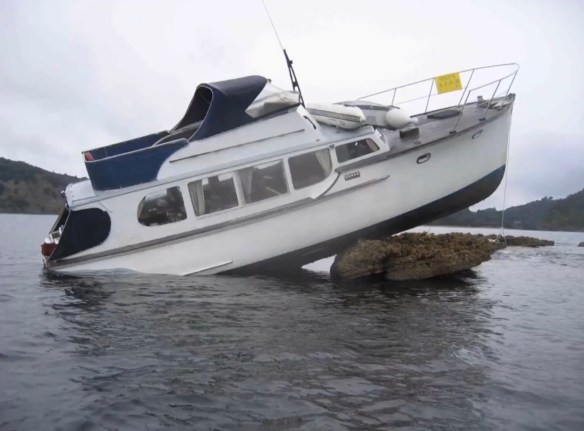
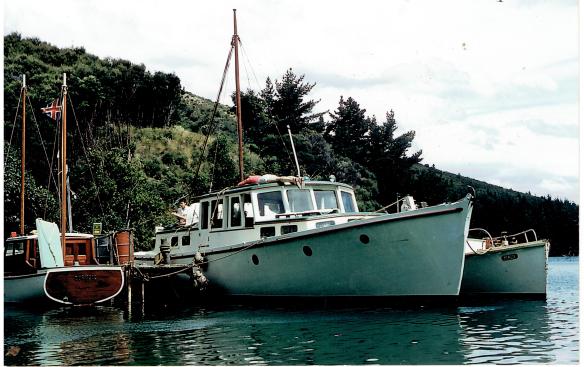
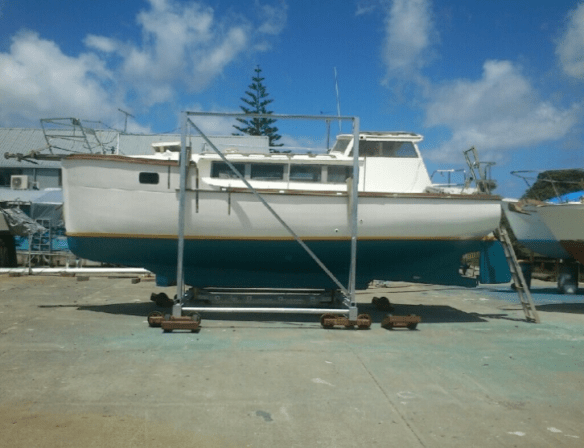
“I received the above disturbing images of another woody being destroyed by an owner who I believe is unintentionally loving his boat to death.

The use of anodes and bonding on a wooden boat is fatal. The cathode or protected metal makes hydrogen gas and this combined with saltwater makes Sodium Hydroxide (Caustic Soda). This chemical is used to pulp wood in the paper making industry. Not on my boat thank you! I say again, there is no reason to use anodes and bonding on any boat. The only exception, steel hulls require anodes. If copper or bronze are being corroded it is due to a positive DC leak and Zinc anodes will not help. Find the electrical leak is the cure. If there is brass or manganese bronze underwater it will corrode due to the
zinc in the alloy. Anodes will possibly stop the corrosion but at the expense of wood damage. A better plan is to replace the brass with proper marine bronze.

Bronze and copper should last indefinitely in the sea. To prove that statement, I ask you to look at the Roman coins and artifacts salvaged from ships wrecked in the fourteenth century. There was no anodic protection and the metal is well preserved. So what is the difference to the copper and bronze on your boat? There is absolutely no difference so why waste your money buying anodes that will in time destroy
your wooden boat.

Three or four bottles of wine will cost the same as anodes and will make you and your boat happier.”

Note: ww is read all around the world, if there is water & boats, there are people reading ww. So a little about the man for non kiwi’s  – Chris is one of NZ’s most respected boat builders (retired) and at one time was the Lloyds (Honorary) Wood Boat Surveyor in Auckland. Chris’s (the original company) ‘McMullen & Wing’ built and repaired wood, steel and marine aluminium vessels. They built the first welded aluminum vessels in NZ. Chris is the current holder of the Classic Yacht Association of New Zealand ‘Outstanding Achievement Trophy’ for services to classic boating.

14-05-2016 Photo Update
Gavin Gault sent in the below photos of a Nova skeg floor that he believes were probably damaged due to engine – anode bonding failure. Pretty graphic !!


10-07-2016 Reply from Chris McMullen

“Wow. Thank you Gavin Gault for sharing your very graphic images. Very sad, small consolation but yours will not be the only wooden boat affected by this scourge.
Maybe, at last some of the Flat Earth Society will start to believe what I have been saying. The worst detractors are some in the Marine Industry who have been preaching the Anode, Bonding party line for years.  Now there is no where to run for cover,  they continue to conjure up excuses and it seems, refuse to accept a simple scientific fact.
“If you have a positive and negative electrode in salt water, the negative cathode or protected metal makes hydrogen gas and this combined with salt water makes Sodium hydroxide.”
This chemical is also known as caustic soda and removes paint and destroys wood.  There is no doubt about this fact. You do require a power source and bonded dissimilar metals ( zinc and copper) provide sufficient current to do the damage, but slowly.
If there is a negative DC leak (to the sea)on a bonded boat the process is accelerated. If there is a positive leak any metal becomes an anode and will waste away. It is important to isolate the DC power from contact with the sea. Again bonding is just asking for trouble. Please remove Anodes and Bonding from your wooden boat now!
Chris McMullen”

06-09-2106 In case you were not to sure what to look out for – the below photo should be a wake-up call to a few woodys 😉

IMG_1120


Royal Saxon – Revisited

ROYAL SAXON
photos ex Mark Javis

After the amazing response to yesterdays post on Arohanui, which set an all time ww record for the most views in a single hour (1,707) it was always going to be a challenge to back it up. So when I received out of the blue a selection of photos of one of my favourite boats – Royal Saxon, from Motueka resident Mark Javis the challenge was solved.
Mark lives near a little old-world estuary where boats were once built and scows traded at the remaining wharf. A small number of woodys are still berthed there, one being Royal Saxon.

Royal Saxon was built by Colin Wild for Whangarei surveyor Harold Frederick Saxon Charlesworth and launched in October 1930. She is 33ft loa, 9ft 6in beam and draws just under 4ft. Lots more details & photos + a few good yarns found on the ww link below.

Royal Saxon

She is a very pretty boat & was once owned by Rick McCay who owns Luana, Rick is a man with a very good eye for beautiful things 😉

waitematawoody t-shirts – remember to get your order in – limited print run, full details here https://waitematawoodys.com/2015/11/22/waitematawoodys-t-shirts/

Old Logo ww shirt

Florence

So far there have been over 2,000 classic wooden boat stories featured on waitematawoodys & the viewing numbers (3,300,000) have grown from a dozen people to over 80,000. I have had some loyalists from day one but the big numbers have happened in the last 2 years – so not everyone will have been exposed to all the stories. Over the Christmas / NY period I have decided to take a peek back in time & feature some of the gems from the early days. Enjoy.

Have a great holiday & remember to take the camera / phone with you & snap a photo of any woodys you see. Email them to waitematawoodys@gmail.com


FLORENCE
photos ex Clare Jordan

Todays photos of Florence (1910, HN Burgess) are from Clare Jordan. Clare found them in an old album of her  great-grandparents (Jim Turner), they show one at sea, two with the life preserver ring and one that looks like on a creek somewhere, dated early 1920s. Clare’s not sure where the Creek area is,  but commented that it looked like her family spent a bit of time there camping.  They had a batch in Titirangi, but Clare felt it didn’t make sense for Florence to be on the Manukau Harbour area?
Jim Turner spent a lot of time with his best mate (Alexander Lewis) at Jenkins Bay, Titirangi.  Alexander (Sandy) had something to do with the VCC.
Claire’s not sure who the people are, the man in the photos looks like the same person with the captains hat on.

I have forwarded these photos to Florence’s current owner Adam Wild & as expected Adam was rapt to get them, he is currently looking at some subtle rework to the painting scheme of Florence’s superstructure and commented that these photos will assist greatly.

Enter Florence in the ww search box to see more

Harold Kidd Update

FLORENCE spent her years from 1922 in Whangarei owned by J.C. Reynolds but, if the companion pic of JEAN GRAY is anything to go by, the album contains pics of the period before that and associated closely with people in Victoria Cruising Club. FLORENCE was owned in 1919 by F. Price, like JEAN GRAY’s owner, A. Lewis and later A. Hazleman, a VCC stalwart, and was Vice-Commodore from 1920. In fact, the life ring in the lowest pic has “VCC” on the bottom. So the pics pre-date her Whangarei period. Quite where the creek pic was taken is anyone’s guess but I don’t think it could have been on the Manukau unless they fitted FLORENCE with wheels. Just to confuse things a bit, there was a FLORENCE on the Manukau, owned by Pardington, but it was only a 20 footer.
So, these are companion pics to the JEAN GRAY pic, featuring VCC notables of the time.

OOPS – Last Quiz Of The Year

Unknown

OOPS – last quiz of the year

The above photo was sent to me by a mate, he recalls the incidence was 3>4 years ago. Interesting to note the 4sale sign on the bow rail….. wonder if it happened during a test run ?

So woodys – the 1st one to correctly name the boat & the location, wins a Lake Rotoiti Classic & Wooden Boat Parade 2018 calendar. Entries via the WW comments section.

I hope Santa finds your chimney on Sunday night & you get to spend time with the people closest & dearest to you 🙂


Rainbow

Screen Shot 2017-12-20 at 7.35.42 am

RAINBOW

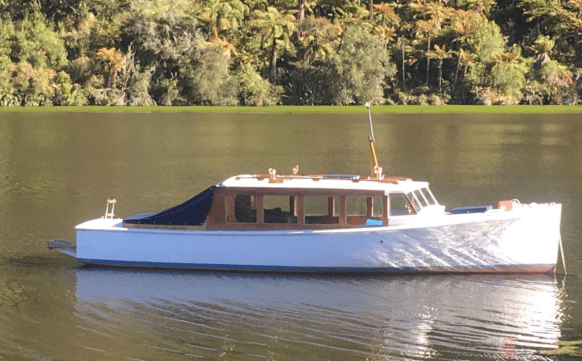
Rainbow was built in 1930 by Chas Robinson at Ohiniamutu for the Smiths who owned Rainbow Point on Lake Taupo – hence the name Rainbow.
She is 22.96’ in length & powered by a 15hp diesel.

She looks a very smart classic kauri launch & with a trademe asking price of $20k ono, could be a great buy. While still a lake boat, it would not cost a lot to truck her to the Waitemata 😉
Do any of the lake woodys know more about the boat ?
(thanks to Ian McDonald for the listing heads up)

Input From Paul Drake

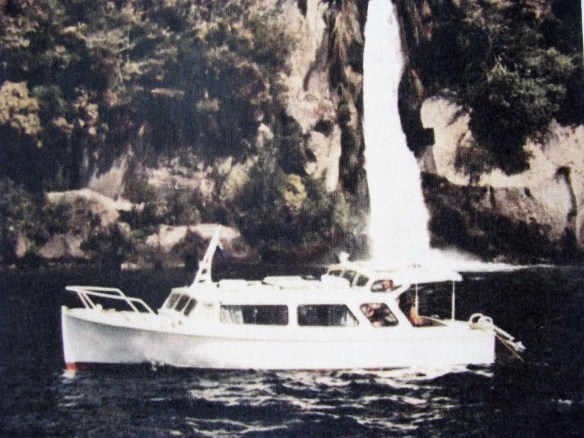
RAINBOW was a Taupo boat for more than 70 years, before moving to a nearby hydro lake where I suspect she still is. Someone has done a superb job on her cabin since she left. When built, she had an extensive canvas canopy instead of a cabin, supported by heavy tubular nickeled rods. She was fitted with copper buoyancy tanks, making her unsinkable. She also fitted with a magnificent 6 cylinder twin ignition Gray. Two spark plugs to each cylinder. To change from battery to magneto requires the flick of a switch. Fresh water is very kind to engines and this engine, in very good condition, now resides in brother Michael’s shed, complete with owner’s manual and original instruments. RAINBOW lived in a substantial boatshed at Rainbow Point, and was launched via a similarly substantial slip. She is a most unusual boat, in a good way, being very shapely and very shallow draft (half a metre) with exaggerated flare forard and very flat underwater sections aft. A fabulous looker and the perfect lake boat. In the photos below – the last photo shows how she looked when she left Taupo. The first three are from the 1930’s. 

DSC03684

DSC03685

DSC05549

New Zealand Classic Wooden Boat Register – 200+ Photos

image1

New Zealand Classic Wooden Boat Register – 200+ Photos

Stoked to be able to share with you the 2018 edition of the CYA Classic Register. Big ups to the CYA team behind it, pulling everything together is a massive undertaking, I’ve been there & done that, having been involved with the first 4 issues – 2018 is a winner, so make a cup of coffee or pour something a little stronger & sit back & enjoy over 200 photos. Click link below

to view https://www.yumpu.com/en/document/fullscreen/59612422/cya-classic-register-2018-yum

Lucky CYA members will be getting a free hard copy version in the post very soon. Almost worth joining to get a copy 😉 Membership details here  http://classicyacht.org.nz/joinus/

Matira

Unknown

MATIRA

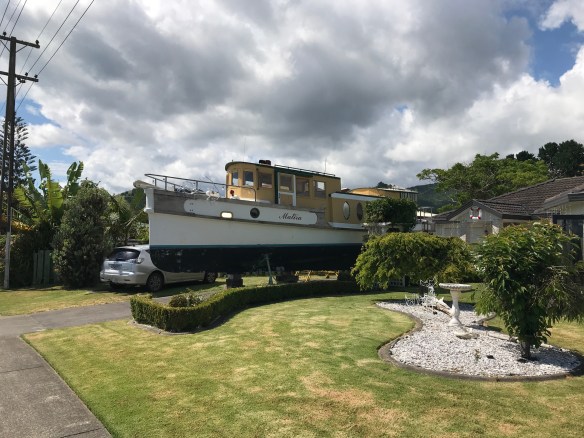
Today’s photo was emailed into me by John Burland, who spotted Matira recently while on a road trip, he took the coast road to Thames & while driving through Kawakawa spotted (hard not to) Matira sitting on Barry Abel’s front lawn.

Barry has recently sold Lady Jane, see link below, to a young couple & has acquired Matira as the next project. I seem to recall her appearing on WW once before but cannot find her, maybe she is still in the ‘one-day’ file. Te Atatu Boating Club rings bells also.

I also recall she was on the market for rather a long time & no doubt Barry picked her up for a bargain price. There is a nice hull hiding under the additions that showcase a mixed of styles. As an aside her hand basin is from a B747 washroom.

Do we know any more about Matira?

Lady Jane

05-10-2019 Update ex Barrie Abel – photo below shows Matira before her refit.

Matira 1912?

Screen Shot 2017-12-19 at 10.31.40 PM

Ideal Woody Xmas Present

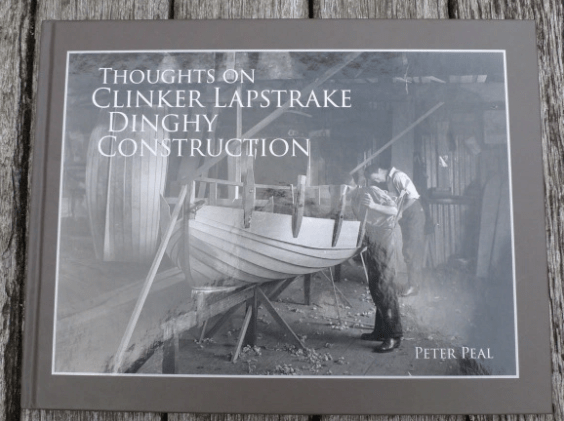
I’m a big fan of buying yourself a xmas present & the book ‘Thoughts on Clinker Lapstrake Dinghy Construction’ by Peter Peal, ticks most of the boxes. It is a must have for all serious woodys. 

Copies are available from Chris Peal at a cost of $60 including post and pack within New Zealand.  Transfer the $60 into the back account below & then email Chris with your postal address & a copy of the hard cover book will be mailed out – chrispeal8@gmail.com

Payment is to ANZ Bank – Peter Peal’s Book A/c  01-0210-0030056-47

View the WW story on the book here https://waitematawoodys.com/2016/11/28/what-do-you-want-for-xmas/

Mystery Clinker & Engine

Screen Shot 2017-12-13 at 4.47.14 pm

Screen Shot 2017-12-13 at 4.49.59 pm

MYSTERY ENGINE

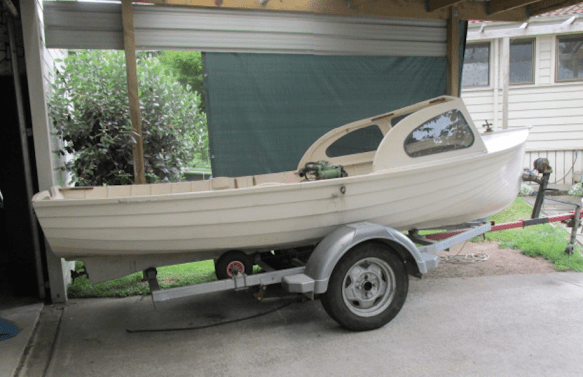
In the latest Lake Rotoiti Wooden Boat Association newsletter, one of the members, Andy Hammond, was looking for help to ID the engine in his 14’ clinker run-about.

Andy commented that the engine was a proper marine unit with F & R gearbox, and almost certainly “Made in England” as it says so on the fuel filter housing. Also has A/F spanner sizes.

Any woodys able to help Andy out on the engine? & what do we think about the design of the boat?


Nukutere – Part 2

Construction & Launching

Unknown

Unknown-5

1940’s War Service & Up To About 1950’s

Unknown-23

Unknown-10

1960’s > 1981

Unknown-13

Unknown-15

Unknown-16

Unknown-18

Unknown-22

NUKUTERE – Part 2

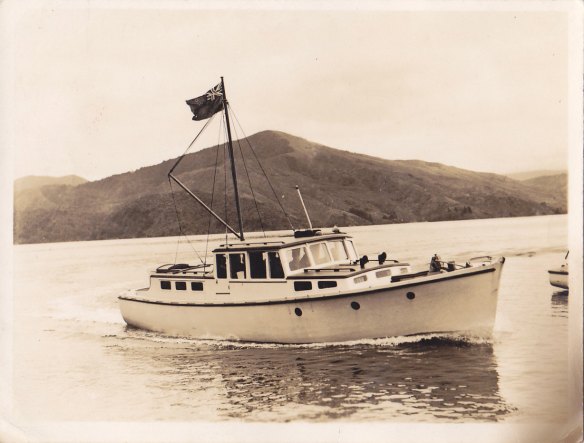
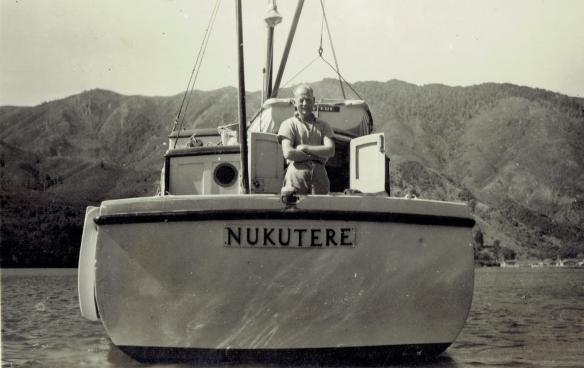
Back in September (11th 2017) I wrote a story on WW about the launch Nukutere, as a result of that story Bernie Warmington made the comments below on the WW Comments section

“Hi, the lovely Nukutere was built by Arthur Sang for our grandad Foster Warmington of Wellington, from 1939-41.  She remained in the family until 1981.  Grandad sketched up some design drawings from reading boating magazines and Arthur made up a model.  (Grandad then shaved the model to make the bows finer, Arthur didn’t find out until she was partly built!).  Moored mostly at Port Nicholson and then later at Seaview, and in the Sounds she was moored at Nana and Grandad’s house in Double Cove.  She saw naval service as Frank mentioned, her registration was Z74.  My Dad Gavin and Uncle John went on night patrols when 14 and 15 until the navy banned them due to age.  Not sure what Nana thought of all this… We have a small book based on Dad’s memories of the Nukutere and her adventures, happy to share these, photos etc with the current owners and others interested.”

I asked Bernie to send me the above mentioned photos, which appear above. What a collection – I have broken them into 3 parts.

  1. Construction & Launching (stunning photo of the kauri log)
  2. 1940’s War Service & Up To About 1950’s
  3. 1960’s > 1981

THE NUKUTERE STORY – Below is a link (in blue) to a photo-essay book, titled The Nukutere Story, that Gavin Warmington authored for his family. The story & photos were passed over (told) to his children – Julie, Bernie & Matty in late 2007 > early 2008.

The family edited the story & published it in March 2016. WW is in debt to the Warmington family for sharing the book with all us woodys.

Enjoy the read, it puts all the above photos & more in context.

THENUKUTERESTORY

Screen Shot 2017-12-14 at 7.53.40 am


Link to the WW post #1 showing Nukutere today.  https://waitematawoodys.com/2017/09/11/nukutere/


Waiata H15

Screen Shot 2017-12-13 at 1.53.30 pm

2017

WAIATA H15

 A gent by the name of Billy Bott called me last week with a wee problem, with a such a cool name, I couldn’t not help him out

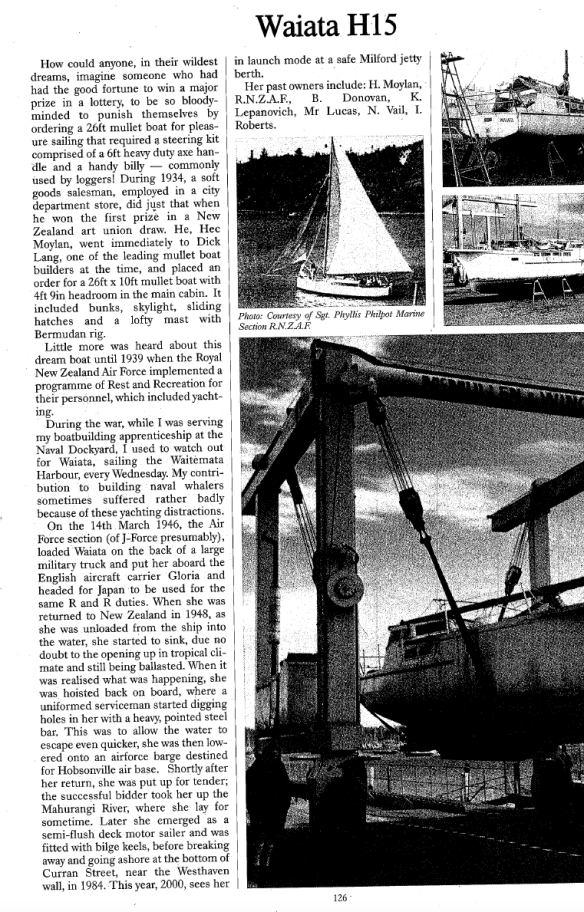
Billy has a 26ft Mullet boat (now in motor launch mode) with a very colourful history. Built by Dick Lang, one of the leading mullet boat builders at the time and launched in 1936. One of the last boats launched before the man power project in 1938. Her first owner, Hec Moylan, won 1st prize in the ‘NZ Art Union’ lottery & commissioned Lang to build the yacht.

Waiata was transported to Japan in 1946 aboard the English aircraft carrier “Gloria” to be used for Rest and Recreation duties by members of the Royal New Zealand Air Force. Waiata was also used for recreational sailing at the RNZAF Sunderland base at Lauthala Bay, Fiji.

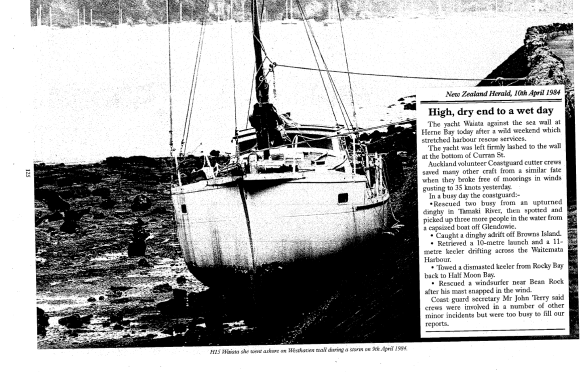
In 1984 as the result of a rather big storm, she had a wee altercation with the Westhaven sea wall, at the bottom of Curran Street, Herne Bay (refer press clipping below) & more details on her past.

Today Waiata resides in the Milford Creek. Powered by a 25hp Volvo diesel motor and gearbox. The motor has only done a few hundred hours since being reconditioned. She is very roomy for a 26’ boat, with full head room throughout.

Billy’s problem ? – Waiata needs a new owner, sadly she has not been used lately & someone could acquire her for not a lot of money, in Billy’s words “I’m open to all offers”

For more information call Billy on 0274956561

ERNIE SEAGAR RIP – Saddened to learn of the passing last week of Ernie Seagar, one of the giants of our wooden boating community. 

Harold Kidd Input

Sad indeed to hear about Ernie Seagar’s death. He was already a legend as a boy. He was Head Prefect and Captain of the First XV at Takapuna Grammar in the 5th Form and a very useful cricketer, track and field athlete and yachtsman. In his later years he became a truly admirable hard man from his experiences at sea and in life. A true two-fisted tough-minded Seagar of the great New Zealand engineering family. His great-grandfather worked under Isambard Kingdom Brunel in the construction of the GWR Saltash Bridge and the SS GREAT EASTERN at Milwall.
My sincere condolences to his family.
WAIATA was launched by Dick Lang on October 5 1934, not 1936. My father and mother lived in London Street, just up from St.Mary’s Beach. Dad knew Dick Lang well (as well as Lloyd George).
Boylan raced her infrequently with Ponsonby Cruising Club and Richmond but she was well-known on the waterfront.
This “manpower” comment is way off beam. Between 1934 and 1940 (not 1938….WHY 1938, the war was a year in the future?) when tradesman began to be “manpowered”, many hundreds of yachts and launches were built in Auckland, a large number by Dick Lang.

Screen Shot 2017-12-13 at 1.55.05 pm

Screen Shot 2017-12-13 at 1.56.18 pm