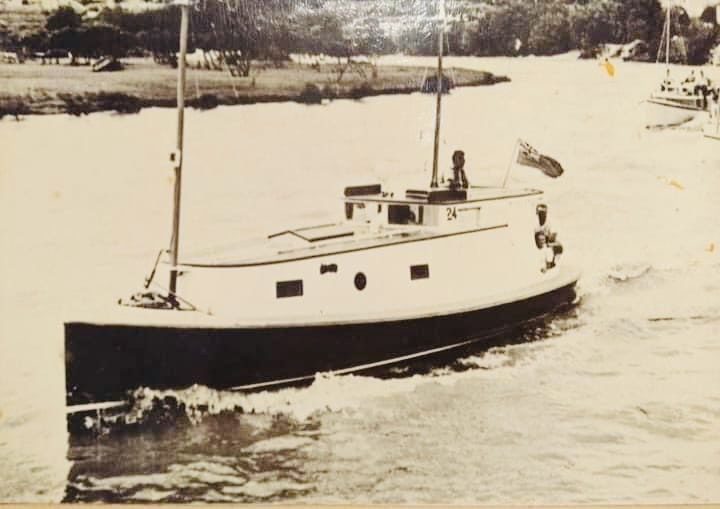
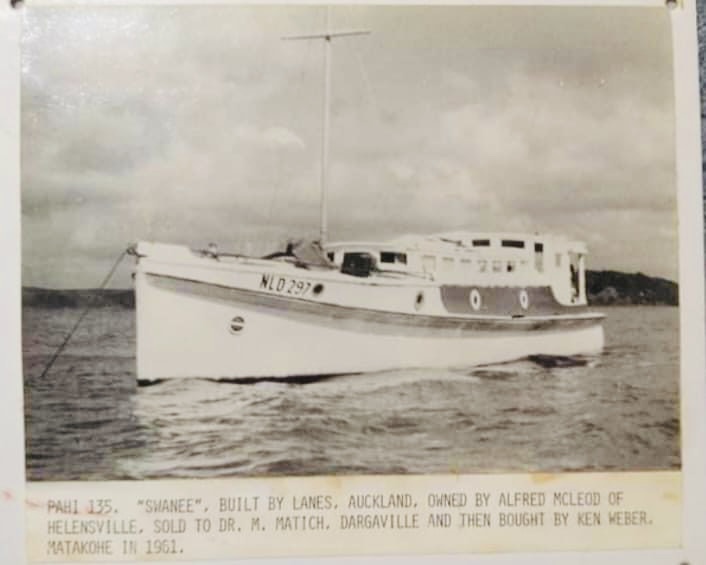
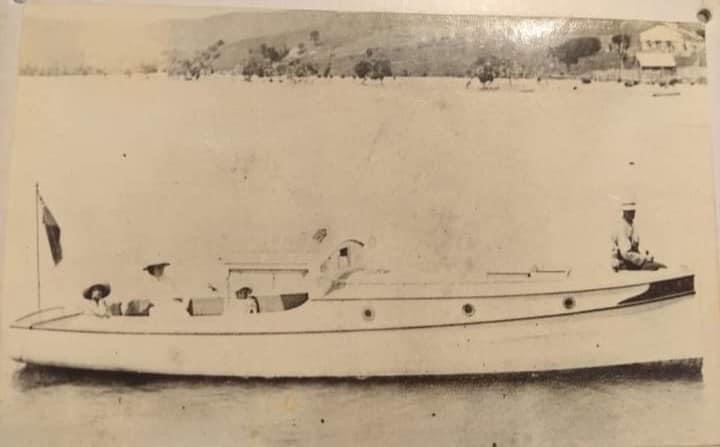
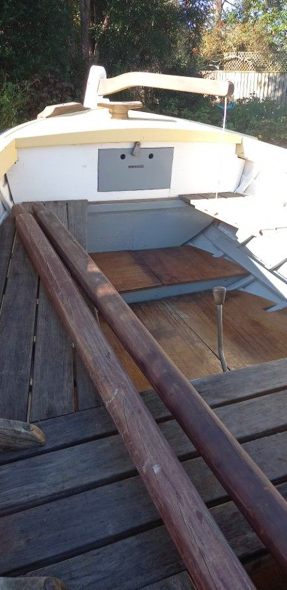
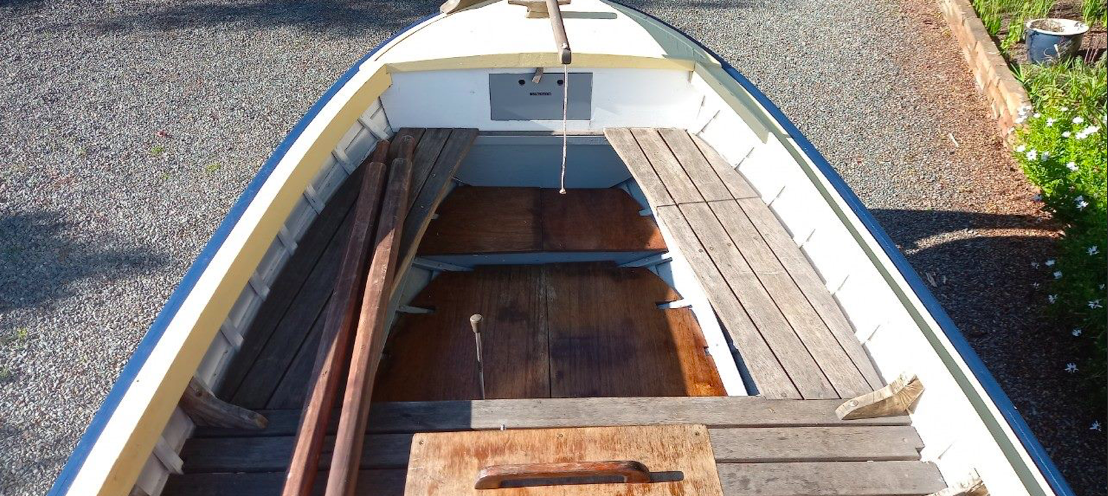
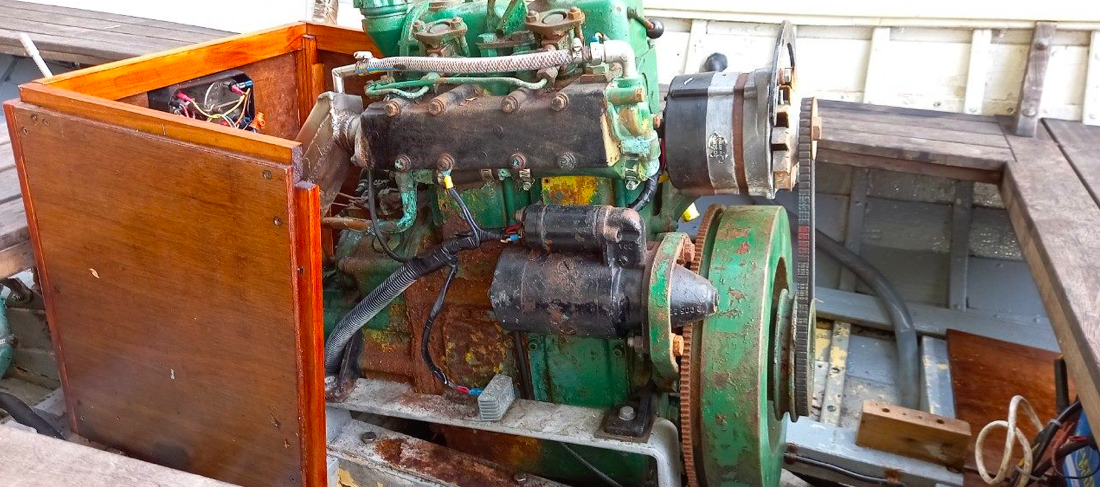
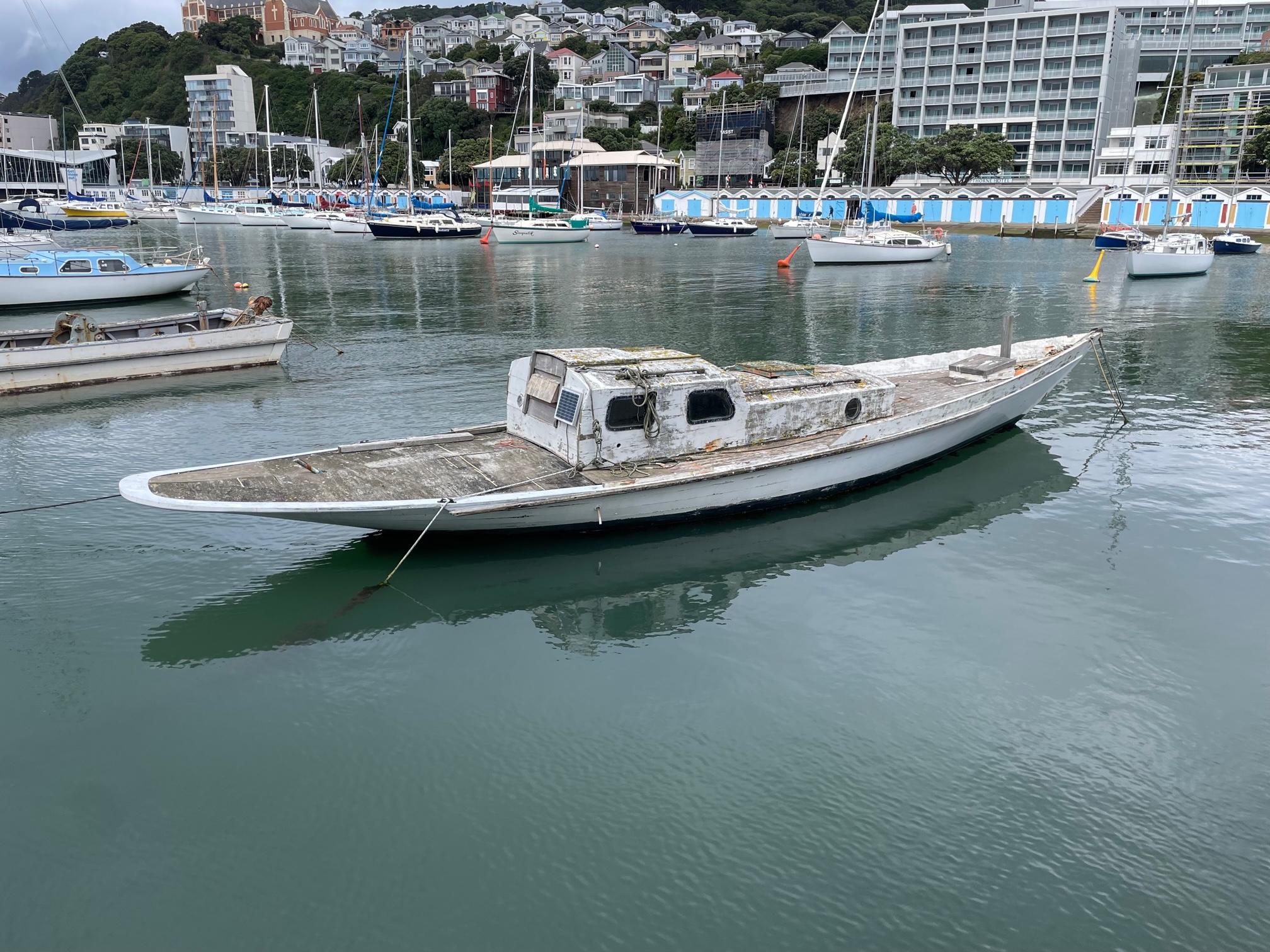
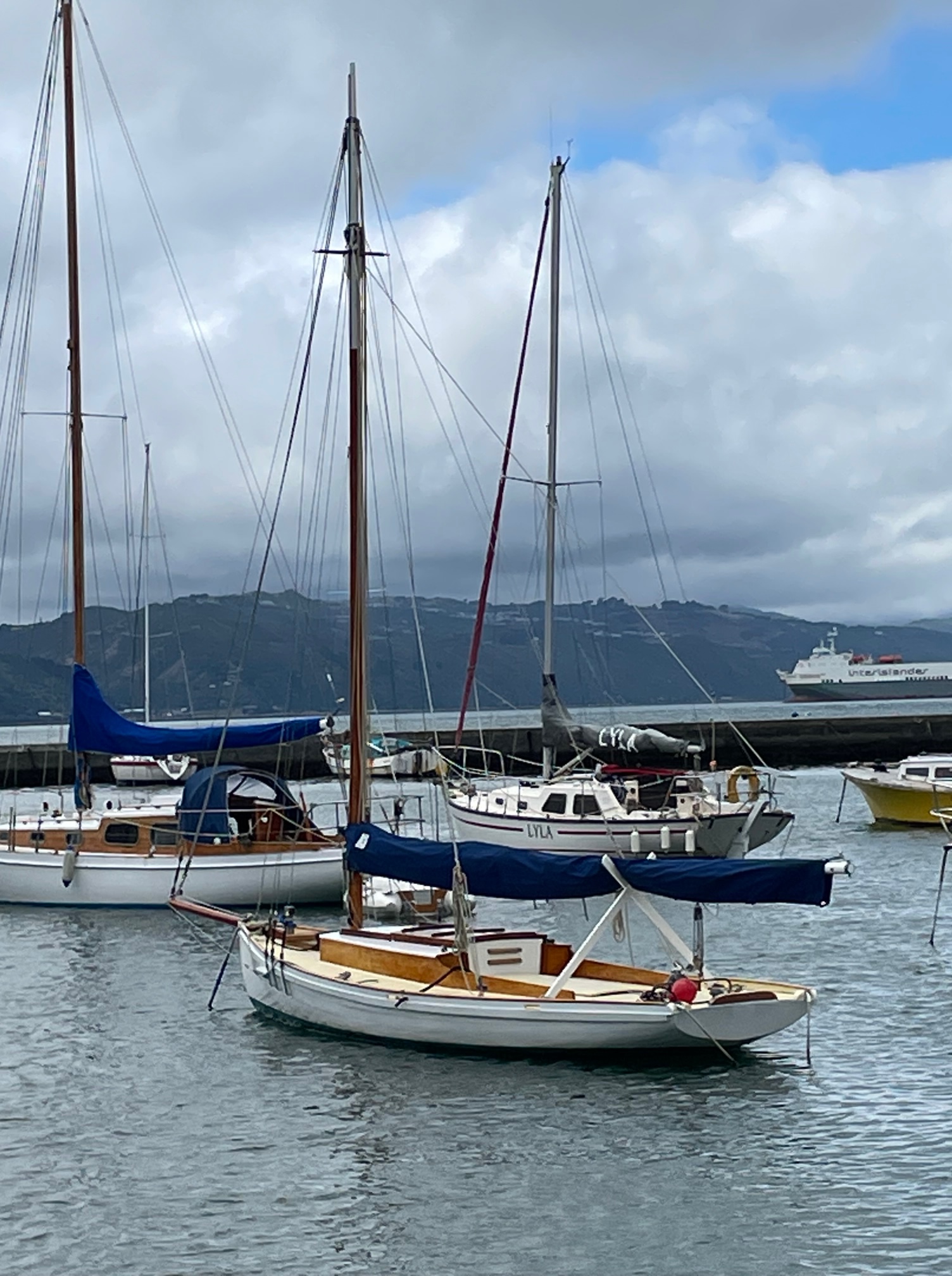
Input from Chris Manning – I believe Pania is alive and well and in regular use as the Committee Boat for Evan’s Bay Yacht Club in Wellington. Has been since the 90s
Last week we featured the relaunch of the 48’, 1919, Joe Slattery built launch – Raiona, after a 2 year refit at the Colin Brown / Josh Hawke yard. Today thanks to her owners we get to have a gander down below. Launching story link below – https://waitematawoodys.com/2022/07/09/raiona-relaunch/
The ’new’ decor (can I use the word when describing a classic woody?) really lightens the interior up and the varnished woodwork is magnificent. Well done to everyone that rubbed up against her during the last two years – below is a shot of Raiona leaving the yard, on-route to relaunching.
The Norman R Wright & Sons began building boats in Brisbane Australia in 1916 and are still operational today – building almost anything that floats – tenders to Superyachts.
To celebrate the 110th anniversary the yard launched a very cool interactive website that allows you to select the vessels that most interest you eg motor boats / timber – you can then slide across a time line to narrow the search to a particular period – then if you click on a vessel, it opens up to display more info on it . Link Below – have a play, its slightly addictive 🙂 https://www.wrightsons.com.au/archives/app/
The double-ender Raiona or Alcestis as see was called when launched in 1919 , was built by Joe Slattery. She would have to be a contender for the most appearances on WW, mainly due to the wonderful photographic collection ex the H.D. Guthrie collection from the early 1900’s. Search both boat names in the WW Search Box to read and see more.
Almost exactly two years ago (July 2020) the new owner of Raiona hauled her out and trucked her off to Colin Brown and Josh Hawke’s – ‘Kauri Classics’ boat yard for a birthday.
We will cover the extent of the work in another story – today is about celebrating the relaunch of Raiona and to step back and admire the craftsmanship of Colin and Josh.
Photo below taken in 2018 prior to Raiona changing hands – it was never a dull day when Raiona was in your bay 🙂
B/W photo below ex Graham Guthrie shows Alcestis in the 1920>30’s period when owned by the Guthrie Family
Following on from yesterdays WW story on Bonita , link below – today we document the life of the launch – that was built in 1923 by E.R. Lane in Picton. It takes us up to 2016. Its a wonderful read and how lucky are her current and future owners to have such a detailed history. We thank Beth Gordon, daughter of the original owner, for researching and writing the story – special thanks to current owner Richard Neighbour for sharing it with us. I will let Beth tell the story – enjoy https://waitematawoodys.com/2022/07/07/borato/
The following is a partial history of this launch compiled by myself, Beth Gordon. Thanks to H Kidd, M Hatton, G Ruffell, J Bunt, J Shallcrass, E Guard, C Guard, A McManaway & R Brownlee. Further corrections, additions and comments are most welcome.
Ernest Richard Lane learnt the trade in his father’s yard: T M Lane & Sons, Mechanics Bay. He “went to America to further his knowledge of boat building and also attended a Naval College in San Francisco to learn the architectural and designing side of the business” [Picton Builders, The Seaport News 01 April 2011]. He came to Picton in 1907 and purchased Carl Brunsill’s business at the Spit.
Ernie Lane’s boat building shed and slipway was located at the eastern aspect of Picton Harbour south of Shelley Beach. Access was by the early footbridge across the Victoria Lagoon from Waikawa Road. The Bonita was built in 1923 and fitted with a 12 hp Kelvin Marine Engine (benzine fuelled). “Bonita is a feminine name as well as a word meaning ‘pretty, nice’ in Spanish & Portuguese … also ships and submarines of the US Navy were named USS Bonita – submarine 1926 -1937.” [Wikipedia website, June 2011]
The earliest possible owner was Charles Forbes who died in 1927 aged eighty-eight. But there is a possibility it was Mrs Renwick who bought the launch for her nephew.
In 1927, the Bonita was sold through A A McNabb, Barrister and Solicitor, Blenheim as receipted on 6th October 1927. Joseph William Bunt paid £305.0.0 for her. The receipt states “… price of launch Bonita as she lies at Picton … & waiting in Mr Lane’s shed”.
An H M Customs document gives the principal dimensions of the Bonita as:
• Length 36 ft • Length of keel 32 ft • Breadth 8 ft 6 ins
• Gross tonnage 3.7 • Net tonnage 3.0
Owner & Skipper JW Bunt At aged twenty-three, Joseph William (Bill) Bunt was issued with the NZ Certificate of Competency as Engineer (Restricted Limits) on 11th June 1930. It reads “has been examined and found duly qualified to act as Engineer of a Ship propelled by Gas, Oil, Fluid, Electricity or other Mechanical Power than Steam plying within restricted limits”. This New Zealand River Service qualification allowed him to use the launch commercially. The Bonita was apparently at that time licensed to carry 40 passengers.
Early photographs: Bill Bunt, skipper – undated but likely to be pre-1940
The original double-ender launch had a low profile cabin (two fixed porthole windows on each side) with open foredeck which could be covered with canvas.
Fishing Party, Queen Charlotte Sounds -undated
The Picton Harbour was not always a calm mooring place as proven by the events during a severe storm in August 1938:
“LAUNCHES PILED ON FORESHORE … between 4 and 6 p.m. when several pleasure launches moored in the harbor were wrenched from their anchorages and in spite of valiant efforts by residents more than a dozen boats were soon being forced towards the beach … presented a sorry picture, with launches resting at grotesque angles practically all the way from the rowing sheds to the railway embankment … the launch Bonita, owned by Mr W. Bunt, Picton since refloated …” [Papers Past: The Press 11 August 1938; Website: Auckland Libraries Heritage Images, Auckland Weekly News 17 August 1983]
In the early years of ownership Bill used the launch for day fishing trips, charters, perhaps goods service and personal outings. In the summer of 1938-39 (following his marriage) he may have relied on the launch for income as he made 30 trips between December 23rd and February 26th to places such as: Double Bay, the Grove, Bay of Many Coves, Ship Cove, Tory Channel, Ely Bay, Torea, Whaling Station, Onahau Bay, Te Iro Bay. He kept notebooks in which he recorded the outgoing costs and money coming in eg: in 1947 a survey cost £1.10s, wharfage £3.0.0 and 24 gallons of petrol cost £3.12s. [Bill Bunt notebooks: family documents]
One memorable 1948 fishing trip to Tory Channel was written up in the local newspaper and republished fifty years later:
“NEARLY CAPSIZED – mishap in the Sounds. With their anchored launch caught in a fierce williwaw and water pouring over the gunwale of the capsizing vessel, a Blenheim fishing party narrowly escaped disaster about four miles below Dieffenbach, in Queen Charlotte Sound yesterday afternoon at the height of the big nor’westerly gale. The gust which was estimated at well over 70 mph, was fortunately of only a few seconds duration, and it passed before the launch, Bonita, could turn turtle. But those few moments when it was poised on its side, with six of its occupants thrown on the floor of its cockpit with water cascading over them and its owner, Mr W Bunt, blown overboard and clinging desperately to the anchor chain, were nightmare ones for all concerned.” [Marlborough Express 2nd January 1998]
George Moore, Bill’s nephew was on board on this occasion and confirms the situation.
At some stage the wheelhouse was added and canvas extended to fit over galvanized pipe framing of the foredeck. The canvas rolled back to provide forward seating in good weather. Access was from aft through the wheelhouse door and past the engine. This seating under the canvas canopy doubled as sleeping quarters.
Bunt children on Sounds trip – undated c1950
“In later years Dad had a wheelhouse added, on top of which was stored the life raft. He moored the launch on the harbour between the Foreshore and the Railway Station probably now close to the Edwin Fox dock. The clinker dinghy was tied up above the high tideline on the lagoon near the old road bridge. My memories are of walking through the tidal mudbanks where the dinghy was tied up. At low tide we had to drag the dingy down to water’s edge before it could be rowed under the Waitohi Bridge out to the moored Bonita. I learned to row here and remember the sound of the water lapping as we rowed under the bridge, especially at high water. When Dad was rowing, I was the bailer using a discarded tin can. Usually the dinghy was left on the mooring when the Bonita was out. But, sometimes for special outings in the Sounds, it was towed along. Passengers and goods were loaded and later after a tiring day, unloaded at the small launch jetty near the main wharf.” [Beth Gordon, 2011]
For the annual surveys, repaints and repairs Bill may have used different slipways in Picton. Certainly in the latter years he had the Bonita up on Jack Morgan’s slipway situated near to the wharf on the Freezing Works side of the harbour.
Bonita – Morgan’s slip c1952
“In 1952 I remember spending time at Morgan’s slipway when the Bonita was up for maintenance and painting. I recall spending time playing around under the boat and around the boatyard while Dad was working on it. The smells of paint, rusting metals, sea and whatever tidal changes bring to shore, still linger. I remember the green oilcan used to oil the engine – a treasure I still have.
I also remember helping Dad repair the ribs on the dinghy when he ha it in the backyard at home. He steamed the replacement ribs to bend them and I was encouraged to hold the dolly while he hammered the copper rivets in place. A most responsible job I thought then. .
I also have fond memories of some of our family my times in the Queen Charlotte Sounds with the launch and sometimes the dinghy too: Governor’s Bay (beach picnics using the ladder placed over the bow to disembark), Double Cove, Torea Bay (fishing and swimming over the side), Tory Channel (fishing), Te Iro Bay (visiting Reg & Joan Jackson to pick cherries), Double Bay (beach picnics and collecting cape gooseberries). And I remember using the galvanised bucket when caught short. This bucket had a rope attached and was used for all sorts of liquid activity, mainly for washing fish and cleaning the deck down.
Some of these were long days out and once I was given the job of steering the boat while Dad cleaned up. We were inside of Mabel Island and obviously I was meant to steer for a very short time. I managed to run her on to the rocky shore just north of the freezing works. I was terrified until Dad inspected the damage to the bow – only a paint scratch or two!” [Beth Gordon, 2011]
Bill Bunt sold the Bonita after thirty years, date (?mid 1950s) for an unknown price.
The next owner was Ernie Pye of Ngakuta Bay, Queen Charlotte Sound. He used her in conjunction with his holiday baches to take holidaymakers out on fishing trips.
“Ernie and Florence Pye … had a large launch which he used to take people out fishing for five shillings a day …” Audrey Palmer, Ashburton recalls early years of the 1950s. [Kennedy T. Ngakuta Bay – Marlborough Sounds 1832 – 2000. T F Kenney 2000]
Edward Guard at age twenty-one, bought the Bonita for £1200 in 1959. He stripped her out to the hull and put in a new deck. The topside was rebuilt: cabin, wheelhouse, bulwarks and a mast added. The cabin was then separate from the engine. Belting was attached to the bulwarks and ballast also added to keep the launch lower to the waterline for stability. This work was done by Leslie Francis (Billy) Guard at Pukatea Bay, Admiralty Bay in cousin Jack Guard’s old shed.
The alterations were done so Edward and his brother John Guard could use Bonita for net and line fishing and cray fishing, based from Port Underwood, Kakapo Bay and/or Picton. Her license number was PN48.
Bonita – post 1960, photo: E Guard
Edward in clinker dinghy, photo: E Guard
The Bonita was sold in 1967 to Stan Howie and relocated to Kaikoura where she was used for commercial fishing – # PN 6221.
“Stan Howie … purchased his own boat, the Bonita, from Port Underwood, which he fished on for about 3 years. About 1968 Stan and his mate were fishing and were caught in the Clarence area by a severe southerly wind when on the Bonita … forced them to head home. It took them 7½ hours to get back to Kaikoura.” [Garbes Pam & Norma, 2004. Kaikoura Fishermen, Kaikoura District Museum & Archives, NZ]
Stan Howie sold to Jim Shallcrass who took delivery of her on 31st August 1970.
“Jim sailed her to Picton on the 1st September 1970 – a 12 hour trip. On the 28th September the same year while out fishing an oil line on the motor broke. Was towed to Picton, the motor was seized. While she was on the slip for repairs at Jorgesons boatyard at Waikawa Jim had them change the cabin structure to give more aft deck space. She was back in the water 11th December 1970. Jim fished her from Picton, in Cook Strait crayfishing and gropering.” [Shallcrass email, 2011]
“Another mishap was while she was on a mooring in Resolution Bay, August 1971 during a southeasterly gale. In the night she dragged her anchor. In the morning when checked at first light she was found bouncing on the beach. Jim managed to get on board and get the motor going to drive her off, but found there was no steering. Instead he hung a tyre over the side and managed to get her alongside another boat and barge in the corner of the Bay. It was damaged too.The Bonita had lost her rudder so Jim called up and got a tow to Picton. It was so rough they weren’t very happy to come and get him. Jim had to keep pumping her out. While she was on the slip for repairs she was refastened, new engine beds, new keel bolts and a collision bulkhead was put in.” [Shallcrass email, 2011]
When Ed Guard viewed the photo in “Kaikoura Fishermen” he said the front of the wheelhouse alteration (changed to slope backwards) was done by Shallcrass after purchase from Howie. [Edward Guard, Blenheim 2016]
Bonita was next sold in March 1975 to a Nelson scallop fisherman. Richard Chadwick was the new owner and he and Chris Guard took her by sea from Picton to Nelson. Chris had a Ford diesel motor put in and she was then used for scalloping, for a very short while. On one trip home coming into the Port of Nelson near the bar/gap, the load shifted and she capsized. Bonita was towed to port, righted and then kept working until Chris sold her to buy a larger boat which was more suited for scalloping.
The next owner was a young scallop fisherman – Murray Ross Probert. Apparently he fished on the West Coast with Bonita for a few trips, but changed to fish out of Nelson. His father (Tom Probert) sometimes went out with him.
“I gave him a bit of a hand and did a bit of work on her. She had a 4 cylinder Ford diesel motor at that time.” [Tom Probert, 2011]
Murray had the Bonita in the Croisilles area in late November 1977 when she sank.
“BONITA, fishing vessel: On November 29th 1977 a search was mounted for the Bonita when she failed to keep a pre-arranged meeting with other fishing vessels. The body of skipper Mr M R Probert, was found floating in the sea off Okuri Point, west of French Pass, but there was no trace of the vessel, which was last seen at 7pm the previous day between Okuri Point and Croisilles Harbour. The Bonita is presumed to have been lost during storms overnight. A double ended vessel, 11 metres long, she was based in Nelson.’ [Ingran C W N, 1984. New Zealand Shipwrecks 1795 -1982, 6th Edition, page 453. AH & AW Reed, NZ]
There followed a marine court of inquiry which apparently resulted in differences in fact and assumption.
“As Murray had not reported in I did a search the next day. I found Murray’s body about six kms away from where later the boat was located. There was a Court of Inquiry which did not get all the facts correct. It was a clear calm day when there was a technical problem with the water hose. The launch was seaworthy but not suitable for lifting. The inquiry should have asked whether the Bonita was fit for purpose. She was not suitable for lifting.” [Chris Guard, 2011]
Some five months later, Allan (Cat) McManaway was trawling and by chance hooked the boat which was sitting in 23 fathoms. He got the help of Chris and John Guard to salvage her and they towed her back to Nelson. Apparently, once the boat was drained of water, some of the electrical system and the engine still worked. Allan checked with the Marine Insurance firm and was told insurance had been paid out. This meant that technically the wreck belonged to him, the finder. She had sat in “rotten row” near Nalder and Biddles yard for quite a period of time. He sold Bonita to be salvaged.
About 1980 Les Ruffell bought the wreck for a small sum, took her to a shed in Blenheim and completely rebuilt her above the hull. Apparently, the matai deck had been eaten out and was completely gone. The Bonita then went to Havelock and Les used her commercially to service Pelorus Sound mussel farms. He commuted between his home in Mary’s Bay, Homewood and Havelock. Under Les’ ownership the Bonita was used and shared with John Pickering and Robbie Brownlee.
“John and Robbie did a deal with Les Ruffell, who had the Bonita and bought his own mussel farm, license 86, in Old Homewood Bay. He provided the food and whisky, and the three did their own farm work and used contract harvesters.” [Dawber, Carol 2004. Lines in the Water, River Press, NZ]
About ten years later Bonita was bought by Les’ son, Gary Ruffell, Canvastown for private use. Bonita is now again moored in Ngakuta Bay, Queen Charlotte Sound. She is run by a 78 hp diesel motor and is most reliable. On viewing a recent photo Ed Guard said that ballast has been removed as the launch is sitting higher in the water. [Edward Guard, Blenheim 2016]
Bonita – Ngakuta Bay 2014 photo: Margaret Hatton
JULY 2022 UPDATE – THERE IS A TENTATIVE SALE OF BONITA AND SHE WILL BE RELOCATING TO AUCKLAND
I’LL GIVE A WW CAP TO THE WOODY THAT CAN ID THE NEW OWNER
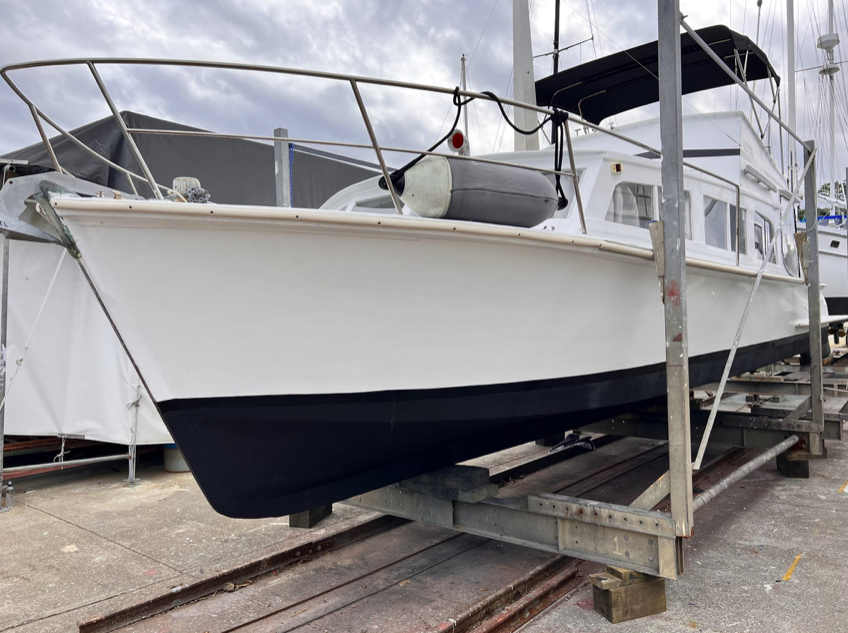
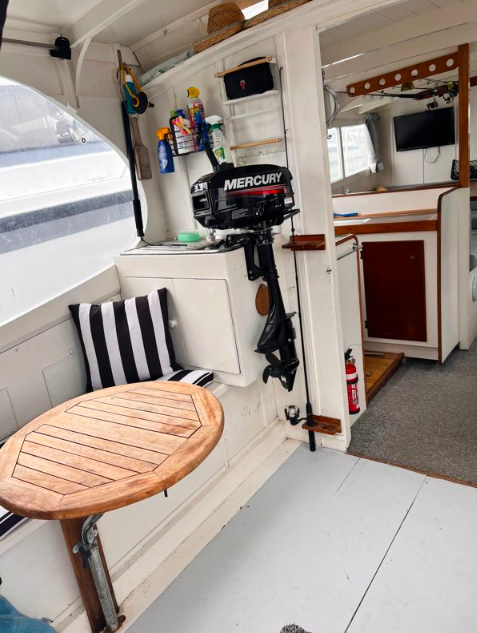
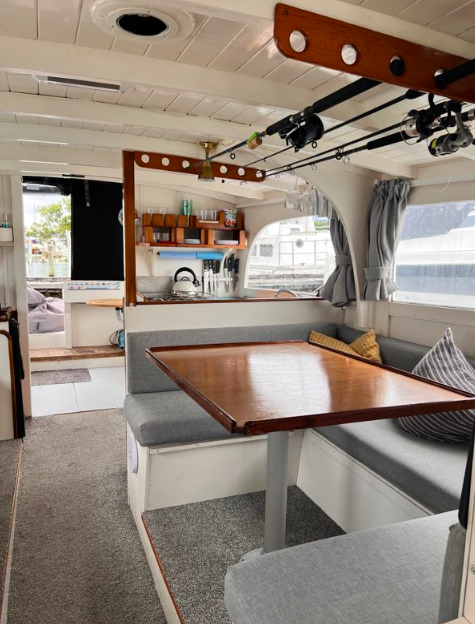
Todays double ender 36’ woody launch just popped up on tme (thank you Ian McDonald) and is just such a looker. Home is Waikawa Bay in the Marlborough Sounds. Currently only set up with two berths, she is crying out for a full conversion to pleasure use.
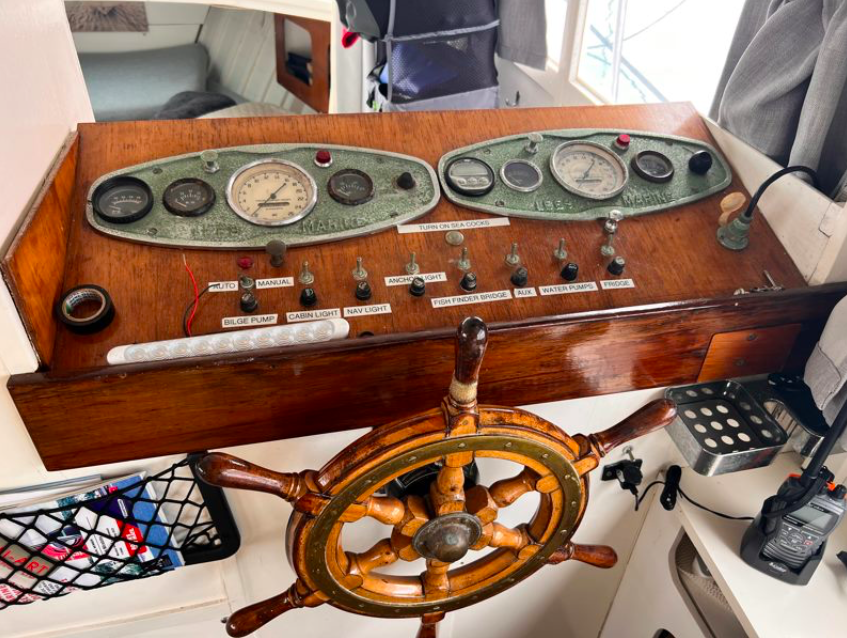
Power is via a 80hp Ford diesel, that according the the tme story has a wee oil leak.
Who ever choose the colour scheme and name font as a good eye. I hope I have the spelling right?
Can we learn more about the boat?
INPUT ex Dick Hall – Correct name ‘Bonita’. Built 1923 by Ernie Lane in Picton as a typical sounds passenger boat with two cockpits both forward and aft of the wheelhouse. Originally powered by a 12hp Kelvin benzine engine. Modified for fishing in 1959 for the Guard Brothers of Port Underwood. Lately used as a pleasure boat by various owners.
INPUT ex Richard Neighbour – Bonito (launched Bonita) 1926, sister ship to Mariner (Shakespeare Bay- Queen Charlotte Sounds) I have emailed the history up to 2016 as given to me by Beth Gordon (original owners daughter). Bonito is a lovely old girl. My wife and I hope to find a suitable owner that will maintain her for many years to come as we have moved from Marlborough and don’t get back as often as we hoped to. Bonito has many years left in her yet, with much credit to the Ruffles family (previous owners of 40 years). Richard & Helen – current owners.
Eldest child, son Tom, was recently mooching around the South Island, from Nelson at the top to Dunedin at the bottom of the south. He was briefed to take a photo of anything afloat that looked interesting. The result was the photos above showing the Broad Bay Boating Club and surrounding area on the Otago Peninsula.
The small double-ender on the trailer looks familiar – but can’t put a name to it.
Following on from yesterdays story showcasing the inaugural running of the Moreton Bay Classic – probably the biggest classic one day on-the-water event in Australia, today we get to see the race fleet up close. The last group of photos are from the post race festivities in Horseshoe Bay. If you missed yesterdays story – scroll down to view it or click this link https://waitematawoodys.com/2022/07/04/the-race-social-event-that-stops-the-bay-the-moreton-bay-classic-part-one/
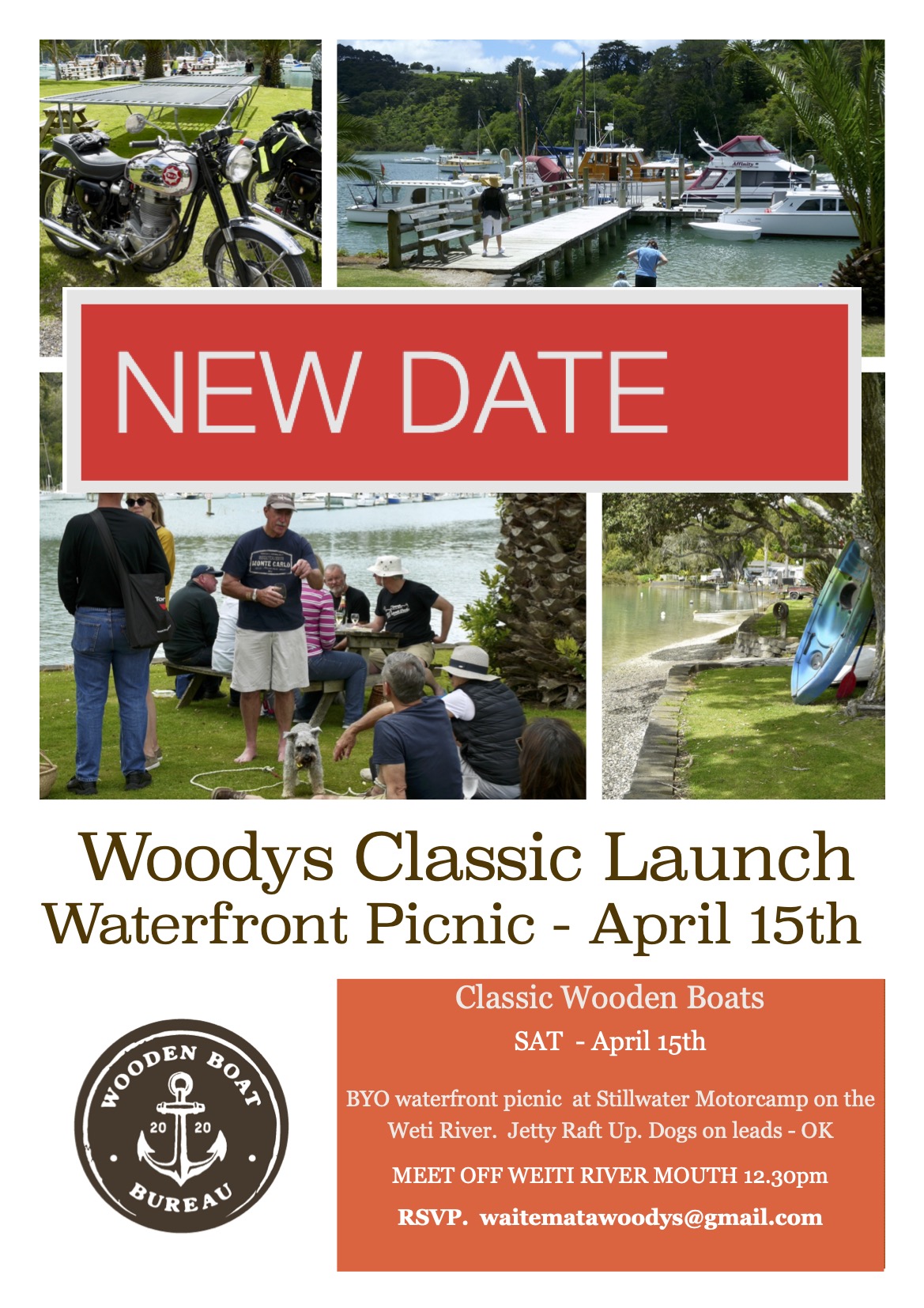
As mention yesterday – the time is long overdue for an event like this on the Waitemata – no drag racers, no show ponies, no big ego’s or bad attitudes and no 24hr marathons – just a good old fashioned woody day out accumulating in a bay for a BBQ. Details soon.
The Race Social Event That Stops The Bay – The Moreton Bay Classic – PART ONE
Todays mega woody story comes to us from Brisbane based woody Andrew Christie, who regularly sends in reports from the woody movement from across the ditch. Todays is a goody, so find a comfy spot and enjoy 🙂 Take it away Andrew –
“For my part I have long looked across the Tasman Sea towards the Waitamata Harbour with envy. The number of classic boats and classic boat events there is the stuff of magic and dreams for a wooden boat tragic.
Here on Moreton Bay in South East Queensland, its own boating paradise, we had nothing to compare until a grudge match between young Jacob Oxlade and Paul Crowther, bubbled to the surface in a throwaway challenge that snowballed in to the largest event for classic wooden boats that Moreton Bay has ever seen last Saturday, 25 June 2022.
Jacob Oxlade, 24 a qualified Master has the good fortune, skill and presence that has seen him become skipper of the South Pacific 11 a 72 foot vessel designed by Eldridge MGuiness and built by the famous Norman R Wright & Son in 1962. Jacob skippers the South Pacific from Far North Queensland to Tasmania and has formerly skippered other known Moreton Bay Classics, Bali Hai, Mohokoi, Lady Brisbane and others. Paul Crowther is a member of a successful business dynasty who has recently become the proud owner of the Mohokoi a 70 foot vessel built by Wayne Tipper in 1995.
Jacob in South Pacific was escorting Paul to Myora on North Stradbroke Island, an anchorage favoured by salty Classic Moreton Bay Cruisers as Paul got to know the ropes. As it happened, Mohokoi was ahead of the South Pacific and Paul slowed to let Jacob enter the anchorage first. As is the nature of such things, an argument then ensued about who was first and who was fastest. The gauntlet was thrown down by Paul and the challenge accepted by Jacob. It was on. The “Race that Stops the Bay” was suddenly being promoted on local classic boating social media but quickly became the “Event that Stops the Bay” to accommodate fears relating to insurance and other regulatory matters that tie down our modern nanny world.
Jacob hoped to attract perhaps eight of the known larger classic vessels and about ten smaller ones for an event he hoped would be reminiscent of old photographs he had seen of the processions of classic boats that escorted the Britannia up the Brisbane River on the Queen and Duke of Edinburgh’s visit to Queensland in the 1970s.
Jacob regrets that the entry form he published was not designed to accommodate the sheer volume of entrants that he had to process. Thirty-One classic vessels registered to actively participate in a race of 10.9 nautical miles from Green Island near Manly Harbour in Moreton Bay to South West Rocks at Peel Island. Seventy-One classic vessels registered as spectators. Jacob counted One Hundred and Twenty Classics in the post-race anchorage of Horseshoe Bay and more again were present close to shore before the starting gun. Entries continued to pour in after close of registration and even on to the day of the event itself.
Jacob is cognisant that each of these classic wooden boats is unique and special. He inherited his love of them from his father Paul Oxlade who would take him boating from a young age, where Paul Oxlade would point out each of the old Queensland woodies, being able to name their owners, builders, build dates and slip ways, a remarkable skill seemingly only shared by the now Skipper of the Lady Brisbane Mark Nielson. Such was his father’s inspiration that Jacob became a Master in his own right who desires to share his love of these classic vessels with his own younger generation. He believes he has come some way to achieving this goal with what is to become a regular event in what is now known as “The Moreton Bay Classic”.
The race format was kept simple with the primary focus being on a day out and participation which had to be both easy and free as an antidote to our post Covid 19 world. It was not a navigation event or log race. It was simply a race from post to post but with a handicap on each boats’ start times set by William Wright, a third generation boatbuilder and naval architect with the Norman R Wright & Sons dynasty who handicapped them according to their waterline length, horsepower and top speed. First across the finish line was the Coral Sea, followed by Floodtide, Lady Mac, Nyala and Tamara. A best and fairest award of a Garmin watch was won by the Skipper of Mohokoi, the decision being made by John Stewart, Commodore of the Breakfast Creek Boat Club. The watch was donated with thanks to Gordon Triplett from Garmin.
Because this year’s event occurred spontaneously and without much notice, a fact belied by the sheer number of participants, it is intended to hold the event once more next year to allow those people who missed out a chance to attend, after which it will become bi-annual, to be held in the winter of each year of the Tasmanian Wooden Boat Festival. The timing is designed to take advantage of the beautiful Winter conditions Moreton Bay experiences and to allow those vessels making their way North for the Winter season both from Tasmania and the South generally to participate. The date has already been set at 24 June 2023 which coincides with the commencement of the Queensland School Holidays and which avoids conflicts with other events listed on the Boating Industry Association’s calendar. In the event of poor weather a contingency plan for celebrations at Royal Queensland Yacht Squadron’s Canaipa campus are in place.
It is Jacob’s intention that next year all of the classic vessels will be entered as participants with any moderns to be registered as spectators as he explained there was confusion in the minds of classic owners unfamiliar with the format of the new event this year with the result many were shy, entering only as spectators.
At the conclusion of the race festivities continued with a presentation that occurred on the beach at Horseshoe Bay, where a feast of seafood, a lamb on a spit, and a pig on a spit was provided free of charge to participants.
Jacob focused specific attention on safety and an avoidance of inconveniencing non participants, the course being designed to avoid conflict with bay ferries or creating wake on local beaches. The event was run in consultation with Maritime Safety Queensland and the Water Police who reported no negative occurrences from the event. Congratulations must go to Jacob and Paul for their thoughtfulness in providing both general refuse and recycling bins at the beach function and for organising a clean-up of the beach the following day such that it was left in better condition than before the presentation.
Thanks must also go to Paul Crowther who paid for the spit roasts and a live band out of his own pocket, Bryant Engineering, the Queensland Gardner specialists who provided the seafood and who operated the rotisseries and set up and pulled down the beach facilities the day before and after the event and to Tony from Tony’s Boats and Marine who paid for bread, onions, napkins and the other bibs and bobs that made the barbeque a success.
The event was filmed by Nick Cornish who runs Game Rod Media so expect a quality documentary about it in the near future. A Facebook group for the Moreton Bay Classic features footage of the vessels and the event and provides updated information future events.
With a view to keeping the event free to participate in, Jacob and Paul are looking for sponsors and are floating the idea of providing a cap or pennant to commemorate each future event which will bear sponsor logos.
And so a new event was born, the fruit of a throwaway challenge, but which highlighted the health of classic wooding boating in Moreton Bay. Make sure you support the Moreton Bay Classic and see you on the waters of Moreton Bay on 24 June 2023, and suffer in your jocks on the Waitemata Harbour as it is warm and dry here in Queensland.”
I think waitematawoodys needs to look into pulling a similar event off on the Waitemata – back to you all ASAP with details 🙂 Alan H
The Race – below is just a tease – come back tomorrow for photos from the course 😉
The 1946 38’ Lidgard built launch – Hirawanu has appeared several times on WW and generated chat around the hot-house ‘up top’. I have included below a photo of her as launched to show her on a good day 🙂
Forward motion is via a Ford 120hp diesel, giving her a stated cruising speed of 8>10 knots.
Now thanks to tme & Ian McDonald we get to have a look down below.