PENGUIN
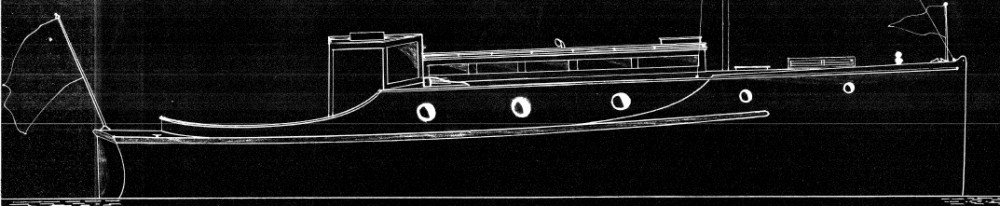
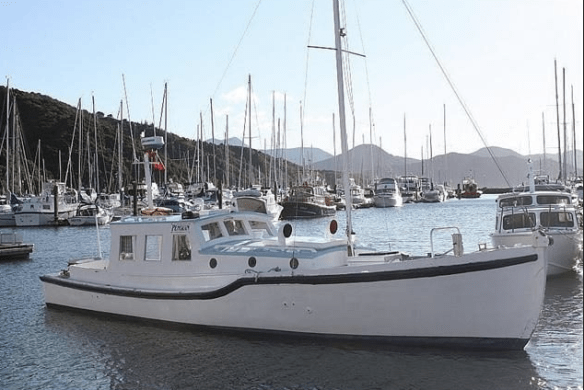
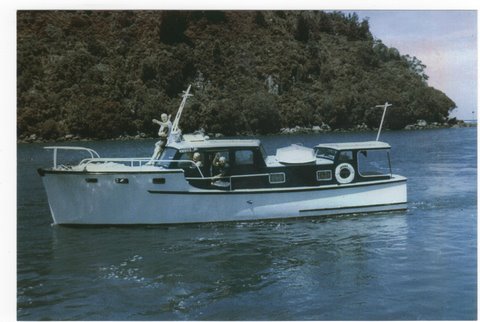
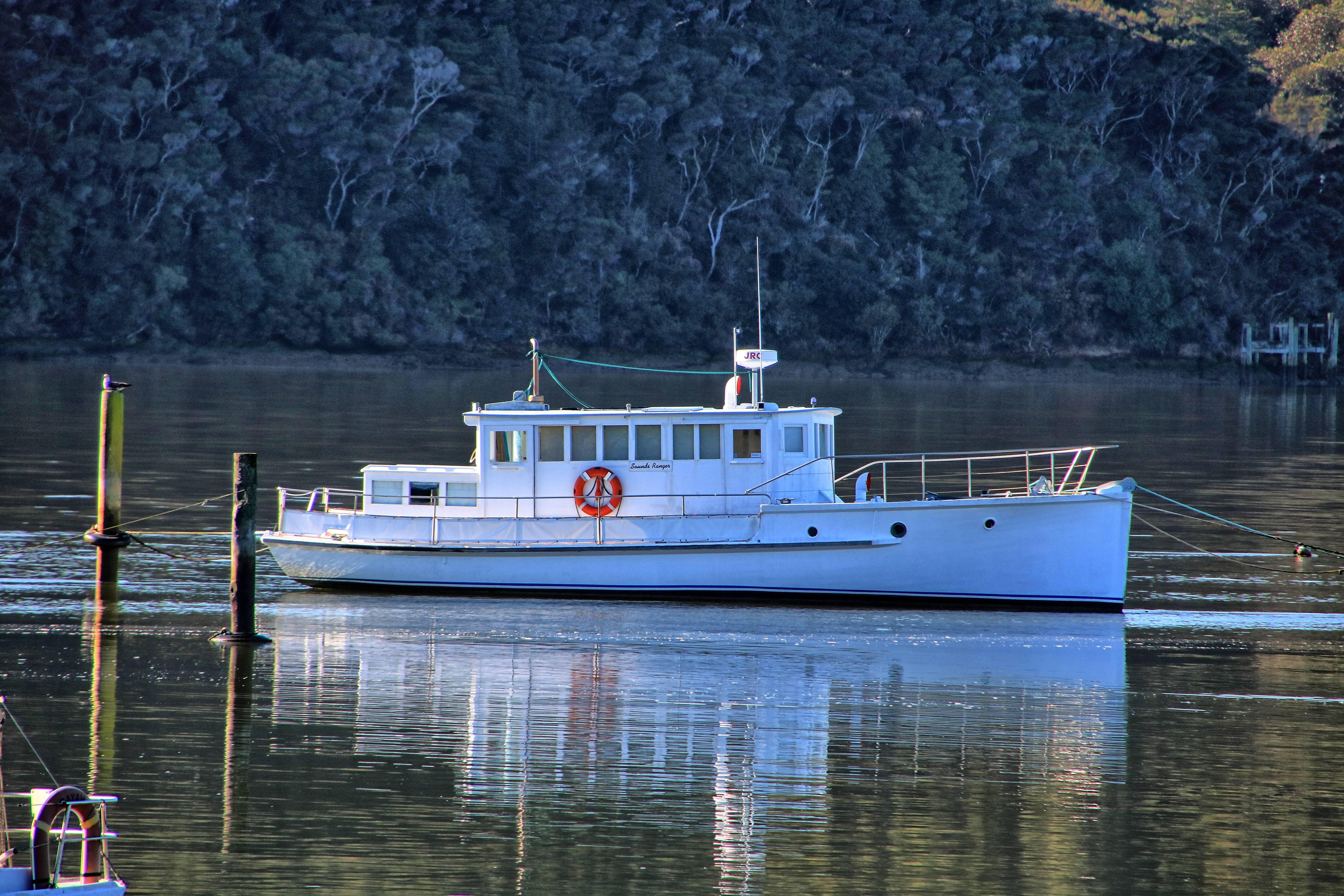
Penguin the 34′ ex Navy survey tender has appeared on ww before (link below for full details). She recently surfaced on trademe, so thanks to Ian McDonald’s tip off, we are able to have a good peek down below. Enjoy – she will appeal to Russell Ward 😉
Next wet weekend when you have little to do, have a peak at the Auckland Libraries, Sir George Grey photo collection, its a gold mine of old Auckland photos. Nathan Herbert pointed me to the collection & while you have to troll thru a lot of average material, every so often you click on a nugget like the above photo of Crusader under full throttle at Great Barrier Island, photo taken December 1929. Given she was built in the winter of that year by Collings & Bell for the Rev. Jasper Calder and Charlie Goldsboro, the above photo could have been her maiden cruise.
To read more on the boat & view a selection of photos old & present day – click the link below
The launch Invader appeared on ww in early Sept 2016, looking a tad sad, being partially submerged (link below). This story prompted her owner for the last 30 years, (sadly the late) Morrie Dunwoodie to contact ww. Morrie’s uncle bought the boat in 1966. Morrie included the above photos & well documented details on her past. Ken Ricketts & myself have edited this into the story below. Sunken Invader Link https://waitematawoodys.com/2016/09/13/sunken-launch/
The History of Invader (as told by Morrie Dunwoodie) Invader measures36′ with a 10′ 2″ beam & is a single skin hard chine, kauri hull & originally had a 6 or 8 cyl petrol engine, with an auxiliary wing motor, with a port side shaft. The wing motor was removed some time before the present owner bought her. She had been bought by Peter Harrison, in 1957, who owned her until 1959, at which time he sold her, because she as too slow, & had a 40′, 22 knotter built, to replace her, by Owen Woolley. Between the Laidlaw & Harrison ownership (later 1940s &/or early 1950s) she belonged to the Townsend family. It was during their ownership that she sank, as seen in the perivous ww story.
She was bought in 1959, by Jim Ansell of Hamilton & moved to Whangamata. He owned her until 1966. During his stewardship he repowered her with 75 Hp TS3 Commer diesel. In 1966 she passed to George H Morrison & remained moored at Whangamata Harbour. He did some upgrading adding sponsons, ‘Tauranga’ deck & new rails. George M. sold her in 1986 to Morrie J Dunwoodie of Thames, the boat is kept at Whangamata. He has replaced the 75hp Commer TS3 with a newer larger 117 hp TS3. In 1988 she underwent a refit with new windows, stainless rails, re-glassing of cabin tops. Then in 1995 replaced decks with ply, & glassed them. She was extended at the stern in 1998, by .9 of a metre to 42 feet. In 2004 Morrie added 3′ to her stern & a 3′ duck board. 2008 saw her get a major out of boat, engine overhaul.
Interested to uncover details on her builder & launch year?
07-05-2018 Update from Mark Dunwoodie
“Invader moved a couple of weeks ago from Whangamata to Hobsonville marina. Her new owners are fantastic people, an experienced sea family and passionate about her. Mum, my sisters and I are very chuffed.
Mark Erskine, Tom Hunt….thank you for your wise counsel in all matters since Dad’s death….and even more so, thank you from Dad for your long friendship and shared passion.
Dad was out on Invader with Uncle George as often as he could from the day George purchased her. From that time he only missed 1 or 2 of the annual end of February trips to Great Barrier….around 50 trips. As soon as we were old enough my sisters and I (and then our children) were regular crew on the daily summer and overnight excursions from Whangamata. Speed mightn’t have been her forte but her seaworthiness, easy layout and the steadiness given by hull shape made her a fantastic vessel.
With the contact from this website Dad had been reinvigorated to research Invader’s history and was enjoying it immensely. Ken, thank you for your kind comments, Dad was enjoying talking to you as well. In the past he had said that it was hard to get to the right people and records from Thames…but had recently been making progress.
I’m not sure where he got to researching her construction date.Uncle George had always said she was built by Lanes in 1936. When Dad lengthened Invader’s hull, he removed the original copper fish tank. The tank had a 1936 coin soldered into the side of the tank. With no hole behind the coin there seemed to be no other reason to put the coin there other than to mark the construction year. From the comments above it looks like this might not be the case.
Anyway, thank you to all.”
08-05-2018 – Update ex Ken Ricketts – overhauled 2008 Roots T23 engine being installe
11-05-2018 New photos ex Mark Dunwoodie
In the gallery below the b/w photo of her high & dry is on the reef, south side Whangaporoa Peninsula. Invader has had her share of oops – in another WW post she is seen submerged https://waitematawoodys.com/2016/09/13/sunken-launch/
Update from John Wicks – Invader hauled out at Hobsonville Marina Nov. 2020 for some TLC
This 45’9” 1966 classic trawler styled Carey motorboat is built using stripped planked kauri & powered by a 135hp Gardner 6LS engine. She was converted to a live-aboard & ticks all the boxes for what I call a floating bach.
Asking price on trademe is $249k, I suspect it will sell for less but what ever the price – it’s a cheap holiday home or a city waterfront apartment. Again thanks to Ian McDonald for sniffing this one out 🙂
Update from Ian McDonald
It would appear that the vessel is ‘Kaheno’ – desined by Carey of Picton & built in 1966 by Sinclair & Melbourne. She was once owned by the Salvation Army to service Rotoroa Island. She tragically sank with the loss of 4 lives in the Tamaki Strait circa 1986 whilst carrying timber as deck cargo from memory.
When I first saw the above two photos from the Tudor Collins Auckland Museum collection I had a chuckle, there has to be a story behind these photos. Venue most likely is Great Barrier Island. Photos emailed to me by Ken Ricketts.
Do we know any more about her?
Photos below ex Dean Wright of Mistletoe at Whangaroa Marina 2007. Nice to see she survived 🙂
25-10-2016 Update ex Alice Morrison
I recall seeing a very similar vessel called ‘Mistletoe’ in Houhora on 11 February 2016 (picture below). I wonder if she is Mistletoe I or Mistletoe II?
Cygnet was purpose built in 1913, as the original Cream Boat of the Mokau River.
After being fully restored in 1994, the Cygnet returned to its rightful place on the Mokau River; this time as the 2nd oldest passenger vessel in New Zealand. She measures 35′ & is powered by a 2012 Yanmar 30h.p. diesel. Most recently SGS (Safe Ship Management) inspected and certified in 2014 and still current.
The M.V Cygnet is currently on it’s newly built custom trailer being stored in a shed near the Mokau River (As it’s current owners are enjoying the benefits of retirement). This is a rare opportunity to purchase a piece of New Zealand maritime history & even earn a living.
photos ex trademe via advice from Ian McDonald
Do we know any more about her – builder etc?
Harold Kidd Input
She was built in Auckland and shipped down to Waitara for Sjolund of Mokau in July 1913, She was described as “on the tunnel style” 34ft in length, 7ft 6in in beam with a draft of 12 ins unloaded and 18ins with a two ton load. No hint of builder in that report but Baden thinks she is by T.M. Lane and Sons and that seems entirely likely. She was meant for the then flourishing Mokau River trade. Sjolund had several launches.
Ma Cherie was built by the Lane Motor Boat Co in 1962 for L.G. Foster of 4 Awatere Road, Hamilton. She measured 50’/14’6″/4′ and was powered with twin Ford 6 cylinder diesels. Her name was changed to Adi Kuila but owner Markham Thomson has done the right thing & gone back to the original.
You can find more details & photos on her past here https://waitematawoodys.com/2014/08/22/adi-kuila/
Ma Cherie has just seen a major re-fit that included fiberglassed topsides, rot removed / rebuilt, rewired, starting/charging system upgraded, new interior, engines head jobs & new water tanks. She is looking very smart, in fact she even gets away with the hothouse up top, just the right height.
Details ex Harold Kidd.
The above photo of Sounds Ranger was emailed to me by Frits Schouten & was taken by Frits in the Bay of Islands, sorry but that all I know. I suspect the name & style are a hint to her past
What do we know about her & her past?
Update 10-02-2022 – Photos below of Sound Ranger on the slip at Dargaville. ex Dave Stanaway
29-05-2024 UPDATE ex NORM JUDD
The following description by Kerry Johnson of the “Sounds Ranger.” is from the unpublished NZ NATIONAL PARKS AND RESERVES RANGERS’ ARCHIVE – a collection of written and taped memoirs of Lands and Survey rangers between 1952 and 1987. Kerry was Chief Ranger of the Marlborough Sounds Maritime Park from the 1968 to the 80s.
“Reading my note to Norm Judd, Havelock based ranger, re starting the Sounds Ranger brought back memories about those early days when I took over, among other things, the care and operation of the vessel. I wasn’t impressed with its overall condition. There was need to bring the launch up to Marine Department standards as soon as possible. The problems included batteries not set up properly to provide backup if one set went flat, the stern tube the tail shaft went through contained a heavy oil for lubrication but would not function properly and no matter how much advice and effort I could muster this thick oil would ooze into the bilge. A few months down the track while cleaning the accumulation of grime from a circulating pump it literally fell apart. Thank goodness the boat was safely in her berth in Picton then! Many improvements were eventually made but there was one incident that occurred one night when I think I was away. Late one rough, wet evening my wife received a call from the Harbour Board patrol to say the Sounds Ranger’s engine was chugging away in her berth with no sign of anyone on board and the doors securely locked! Now there has to be a logical explanation as to how this happened but I was never able to clearly identify the cause and that’s probably why the battery leads had been removed as mentioned in my note to Norm. I’m not superstitious and while I learned later the same thing had happened once before, you can’t help thinking that there must have been some free spirit lurking about that stormy night and was about to take the “old girl” for a cruise in the gloom! “Stranger things have happened at sea.” Thank you Norm for holding on to a note many (including myself) would have discarded long ago. As a friend commented recently when talking about recording family history, “even the milking cow’s name is important”. Here’s the note “Now a few directions in case you should be asked to take out the Sounds Ranger. Batteries have been disconnected – under seat on starboard side, crescent spanner in tool box near batteries. Before starting engine remove bucket from top of funnel – open hatch to engine room, light switch is on a beam just inside the hatch opening, that is if you stand on the engine room floor looking forward, the switch is on your right hand side on the back of the beam that forms the front section of the hatch opening. Move under the exhaust pipe along to the front port side of the motor. If you look around the actual front of the engine you will see a small wheel with finger grips around the outside (about 3” or 4” diam.) This is the wheel that engages the bilge pump by simply screwing or rotating the wheel clockwise or in towards the engine. It should be in this position now, so to disengage the pump, just screw the wheel very slowly out. Do not on any account force the wheel too far out, or for that matter too hard in, otherwise it will stick hard. The pump has to be primed before it will start, this done on the starboard side of the engine. There is another light there with the switch by the light bulb, you will find an old kettle with water in it. You will see towards the front, a tap with an opening for the water to be poured in on the top. With the engine at low idling speed, turn the wing tap to vertical – pour water in slowly. I hold my thumb near the hole and when the pump looks like starting I block the hole with my thumb then turn the wing tap to horizontal. To start the engine use the starter button on a beam in front of the light on the Port side of the motor, but you should only have to use this one when the engine is cold. It also pays to use the overload button on the fuel pump (when the machine is cold only) the button is on the front of the fuel pump.” (Here there was a small diagram that showed the location of the overload button on the fuel pump.) “Button should be pushed up, at the same time pull back the rack. Push the starter button until the engine starts. Be sure to turn both lights out, on leaving the engine room. To stop the motor just pull a string that hangs on a nail beside the top of the steps that lead into the forward cabin. Normal starting can be done by using the starter button by the compass. (This for some reason has given trouble in which case I have used the engine room button.) Push throttle lever up to 1100RPM after about 20 minutes. I doubt whether it will be necessary for you to use the boat, and if you do, I don’t think the bilge will have to be pumped out. There is a hand pump in the engine room, the valve is on the side is off. If you have to use this rather that the pump on the motor please be sure to turn the wheel mentioned earlier to off position. Remember that the motor is only 60 HP and will not pull up as quickly as the PR (Pelorus Ranger – Havelock based vessel) in other words take her quietly and don’t get into shallow water or you will get into trouble. Hope this makes sense?” “P.S. Key to door lock is under bucket by gas cylinder rear of wheelhouse.”
(All of this made sense but just being up with the detail didn’t necessarily mean I was any less concerned with the implementation! – Norm. My recollection is that SR drew about 6 feet and was 45 feet at the waterline.)
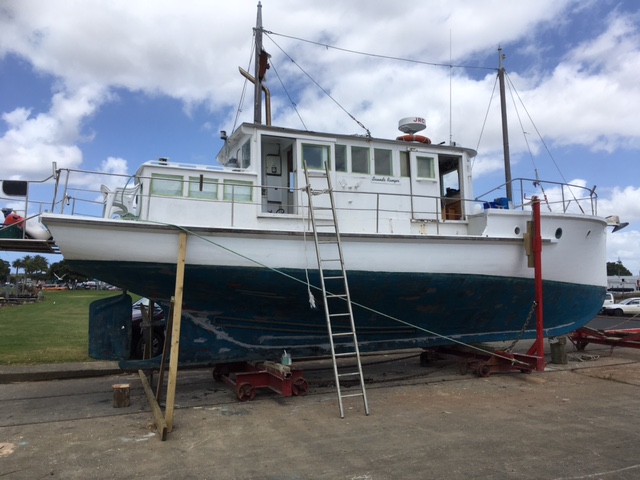
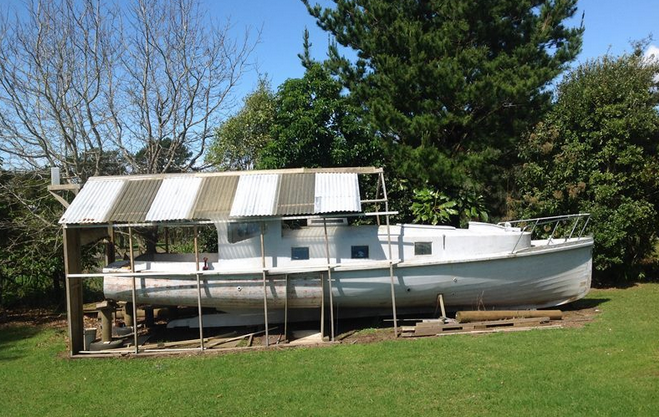
The above 33′ launch is located in Kerikeri & the trademe listing states that the owner auto bid on two boats & won both auctions & now this ones surplus to needs 🙂
There is no reserve & the opening bid is $1 so it could be a good buy for someone looking for a project. The seller states that the previous owner could finish her, on behalf, if a buyer was interested – all very confusing. Thanks to Ian McDonald for pointing out the listing on trademe.
The above two photos were sent to me by Harold Kidd and according to the photo album, the photos were taken at the same place around 1925-7.
The launch with the strange steering position is named Tuhoe, all Harold knows about her is that she was in Taurangs in the early 1920’s owned by a P Best.. She’s not very big, about 20ft, 22ft at a pinch.
The launch in the second photo doesn’t carry a name.
So woodys the question of the day is where are the photos taken and what do you know about the launches?. Harold thinks the location is Waikaremoana but doesn’t know that lake well enough to be sure.