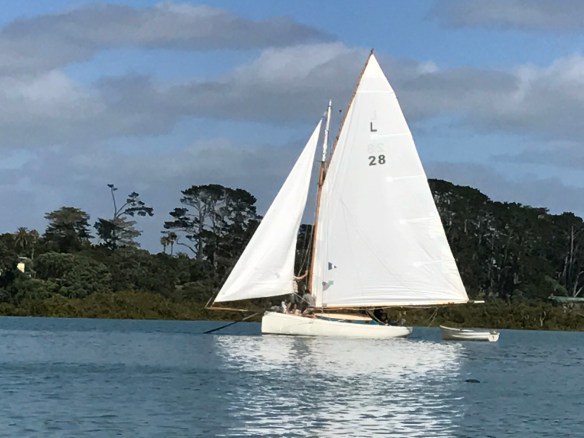
What Do You Want For Xmas?

p1220334

P1220337.jpg

p1220338

p1220339

p1220340

I Have Just Solved The “what do you want for xmas” Problem For You.

Morning woodys – Sorry no classic boat today, I had a story lined up & then last night I started to read a copy of the latest woody boat book to be published – its called ‘Thoughts On Clinker Lapstrake Dinghy Construction’ by Peter Peal. The editor is Baden Pascoe & the book design is by Steve Horsley.

Without a doubt this is the most interesting woody book I have started to read, now I say started to, because after a quick power skim I decided it was too good to read at home – it’s a on the boat read. If you have any interest in wooden boats & the Kiwi boat building scene this is a must have.

To quote Chris McMullen who penned the forward – “this book is more than ‘just another book’ about how to build one of these boats the quick & easy way with the aid of modern glue – it is a book that takes you back in time & puts you in the mode of becoming an artisan who uses the characteristics of wood to his benefit. This lies at the heart of the boat-builders art & is something of which New Zealanders can be proud”.

WIN A Copy: all woodys that correctly answer the question below will go into the draw to win a copy of the book. Entries must be emailed to me (address below). The draw will take place on or near 10pm 28/11/2016. Winners name will be published in Tuesdays ww post. waitematawoodys@gmail.com

Q: What was the class of yacht first built by Peter Peal for his own use?

REMEMBER ENTRY IS VIA EMAIL ONLY – If you post your answer on ww, you tell everyone the answer, that’s if its right 😉

Below is a review of the book by the editor Baden Pascoe.

Book Review:

Thoughts on Clinker Lapstrake Dinghy Construction – By Peter Peal, editor Baden Pascoe, book design Steve Horsley.

There are a few good books on this subject from various authors around the world. As materials and power tools have progressed so has the content of these books explaining how to go about building a clinker / lapstrake boat that one can still call it “a wooden boat”. And to add to this the term a wooden boat is now more associated with art form and a thing you own because of the experiences, stories and history attached to it. Recent books on this subject all use the upside down method of construction and the use of high tech adhesives with super gap filling abilities. A good example is Ian Outhtred’s “Clinker Plywood Boat Building Manual” this book is in a class of its own and the results are stunning.

Here in New Zealand we have Peter Peal’s book hot off the press. From the outset he has set out to offer the reader and potential builder more than just an outcome. In the first section of the book he takes you back in time to the late 1930’s via a story line were you can almost feel the day to day atmosphere of the Percy Vos boat yard. A time when young men were immersed in knowledge and exposed to an experience were they got to know what a nice shear line or lay of a plank should to look like. A place where they learnt to touch a piece of timber and instantly know it’s capably of strength and durability. Working with wood was what they loved to do and they played with the results of their work during their weekends sailing, rowing and steaming their floating works of art that were so kind on the eye. The method used to build these boats without the aid of moulds or temporary frames made the task even more challenging but once mastered it elevated these young men to go on to be the legends of our marine industry that are now the cornerstones of the world class marine industry we now have.

The second part of his book his based on much the same principles as in the first section but ply planking can be employed instead of timber. Laminates can be used instead of natural crocks and to make it easier and moulds or temporary frames are recommended to control exact shape. May I remind you as I have been reminded by the few men left standing today who were taught this method, men who regularly built these boats without moulds could build more boats to near exact shape, something not recommended to the one off enthusiast builder. During the process the builder can experience all the aspects and challenges of the artisans of yester year.

In the third section Peter offers three of his designs with full lines off sets and construction drawings. Boat 1 being a traditional launch or yacht tender, boat 2 a small rowing or pulling boat and boat 3 a clinker large enough to be a small out board run-a-bout. He also recommends designing your own boat.

Section four is a short glossary of the terms and slang used in the Auckland boat yards during his time in the trade. This is something very special and possibly unique to the Auckland area.

Yes, there are many fine tradesmen in Auckland and around the New Zealand coastline who have built what I would be proud enough to say, some of the best clinker boats in the world, but very few of them could explain how this is done via the detailed sketches and drawings from Peters very own pencil. Peter never held knowledge close to his chest, his first love was the parting of knowledge and this fact is reinforced in the forward written by one of his early students, Chris McMullen. This book is a life time treasure and a reminder of Peter’s values and high standards.

A huge thanks to a wonderful man who I have worked with to produce ‘Thoughts on Clinker Lapstrake Dinghy Construction”.

Sadly Peter passed way this year aged 95 – this book is a perfect testament to the man & his trade. – Enjoy


Note: This book is a very limited edition. It is at this time not available in bookshops.

Retail $60 + $7 post and packaging

For orders. Email Chris Peal: chrispeal8@gmail.com

Bank Account no: 01-0210-0030056-47   please include your name as reference.

NOTE: bank a/c number is now correct.

Windhaven II

screen-shot-2016-11-22-at-1-02-42-am

screen-shot-2016-11-22-at-1-03-17-am

screen-shot-2016-11-22-at-1-03-36-am

screen-shot-2016-11-27-at-5-39-18-am

WINDHAVEN II
Yachting Developments have just completed a major refit & restoration on the Colin Wild ketch Windhaven.
Her relaunch was a little more dignified than when she was first launched at her builders, Colin Wild, Stanley Point, Devonport yard. Ngatiringa Bay lacks H2O, even at high water 🙂

Wonderful to see one of your iconic classics returned to her former glory. In fact, the team at YD have delivered her in better than ‘as-new’ condition. As further proof of the work YD do on classics see the photos below of Ranger, also returning to the water after some TLC in the YD shed. Thanks to Paige Cook/facebook for the images. Launch day photo ex John Salthouse collection via Mike Drummond.

screen-shot-2016-11-22-at-1-07-32-am

Kowai

kowai

KOWAI
Kowai was spotted on the hard at Half Moon Bay las week by Alan McDonald. She lives up the Tamaki River at Panmure, on piles.

Thats all we know about her – so can any woody supply more details? One of the river rats must know the boat.

Input from Peter Morton (ex Ken Ricketts)

Help needed – I have been contacted by Kerry Costello with a question. I’ll let Kerry tell it.

“Recently I found a small wooden sailing dinghy (below) at an op shop – unintentionally – and now I’m trying to piece her together and get her in the water. I really want to find out what the make and model is. My partner and I are taking the paint off and want to fix her up nice – figure out the correct paint, put fiber glass on the seams and a of couple dents, and find a mast for her!
It seems that knowing the make and model would be helpful in finding the right mast. I’ve looked on trade me and someone told me that the lumber yard might mill one for me? But it seems that finding a used one would be more appropriate than anything else; using something made by a boat builder rather than milled by someone who doesn’t know boats. So as I said before any advice that you can give me would be so so appreciated.”

So woodys, can we ID the yacht design & any chance someone as an old mast in the garage rafters ?

image1

sail

Jade – Sailing Sunday

screen-shot-2016-11-19-at-8-59-50-pm

screen-shot-2016-11-19-at-9-00-37-pm

JADE – A Herreshoff style weekend/daysailer

Jade fits into the classic category that we call ‘spirit of tradition’ – a gaff-rigger that not only sails well but also has none of the maintenance headaches that other wooden boats have.
Specifications: LOA: 7m, Beam: 2m, Draft: Centerboard up: 650mm, CB down: 1.5m Sail area: 20sqm, Ballast: 300kg, Displacement: 1300kg.
She is 4sale on trademe. With her custom trailer & cover + being a center-boarder she would make a great lake boat. You could even troll for a trout with the 8hp outboard 😉

Art That Floats

screen-shot-2016-10-31-at-7-38-29-pm

screen-shot-2016-10-31-at-7-40-15-pm

Art That Floats

You could buy the 10m yacht above for less than the price of a decent piece on NZ art & the bonus is that come the weekend & you pop it in the harbour & go can get a serious blast of high performance sailing.
She was built in the Ukraine and rigged in NZ for a Russian billionaire, no expense spared, its rumored that the hull & deck cost over $220k to build).
She has only been sailed at a one week regatta & has all new sails (1 main, 3 jibs, 2 spinnakers.) & equipment.
Construction is mahogany on oak frames with teak decks & epoxy coatings & an aluminum tapered rig.

This Dragon is probably the finest trailer-able classic yacht in the country, pristine in every way. Thanks to Colin Pawson for the trademe tip off.

Now woodys who’s got a $66k & maybe a glassed walled garage 🙂

Below is fine example of what we call ‘spirit of tradition’, the Robert C Seamans is a regular visitor to NZ & hails from the US. She’s used for sail training and research and will be in local and Northland waters until December. She’s currently berthed at Princes Wharf. (photos ex Rod Marler)

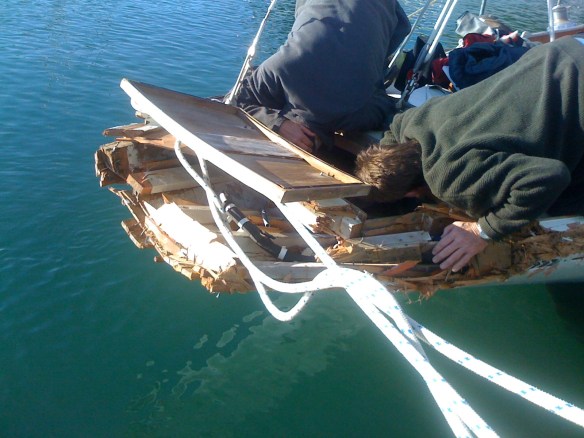
Want to see what electrolysis does to a wooden boat?

img_0552img_0551

 What Is Electrolysis?
I have published Chris McMullen’s comments below for 3 reasons:
1. Out of the blue, today I was sent the above 2 photos by a woody owner who has just discovered they have a time bomb ticking away. Bomb is a good analogy to use as the green wires in the bottom photo are the detonator 😦
2. The subject of electrolysis & wooden boats is topical at the moment
3. I’m passionate about saving our old wooden ladies.

You can read more on the subject here https://waitematawoodys.com/2016/04/28/electro-chemical-damage-in-wooden-boats/
To quote the dictionary – Electrolysis of water is the decomposition of water (H2O) into oxygen (O2) and hydrogen gas (H2) due to an electric current being passed through the water. Electrolysis of salt water or Brine – electrolysis turns NaCl + H2O in electrolysis will produce separated hydrogen gas, chlorine gas and sodium hydroxide*. *Sodium Hydroxide is also called Caustic Soda. It is used for pulping wood in the paper industry and on a boat it forms around any anode protected metal (Cathode) and softens the wood.
Lets check again in the dictionary – “The cause of Electrolysis?”
Electrolysis is due to an electric current being passed through the water or Brine. Surely, the way to prevent electrolysis on a wood boat is by eliminating any electric current passing through the wet wood.
There are two sources of electrical current on most boats.
1. The DC battery used for starting the engine and services. Stray currents are common,(can be very damaging) and hard to find on wooden boats. Any connected dissimilar underwater metals including anodes will create a galvanic current 24 hours a day. There should be no connected dissimilar metals underwater and keep the ships DC system isolated from any metal connected to the sea.
2. Bonding makes a circuit and encourages stray and galvanic currents; the result will be electrolysis and degradation of the wood around metal hardware.
Protecting marine metals (bronze or copper) with an anode is pointless and sets up a current and causes electrolysis that again produces sodium hydroxide that pulps the timber in a wooden hull. If you have brass or manganese bronze underwater, an anode may help protect the metal but set up a galvanic current with resultant damage to the wood surrounding the cathode or protected metal.      

See on Google – graphic descriptions of exactly what happens on our boats if we create an anode and a cathode. Chlorine gas is produced at the anode and hydrogen gas at the cathode.

http://www.google.co.nz/search?q=electrolysis+of+brine&rlz=1C1QJDB_enNZ596NZ625&espv=2&biw=1680&bih=944&tbm=isch&tbo=u&source=univ&sa=X&sqi=2&ved=0ahUKEwjh75ODuObPAhUUSGMKHcDKBkoQsAQIMA

Whether we like it or not, the brine around any cathode or protected metal converts to sodium hydroxide (caustic soda) and this is fatal to a wooden boat.

The solution is very simple – you should not use anodes on a wooden boat.
Anodes are necessary / desirable on steel structures where there is no wood. To use them on a wooden boat is a relatively new idea or myth designed as a solution looking for a problem. On wooden boats it has been proved worldwide to be a disaster but some in the NZ marine industry refuse to admit they have been wrong and continue to promote this profitable business.

The Logan’s, Baileys and Colin Wild never used anodes or bonding and neither should anyone who cares for their wooden boat.

 Read http://mgduff.co.uk/support/knowledge-base/questions/what-is-electrochemical-decay-in-wooden-vessels  

If you would like some more technical evidence read. http://www.mcclavemarine.com/text%20pdfs/Corrosion.and.Corrosion.Protection.Wooden.Boats.pdf

P.S. Chris would like to advise that he has had no input or involvement in any organised discussions on the topic of electrolysis & wooden boats.

Sailing Sunday Eye Candy – Kahurangi & Manitou

Photo © Nico Martinez XXII REGATA ILLES BALEARS CLÀSSICS

Photo © Nico Martinez XXII REGATA ILLES BALEARS CLÀSSICS

Sailing Sunday Eye Candy – Kahurangi & Manitou

Baden Pascoe forwarded me the above photos of Kahurangi ex Pepe d Miguel. The ‘old’ girl is looking very sharp & looking very much at home on the Med. classic sailing circuit. She was built by Percy Vos in 1952 & would have to be one of the prettiest yacht to slide down the Vos slip.

MANITOU – JF Kennedy


Check out the link to the video clip below to view JFK’s old yacht, Manitou. Same bloodlines as Dorade & Stormy Weather i.e. a Sparkman & Stephens (Design #90), she is one of Olin Stephens finest. Launched in 1937, LO= 62′, LW= 44′, Beam+ 13’9″, draft= 8’6″. She carvel & made from mahogany on oak frames. Rumour has it that Aristotle Onassis tried to buy her once. The open fireplace is very me 🙂
If you are interested – 4sale in France for USD$1.3 million – makes the sale price of our Rawhiti the buy of the century.

Susan Jane – Sailing Sunday

fullsizerender-1

fullsizerender

SUSAN JANE – Sailing Sunday

With Omaha boat builder Colin Brown having just re-launched the Colin Wild built launch – Little Tasman, we have been wondering what was next into the shed. The answer is the yacht Susan Jane, built by Chris Robertson c1950. Colin is not sure whether or not he designed her so is looking for any more info the woodys can supply.

Susan Jane is having  a major rebuild as a result of rot issues. Colin has taken the project over from a friend of his, who due to poor health is unable to complete the project. The above photos are by Colin, emailed to me via Ken Ricketts.

01-07-2017 REFIT UPDATE
The Brown family – Colin, son Dylan & son-in-law Josh have been hard at work on the refit.
All exterior hull work done by Dylan & the interior ex the hands of Josh.
Photos below, ex Colin, emailed to me by Ken Ricketts.

20-10-2017 Refit Update – photo ex Colin Brown via Ken Ricketts.

06-11-2017 Refit Update – photos ex Colin Brown via Ken Ricketts

She is going to be powered by a 38 Hp 3 cyl Nani Diesel

10-04-2018 Update – More photo ex Colin Brown via Ken R

And more

SUSAN JANE April18a - ...

SUSAN JANE April18b

24-04-2018 Update – Susan Jane & her restorer Colin Brown had a special yard visit (23/04) from the original builder Chris Robertson, aged 91 years. Chris was accompanied by his son Martin & grandson Aaron – all 3 boatbuilders.

Photo below shows Susan Jane getting the royal inspection from the Robertson family. I understand Colin was very honoured. Photo ex Colin , via Ken Ricketts.

SUSAN JANE 23.4.18

A Lap of Waiheke


rd-oct2016c

jonquil-little-o-oct2016a

w1-mow-labour-weekend2016

rd-oct2016a

A Lap of Waiheke

Over Labour weekend we did a lap of Waiheke Island in Raindance – bumped into a few classic’s, some will appear on ww in the next few days.
As we approached Oneroa mid afternoon on Saturday the weather was doing exactly as predicated  & the southerly was starting to pick up, coming around the point & it was blowing dogs off chains. Headed over to Little Oneroa & it was almost a mill pond, dropped the pick between James Mobberley (Moon Engines)  & Dan Ranell’s stunning N. Herreshoff designed yacht – Jonquil, pictured above with George Ranell ‘on watch’. Potentially it could have been a disaster i.e. 3 kids under 5 between the 2 boats – but good parenting saved the day. A few late afternoon coldies on Jame’s launch ‘Cartel’ was the perfect lead in to dinner – a wood fired pizza on the beach from the resident pizza caravan. Saturday was a cracker of a day on all fronts. Nice weather, people & boats.

For the first time (that I can remember) we had a peaceful night in Little Oneroa & woke to a stunning day (Sunday), one out of the bag. A quick breakfast ashore at ‘Wai’ & a few provisions from the ‘new’  store on the roundabout, called ‘The Island Grocer’ – its where the old general store (fruit & veg focus was) used to be. Less hairy armpits on display these days & a great hole in the wall coffee operation. Perfect spot to people watch.

Headed down the north side to the bottom end, very pleasant trip & a lot of people both fishing & catching fish. Mooched around a few bays & anchored in Man ‘o’ War Bay. The vineyard operation was a zoo with Island day trippers, so held off going ashore until late afternoon for a drink. Quiet night in the bay, except for 2 sets of very young children doing laps of the bay in dinghies with 2hp outboards – I do not lie when I say it went from 6pm to 10pm, if I had had a gun – I would have popped the tubes.

Slow start in the morning, had to wait for the tide, appears I had discovered a wee mud bank, never went a ground but I draw 2’3″ & the depth sounder was showing 0.700m (27.5″) 😦 So it was a leisurely breakfast 🙂 Th day was overcast & forecast to rain later on, so we headed home at lunch time. As we were leaving MoW, W1 was coming in – first time I had seen her ‘live’ on the water – way more narrow than I expected given her length, but still an impressive sight & a credit to the owner, who under took a lengthy restoration in his driveway in Herne Bay.
Saw Deodar (#1) in MoW looking very smart – photos tomorrow on ww.

A fantastic weekend, only takes a few days of good weather & one quickly forgets all the cursing & swearing over winter about bloody old wooden boats.

Below are a couple of photos from Rod Marler of the classic’s –  Arohanui, Trinidad, Lady Crossley & Nereides (looking none the worse for her oops at the Whangateau boat yard) at Kawau over the weekend. I hear the Kawau Boating Club was going off on Saturday night for the All Blacks v Aust rugby test.

Photo below of Wairangi at West Bay, Rakino Island on Sunday, taken by her owner & emailed in by Ken Ricketts.

wairangi-rakino-23-10-16

Mistletoe 228 – Sailing Sunday

mistletoe-228-gt-barrier-t-collins-collection-ex-museum-i-d-ph-2013-7-tc-b923-04

mistletoe-228-gt-barrier-t-collins-collection-ex-museum-i-d-ph-2013-7-tc-b923-05

Mistletoe 228 – Sailing Sunday

When I first saw the above two photos from the Tudor Collins Auckland Museum collection I had a chuckle, there has to be a story behind these photos. Venue most likely is Great Barrier Island. Photos emailed to me by Ken Ricketts.

Do we know any more about her?
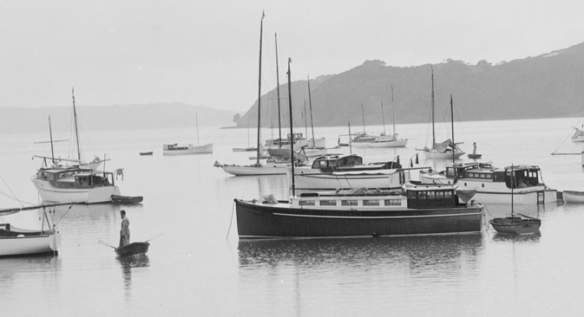
Photos below ex Dean Wright of Mistletoe at Whangaroa Marina 2007. Nice to see she survived 🙂

25-10-2016 Update ex Alice Morrison

I recall seeing a very similar vessel called ‘Mistletoe’ in Houhora on 11 February 2016 (picture below). I wonder if she is Mistletoe I or Mistletoe II?

img_5091-mistletoe