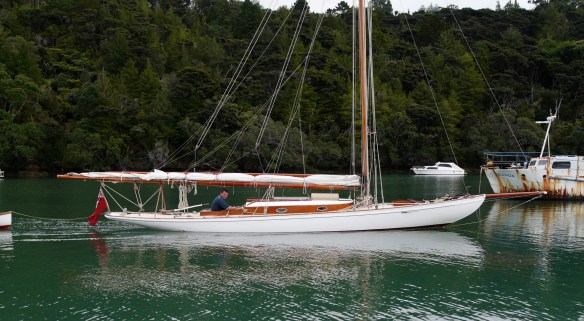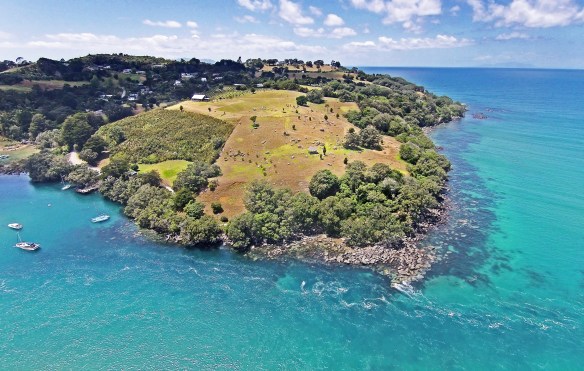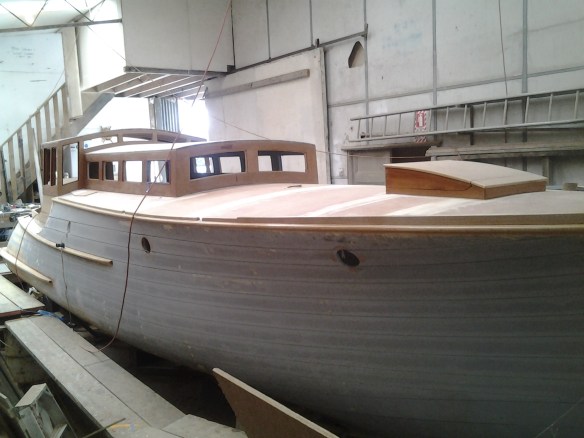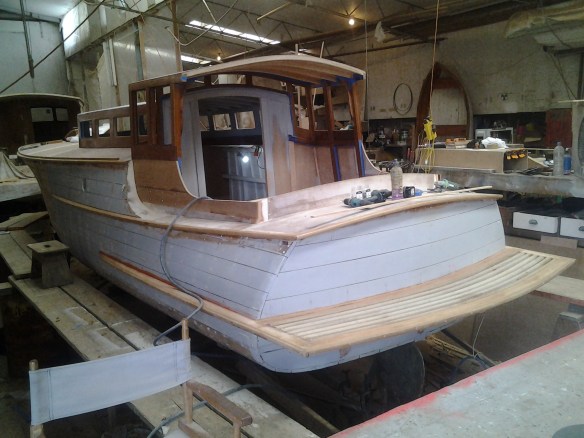
Shalom

SHALOM B.O.I. CHRISTMAS 2014

SHALOM
photos ex Barbara Cooke & Ken Ricketts. KR-details edited by Alan H

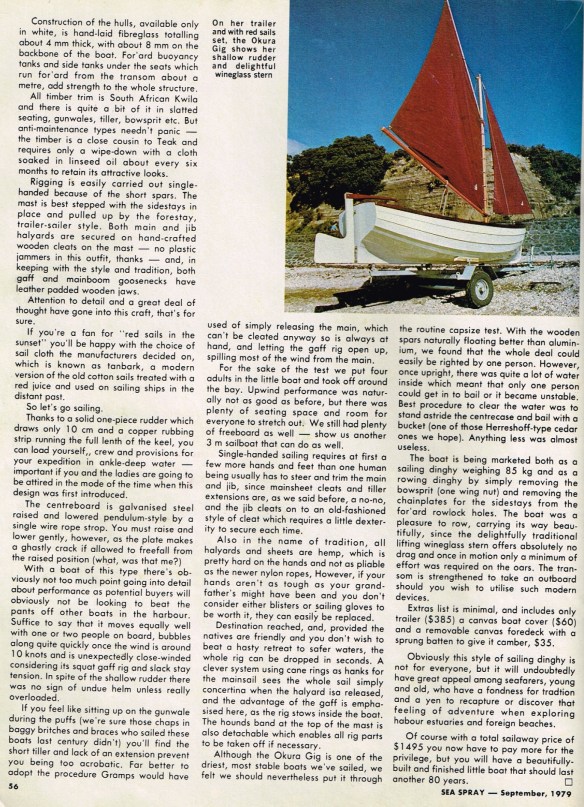
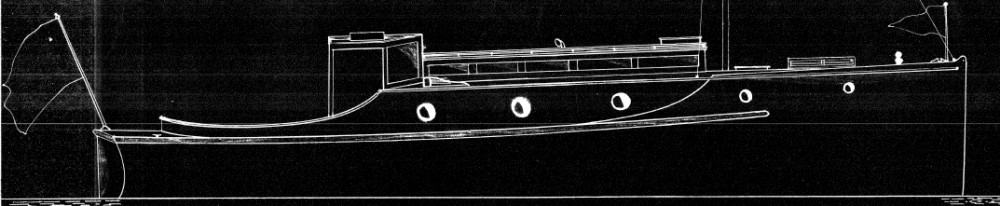
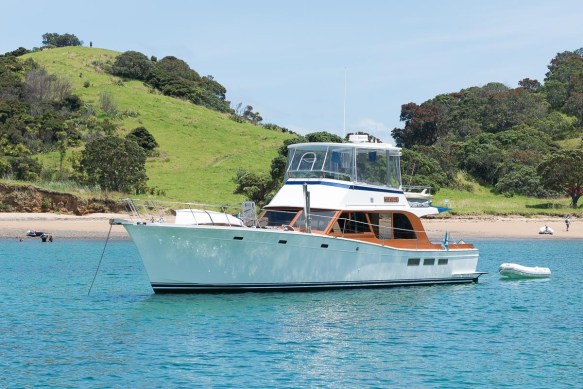
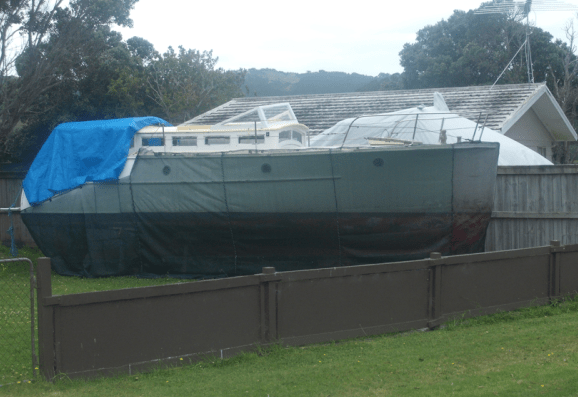
During the recent CYA meet-up at the Salthouse Boat Yard at Greenhite, we got to see Greg Salthouse’s own launch ‘Shalom’ up close. She was built in 1973 in Browns Bay by local boat builder T K Atkinson as his own personal boat. When launched she was approx.  42′ but while in the ownership of her 2nd owner, Howard Collier, she had an extra 6′ added on by a now non-existent company, in Whangarei.
She is powered by 2 x 350 hp Yanmar diesels & has a top speed  of around 25 knots & cruises comfortably at 17/18 knots. A wee bit faster than his father-in-laws magnificent classic – Trinidad.

Greg & Delayne Salthouse have owned Shalom for 3 years & commented that although T K Atkinson built her for himself, she was owned by Collier most of her life e.g. 25>30 years. Collier kept her at Whangarei during this period. Greg believes she was built to a design ex the American designer, Ray Hunt.

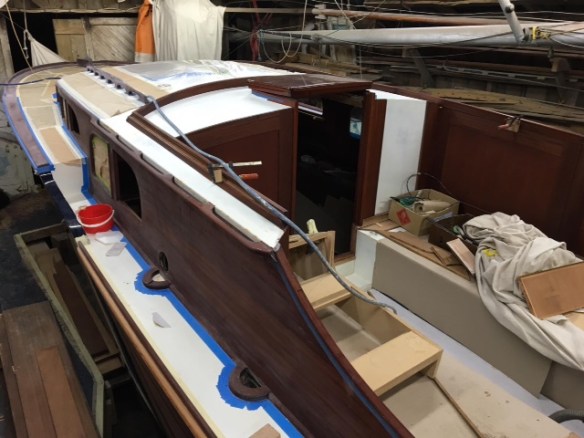
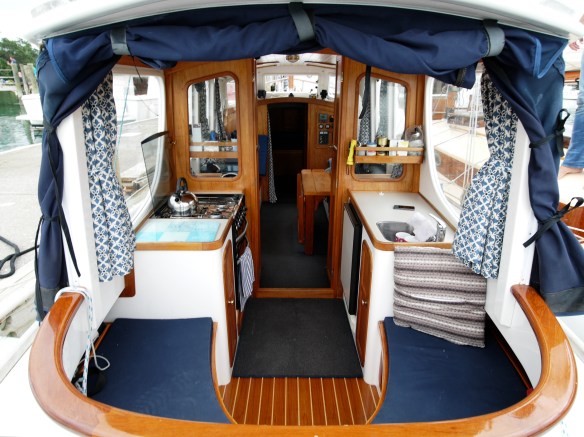
A while ago I (Alan H) was aboard & Greg has sprinkled some of the Salthouse yard magic on her, mainly modernizing the interior to better suit his young family. For 48′ she  is a very big boat. When I was aboard I was in company of Colin Pawson, one of the marine trades most fastidious technicians & he was impressed enough by the T K Atkinson’s workmanship that he was heard to mutter ‘I’d own her’, enough said 😉
While she is sporting a penthouse, it is very ‘light’ in appearance & almost gets a tick 😉

Laughing Lady Updates

IMG_6611

IMG_6868

Laughing Lady June 2016 Update
photos ex James Dreyer

Chatting with James on-line a while ago I nudged him for an update on LL. As ww followers will know the Lady has been tucked up in the shed at Whangateau Boat yard for over two years getting a serious over-haul from Pam & when in country James + hangers on. James & LL’s co-owners re to be commended on they desire to return LL to her former elegance – below is the note James sent me (slightly edited)

“I was hoping to get some varnish on the topsides before departing offshore and subsequently photographing her looking sharp and shiny but it didn’t happen.  We did, as you know get her in her new coat of Flag Blue.  Unfortunately the port side will need a re-shoot due to some sags – the weather was not in our favor the day we had to spray. We will definitely be in better shape to give a good update in August as we should be well on the way with putting her together.

Pam and I had a bit of a discussion recently and think it is probably worth me commenting on the dark two part LP finish that I have gone with, before the armchair generals and experienced boat builders / owners wade in.  There has been many well qualified comments about the potential for paint failure over the last two years and they have certainly been weighed up and taken onboard.
When LL had her hull rebuild in San Diego, she was taken back to bare wood, re-framed and re-fastened, then impregnated with two coats of epoxy and many seams were splined.  She is tight seamed double planking and the new bottom is double planked and epoxy glued.  The paint system that was applied to her extremely fair hull 10 years ago in San Diego is a two pack epoxy / LP system – Awlgrip above the waterline and International below.  After 10 years sitting in a semi finished state, in the rather extreme conditions of an inland San Diego yard, she had cracked and opened a number of seams, but to be honest, no more than the single pack finishes on the boats around her.  

My concerns were that she would move significantly once parked in the Whangateau shed as she adapted to the cool, moist environment.  Pam repaired various areas that were in need, primarily around the extreme flare and planking twist in the bow, then built a good base of primer.  We let her sit for a year in primer, and surprisingly there was no movement or cracking to speak of.  To strip her back to bare wood was to remove the hundreds of hours of fairing and painting that had been never seen the water even though it was done years before.

On this basis and after much deliberation and discussion, I chose to continue with the two pack system.  The aim from the start was to get her in the water and in use as soon as practicable (as far as restorations go).  

For the first 50 years of her life, she was painted jet black and spent hot summers in the water around Long Island and her winters in a snow covered shed.   After the work in San Diego she was painted Awlgrip royal blue.

We chose Awlcraft Flag blue as the topside color.  Awlcraft has some more give (urethane rather than polyurethane) and can be locally repaired and polished.  My goal was to have her looking as close to original as possible when she launched, and the dark hull is truly striking as I’m sure everyone agrees.

I am well aware that the system will probably show some failures around the seams as she moves.  Its also likely that we will be painting her white in a few years, but to me it makes sense to let her out the door in the current (gorgeous) state and see how she fares.  If need be, we will re-wood her and go single pot, but if not, then a white two part system will continue to be used”

REMEMBER – To enlarge a photo – just click on it 😉

16-07-2016 I received an email from James today with the 2 photos below attached – when LL was launched she was powered by Packard straight 8’s, nowadays is powered by twin Volvo turbo diesels. In his travels overseas James came across the engines below – my response to the email was short – “WALK AWAY & DO NOT LOOK BACK” 🙂

image2

Screen Shot 2016-07-16 at 7.52.03 AM

August 2016 Update (ex James D fb)

It appears with the hull painted its now down to the shiny stuff 🙂

IMG_0455

IMG_0456

01-09-2016 Update ex James fb

Applying 24k gold leaf to the carved details on Laughing Ladys hull. The first arrow head needs a little tidying up, but with some more practice the unique scroll work detail carved into her bow in 1949 to identify her builder is going to look sweeeet!

Screen Shot 2016-09-01 at 5.54.52 AM

The Mighty P Class – Sailing Sunday

THE MIGHTY P CLASS – Sailing Sunday
ex Yachting NZ

A pictorial history of New Zealand’s mighty P Class yacht

Whilst trolling around the Wellington Classic Yacht Trust facebook page I uncovered the above gem that utilizes the two formats of a slide show and video clips to showcase the history New Zealand’s mighty P-Class featuring images and footage from the 1920s to 2013.
The clip has been assembled by P Class expert and historian Gun Caundle, from photos collected while researching for his book ‘Our Secret Weapon’, a history and stories about the P Class. While 15 minutes long its great viewing & I’m sure most woodys will bothe relate to it & probably recognize some of the people featured. Enjoy 🙂

IDA – Sailing Sunday & more

Ida 1

Ida 2

Ida

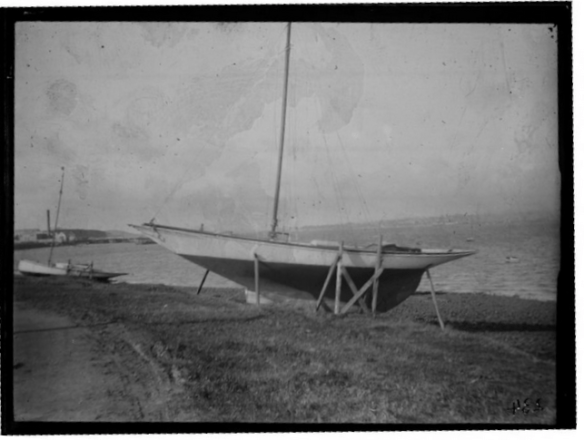
Careened early 1900’s

IDA – Sailing Sunday
photos ex Gregor McQuaters

In February Gregor sent me the above photos, with the promise that family members had more & he would track them down, so todays a little bit of name & shame – where are the photos Gregor? 🙂
In the back of my mind Harold Kidd posted a comment on ww a while ago about Ida but I have had no joy tracking it dowm. I can tell you she was built by Bailey’s in 1895, measures 65′ LOA & 45′ LWL. Home is Sydney, Australia & has been for a very long time. HDK – can you help out (again) 😉

23-07-2016 Input from Robin Elliott

Here’s a bunch of owners for Ida. Jim Platt was part of a syndicate that registered her in 1962.

W. Hicks 1919/21+? L.(& O.) Jenkinson 1922/32 A.A. Angell 1932/39+? A. Angell 1946?/49+? E.S. Green & Others 1950+? J. M. Pinkerton & L.H. Mirams 1951?/53+? J.M. Pinkerton 1952/60+? R. Price, J. Platt, O.C. de Bruin 1962+? J. Tenbroeke 1969+? G. Broeke, T. Guthrie & C. Taylor (RNZAF Hamilton) 1970+? E. Tansell (Pt Chevalier) 1976+? (Still Registered Owner NZYF 1980) R.B. Cornell (Pakuranga) 1982+? (Still shows as owner in 1984 NZYF).

In 1968 she was reported as being owned by several members of RNZAF Hobsonville and in 1969 was reported as being on moorings near the Hobsonville slipway.

Cornell of Pakuranga appears to be her last registered NZ owner. By 1992 her sail number (11) has been re-issued to Francis

23-07-2016 Input from Harold Kidd

IDA was built by C. & W. Bailey for the Jagger brothers and Frater and launched on 21 December 1895. She was a contemporary and competitor to the other 5 rater of that season, the Logan Bros’ MOANA which had the measure of her from the start. However, when C.P. Murdoch of Devonport bought her in 1900 her performance improved radically. The hauled-out pic above is during his ownership and she’s seem on the beach in front of Garden Terrace Devonport where Murdoch lived. His house, with a turret, still stands. Murdoch was Commodore of the Squadron at this time.
Harold Nathan bought her in 1907, N A Nathan in 1908, J. & W. Smaill in 1911, W. Hicks 1919 and then L & O Jenkinson in 1920. Robin has provided the rest.
She was badly knocked around in the gale of March 1918 on the Devonport foreshore where she had been laid up by the Smaills with her keel removed for several years since the start of the War.
In the 1940s she was seen as very old-fashioned and survived both wars because of the incredible rise in yachting as a sport post-war and the shortage of good yachts to satisfy the demand.

Details of Classic Boat Construction – 25th Anniversary Edition
Larry Pardey Book
Larry Pardey is/has just relaunched a 25th edition of his world famous book. The link below takes you to Larry & Lin’s very cool website where you can see a great collection of photos of the construction of his ex yacht ‘Taleisin’. I understand that more photos will be added next week, so make sure you check back in 😉 http://www.landlpardey.com/details

Looking for a bargain buy woody project?

Rakino salvaged 017

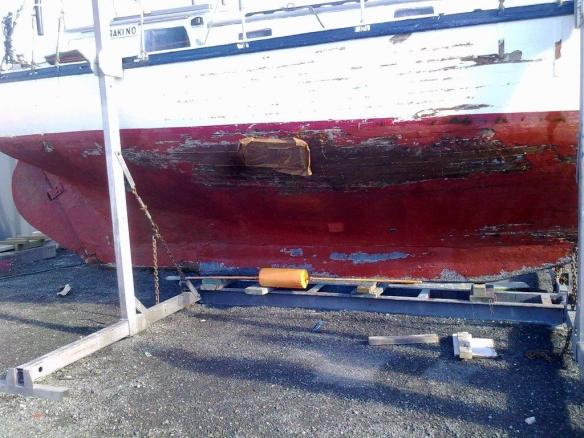
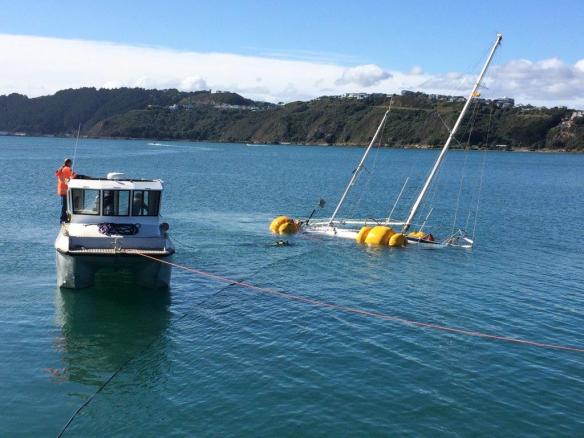
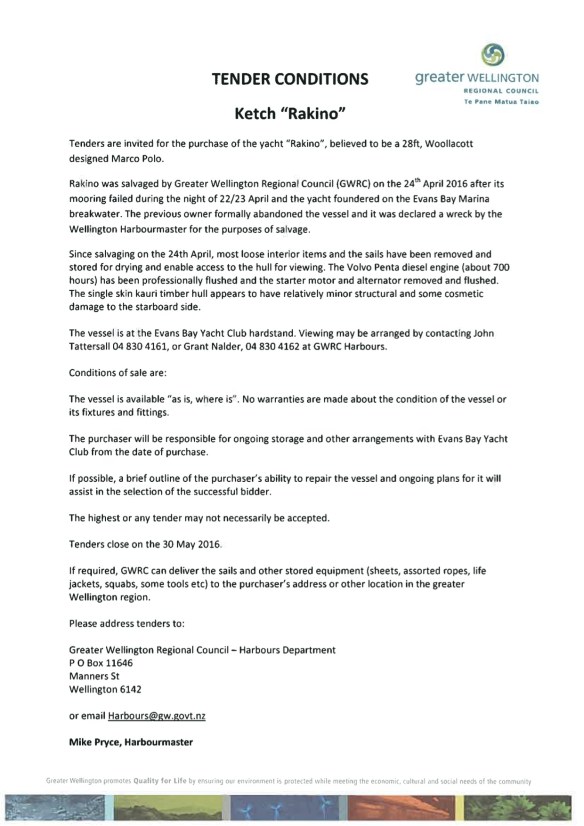
The Woollacott (Marco Polo) ketch ‘Rakino’, was recently salvaged by the Wellington Harbour Ranger after its mooring
failed and it sank against the Evans Bay Marina breakwater on the night of
22/23 April 2016.
Rakino is a sister ship to Ebb Tide & Maia II both owned by Jeff Cook. See the Woollacott Association website re the Marco Polo design & the exploits of Tony Armit. http://www.woollacott.org.nz/

Since salvaging on the 24th April, the Volvo Penta engine (about 700 hours)
has been professionally flushed and the starter motor and alternator removed
and flushed. The single skin timber hull appears to have relatively minor
damage consisting of one hole and other apparently cosmetic damage.

Most loose interior items and the sails have been removed (and stored) to
enable better access for viewing and drying.

The Greater Wellington Regional Council wishes to dispose of the yacht by way of a closed tender process and
invites firm expressions of interest.
The tender conditions are below. Note the close of date id May 30th so if you are interested , place a tender, historically some real bargains can be had in these circumstances.

IMG_1708

Tender Conditions

From Timber To Tide – Sailing Sunday

From Timber to Tide – Sailing Sunday

I discovered the video ‘From Timber to Tide’ while mooching around wooden boating websites, it features a traditional Cornish boat builder Ben Harris. In a beautifully shot video, Ben talks about his work and what inspires him. Featured is ‘Alva’, a Paul Gartside – designed 30′ gaff-rigged cutter that Ben built. Her lines inspired by the quay punts of Falmouth. Construction is larch on laminated pitch pine and steamed oak frames. Cedar decks, cabin-sides and capping rail in iroko, teak cockpit and trim, pitch pine interior and bronze and copper fastened throughout.

Enjoy, you’ll feel good after watching it 🙂

Looking For A Great Read

IMG_0380

I mostly plug nautical books here on ww but friend Richard Loseby has just published his 3rd book titled ‘A Boy Of China – In Search of Mao’s Lost Son’ & as expected its a cracker read. Pick up a copy at Paper Plus, Whitcoulls, Unity Books – pretty much everywhere + Ebook version on Amazon, iTunes etc etc

Richard used to own a beautiful Townson but has temporally drifted over to the low(er) maintenance side with a rather nice f/g ketch. I’m sure he will return to wood one day 🙂

Richard’s two previous books ‘Blue is the Colour of Heaven’ & ‘Looking for the Afghan’ are on my all time great reads list. Both available on iBooks, Kindle, Kobo etc so fork out a few dollars, you won’t be disappointed. Start with ‘Blue…….Heaven’ 😉

ps when I went to look at my copies of the above two books, I discovered (again…..) that one of my books ‘out-on-loan’ has not found its way home. These days I keep a digital record of who has books of mine on-loan. A quick visit to trademe & I picked up a copy of ‘Blue is the Colour of Heaven’ for $4 😉

Classic Raft-Up at Salthouse Boatbuilders

IMG_0178

P1230409

Lucille

CYA SALTHOUSE 30.4.16

Rod Marler, Greg Salthouse, Bruce Marler, Bruce Tantrum, Mrs. B Marler, George & Dan Renall


P1230414

Wairiki

Classic Raft Up at Salthouse Boatbuilders
photos from Alan H & 2 from Ken Ricketts

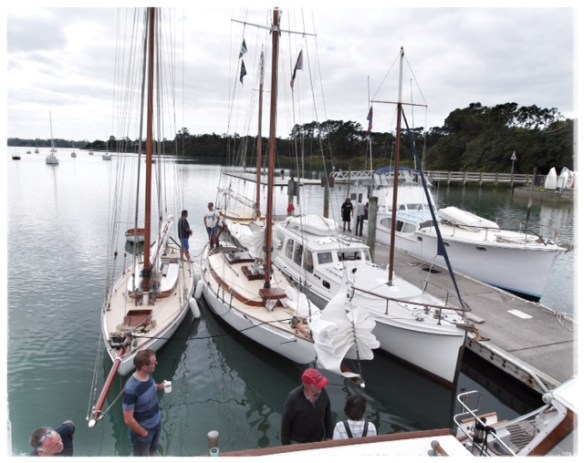
Saturday saw the CYA host a visit to Greg Salthouse’s Greenhite boat yard, members had the choice of arriving by water or road. Given the deep water anchorage at the wharf it was ideal for some of the yachting members to join in. Fiona Driver & Rod Marler buddied up with Barb & David Cooke to provide a BBQ lunch that disappeared very quickly 🙂
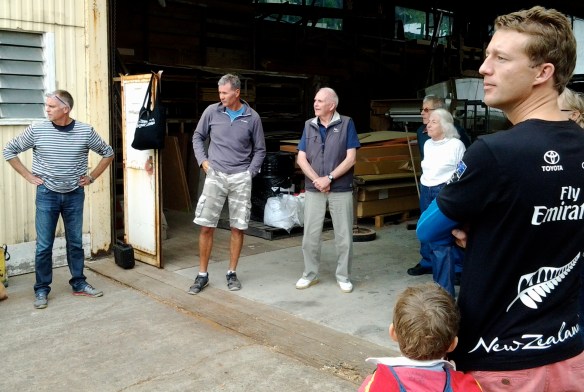
Greg S gave the attendees an intro to the yard & the work that was being undertaken & then thru the yard open to members to explore at their leisure.
Salthouse is one of the few remaining classic wooden boat friendly ‘railway’ haul-out slips in the Auckland area, so folks to quote that old saying – use it or lose it 😉

And on Sunday, while most of you rested I spent the day picking olives at a friends Ti Point property. Bumper crop this year made the day fly by, helped by a longish yum lunch featuring local produce & wines. If we got bored the view was pretty wow.

DCIM100MEDIA

Drone photo looking back at property

Electro-Chemical Damage In Wooden Boats Update

rudder electrochemical damage


ELECTRO-CHEMICAL DAMAGE IN WOODEN BOATS UPDATE
A Special Post By Chris McMullen

Recently I received a note from Chris where he questioned if the story we posted last year on ww about electro-chemical damage to wood  was a little too long & were people reading it. Well I can tell you that the post is the single most visited story on ww, ever, & gets read by people all over the world. Its frequently referred to on the hugely popular WoodenBoat Forum in the USA. The link below takes you to the original story.

Electrochemical Damage To Wood – the marine version of ‘leaky homes’

For the impatient ones out there 🙂 Chris has done a ‘Readers Digest’ version & refers to a vessel that recently featured on ww.
I encourage all of you to read today’s story & if you own a classic wooden boat – read both versions – the problem is the biggest risk to the life of our classic boats.

In Chris’s words:
“I received the above disturbing images of another woody being destroyed by an owner who I believe is unintentionally loving his boat to death.

The use of anodes and bonding on a wooden boat is fatal. The cathode or protected metal makes hydrogen gas and this combined with saltwater makes Sodium Hydroxide (Caustic Soda). This chemical is used to pulp wood in the paper making industry. Not on my boat thank you! I say again, there is no reason to use anodes and bonding on any boat. The only exception, steel hulls require anodes. If copper or bronze are being corroded it is due to a positive DC leak and Zinc anodes will not help. Find the electrical leak is the cure. If there is brass or manganese bronze underwater it will corrode due to the
zinc in the alloy. Anodes will possibly stop the corrosion but at the expense of wood damage. A better plan is to replace the brass with proper marine bronze.

Bronze and copper should last indefinitely in the sea. To prove that statement, I ask you to look at the Roman coins and artifacts salvaged from ships wrecked in the fourteenth century. There was no anodic protection and the metal is well preserved. So what is the difference to the copper and bronze on your boat? There is absolutely no difference so why waste your money buying anodes that will in time destroy
your wooden boat.

Three or four bottles of wine will cost the same as anodes and will make you and your boat happier.”

Note: ww is read all around the world, if there is water & boats, there are people reading ww. So a little about the man for non kiwi’s  – Chris is one of NZ’s most respected boat builders (retired) and at one time was the Lloyds (Honorary) Wood Boat Surveyor in Auckland. Chris’s (the original company) ‘McMullen & Wing’ built and repaired wood, steel and marine aluminium vessels. They built the first welded aluminum vessels in NZ. Chris is the current holder of the Classic Yacht Association of New Zealand ‘Outstanding Achievement Trophy’ for services to classic boating.

14-05-2016 Photo Update
Gavin Gault sent in the below photos of a Nova skeg floor that he believes were probably damaged due to engine – anode bonding failure. Pretty graphic !!

10-07-2016 Reply from Chris McMullen

“Wow. Thank you Gavin Gault for sharing your very graphic images. Very sad, small consolation but yours will not be the only wooden boat affected by this scourge.
Maybe, at last some of the Flat Earth Society will start to believe what I have been saying. The worst detractors are some in the Marine Industry who have been preaching the Anode, Bonding party line for years.  Now there is no where to run for cover,  they continue to conjure up excuses and it seems, refuse to accept a simple scientific fact.
“If you have a positive and negative electrode in salt water, the negative cathode or protected metal makes hydrogen gas and this combined with salt water makes Sodium hydroxide.”
This chemical is also known as caustic soda and removes paint and destroys wood.  There is no doubt about this fact. You do require a power source and bonded dissimilar metals ( zinc and copper) provide sufficient current to do the damage, but slowly.
If there is a negative DC leak (to the sea)on a bonded boat the process is accelerated. If there is a positive leak any metal becomes an anode and will waste away. It is important to isolate the DC power from contact with the sea. Again bonding is just asking for trouble. Please remove Anodes and Bonding from your wooden boat now!
Chris McMullen”

06-09-2106 In case you were not to sure what to look out for – the below photo should be a wake-up call to a few woodys 😉

IMG_1120


Little Tasman

LITTLE TASMAN - STARBOARD SIDE - 7.3.16 - 3

LITTLE TASMAN - STARBOARD SIDE - 7.3.16 - 0

LITTLE TASMAN
shed photos & info ex Ken Ricketts. Pt Wells photo ex Mark Edmonds. details ex Harold Kidd. edited a lot by Alan H

Back in early March Ken Ricketts dropped in to see artisan boat builder Colin Brown at his Omaha yard. Colin & side kick, Josh, have been restoring the rather pretty 26′ Colin Wild launch Little Tasman.  She was named Tasman when built in 1925 for Albert Spencer & changed her name to Little Tasman in 1927 when the bigger Tasman (photo included below) was launched by the same owner/builder. Its said she that LT was a prototype / test boat – Mr Spencer was not short of a few pennies 😉

It is such good news to see whats happening to Little Tasman as she sat on a front lawn at Pt. Wells for a number of years (photo below) & her future was at risk.

Little Tasman at Pt Wells

In Harold Kidd’s words Little Tasman is ‘pure class’ & whats happening in Colin’s shed is also pure class  – the man is one of the best classic friendly tradies out there.

You will see in the above photos that she now has a brand new 4 cyl Nanni 38 hp diesel in place, which should give her a top speed of around 10 knots, with a cruising speed, with her 2 to 1 reduction gear, of around 7 knots. Will be interesting to see her performance as the Nanni is a lot lighter than the old 6 cyl Ford diesel it is replacing.

Her restoration has seen most of her ribs replaced, a full recaulk (no splining), work on the forepeak & bow, a new dodger, very faithfully copied from the original & a full interior refit & partial redesign of the interior layout, for greater space use, & practicality.
Steering will be from the front of the tram top, as it was before, where there will be a large hatch fitted, to the newly replaced, as original, T & G cabin top. Check out the stern photo, classic Colin Wild on show there 🙂

Launch date is fast approaching so we will update on the event.

Read more on her past here      https://waitematawoodys.com/2015/04/20/little-tasman/

Below is a photo of Tasman that I took a few years ago in Sullivans Bay. She is stunner & on a lot of woodys bucket list.

Tasman @ Sullivans Bay

30-06-2016 – Another great photo update from Ken R of Little Tasman’s restoration at Colin Brown’s yard. Remember click on photos to enlarge 😉

Mystery Launch Quiz

Mystery Launch

Mystery Launch Quiz
Win a copy of Robert Brooke’s book – ‘Beautiful Boats’

Ok woodys the first woody that can supply the boat name, designer, builder & year of launch will win a copy of Robert’s just released book ‘ Beautiful Boats’. The first reply in the ww comments section with all 4 answers correct – wins.

Robert has been collecting classic yacht designs for over 50 years, amongst his collection is work from our most talented & recognized designers – Arch Logan, Chas Bailey, Charlie & Alex Collings, Colin Wild, Bert Woolacott, Bob Stewart, Des Townson, Alan Wright & Robert’s father – John Brooke.
From his collection Robert has chosen 50 & redrawn each design, tracing off the original drawings to present them in a similar format. To add to the wow factor, Robert used the drawing equipment & ships curves that were once used by either Arch Logan, Charlie & Alex Collings or his father.

The 105 page, A4 size book allocates 2 pages to each vessel with specs & photo/s on the left & the drawings – hull lines, profile, half breadths, sections, diagonals & sail plan on the right hand page (refer Rainbow drawing example below). Its a must have in all serious woodys library.

Robert has very generously donated 4 copies of the book to waitematawoodys so over the next few weeks I will be giving them away as prizes. In addition I also have a framed 380 x 300 rendered copy of one of the Beautiful Boats. I have not decided yet how this will be ‘won’, details soon.

There are thousands of ww followers out there so do not get your hopes up on winning a copy 🙂 I would suggest you visit Boat Books at 22 Westhaven Drive, Westhaven, Auckland & grab a copy for yourself, cost is $60. For out of towners or those who refer the web – copies are available on line at  https://www.boatbooks.co.nz/
Its a very limited print run & Boat Books are the sole outlet. Boat Books also have framed copies of the prints for sale – David Glen was one of the first to race in & buy a print of his Rainbow.

Cover, Tawera

Rainbow

Okura Gigs – Sailing Sunday

Okura Gig 49 (9)

Historic photo 01

Historic photo 02

OKURA GIGS
photos & details ex Darren Arthur

We did a post on ww a little while ago about ‘Seabird’ dinghies & this generated chat & subsequent comments about the ‘Okura Gig’. This sparked Darren to contact his wife’s uncle – Dennis Hart, who with his late brother Ray ran Hart Brothers Marine and were behind the Okura Gigs. Darren encouraged Dennis to document their history.
Darren asked me that given that the boats we not wood, was it a potential ww story – after a quick peek at the photos – I replied that there was more than enough wood & bronze to get the ww tick 😉

I have published Dennis’s story below word for word, its a great tale & combined with the above collection of older & recent photos is a cracker read. Enjoy 🙂

THE OKURA GIG:  A Brief History By Dennis Hart

Background

During the late 1800’s the area at Silverdale now known as Millwater included the Grut (pronounced Grew) farm which had access to the Orewa Estuary. Mr Grut had a 10 foot kauri clinker rowing boat, understood to have been built by Bailey & Lowe at Sulphur Point, Northcote. The boat was mostly used for net fishing. Charles St.Croix Grut and Alec Grut later inherited the farm and continued farming until the 1960’s ?

Dennis believes Croix and his wife Merle had the 38ft Wollacott design yacht Iorana, built by Don Wood at his yard in the Orewa Estuary. However the memory can play tricks over time & Dennis would be interested to learn if he is correct in this. The couple then in their late 60’s were the first Weiti Yacht Club members to circumnavigate the globe.

Croix brought the boat to my brother Ray and I at Hart Bros Marine  in the mid to late 70’s for a full restoration to its original configuration as the 70 plus years had taken their toll. We duly completed the ‘no expenses spared’  job resulting in a very pretty and sound rowing boat. We negotiated a deal whereby we could use the boat as a plug and take a mould from it in order to produce the boat in fibreglass , We made no charge for the restoration returning it to Croix and Alex with a fibreglass replica rowing boat each for their general use. The original boat was retired.

I tried to locate the original boat and was told by Croix that he had entrusted it to a gentleman who had promised to donate it to the Maritime Museum. On enquiring there I was told that no such boat had been received. Croix Passed away in November 2012 aged 94.

Building the OG

Because of the tumblehome created by the very pretty wineglass transom the mould had to be in two parts. The original boat had no centrecase so a slot was cut in the keel and a case was moulded in -situ at the same time as fitting the buoyancy thwarts and stern benches . A galvanised steel swinging plate was hinged at the top forward point, raised and lowered  by a stainless wire. After release from the mould Kwila slats were fitted to the thwarts, the inner and outer gun’les were copper riveted together, the thwart  and lodging knees fixed in place followed by the remainder of the fit-out . Two rowing positions were provided, the forw’d pair provided fitting for the side stays.

The rig

The sails were kept as traditional as possible by using ‘tanbark’ coloured sail cloth and braided lacings. The oregon spars were made so that they would fit inside the boat, when not in use. This worked well as a handy sized main was set with the peak well above the mast top. This, coupled, with a boom that overhung the transom and a jib tacked to a short sprit,  giving plenty of sail.  Many of the fittings  that controlled the running rigging (cleats and blocks, were made by hand or modified from Harken traditional range. All other fittings were sourced from the depths of Fosters basement or were bespoke by us of copper, brass or bronze. The gaff jaws were covered in leather. Rope sheets were a light tan poly. The gaff halyard was rove to a bridle to make setting the main more simple.

Development

Like the old harbour ferries the OG has a balanced waterline with fine ends so does not drag water at the transom as the boats bottom lifts the transom clear of the water at the stem of the wineglass.  Fit-out of these boats was kept to an affordable minimum at the time.  As production continued we made some minor modifications and improvements, i.e. separate peak and throat halyards to give better shape control to the main, reefing points and tackle for the main, a change from cane rings to lacing on the luff.  The rudder is if fixed shape with a swivelling tiller, its bottom edge does not extend below the keel line which allows safe beaching.

The sail plan was easy enough to balance on paper.  In practice it showed a slight weather-helm  in fresh airs which was easily adjusted by swinging the centreplate back,  flattening or easing the sails.

Production

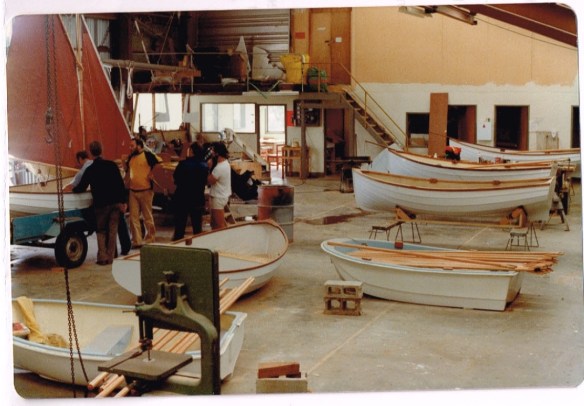
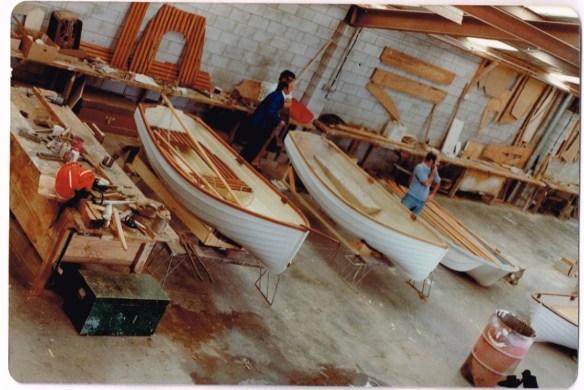
The Okura Gig became a ’boutique’ activity.  As a result of the boat tax being imposed in 1979 we reduced the size and scope of our business and closed our fibreglass manufacturing operations and moved our boat shop into the mould shop. We had built about 55 OG’s between 1978 and 1981.  The moulds were taken by Dinghy Developments who resumed production giving the OG a Seabird name.  I believe that they took their version to USA west coast boat shows where they were warmly received. I have no idea how many more were built.

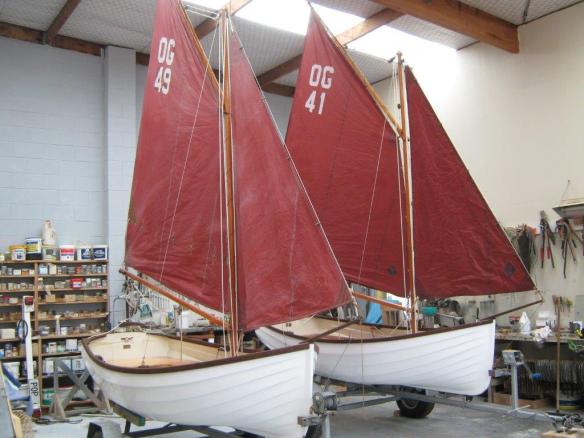
I have  two OG’s,  No. 41 and No 49.  One had spent about 35 years in a wet boatshed at Lake Rotoiti,  it required a complete grind off of the osmosis damage before refitting.  The other is our long time family boat. I have refitted them both to a much higher standard than the originals. They are currently in my shed at Whangaparaoa.  I still sail OG49 occasionally and still find it enjoyable. It really romps sailing just off the wind with the peak halyard eased . OG 41 is too pretty to put in the water. It would make a fine centre piece in a large lounge.

Croix Grut  got to see OG’s 41 & 49 restored and fully rigged before he passed away. Photo below.

Photo0006

Foot note:

I was fortunate to have served my apprenticeship at the Devonport Naval Dockyard commencing in 1958.  Marty Martinengo was in the same intake as I, as was Denis Cantell, in 1958. We have enjoyed  a very solid friendship ever since, as we do with many of the apprentices who were indentured before or since us.   The Dockyard provided a very traditional training in all aspects of boatbuilding and shipwrighting  . It was a very competitive environment with up to 14 apprentices at any one time. My brother Ray Served his time at Lidgard’s and Lane’s before moving to Max Carter. He  moved to Whangaparaoa about 1968 where he started boatbuilding.  I joined him  in 1972.

Below is an article reproduced from Sea Spray magazine Sept 1979

Sea Spray Article Sept '79 p1.pdf

Sea Spray Article Sept '79 p2.pdf