Laughing Lady Restoration Update

Screen Shot 2016-09-03 at 7.02.57 AM

Laughing Lady Looking Very Shiny

Trolling the web I came across the Seven Oceans Boatworks facebook page, the above photos do not need any copy, if you want to see lots & lots of photos of the work being done on Laughing Lady, check out sevenoceansboatworks on facebook 😉

24-09-2016  Update – getting closer. Love the ‘n0w you see it now you don’t GPS unit” 🙂

screen-shot-2016-09-24-at-3-44-36-pm

screen-shot-2016-09-24-at-3-45-04-pm

Click to view GPS Unit ‘jack-in-the-box’

Kailua 2016 Refit

P1120324

KAILUA 2016 REFIT

ww readers will be familiar with Graham Guthrie’s 1960 classic Bob Salthouse sedan launch – Kailua. During Graham’s ownership Kailua was maintained by classic woody master tradesman Mark Stapleton & always presented in immaculate condition by Graham, refer first photo above.
Early in 2016 Kailua changed hands & her new owner is Stephen Langton. Classic wooden boat enthusiasts will be happy to hear that Stephen has good woody genes, being the son-in-law of Margo & Jamie Hudson, owners of Lady Crossley.

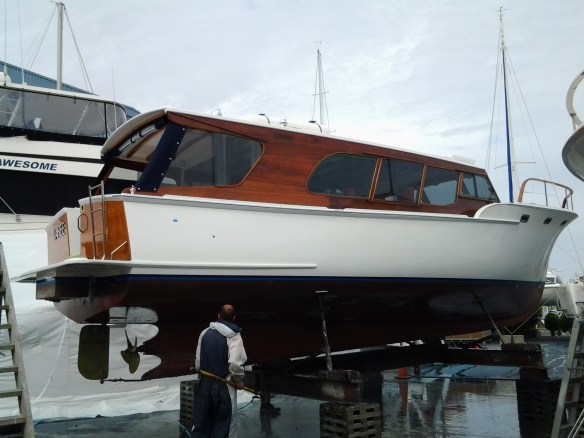
Now while Kailua’s configuration was fine for Graham’s usage, Stephen had other plans & has engaged the services of West Harbour boat builders – Nautique (Neil Williamson and Ben Freedman) to completely ‘make-over’ her interior & at the same time give the exterior paint and bright work job a very big fright. A new boarding platform has also been added. The workmanship & attention to detail looks up there with the best & I can’t wait to see her again once the Awlwood MA (Uroxsys) is applied. I always gave Graham a hard time about the plastic helm seat, so I’m very happy to see the new one !

Kailua is a very deceptive classic, she is fast – several years ago James Mobberley from Moon Engines, shoe-horned in a 160hp turbo Hino engine & this provides Kailua with the means to lift her skirt & dance. Moon’s have done the same transplant to several other classics (Falcon, Romance II) placing them all in the serious zoom zoom category (for old classic wooden craft).
Splash date is late September so will update you with ‘finished’ photos 🙂

ps a few years ago Graham arrived late to the CYA Xmas Weekend Party at Patio Bay, Waiheke Island & in true Guthrie style proceeded to drop anchor right off the beach (on a dropping tide) – “I’m a local, I know where the best spots are” – fast forward 2 hrs & Kailua is starting to sport a wee lean. Now normally few people see our oops but not today – 150+ classic boat owners & crew all had to row past Kailua to get ashore for the BBQ. Again in true Guthrie style, Graham just laughed it off. BUT he told me if I published a photo, I would never enjoy Waiheke’s finest syrah on Kailua again – well the boats sold now…………. photos below 😉
BW photo also below from her early days when named Lady Beryl.

SORRY FOR A FEW RANDOM POSTS YESTERDAY, SYSTEM WAS HAVING A FEW HICCUPS 🙂

LADY BERYL

Lidgard Run-About

Lidgard15a

Lidgard14a

Lidgard Run-About

The photos of the above Lidgard run-about were emailed to me by John Pryor, a friend of whose is hoping to uncover some details on the boat. She measures 14’3″, with a 5′ beam. All her new owner knows is that she came up to Mt Albert from the Coromandel in the condition you see her in above & the trailer was built back from army surplus and the coil springs are apparently from an Indian motorcycle.
She’s in need of quite a restore but given her Lidgard pedigree is worth saving. The bonus is she’s small enough to be tucked in the garage & worked on i.e. no expensive yard fees

So woodys what do we know about these small Lidgard run-abouts – the year(1940’s?) model, possible owners, copies of the plans etc. Anything would help / encourage her owner to commence the project 🙂

25-08-2016 Input from Roger Guthrie

6x4

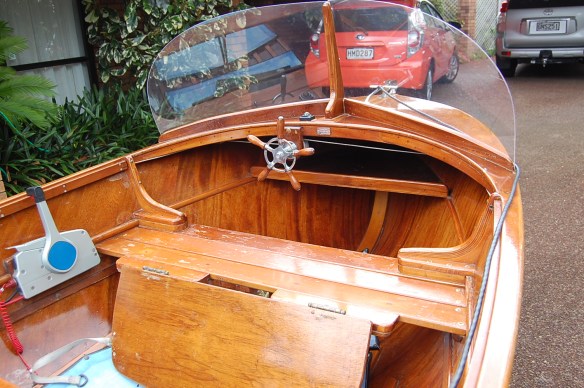
You posted a picture of an old boat on a trailer the other day. It was in severe need of restoration. Above is a very similar one we had at Silver Bay Waiheke. It was about 1951. It had a steering wheel and seat at the front. We had the popular 4H.P. Seagull outboard and had to steer from the back. There was a steering wheel but dad never connected it.

We called it the speedboat but there was no speed about it. It did however serve us well for family picnics to Man’o’War Bay and Ponui Island. Neither I or my brother Graham can remember the make. We had the usual collection of clinker dinghy’s which we rowed and two of them had centre board provision and sails. The largest one was 12ft. long and good for going to Connells Bay for the milk and supplies but this to us was the start of something new. This boat was varnished marine ply.

Shown in the boat photo – Ivan Guthrie (my father), myself and sister Prue. The boat was very near to the beach hence dad sitting on deck ready to pull up the motor. Them was the days………and they were wonderful days too.

Max Carter & His Boats

Screen Shot 2016-07-29 at 8.19.38 am

Screen Shot 2016-07-31 at 5.41.35 AM

Max Carter & His Boats
details & photos from Chris McMullen, edited by Alan Houghton
(remember to click on photos to enlarge)

Max Carter was responsible for building a huge number of boats of all sizes in a relatively short time, refer lists below. Chris believes that Max producing his modified H-28 /29ft was the first serious attempt at building stock keel boats in New Zealand. Back then there were no fibre glass boats, no marinas and no travel-lifts in NZ. The industry was experimenting with epoxy resin & glass cloth.
Max was supported by Consolidated Chemicals (Epiglass), the Colmore William’s Bros & their ceo Trevor Geldard. The P-Class & other small boats listed below in big numbers were kit sets for amateur construction. These boats also used up what would have been waste wood in the yard. The idea was to introduce young people to sailing & ensure a future for the marine industry. It certainly worked, but Max never benefited from his effort.

When Chris was reviewing Max’s files he found  a copy of a 1989 New Zealand Power Boat Magazine, which he  had never seen it before. There is an article on Sandy Sands and Sea Craft.  It talks about how Sea Craft increased their productivity by using methods learned by Sandy Sands while working for Uffa Fox. Chris’s previous  observation about a possible Fox connection was right. Sandy Sands commented in the article “without people you have nothing”.  Max realized the value of his skilled staff and treated them as friends. He stayed in contact with many for almost fifty years. There was a list of his ex employees and their addresses amongst his files.
When you consider the age of these photos the presence of all the health and safety gear – fluro jackets, disposable overalls & hard hats really stands out. Chris commented that there was the odd accident but nothing really serious.

All Max’s boats were built from medium kauri treated and will last forever (well a very long time). He had huge stocks of timber. At the time most boat builders built hull’s & decks & the owners finished them in their back yard. Max did some hull’s but mainly catered for the few that could afford a finished product.
The shed photos above are more reminiscent of the Herreshoff Manufacturing Company, Bristol, Rhode Island. While Max was way ahead of his time, unfortunately, New Zealand’s economy and small population was such that his operation could not survive. Sadly but wisely he closed the doors, sold the plant and leased the buildings.

To read the eulogy Chris McMullen gave at Max Carter’s funeral, click the blue link below

A Eulogy to Max Carter by Chris McMullen

Chris McMullen’s comments about the photos:

The photo with the 1/2 model is Max with Les Holt. Of significance in the photo is that the model was made by Chris. It was the Pipe Dream design featured in Francis Kinney’s book. The new version of ‘Skenes Elements of Yacht Design’.
The portrait photo of Max shows the MY Du Fresne in the back ground. The yacht on the hard stand is the Rainbow II. Max has written on the back of the photo. “Built in seven weeks after lofting.! “
Another photo shows the kit set boat production. No CNC machinery, just a good man (Lindsey Stone) on the spindle moulder shown in the left of the photo.
Another photo shows Max with his long time friend Laurie Davidson.
The Stewart 28 is the Hop Scotch.
Seems there are huge gaps. Photographers were always at the yard. Chris believes some photos were lost.
Orinda and White Mischief were both Max’s designs maybe 40 years apart.
The brand new Northerner struck Bollen’s Rock while racing through Tiri Channel. Her first race! Max was her skipper for the day. She was raised and repaired like new. Capt Warwick Dunsford, Owner Boyd Hargrave with the binoculars. (more photos & press clippings below)
The H-29 was an H-28 with the sheer raised. It was an attempt to build a small(ready to sail) keel yacht that people could afford. Tom Beaton, Bryan
Williams and Nick Panich in the photo.
The Du Fresne was built for Mr J M Butland and the first H-29 for his son Mr JR. Du Fresne was a Laurent Giles design. The Butland Family were a well known boating people Thetis, Titan, Sirdar, Dufresne DurVille, Inverness and the brigantine Fritha were commissioned by the family.
The Ta Aroa was a 60 foot Sparkman and Stephens design. A beautiful yacht built for Mr Doug Bremner. She had one of the first imported aluminium masts. A single spreader rig.
The Calypso shown being launched with a crane was built for Max’s own use.
The same design shown under construction is the Tamure. This was a Max Carter
design & the second NZ yacht to do a circum navigation of the world. She
was owned by the late Jerry Challet & Mac Nell. boatbuilder, Dave Baxter
was on the crew. From memory (marine engineer) Terry Burling was part owner
or crew.
All the big Carter boats were launched by the A.H.B floating crane. There were no travel-lifts. Note the ships in the background.

Screen Shot 2016-07-29 at 8.20.35 am

Screen Shot 2016-07-29 at 8.20.50 am

Screen Shot 2016-07-29 at 8.21.03 am

The Sinking, Re-floating & Repair of Northener

Article below from the New Zealand Exporter magazine that tells the story about
the H-29 better.  In the photo of the three builders bending steamed ribs on a H-29 they are from the left – the
late Eric Wing, Chris McMullen and Peter Sowman.

Screen Shot 2016-07-31 at 5.39.20 AM

Screen Shot 2016-07-31 at 5.40.02 AM

Screen Shot 2016-07-31 at 5.41.11 AM

Check out the 1967 Prices

Screen Shot 2016-07-31 at 5.40.48 AM

09-08-2016 A Tribute To Max Carter – by Nigel Armitage
Below is a link (in blue) to a downloadable file of rather nice tribute to Max Carter by Nigel Armitage. Nigel worked with Max on the replica scow ‘Ted Ashby’ project that he and Max were very involved in together at the Hobson wharf, Maritime Museum. Its an insight into the amazing work Max did.

A tribute to Max Carter

Seabird

SEABIRD  28.6.16 - 1

SEABIRD
photos & details ex ken Ricketts

Seabird is owned by Omaha boat builder Colin Brown who very recently bought her off Dave Gould, an ex New Plymouth long-liner who told  Colin he had owned her for a good many years & had bought her off another New Plymouth fisherman.

Seabird is 19′ long with a 7′ beam & powered by a crank handle start, 1 cyl Yanmar, salt water cooled diesel, – so no batteries or cooling systems to worry about.

Colin does not know a lot about her early history, except that she was built in 1940, in New Plymouth & used for longlining, most of her life.

Colin reports she has a little bit of rot in one plank, as a result of having been sitting for quite a period.

Any woodys able to fill in the gaps on her past.

Dawn

20160227_081835

Dawn 2016

DAWN
photos & details ex Steve Archer & Darren Arthur

I was contacted by Steve Archer who owns the launch ‘Dawn’, Steve believes Dawn may possibly be the L C Coultard design/built launch ‘Doraine’.
According to Steve, Dawn (Doraine) was built by Coultard in Onehunga for a flounder fisherman on the Kaipara in 1936. She is 28ft long and was owned for 24yrs by the Arthur family who kept her moored in the Tamaki River. Darren Arthur sent Steve a collection of photos from Dawns past, he was 11 years old when on the foredeck in one of the photos.
Steve has owned Dawn for 6 years after trucking her down from the Hokianga. During the 6 years she has been kept at Bucklands Beach Marina, then on a pole mooring at Panmure, on a berth at Pine Harbour and currently on a swing mooring at Wyuna Bay Coromandel.

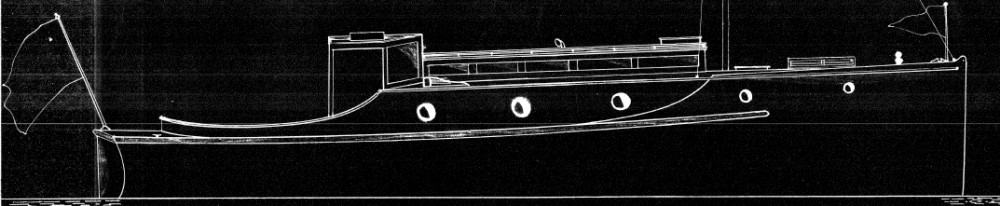
So woodys – is Dawn actually Doraine?  And woodys I can help the discussion – last night Rosemary Robinson emailed my a photo of her grandfather L C Coultard’s drawings of Doraine below, also I have included a photo of Doraine. (Harold Kidd once commented on ww in regard to the number of launches named Dawn – “TOO MANY DAWNS” 🙂

29-06-2016 Update ex Rosemary Robinson

“The plans say 24’ V bottom Cruiser drawn by LC Coulthard 23/5/58 – so NOT the plans of the Doraine despite the cardboard roll they were stored in, being labelled “Plans for the pleasure craft Doraine”.  The other drawings are of random boats and are very indistinct.  Sorry about that!
I’m not sure the Dawn is actually the Doraine because she seems to have been kept in the family until at least 1943 and my mother distinctly remembers her being in Taupo but cannot remember who she was sold to.  It would be amazing to think she still exist and looks that good after 80 years.”

Doraine (a)

Doraine plans

ps the Auckland Motor Yacht Club burgee looks even better flying 😉

AMYC on RD

New Golden Hind

Screen Shot 2016-06-07 at 10.51.17 PM

New Golden Hind
photos ex Gavin Bedggood & Roger Welch

Yesterdays story on ww featured a great photo of several motorboats & yachts on the beach in front of the Deemings Yard in Opua, Bay of Islands. The photo came from the Coralie Hilton collection, Coralie’s maiden name was Deeming (her father) & her mother was a Bedggood, so that’s how Gavin came by these photos.
In yesterdays story the ‘main actor’ was the 93′ ketch ‘New Golden Hind’, today I have posted more photos from Coralie’s collection, these ones show her build & post launch.
The New Golden Hind was a Chas. Bailey Jr. design & built Deemings for a Mr. Jenkins.

Below is a link to a great blog read about a Pacific cruise aboard the New Golden Hind. The story is by Roger Welch & documents his father, Henry Thomas Welch, on a 1940’s cruise aboard the New Golden Hind to the Pacific Islands . Some of the photos above relate to this story. They are more photos at the link below

http://beyondeyelevel.com/446/aboard-the-golden-hind-1940/  “My Dad, Henry Thomas Welch, was raised in the little country town of Te Awamutu in the Waikato area, the mid North Island of New Zealand. He was an only child, and grew up during the Great Depression. His Dad, Thomas Henry Welch, was by all accounts a hard-working man, with a strong Christian sense of duty to his wife and family. In those days everyone had to work, so it was the case that Dad virtually grew up working in the family butcher shop. I have a framed black and white photograph in my boardroom of Dad on horseback in the 1920s outside the butcher shop. Despite gaining his University Entrance exam (UE) at Hamilton Tech, he was unable to afford to go to University in Auckland. By 1940, at the age of 26,  I suppose that he was frustrated with a small town existence and wanderlust took over. Dad got away to crew on a 90 ft yacht that was sailing to the then remote Pacific Islands, a young man’s dream. As far as I can determine he had no previous sailing experience.  From a short note signed by Mr. Jenkins (the owner of the boat) I  gather Dad signed aboard as a paying crew.  Very much on “a wing and a prayer” as there was precious little money in the family kitty in 1940.

I recount the story of Dad’s trials and tribulations aboard the ketch he called “Golden Hind”, named obviously for the famous ship that carried Sir Francis Drake on his epic voyage around the world. According to a newspaper clipping (“Auckland Star”) at the time the ship was actually named the “New Golden Hind”, and owned by Mr. H. R. Jenkins. The ship was a 94 ft schooner, although subsequently dimensions are given as 93 ft overall, with a 22 ft beam, and 10 ft draft. The ship in the previous year had made a similar trip, which constituted her maiden voyage. According to the “Star”, “She behaved well in all weather encountered, and the engine which was used much of the time as the winds were light, never gave any trouble.” In addition to Mr. Jenkins, and the crew, the party aboard includes Miss Culford Bell, and Mrs. Harrison, of Auckland, Mr. W. E. Mitchell of Nelson, and Mr. Welch, of Te Awamutu.  Dad paid a princely sum of five pounds a week for the trip, as working crew, and in this regard, please see letter in the gallery from Mr. Jenkins”

YESTERDAYS QUIZ WINNER WAS NATHAN HERBERT BEING THE FIRST TO GET

‘New Golden Hind, Chas. Bailey Jr. Deemings, 1939, Okiato (Opua)’

Nathan, well done.  I email you re which framed print you want from Robert Brooke’s boat – Beautiful Boats.

23-06-2016 update from Harold Kidd – photo below of Chas Bailey Jr. wishing Jenkins well on the departure of the yacht on its Pacific voyage.

NGH

waitematawoodys.com hits Two MILLION Views + a Great Prize

ww mystery

waitematawoodys.com hits 2 MILLION Views + a Great Prize 2 be Won

Yesterday saw the waitematawoodys site hit 2 million views, something quite amazing for such a niche topic. As  stated in the site masthead, waitematawoodies was founded upon a desire to tell the stories & a need to archive the history of our classic wooden boats, the craftsman who built them & the characters that owned & crewed on them. A lot of people thought we would run out of content to write about in a few months, well that has not happened & given the size of my email in-box won’t  🙂
One of the things that differentiates waitematawoodys from traditional media is the ability for readers to interact with the site & with each other. So far there have been over 1,500 stories & 10,000 comments posted on the site, if you are one of the many that comments – thank you for your contribution, if you have not commented, maybe its time you did. Everyone has at least one good story to tell 😉

While at the start it was not the intention to create a reference library on classic wooden boats, we have ended up with one & its pretty awesome – I have Harold Kidd to thank for giving me a wee ‘fire-side chat’ about striving to get accurate data on the site. These days you can search by vessel name, designer, builder, year, length, category – launch/yacht/work boat, boats for sale & a lot more. Again if you have not tried the Search Box on waitematawoodys – give it a ago.

Cheers Alan Houghton

WIN – Now I’d like to offer up a very cool prize to mark the 2 million milestone. Regular ww readers will be aware that Robert Brooke recently published his book ‘Beautiful Boats’. Robert has been collecting classic yacht designs for over 50 years, amongst his collection is work from our most talented & recognized designers – Arch Logan, Chas Bailey, Charlie & Alex Collings, Colin Wild, Bert Woolacott, Bob Stewart, Des Townson, Alan Wright & Robert’s father – John Brooke. From his collection Robert has chosen 50 & redrawn each design, tracing off the original drawings to present them in a similar format. To add to the wow factor, Robert used the drawing equipment & ships curves that were once used by either Arch Logan, Charlie & Alex Collings or his father. The 105 page, A4 size book allocates 2 pages to each vessel with specs & photo/s on the left & the drawings – hull lines, profile, half breadths, sections, diagonals & sail plan on the right hand page. We have given away 4 copies of the book on waitematawoodys over the last few weeks, in addition Robert donated a framed 380mm x 300mm rendered print of one of the featured boats. Sample below
SO WOODYS – TODAY’S PRIZE IS YOUR VERY OWN FRAMED PRINT OF THE BOAT OF YOUR CHOICE FROM THE BOOK – BEAUTIFUL BOATS.

LJ

How to enter & a few t&c’s
1. The first woody that can supply the name, designer, builder, year & photo location of the large yacht on the right in the photo above wins the print.
2. Entries must be in the ww comments section & have all 5 answers correct. You can enter as many times as you like.
3. The judges (thats me) decision is final & no correspondence will be entered into.
4. The winner must collect the prize from Auckland.
5. HDK you are excluded – you have already got one 🙂
THE BOOK
If you would like a copy of the book – visit Boat Books at 22 Westhaven Drive, Westhaven, Auckland & grab a copy for yourself, cost is $60. For out of towners or those who refer the web – copies are available on line at https://www.boatbooks.co.nz/
ps I have also held back posting this on ww until 7.00am to give all woodys (not just the night owls) a chance to win 🙂

Building the Mullet boat ‘Tamatea’ by Chris McMullen

Tamatea 17

1961 – the build begins @ 67 Waiatarua Road, Remuera

Tamatea 22

Tamatea 1

Tamatea 29


Building the 22’ Mullet boat ‘Tamatea’ – Sailing Sunday

photos & story by Chris McMullen. edited by Alan H

After Chris McMullen saw last weeks ww story on ‘Tamariki’ he contacted me re sharing his ‘Tamatea’ photos that had been languishing in an album kept for him by his dear mother, Vera McMullen. I couldn’t let Chris escape with just sending the photos to me, so I asked him (nicely) to write us a story. Now that’s something he is always a tad hesitant to do, why I don’t know he tells a good yarn. But being the great guy he is, he put pen to paper, in doing so Chris commented that he hoped that bringing these photos into the daylight may encourage others to share their boating or boat building history on waitamatawoodys.

Below is Chris’s story on the building, launch & sailing of the 22′ mullet boat Tamatea. Remember you can enlarge photos by clicking on them 😉

“In the early 1960’s I was apprenticed to boat builder, Morrie Palmer who was also an enthusiastic Mullet boat sailor. Sailing, cruising and Mullet boats were the conversation most lunch breaks.
Morrie had in mind to build a 22ft Mullet boat but family and business commitments at the time, delayed his plans. He had a new steel centre board plate, a profile plan and the offsets of a design for a hull that was supposed to be the Charlie Colling’s design ‘Tamariki’. I am not sure how he got these offsets but the original lines plan were in safe keeping at the R.N.Z.Y.S and not available to anyone at the time.

Morrie encouraged me to build this design and gave me his centre board plate and loaned me the offsets. I managed to scrounge some primitive basic machinery and set out to build the boat. As an 18 year old apprentice boatbuilder I had no money, no car and no girl friend but I was full of enthusiasm and wanted to go sailing. And yes, I had read Johnny Wray’s book. “South Seas Vagabonds” many times.
The Tamatea was built in my parent’s back yard at 67 Waiatarua Rd Remuera. These days such a project would not be possible due to the noise regulation’s but in the early 1960’s people were remarkably tolerant and it was not unusual to see half built boats on people’s quarter acre sections.

 Riveting of Tamatea at night was not really fair on the neighbours. I got one complaint by working too late. I had to enlist my friends to back up the nails with a dolly. If they came late, we worked late. I was desperate to get it done. Another source of irritation was my Fathers Desoutter electric drill. It had no suppressor and affected the people who had TV’s. I was the neighbour from Hell for a while.

Now to the photos.

The photos feature some of my friends who helped. Recognised in the photos are
John Jennings, Des Laery, Ken Wilding, Murray Napier, sorry but I can’t remember all the names but Alan Bell and Neil Gillard would have been there. In the dinghy sculling is ‘Snow’ (Neville Stacey) who was / is a well known helpful character; he loved boats and spent much of his time at the ‘Okahu Bay’ hardstand.
The young man painting the Tamatea in the colour picture is the late John Eastwood. In the same image but in the cockpit is a another young man, John Court, also since deceased. My Model A truck alongside the boat, used as a work bench. The sailing cockpit shot shows Ken Jaspers and with me on the helm. These three guys and John MacDonald built and loaned me gear and helped finish the boat. I guess this was the year after she was launched. I was grateful for their help as I could not afford to run the boat myself at that time.  
You may notice in some of the images, the concrete blocks on the roof of the shed. These allowed me to force rocker (bend) into the keel using a timber prop under the rafters, their weight prevented the roof lifting. Looking at it now, I am lucky the lot never collapsed on top of me.

I never lofted the hull; I just made the temporary frames (moulds) direct from the offsets and cut the plank rabbet’s (rebate) by eye using battens.
The hull was planked with kauri over temporary frames or moulds. The planks were tapered towards the ends like a wooden barrel. The garboard plank was steamed but most was bent cold and edge set. I broke some planks! They should have all been steamed but with my primitive steam box it would have taken too long and I was in a hurry and wanted to go sailing.  
The short planks left out in some of the photos are called stealers and have to be spiled. I remember the frustration of not having a thin plank to use for a spiling batten. I could have borrowed one from my boss but with no car or trailer, how could I get it from Devonport to Remuera on a motorbike?
The ribs were Tanekaha, all steamed and held with riveted copper nails. The centreboard case was demolition kauri held to the keel with galvanised bolts.

Some of the images show the most distinctive feature of a proper Mullet boat – the hollow sections aft and the deep built down deadwood. The boats are a built to certain design and scantling rules.

Tamatea was transported to the water using a trailer kindly loaned by Sandy Sands of Sea Craft and towed by a neighbour Mr Picket with his (at the time) huge truck. A dangerous load? Well maybe, but we got there!

Tamatea was the last planked 22 foot Mullet boat.

My boss, Morrie Palmer forced change to the class rules by building “Controversy” using 3 diagonal layers of ¼” kauri over stringers instead of carvel planking caulked over ribs. Now Mullet boats can now be built in G.R.P.

I was about 18 when I built Tamatea, she was rather amateur built as I was a second year apprentice and although, I thought I knew it all, I was very green. She was built under difficult conditions almost in the open and exposed to the weather, I had very primitive tools and no transport or money to purchase anything other than what went into the boat. Later, I replaced a damaged plank in the “Contessa” built by Cal Crooks and sailed on the”Patiri”built by Bob Harkin. Both these Mullet boats were beautifully built by apprentice boat builders but to be fair, they were older and more experienced than me.

I built the Tamatea for cruising and she was a raised deck Mullet boat. She was very spartan when launched. Second hand sails and a poor rig. We cruised north to Whangaroa the first season but some time later lost the first mast. Insurance paid Baileys to build a new box section oregon mast and my new crew of engineers made all new mast fitting and a set of backstay levers. Their efforts made a huge improvement to the yacht.
Leo Bouzaid (‘Sails & Covers’) built a new dacron mainsail and gave me a year to pay. That was in April 1962 I still have the original invoice for 126 Pounds!

I/we sailed in the Lipton Cup but with poor results. Since then the raised deck has been cut down to a conventional sheer and she has a modern rig. Sailed by others she has won the Lipton Cup a number of times.

Further – looking back to the early 1960’s to give my story some context :-
• I crossed the harbour every day usually on a steam ferry.
• There was six o’clock closing at all bars.
• There were few restaurants where you could buy a drink with your meal.
• A quart bottle of beer cost 2 shilling and sixpence or 3 shillings and sixpence at the   Mansion House, Kawau Island in ‘The Snake Pit’ sly grog bar.
• Many cruising boats carried a rifle on board.
• There were no imports except for essential industries or you could apply for special licence but it would be most likely declined. You could only buy a new car if you had overseas funds.
• A few importers had import licence and charged accordingly.
• There was death duties and high tax.
• There was black and white poor quality TV and manual calculators.
• There were No mobile phones.
• No double insulated power tools.
• No  epoxy  Glue.
• No GRP boats and very few synthetic sails
• No moorings in Matiatia.
• No marinas or travelift’s
• Most pleasure boats were hauled out for the winter.
• There were NO IMPORTED BOATS and you could buy kauri so wooden boat building was a competitive but viable business.”


Doraine

Doraine (a)

Doraine (b)

DORAINE
photos & details ex Rosemary Robinson

I get lots of emails at ww, which is great, but when I get one that starts off “Hi  Alan, I am the granddaughter of L.C. Coulthard, boat builder of Onehunga.” I get a little excited.

Rosemary went on to tell me that while sorting through her elderly mother’s possessions recently, she came across the original plans of a Coulthard launch, the ‘Doraine’ plus a few photos. Doraine was 26′ in length with a 8’3″ beam & was intended to be the prototype for a ‘reasonably priced family boat’.
Now according to Coulthard’s daughter Elaine (now 93) this launch was last seen on Lake Taupo about 20 years ago.  Rosemary would like to know if Doraine still exists (maybe under a different name?) and whether the current owners would like those plans and copies of old photos?
Apparently her grandfather altered her for a subsequent owner to extend to approximately 28′.

So woodys what do we know about Doraine? L.C. Coulthard launches have been robustly discussed on ww before – click the link below to view/read.

Lucinda

Now woodys you would have been disappointed with me if I had not also asked Rosemary the question “Do you have any other photos?” well I did & the answer was yes – so over the next week I’ll post some more 😉

Doraine launch day