Awarua – Gets  A Make Over

AWARUA PAINT JOB 024

nov 2018 022

AWARUA PAINT JOB 052

AWARUA PAINT JOB 073 (640x640)

AWARUA PAINT JOB 078

AWARUA PAINT JOB 079

Awarua – Gets  A Make Over

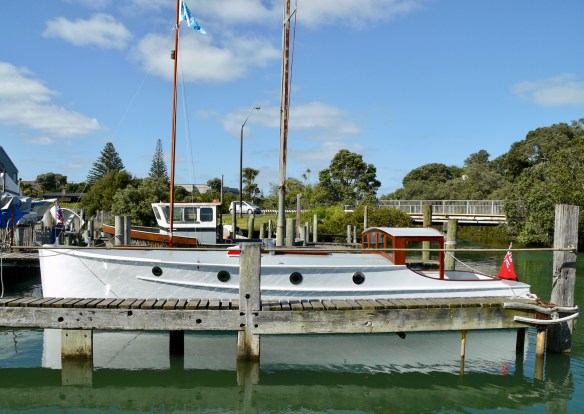
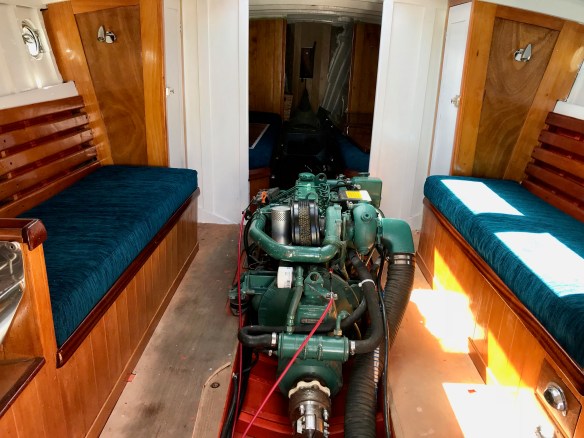
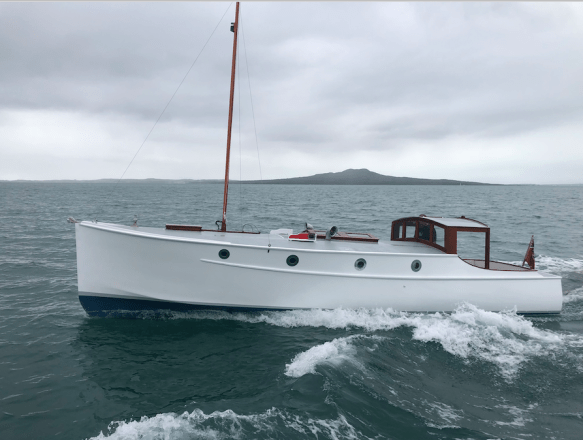
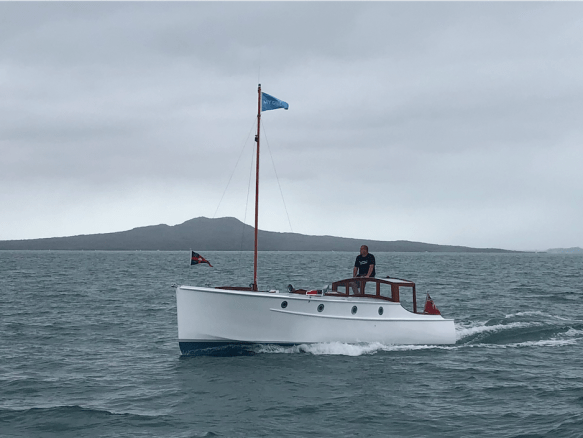
Last year we featured the 1947, 36’ Roy Lidgard launch Awarua twice on WW, with photos of her afloat & even a ‘peek down below’(WW links below)

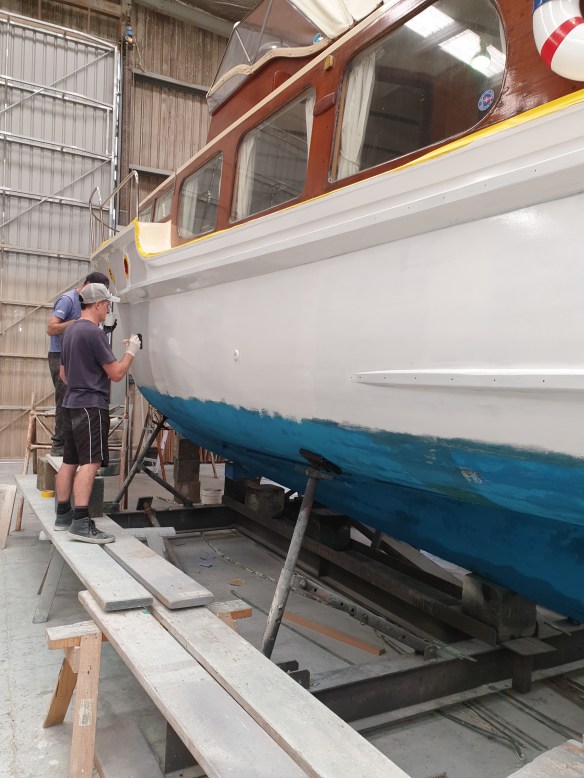
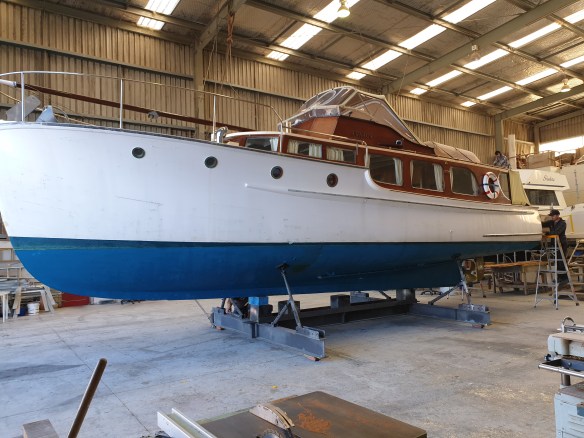
In recent chats with owner Ross Mason, he mentioned that he had hauled out at Pine Harbour & put her in the Harkins Boat Builders shed, where Jared Kirby & team were painting her topsides. A Altex alkyd 7 coat (roller & brush) system was used that consisted of –   x2 coats primer, x3 undercoats & x2 gloss coats. Prior to this the hull was sanded back to bare wood in places.

You will see in the above photos that her kauri hull was in excellent condition, a great testament to the kauri timber used & the skills of her original builders. Ross understands that the kauri used originated from the Naval Dockyards.

I’m (as is Ross) very impressed with the end results, she was always a very smart ship, now she is up there with the finest in our woody fleet. Well done to everyone involved & Ross for the biting the bullet & commissioning the work.

Awarua – A Peek Down Below

Awarua

Launch day video ex Ross , via Ken Ricketts

What Does Electrochemical Deterioration In a Wooden Boat Look Like

20181103_142047
What Does Electrochemical Deterioration In a Wooden Boat Look Like
 
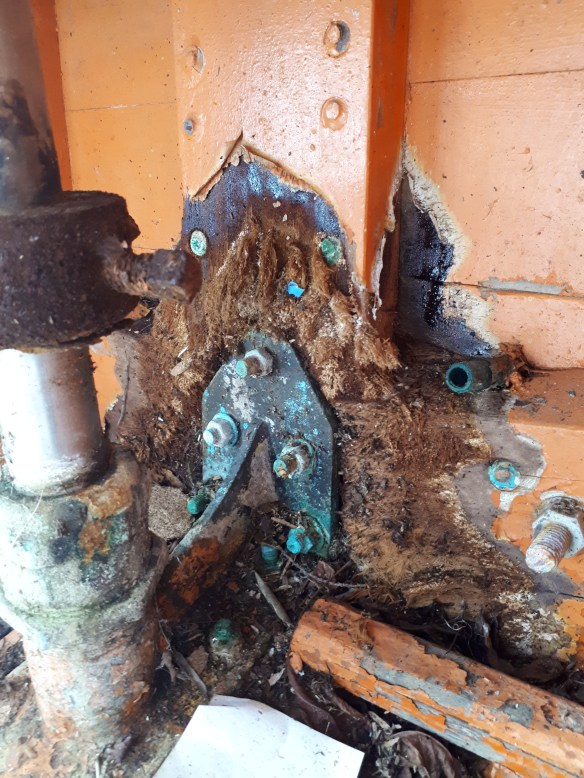
Todays story is in two parts – firstly the photos above were sent in by a concerned woody that viewed this boat, with purchase in mind. I share to highlight what electrochemical deterioration in a wooden boat looks like. This decay is the result of ignorance.  The builders of this launch would have used the best kauri and proper Aluminium bronze for the stern gear. Marine bronze does not require an anode but you can see where one has been mounted (rusty mounting) You can see the copper strap used to connect all the metals to the anode. A perfect example of what you should not do on a wooden boat. After about two years you will see discolouration of the wood around the so called protected metal , in ten years the wood will be soft and in twenty years uneconomical to repair. So woodys – read below an abridged version of Chris’s WW article. I do encourage you to take the time to review the long version as it appears on WW – link below    https://waitematawoodys.com/2016/04/28/electro-chemical-damage-in-wooden-boats/
 
 
Firstly I should point out that Chris repeatedly points out he is not a consultant and does not have a degree in chemistry. But his views are the result almost 60 years of working in boatyards. 
 
“If you connect a positive and negative metal in any electrolyte (sea water)  you will make a battery and create an anode and a cathode. The positive anode gives off Oxygen and Chlorine gas. The negative (protected) metal is the Cathode and this gives off Hydrogen gas.  That is why battery compartments have to be ventilated. Back to the Cathode. In sea water the Hydrogen from the protected Cathode mixes with the salt water and the by product is Sodium Hydroxide or Caustic Soda. Caustic Soda is used as paint remover and to pulp wood in the paper industry. Want that on your boat?
While a lot of boats may have no bonding, they do have anodes on the shaft. The shaft is in affect the bonding wire between the (+) Anode and (via the white metal bearing) the (-)bronze stuffing gland.  Zinc is at the bottom of the galvanic scale and bronze and copper could not be more dissimilar.  So there is your battery, the salt water is the electrolyte.
The Sodium Hydroxide is washed off the outside of the hull so you don’t see it but the chemical is trapped under huge pressure round the stuffing gland and slowly forces it’s way out. That is the white powder you see. Unfortunately, even if you remove the Anode the chemical will remain in the shaft log and soften the wood. 
A proper fix is to remove the gland and soak the wood in vinegar.
Cathodic protection is necessary on a steel hull but should never be used on a wooden boat. Marine surveyors round the world are now awake to this after seeing some ruined wooden boats.  Wooden Boat Magazine, Professional Boatbuilder Magazine and Classic Boat Magazine have all written on this subject. Some of the articles are thirty years ago, but few people in New Zealand seem to read this technical stuff and they fork out $ for anodes every year i.e. Loving their boat to death. Refer below re these articles”
 
For the people who doubt what I say about anodes and bonding. Please check out this article in the “ Professional Boat Builder” Magazine.  # 64 page 38 – 51 Here is the direct link https://pbbackissues.advanced-pub.com/?issueID=65&pageID=44  For any one with a wooden boat it is essential reading.
 
 
On a wooden boat it is extremely difficult to recommended bonding of any sort, due to the extreme problems created for any wooden structures in proximity to the noble fittings. Consider the following: In the galvanic couple created by bonding, the protected fittings are the cathodes and the remotely placed sacrificial zincs are the anodes. The water-soaked wood below the waterline is electrically conductive. In the area around each of the noble metal fittings (the cathodes) highly alkaline sodium hydroxide is formed, and the wood is destroyed. A white fluff is formed that looks like small ice crystals or snow, and is very caustic. The lignin is stripped out of the cellular matrix of the wood leaving only soft spongy cellulose behind. Sodium hydroxide, where found, can on the surface be neutralized with vinegar, but the problem is not cured. On a wooden boat, the system put aboard to protect the underwater metals eats the boat instead! 
 
Cathodically Protected Metal The formation of alkaline conditions at the cathode and the resulting wood degradation describe the phenomenon that occurs in wooden vessels around embedded metal that is being protected cathodically against sea water corrosion. It is common to protect the immersed metal on ships from corroding by cathodic protection. This is accomplished by attaching zinc or magnesium anodes to the vessel, and connecting these either directly or by a conducting wire to the immersed metal. The anode is a sacrificial metal, and it corrodes preferentially to the immersed metal. For a wooden vessel, the metal to be protected is purposely made the cathode. However, it is often overlooked that the alkaline reaction product at the cathode, in time, can result in loss of strength of the adjacent wood. The end result is that, although the metal does not corrode, the wood surrounding the fastener may fail. The vessel can literally “stew in its own juices.” It probably requires more than 10 years to produce conditions that can cause some loss in strength to the wood, and severe strength loss has been noted in wood vessels after 20 years’ service. Figure 2 shows some planking removed from a 20-year-old vessel. The wet hull planking was fastened to internal silicon bronze structural straps that were protected cathodically. Salts with a pH of 11 were found in the wood in contact with the bronze where the wood deteriorated. 
 
 
“You may be wondering why I say not to bond and others say to bond. Why should you believe me? It turns out my boat is very old. The things I am saying have been tested in real conditions on my boat for 50 years. For example, last year I replaced two bronze through hull fittings just because they were over 50 years old and happened to be the last two old fittings, the others having been replaced or removed for other reasons. As I said, bronze has a shelf life in salt water of about 100 years so I was giving myself a 2:1 safety factor. These through hulls had never been bonded in over 50 years. They have been in salt water the entire time and near the shaft and other metals I might add. We cut them in half in the process of getting them out. They were pristine. I could have left them in there another 50 years.”

Vagrant N17

46098818_10156766362638700_7973281351057014784_n

46268965_10156766537873700_8682186370644443136_o

VAGRANT N17
 
During the week I was contacted by Stuart Windross in regard to the mullet boat Vagrant, built in the early 1920’s by his grandfather Jack Greenhalgh. I’ll let Stuart tell that story below. 
Then out of the blue while I’m on fb & up pops on the Whangateau Traditional Boat yard page the pictorial of Vagrant being salvaged after sinking at her moorings in Okahu Bay 3 weeks ago. Vagrant was raised and barged ashore on Tuesday, then brought up road by Boat Haulage arriving at the WTB yard on Wednesday. 
I understand that Vagrant  was saved from the crusher by Dino Herbisone, who will carry out her repairs at the WTB yard. 
It would be amiss of me to not mention the wonderful contribution to our wooden boating community the Pam Cundy & George Emtage offer up at the WTB yard. I do not think the word NO is in their vocabulary, they so generously offer up the yard to help stop the demise of heritage craft and then pair the boats up to capable tradesman or people that can repair them if need be or indeed use and enjoy them. The yard can be contacted via email at 
“Further to the discussion regarding the builder of the mullet boat Vagrant I have followed up my post confirming it was built by my grandfather Jack Greenhalgh with a delve in the family photos. 
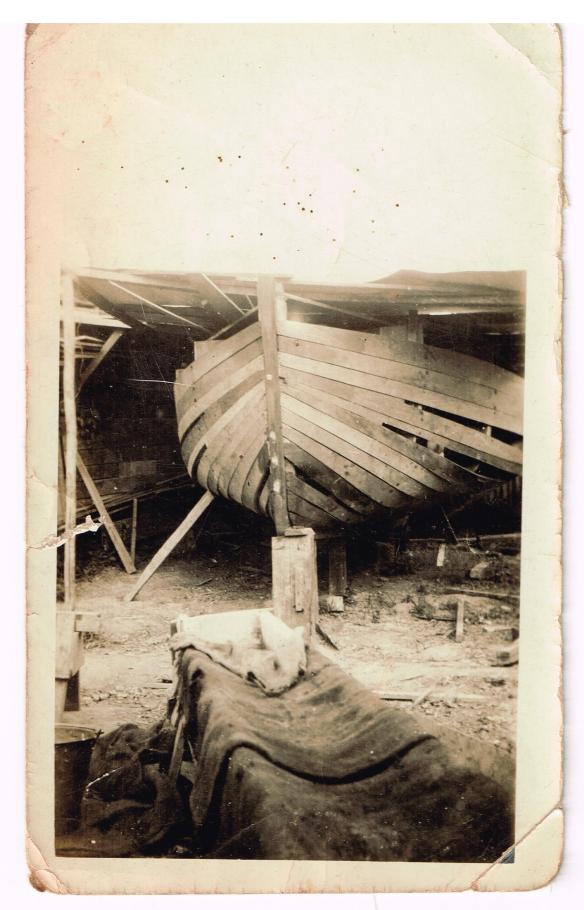
Attached please find photos of Vagrant  N17 under construction and one of her sailing close to the camera in light winds bow on.  These are verified as they have her name inscribed on the back.
The other pics below, are of what I believe to be an 18 footer named Vim that my Pop John (Jack Greenhalgh) also built prior to Vagrant.  From one of the photos it is pretty clear that her number is V34.  I wonder if you have any info about her fate as she seems absent from online records and the literature.
John (Jack) Greenhalgh was born 20 June 1901 at Riverhead and died 13 July 1984 at Waitakere Hospital.  He was the middle child of 11 born to Edward Walls Greenhalgh and Helen Ramsay (nee Paterson).  His grandfather John William Greenhalgh, originally a coalminer from Wigan UK arrived in NZ in 1886 to oversee the establishment of paper mills at both Mataura and Riverhead.  His father Edward Walls Greenhalgh also worked in the paper mills both at Riverhead and Mataura later living in Richmond Road Auckland.   At the time of building Vagrant he would have been 24 and obviously younger when he built Vim.  He kept the scale half models of their hull shapes (shaped from Kauri) throughout his life.  My Auntie may know of their whereabouts. I believe that both of these boats were built in the back yard of his parents home at Richmond Road.  As you will see the set up was fairly basic!   
Albert Greenhalgh (Alby Jack’s brother) was born in 1906 and I understand was a sailing partner.  The two brothers were very close, marrying sisters (Doreen) Vera and (Florence) Rita Lee.   Alby and Rita’s son Keith is still active in the Reactor sailing fraternity and daughter Beverley’s husband Jaape Pos was a boat builder (at Sea Nymph I think).  Another cousin was Roy Parris (the well known launch builder).
Jack and Vera married in November 1926 and soon purchased a new home in Kingsley St.  This transaction probably necessitated the sale of Vagrant. A later craft (a dinghy I believe the kids used for fishing trips and floundering in Coxs Bay) was built in the front room of the marital home much to the displeasure of his new wife.
A mischievous and witty character he was always ready to enthrall us with a prank or yarn.  I recall his stories of searching shoreline pohutakawa for suitable bends for stems or knees and cutting the corners off square balks of timber to fashion his masts.  He was a very patient worker in wood or metal.
I have included a photo of Jack and Vera Greenhalgh(with my Mum) c1938
I am not 100% sure if all the fleet shots are of Vim but the colour scheme suggests so (unless Vagrant’s cabin sides were painted darker at some stage).
Apologies for the picture quality as the originals are very small and showing their age”.
N17 Vagrant under construction c1924 (inscribed)

N17 Vagrant under construction c1924

N17 Vagrant 1920s (inscribed)

N17 Vagrant 1920s

Vera, Jack and daughter Shirley Greenhalgh

Vera, Jack and daughter Shirley Greenhalgh

How Not To Be Mistaken For A Plastic Boat Owner

P1240008 copy

The Order Book Is Open For Waitematawoodys T-Shirts

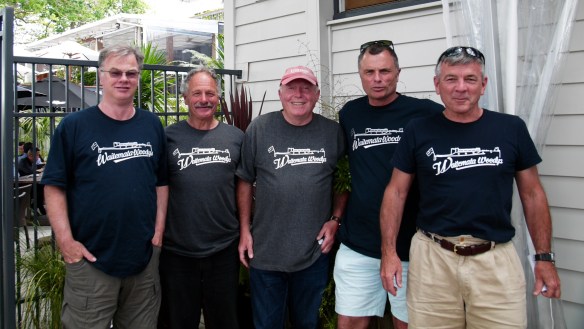
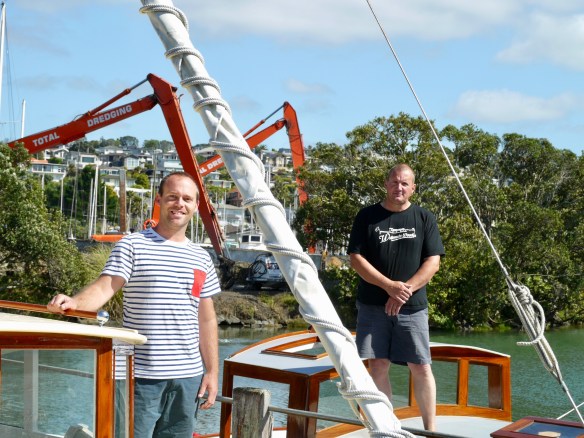
Yesterday’s story on the re-launching of Pacific & My Girl, caused a bit of a stir – nothing to do with the boats, it was all about the photos of people wearing waitematawoodys t-shirts, my email inbox was overflowing with – where’s mine?, where can I buy them? etc.

So folks, it’s been 2 years since I offered up the chance to grab your own WW t-shirt, last year I was just too busy with the boring things in life e.g. work & also getting my boat ready of the Christmas/ NY cruising. This year I’m ahead of the game, for once 🙂 Also the numbers of people reading WW has increased by over 500%, so there are a lot naked woodys out there 🙂

  1. Some background on the T’s – I only source top quality AS Colour garments & we print in-house using old school manual screen printing processes for really tight detail & a durable finish. I’m passionate about WW & will only put the logo on something that is 100% quality.
  2. In terms of colour – previously I printed a very dark blue (navy) T, with white logo. So it’s that again. Over the last 2 years I have printed other colours for friends & give-ways, no promises but I might do another colour – e.g. black, let me know if you had a 2nd pick & I’ll see (no promises) how things go. The logistics of the ordering > printing > dispatch is a little frightening, my lips are sealed on numbers, but the house looked like a NZ Post mail center for a few weeks.
  3. Price – same as 2 years ago $34.95 (gst inclusive) + $5 p&p (one off freight charge, no matter the number you order). If that’s too much to pay for a quality T-shirt, well I guess you won’t be buying one, but I’m not prepared to compromise on standards.
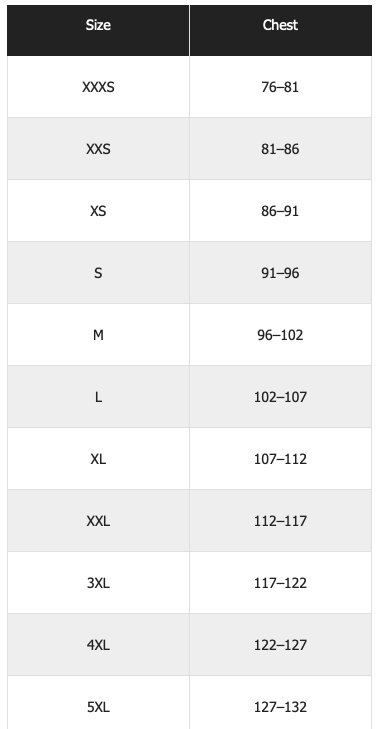
  4. Sizes? Refer chart below. If there was interest I could do a smaller female size.
  5. Ordering – B4 Xmas I’m doing a limited print run, so if you want a shirt/s – I need your order by Friday 30th November, sooner would be even better. I’ll advise payment details when I confirm your order.
  6. What’s next – email me at waitematawoodys@gmail.com & advise:

# Your name 

# Postal address

# Phone

# Quantity & size/s 

Ps – Sent in a sealed courier bag, so if you are ordering for a Xmas present, no-one will know the contents.

Pps – Yes, I can send overseas – freight costs tba

Ppps – My models where flown in from Milan for the shot photo, at great expense – they won’t have to worry about ordering a new shirt 😉

Size Guide

Circle December 1st In The Diary – Big Woody Day / Weekend For CYA Woodys

Screen Shot 2018-11-12 at 5.24.52 PM

MY GIRL and PACIFIC Relaunched – 60+ Wooden Boat Photos

IMG_0142

P1030869

PACIFIC

P1030845

P1040033

P1040039

P1030999

MY GIRL

P1030846

P1030872

P1030900

IMG_0157

MY GIRL and PACIFIC Relaunched – 60+ Wooden Boat Photos

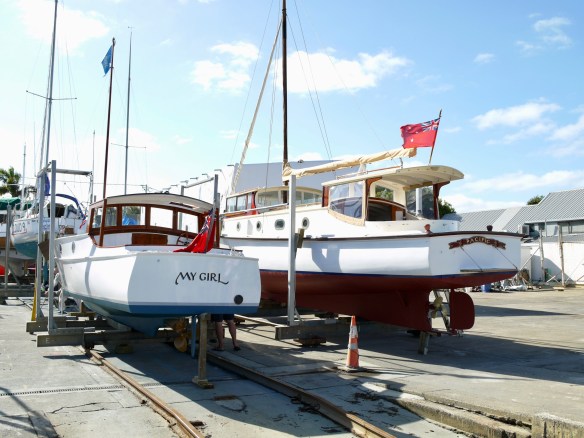
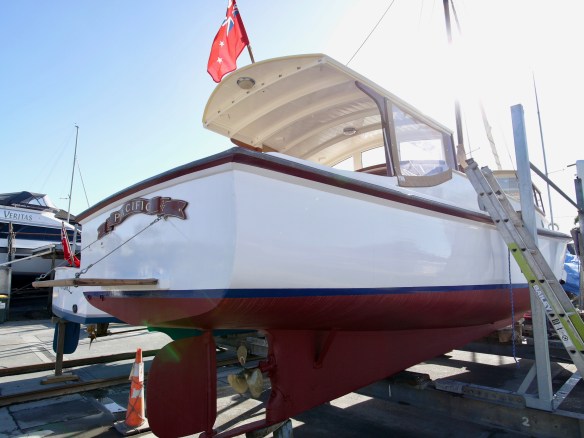
Big day on Saturday in the woody world, we had the launching of Pacific & My Girl. Pacific is a 1917 Joe Slattery designed & built launch, owned by Nathan Herbert, & has been out all winter at Milford Crusing Club’s yard getting a major over-haul – hats off to Nathan, Pacific is a stunner, the perfect choice & mix of colours & varnish. It has been a long winter but from the smiles on everyones face, dock-side, it was all worth it. This WW link will give you a peek at what she used to look like.   https://waitematawoodys.com/2014/02/07/5898/
Well done Nathan & Steven + a big cast of helpers thru-out the project.
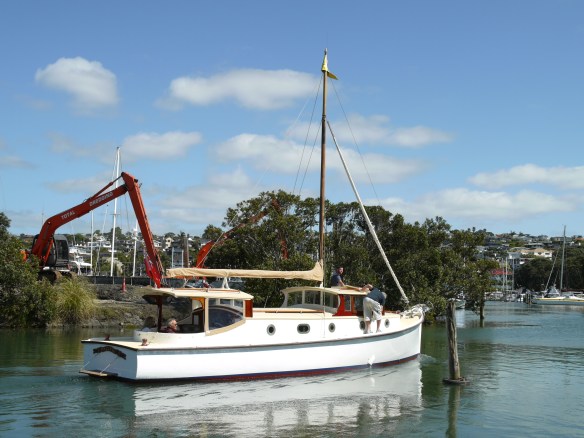
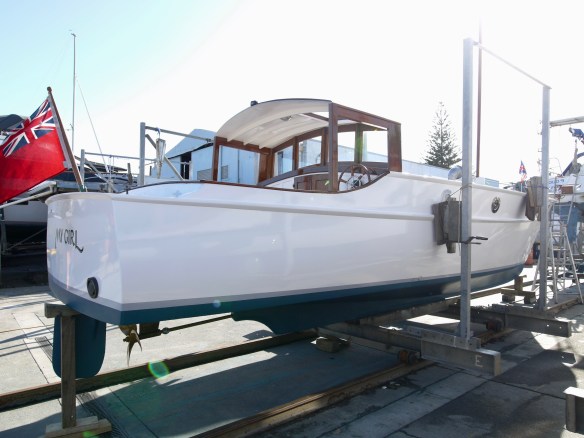
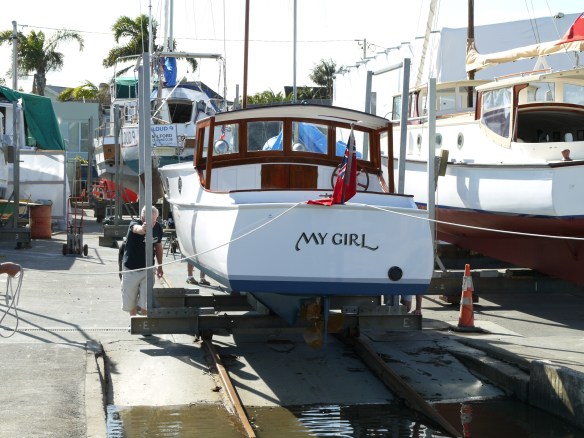
Second splash was Jason Prew’s – 1925, Dick Lang built ‘My Girl’, also re-launched at MCC. Jason’s re-build of My Girl has been a very long 4 years, mostly out of sight in a cold (& sometimes wet) commercial storage yard. My Girl arrived at MCC approx. 6 weeks ago for the final touches. Some of NZ’s most respected woodys were shaking their heads when Jason bought My Girl, she was so close to being a BeeHive (box of matches) restoration, but Jason has a track record of bring woodys back from the dead & that he did with My Girl. This link will show you what he started with    https://waitematawoodys.com/2014/12/12/my-girl/
To see more of the project – check out his weblog.  https://www.my-girl.co.nz/mygirl/Welcome.html
Post launching, I managed to score an invite to go for a blast on My Girl, she is fast (my lips are sealed) but I expected that, what really impressed my was the ride – very smooth. The question of the day was – are classic woodys allowed trim tabs 🙂 I seem to recall James Mobberley had some ‘additions’ on Falcon…………..
Remember click on photos to enlarge 😉
Video footage of My Girl with the throttle open 🙂
Video & photos below ex Nathan Herbert 
Screen Shot 2018-11-12 at 4.42.21 AM
Screen Shot 2018-11-12 at 4.42.48 AM

Ella B 4 Sale

Bill's Boats 015

Bill's Boats 010

Bill's Boats 012

Bill's Boats 004

ELLA B – 4 Sale
 
I have been contacted by Taupo woody, Shawn Vennell regarding the very smart woody – Ella B.
 
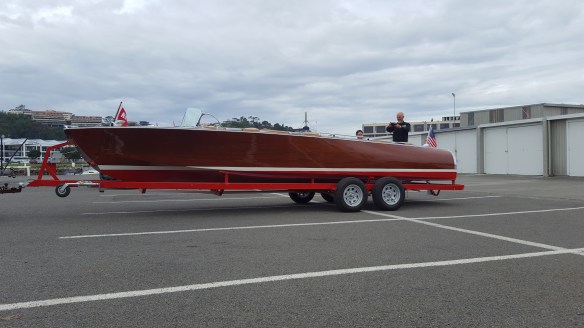
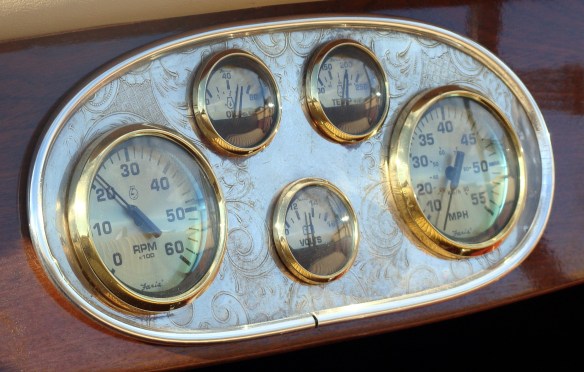
Ella B is a ‘Monte Carlo’ design, barrel-back, classic inboard mahogany run-about. She was built in NZ by Bill Brassington, & measures 24’6” with a 7’6” beam.
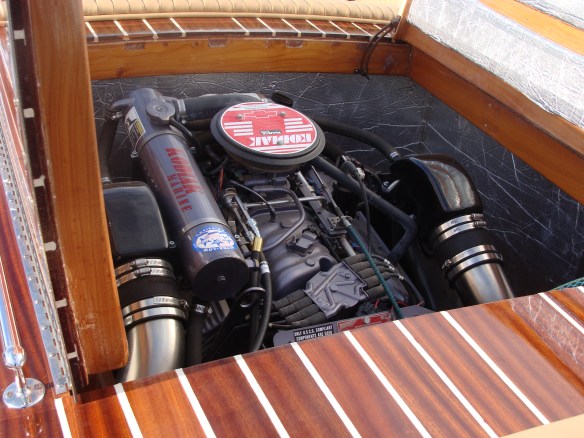
The zoom zoom is via a brand new 5.7 litre 350 BFI marine V8 Kodiak engine complete with a Borg Warner 71c model 1.1 velvet drive transmission. The build quality & attention to detail is amazing + all components in the build were brand new, with the trailer being custom made by Bill.
 
Unfortunately due to health issues, Ella B is reluctantly for sale. This is a turn-key boat, fill the tank & you are off. I suspect the seller is very realistic in terms of a price, interested parties can contact Bill’s son Glen, via email  ellaco@xtra.co.nz to discuss Ella B in more detail.
 
Ella B has appeared on WW b4 – more details here.


Folly III

FOLLY III

Today’s woody story features a 5’10” video on Folly III, a 33’ cruiser designed by W. Holmes & built by his sons, Reginald & William, c.1920 in Sydney, Australia. Her beam is 9′ & she draws 3′.
I understand Holmes senior was a kiwi builder that moved to Sydney to build bridges & later turned his talents to wooden boats, of all shapes & sizes.
I’m sure HDK will be able to enlighten us on the man.
The Folly III design follows the look of the popular American Lake Union Dream Boats.
The video is beautifully shot in Moreton Bay, Queensland & has a ‘colourful’ commentary from the Folly III owner, Stephen Lake 🙂 Enjoy
Thanks to woody John Sloane for the heads up on the video.

Aurora – Sailing Sunday

image

Aurora

Waiheke Island, March 2018


AURORA – Sailing Sunday

The other day I received a note from Bill Brown, the owner of the lovely yacht – Susan Jane, that featured on WW when she was being restored at Colin Brown’s Omaha yard.
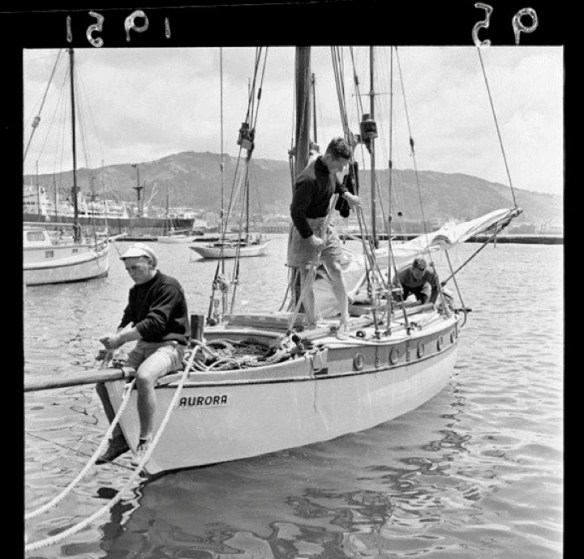
Bill is a kiwi but works overseas & was delighted to see that his uncle’s old yacht – Aurora appear on WW (link below) recently. Aurora is a 22′ Harrison Butler design, built & owned by his uncle, Neil Brown c.1940’s.
Bill’s father, James Brown, a salty old dog who spent most of his time going up and down the Whangarei Harbour, in various craft, including Woodys; Sarina, (currently for sale, and whom mum and dad had their honeymoon on) Temptress and Yvonne. James passed away last April, just a few days shy of 90, having sailed his entire life, and selling his last boat at the grand old age of 80.
The timing of the WW story on Aurora was very opportune as Bill had recently been canvassing the extended family for  details – with Bill’s permission I have published below the email he sent out – its an great read. Enjoy.
“I saw Aurora for sale on Trademe yesterday and I thought you might be interested in seeing these pictures of her. As far as I know Uncle Neil built her himself in Dunedin to a Norwegian design. Dad used to tell me she was built like a brick outhouse and you can see that even though she is clearly neglected, she is still a tight wee ship! The photos and advertisement make her seem much bigger than she is. I think she is only 21 feet long, making her essentially the size of a trailer sailor!
Most of you know that Uncle Neil sailed her in the famous Wellington to Lyttelton yacht race that was at the time one of New Zealand’s worst sailing tragedies. That was perhaps the first, but not the last time, that old Gran thought Uncle Neil had been lost at sea!
If I remember correctly, dad used to say that Uncle Neil ran before the storm with bare poles and with a spare anchor warp streaming out the stern. As it states in the article he eventually ended up in clear skies up off the coast of the Hawkes Bay.
The other great story I remember about Aurora that was more directly connected to dad, was that Uncle Neil asked if dad wanted to go on a summer cruise from Dunedin to Auckland to coincide with the Queen’s visit in 1953-1954. Dad said yes and that was the plan they told Gran, however when they cleared the Otago Heads Uncle Neil kept heading east! It wasn’t till then that he told dad that they were aiming to be the first pleasure yacht to visit the Chatham Islands post WW2! Uncle Neil figured that if he had told dad the truth he wouldn’t have said yes and Gran would have worried too much. I remember dad had a handwritten log of the voyage, boasting of the huge crayfish they ate when they finally arrived at Waitangi, Chatham Islands. After a few days socialising with the locals they then set a course for Auckland to visit the Queen!
I have seen her only twice in the real flesh. Once she was waiting outside the Kissing Point Boatshed that we kept the launch Yvonne in. We were returning from a weekend down the Whangarei Harbour and the owner had tracked dad down to have a chat with him about her history. I think she was then based in Tauranga. The second time I spied her she was on a swing mooring in the Tamaki River.  I was at University and I had been out windsurfing and noticed her and that there was a guy in the cockpit. I stopped at her stern and explained that my uncle had built her and found out that the guy in the cockpit was readying her for sale, as her owner had been in some trouble picking up the mooring, bouncing off a few boats in the tide and had suffered a heart attack!
Uncle Neil’s second major build was the modified Woollacott – Katherine Anne, Maraval (photo below), which he built in Whangarei, at Smiths boatyard and sailed around the South Pacific and the east coast of Australia, ending up back in Dunedin. I heard that he received a RNZYS Blue Water Cruising Award for this effort, but I can’t seem to find much evidence of that. An interesting aside to this cruise was when I sailed in the Farr 9.2 Interdominion series in Perth Australia, there was a crew from Wellington, who recounted a story of Uncle Neil on Maraval being in Hobart at the same time as the finish of the Sydney- Hobart Yacht Race that they had just competed in a fully powered up ocean racing yacht. Apparently as the story goes, they left Hobart together and Uncle Neil beat them back across the Tasman!
Back in Dunedin, for summer holidays Uncle Neil would head around to Fiordland, down to Stewart Island, even on one occasion venturing to the Campbell and Auckland islands.  Sometimes just for the heck of it he would throw in a circumnavigation of the South Island. On one occasion he lost Maraval, when she was washed out to see by a flood, after sheltering in Port Jackson, Jackson Bay, West Coast, only for Maraval to float out into the Tasman and a few weeks later return on to a piece of sandy West Coast beach up by Greymouth! The only reported damage to her was the broken mast and the front bollard that the farmer had tied his tow rope to as he hauled her up the beach! He re-floated her, had her towed by a fishing boat to Greymouth, built a new mast and went on his way back to Dunedin.”
Link to previous WW story on Aurora, below
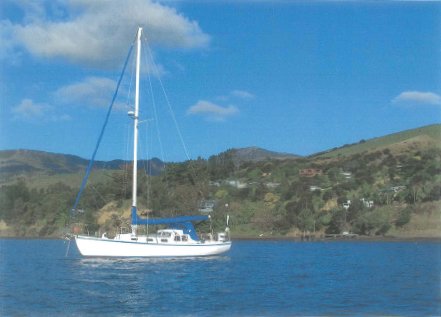
Maraval01

Maraval at Takamatua, Banks Peninsula
Leda A26

Screen Shot 2018-10-18 at 8.48.02 PM

Screen Shot 2018-10-18 at 8.51.00 PM

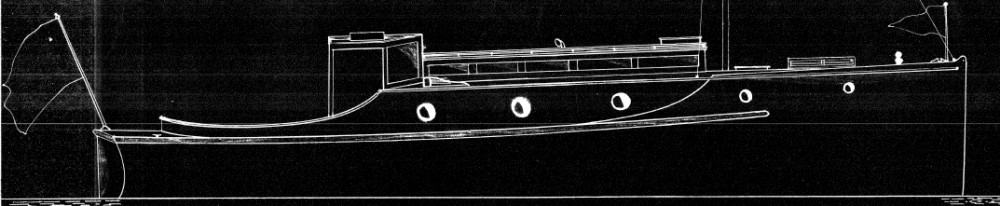
LEDA A26
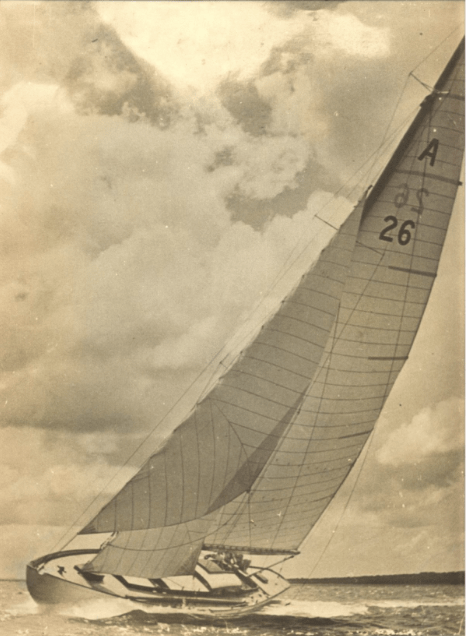
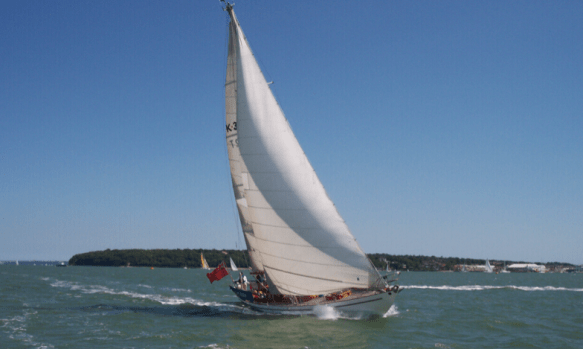
I was recently tipped off by the new CYA chairperson – James Mortimer, about a great tale that was unfolding on the CYA forum. It involves a gent by the name of Russ Senkovich, who owns the 54’ kiwi built, 1949, yacht Leda. Russ & his wife are thinking of bringing Leda back to NZ & ultimately selling her here. Leda left NZ in 1953 & has been off shore ever since – there is an amazing weblog on her travels & maintenance over the years, check it out here   svleda.com
You can also follow the story on the CYAF – link here    https://classicyacht.org.nz/cyaforum/topic/leda-a26/ 
But let me set the scene for you on Leda, it starts with a Christopher Gordon Wilson, better known as Dooley and his brother Alexander, better known as Sandy who were both home from WWII and had a dream of racing the Fastnet.  However, the war had left the NZ dollar devalued and buying a yacht was out of the question.  So, of course, they decided to build one.  They had in their possession a book by Uffa Fox of noteworthy yacht designs.  One of the boats featured in that book was Ragna R.
Ragna R, launched in 1938, was built by Gustav Plym in Stockholm for a British client.  She is a Knud Reimers a design. The Wilson brothers admired the yacht and showed the book to a fellow named Jack Taylor, whom its believed worked for Lidgards.  Jack Taylor developed a full set of construction plans, including the dimensions of all the timbers needed for the project.

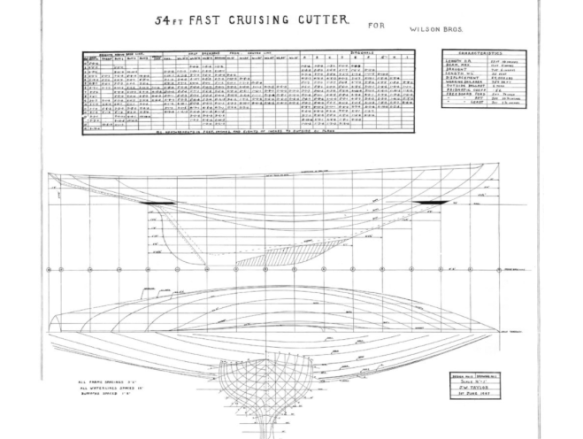
So, Dooley and Sandy, had their plan.  Now they just needed to build their boat. The line drawings below are dated June, of 1947.  Sandy would have been 25 and Dooley, 27-years old.  Remarkably Leda would be sailing 29 months later. She is double-planked kauri over mangeao frames with pohutakawa knees and copper rivets.  Leda’s deck is double planked kauri, her cabin is Douglas fir (Oregon pine) and pine.

Thats all you’ll get here today on WW – use the link above to read / view the full story – its a great read.
Screen Shot 2018-10-18 at 8.52.15 PM
22-10-2018 Input from Neil Chalmers – Neil commented to me that the Leda post reminded Neil of a story Con Morley told him about his admiration of Knud Reimers yacht designs . 

Con owned and raced ‘Freya’, a 32 foot double ender built in the 1950’s. ‘Freya’ was very similar to  Reimers ‘Stor Tumlaren’ design made famous by the well known British yachtsman / author K Adlard Coles and his yacht ‘Cohoe’.
During a visit to Stockholm, Con called at  the Reimers design office and met the great man himself. Reimers was very polite and formal . He mentioned to Con that he was aware several of his designs had been built in NZ , however he had never sold any plans to NZ !

Lady Ellen Restoration Update

IMG_0890

LADY ELLEN  Restoration Update

Just had an update on Bruce Mitchinson’s Lady Ellen restoration project, I wish everyone was a s good as Bruce is in sending in work-in-progress reports 🙂

Bruces words – “Strut and rudder all back in place, below waterline fairing is going on at the moment.

Fairing done on the topsides, final fill and longboard, all over, will happen over the next few weeks.
Toe rails and beltings have been repaired and reinstalled.
Looking to undercoat topsides, deck, and below waterline early next month.
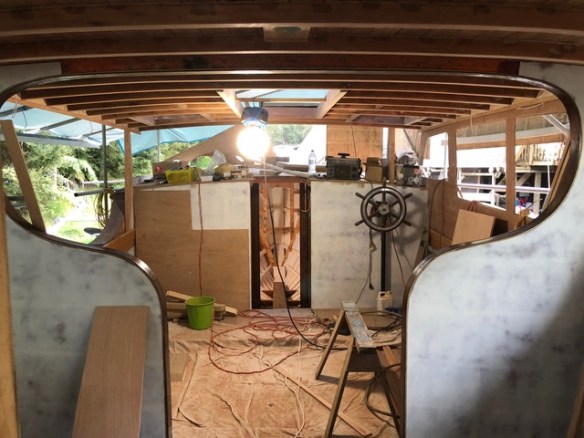
Inside we have stripped the paint off the underside of the cabin top and the decks, ready to be sprayed, along with the rest of the interior, as we move from aft, for’ard.
Cockpit complete with draining floor and seating, plenty of locker space, and gas bottle enclosure.
The existing rod steering, that used to be buried under the old water tanks, has been refurbished and can now be accessed through the new lockers.
Galley and saloon trim underway this week.
Painting inside the hull, to get ready for fitting out below deck.
Keeping the original layout apart from opening up the hanging locker into the for’ard cabin with a McGeady style window opening through the bulkhead.
No guesses as to what I will be doing this Labour weekend.”
Remember – click on photos to enlarge 😉