Kotanui


KOTANUI

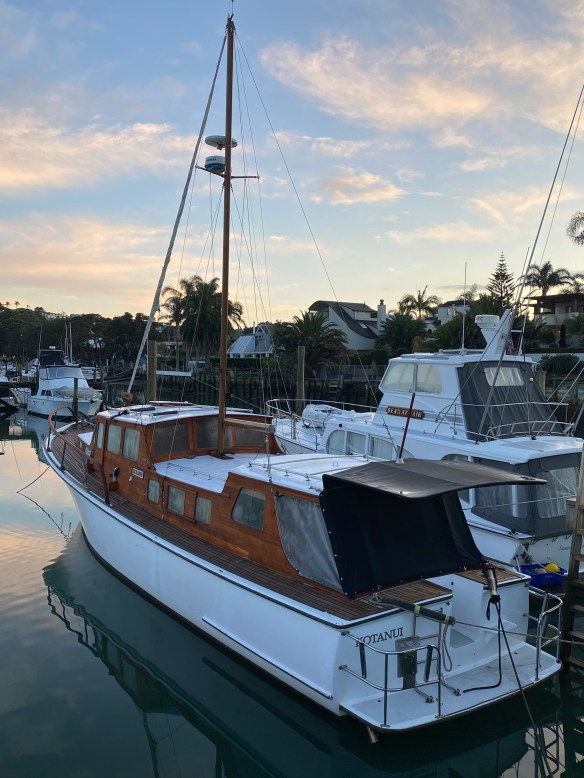
While down at Milford CC over the weekend ‘supervising’ the painting prep on Rorqual, the launch Kotanui was being hauled out. A little bit of a tight fit 🙂

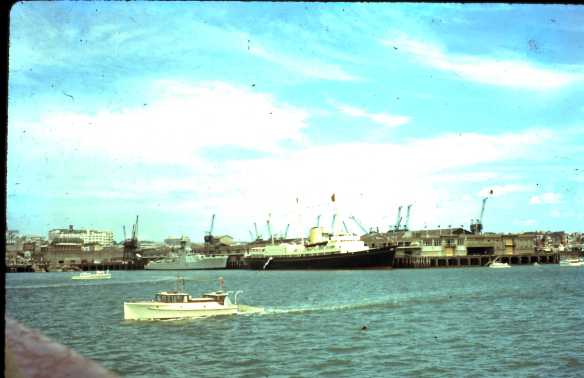
I have also posted a photo of her being hauled out at (a long time ago) on the beach at what I think is now ‘Gulf Harbour’. Nathan Herbert will correct me I’m sure, it is after all his photo.
Kotanui is a slightly scaled down version of Trinidad & differs in that she has twin engines/screws.

30-10-2016 Hauled out again – this time at Gulf Harbour (photo ex Ken Ricketts)

20-05-2020 Update ex Glenn Martin – photo below of Kotanui at Milford Marina

Kotanui May2020

Trinidad – 52′ Salthouse Motor Yacht

Trinidad – 52′ Salthouse Motor Yacht

Launched in 1965, designed by Bob Salthouse, built with 3 skin kauri planking at John Salthouse’s Greenhithe yard. She featured on the cover of the September 1966 edition of ‘Sea Spray’ magazine.
Powered by a 6LX Gardner diesel she cruises comfortably at 8.5>10 knots, with a cruising range of 1000miles. In my mind there are a few things that make a boat a ship, one of them is an ‘engine room’ versus an engine compartment & the second is a ‘workshop’ & the last is a galley that is a separate room – Trinny sports all three of these.
Trinidad is a very spacious vessel with 6’9″ headroom & her wheelhouse enjoys excellent visibility & is one of the most used areas on-board.
Trinidad is a true blue water ship with passages to Australia & a circumnavigation of NZ.
Her owners, Barbara & David Cooke maintain her to a standard that some would say is better than new & she is much admired where ever she drops anchor. AH

Kotanui

KOTANUI

Story & photos from Nathan Herbert

Named after the original owner’s farm and adjacent island, was designed by Bob Salthouse for J.N (Jack) Hobbs of Hobbs bay Whangaparaoa and built at the Salthouse Greenhithe yard in 1964. She is 44 feet in length and was powered by twin Lister 60hp diesels cruising at 10 knots and pushing her to around 12 knots with mechanical gearboxes, later replaced by twin Fords on hydraulic gearboxes but retaining the original gear levers. She is a motorsailer with main and headsail of almost equal dimensions.

Her design is modelled from Jack’s previous launch the Pacific, which his father had built by Joe Slattery. Layout is practical with galley in the aft dodger area, long settee berths in the saloon coming up to a flat- floored wheelhouse with engines beneath (a bonus of the bridgedeck layout) and master accommodation and head for’d.

Before the Gulf harbour marina was built she would be hauled up at the eastern end of Hobbs Bay on a purpose- built slipway, operated by a winch driven from a Fordson Major tractor. Pacific had the same setup alongside her. Kotanui was the first boat to enter and berth in the new Gulf Harbour marina, followed by the Pacific.

A fixture of the Auckland cruising fleet from her launch until Jack’s death in 1991 at age 84, Bob Salthouse notes that her presence “opened a few eyes” leading to further commissions of fine, large launches.

Kotanui is now berthed on the marina in Milford, with very few alterations (refer 2012 photo ex Alan Houghton)

Scroll down to view 2 home movies of Kotanui 

Classic Launch Old Movie Footage – Pacific

Video

Some ‘old’ home movie footage, of Pacific, note the varnished cabin top, we like that 🙂
Supplied by Nathan Herbert

Update from Grant Burrell

This movie is taken around 1960 before the wheel house cabin was extended and the stern cabin had canvas sides. The cabin was never varnished but my Grand Father painted an imitation fake painted wood grain, It did look good, worked well on a swing mooring but the dark paint dried the timber when on the marina.

Marnine

Scan 12

c1963

Scan 32

Ready for engines

MARNINE
Story & photos from Terry Porter
The name ‘Marnine’ is an anagram of Margaret (Joan Porter’s mother) and Janine (Fred and Joan’s only daughter after four sons).  ‘Marnine’ replaced ‘Wanda’ to cope better with a bigger family.
Dad and Garth Lane were good friends.  ‘Marnine’s’ lines were based on Ted Clarke’s ‘Lady Margaret’.  Mum and Dad were great friends with Ted and Margaret (Uncle Ted and Aunty Marg to us kids though no relation).  Dad liked ‘Lady Margaret’s’ sea-keeping characteristics so took control of the design of ‘Marnine’.  ‘Wanda’ rolled!  ‘Marnine’s’ styling and engineering design were all Fred’s work;  done in house at Mason & Porter with help from Ralph Ricketts and others (in particular Jack McLeod).
‘Marnine’ was launched at the end of 1961;  being 46 feet long with 4 feet added not long afterwards.
Contrary to some thinking, the boat performed OK as it was but the extra 4 feet would provide more bunks, a bigger head and more storage up forward.  A benefit was that ‘Marnine’ cruised and looked better.
‘Simran’ was also lengthened from 58 feet 3 inches to 64 feet.  This time on the stern and she too cruised and looked better.
On reflection, it seems most boats should be designed and then have 10% added prior to construction.
Photos
– B&W at Lanes Tamaki River being launched to have engines fitted across the river at Rothery’s Landing.
– Colour is cruising in 1963 prior to being lengthened.  Lack of forward handrail indicates pre-lengthening.
Note: to view more photos, just enter Marnine in the search box
08-05-2018 Input from Peter Wheeler – Regarding extending the bow.I was an apprentice at lanes at the time and helped Ray Pateman to loft out MARNINE. Ray actually altered the original design and extended the bow. Fred would have none of this and told Ray to go back to the original design. I had left Lanes and was surprised to see MARNINE getting her new bow when I called in to see the lads. She looked much more balanced I thought and saw her a few months ago and pointed out to my friends with me that I spent many a happy time helping to build her. She looked what she is classy.

Meola

MEOLA
story & photos ex Russell Ward
One of my favorite workboats- was built in 1961 by Miller and Tunnage at Port Chalmers. She was built for the Ministry of Works for servicing of Marine Dept and navy installations around Waitemata Harbour and the Hauraki Gulf. Barney Soljak told me that she was modeled on Clematis but with a transom instead of a ducks ass. He felt that she was a little archaic and that they needed a more modern boat.She is 42’6″ LOA x 12’7″ Beam powered by a 4L3 Gardner. She was taken over by the Navy in 1976. She performed some impact hydrography cutting the corner inside Emu Rock and sank in Islington Bay 8 November 1978. RNZFA Arataki and a barge had her salvaged the next day –The tug Arataki had an interesting life in those days, frequently sorting out the Navy coastal cockups (usually before the media got there).
Meola is now in private ownership and much loved. She comes to all the classic workboat events.

Lola

LOLA
A unique and incredible boat in our Marlborough Sounds, lives in a purpose built, air-conditioned building, on the waters edge.

‘LOLA’ is a 1962 Riva Tritone Aperto, tritone means the boat uses twin engines and apertos is the large open sunbed on the aft deck. She has a LOA of 27ft and is one of only 15 in the world. It is believed to be the only original Riva in New Zealand, and a stunning example of boat restoration. Only 3000 Rivas were built, between 1950 and 1966.

The restored Riva, has a flared bow, confident lines, a tumblehome hull, gleaming engine and exhaust vents and chrome fittings. It seats up to 10 people, plus two (or more) on the sunbed.

The boat is left-hand drive, and uses independent throttles and gear shifts. The latter are on the steering column, (one on either side), while the horizontal throttles are mounted on the side, to the left.

The two Riva Crusader 350XL V8 5.7L 270 horsepower engines offer agility and smooth manoeuvring. The Riva’s fine entry, chine line and deep forefoot combine for a soft ride, light steering and perfect trim. The Crusaders push the boat to a top speed of around 40 knots.

Features of the now restored Riva, include the brand name set into the boss of the steering wheel, the rear vision mirror, the flagstaff, the fairleads, the navigation lights, the windscreen and the windscreen wipers. The attention to detail involved in the craftsmanship is second to none.

LOLA was restored by Sounds Marine boatyard in Waikawa, where the paint was stripped, and the bottom faired. Topsides, some of the teak and mahogany foredeck needed replacing, and a new kingplank was crafted. The interior was cleaned and repainted.

All of the instrumentation is original Riva gear, with original hand-beaten chrome fittings. Many of these latter pieces required re-chroming. Four coats of International’s Epivar two-pot varnish were used on the completed hull, and the bottom painted.

The engines were removed and reconditioned by a local engineering firm, Boating Marlborough.

Specifications

Length 8.02m
Beam 2.62m
Draft 0.60m
Engines 2 x Riva Crusader 350XL V8 5.7L 270hp
Top Speed 40 knots
Fuel Capacity 476 litres

Video footage at link below (thank you Trade-a-boat)

http://www.tradeaboat.co.nz/news-reviews/2009/5/video-1962-riva-tritone-aperto

Story & photos supplied by Ken Rickets. edited by Alan H
Royal Visit – Britannia

Image

Royal Visit - Brittania

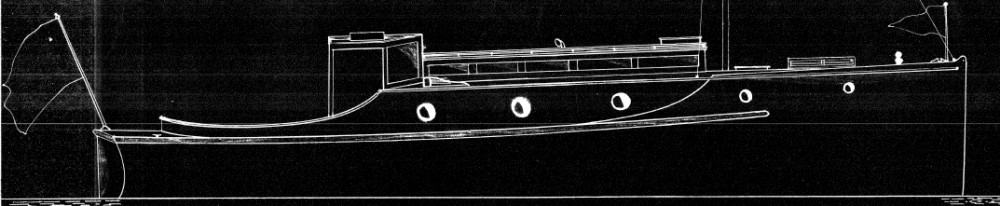
Royal Visit 1963 – Britannia

Photo taken by William (Bill) Fletcher, ex commodore of the Devonport Yacht club, Grant Cardno’s step grandfather.
Fletcher was an active photographer.
While Britannia is an interesting backround boat, waitematawoodys is more interested in the wooden launches in the foreground.
Any input on naming them would be appreciated.

Photo supplied by Grant Cardno