Unknown's avatar

About Alan Houghton - waitematawoodys.com founder

What is Waitemata Woodys all about? We provide a meeting point for owners and devotees of classic wooden boat. We seek to capture the growing interest in old wooden boats and to encourage and bring together all those friendly people who are interested in the preservation of classic wooden vessels for whatever reason, be it their own lifestyle, passion for old boats or just their view of the world. We encourage the exchange of knowledge about the care and restoration of these old boats, and we facilitate gatherings of classic wooden boats via working together with traditionally-minded clubs and associations. Are you a Waitemata Woody? The Waitemata Woodies blog provides a virtual meeting point for lovers of classic and traditional wooden boats.
 If you are interested in our interests and activities become a follower to this blog. The Vessels Featured The boats on display here (yes there are some yachts included, some are just to drop dead stunning to over look) require patrons, people devoted to their care and up keep, financially and emotionally . The owners of these boats understand the importance of owning, restoring and keeping a part of the golden age of Kiwi boating alive. The boats are true Kiwi treasure to be preserved and appreciated.

Kotanui


KOTANUI

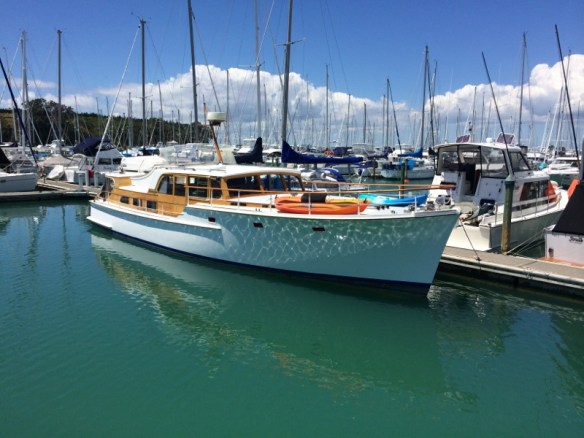
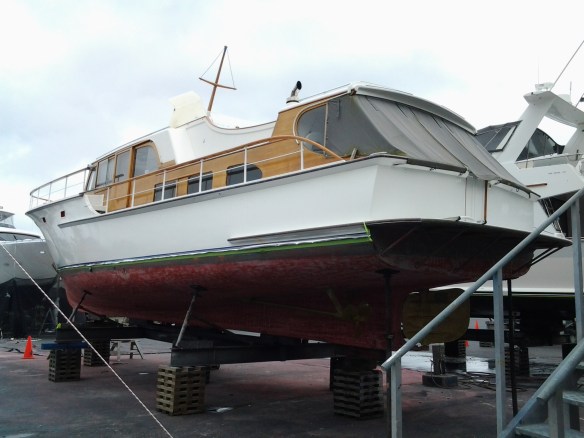
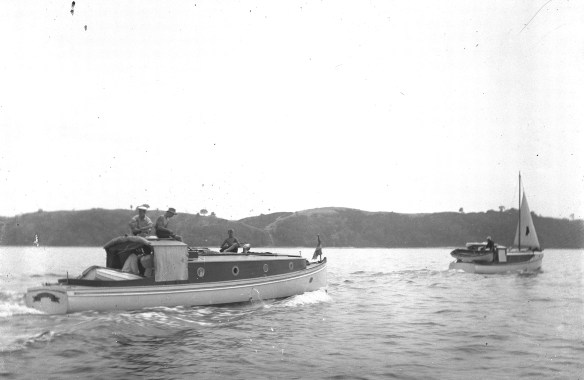
While down at Milford CC over the weekend ‘supervising’ the painting prep on Rorqual, the launch Kotanui was being hauled out. A little bit of a tight fit 🙂

I have also posted a photo of her being hauled out at (a long time ago) on the beach at what I think is now ‘Gulf Harbour’. Nathan Herbert will correct me I’m sure, it is after all his photo.
Kotanui is a slightly scaled down version of Trinidad & differs in that she has twin engines/screws.

30-10-2016 Hauled out again – this time at Gulf Harbour (photo ex Ken Ricketts)

20-05-2020 Update ex Glenn Martin – photo below of Kotanui at Milford Marina

Kotanui May2020

A proud NZ maritime family – the Guthrie’s

This slideshow requires JavaScript.

The Guthrie’s

CYA member Graham Guthrie & brother Roger’s great grand father, Henry Guthrie, settled in Dunedin in July 1864 from Largo in Scotland. He married Isabella Graham in 1866 & became a ship owner & broker. Most of the ships owned by Henry initially were jointly owned with mainly with his younger brother Walter. Sir William Larnach (Larnach Castle, Dunedin) was another co-owner & several joint ships can be viewed today on the walls of the castle. One joint ship has the claim of taking the 1st shipment of frozen lamb to Britain.

However from 1878 he was essentially the sole owner of the vessels.The Laira an iron barque built in Sunderland,England was owned by Henry from 1889 to 1893.
A large number of ship passed through his hands in his role as a broker. He was a member of the Otago Harbour Board in 1879-1883 and 1892-1894.
It appears that he was bankrupted in the late1880’s but all their children received a sound education and the family lived a settled and comfortable life.
Henry died  on 21st April 1913 in Rattray  St Dunedin as he was walking up the steep hill to his home.
The photo above shows the ship Alcestis when she ran aground in Otago Harbour c1880. This ship ‘gave’ its name to the Guthrie family launch, Alcestis (photo attached), which features frequently on this site.
Update / photo from Russell Ward – photo of an unidentified tug -possibly ‘Dunedin’ – towing Alcestis out of Otago after her grounding.
I guess she lived to sail another day unlike many of them on that coast.
photos & details ex Roger Guthrie

Florence

This slideshow requires JavaScript.

FLORENCE
Designed & built by H.N. Burgess in 1910, she has survived almost ‘un-touched’ by the wood butchers hands & today is as graceful as the day she was launched at Judges Bay. Florence, 33′ carvel planked kauri, has been lucky with her recent owners, Mike Hunter & now Adam Wild who is undertaking some wonderful work to present her in the condition she deserves. AH
Harold Kidd Update
Additional photo of Florence on her trials in March 1910, no tramtop, no dodger, just a flushdecker with a raised foredeck, terribly advanced and chic for 1910.
29/07 – The tramtop and dodger were put on in August-September 1919 at the Victoria Cruising Club’s haulout yard. F Price, her then owner, was Vice-Commodore of the VCC. The pic of her with two masts is probably taken in early 1920 and she’s flying his VCC V-C flag.

Around the yards – Karanga, Kiwitea & Rover

This slideshow requires JavaScript.

KARANGA, KIWITEA, & ROVER

Three nice classics spotted hauled out in the last month or so by Ken Ricketts – more info on the boats history, owners etc would be most appreciated, post your comments here or email to:
waitematawoodys@gmail.com
Note – Karanga was at West Harbour and Kiwitea and Rover were at Gulf Harbour.
Harold Kidd Update
KARANGA was probably built by Collings & Bell for Keith Otway of Takapuna in 1948.
KIWITEA, according to the 2006 owner I spoke to, was built by Lidgards at Kawau post WW2 which is possible I guess.
There have been many ROVERS. A 28ft ROVER was built by H.N. Burgess at Judges Bay in December 1912 as DRAYTON (I) and renamed ROVER in 1915 when DRAYTON II was built. I suppose it’s possible it’s the same craft. I’ll check on pics of DRAYTON.
Photo (ex Heather Reeve- ‘Paea’) of Karanga at Oneroa 22/23-03-2014
Karanga

Summer Wine

SUMMER WINE
Summer Wine – could be a very special boat, I suspect she was designed by one of NZ’s most talented modern(ish) yacht designers, Des Townson. He only designed (I think?) one launch & Summer wine could be it. You do not have to be a rocket scientist to iD most Townson boats – not a lot of right angles on them 🙂
I said hello last weekend as I cruised past her stern in Oneroa, I would love to know more about the boat, she was flying the CYA burgee but I can not find her in the database?
ps I might be wrong about her being a Townson, more knowledgable people than I have question my judgement on this launch – so jump in with your view.AH
An Update From the Owner – I was wrong but right 🙂 AH
MV SUMMER WINE (registered as such to avoid confusion with the plethora of Summer Wines) was designed and built by Noel May of Bucklands Beach, and launched in 1993, for his own use in retirement.  Noel had been a long time friend of Des Townson and had built a number of Townson keelers, culminating in the build of ARISTOS, the only launch designed by Townson.  The two launches are similar, but distinctly different in both dimensions and layout, in that they share the same materials (triple kauri hull, epoxied inside and glassed outside, teak coamings, glassed and clear finished, walnut panelling interior).  ARISTOS has recently been purchased from Whitianga and is now in the OBC in the capable care of a jeweller, I believe.
SUMMER WINE hopes to become a classic when she is old enough, meanwhile her owners,  most certainly are old enough to be classics, although their construction may let them down a bit, are content to be ordinary members of the CYA, hence the burgee.
My daughter, who knows about such things, took the opportunity to spend some time with Noel May shortly after we took the boat over and scanned a number of photos of the designing and construction and launching which she made into one of those self published book thingies.  We have spare copies aplenty by the way, which the CYA is welcome to one of if there is any interest.
We have covered a lot of miles in the three and a bit years past and have found her to be vice free, comfortable, and manouverable due to her little twin Yanmars. Dennis Rule
26-03-2017 Photos below of SW at Pine Harbour – Mar2017 ex Ken Ricketts

Ngaio

NGAIO
I’m pleased to be able to announce that after being ‘on-the-market’ for several years, the 1921 Arch Logan 36′ launch Ngaio now has a new owner. She passed her survey with flying colours & has been hauled out & is now safely in a shed for a major external renovation.  As part of the work she will return to her original colour scheme i.e. a dark (black) navy blue. Above are photos of her post launching (possibly taken in Devonport), today – both in the water & at her recent haul-out, a preliminary sketch of her new colour scheme & wonderful scale model built of her by CYA member Bruce Tantrum.
Also click this link to view a youtube clip from the recent CYA Riverhead Cruise.
Her new owner has already applied to join the CYA, so Ngaio will be a wonderful addition to the launch fleet.
We will follow the project with great interest.
26/07/2013 – The restoration begins, photos added of haul out & transport to her new (temporary) home – a boat shed for the work.

Weekend 1

All fittings are off, belting 50% off, mast and stack removed, paint stripping beginning.

Findings so far; pohutakawa stem, kauri carvel planking, original waterline belting line cut into hull, original color is black hull, 13 coats of paint below the belting strip, 6 above the strip.

11/08/2013 – On Bruce Tanturm’s instructions (I always do what BT’s tells me to) I visited the boat shed today & meet the new owners, pleased to report that Ngaio has fallen on her feet 🙂

To quote Bruce “Her beauty out of the water, as one would imagine, is complete, simple and beautiful. The hull’s multi layered accumulation of many decades of paint has been removed revealing the symmetrical artistry of master craftsman Jack Logan’s full length bare kauri planking, all in absolutely perfect condition. In the next few days, she is going to be splined and fibreglassed to preserve her.

Never again will this particular definitive testament of material, form and craftsmanship be seen, never”

I can happliy add that the splining & f/g will only be above the waterline.

A mini wooden boat show.

This slideshow requires JavaScript.

A mini wooden boat show.
Popped down to the Salthouse yard on Sunday to catch up with Barbara & David Cooke & got a very pleasant surprize – 3 of our best classics tied up at the wharf looking pretty wow in the afternoon light. Linda was glowing from her recent coat/s of Uroxsys. (photos ex the iphone) . From left – Trinidad, Linda & Luana.

Kawau Island Copper Mine

KAWAU COPPER MINE

If you live in Auckland & own a boat at sometime you will have cruised past the remains of the mine & no doubt wondered how & why it was constructed on this beauitful island in our Hauraki Gulf – well read Russell Wards story below & next time you pass by you will be the ‘clever one’ aboard that knows the answers 🙂 AH
story by Russel Ward
Below is a bit of nostalgia. It is the engine house at the Kawau copper mine when I first saw it a misty day in 1961. A lot of it has fallen since then.
It may be of interest to you all that the pumping engine didn’t actually do much work at all because it became obvious to the engineer in charge that the rock they were having to get though was harder and harder. Moreover the initial expert had grossly overestimated the amount of copper available.
Of great interest is that a beam engine enthusiast in the UK, Kenneth Brown has visited the Kawau pump house and measured it and thus deduced the size of the engine. He is adamant that it was transported back to Cornwall making it the most travelled Cornish pump engine ever. This was a bit early for the Thames miners 20 or so years later, it would have sold readily in NZ. 
Ken Pointon of MOTAT, however is certain that it went over to Australia. Interesting. 
I wrote article below 20 years back, its still good bedside reading. RW

THE KAWAU COPPERMINE AND ITS PUMPING ENGINE – Russell Ward

I first saw the Kawau copper mine in the late 50’s and have nursed a fascination for its history ever since. My primary interests are mechanical and I often wondered what sort of engine had been installed and the nature of its fate. There was an old boiler lying alongside, but it appeared to be much more modern than the engine house. It was evident that the engine house was of a type found in Cornwall and that a beam engine typical of Cornish mines was likely to have been installed. I researched the nature of the workings in the early 1990s and reported on my findings in “Breeze” at the time.

My interest in the old engine was revived in Finland, of all places, where I was attending an EU classic steamships meeting. A chance mention of the Kawau engine to Brian Hillsdon archivist for the Steamboat Association of Great Britain led me to an exchange of correspondence with Kenneth Brown, a member of the Trevithick Society for the Study of Industrial Archaeology in Cornwall. Kenneth kindly sent me a copy of the Society’s journal, which reported on the various attempts to mine copper at Kawau and the possible fate of the pumping engine. I am indebted to the Society for allowing me to draw heavily on this document.

A SHORT HISTORY OF THE MINE

In the 1840s Kawau was bought and settled by the Bon Accord Mining Company of Aberdeen on the strength of its copper deposits, which had been discovered in 1844. Mining started using local labour but, in January 1846, a party of miners arrived from Cornwall with Capt James Ninnis head operations. Ninnis, an able manager, was from a well-known mining family and a strict teetotaller. He founded a flourishing Kawau Total Abstinence Society.

For a time, 200-300 people, miners, surface workers and their families, were living on the island in timber dwellings. At first ore was shipped to Sydney with the intention of sending it to Wales for smelting. However the ore displayed an alarming tendency to spontaneous combustion, not healthy in a wooden ship, which led to the decision to build a smelter on Kawau itself. The copper content could then be raised from 6 to 30 percent making the ore safe to ship to Swansea for final refining.

The copper lode itself lay in the small (though originally much larger) headland we all know, just 18 ft below the surface. As the miners sank shafts the workings inevitably went below sea level. A 12 hp steam engine was bought in NZ and installed to work pumps in one of the shafts and possibly a crusher as well. A horizontal level, or adit, ran into the mine from an opening in the headland above sea level. To provide a greater working area, the miners blasted the cliffs and used the rubble to form a narrow strip retained by wooden piles, which incorporated a wharf to load ships. A longitudinal section of the mine, on a plan drawn by Captain Ninnis in 1848, shows four shafts. Three were inland, each equipped with a horse whim (or gin) for hoisting. Lawyer Frederick Whitaker owned the fourth shaft.

Whitaker seems to have had his share of skulduggery in the young colony. In this instance he managed to obtain from the government the right to mine beyond the high water mark. His workmen, however, were caught red handed mining inland on the other claim. Protracted legal battles ensued, resulting in the company having to buy Whitaker out for £5000. While there was an expectation that the copper deposits extended out under the sea as often happened in Cornwall, the unfortunate consequence of the physical integration of the inland workings with Whitaker’s undersea workings probably hastened the later flooding of the mine.

Ninnis left when his contract expired and his place was taken by Begher a German metallurgist with experience of smelting but not mining. As the mine went deeper, the amounts of water seeping in became ominous. In 1852, with the work at 24 fathoms down, the ingress of seawater overcame the pumps, flooding the mine. Begher set sail for England to persuade the company to put up the cash for increased pumping capacity. At this time, the company was reformed as the North British Australasian Company and management was from London.

A report by mining engineers John Taylor & Sons was optimistic on the prospects for the mine and proposed

“… To send out immediately a Cornish steam engine of sufficient power to drain the mine with facility to a depth of 60 fathoms at least and keep it clear of water even if the present quantity should be doubled.”

It is on record that the 330 ton barque Baltasara was purchased by the North British Australasian Company and despatched from Falmouth in late 1853 or early 1854 with the engine, engineering and mining personnel on board. The Perran Foundry was one of the three major builders of Cornish beam engines and is the only one likely to have shipped an engine from Falmouth. The engine was erected in the engine house and ready for work by 15 July 1854. In 1995 it was deduced from on site measurements that the engine was probably about 36” bore and had a stroke of between 8’ and 8’6”. More of this later.

By August 1854, the new engine had dewatered the mine to the 24-fathom level where the work had ceased three years earlier. Begher was back in charge but a Cornishman Capt Anthony Bray was appointed to oversee the actual mining. The difficulty was that the deeper the mine went, the harder the rock became and the costs escalated. The 34-fathom level was finally reached in September 1855 to find that no payable ore was available. Begher had, moreover, grossly overestimated the quantity of easily workable ore left at the 24-fathom level.

Shortly after, the Sydney agent began refusing to honour Begher’s heavy drafts on the company. The decision to recoup company losses by stripping the assets seems to have taken the English shareholders by surprise. By December 1855, all mining had ceased and the engine had been or was about to be dismantled after little more than a year’s work. The only result was 32 tons of copper ore shipped back to England and a further 50 tons said to be ready for shipment from the smelter.

After this setback, the company sold its mining interests in Australia and concentrated on sheep farming.

The Mining Journal, a weekly newspaper of the period reported quite fulsomely on the recriminations at the shareholders’ meetings that ensued. They reveal a sorry tale of failure of the mine after little more than a year’s activities. As a result Taylor resigned but the directors and Begher seemed to have been primarily responsible for the company losing £30,000 on the venture. The previous company apparently lost £45,000; these were quite substantial sums for the day.

WHAT BECAME OF THE ENGINE?

Following the abandonment of the mine, it seems that the engine was returned to England for sale. The suggestion is that the company hoped to return it to the Perran Foundry for resale. There is no record of it making it back to Perran’s works. The plot thickens a little and the following advertisement, which appeared in the Mining Journal 4 October 1856, is interesting.

FOR SALE

            Mr Little will sell by auction at Devoran in the port of Truro on Monday 13 October next at Twelve o’clock the undermentioned materials all of which will be found in excellent condition (some of the pitwork quite new) and lying on the wharf convenient for shipment:

A steam engine 36″ cylinder, 8½ ft stroke equal beam. Large iron angle bob, with plummer blocks and brasses about 3 tons 31 9ft 3in pumps (ie sections of the rising main)

Then all the pitwork in detail including 12 and 14 in brass plunger poles, 10 and 12in iron buckets 6 and 7in brass buckets and clacks.

May be viewed on application to the Redruth and Chacewater Railway Company’s offices at Devoran

From Kenneth Brown’s measurements, it would appear that this might be the same engine. Certainly the ancillary equipment offered suggests that it was recently removed from a mine. Moreover, it appears that some of this equipment was not associated with the new engine but was from older pumping activities.

The more modern rusty boiler on site dates from a short-lived attempt to rework the mine in 1898-1900 by a Capt Holgate. It features in a picture in the Auckland Museum showing its installation in a lean-to alongside the old engine house. Jet machinery was installed in the shafts for pumping.

I have included a picture scanned from the latest copy to hand of the British journal Old Glory. It is part of an article about a preserved Cornish tin mine. The Levant mine ceased work in 1939, but was reopened and worked again in 1960. Its venerable pumping machinery was taken in hand in 1935 by a group of local enthusiasts and conserved. The National Trust now preserves the mine. Would that we had had some preservation enthusiasts in 1935 over here! Our only enthusiasts were wielding gas axes and chopping our heritage up for the melting pot.

The Kawau copper mine pump house is worthy of rebuilding to its original configuration. It stands as the first major site of very early colonial industrial activity and should be reinstated. Any lobbyists keen to take up the cudgels?

Harold Kidd Update

I had a lot to do with the mine in the 1960s when I acted for a couple of eager fellows who were sold on the idea of recovering the rails in the mine. The mine had run well out under the sea and flooded as soon as the workings ceased. The seawater acted as an electrolyte, depositing the copper from the exposed workings on to the iron trolley rails in a fairly pure form. Despite valiant attempts, the two guys just could not dewater the mine to make it safe enough to get at the rails.
I took a party of Japanese mining engineers to the mine to show them around with a view to raising capital to get the appropriate gear. To impress them (I thought) I turned up in my father’s brand new Datsun Bluebird, one of the first Jap cars sold here. But nothing impressed them, especially not the rough trip to the pumphouse on the tray of a beat-up WW2 GMC truck. Guadalcanal all over again perhaps?
So the copper is still there for the taking…if you’re brave enough!

Winter – yeah right

This slideshow requires JavaScript.

Winter – yeah right

Forecast looked good & I had a wee bit of reading (work) to catch up on so I gave Raindance a fright & slipped the lines on Friday morning & headed down to Waiheke Island. Chris Miller (Rorqual) came down late afternoon. We were rewarded with a great weather, mill pond bay & crystal clear water. Plus not a lot of boats overnighted.

Trinidad – 52′ Salthouse Motor Yacht

Trinidad – 52′ Salthouse Motor Yacht

Launched in 1965, designed by Bob Salthouse, built with 3 skin kauri planking at John Salthouse’s Greenhithe yard. She featured on the cover of the September 1966 edition of ‘Sea Spray’ magazine.
Powered by a 6LX Gardner diesel she cruises comfortably at 8.5>10 knots, with a cruising range of 1000miles. In my mind there are a few things that make a boat a ship, one of them is an ‘engine room’ versus an engine compartment & the second is a ‘workshop’ & the last is a galley that is a separate room – Trinny sports all three of these.
Trinidad is a very spacious vessel with 6’9″ headroom & her wheelhouse enjoys excellent visibility & is one of the most used areas on-board.
Trinidad is a true blue water ship with passages to Australia & a circumnavigation of NZ.
Her owners, Barbara & David Cooke maintain her to a standard that some would say is better than new & she is much admired where ever she drops anchor. AH