Sterling Girl

Image

Sterling Girl

STERLING GIRL
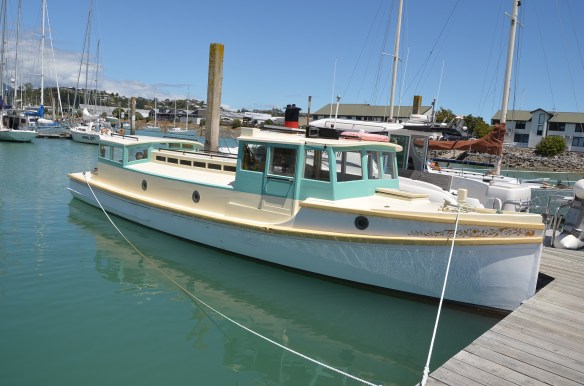
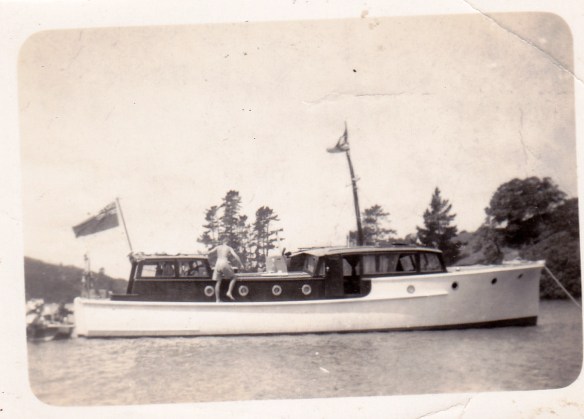
Built by Bailey & Lowe in 1913. Being a B&L Harold K will know doubt be able to shed some more light on her.

photo ex classicgameboatnz

Harold Kidd Update

Bailey & Lowe were agents for the very fine US-built Sterling marine engine and so were keen to promote the brand by incorporating the name in names of boats they built for themselves and even others eg the launches STERLING (2 of them), STERLING GIRL and the motorsailer LADY STERLING. STERLING GIRL was built for K.R. Taylor of Birkenhead and launched in November 1913. She had a 20-35hp Sterling engine and was built on their 35ftx 8ft 6in launch moulds that had produced a long line of fine boats including STERLING, PRINCESS, COUNTESS etc and which in modified form, produced the later MANU and ROMANCE II. Taylor sold her to Capt. G. H. White during the winter of 1920 when he had commissioned the 48ft schooner-rigged motorsailer LADY STERLING from Bailey & Lowe. Roy Henderson owned her in 1925 and then she was sold to the South Island. I saw her in Nelson in 1999 when she was owned by Ross Power of Christchurch and I think she’s still there.

10-12-2015 Update from John Burland

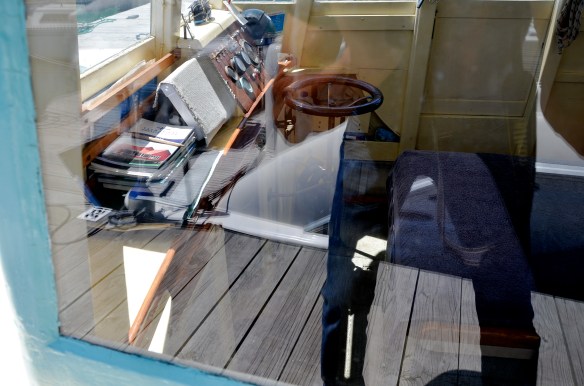
Photos below in Nelson Marina & she is still owned by Ross Power. Love the Ford Model T wheel.

Sterling Girl

Sterling Girl - wheelhouse


Same bay, same view

Image

Same bay, same view

Same bay, same view, same cold beer – only difference a few $000’s

Took this ‘selfie’ of Raindance off the northern end of Pakatoa in early 2012, was standing on the beach & thought other than maybe a few more feet on RD, I was pretty happy.

Valsan – an ageless classic

Image

Valsan - an ageless classic

Valsan – an ageless classic

details & photo ex Ken Ricketts, edited by Alan H

One of our really magnificent ageless classics of all time & so wonderfully original & unspoiled. Ken commented that if you look at her you can see Couldrey, Ford & Lidgard all in her, the bridgedeck is classic later Ford, refer Lady Karita, the flair is very Couldrey — refer Tiromoana, the sheer line in the sweep in the deck could be all 3 & there are also resemblances in the shear & flair to Awarua, which of course was part Lidgard along with Ted Cooper.

Ken took the above photo of her Christmas 1948 in Schoolhouse Bay. She was launched as VALSAN, after the original owners two children – Valerie & Sandy. She was later sold to a publican, those surname was Annan & he renamed her Lady Edith, after his wife. When Arnold Baldwin bought her he returned her to her original name.

Her original engines were either Graymarine or Kermath, but Ken’s memory is leaning towards 6 cyl flathead 90 hp Graymarine’s. He remembers the instrument clusters & they had a polished metal backplate with the name in the middle at the top. These were replaced by 2 x Falcon 4.1L marinised petrol car engines in the 1970s.
Her present engines are 4 cyl. (100hp?) Mitsubishi diesels. In Ken’s opinion not becoming to a vessel of her stature. She has deep under hull exhausts now, amidships & bubbles away at the sides, used to be out the tuck just above the waterline, about 10 inches in from each side, when the petrol engines were fitted.

Harold Kidd Update

Ken is right with the engine brand this time (after having a bob each way). (Alan H called James Mobberley at Moon Engines & asked what the motors were) VALSAN was built by Lidgards for Alex Harvey Jr as a 38 footer with twin 90hp Grays. She was lengthened (as were so many of these big bridgedeckers) to 45ft by the time she went into NAPS as Z10 in 1942-3, possibly during the time she was being repaired after going up on the Castor Bay reef in February 1940. Peter Annan bought her when she was demobbed in 1944 and renamed her LADY EDITH. Annan had been the long-term owner of the big Logan cutter THELMA. In 1948 Annan sold her to Arnold Baldwin who changed her name back to VALSAN.

BTW Bill COULDREY’s surname is spelt COULDREY. (fixed. thx)

I think it’s just empty blather to “see  Couldrey, Ford and Lidgard” in her. The greatest influences of all were the styling themes seen in the US yachting magazines of the time, like RUDDER and MOTOR BOAT & YACHTING which influenced all local designers and owners a thousand times more than the Auckland designers and constructors influenced one another.

PS Peter Annan died in 1951 aged 82. He was a Master Mariner but had retired to the hotel trade when he bought VALSAN.
Ozone & Rosemary

Image

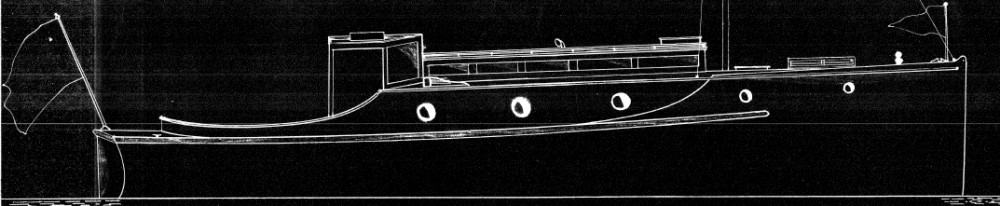
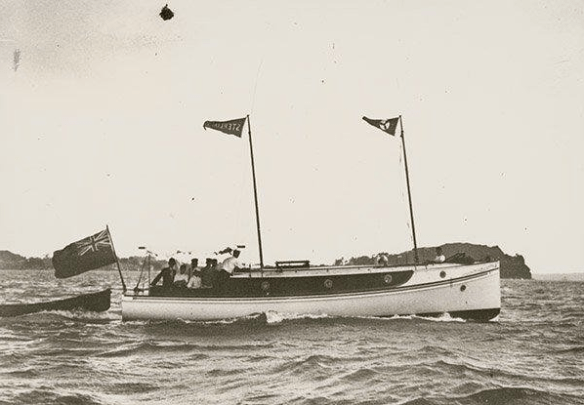
Continuing the game fishing link today – this time Ozone & Rosemary – more details below

photo ex classicgameboatnz

Harold Kidd Update

There were two OZONEs which makes matters confusing. The first was built by Collings & Bell in 1912. The second was built by Percy McIntosh in Whangarei in 1914 for Harold Vipond for the Auckland-Wade River trade but which Vipond took north to the Bay of Islands in 1925 or perhaps a tad earlier for game-fishing. 

ROSEMARY was built in St.Mary’s Bay by Leon Warne in December 1920 for himself and his brother George and was taken north for game-fishing out of Russell at about the same time as OZONE. The Warne brothers then set up boatbuilding, repairs as well as gameboat chartering at Russell. ROSEMARY originally had a Scripps 4 cylinder but was later fitted with a Redwing. There wasn’t much love lost between Chas. Collings and Leon Warne after Warne served his time with Collings and set up alongside him in 1916. Warne shared that opinion with Alf Bell who probably worked for Leon when he left the Walsh Brothers at Kohimarama; but Alf Bell didn’t build ROSEMARY. Perhaps there’s confusion because Warne’s foreman was Alf RAGG.

Both launches were very successful in promoting the deep sea angling sport in the Bay of Islands, both from Russell and Whangaroa. The boom in the sport was accelerated by Zane Grey’s involvement in the later 1920s but ground almost to a standstill in the Depression, picking up gain by 1937.

ROSEMARY was originally launched a a dashing flushdecker. See “N Z Vintage Launches” p92 for a pic of her at speed on the Waitemata in the 1925 Anniversary Regatta.

Cutting From Northern Advocate – 30 Dec 1920 ex Harold Kidd ex Papers Past


Avalon

Image

Avalon

AVALON
I do not know anything about the above launch other than she was actively engaged in the game fishing sport.
Any help re more info much appreciated.

photo ex classicgameboatnz

Harold Kidd Update

AVALON was built by Collings & Bell in December 1927 for Peter Williams of Russell for use as a game fishing boat in the Bay of Islands. She was one of Collings’ typical concave-convex square bilge designs, 36′ x 8’6″ x 3’6′. She had a 85-100hp Redwing engine and was designed for 16 knots. She was often chartered by Zane Grey who took her to Queensland in 1936 for game fishing there. Some few years ago she was exported to the US to the Zane Grey Museum, somehow avoiding the then Antiquities Act.

And more

OOPS Zane Grey chartered AVALON to chase sharks at Bermagui, NSW, not Queensland. She came back to NZ after the expedition of course. And I may have made a glib assumption that she was square bilge to his “concave-convex” design like the other Bay of Islands game launches he built like ALMA G and ZANE GREY (later ALMA G II) for the Arlidge brothers etc. I am doubting that somewhat and wonder if anyone can post a hull shot of her?

And more

All’s well. I’ve turned up a pic of AVALON clearly showing that she’s square bilge, like ALMA G, MANAAKI, LORNA DOONE and ZANE GREY also built for the Zane Grey game fishing circus.

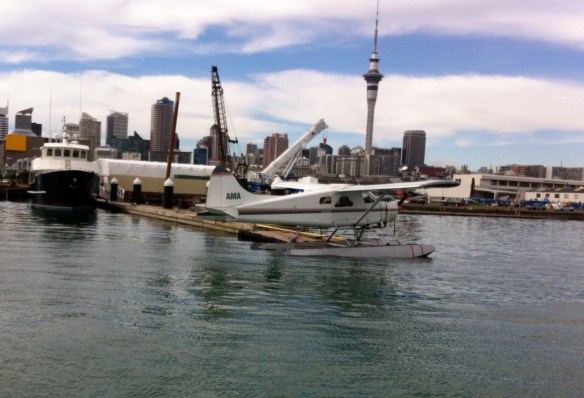
Its not a boat, but it floats

Image

Screen Shot 2013-08-25 at 10.29.57 AMIts not a boat, but it floats

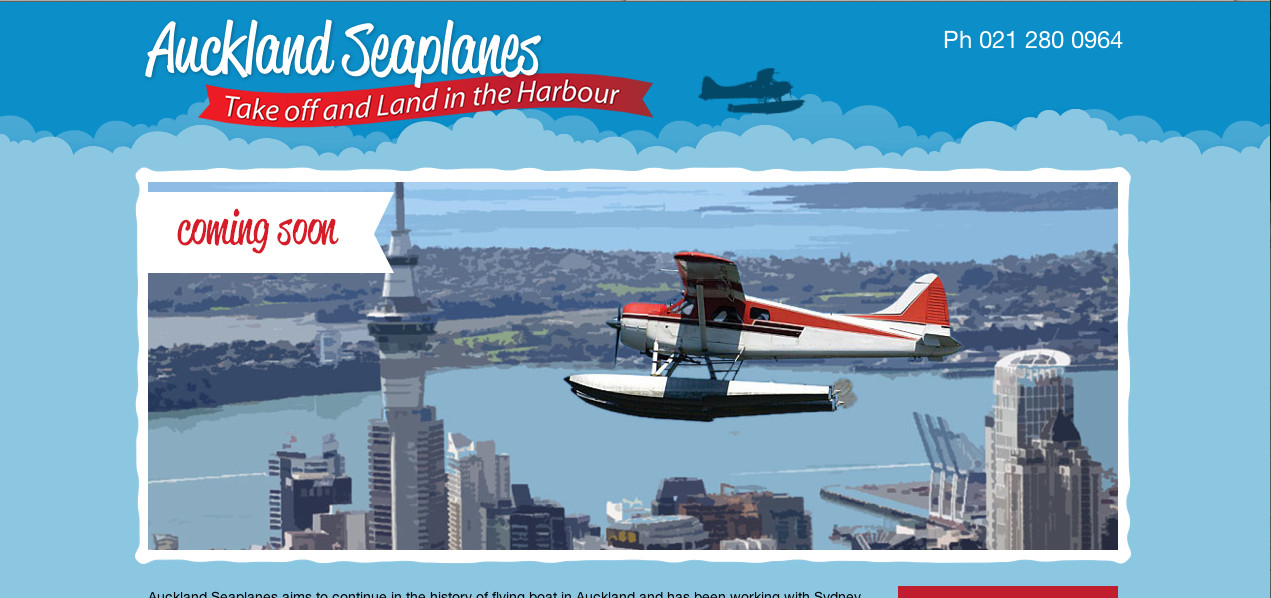
Now its not a boat, but it floats sometimes & at a guess I would say age wise it would almost qualify as a classic. We do not see many of these in NZ & even fewer in Auckland.
Anyone know anything about her, make etc & what she is doing at Westhaven??

Update – website here

http://www.aucklandseaplanes.com

Update from Russell Ward

More here: http://nzcivair.blogspot.co.nz/2013/08/beaver-takes-to-water.html  I am told by an esteamed (sic) friend that her registration used to belong to a Teal Solent. You show your age if you’ve ever crossed tacks with one of those on the harbour!

Let’s hope there are many more floatplanes in/on/over the harbour -could be like Victoria (the Canadian one) where one takes off practically every five minutes. Much more fun than these noisy eggbeaters.

Cheers Russell

Grey Witch

Image

This slideshow requires JavaScript.

GREY WITCH

Given the budget & a free hand the old masters could create something pretty special, Grey Witch from the T M Lane yard must have turned a few heads + 24 knots. Would have look amazing at that speed.

photo ex ‘Sir George Grey Special Collections (Auckland Libraries)

Update ex Harold Kidd

This image is reversed. T M Lane & Sons built her for C.A. Whitney of the Colonial Ammunition Co in December 1905. CAC had done rather well out of supplying .303 ammunition for the Boer War. She was originally fitted with a single 50hp (rated) Monarch engine but that was replaced by twin Antoinette aircraft-type V8s of 55hp each in late 1907. They were English-made by Adams & Co and were set up in line to drive in tandem, the forward one being de-clutched for economy running.

In the image, Whitney is taking the current Governor-General Lord Plunket for a blast around the Waitemata. She caught fire in her shed at Ngapipi Road in December 1916 and was completely destroyed.

Update #2

She did 17 knots on the Monarch, 24 knots on the two V8s (reputedly). The forward V8 was taken out and kept as a spare but she still did 17 knots with just one. I am sad that there is no recording of the sound she made at max (1400) revs on the two 7 litre side valve 90 degree Antoinettes, 2 V8s wuffling away like caged lions.The Adams-built Antoinettes had a reputation for breaking crankshafts but that doesn’t seem to have afflicted Grey Witch.

PS The Antoinettes had an early form of fuel injection which makes sense in an aircraft engine.

WW celebrates 100,000 Views

Image

WW celebrates 100,000 Views

WW celebrates 100,000 Views

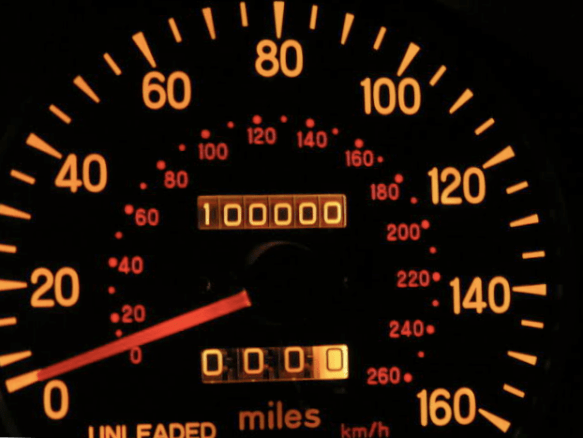
The site has just passed the 100,000 views milestone & I thought the photo above was an appropriate one to celebrate with.

Thanks to everyone for the support & a special thanks to all those that send me images & tales.

If you have any classic boating photos you want to share & more importantly record / store for feature generations to view – email them to me at

waitematawoodys@gmail.com

Now is also a good time to remind / enlighten people on using the ww site.
There are many ways to enhance your waitematawoodys experience, the easiest is by using the categories & tag sections on the right hand side of the page, here by clicking on a word/s you can search by any topic & see a summary of articles linked to that topic e.g. individual designers, build / launch year, CYA owned vessels, boat names or locations etc.
To get the most out of the waitematawoodys you really need to be a follower, relax its not some new cult, all you have to do is click on the ‘Follow’ tab that appears at the bottom of you computer screen on the right when you have the waitematawoodys page open. You then enter your email address* in the box that appears & now you will be able to:
(a) receive an email advising you when new articles have been posted or updated. Means you no longer have to check in all the time.
(b) allows you to make comments on articles that have been posted.

*waitematawoodys won’t divulge, sell or otherwise do anything silly with your email address

I hope this helps, if you need any advice at any time just drop me an email.
Alan Houghton

In the days before travel lifts & floating docks

Image

In the days before travel lifts & floating docks

In the days before travel lifts & floating docks

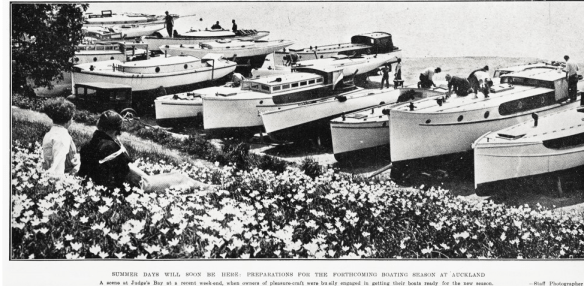
Boat maintenance was a lot cheaper in the early days, you could just head into Judges Bay, point the bow to the shore & power up, a couple of lengths of 4″x2″ & just wait for the tide to go out.

How did they keep their hats on

Image

How did they keep their hats on

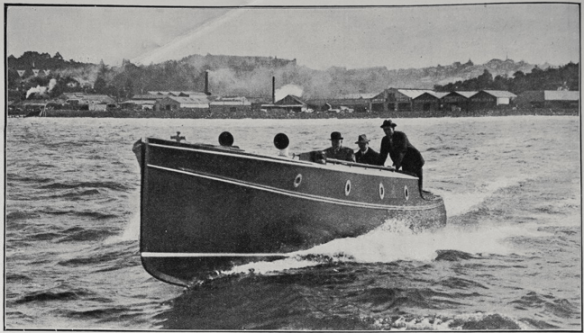
Thats the question of the day.
You see all the motor boats at full chat (love that saying – I stole it from Harold K) & the hats seem glued in place 🙂

Harold Kidd ‘Update’

SCRIPPS III was pretty quick with her 4 cylinder Model K Scripps, bore 5.5″ and stroke 6″ = 475 cu ins =7.6 litres. It was a straightforward side-valve engine with twin ignition, producing vast gobs of torque. A special feature was a vacuum bleed off the inlet manifold leading to a distribution box which in turn had flexible copper pipes which could conveniently be affixed to the back of one’s coat and then up the neck to the hairline and thence to the top of the head. This produced a respectable partial vacuum under the hat crown, keeping it firmly in place (unless one was a Mexican or Tom Mix or wore a ponytail).