Rongo

This slideshow requires JavaScript.

RONGO (II)

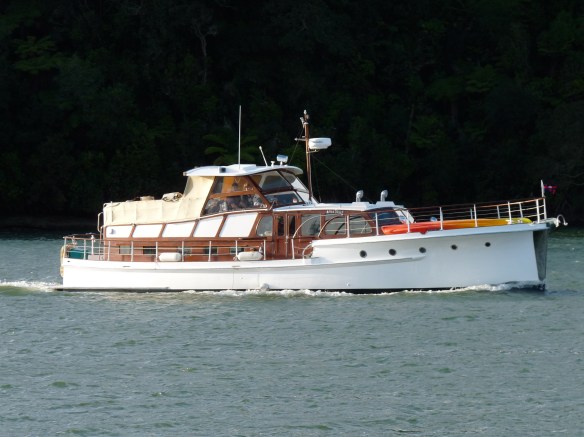
The above images of this rather grand & large launch have me stumped as to its identity, I’m sure its easy but today my mind is a blank. Photo says c.1930

30/05 – appears the collective brains trust agree on Rongo – thanks team 🙂

Harold Kidd Update

I’m certain it’s RONGO (II) when owned by W. Cecil Leys in 1930. She was built as GLADYS II by Bailey & Lowe in 1919 for Chas. Court of Stanley Bay and fitted with a 150hp Sterling Model FM 6 cylinder engine. Court sold her in 1930 to Leys who had her lengthened 10 feet and renamed her RONGO. Leys owned her until 1942 when she went into NAPS as Z20. Subsequent owners included R W Butcher (1942-44), Joe Moodabe (of the Civic Theatre) (1944-47), W J Henry (1947-49), W A (Wilkie) Wilkinson (1949) W A Kenny of Picton (1964) by which time she had a 1955 Gardner 5cylinder diesel. She came back north but went to pieces at Algies Bay in July 2007.

Update 2

1. Rongo went into NAPS with a Chrysler fitted around 1938, so they probably left that in throughout hostilities as ex-USN Chryslers (and GM/Graymarine 71 series) were standard issue, for parts rationalisation.
2. Walter Bailey designed her and Bailey & Lowe built her. I would have thought that she was manifestly Bailey & Lowe, not Lanes (although I do accept that all launches do default to Lanes in the case of doubt [and I won’t repeat my conceit that Garth built them all by himself at the risk of being flamed again by Alan]).
3. Mike Moodabe never owned her. It was his brother Joe, and then only briefly, from when she came out of NAPS in 1944 until 1947.

 
PS [sackcloth and ashes] a bit of misinformation I created myself…..I have now found the reference to Chas. Court selling GLADYS II to Sir W. Cecil Leys .. ….it was in October 1927, a lot earlier than I had thought. It was hard to pick out which of the references were to RONGO (I) and which to RONGO (II) (OMG here we go again!).
 
The 35ft RONGO (I) is very interesting. She was built as MOLLIE for Capt Somerville by T M Lane & Sons (really) in December 1911 equipped with an 18hp 4 cylinder Scripps. Capt. Somerville sold her to Percy Colebrook around late 1913. Colebrook sold her to Leys in August 1919 while he was having the second MOLLIE (later ALCESTIS/RAIONA) built by Joe Slattery. Leys had her extensively modified (cabintop raised, lengthened by 3ft etc) and renamed her RONGO. The work was done by Lanes who fitted a big 100hp Scripps in 1926 for which they were the agents.
When he bought GLADYS II and renamed her RONGO II in 1927 he sold RONGO I to J T Julian of Remuera. Julian retained the name RONGO and sold her to C W H Ronaldson in 1938. I lose track of her after 1940 but will work out what happened to her one day…undoubtedly a postwar re-name.
It’s all a bit convoluted……………
 
Update 3
Sorry to bang on about the RONGO tribe but I have found that it was Chas. Bailey who modified MOLLIE (I) for Cecil Leys in 1919 into RONGO (I). Lanes had their hands full with LUANA. At that time there were 5 big (45ft+) launches being built around the Waitemata; Collings & Bell with MARGUERITE (later LADY UNA), Joe Slattery with MOLLIE (II) (later ALCESTIS/RAIONA), Bailey & Lowe with ATATU and GLADYS II (later RONGO II) and Lanes with LUANA. The huge postwar demand was hard to satisfy but Chas. Bailey didn’t attract any orders for big launches for some reason.

Update from Baden Pascoe:

(refers to colour photo in slide show)

This is how she looked when I saw her. In my files I found she was a NAPS vessel, no Z20, 1/7/42 -27/12/43.

She had a 6L2 installed the same engine Joan had fitted. Conrad Robinson still has this engine at Warkworth. One good thing about NAPS, your boat came back with a very nice engine. At this time she belonged to R.W. Butcher of Auckland. The man in the white hat is dad, he could not get over the length of her and was concerned that she was hogging while they lifted her. He supervised the blocking of her keel once she was slipped. Very nice boat, shame she got wrecked. Very Lanes looking though!!

Wairangi

 
WAIRANGI
 
Story by Ken Ricketts
 
Designed by Wren Carey of Christchurch, as a pleasure craft for himself and his family. She was to be 17 meters long x 4.1 meters beam x 1.9 meter draft with 10 berths in 3 cabins. Her weight is estimated at 35 tons and she is perhaps a little different from other classic launches of that era in that she has a cruiser stern which, in a following sea  is very, very comfortable.
 
Well known boat builder, Andy Millar, of Millar & Tunnage, in Dunedin, was selected by Carey to build her, – which they did, from heart kauri, and completed her in 1934.  It is believed Wren Carey based her in Lyttelton, and mainly cruised Banks Peninsula, but there are photos, which show her in Picton, so Carey and his friends used her in the Marlborough Sounds, probably over the summer holidays. In those pre-war days.
 
Photos below show she sported 2 masts, the main mast, just in front of the wheelhouse, and the mizzen mast about over what is now the owners cabin, which is fairly well aft.
 
In those days the super structure stopped at the funnel, so access to the lower areas aft, would have been via an external hatchway, just aft of the funnel casing.
 
Her engine was Thornycroft, which must have been used as an auxiliary, with sail being used, when possible.
 
At the outbreak of WW2 she wascommandeered for use by the Lyttelton Harbour Board  as an inspection vessel..
 
At the end of hostilities, she became surplus to requirements, and was handed back to Carey, who then sold her in 1948, to the Lyttelton Harbour Board, (LHB) (refer Russell Ward’s comment below), as their pilot boat, and small tug. The LHB removed the old petrol motor, and installed a brand new Gardner 6L3 marine diesel, which is still operating perfectly today. They had an engineer in the engine room, who manually shifted the gearbox into forward, neutral & astern, on instruction from the skipper on the helm, but today a Morse system is used at the helm, which goes from mechanical, to electrical, to hydraulic, via an ingenious conversion system. She cruises at about 7.5 knots and uses about 6 – 8 litres of diesel an hour. There are very few 115hp marine engines today, with this low consumption figure, and the 4 new fuel tanks installed recently, will hold around 3,500 litres of diesel, which makes her ideal for expedition work or long passages.
 
LHB also removed her sails and the mizzen mast, and installed a radar above the wheelhouse, where the mainsail on its boom would have swung.
 
So began her transformation from a motor sailer, to 100% launch.
 
It can safely be assumed that Wairangi, during time with the LHB, has rubbed up against virtually every passenger and cargo ship visiting Lyttelton, from 1948, to the late 1980’s, when she was sold to Lionel Jeffries, an Auckland businessman, who used her as a pleasure craft. He also extended the superstructure aft, from the funnel casing, to what is  there today, using teak planking, to match the original wheelhouse upper works.
 
He sold her to Lew Ritchie, who used her as a dive and charter boat, out of Tutukaka, in Northland, for a few years, before putting her on the market, and finally selling it to Andrew Jackson, – a retired Auckland businessman, now living in Picton, who immediately started a large scale refit, and refurbishment of the vessel. Sadly, through years of neglect, it proved not possible to keep the exterior teak planks varnished, as many had split and needed filling, so they were painted over. To replace them would have been very costly..
 
Jackson was looking for an old, NZ built, classic launch, to undertake a couple of adventures abroad. At one stage, it looked like funding might appear, for an expedition, to search for the answer to what happened to Amelia Earhart, when she went missing in her epic 1937 round the world flight. A second plan, one which used her in Europe, in a 13 part television series,  looked like it may eventuate, but the worldwide economic downturn, saw both projects shelved.
 
With her low fuel consumption and huge range she is ideal for expedition work, and long range cruising.
 
The vessel has been fully refurbished, to the point, where the Jacksons now live aboard her, in the new Picton marina.
 
She still has her original call sign of ZMTM.
 
She is now for sale,  contact – Andrew Jackson on 021347988.
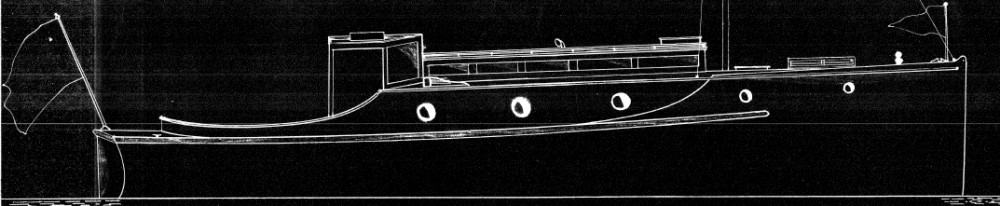
WAIRANGI 2013 --  BUILT 1934WAIRANGI - PILOT LAUNCH-  CIRCA 1948

Te Rauparaha

TE RAUPARAHA
Te Rauparaha was built by Chas. Bailey and Sons Ltd in 1938 for Harry Mills and was requisitioned in WWII as coastal patrol on the Northland Coast bearing the insignia of Q07. Te Rauparaha represented a departure to a more ‘contemporary look’ for the Bailey yard, featured in her beam and obvious elegance. She was 55 feet overall (53’4” on the waterline) and her bow was 14ft off the water and sported a magnificent flair, that can be seen on the later, albeit in reduced proportions, vessels that followed Te Rauparaha out of the yard.
Harry Mills turned over the ownership and running of Te Rauparaha to his fourth son Graeme (my father) in about 1962/3 and she was, until the late 1970’s our much-loved family vessel. I was practically bought up on her and still hold a half model of her crafted for my grandfather by Charles Bailey jnr.
Te Rauparaha was, for some years in New Caledonia where they ran tourist excursions with her. Her name was changed to M V ‘Tamara’. I do not believe that she is in New Zealand waters, but stand corrected on that. However, should anyone have any information as to her current whereabouts, and any other information, the Mills-Hillyer family would be very pleased.
The images above of our much loved family vessel are:
a) Sea trials off Brown Bay post launching.
b) As Q07 during wartime.
c) A more contemporary version (from my childhood) moored in Smokehouse Bay, sporting a flying bridge that my father had built in the 1960s.
Story & photos ex Pamela Hillyer, Harry Mills’ granddaughter
Harold Kidd Update
A true “Express Cruiser”, TE RAUPARAHA was the product of the late flowering of Chas. Bailey Jr’s genius, exemplified too by his design of the 94ft ketch NEW GOLDEN HIND for his old customer H.R. Jenkins (SHENANDOAH, 1929),which was built by Deeming Bros of Opua in 1939 and several outstanding sweet-lined contemporary fishing boats like KATOA, JOAN and MARGARET.
TE RAUPARAHA was fitted with twin 110hp Buda diesels which were becoming very popular at the time, supplied by Seabrook Fowlds and fitted by Allely Bros. They were replaced with Graymarines after her extensive wartime patrol work in WW1, often well off the Northland coast.
A motor launch to make the pulses race if ever there was one!
Update 22/05/13 – this is scary, just posted the above & CYA member Andrew Pollard (Aumoe) spots her for sale on trademe, appears to be in Noumea, listed yesterday click link to view http://www.trademe.co.nz/Browse/Listing.aspx?id=595731758
Update from John Senior
Mark williams and myself delivered her from Auckland to Noumea in 1979 to a kiwi owner who lived there and ran a buisnes of taking tourists out to Amede Light. She had extra seating installed and carried 80 pasengers, i think from memory she had two Grey Marine 6 cylinder diesels. It was a good trip taking 4 days to the hour.
 

Shenandoah Cruising in the North

Shenandoah Cruising in the North
Over the 1931/2 xmas holiday period Shenandoah cruised in company with Alcestis & Lady Margaret. Two of the photos above show Shenandoah off the settlement of Mangonui, one tied up alongside Alcestis (Guthrie family launch) at the Mangonui Store, now the site of the famous (in the Far North) fish & chip shop. The other photos are possibly on-route to Haruru Falls.

Movarie

MOVARIE 

story & photos ex Russell Ward

Bridgedecker “Movarie” was built for W Macpherson by W & G Lowe St. Marys Bay and launched in 1938. I was told that she was largely the work of Cyril Tercel (Lew’s brother) who was not long out of his time. The Motor Boat and Yachting 17 June 1938 article records that she was built as a “game fishing vessel and was very successful”. It seems that WW2 got in the way of Macpherson’s plans and HDK elicited that he apparently died in 1953 back in England.

We are not sure of the origin of her name –Macpherson’s house in the UK was called “Movarie”. I had always assumed the name was a contraction of the daughters’ names -as were many boats names– but not so. Doubtless Harold will find out in time.

Macpherson sold “Movarie” to Vic and Robbie Sanders not long after launching and they had the wheelhouse lowered and a dodger put aft. It gave her a purposeful, striking and handsome appearance, but IMHO she is not pretty. Her hull is gorgeous though.

“Movarie” was chartered to the navy and served on offshore patrol duties for the duration of the war. The second picture shows her in this role. .

After the war, the Sanders kept her until 1956 and later bought “Lady Crossley”. “Mpvarie” kept her original 40hp Russell Newberry engines until 1960 when they were replaced with Fords. One of them still survives albeit rather rusty. You can still buy them in the UK though very expensively. Lovely engines and easy to live with, popular with the barge people. Despite what you might expect, her shafts were inward turning –outward turning gives maneuverability, inward gives power. Anyway she would handle as a twin-screw boat but just more ponderously. Our RNZN minesweepers “Inverell”, “Kiama”, “Echuca” and “Stawell” had the same arrangement and were a handful too as many captains found.

We owned “Movarie” for five years from 1996 –you will recall that, in another Woodies entry, I blamed my buying a fizz boat on Andrew Johns and “Ruamano”. I was sad that the last surviving Sanders brother had died not long before. His son John said he would have been delighted to talk about her and gave me a lot of information and a few family photos.

Frustrated by her run down state and machinery, I took her out of the water for a couple of months early ’97. I replaced the flogged out Fords with newer ones and took the opportunity to replace the fuel tanks, the tops of which were rusted through. I put new steering gear in, attended to some interior woodwork and generally tidied her up. I also put her back to the original type masts.

She is a magnificent sea boat we enjoyed her company.

09-04-2016 – photo added – Movarie & unknown game fishing boat. Photo ex Hylton Edmonds via Ken R.

MOVARIE & UNKNOWN GAMEFISHING EX H.E

Karamana II

Image

Karamana II

KARAMANA II

I have always known her as just Karamana, but I guess she has to be Karamana II, as I’ve now read this morning, the original one, which was built for the Cadman family in the 1920s. has been created before her. The name, I read also, is, to quote, a “pig Maori,” interpretation of the name “Cadman.” — lovely name anyway, sounds good.

KARAMANA II is a WW II 105 ft Fairmile converted to a pleasure craft circa 1945-46 by the Cadman family powered by 2 x 6-71 GM Detroit diesels, or the Graymarine version of them, & was undoubtedly, the very best pleasure craft Fairmile conversion, I ever saw. From the outside she was, in my view, aesthetically lovely. I took this pic circa1948 on her moorings in Hobson Bay. She was always immaculate & hardly used, Disappeared from there in the early 1950s, & I never saw her again — I think perhaps she may have gone to the Pacific Islands.
Any news anyone has would be great, just email me at kenpat@ihug.co.nz

story & pic ex Ken Ricketts

Harold Kidd Update

Andy Ryland was my uncle. This Fairmile was sold to his mate Cadman after Andy was killed in the NAC Lodestar crash at Paraparaumu. Bob McDougall’s book tells the story about Fairmiles more than adequately.

Shenandoah

Image

Built in 1929, by Chas. Bailey & Son for Mr H R Jenkins, who did well making rubber products for the milking industry. She has had a few additions since then 😦

She had  Cummins diesel when new.

The early pic is scanned from the book by Jenkins’s daughter. The other pic is a wartime Navy pic.

Safari

SAFARI HISTORY
 
From recollections of Zelda Batterton (Nee,  McGuire) eldest daughter of Trevor Innes McGuire.
8 December 2012
 
Safari was built by refrigeration engineer and inventor Trevor McGuire during World War II.
Trevor was a business ownerwho had several businesses over the years. One of these was a business making refrigerators for Bond and Bond, Fisher and Paykel and McAlpine. He also had a building business in Fiji and a sawmill in Samoa. Trevor was also a founder of the Royal Suva Yacht Club. Prior to McGuire refrigeration he owned a saw mill located in the Waitakere ranges where the firm ran a Kauri logging business.
 
During the war the refrigeration business manufactured sectioned coolrooms and commercial refrigerators, which were invented by Trevor. Some of these were used by the Americans to store their deceased soldiers in before they were shipped back to America. The business was originally in Manukau Rd in Epsom, with about 6 employees, and the boat was built in a field out the back of the factory. A new factory was later built at 25 Fairfax Avenue Penrose. The refrigeration business was eventually sold to Fisher and Paykel around 1947, and the Paykel families were known to be onboard Safari during for weekend excursions.
 
Boat designer Dick Lang was a friend of Trevor’s, the two met in Fiji and the plans used for the boat were Dick Lang’s. A sister boat,  “Zephyr” was built later using the same plans. Zephyr was built by the Ellerslie Mayor at the time Horace Whyte, also a friend of Trevor’s . Zelda recalls going into the forest to collect Pohutukawa for the knees. Apparently they had to be carefully selected to be the right shape but in those days it was okay to chop up native trees. The NZ sourced kauri timber Safari was built from came from Newmarket, most likely from Odins Timber Company.
 
Safari was launched around 1940 in Mechanics Bay after being shipped by truck from Manukau Rd.
Trevor’s wife Madge did not like the water but she always came out on Safari to do the cooking. As “petrol” was still scarce, anyone coming out on Safari would donate war time petrol coupons. Trevor always wore a hat and had a cigarette dangling from his lips. He also had a ‘twinkle in his eye.” Zelda says they were very lucky children to have such fantastic parents and a brilliant childhood. Many hours were spent on the boat although due to the shortage of petrol this was mostly around Waiheke and Rangitoto Island.
 
[Just between us Zelda say’s with a smile] Safari had 26 people on board to go out and meet the NZ warship Achilles. Trevor took Safari across the bow of Achilles and a loudhailer boomed out “Will that launch please get out of the way”, whereupon Trevor apparently said “We’re smaller than them, they have to give way.” Madge was not impressed.
 
During the war Safari’s boat ID number was 1263. All boats had to have a large number for identification. A boom was placed from Devonport to Bastion Point to deter enemy vessels, with a small gap in the middle that was closed at night. Trevor came back too late one day to meet the curfew and had to stay outside the boom, where spotlights would be beamed across the boat during the night.
 
In the early years Safari was extended in length by Trevor McGuire, Zelda seems to think from 33 or 34’ to 38’ 

Atalanta (Rotoiti)

Image

ROTOITI (Atlanta)

ATALANTA  (Rotoiti)

Unsure of builder, approx. 40 ft . When Ken Ricketts first saw her in 1946-47 she was called Rotoiti & owned by a Larry Johnston owner of Johnston Blue Motors the airport transport bus service providers for Auckland & she was called the ROTOITI. He owned her from at least the mid 40s through to the 50s, he recalls she had a 6 cyl Kermath petrol engine. Kept in quite good condition & used fairly regularly.

Her original, “real” name, was ATLANTA, & it was not until Ken came in contact with her again many years later, in the 1980s, that he was told by the then owner, that they had removed all the old paint from the hull during a refurbishment, & discovered “ATLANTA” carved in to the tuck, in big letters about 1/2 inch deep. Unsure who changed it, or when the name was changed, but he feels by the look of her, she was probably built between 1933 & 1937, & it was probably changed in the later 30s or early 40s. Ken is pleased to say that the last time he saw her she was ATLANTA