Shenandoah

Image

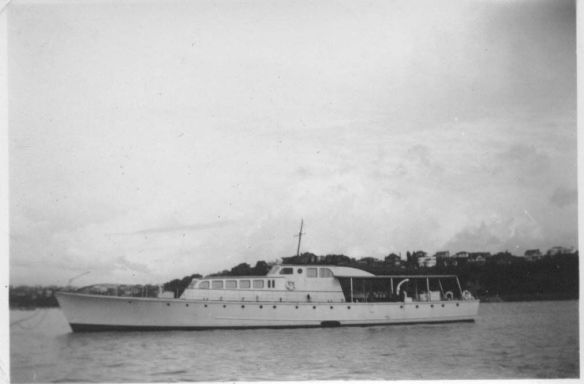
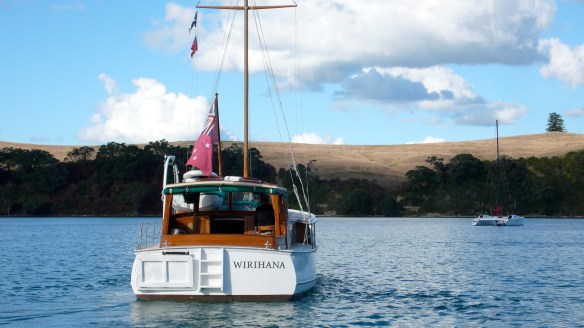
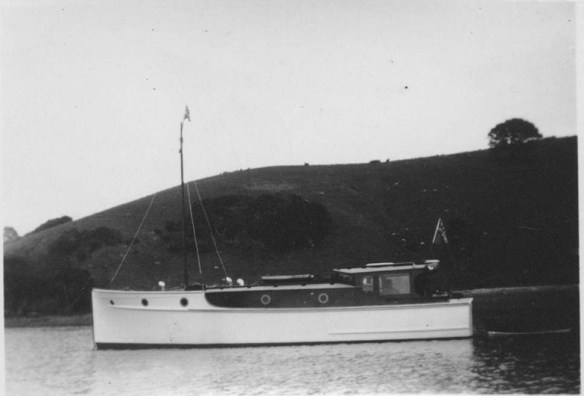
Built in 1929, by Chas. Bailey & Son for Mr H R Jenkins, who did well making rubber products for the milking industry. She has had a few additions since then 😦

She had  Cummins diesel when new.

The early pic is scanned from the book by Jenkins’s daughter. The other pic is a wartime Navy pic.

Safari

SAFARI HISTORY
 
From recollections of Zelda Batterton (Nee,  McGuire) eldest daughter of Trevor Innes McGuire.
8 December 2012
 
Safari was built by refrigeration engineer and inventor Trevor McGuire during World War II.
Trevor was a business ownerwho had several businesses over the years. One of these was a business making refrigerators for Bond and Bond, Fisher and Paykel and McAlpine. He also had a building business in Fiji and a sawmill in Samoa. Trevor was also a founder of the Royal Suva Yacht Club. Prior to McGuire refrigeration he owned a saw mill located in the Waitakere ranges where the firm ran a Kauri logging business.
 
During the war the refrigeration business manufactured sectioned coolrooms and commercial refrigerators, which were invented by Trevor. Some of these were used by the Americans to store their deceased soldiers in before they were shipped back to America. The business was originally in Manukau Rd in Epsom, with about 6 employees, and the boat was built in a field out the back of the factory. A new factory was later built at 25 Fairfax Avenue Penrose. The refrigeration business was eventually sold to Fisher and Paykel around 1947, and the Paykel families were known to be onboard Safari during for weekend excursions.
 
Boat designer Dick Lang was a friend of Trevor’s, the two met in Fiji and the plans used for the boat were Dick Lang’s. A sister boat,  “Zephyr” was built later using the same plans. Zephyr was built by the Ellerslie Mayor at the time Horace Whyte, also a friend of Trevor’s . Zelda recalls going into the forest to collect Pohutukawa for the knees. Apparently they had to be carefully selected to be the right shape but in those days it was okay to chop up native trees. The NZ sourced kauri timber Safari was built from came from Newmarket, most likely from Odins Timber Company.
 
Safari was launched around 1940 in Mechanics Bay after being shipped by truck from Manukau Rd.
Trevor’s wife Madge did not like the water but she always came out on Safari to do the cooking. As “petrol” was still scarce, anyone coming out on Safari would donate war time petrol coupons. Trevor always wore a hat and had a cigarette dangling from his lips. He also had a ‘twinkle in his eye.” Zelda says they were very lucky children to have such fantastic parents and a brilliant childhood. Many hours were spent on the boat although due to the shortage of petrol this was mostly around Waiheke and Rangitoto Island.
 
[Just between us Zelda say’s with a smile] Safari had 26 people on board to go out and meet the NZ warship Achilles. Trevor took Safari across the bow of Achilles and a loudhailer boomed out “Will that launch please get out of the way”, whereupon Trevor apparently said “We’re smaller than them, they have to give way.” Madge was not impressed.
 
During the war Safari’s boat ID number was 1263. All boats had to have a large number for identification. A boom was placed from Devonport to Bastion Point to deter enemy vessels, with a small gap in the middle that was closed at night. Trevor came back too late one day to meet the curfew and had to stay outside the boom, where spotlights would be beamed across the boat during the night.
 
In the early years Safari was extended in length by Trevor McGuire, Zelda seems to think from 33 or 34’ to 38’ 

Atalanta (Rotoiti)

Image

ROTOITI (Atlanta)

ATALANTA  (Rotoiti)

Unsure of builder, approx. 40 ft . When Ken Ricketts first saw her in 1946-47 she was called Rotoiti & owned by a Larry Johnston owner of Johnston Blue Motors the airport transport bus service providers for Auckland & she was called the ROTOITI. He owned her from at least the mid 40s through to the 50s, he recalls she had a 6 cyl Kermath petrol engine. Kept in quite good condition & used fairly regularly.

Her original, “real” name, was ATLANTA, & it was not until Ken came in contact with her again many years later, in the 1980s, that he was told by the then owner, that they had removed all the old paint from the hull during a refurbishment, & discovered “ATLANTA” carved in to the tuck, in big letters about 1/2 inch deep. Unsure who changed it, or when the name was changed, but he feels by the look of her, she was probably built between 1933 & 1937, & it was probably changed in the later 30s or early 40s. Ken is pleased to say that the last time he saw her she was ATLANTA

Reremoana

Image

Reremoana

REREMOANA

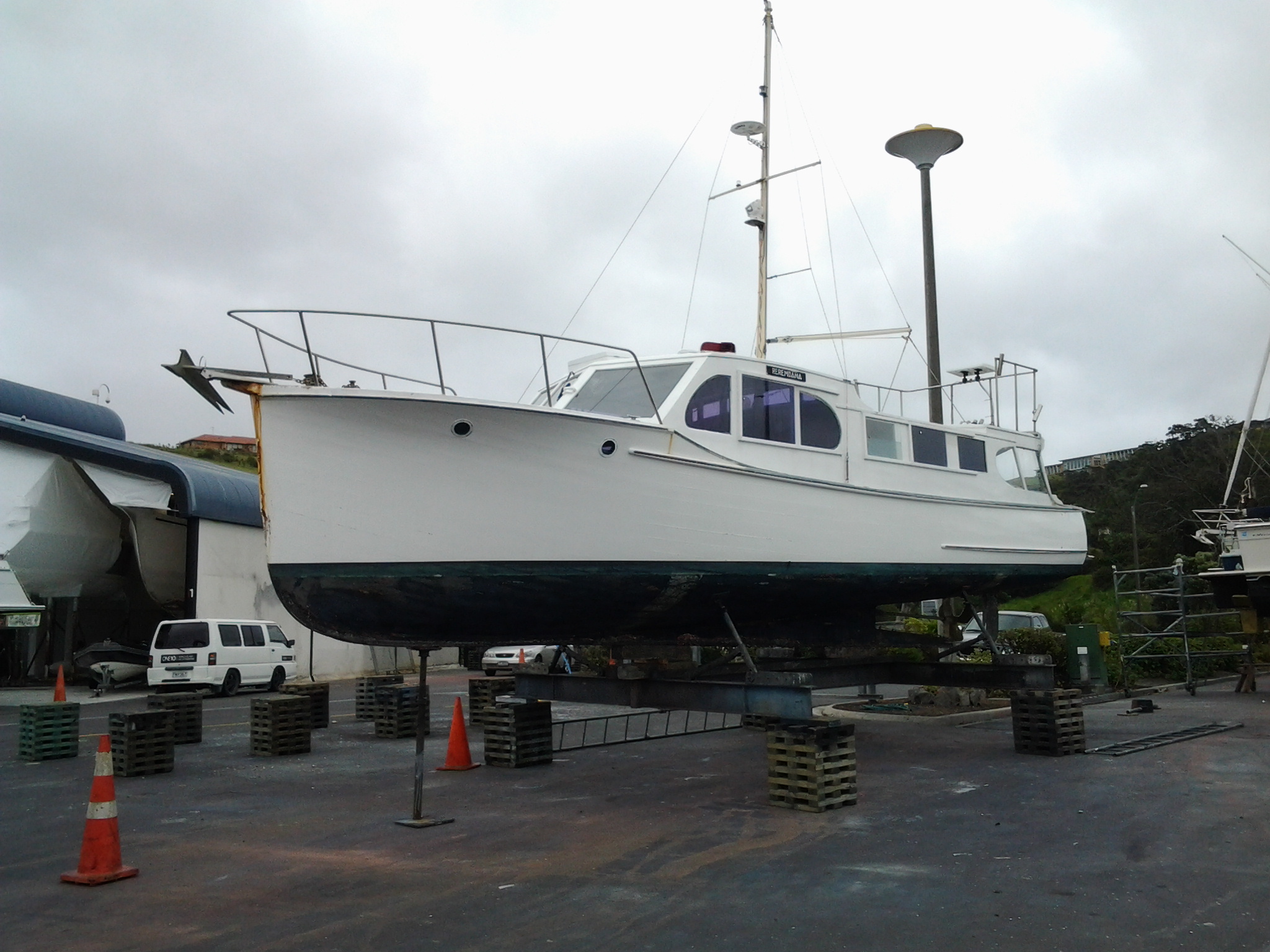
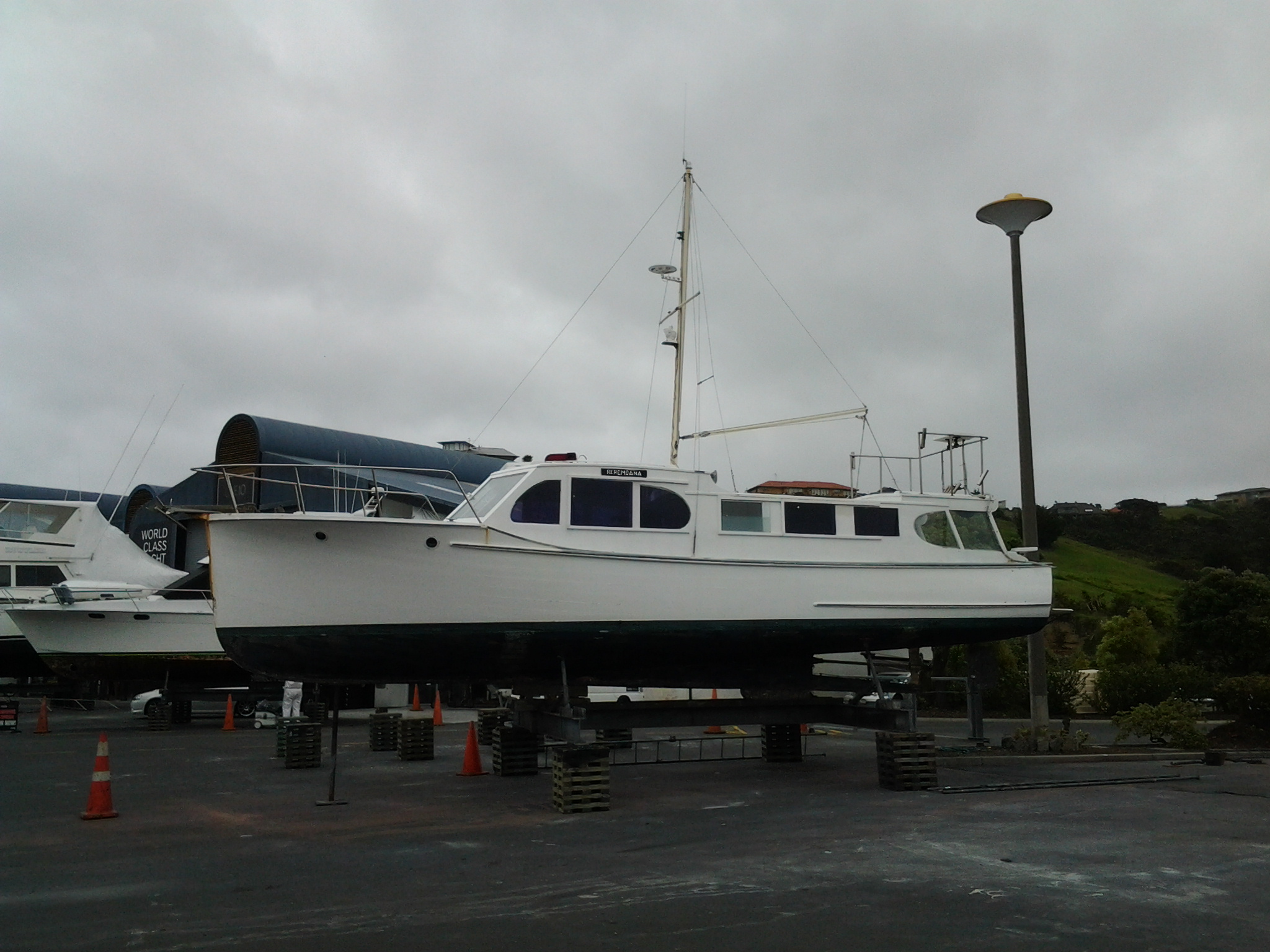
We know very little about her, except that she is another example of the Couldry excellence of design & build, circa 1936-38 lived in Westhaven in the 40s & early 50s right next to Tiromoana,
Ken Ricketts took this pic c.1948

Last saw her a few months ago, entering Gulf Harbour, sadly the lovely varnish has gone — not looking outstanding, but still recognisable.

REREMOANA-2 11-10-13 REREMOANA-1 11-10-13

Update 12/10/2013 – Colour photos ex Ken Ricketts, on-the- hard at Gulf Harbour. It upsets me when I see what ‘enhancements’ can do to a beautiful design……………. 😦  AH.

Update 26/06/2013 Launch Day photo ex Papers Past ex Harold Kidd referral.

A rare photo of Reremoana below as launched in November 1938, as a 28 footer, prior to being lengthened by 6′ & having a wheelhouse & raised top added by Lanes in September 1939.
Read the comments section, lots more info there.

I have to say, these Couldrey launches are starting to grow on me 🙂

12-01-2016 Photos below of her at Te Atatu Boating Club yard

07-08-2017 Photos below re-launched at TBC

Unknown-1

Unknown

Sept 2017 Out again at Te Atatu – photos ex Ken Rickets

Coquette

Image

Launch Number CoquetteCoquette

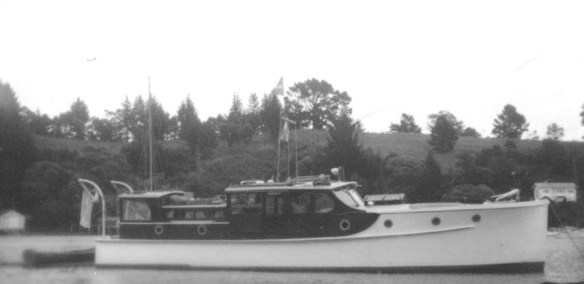
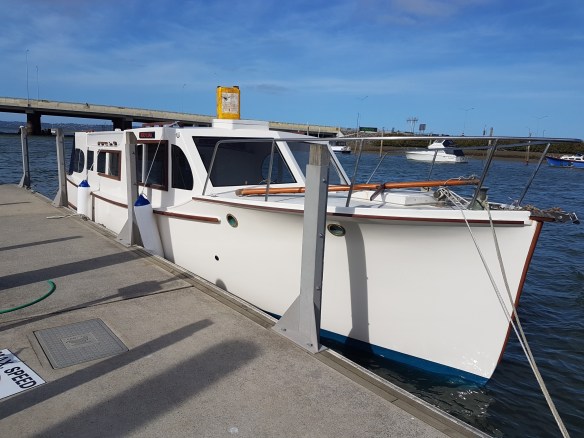
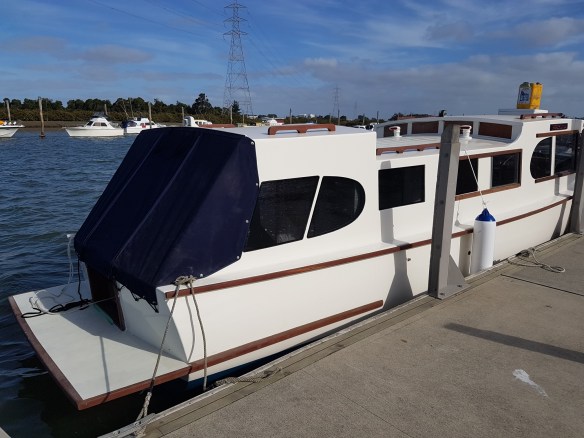
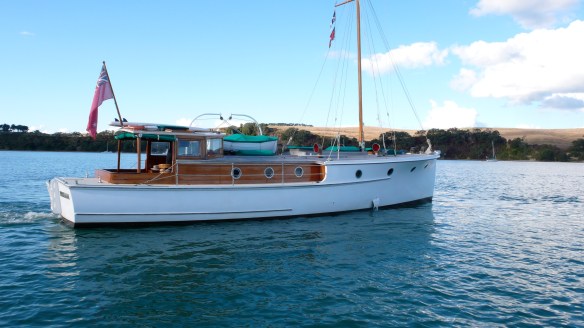
Coquette, 1912 Logan designed . Coquette was used to take a mould off for the popular Logan 33 f/glass replicas e.g. Lucille, Lady Dorothy, Lynette.
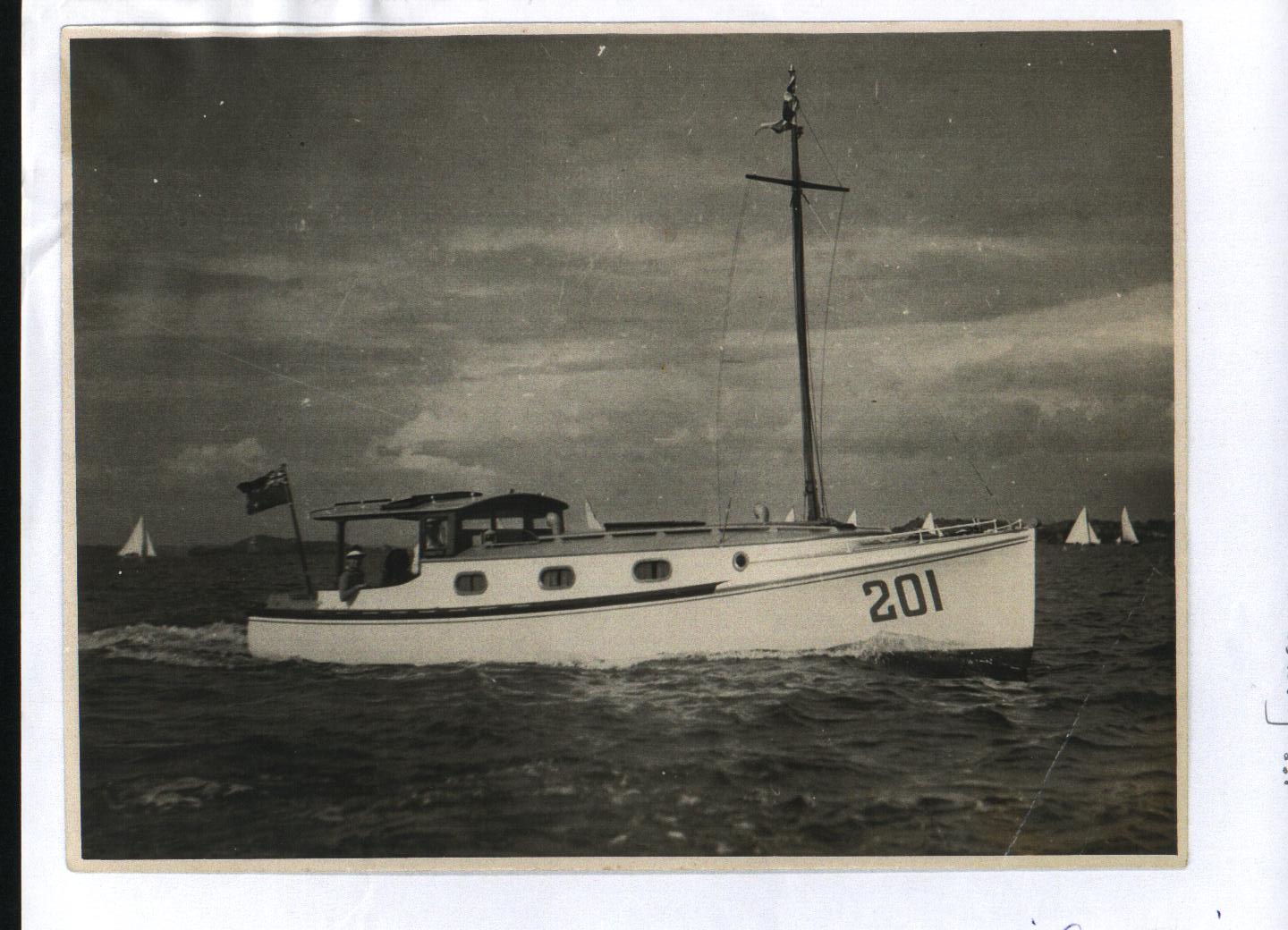
The early shot ( with number 201) with dodger would have been taken c. 1926

Update from Robin Elliott 

Coquette was launched as Doreen in 1912, built by Arch Logan for his brother Robert, who named her Doreen after their sister.By 1915 (??) she was named Haku & renamed Coquette c1923.That b&w photo above was taken c1942 or so and carries her wartime number. 

Around 1945 Bill Couldrey (one of Arch Logan’s preferred boatbuilders) was asked to modernise the cabin and superstructure and this is what we see on her today. He got the curves and proportions just right. This revamped design of Bill Couldrey’s was also copied for the GRP Logan 33’s.

 
Photos of her as Doreen can be viewed in the book ‘The Logans – NZ’s Greatest Boat Building Family’ & as Coquette in the book’Vintage NZ Launches’. Both books by Harold Kidd & Robin Elliott & still available in good book stores.
Photo added as Coquettee c.1964, ex Ken Ricketts 15/10/2014
 17-03-2016 photos ex trademe

Mataroa

Image

Mataroa

MATAROA. Owned by Ted Ward in the 1940s & 50s, photo taken in Matiatia in 1948 by Ken Ricketts. Possibly a Baileys boat, had a 6 Cyl Graymarine petrol engine. Not been seen for many a year – anyone able to advise her current status, location?
She appeals to me, looks as if she was fast.

Harold Kidd Update

MATAROA was built by Joe Slattery as KENYA for Len Heard of Parnell in 1928 with a 40/60 Ailsa Craig. So this pic is probably taken during Heard’s ownership ie 1938 or earlier. He sold her to  Seagar and replaced her with KENYA II built for him by Lidgard Bros and delivered in early 1940.

The RNZAF took her to Fiji in1943 for towing at Lauthala Bay and put a 6 cylinder Chrysler Crown in her as the Ailsa Craig was thought to be on its last legs and for spares rationalisation.

08-01-2015 Updated Info from Kevin and Jan Price.

We owned her for a few years after purchasing her from Maurice Reynolds (of Auckland Coast Guard). I believe she is now in Wellington.
She was originally names Kenya. She was nearly named Kenya Mist after a book title that was popular during her build, but the name was considered too long so shortened.
She was designed to fit into Len’s boat shed and had a droopy sheer line forward to fit under the door lintel, but it looked horrible and false works were built to improve her forward end appearance.
When Len Heard (Heard’s Barley Sugar) sold her to the Seagers, Len kept the name for his new bigger launch and the Seagers named her Mataroa after a much enjoyed cruise on the liner Mataroa.

She saw war service in Fiji as RNZAF No W71 and was employed in the construction of the Lauthala Bay breakwater to shelter the flying boats and also the metalling of airfield hard standing for warbirds. To achieve this she towed three barges totaling 90 tons. I was told that some of her trips down the Suva river fully loaded was sometimes a finally tuned effort to keep her lined up and thru the bridge. I was told her engine was only a 30hp Ailsa Craig at that time. Her Cox was a young 18 year old with a Fijian boat boy. Somewhere at home I have a tape recording of his wartime exploits.
Under her paint forward are scribed roundel circles.
Under that paint on the transom is the imprint of a brass bowsprit star received when towing a string of yachts home following the Suva annual Pacific yacht race.
She was offered back to the Seagers after the war. When they went to look at her at Herald Is she was not in good order and considered not taking her back, but did.

I think the engine was replaced by a Crown then later by a 90hp Ford wet sleeve by the Reynolds. 8knots at 1900rpm. (One day in a fit of exuberance I pushed the throttle to the wall and the GPS recorded 14knts)

After a mishap when an accompanying launch lost her steering and rammed Mataroa broadside amidships and split her open from deck to waterline she was run up on a nearby beach. The hull was propped out with an array of timber posts and she was motored back for repairs by matching the waterline wave curve with the bottom of the broken planking
She underwent repairs and refit. During this refit her rear house top was raised 4” and her vertical shaft steering column and flat “ bus drivers” wheel was replaced with the current more conventional setup. The round ports in the saloon where changed to oval for improved interior lighting. The saloon was relined with oak paneling. The overhead was lined in white Seratone as trying to maintain any sort of finish on the underside of the cedar deck was not possible due to it’s continuous movement. This refit was during the Renold’s time.

Under the forward cabin sole is/was a large admiralty anchor, possibly an original. Under the cockpit sole is/was a spare five blade prop.

1” Carvel Kauri.
Spotted gum ribs.
Possibly Pohutakawa stem.
Cedar deck / cabin tops for light weight.
Cedar sole floor boards screwed one Kauri floors.
No frames.
Mid and aft bulkheads removable, to allow engine to be taken out aft.
Log is kauri boxed and pitch filled.
Her capstan motor was an aircraft starter motor and reduction box that finally gave up the ghost when we owned her.
300trl copper diesel tank at the transom. Copper water tanks under cockpit seating.
No ballast.

That’s all for now. When I eventually get home ( we haven’t been home for seven years) I will look for some old photos I have tucked away.

Regards,
Kevin and Jan Price.
LINDA

Image

LindaLinda oldLINDA

LINDA story by Ken Ricketts

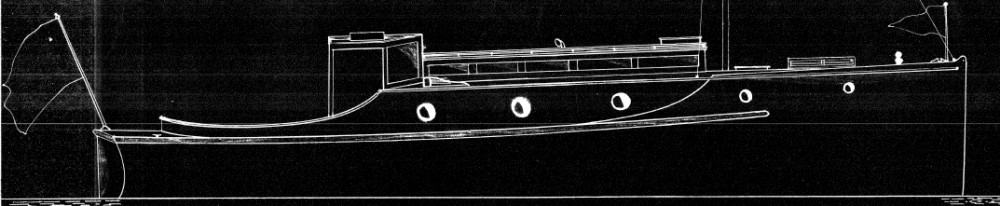
I first saw LINDA in 1946, when Roy Swales owned her. She is a another beautiful example of Colin Wild’s work, built in 1927 for E.J. Kelly, with huge grace & beauty. Linda had a 50/90 Loew Victor sleeve-valve (Knight’s patents) engine, sitting in the middle of the engine room, which was a large cabin, devoted solely to the engine, with only the toilet, as an extra, making the engine look very tiny.

The Loew Victor was replaced with a GM Detriot 6-71, in about 1947/48, & when I took the pic Christmas 1948, she had the GM, — note the large side exhaust pipe needed for the GM, (about 5 or 6 inches I recall). She later had a Volvo for a period, & presently has a 6 cyl Gardiner Diesel.

She had a cast bronze plate, screwed to the centre of the rear cockpit wall, just below the top of the tuck, with the words “Colin Wild Builder, 1928”, which I beleive is still there today.

The Swales lived in Fernleigh Ave Epsom & they owned the NZ Lead Works Ltd in Morrow St Newmarket.
She suffered a massive fire whilst unatended on her moorings at Waikeke in the mid 1980s, & I later saw what was left of her, bundled on to a barge, up in the mangroves at Beachaven North Shore, one day when we were going for a run up to Herald Island, on my own boat, TIARRI, so as the tide was in, went over to have a look, & I would never have beleived that anyone could ever have faithfully & beautfully rebuilt her to her original glory, but Robert & Russell Brooks & their family have done an amazing job, — well done.