
SPANGALANG 4-Sale
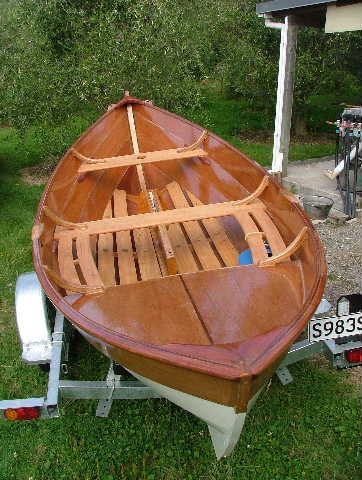
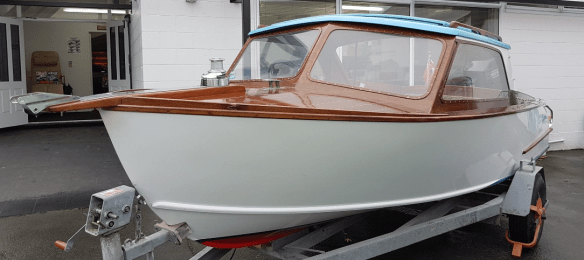
Back in 2012, in the days before waitematawoodys.com , I posted a story on the WoodenBoat magazines online forum about the building of Spangalang, a 14’6” Whilly sail boat, designed by Iain Oughtred.
She was built by Gary Drummond, who lives in Nelson & is the father of a good personal friend. Gary started the build in May 2011 & finished her in March 2012.
I followed the build with much interest & was amazed by Gary’s build quality & attention to detail. The boat won best new build at the Lake Rotoiti (Sth Island) classic boat show in 2012.
Last week I was contacted by Gary who sadly is having to look for a new owner / custodian for Spangalang. It’s not often that any Ian Oughtred craft pop up for sale in NZ & even rarer for one of this quality.
Interested parties could initially contact Gary via email gvdrumdoon@gmail.com
I have reproduced Gary’s story on the build – it’s a good read – Enjoy.
PROJECT – WHILLY BOAT (as told by Gary Drummond)
“This is my fourth boat project. For many years I have been looking for a suitable dinghy design and finally after checking out many designs settled on this one admiring the lovely sheer line. The other criteria was that it had to fit in my existing workshop. After cramming all my machinery in a huddle between two doors there was enough room including a fold down plan desk.
The frames were all 25mm dressed cypress fastened with reclaimed 65mm roofing screws and Titebond adhesive. The building frame was bolted to the concrete floor which allowed me to pack and level to adjust for the uneven floor and a slight bow in the main 140×45 bed beams. All of the framing timber came from trees that we had planted years earlier in our small forestry block.
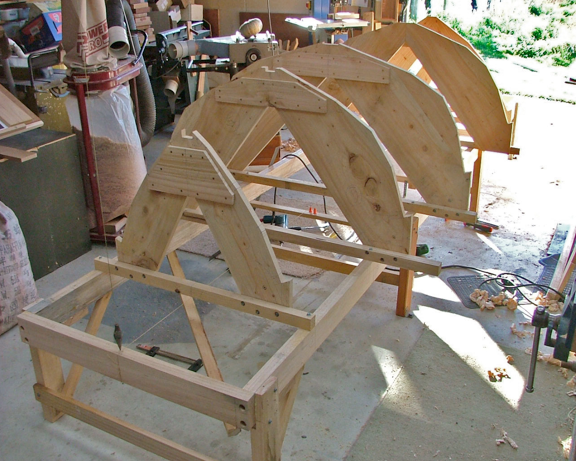
(Building frames setup)
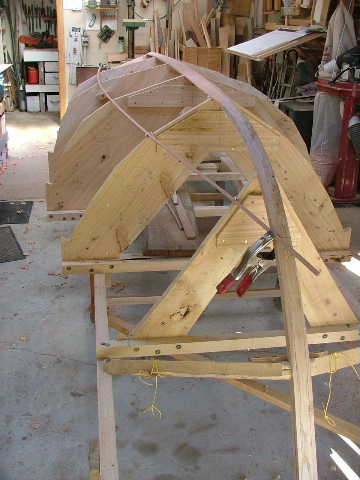
STEMS – The stems were laminated using Rock or Cork Elm (Ulmus thomasaii) as the timber was recommended for boatbuilding in Iain Oughtred’s book “Clinker Plywood BB Manual” and also in Clinker Boatbuilding by John Leather. I had previously flitched some trees we had growing on our creek bank and was aware on how well it bends. Not wanting to set up a steam box I first tried a wet soak for a day then clamping in the mould with additional spring chocks and left it to dry out. That was successful but it was quite easy to pull the laminates round the curve dry and clamp in place, so that was the method adopted. The building notes suggested a 3mm spring each end to the curve, but after release from the jig 5mm would have been better to allow for the relaxation or creep after gluing.
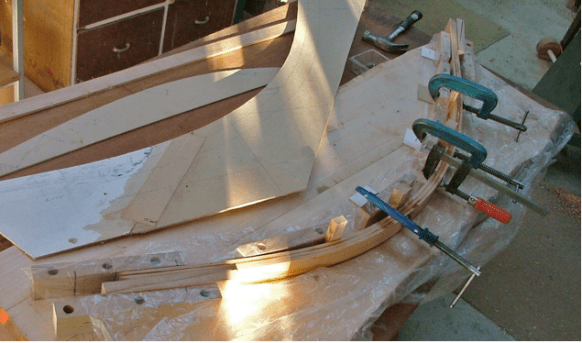
(Stem pre-soaked bending trial)
PLANKING – I discussed plywood species and potential suppliers with two local boat builders and the recommendation was, “Meranti Ply” Part of our local coastline has beautiful golden sandy beaches compete with rocky granite headlands and submerged rocks, so reckoned a heavier garboard strake could be an advantage. I settled on the 9mm for the garboard and 6mm for the upper strakes. (8mm thickness is unavailable in NZ)
It was only when I was cutting out the garboard planks that I realised all laminates were not of the same species. On enquiry the suppliers comment was “Well 100% Meranti would be expensive and it is normal to have a mixed hardwood core” After all of my research on attributes of marine ply I had missed this one. A usual, don’t assume anything. The supplier was in another city so I didn’t see the ply before purchase. By comparison the 6mm ply appears to be 100% Meranti.
With some careful placement of the templates I managed to cut both of the garboard planks from one 2440×1220 sheet. Still I assume that is how it was supposed to be. I have been using my Hitachi jigsaw to cut out planks and have found that hollow ground Makita 2mm tpi blades give a good clean cut without the usual hairy edge.
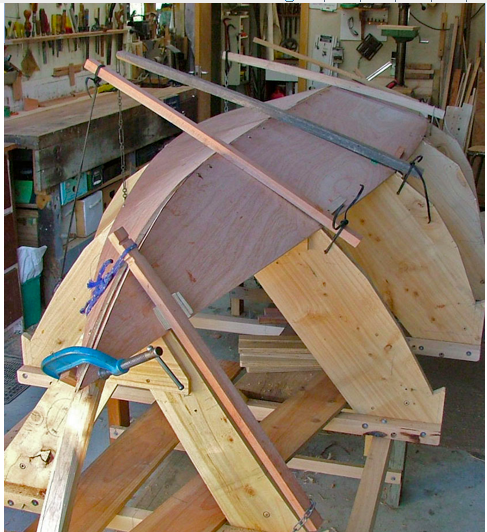
(Fastening the Garboard plank)
Bending the 9mm garboad plank to the stems seemed a bit of a mission for a start, until I devised a simple lever system with some short rope ends fastened through the frame one side, timber batten and light chain to hook over screw head fixed to each mould. This was especially useful when fixing the second plank, being unable to use clamps to the keelson. I have delayed fastening the ply until after the epoxy has set up for a couple of days and after trimming down to the stem-keelson surface. This was so I could locate a nail line that would be below my plane blade.
(Fastening the second Garboard plank 9mm+ ply)
To locate the plank template and ply strake precisely in the same place each time for fitting and especially when at the glue stage I drilled two push fit holes for 50mm nails (minus heads) just below the 20mm joint through the template and into two of the station moulds. When I was happy with my template, marked and cut the paired planks about 2mm oversize (Not forgetting to drill the two location holes). Next I sandwiched the template between the two ply strakes and the faired the ply carefully to fit the template. On the second plank I glued the scarf as part of the plank gluing operation. The scarf was just clamped between two 40mm wide timber pieces without any location screws at the upper edge and to my horror after cleaning up and eyeing over the upper edge noticed a slight out of a fair alignment. Oh well with a little luck it should take up with the fitting and fastening of the next strake. Just one temporary screw would have kept all in line. Oh bother.
For additional temporary fastenings in between clamps I have been using 30mm “Button Head” screws which worked well except for at the finishing stage having to plug the many screw holes. The plank scarf misalignment didn’t go away, I just had to rectify it before proceeding further it so purchased the second Japanese Saw without the backing rib, recut the epoxied scarf and also cut back 200-300 along the glue line between planks all to allow some movement. To ensure the correct fair line along the strake I cut and fitted a curved beam between the adjacent frames that I could clamp the re-cut scarf to achieve a fair line.
When fitting the outer stems, skeg and brass wear strips I made a sketch locating all of the screw locations to ensure when fastening the next layer I didn’t end up drilling a screw hole into an existing one below, however I did have one senior moment and had to move one hole.
This brings to mind the fragility of the posidrive square head silicon brass screws when forgetting to back off the torque setting on the drill. After shearing off a few I resorted to a hand held square driver for the final tightening.
The brass wear strips were, for better or worse polished and coated to minimise later tarnishing. When countersinking for the screw heads using a suitably reground 10mm twist drill the drill picked up the brass strip and a formed neat 10mm hole clean through. A moment of dilemma as I didn’t want to alter the screw spacing and have a spare hole. Anyway I didn’t check on the potential difference between brass and solder and soldered up the hole and started again this time with the strip in the drill stand vice. Since then I am told when modifying a twist drill for countersinking grind back the spiral cutting edge to near vertical so it is working with a scraping shearing action. This modification has since worked satisfactorily on some stainless steel.
Turnover – At Christmas time with the help from daughter Paula and two nephews we carried the hull out on the lawn and made the turnover, replacing it back on the build frame. I took care to reposition the hull exactly beneath my overhead centre line fixed to the roof truss collar tie and then set up a system of props and braces making sure all was vertical so I could make use of the level to align some of the interior components.
Interior Fitout – The mahogany strips for the gunwale needed scarf jointing in two places over the full length so set up a jig for cutting them on the circular saw which was quick and accurate, but in hind sight wonder if hand formed scarfs with the plane (once I got the hang of it) would have been just of quick. A lesson learned. I machined the qunwale strips to final dimensions, when I should have allowed say 3mm extra width for the final top trim of the four laminations incl, the ply sheer strake. To form the quarter round edges to the gunwale I cut them using the router hand held and inevitably left some black burn marks which would require a filler to disguise, so have left them as is just as a reminder of my folly.
Once again, sometimes a hand formed shape can be equally crafted successfully without the potential problems inherent in using power tools.
I formed the breasthooks from southern rata and the individual pieces when finally formed almost looked like small pieces of a sculpture. I opted for two 13mm oak dowels to reinforce the two halves. Setting up a jig on the lathe to drill the dowel holes was more of a challenge than making the dowel pins. Just this small operation to form and fit the two breasthooks ran away with three days.
Interior layout – Locally we have several tidal estuaries and a maximum high tide of some 4.8 metres and so decided on the pivoting centre board as being the best option for these conditions. This option required the center thwart to be moved aft 200 mm. Next I decided to include the stern sheets (Aft decking) for which the forward bulkhead is positioned 150mm forward of station#6. Now, all of that was hopefully simple until you get in to start rowing only to find that with my 1.8m tall frame I couldn’t straighten my legs out for a comfortable rowing stance with the shortened cockpit length.
Well at the Lake it wasn’t a problem to sit on the stern sheets and row looking forward and it also helped in keeping clear of all of the other canoes, yachts, skiffs, steamboats etc, during the drive past. To sort the problem, I have formed a shaped clip-on thwart extension that sits over the center case. The only potential problem being that the seating position will be further away from rowlocks requiring a bit more back bending when rowing.

Protective Coatings – The complete hull firstly had two coats of West Epoxy. The exterior then had two prime coats, two undercoats, and two finish coats of paint, all wet and dry sanded I could only find one small flat on the second strake. Those final glossy finishes sure show up any earlier mistakes, and at that stage too late to rectify just like the odd pencil line I failed to erase before applying the epoxy. The interior is all bright finish using a two pot varnish.The thwarts and floor boards received an matt oil finish with “Deks Olje”
Timber Spars – My idea was to obtain some unwanted spars and recut and reshape them to meet the requirements. Well what was a light rectangular boom to be formed into the yard, was after I had started splitting it longitudinally turned out to be a hollow spar and what initially was to be a simple say cut and re-glue turned out to be a little more complicated. On completion though I must say that it is light. A similar complication with the mast thought to be hollow as it was so light, I think it is spruce timber. After detailed checking of the diameter I found that it required widening in one direction to achieve the design. So it has ended up also as hollow spar. Next was the boom. A friend of a friend had a surplus oregan flagpole which after splitting it on the bandsaw and being careful not to cut it with a longitudinal wind managed to machine two suitable pieces from it. Having two hollow spars couldn’t resist now running the router along each piece to hollow them out. All went well but I will be holding my breath when under sail and the first big gust swoops in.
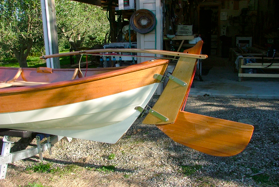
Rudder- I chose the swivel rudder option and it was all fairly straightforward until I came to choosing the gudgeon and pintals. No one locally seemed to have anything like what I needed and I am now wary of purchasing fittings from the net as the nice pictures you see and the product you receive aren’t always the match your expectations. Anyway I drew up what I needed and had a Stainless Steel Fabricator make them without any fastening holes and extra length to allow for fitting modifications. There just aren’t that many double ended boats around to get any ideas from. Luckily there was sufficient room behind the formed pin holes to be able to redrill a set of new holes in a straight line for the pins with the pintal frame sitting snugly against the curved stem. I should have drawn them on the full sized on plan and then could have worked out the offset hole positions pre fabrication. Next time.
The Tiller is laminated cork elm with a 10mm hardwood dowel either side if the slot which fixes over the rudder head to ensure it doesn’t part company.
Choosing the name – With both sides of our family being of Scottish decent and the boat design coming from the Shetland Island the name just had to reflect all of this history. Firstly I scoured Celtic Scottish on line dictionaries and finally resorted to making contact with a relative from the Shetlands. He supplied me with a list and that was it.
Building Aids – Masking tape – should have used it more often to eliminate the many epoxy runs that are difficult to clean away under clamps.
Skarsten Scraper – great for removing epoxy runs and gauging grooves in the ply.
Steel Scraper – As well as straight I have made several with varying curvatures from old band saw blades.
Cam Clamps – Hadn’t seen one until I read Iain Oughtreds book, made a prototype and then a few more with a 200mm reach. Clamping pressure is not as great as a G Clamp, but is quite adequate for clamping glue jobs and just holding things.
Drawings – These were good to work from, but, always read the fine print as I have in the rack a 1.97m half made boom. The actual Balanced Lugsail boom was 2.62m long.
Rigging – Iain Oughtred directs the builder to previously written articles, none of which I managed to locate. However on one of the many web searches via the site “The Mother of all Maritime Links” http://www.boat-links.com From this site I found just what I needed at, http://www.storerboatplans.com/GIS/GISRigging.html
Now for some rope and fittings and we will finely be under sail on the water.
Conclusion – This has been a great project and has drawn many favorable comments. Apart from the personal satisfaction of having created this thing of beauty it has been a great brain teaser. Every day there have been problems to solve such as how do I, set that out, clamp it, etc., etc.,. I am sure the brain has had a good workout and I will miss all of the challenges.
However, getting out on the water is going to be fantastic.”















 waitematawoodys.com #1 for classic wooden boat stories, info, advice & news - updated daily - 15+ million views