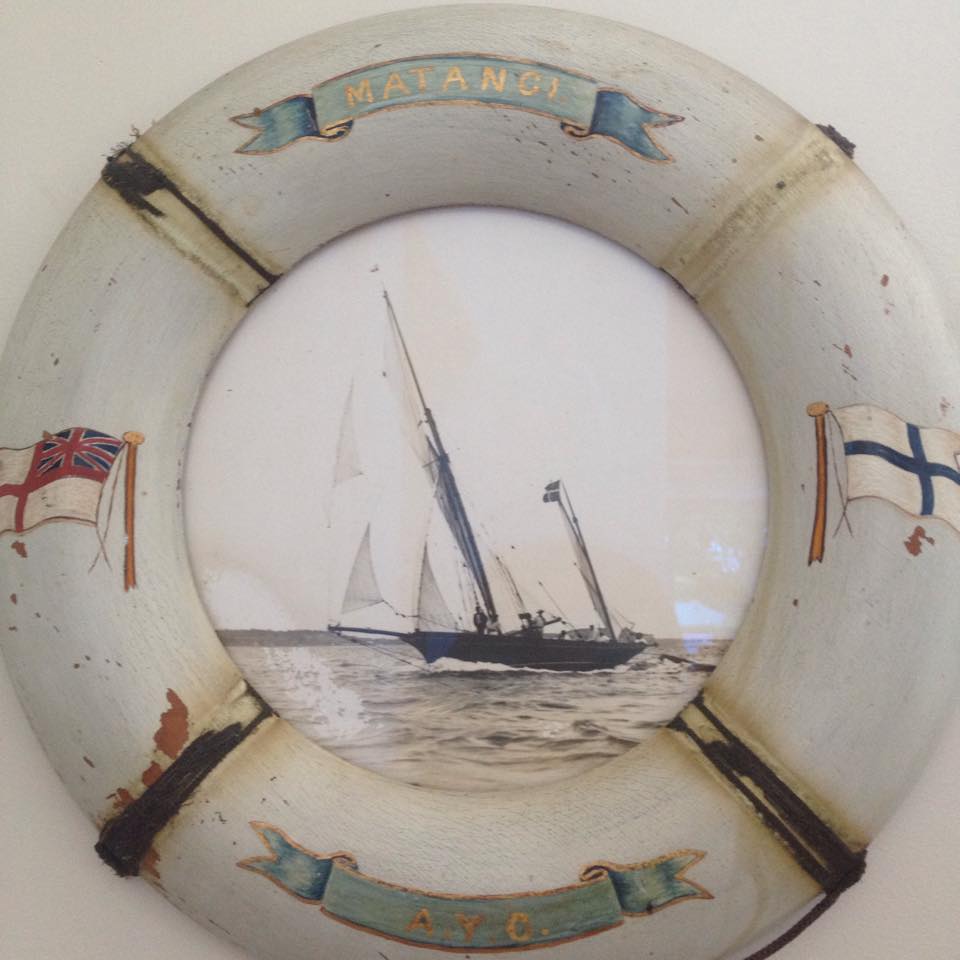
MATANGI – Sailing Sunday photo & details ex Nathan Herbert
The above photo shows the yacht Matangi & given the photos owners family connections, is most likely a Winkelmann photo. What more do we know about the yacht?
Harold Kidd Input
Robert Logan Sr built MATANGI for C.B. Stone, then Chairman of the Auckland Harbour Board and Commodore of the Auckland Yacht Club in 1887. She was a typical schooner-bowed cutter/yawl of the period, rating at 15 tons with dimensions of 51′ loa, 9′ beam and 6′ draught. Stone sold her to John Wiseman and Willie Wilson of the “N.Z. Herald” in 1888 as a swap for TAWERA. She remained with Wilson for nearly 28 years but he sold her to Alex Alison of the Devonport Steam Ferry Co in 1905. Ernest Davis bought her in 1909 after she had been hauled out at Stanley Bay for several years. In early 1912 H E White bought her and had her sailed down the coast to Wellington. She had a 14hp Anderson auxiliary installed and was sailed by Oscar Freyberg. Later in the year she was sailed back to Auckland, White went off to Sydney. In August 1916 Chas Bailey broke her up for her lead. There was only just over 6 tons of it. Bloody shame. I guess her her lead was turned into .303 projectiles by Colonial Ammunition Co and strewn about the Somme.
At some stage today the counter on the watematawoodys.com blog site will tick over & show that people have viewed the site 1,000,000 times.
I choose the above photo for todays post because to me it captures what the classic wooden boat movement was / is all about. Its got everything there – motor boats, yachts, dinghies, people hanging out having a good time – there is even a dog 🙂 . The location is obviously Mansion House Bay at Kawau Island. The photo was sent to me by Robert Brooke & is from his father’s, Jack Brooke, stunning collection. (click on the photo to enlarge)
When I look back at the first few posts on waitematawoodys its amazing how we have evolved & now how big the audience is both in terms of numbers & the geographical reach.
I would like to thank all the followers of the site, but special thanks must go to everyone that sends in material (photos & info). Doing a daily post can be a little challenging at times but just when I start to panic, an email arrives from someone with some old photos of granddads boat. I would also like to thank Harold Kidd who gave me a swift kick in the backside 2 years ago in terms of getting serious about the site & the accuracy of the content. I would be embarrassed to say how many hours I had to spend to go back & populate the existing posts in terms of year, designer,builder etc but now the site is the #1 reference tool for New Zealand classic wooden boats. But that is a by-product, the real success of the site is that everyday it delivers to people something fun & enjoyable to read & interact with, something that puts a smile on their face.
Way did I start waitematawoodys ? – well the idea came to me via my involvement in the NZ Classic Yacht Association, the CYA is a great club but like most small clubs it can be seen as slightly cliquish, we do so many neat things but the audience is small & there are so many more people out there with an interest in wooden boats. With the birth of social media networks, stuff (photos, stories, info) that had previously been packed away, could now be available to anyone with a computer or smart phne. The future was all about content being on-line & easy to access. It was also about being collaborative. With the advent of personal websites (called blogs) people like myself are able to create a communication channel that has no boundaries. But more importantly blogs are able to be managed/controlled so that they remain true to the topic, which in the case of waitematawoodys is – the study & appreciation of classic wooden boats & the desire to tell the stories behind them & the people who built them, owned them & crewed on them. At the start the content was all about motor boats but as the audience has grown the readers now have a broader interest in all classic wooden boats & things related to them.
Why did I call it waitematawoodys – now I could put my advertising hat on & rabbit on about what the words mean to people but the simple truth is its just a cool name & looks great on a tee-shirt 🙂
I still get a buzz out of posting daily & from the feedback I get, so do you. But folks – do not hold back on spending stuff to me, some of it in isolation may not be enough for a post but I file it & then bang, someone else sends me something on the same topic & we have a story.
Again thanks for being part of waitematawoodys & remember – its all about wooden boats.
Cheers Alan
ps below is an advertisement I made to plug membership of the CYA (you should join up) the photo (ex Chris Miller) shows we are still enjoying these wonderful craft. If you look hard that’s me in my number one clinker dinghy – I say #1 because there are a few………….. 🙂
In todays world of publishing, hitting 100 issues for a bi-monthly is pretty impresive. If the below is a little hard to read, click on the blue link below to download a pdf file. Enjoy 🙂
Today’s post profiles the work of Wayne Spicer, a very talented modeler who has built an impressive number of our classic fleet. Wayne has been modeling for approx. 17 years & is a volunteer model maker at the Maritime Museum in Auckland (on Tuesdays). Wayne has built a number of square riggers including Endeavour, Bounty (3), Victory (3), Spanish galleon.
While at the Museum Wayne meet Rod Marler, the owner of the Logan yacht ‘Little Jim’, Rod commissioned Wayne to build a model of LJ & this got Wayne hooked on Logan boats. Wayne told me that he enjoyed the classic lines of the Logans and how they showed the evolution of sailing designs since the late 1800’s. You will see from the the list below that he has built quite a few.
BUILT TO DATE:
Thelma
Rainbow
Waitangi
Jessie Logan (2)
Little Jim (2)
Tawera (2)
Ariki
Aromoana
Ngaio
Gypsy
Nomad
Ranger
Helen
Most of Wayne’s models are made from scratch which means they are not kit sets, fyi below are some photos of the model making process for Nomad.
Rawhiti – A Once In Your Life Time Opportunity photos ex Classic Boat, Chris Miller, Alan H & owner
Firstly – a challenge – can anyone dispute that Rawhiti is New Zealand’s finest classic yacht afloat? From all angles she is simply beautiful, a true classic from the drawing board of Arch Logan & built by Logan Bros.
Rawhiti was completely rebuilt by Peter Brookes at Brookes Boatbuilders in 2011. For her owner Greg Lee, it was a pure labour of love, he extensively researched every aspect of the project & worked alongside Peter on a daily basis, the end result being a Logan that is better than launch day in October 1906 & thats pretty bold statement to make about a Logan.
Yachts like Rawhiti only come along once in a life time, to get the chance to buy one is even rarer. That opportunity now exists, to do that – to own this beautiful piece of New Zealand’s maritime heritage, a floating work of art.
So my 2nd challenge today is to all classic boating aficionados – gather your friends or business associates & form a syndicate, sell that bloody ugly Colin McCahn, sell a few shares, sub-divide that section – do what ever you have to do, to put the money together to acquire Rawhiti.
Interested? – read on
Without boring you with details, Rawhiti’s owner is serious about selling her & now via another business transaction has the opportunity to offer Rawhiti for sale to the right owner for a fractional of the restoration cost i.e. in the $400k range.
The time window in which the business transaction is available is short and therefore there is a limit to how long Rawhiti will be marketed in this price range. If you are interested in discussing the sale, please initially, contact the owner Greg Lee on the email address below.
For anyone with an interest in acquiring Rawhiti who is unsure what they might be doing with her in the short term (but wishing to secure the opportunity to acquire her now), her owner has had provisional discussions with Peter Brookes about storing her under cover at his yard at favourable rates.
When I read the Jan/Feb2015 issue of the kiwi lifestyle magazine – NZ Life & Leisure the article on the 40′ classic K-Class yacht ‘Penelope’ & her Marlborough Sounds cruising grounds jumped out & not just because its a great read. The spectacular photography we kind of expect from NZL&L but the boat friendly recipes were a big bonus for me.
Read below to meet the Shearer family & have a peek at life aboard. WW thanks them for sharing with us.
Today’s post has been reproduced with the permission of Fairfax Media. The spectacular photos are from the camera of Tessa Chrisp & the words from the typewriter of Lee-Ann Duncan. Check out the magazine at their website http://nzlifeandleisure.co.nz
Electrochemical Damage To Wood – the marine version of ‘leaky homes’
Story & photos by Chris McMullen. Edited by Alan H
NOTE: The photo above is the residue left from a heart kauri floor. The keel bolt had been bonded for ten years. Impossible to affect a proper repair as the bolt went through the deadwood.
Today’s post appears on WW for three primary reasons:-
#1 the author Chris McMullen is someone I & most intelligent, thinking boaties respect.
#2 waitematawoodys is all about the study & appreciation of classic kiwi wooden boats – if people do not wake up, there wont be any to appreciate.
#3 this information needs to be stored somewhere like waitematawoodys so when people are searching the topic of electrochemical damage in wooden boats, they will find this & be able to make their own decision based on sound, robust debate like the below.
Most people are aware that Chris is one of NZ’s most respected boat builders and at one time was the Lloyds (Honorary) Wood Boat Surveyor in Auckland. Chris’s (The original Co) “McMullen & Wing” built and repaired wood, steel and marine aluminium vessels. They built the first welded aluminium vessels in NZ.
Public opinion back then was, “They were mad” and the hulls would fiz and corrode in salt water. Not so, and now aluminium is used for not only yachts but all types of commercial vessels.
Chris is also the custodian of the magnificent classic Colin Wild launch ‘Wirihana’.
Chris is constantly asked for advice on kauri vessels with wood degradation problems. His view is somewhat different to many marine industry technicians in NZ but backed up by Yacht Surveyors in the USA and the UK.
If you don’t have time now to read this post today, please bookmark it, as I guarantee it will at the least have you doing a double take.
Update 06-06-2015 – if you are time poor scroll to the bottom, new info & photos added
I’ll let Chris tell the story. Alan H
Chris McMullen – I am absolutely convinced that any wet wooden (caulked) vessel is doomed to a slow death if dissimilar metals or zinc anodes are fitted and bonded by wire to underwater metal. I do not reject the theory of cathodic protection; in fact I use it and zinc anodes on my steel floating dock. The problem is the wet wood component. There is a voltage between any two connected (bonded) dissimilar metals and the wet wood completes the circuit. Any voltage in the wood (from any source) breaks down the lignin in the wood round the cathode (protected metal) and that is the issue.
The white corrosion byproduct formed, Sodium hydroxide, is used for pulping of wood in the paper making industry! Want this on your wooden boat? Yuk!
Included below are some links to technical papers written by wood chemists rather than by metallurgists. These articles are not new but quite convincing and are parallel to my thinking and experience.
It seems however that people don’t like reading technical stuff. And it’s (I guess) easier to read and believe what is written in a local boating publication.
I decided to do an experiment to prove my point.
I used a length of 6”x 1” pine. I bolted to it an old zinc anode and about a metre away bolted two bronze objects. I connected one to the anode with a copper strip and the other is close by but not connected to the anode.
I hung these on a rope in the water of the Tamaki River (salt) off my floating dock.
After six months, I pulled the test rig out and cleaned off the considerable marine growth.
I removed the bronze objects. Under the one connected to the anode was a black stain and the bolt fell out of the hole. The other, the bolt had to be punched out and the timber was clear bar some copper residue.
I photographed the test & also took the voltage readings between the metals and also the metals potential against a silver-silver chloride reference. (click photos to enlarge)
The minor damage done to my test piece is the result of only six months submersion. I will put it back and check in another six months.
It is however, quite obvious to me some thing is wrong and in time the wood will deteriorate further. If this is due to a voltage (less than half a volt) well, you can imagine the damage coursed by electrical stray current, and that is likely on old boats. My test rig is very basic and not influenced by other factors.
Sure, the wood may be less effected if painted and if the bronze was insulated by bedding compound. The damage can take years but our kauri boats should last indefinitely if we don’t do things that destroy them. Someone is bound to say I have over sized the anode on my test and thus the timber damage. I know that is the case but I had to accelerate the process.
On a boat it is almost impossible to size an anode correctly due to wasting and wiring faults in inaccessible areas of the bilge.
The point I am trying to make is:
Eliminate any current flow in the wet wood.
If you bond metals underwater you are inviting problems.
Further, a stray leak from the ships battery will do far more damage in less time. I believe most metal corrosion problems originate from this source. Cathodic protection will do nothing in this case.
Again, bonding will encourage a circuit. Remove the bonding and you have no circuit.
Want to check your electrical system for stray voltage in your wet hull?
Connect a voltage meter between the positive on your battery and any bolt or fastening in your hull. You may get a surprise. It may be 12 volts but high resistance so you can’t light a bulb but enough to cause corrosion.
If you have bonded underwater metal, the surprise maybe an expensive. For a start, try tightening the lag screws fastening the stuffing gland to the shaft log. If you don’t, a surveyor will, if you ever want to sell your ship.
History
In Yachting World Magazine March 1957 Mr. MG Duff wrote a convincing article headed “Stern Gear Corrosion” (cathodic protection for underwater metal fittings on wood yachts”.) In the article he never mentions wood degradation! He did not know until the problem showed up years later, see below.
The subject article date (1957), ties in with my memory of Jack Brook (head of the old D.S.I.R) yes, Robert’s father, and Alan Odell (Professor of Chemistry) fitting an Anode on the Tobin Bronze(H/T Brass) shaft of Alan’s Logan yacht the “Mahaki”.
I was only a kid who happened to be at Devonport Yacht Club with the Odell’s that week end. I remember a crowd of onlookers thinking this was black magic.
I believe this resulted from the Duff article. Later Jack Brook had the DSIR print a pamphlet on the subject. Sadly, (like Mr Duff) these academics never thought about wood damage.
Now using anodes did not catch on here until the late1970’s when a local business man saw it as an easy way to print money. He, like the Duff article was very convincing and I am sure well meaning. Some wood boat owners now refer to him as Dr Death! (I never coined the name)
Since then almost every marine electrician has got in on the bonding scheme. It was a new subject for books and magazines, now some misinformed boat owners are pushing it too.
On a hard stand a boat without an anode stands out and in many eyes shows an uncaring owner and will draw criticism. This is mistaken thinking and sadly is self perpetuating.
Please consider, “Logan, Bailey and Wild never used cathodic protection. They had knife switches and crude electrical systems but no bonding! Their boats lasted 60 years plus. ” Why should we use anodes?
As an apprentice wooden boatbuilder, we were told at night school, I quote “ “Never use dissimilar metals underwater” and further ” never use brass”. These days the advocates of bonding use zinc underwater! What could not be more dissimilar or further apart on the Galvanic scale?.
In the 1960’s and prior to that, boat builders used bronze and copper only. There were no stainless shafts available ex stock in New Zealand.
Despite working on all sorts of boats, I never saw the timber degradation I have sighted in recent times. Sad, as we no longer have the kauri or people with the skills to affect these sometimes major repairs.
The boating public and boating industry technician’s have been mislead by a situation rather like “The Leaky Homes”, just because everyone is doing it, does not mean that it is right.
This problem was aired in Wooden Boat Magazine (30 years ago) Also in Classic Yacht Magazine. I sent some information to New Zealand Boating magazine. They showed no interest. Their advertisers sell anodes! Big business!
Further, the NZ Marine industry is partly to blame. Locally made strut bolts were made from tobin bronze! tobin bronze (these days) is brass and in my opinion unsuitable underwater. Their “Through Hulls” were made of gunmetal that although a bronze, is in my opinion a very poor choice of material. Use aluminium bronze or silicon bronze or reinforced plastic.
Cheap propellers are made of manganese bronze. Again a poor choice (these days) and little better than brass! Use aluminium bronze for propellers.
Bronze gate valves have brass spindles. Use reinforced plastic valves.
A lot of confusion comes from reading old books. (See L Francis Herreshoff “Common Sense of Yacht Design”) He recommended tobin bronze (Trade Name) and manganese bronze.
These are now generic terms. Both materials were (possibly) once good marine metals but over the years the makeup of these alloys or the way they are cast has changed and as a result I believe their resistance to dezincification has been compromised. This is evidenced by. See https://www.flickr.com/photos/109707376@N06/11134934714/
This manganese bronze propeller (Mizen Head Ireland) had been underwater 100 years! I checked it out some years ago. The bronze blades with the “Stones” trademark look perfect. The Stones Co. built ships propellers all from manganese bronze! Yes, the iron hub was an anode and (possibly) protected the bronze. A perfect example of cathodic protection! Note.There was no WET wood involved.
I talked to the new owner of Chatfield Engineering. He tells me they are now using silicon bronze for strut bolts. I say “Not before time”!
Sopac Marine Ltd is importing “Groco” silicon bronze hull hardware from the USA. They also stock aluminium bronze plumbing fittings that will last forever.
Support the local manufacturers? Unless they tidy up their act, they do not deserve your support.
Please remember bonding poor quality underwater metals does not guarantee their security. Read about “Random Harvest” (Link below)
Boats are supposed to be fun but you really have to be an expert to keep your ship afloat.
It all comes down to attention to detail. Use the right marine materials, be sure your wiring is done properly and your boat will not suffer from metal corrosion. You certainly won’t need bonding or anodes.
Sadly, for most it is too late. Cut the bonding & remove the anode but the caustic soda corrosion byproduct previously formed will remain and continue to soften the timber. Remove the effected timber round the cathodically protected metal or live with the problem caused by LOVING YOUR BOAT TO DEATH.
Some hints to eliminate DC Voltage Leaks in Boats.
1. Insulate the negative connection from the frame, on alternators, generators and anchor windless motors.
2. Use two pole senders on the engine alarms.
3. Install a solenoid on the starter motor negative so it is only connected as the engine is started.
4. Battery switch’s can leak. Have a second switch on the negative.
5. Be sure your bilge pump is wired correctly and in good order.
6. Use an insulated gearbox to shaft coupling.
7. A Furuno depth sounder is two wire but the bronze housing (like an alternator) connected to the negative! Sleeve it with plastic so there is no connection to the wood. Leave it, and it is unintentionally bonded and you have a circuit.
8. If you have shore power, use an isolating transformer.
9. If you still must bond for safety purposes? Well, accept the fact you have made a circuit and face the consequences, maybe you should not have a caulked wet wooden boat!
Why go to all this trouble?
The negative wiring in the ship can act as bonding wires if the appliance on the end has been designed for automotive use (chassis metal is usually the negative ground on a vehicle.) and touches damp salty wood. Say, for example, you have a negative leak in the autopilot drive that is coupled to the rudder that carries an anode. You once again have made that dreaded circuit and the wood round the rudder gland will suffer.
On a metal boat all the above is mandatory.
Put up with some minor corrosion.
It is easier, to replace a metal fitting than the wooden hull structure. Further it is pointless putting an anode on a aluminium bronze rudder (as is often seen) Of course the anode will erode. The bronze is a marine metal and does not require cathodic protection. If it has a stainless Shaft well that is dissimilar metal underwater. If it corrodes, change the shaft to bronze is the best advice.
If you are worried about your stainless propeller shaft, have a cast iron (nut type) sacrificial anode made. It should only have contact with the shaft not the bronze.
I write this (as a boatbuilder and certainly not as an expert) It is the result of my experience and research into a problem, I first noticed thirty years ago but seems more prevalent in recent times.
I share my observations, for the benefit of classic boat owners to help assure the long life of their vessels.
There is nothing in this for me.
For those interested I would encourage you to click on these links & read carefully.
If nothing else page 4. Written by a Wood Chemist in the USA.
Nothing has changed, except I gave up, trying to convince people. It is no fun swimming against the tide.
See below on how to make paper.
Soda Pulp
Soda pulp is the original chemical pulp and is produced by cooking chips of (usually) deciduous woods in a solution of caustic soda under pressure. This leaves a relatively pure cellulose pulp which is then washed and bleached. Soda pulp produces relatively soft, bulky papers (as a filler with other pulps) used in books, magazines and envelopes. Caustic soda dissolves most of the lignin in wood while having little effect on the cellulose. Cooking liquor is recovered during the washing process.
It Is Not Just A Wooden Boat Thing
The photos below show a carbon fibre boat and a fibreglass yacht bonded and with electrical issues. The point here is that all boats can have electrical issues. On these boats it showed up. On a wooden boat the damage is invisible until it is too late.
This slideshow requires JavaScript.
06-06-2015 A Short & Hard Hitting Update From Chris – Read It, Its Pretty Simple Really!! Alan H
Less zinc, more zinc, over zincing are terms used by those who have recommended bonding to their clients and when things go wrong and they will. They have to have an excuse.
Please consider the following.
Sodium hydroxide or caustic soda is the chemical that damages the wood. This chemical is used for pulping wood and used in the paper industry
You will find the requirements are a positive and a negative electrode of say carbon, a container of brine or salt water and a power source i.e. a battery charger or a battery.
Now on a bonded boat you have a zinc anode that is positive and the protected metal (the cathode) is negative. You have the sea water electrolyte and if you have any stray current (and that is likely) you have the power source.
You don’t actually require the power source as there is a natural battery with a continual current flow from the electro-positive zinc anode towards the protected metal or electro-negative cathode.
So in effect you have a sodium hydroxide manufacturing plant (factory) incorporated in your bonded boat. Now this plant runs 365 days per year or until you sacrifice the anode.
If there is an electrical leak on the boat, well the plant ups it production.
Now the sodium hydroxide coats the protected metal and the old wet wood assures an all over electrical connection.
So it is the sodium hydroxide that causes the degradation of the wood surrounding metal on all bonded wooden boats.
Unfortunately, there has to be a current flow between any connected dissimilar metals and zinc is way apart from copper and bronze on the galvanic scale.
So it is obvious you should not use zinc anodes and bonding on a wooden boat.
Sorry, this is not what some of you wanted to hear and it is contrary to popular belief in NZ. Remember, popular belief does not mean it is right.
If you don’t take my free advice, it will not be long before a boat repairer welcomes you to his yard. He may not be as charitable.
Chris McMullen
Auckland. New Zealand.
1/6/2015
Remember – click on the photos to enlarge & read captions 😉
Sodium Hydroxide production requires voltage, salt water and a cathode protected by an anode. this after two hours!
Serious Corrosion overnight.The + is connected to a piece of 316 stainless steel tube
sodium hydroxide build up on cathode after two hours
sodium hydroxide build up on cathode skin fitting after two hours
High quality bronze gate valve with brass spindle
316 Stainless steel tube as the anode after 12 hours
Movie showing gas coming off the bronze cathode The Anode Zinc accelerated with 12 volts – click link below
04-07-2015 Additional reading below on the electrochemical degradation of wood in boats from Chris McMullen.
I have heard that some boat builders/ repairers are of the opinion that bronze and copper stern gear is the cause of damage to the wood in shaft logs.
Their fix is to remove this hardware and replace them with a carbon fibre tube and reinforcing.
Sounds like an answer to a problem that does not exist.
There is nothing wrong with the bronze and copper stern gear, it should last the life of the boat or longer. The problem is the fact, that the hull was bonded and catholically protected with a zinc anode. The unnecessarily protected cathode produced sodium hydroxide (caustic soda) and this chemical destroyed the wood.
Possibly, and likely there has also been an electrical leak and this has accelerated the process. The bonding encourages this scenario by creating a circuit.
Sodium hydroxide is a used to pulp wood chips for making paper!
I ask, why not just renew the wood, replace the existing bronze stern gear and remove all the bonding and anodes?
But no, that is too easy, the unfortunate bronze and copper get the blame and is sold for scrap and the new carbon fiber miracle material comes on the scene.
No one it seems has bothered to look at the ‘Galvanic Series of Metals’.
Carbon is right at the top. It is highly conductive and electro negative. All metals are anodes and sacrificial to carbon.
Zinc is at the bottom electro positive and anodic (sacrificial) to all metals.
So if there is any bonding (intended or otherwise) there will be a current flow from all the metals on the boat through the salt water to the carbon fibre and all the copper and bronze in the boat are anodic (sacrificial) to the carbon.
You now have an even bigger battery sitting in the marina than you had with the bonded bronze, copper and zinc. A floating sodium hydroxide factory! This is working 365 days per year making a chemical that will destroy the wood in your boat.
Don’t believe me? Check out the movie showing my experiment.
You can try it yourself. A piece of carbon tube, an old zinc anode and some salt water electrolyte in a glass or plastic container. Couple the positive of a battery to the zinc and the negative to the carbon. Wait two hours and you will have a thick layer of sodium hydroxide or caustic soda. Exactly what happens on your boat but accelerated.
If you have a wood degradation problem please insist the boat be repaired exactly as it was built and replace the hardware.
Remove all the bonding and the zinc anodes and I am sure you should have no further problems.
However, be aware that a bonded boat will have the dreaded caustic soda round all the bonded metals and that will remain even when the bonding is removed.
Sorry, there is not a lot you can do other than remove the hardware and wash it out.
Sodium hydroxide Na OH is an alkali. It is neutralized by acids (vinegar)
This can be a big job if done properly but less expensive than replacing timber. Stop the producing the chemical is easy and the most practical solution.
If you have already used carbon fibre underwater on a wooden boat (dread the thought) make sure it is not bonded. Do everything possible to isolate the carbon and on no account use zinc anodes.
Bonding and anodes are the biggest risk to our classic wooden boat fleet.
We are only custodians of our heritage boats. Eventually, someone else will take over our roll.
If you want your grand children to enjoy owning a classic wooden yacht, I urge you to remove all anodes and bonding from your boat.
I am an experienced boat builder, not an expert, this is just common sense. I write because I care about your classic wooden boat, unlike your bank balance it can’t be replaced.
VENTURE – Sailing Sunday photos & detail ex Don Ross ex Merv Stockley. With lots of input from Harold Kidd The history of Venture (E38) goes something like this – she started life as a carvel lifeboat built on the Northern Wairoa by Barbour then was converted to a keel yacht by Bob Shakespear. Alan Coates (later a Magistrate) owned her about 1931 and sold her to Dick Bakewell in 1936. Harold imagines Dick sold her on when he bought JEANETTE from Ted Le Huquet in 1948. Don Ross purchased her from Dick Bakewell about 1939-40 (dates a bit out, but you get that), Don thinks she was built of island kauri and thought she had been built in the islands and sailed to NZ, this contradicts Harold’s records but Don’s version is only ‘dock chat’. She was only 18ft and a carvel double-ender. Don later swapped Venture’ for the launch Ngaroma from Snow Harris who Don believes was a well known yachtie in Mullety circles from Auckland. At the time Snow lived at Hansen’s Island (after Charlie Hansen had passed on) and wanted a yacht instead of a launch. Don lived for most of his younger years in Auckland and sailed all round the Gulf. One of his favourite trips was to sail up to Hansen’s Island for the weekend. He has a number of letters from Charlie Hansen. In 1949 Don,his wife and daughter Lyn headed off to Whitianga in Ngaroma where he used her for game fishing until 1962. Merv Stockley believes they saw Venture up on Bucklands Beach in Auckland around 1968 and took the above photos. Some of her original keel had been removed then. Merv has commented that of all Don’s boats Venture was closest to his heart as he & his late wife, Joan, did a lot of sailing in Venture & he would love to know if she is still around. Harold Kidd InputMerv is undoubtedly right that Don bought her from Dick Bakewell c1939. My date of 1948 was the most recent limit date, logically. The first mention of her I can find (amongst a scrum of other VENTUREs) is in 1933 when she took part in an Otahuhu Sailing Club race to Bucklands Beach, so she was obviously up the Tamaki at that time. Dick Bakewell told me she was built by Barbour as a lifeboat for ARATAPU which he built in 1878, a sister-ship to HUIA. ARATAPU was sold overseas in 1932, so that kind of works.Did I say Alan Coates owned her in 1931? All I know about his ownership is that he sold her to Dick Bakewell in 1936. Alan was a keen yachtsman in his earlier days and was associated with the Richmond, Otahuhu and Manukau clubs.Lovely bloke. It’s possible that he bought her when ARATAPU was sold, and had Bob Shakespear convert her to a deadwood keeler, but that’s conjecture.She was registered as E38 when it became necessary to wear sail numbers during WW2.Update from Russell Ward – 12-05-2015 1987 photo below of Venture moored at Okahu Bay, off the slipway over towards Pooh Pt. Russell had just launched SL Gypsy and admired Venture’s style. In typical Mr Ward style he warns us to not get sidetracked by the elegant steamer centre frame 🙂
Colin Wild Yard – Stanley Point, Devonport photo from the John & Judy Salthouse Collection
Todays photo was sent to me by Mike Drummond, with the permission of Judy & John Salthouse & was taken during John’s time at the Wild yard. It looks a little familiar – possibly posted on the CYAF a few years ago & I recall Harold Kidd ID’ed the vessels. I could be wrong…….. ?
Can we attempt to do a L>R listing.
Note: thanks to Mike digitizing the Salthouse album & Judy & John kindly agreeing to share it with ww, we will have some great content coming up. Mike has a interesting link to Colin Wild in that his house is on the site of Wilds yard. Who knows one day we might get Mike off that 40knt+ foiling cat & into a Col Wild classic 🙂