St. Mary

st-mary

ST MARY

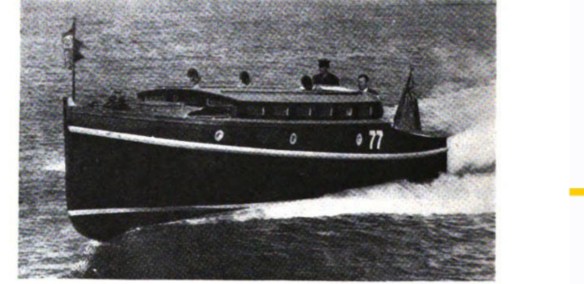
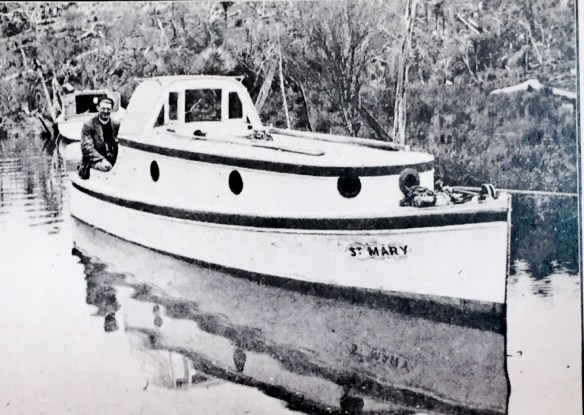
Today’s post features the launch St Mary, seen here transporting an Anglican Home Mission priest on the Hokianga River. The church used launches to undertake church work in the Far North in areas inaccessible by road. The photo was spotted at the Pah Homestead in Hillsborough by John Burland & is ex the Sir George Grey Collection (Auckland Library) & taken by Barry Bennett.

Any woodys able to tell us some more info on the launch & what happened to St Mary?


ps – seems even back then, boaties had ideas around building a ‘block of flats’ 🙂

Harold Kidd Input – Jack Harker wrote a great little book about this Anglican clergyman “Soldier, Sailor, Priest”. ST. MARY was based in the “Roadless North” at Kohukohu in 1914, was 24′ loa and had a single cylinder 4.5hp Standard engine. I don’t think he did a Jasper Calder and preached from the boat.
By 1923 it was said to be the only launch the Anglican Church owned in NZ. The minister, the Rev. J.C. Hawkesworth conducted 276 services, performed 34 baptisms, 8 marriages, 9 funeral services and 41 candidates for confirmation. The northern shore of the Hokianga is largely Roman Catholic with a superb church at Te Karaka, visible for miles, set up by Bishop Pompallier, so there was a bit of inter-denominational rivalry going on.
I can’t find a whiff of her provenance in the book or anywhere else.
The Anglican Church did build other launches, one in 1909 for use at Stewart Is and Ruapuke and a 40 footer in 1914, G.A. SELWYN, (later just SELWYN) by E.R. Lane for use at Nelson for the Church’s Sounds and Tasman Bay communities.

Fisher Lassie

screen-shot-2016-11-16-at-5-04-27-am

screen-shot-2016-11-16-at-5-03-28-am

Fisher Lassie
Built in 1938 by Miller & Tunnage, Fisher Lassie is a 39’3″ converted fishing boat that is powered by a 1952, 3LW Gardner with a 2UC gearbox & a keel cooled dry stack. The Gardner has done 3380hrs in the last 17 years with no grief using about 3 litres per hour.
She cruises at 6 kts, her ex work holds provide lots of storage & combined with her extensive fit out, has the basics to be a nice live-a-board.

Given the amount of interest / chat on trademe, a northern woody might have trouble getting her North 😉 those southerners do not like losing boat north 😉 Current bidding is in the low $3k’s so a good buy. Thanks to Ian McDonald for the heads up on the vessel.

Any of the work boat woodys know anything more about her?

The launch of Albacora

albacora-launching-day-2

The launch of Albacora

Thanks to Hylton Edmonds there is a very detailed & accurate history of Albacore already on ww (link below). What we were missing was launch day images. Thanks also to Hylton Edmonds for the above photos showing her being splashed in 1954.
Albacora was a McGeady, which is surprising as she was rather pretty, she measured 38′ & was purpose built for big game fishing. Albacora spent the early part of her life in the Bay of Islands & was then freighted to Fiji in 1968. Sadly she was a victim of the 1983 Cyclone Oscar but prior to this she very neglected. Post the cyclone her fate was a bulldozer & a box of matches 😦

Full details here  https://waitematawoodys.com/2015/07/06/13148/

Fleetwing

screen-shot-2016-11-08-at-9-46-56-pm

screen-shot-2016-11-08-at-8-46-25-pm

screen-shot-2016-11-08-at-8-48-01-pm

FLEETWING

Today’s story has come about by 4 people digging me in the ribs – started off with Chris Manning letting me know that he had purchased Fleetwing, but not really for future ownership – more to protect her from future neglect & to secure a new owner that has the vision & passion to bring her back to the condition a vessel with her provenance deserves.
Next Nathan Herbert gives we a nudge, then Ian McDonald, then Cameron Pollard emails me, now if you know Cameron he is a man of few words (in emails) his message was “some woody needs to buy this”. And someone does.
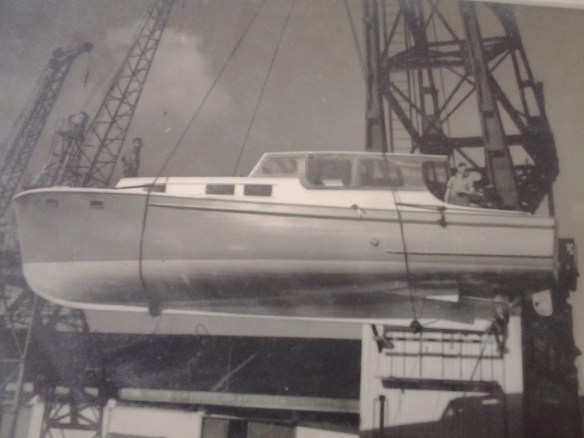
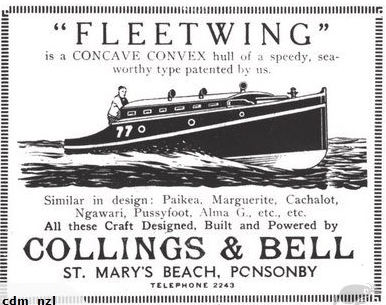
Fleetwing is a 32′ kauri carvel planked hull, built at St Mary’s Bay, Auckland at the Collings & Bell yard, launched September 1920. She has spent the majority of her life in the Marlborough Sounds as a commuter and work launch.

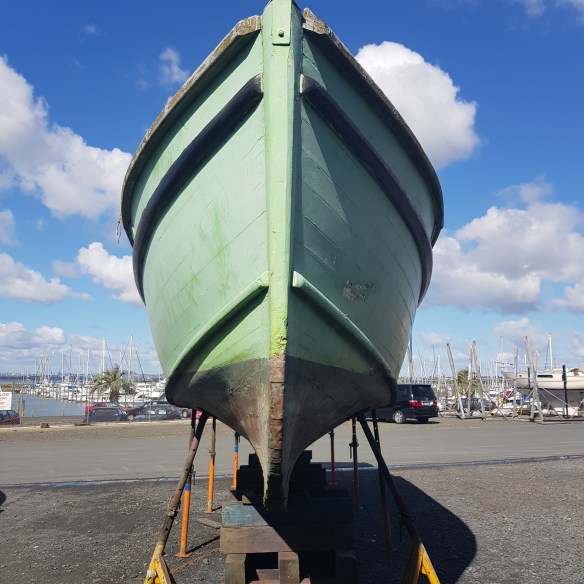
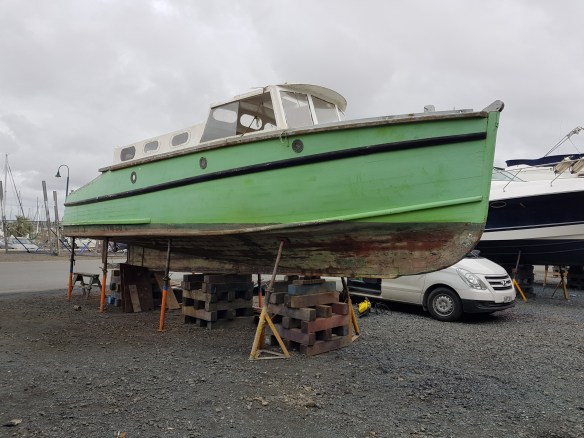
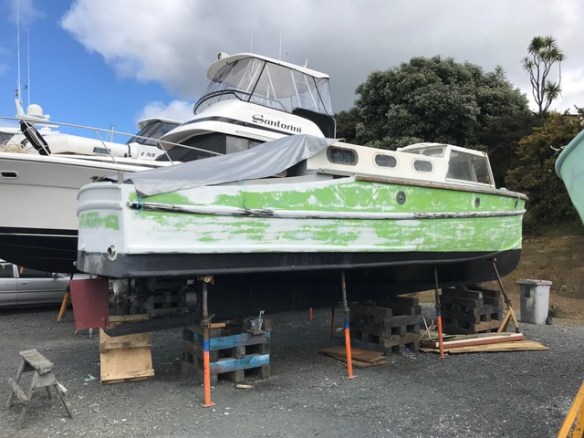
No engine, no propeller, other running gear in place. No ancillaries/tanks. Hull appears sound and appears to have had significant refastening work done in the recent past. The deckhouse would benefit from the use of a chainsaw.

Currently lying on a mooring in Paremata. Can be shifted to Mana Marina Travel-lift if required.

Above are a couple of historic photos . The photos of her with the Aramoana green hull are as current.

So woodys if you are seriously seeking a historic New Zealand launch for refit or restoration then Fleetwing could be for you.

You can read more about her at the ww link below. You’ll find her list on trademe at $900 ono – yeap – $900.

Charles (Chas) Collings – Designer / Boat Builder

12-11-2016 update ex Gavin Pascoe – In the colour photos the launch in the background is  another Collings and Bell, named Surprise. Built for Cook Strait whaling again on the concave convex principle.

28-08-2018 Update

I’m very pleased to advise the after a 91 year absence the 1920 Collings & Bell launch – Fleetwing, has returned to her original waters… Auckland.
She joins the Pollard Bros fleet. Photo below ex Andrew Pollard.
20180824_132808
More photos below of her at West Park Marina – ex John Wicks 
20180828_160501
20180828_160536
Update 30-08-2018 Photo below supplied by Andrew Pollard – looking very quick 🙂
Screenshot_20180808-214051_Gallery
20-09-2018 Update – my spies sent in the photo below – rather a zoom zoom prop has been added – maybe the bros are doing the 2018 Rudder Cup race ????
Screen Shot 2018-09-20 at 3.06.11 PM
29-09-2018 Another yard photo from Jason Prew, the guy should be working on his own boat 🙂
IMG_6788
08-10-2018 Updated photo ex Andrew Pollard – looking very smart 😉
Fletwing Oct2018

Want to see what electrolysis does to a wooden boat?

img_0552img_0551

 What Is Electrolysis?
I have published Chris McMullen’s comments below for 3 reasons:
1. Out of the blue, today I was sent the above 2 photos by a woody owner who has just discovered they have a time bomb ticking away. Bomb is a good analogy to use as the green wires in the bottom photo are the detonator 😦
2. The subject of electrolysis & wooden boats is topical at the moment
3. I’m passionate about saving our old wooden ladies.
You can read more on the subject here https://waitematawoodys.com/2016/04/28/electro-chemical-damage-in-wooden-boats/
To quote the dictionary – Electrolysis of water is the decomposition of water (H2O) into oxygen (O2) and hydrogen gas (H2) due to an electric current being passed through the water. Electrolysis of salt water or Brine – electrolysis turns NaCl + H2O in electrolysis will produce separated hydrogen gas, chlorine gas and sodium hydroxide*. *Sodium Hydroxide is also called Caustic Soda. It is used for pulping wood in the paper industry and on a boat it forms around any anode protected metal (Cathode) and softens the wood.
Lets check again in the dictionary – “The cause of Electrolysis?”
Electrolysis is due to an electric current being passed through the water or Brine. Surely, the way to prevent electrolysis on a wood boat is by eliminating any electric current passing through the wet wood.
There are two sources of electrical current on most boats.
1. The DC battery used for starting the engine and services. Stray currents are common,(can be very damaging) and hard to find on wooden boats. Any connected dissimilar underwater metals including anodes will create a galvanic current 24 hours a day. There should be no connected dissimilar metals underwater and keep the ships DC system isolated from any metal connected to the sea.
2. Bonding makes a circuit and encourages stray and galvanic currents; the result will be electrolysis and degradation of the wood around metal hardware.
Protecting marine metals (bronze or copper) with an anode is pointless and sets up a current and causes electrolysis that again produces sodium hydroxide that pulps the timber in a wooden hull. If you have brass or manganese bronze underwater, an anode may help protect the metal but set up a galvanic current with resultant damage to the wood surrounding the cathode or protected metal.      

See on Google – graphic descriptions of exactly what happens on our boats if we create an anode and a cathode. Chlorine gas is produced at the anode and hydrogen gas at the cathode.

http://www.google.co.nz/search?q=electrolysis+of+brine&rlz=1C1QJDB_enNZ596NZ625&espv=2&biw=1680&bih=944&tbm=isch&tbo=u&source=univ&sa=X&sqi=2&ved=0ahUKEwjh75ODuObPAhUUSGMKHcDKBkoQsAQIMA

Whether we like it or not, the brine around any cathode or protected metal converts to sodium hydroxide (caustic soda) and this is fatal to a wooden boat.

The solution is very simple – you should not use anodes on a wooden boat.
Anodes are necessary / desirable on steel structures where there is no wood. To use them on a wooden boat is a relatively new idea or myth designed as a solution looking for a problem. On wooden boats it has been proved worldwide to be a disaster but some in the NZ marine industry refuse to admit they have been wrong and continue to promote this profitable business.

The Logan’s, Baileys and Colin Wild never used anodes or bonding and neither should anyone who cares for their wooden boat.

 Read http://mgduff.co.uk/support/knowledge-base/questions/what-is-electrochemical-decay-in-wooden-vessels  

If you would like some more technical evidence read. http://www.mcclavemarine.com/text%20pdfs/Corrosion.and.Corrosion.Protection.Wooden.Boats.pdf

P.S. Chris would like to advise that he has had no input or involvement in any organised discussions on the topic of electrolysis & wooden boats.

Signature (Beluga)

screen-shot-2016-11-08-at-6-12-42-am

screen-shot-2016-11-08-at-6-13-09-am

SIGNATURE (Beluga)

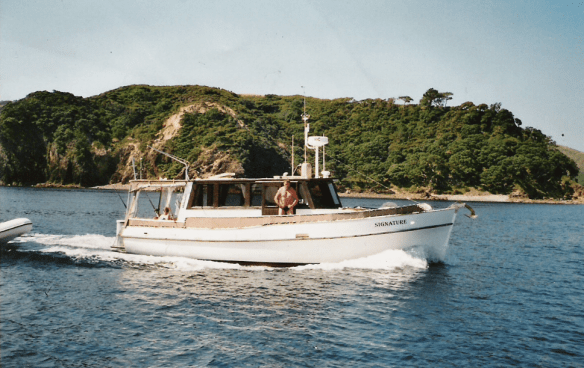
When Ian McDonald found the above boat  for sale at Westhaven she was named “Beluga” as someone thought she looked like a little white whale.

Her history Ian was told is roughly this:  Strip plank built in 1990 as a spec, to be a work or fishing boat, over 2 or 3 years when the Miller & Tunnage yard was quiet in Port Chalmers, then sailed to Nelson in the hope of an easier sale. She was sold from Nelson to become a long-liner out of Leigh. How she got to Leigh, Ian doesn’t know, maybe sailed up, maybe trucked.

In Ian’s words a trendy city fella bought her, post fishing, named her Beluga, and then sold her after a brief ownership. Ian bought her in 1998 having done a lot of sketches of what he would like to do to her, Ian commented that if one imagines her without the wheelhouse door, and no extension to the coach-roof aft, she wasn’t a pretty boat at all.  Miller & Tunnage didn’t seem to go for topsides looks, but their hulls are beautiful.

Ian visited the Miller & Tunnage yard looking for a genuine bronze M & T name plate and was helped by the manager who sent the plate mould into Dunedin and had some cast, one of which should still be in the boat today. During the visit, the manager took Ian up to the mezzanine floor and showed him the frames still there, off which she was lofted. They had previously built the “Deborah” of the same frames, for the older, about to retire partner, which was moored just up the harbour at Deborah Bay. Ian showed them a photo of what he was doing and they said  “that’s Signature”  and, when Ian enquired as to how she was thus named, they told him that when any new build was about to begin, it required paperwork, description, who it was for etc, and, a signature, so that’s what she was called.

The extension to the cabin top, aft from the door to the stern was designed by Ian in conjunction with Mike German & Graeme Lyons ( German & Lyons Boat-builders), in 1998 and fitted by Mike & Graeme in the shed at Half Moon Bay hardstand, as was the wheel-house door which didn’t exist when Ian bought her. The teak cladding around the windows was also Ian’s idea.  She was then powered by a 4cyl Isuzu and had a fuel capacity of 1,000 litres

Ian kept her until 2003 & she went on Jacob’s boat-haulage to Mana Marina & was sailed to Waikawa where she remained for a few years before once again being trucked north to appear again on the Waitemata. Then she was sold and appeared in Nelson, which is where Ian took the marina photo above in 2015. The second photo (of someone who resembles Ian, doing an Arnold Schwarzenegger impression), was taken just entering Port Abercrombie a few summers ago now.
In January this year Ian was at Mana Marina and spotted her being prepared for another trucking north and, Ian believes she now resides in Kerikeri.
This boat has done a lot of road miles 🙂 Anyone able to confirm her current whereabouts?

Photos below ex Dean Wright of Signature at Doves Bay Marina. Looking a tad different 🙂

20161108-_dhw7113

20161108-_dhw7114

20161108-_dhw7115

Penguin

penguin-1

penguin-3

PENGUIN
Penguin the 34′ ex Navy survey tender has appeared on ww before (link below for full details). She recently surfaced on trademe, so thanks to Ian McDonald’s tip off, we are able to have a good peek down below. Enjoy – she will appeal to Russell Ward 😉

Ex Naval Motor Launch

17-05-2017 WARNING – IF THIS BOAT IS OFFERED FOR SALE  BE CAREFUL. FYI – READ THE LINK TO THE POST BELOW.

Vacuna

Deodar

deodar-mow-labour-weekend2016a

deodar-mow-labour-weekend2016c

deodar-mow-labour-weekend2016b

DEODAR

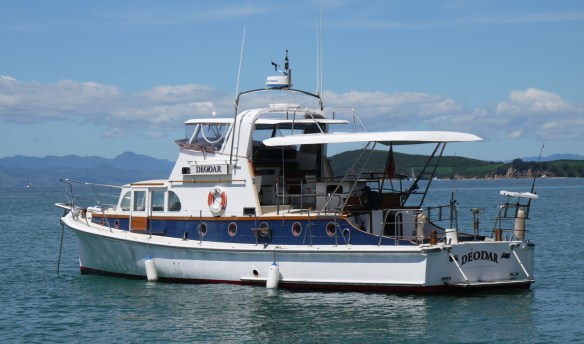
Mooching into Man o War Bay on Sunday I spied the 52′ Deodar at anchor, looking very smart. She was built by Millar & Tunnage in 1960 & is an ex Auckland Police launch.
In 1996 she was converted for pleasure use & recently underwent further work – more details & photos here https://waitematawoodys.com/2013/12/29/deodar/

Kaheno

screen-shot-2016-10-20-at-11-37-55-pm

screen-shot-2016-10-20-at-11-45-03-pm

Kaheno Looking For A Cheap Waterfront Bach

This 45’9” 1966 classic trawler styled Carey motorboat is built using stripped planked kauri & powered by a 135hp Gardner 6LS engine. She was converted to a live-aboard & ticks all the boxes for what I call a floating bach.

Asking price on trademe is $249k, I suspect it will sell for less but what ever the price – it’s a cheap holiday home or a city waterfront apartment. Again thanks to Ian McDonald for sniffing this one out 🙂

Update from Ian McDonald
It would appear that the vessel is ‘Kaheno’ – desined by Carey of Picton & built in 1966 by Sinclair & Melbourne. She was once owned by the Salvation Army to service Rotoroa Island. She tragically sank with the loss of 4 lives in the Tamaki Strait circa 1986 whilst carrying timber as deck cargo from memory.

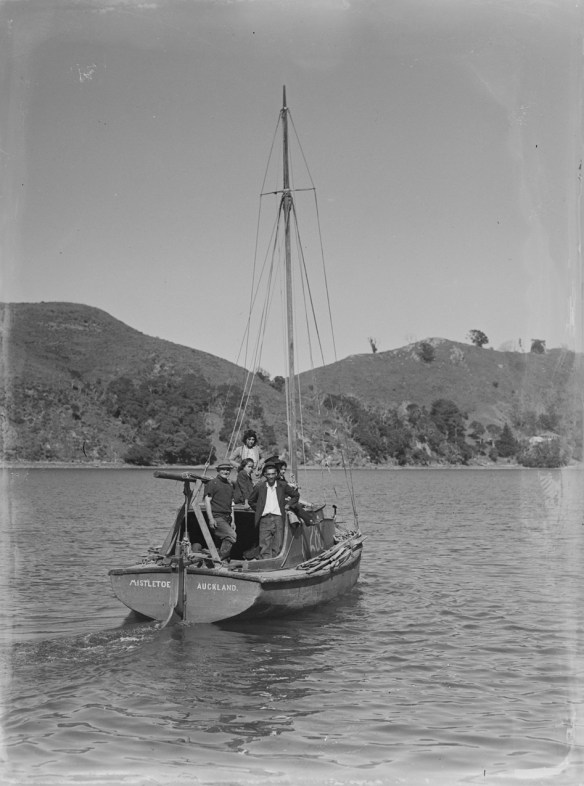
Mistletoe 228 – Sailing Sunday

mistletoe-228-gt-barrier-t-collins-collection-ex-museum-i-d-ph-2013-7-tc-b923-04

mistletoe-228-gt-barrier-t-collins-collection-ex-museum-i-d-ph-2013-7-tc-b923-05

Mistletoe 228 – Sailing Sunday

When I first saw the above two photos from the Tudor Collins Auckland Museum collection I had a chuckle, there has to be a story behind these photos. Venue most likely is Great Barrier Island. Photos emailed to me by Ken Ricketts.

Do we know any more about her?

Photos below ex Dean Wright of Mistletoe at Whangaroa Marina 2007. Nice to see she survived 🙂

25-10-2016 Update ex Alice Morrison

I recall seeing a very similar vessel called ‘Mistletoe’ in Houhora on 11 February 2016 (picture below). I wonder if she is Mistletoe I or Mistletoe II?

img_5091-mistletoe