Tauraka

TAURAKA

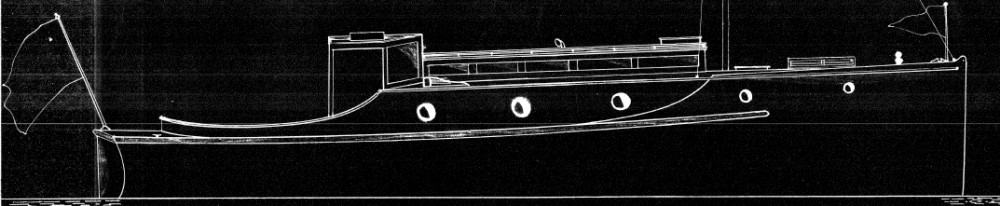
Now I’m not sure if Tauraka is her current name, but according to trademe she was built in 1912 by Fred Man for F.W. Chalmers.  She started life as a gaff rigged sailboat with a 10 hp Frisco engine. About 1925 she went to Tauranga where she had 4 owners before moving to Lake Rotoiti about 2005.  Currently powered by a Ford 4 cyl. 60hp diesel engine. The trademe listing says she sold for $4,020,  at 32′ that is a huge amount of boat for the price. Someone got a real bargain.

Harold Kidd (brilliant) Input

It’s actually a bit more complicated than that. Fred Mann of John St., Ponsonby built a 24ft launch for Frank W. Chalmers in 1910 called GWEN. Chalmers worked for J.J. Craig. In December 1912 Mann launched another launch for Chalmers, the 32 footer, GWEN C. She had a 10hp 2 cylinder ‘Frisco Standard. Chalmers kept GWEN C until September 1921 when he sold her to Percy Carter of Tauranga. Carter changed her name to HELEN C.
Now Carter was a leading light in the Tauranga Yacht & Motor Boat Club and a yachtsman through and through. Although the launch had used an auxiliary rig beforehand, Carter rigged her right up as a schooner and took part in yacht races in Tauranga with her. There had been a number of such launch/yacht hybrids before that in Auckland but they were neither fish nor fowl and generally defaulted to their launch role. HELEN C didn’t and carried her rig for many years. She was allocated the sail number E79 by the APYMBA and raced in the 1932 Auckland Anniversary Regatta on 20m handicap and came 6th on line.
Carter sold her when he bought the Woollacott ketch MAY in 1953 and renamed MAY RAUMATI after a small yacht he had owned and raced in Tauranga pre-WW1. HELEN C’s new owner renamed her TAURAKA.

Stella

STELLA
details & photos ex Judith Wallath

Stella was built by Lanes of Totara North in the mid 1950s.  Benjamin (Ben) Le Clerc, farmer of Otara, Helena Bay, bought her from Lanes.  Stella was 32 ft, built of kauri, with a petrol motor and set up as a game boat.  Later, while moored at Helena Bay, a petrol explosion occurred which blew out the forward hatch.  She sat on the beach for three months while having a 40 h,p, diesel motor installed.
Disaster struck again on the 21st April 1963 when Ben was returning from a fishing trip with eight men on board, and a catch of 13 hapuka.  The boat hit a rock off the Wide Berth (Limerick, Rimiriki) Islands.  A mayday signal was sent which was picked up at Russell and Port Charles.  In the meantime the boat broke up and the men clambered onto a rock.  The first to answer the mayday call were Jack Foote of Footes Bay and Mr J.D Prestney, manager of Mimiwhangata.  A runabout was sent out, which laboured to the mainland with 11 people on board.  Mr Prestney was off-loaded at Mimiwhangata.  He raced to his Landrover and flashed his headlights to attract the attention of the Kitty Vane which was approaching from Tutukaka.
Meanwhile the other ten proceeded towards Helena Bay where disaster struck again. The runabout struck a submerged reef and began to sink.  All had to abandon ship once again and cling to a small dinghy which was being towed.  It was 3 a.m. before they reached the mainland again.  21 year old Glenys Foote was the heroine of the event.  She rowed the dinghy that transferred the men from the rocks to the runabout, and then later rowed the 8 men to shore while Ben swam.

So woodys can anyone add to the history of Stella. Was she salvaged or slipped away to Davey Jones locker? There is some confusion as to her length some say 32′ others 38′, can anyone confirm?

Harold Kidd Input

STELLA apparently WAS a total loss when she went aground on the Limericks, Wide Berth Island, on 21/4/1963, that is according to Madge Malcolm’s book “Where it all began”, but the wreck doesn’t appear in “Shipwrecks of NZ”. She was then owned by B.C. Le Clerc of Helena Bay and was a 38ft bridgedecker. I think she was probably supplied by Lanes at Totara North but was undoubtedly built by Lanes at Auckland, despite the Sam Ford-type waist windows.

Thetis

THETIS
photos & details from Luke Richardson

Thetis (Greek for Sea Nymph) was launched in Dunedin on the 31st August 1929.  She was built by Mr J McPherson boat builder of Dunedin for Mr Charles Sundstrum.
Thetis was designed by renown naval architect Mr William H Hand Jnr of New Bedford USA.  William ‘Bill’ Hand was the originator of the V-bottom hull type per Thetis.  In addition Hand was an early pioneer of the motor-sailor type. Thetis was designed as a fast day cruiser.
She is 35’1” in length with 8’1” beam, 2’9” draft and a total height of 6’9”. She is a British Registered ship dated 16th August 1929.  The official number is 127819. Her registered tonnage is 4.68 with a Gross Tonnage of 7.57.

Thetis was originally powered by a Chrysler Imperial 6 cylinder petrol engine producing 160hp at 2800rpm.  Later she was re-powered by a Chrysler Royal engine with 140hp.  With a Ford diesel in between she was subsequently re-powered in 2003 with a Mercedes Benz 5 cylinder diesel engine.  That motor is to be replaced now. Documents show Thetis was originally good for 18 knots.  A bigger engine was installed around the war years and its said she has seen 26+ knots.  In current configuration she’s more like 12-13 knots.

Construction is of kauri hull planking and Kowhai frames with teak decks. The cabin was subsequently modified and enclosed by Magnus Smith of Lyttelton, Luke believes the work was done  for Bruce Stewart of Pigeon Bay.

Known Owners
Charles W Sundstrum                         1929-37
Bruce F Stewart (later Sir Bruce)         1937-50
William Carey                                      1950-54
Clarey Beaumont                                1954-57
Des Sinclair                                         1957-67
Laurie Wales                                       1967-1997?
David Martin                                        1997-2006
Brendon Leech                                    2006-2014
Glenn Tod                                            2014-2015
Luke Richardson                                  2015-

Known History
Dunedin to late 1930’s
Pigeon Bay for some 20 years
War Service – she was commandeered by the NZ Navy Naval Auxilliary Patrol Service (NAPS) in WWII and used as a coastal patrol boat.  She commenced service 9th May 1942 and was relieved of duty 23rd February 1944 when the NAPS formally disbanded.  She was assigned the pennant number Z125 and served in the unit based in Lyttelton.  The owner at that time was B.F. Stewart.

Luke purchased her in July 2015 and she is now hauled out of the water for some long overdue TLC.  A period of neglect following the Christchurch earthquakes meant she was long overdue for some maintenance.  Luke would love to know more about any of the owners over the years and any of her history not covered above.

To view more photos & to follow the work, Thetis has a facebook page –  Friends of Thetis

https://www.facebook.com/groups/1608024876125109/

See below an article on Thetis’s launch from the Australasian Motorboat & Yachting Monthly from October 1929. Its a good read 😉

Harold Kidd Input

Charles William Sundstrum was a Dunedin dentist who was a key figure in Dunedin yachting circles for many years. His first launch was the 31ft clinker double-ender VALMAI of 1910 which had a Dunedin-built 5hp Viking engine. He raced her with the Otago Yacht Club including one of their Ocean races to Timaru.
He replaced VALMAI in 1913 with the 40 footer NORANA designed by Joseph Gillanders and built by Miller Bros at Port Chalmers. She had a 16-18hp Jersey Standard marine engine and was a handsome craft. He sold her to Arthur Brett of Auckland in 1927. During WW2 she was taken over by the RNZAF and sent to Fiji for towing work.
THETIS was NORANA’s replacement. Photo of Norana below.

13-05-2017 – Additional Photos ex trademe (Ian McDonald nudge)


Ngaio – Sailing Sunday

Ngaio – Sailing Sunday
photo ex Nathan Herbert

Todays photos were taken in early Jan 2015 by Nathan & are from Tutukaka. The hauled out ‘yacht’ has an interesting set up – 2 masts + game poles 🙂
I have to say it looks a great spot to haul out.

Anyone able to shed some light on the boat?

No longer a mystery – its Ngaio, designed by Jim Mason in 1941 – photos below from Dean Wright

Harold Kidd Input

In case Ian doesn’t post, she was designed and built by Jim Mason at Grey Street, Whangarei from a half model and launched in 1941. She was partly mobilised in 1942 by NAPS and crewed by Jim Mason, skipper, Tom McKinnon, deputy skipper, and Jack Carpenter, Bob Baker, Peter Roberts and Ian Crawshaw. Her NAPS number was Z40.
These NAPS boats did a great job during wartime when German commerce raiders and minelayers were busy around New Zealand at the start and were followed by Jap submarines checking us out. The Whangarei boats were in the most likely place for trouble.
Lovely boat.

Input from owner & son of builder, Ian Mason

A following up on Harolds post on Ngaio,all correct I might add. She was built over a two year period. She is carvel planked in kauri over kowhai ribs and pohutukawa stem, stern and floors. Her first engine was a 6 cylinder Delage out of a car owned by my father. When it was replaced in 1957 by an air cooled Enfield they got more for the scrap than Dad originally paid for the car. When she was built kauri was 3 pound 15 shillings per 100 super feet and the copper nails were the equivalent of 75c per pound. The original suit of sails cost 25 pound from Sails and Covers. In those days she carried 750 sq ft of sail. Since the Enfield she has been powered by a Ruston, Bedford and now a 6BB1 Isuzu. I installed this in 1995  and we have had 7000 trouble free hours since. I first went aboard Ngaio when I was 4 months old. I have 4 children and 9 (to date) grand children and they all love her as much as those  that have gone before. I think she will keep the same name and family ownership for a while yet.


Woody Trip Report – Inside Passage Cruise

WOODEN BOATS OF THE INSIDE PASSAGE

Story & photos by CYA NZ member Denis O’Callahan (owner of MV Tasman)

Today’s post tells the story of Judy & Denis O’Callahan’s adventure cruise – its a great read, so I’ll let Denis tell the story. Enjoy 🙂

 “In April 2000 I was invited by a Canadian friend to help launch a boat which his brother Wayne had built on Thetis Island in the Strait of Georgia near Vancouver. The “Grail Dancer” is 48’ on the deck, ketch rigged and based on the lines of the “Emma C Berry”, a 150 year old traditional fishing boat now preserved at the Mystic Seaport Museum, Connecticut. Wayne works as a wooden boat builder and restorer who at that time was restoring historic paddle steamers at Fort Dawson and Whitehorse on the Yukon River during the summer. During the winter he worked on the “Grail Dancer” which took him 14 years to complete. This trip was a great experience which gave me an inkling of what a wonderful cruising ground the Inside Passage to Alaska would be. This was further reinforced when I read the great book, “Passage to Juneau” by Johnathan Raban.

Eventually this year my wife Judy and I planned a visit to Vancouver and Alaska, including an adventure cruise of the Inside Passage. Our first stop was Vancouver, from where we took a float plane to Victoria on Vancouver Island to spend a couple of days with friends who live near Nanaimo. On the way north from Victoria we called in at the small fishing port of Cowichan where I was able to see a converted fishing boat, “Morseby III”, which belongs to a guy I know who lives at Mangawhai. We flew back to Vancouver from Nanaimo and had a couple of days there including a visit to the excellent Maritime Museum. Here there is preserved the wooden auxiliary schooner St Roch, built in 1928 in Vancouver and operated by the Royal Canadian Mounted Police. In 1942 St Roch completed the first voyage from the Pacific to the Atlantic through the Northwest Passage, 27 months from Vancouver to Halifax and spending 2 winters in the ice. In Halifax her engine was upgraded from 150hp to 300hp and she made the return journey in 1944 in 86 days.

Next we boarded the Alaska Marine Highway ferry “Columbia” for a 2 night, 1 day voyage from Bellingham to Ketchikan. This was rather like a Cook Strait ferry and while we had a comfortable cabin many hardy souls camped in deck, fixing their tents down with duct tape. We saw a number of other boats during this trip, huge barges laden with containers and trucks, cruise ships, fishing boats, pleasure boats and some of the contestants in the inaugural “Race to Alaska” (R2AK). R2AK is open to any kind of boat without an engine, from kayaks to racing trimarans, 750 miles from Port Townsend to Ketchikan. First prize, $10,000, second prize, a set of steak knives. The ferry passed through many spectacular narrows and channels and at Bella Bella we stopped while the crew lowered the anchors to demonstrate compliance with US Coast Guard requirements.

Ketchikan is a busy port town with floating docks and other marine facilities. However during the summer it is dominated by up to 4 giant cruise ships visiting each day. A large marina (“floats” in the local lingo) accommodates a variety of fishing and pleasure craft. The salmon fishing boats are divided into 3 types, purse seiners which go for large volume, low value fish, gill netters which aim for better quality and trollers which target the top quality product. Long-liners target halibut, a kind of gigantic deep water flounder which can grow up to 200kg.

We took a 10 day adventure cruise on the “Alaska Dream”, a 104’ catamaran, rather like a Waiheke ferry with cabins for 40 passengers and a crew of 17. We strongly recommend this as a way to see the Inside Passage. Activities included walks ashore, railway excursions, kayaking and even swimming. We saw amazing wild life, indigenous culture, glaciers and fishing ports, including Sitka, Skagway, Haines, Juneau, Petersburg, Wrangell, Thorne Bay, Matlakatia and Ketchican. In every port there were numerous classic wooden fishing vessels in varying states of preservation. I would estimate that 90% of the working fishing boats around the Inside Passage are of wooden construction. The plentiful supply of rot resistant old growth Yellow Cedar and Western Red Cedar no doubt accounts for the durability of these vessels”

Flirt

FLIRT
photo & details from Judith Wallath

Today’s photo of Flirt was sent to me by Judith Wallath whose recalls that before WW1 her uncle Fred Briggs, solicitor of Whangarei, owned this small launch and used her on the Whangarei Harbour for fishing trips and outings.  He had four sisters and with friends they had wonderful times at Urquarts and Smugglers Bay etc.  In 1915 Fred left NZ with the Royal Navy Volunteer Reserve and on the strength of his NZ boating experience was made sub-lieutenant in the Motor Patrol headquarters at Torquay in England, patrolling the English channel looking for submarines etc.
This photo of Flirt was possibly taken in Urquarts Bay.  Fred on the left.  Judith commented while she was anchored in Urquarts last summer they saw a launch somewhat similar to Flirt though slightly longer, moored there.

Any of the woodys able to contribute to details on Flirt & what became of her?

Harold Kidd Input

This FLIRT (there were several) was built for J.F.S. Briggs by Percy McIntosh in Whangarei and launched about October 1912. She was 25ft with a 4hp Palmer engine, upgraded in April 1913 to a 5hp Zealandia. Briggs sold her to E.J. Jones who raced her at the Onerahi Regatta until December 1919 as FLIRT. Jones changed her name to VICTORY soon after, but I lose track of her in 1921, probably because of another sale/name change.

Tomif – Sailing Sunday

TOMIF – Sailing Sunday
photos & details ex Don Kurylko & the WoodenBoat Forum

Now I have been a fan/follower of the USA WoodenBoat Magazine’s on-line forum for a long time, it was my go-to place for advice & guidance on most things to do with classic wooden boats. The secret was being able to ID who was handing out advice based on experience & who was sitting in a farm house 5,000 from the sea & had never owned a boat. There have been some amazing build projects & some real characters on-line. If you have not visited the forum I would encourage you to.

Everyone has their favourite stories (called threads) but one of best & longest running is the tale of Don Kurylko & the build of his 45′ cold moulded, topmast gaff cutter.  Below you will find the link to the WBF thread on Tomfi – lofting started back in 1981 & she came out of her shed earlier this year, yep thats 34 years 🙂  Don says that works out at close to 16,000 hours or 8 years of full time labour.

The story of Don test lofting in the snow is just one of many amusing tales – I’ll let Don tale it :-

“One day, a couple of winters before I started building, I found myself going a bit stir crazy and needed something to perk up my spirits. We were living in a small log cabin out in the boonies, without electricity, and there wasn’t much in the way of entertainment to be had. So, I grabbed a set of plans I had bought from designer Tom Colvin and headed out to the small pasture behind our place. I made up some long battens and “lofted” out the accommodations plan full size to see how it would fit. The snow was perfect. It had been really cold and the surface was so hard and crusty that you could walk on it without fear of breaking through. Once I got all the lines laid out, I filled them in with ashes from the wood stove. In a few hours I had a virtual boat that I could walk around in. It was fun and the drawing lasted for several weeks before it snowed again and covered it up. I guess there are some advantages to Canadian winters after all”.

The above photo collection is just a selection from the 100’s on Don’s Tomfi thread – if its raining today, I’ve probably ruined (or made) your day.

http://forum.woodenboat.com/showthread.php?123343-More-photos-of-Don-Kurylko-s-new-boat

SPECS:

LOA: 45’
LOD: 34’
DWL: 29’
BEAM: 10’
DRAFT 5’
DISP: 18,000 lbs
D/L: 333
BALLAST: lead – outside 5,600 lbs – inside 1000 to 2000 lbs, as required
B/D: 36% @ 6600 lbs; 42% @ 7600 lbs
SA working: 800 sq. ft. (SA/D: 18.5)
SA 3 lowers: 695 sq. ft. (SA/D: 16)

Swanee

SWANEE
photos & details ex Ralph Weber

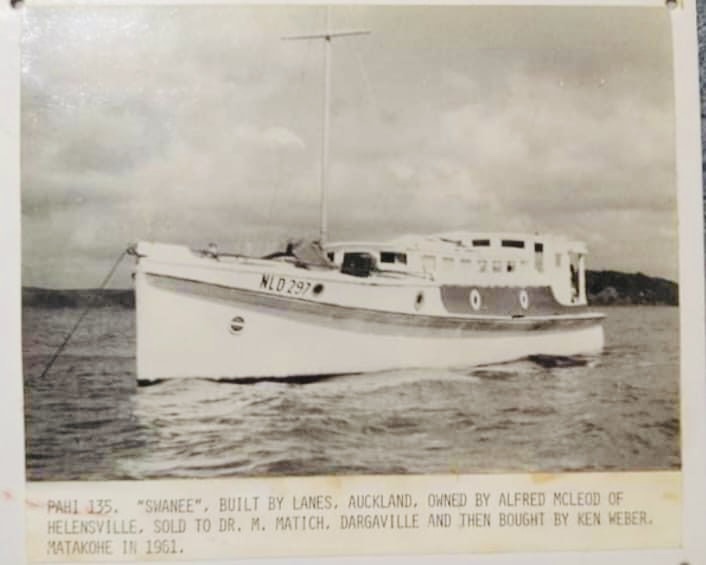
While the exact details of who designed & built today’s launch Swanee are unclear, she is rather unique in that she has remained in that same family for over 50 years. Built from kauri she is 33′ long with 8’9″ beam & 2’8″ draft, currently powered by a 60hp Ford diesel.
You can see from the photos that she is very well appointed with everything one needs for comfortable cruising – electric flush toilet, freezer/frig, electric capstan & all the safety gear.
Over their period of ownership the Weber have ensured Swanee remained in great condition with a major 2 year out-of-water refit in 1970 that saw her re-ribbed with pohutukawa (you could back then 🙂 ) & new topsides. In 2004/5 her topsides were glassed & 2 pot painted & she was rewired.

Owner Ralph understands, from his mother, that she was built c.1920 in Auckland for Sanfords. Then later sold to the McLeod family of Helensville. Then she went to Dargaville and then owned by Matich Bros and later by Dr Maurice Matich. The Weber family, Ken & June, bought Swanee in 1961 and now ownership is with their son Ralph Weber of Matakohe. Currently moored at Pahi.
Ralph commented that Harold Kidd had previously mentioned that she may possibly have been the – ‘Sister Lola’ & built by Bailey & Lowe, if so she ‘raced’ with the Ponsonby Cruising Club.

Ralph sent ww photos of Swanee over a year ago & contacted me recently to say that unfortunately life has moved on & the family have had to make the difficult decision to sell Swanee after 50+ years of ownership, so today’s post has a degree of sadness but could offer a lot of happiness to someone looking to buy a classic launch. For a 33′ launch, Swanee is a lot of boat, you can see in the photos that there is no shortage of living area & she comfortably sleeps 5. After 50 years you end up nothing what works best & where on a boat 😉
Boat aesthetics is a very personal thing & with some people practicality is #1, but if I was buying her I would be off to see a good sympathetic wooden boat builder like Geoff Bagnall & returning her cabin windows to a style a little more in keeping with a 1920’s classic. People forget that these old girls are wood & the cost of a wee bit of restoration like this would not be great. After all there is little else that needs doing to her.
She sports rather a racy (flat aft) bottom so with a bigger motor I would imagine she would perform very well.

So woodys – can we find a buyer for Swanee or know something that is looking for a classic wooden launch? Being based currently at Pahi she does present some interesting scenarios e.g. you could keep her there for a few seasons & have a floating family bach. A group of guys could get together & buy a good fishing / man bach on the Kaipara. Or simple put her on a truck & return her to the Waitemata.

Now I do not normally like to talk money in ww posts but the overall 2nd hand boating market is just so soft that when I think something is great value, I will – well woodys someone could own Swanee for less than $30K. , that is real value, you could not build a garage for that.
If you or anyone you know could be interested – contact Ralph, initially via email on weber.bros@xtra.co.nz

Also interested in any info /photos on her past.

Harold Kidd Input

SWANEE was certainly built as SISTER LOLA pre-October 1920, possibly by Harvey or DIck Lang. I don’t know where the Bailey & Lowe reference came in, although Bailey & Tyer did build a 33 footer (unusual dimension) just pre WW1. Lang too had built a 33 footer in 1916 and just could have used those moulds.
I can’t find a direct report of her owner as SISTER LOLA but am pretty sure she’s the boat reported in the Auckland Star of 28th August 1920. If so, her hull was built professionally and she was finished off by her first owners Pavitt brothers and Verran at Bayswater. There again the Verrans were Northcote people and Bailey & Tyer were at Hall’s Beach, Northcote Point.
She was sold to Arthur Sandford of Vine St., Ponsonby in late 1922, early 1923. He changed her name to SWANEE probably after the Al Jolson song “Swanee”. Sandford was, for a time, a professional Vaudeville artist and no doubt sang that song on stage. She had a 6 cylinder Studebaker car engine in 1925.
Sandford sold her to Alfred McLeod some time between 1934 and 1939. McLeod joined the Squadron with her in 1939. She then had a 30hp Hercules engine which he replaced with a 100hp Meadows ohv 6 in 1947/8 (probably a war-surplus engine). The rest of her history on the Kaipara is well-known.
There’s a big dose of conjecture in the above. I’ll check with the Verran family.

Update 30-08-2015

B/W photo added above ex Ian Miller whose wife Rosalind’s late father, Doug Hazard, crewed on Swanee in the 1930’s

Update 06-03-2023 – photo below ex Kauri museum, Matakohe via Diane Wilkinson fb

Janet – Sailing Sunday

JANE – Sailing Sunday
photos & details ex Mike O’Dwyer

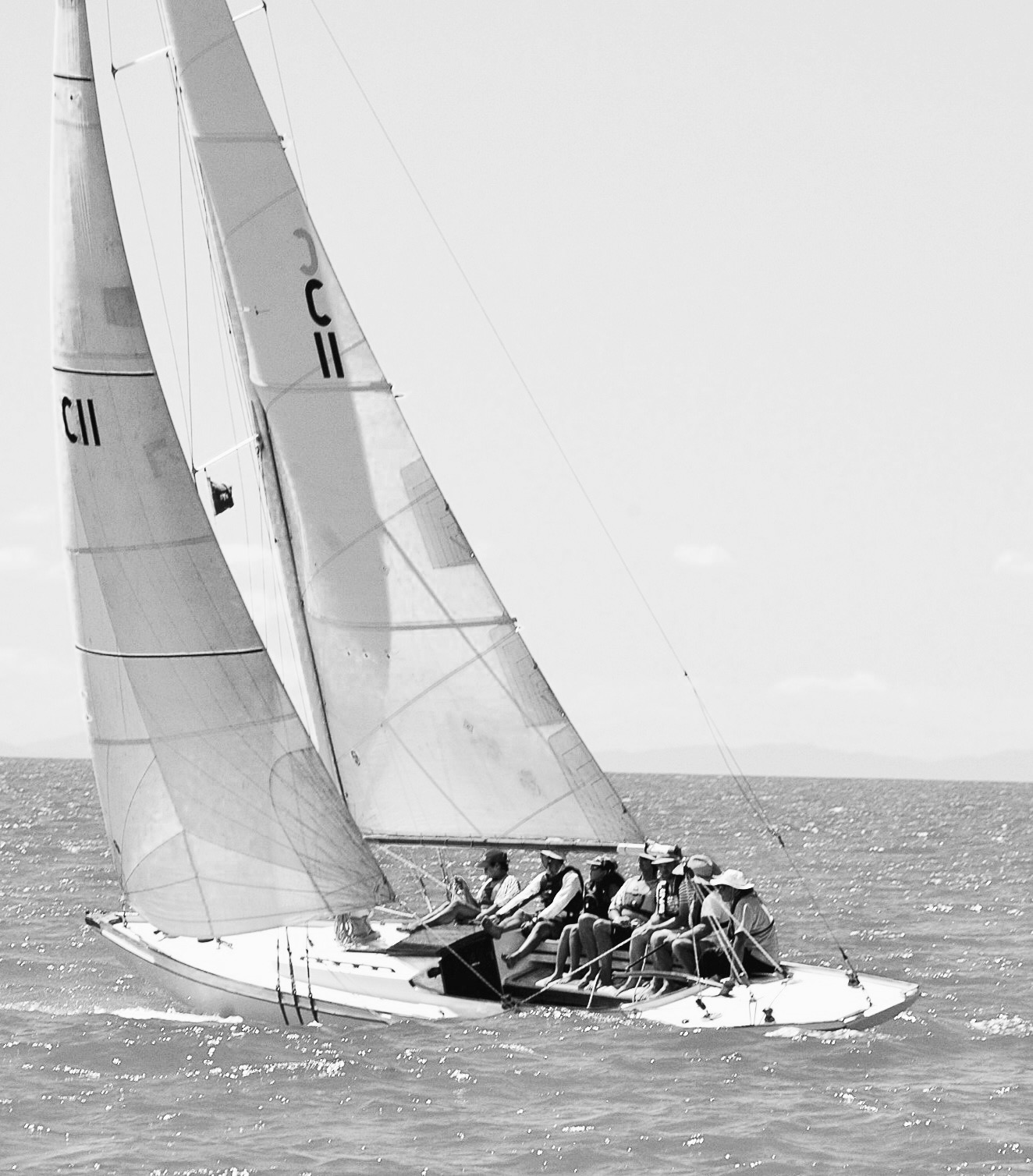
Janet was designed by Chas. Bailey Jr. in 1902 & built by the Sutherland brothers in Domain Street, Devonport*. She is now owned by Andrew Wares, Bruce Isles and Michael O’Dwyer of Hawkes Bay. All friends since childhood with a common interest in sailing who decided to obtain a classic yacht – a day sailer, not too big, something with a bit of provenance that had to look nice. After a year of looking Janet came up and fitted the bill.

Janet was purchased in June 2013, shipped to Napier in April 2014 and relaunched in April 2015 after an eighteen month makeover. Almost all of the work being done by Mike O’Dwyer & with limited spare time saw the project sixteen months longer than expected. A brief overview of the project goes like this – she had six planks replaced, three each side in the garboard area, a certain amount of repair completed on the inner skin, and was fully re-caulked, puttied and painted. The keel and rudder were fared and the floors refastened. The rig was also spruced up with the mast being painted, the boom varnished/painted, fittings newly galvanized and the roller reefing system rebuilt. The owners report she sails beautifully and with improvements and tweaks continuing will only get better. In the first photo above she is seen enjoying her first sail in Napier waters.

The restoration goes like this – Janet was stored at the sailing club hardstand with scaffolding around her, the tarp covering the scaffold was originally rented because  they thought they would only be there two months to do a spruce up. Well the best laid plans…. After removing the paint with hand scrapers it was discovered that the wide seams were full of sika around the garboard area, a copper strip covered a dodgy seam, planks that looked like they had lost some fastenings. Further raking of seams revealed very old caulking and putty.

In one of the photos you can see below the dark water stained areas that there was a 10mm gap between the garboard plank and the inner skin. Only one thing for it, full re-caulk, putty and new planks. The bottom three on each side had to be replaced.

In another photo you can see a copper strip covering the seam just above the forward edge of the lead keel, the seam behind this was about 10mm wide and full of gunk. The wooden filler block on the leading edge of the keel also needed to be replaced.  When raking out a small section of a seam it started with newer cotton on the outer, as you went deeper the cotton got older until finally the last cotton to come out  was like a ribbon. The plank edges were parallel to each other back to the inner skin which made for a narrow deep seam. The seams were paid with a variety of products e.g there was black sika,white sika and putty. Up to five layers of caulking( the stranded type) were removed from some seams.

You can also see the scored waterlines in the hull planks. They counted about six of these either side. Janet had an inboard engine at some stage which could account for some of them.

The varnish product on Janet is Hempel diamond varnish & is a two pot varnish. There are five coats on everything that needed varnishing. The wind vane is home made & works a treat.

Below is an index to some of the photos & her owner talks you thru some of the work. Scroll over the photo to view the number. Also remember you can enlarge the photos by clicking on them 😉

Andrew, Bruce & Michael have done a wonderful job in restoring Janet & hopefully we will see her back on the Waitemata for some of the classic yacht regattas.

Mike will be posting some updates & photos on the CYA Forum – link below http://classicyacht.org.nz/cyaforum/topic/janet-back-in-action/

PHOTO INDEX:
Photo 1 – shows the hull primed and caulked. You can see the lowest three planks that are to be replaced and a rough area where a copper strip was used to cover a wide seam.
Photo 2 – the hull above the waterline puttied. Below the waterline redlead paint was added to the putty.
Photo 3 – planks removed portside. A couple of the planks literally fell off when the end screws were removed. It must have been the corrosive entities handing hands that kept them on.
The inner skin though black from years of bilge water,oil and god knows what else was still sound. Gotta  love that kauri. A few kauri shims also fell out,used as packers to take up a few gaps between the skins.
I remedied this with lightweight filler mixed in epoxy. Kauri locks also fitted at fore upper end of the lead keel ready for shaping.
Photo 4 – Inner skin repaired and first plank fitted. The floor fastenings were replaced also.
Photo 5 – Planks awaiting faring. Lots of red lead paste between the skins. Kauri blocks shaped and primed.
Photo 6 – Starboard planking underway. Eight new inner skin plank ends were scarfed in place.
Photo 7 – Bit of bling – I’m letting this oxidize however as I like the vert de gris look. Aging gracefully.
Photo 8 – Just about ready for the water. Still work to do on the rig.
Photo 9 – Not a bad looking rear.
Photo 10 – Happy boat back in the water after 15 months.
Photo 11 – Mast painted by brush. To many scarfs of different coloured timbers so went with the paint option.

*Harold Kidd Input

Angus and William Sutherland lived in Domain Street, Devonport. Angus was a shipwright with Chas. Bailey Jr and had Bailey design two yachts for himself and his sons. The first was JANET in 1902, a 24ft linear rater. The second was the 40 footer WAIONE, built to replace JANET in 1907. She was a 9 metre under the recently-adopted International Rating Rules.
Both yachts were built privately by the Sutherlands at their home in Domain Street, not at Bailey’s yard which, until 1912, was at 43 Customs Street West at the foot of Hobson Street. In November 1912 he moved his yard to the new reclamation at Beaumont Street, Freeman’s Bay.
Confusion arises sometimes because Chas. Bailey Jr DID design and build a JANET about this time, but it was a 30ft linear rater for J. McMurtrie of Sydney. Even then, some sources say she was a Sibbick design.
Your yacht was probably named after the Sydney yacht which was launched in 1901.

03-04-2016 Update – 2016 Art Deco Parade of Sail –  A Mark Foy start, Janet claimed line honours.
FullSizeRender (65)

Privateer

PRIVATEER
photo & details ex Paul Drake

Today’s launch is Privateer a recent arrival at Lake Taupo. Can anyone comment on where she came from and what her history is? Paul mentioned that she seems quite heavily ribbed. Not an Auckland boat perhaps?

The photo is taken (Aug 12) at the marina at Motuoapa (at the southern end of the lake) & the reason its so empty is it has been closed and emptied of boats, in preparation for its re development.
Soon the weathered wooden jetties and the wetland/island in the middle will be gone. The new marina will lack any character whatsoever and be all plastic, as is the custom these days. A little sad if you like weathered wooden jetties! Anyway, its great that the last boat out will be a woody.