Jeunesse

JEUNESSE

b/w photos ex Keith Munro

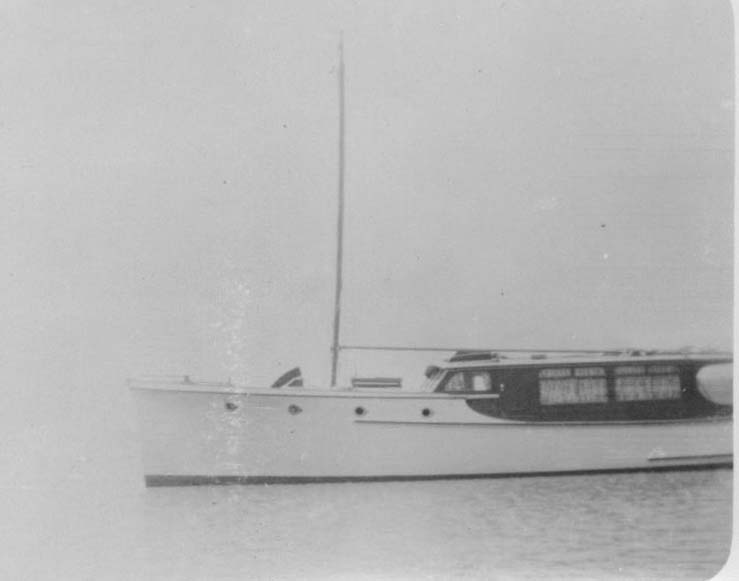
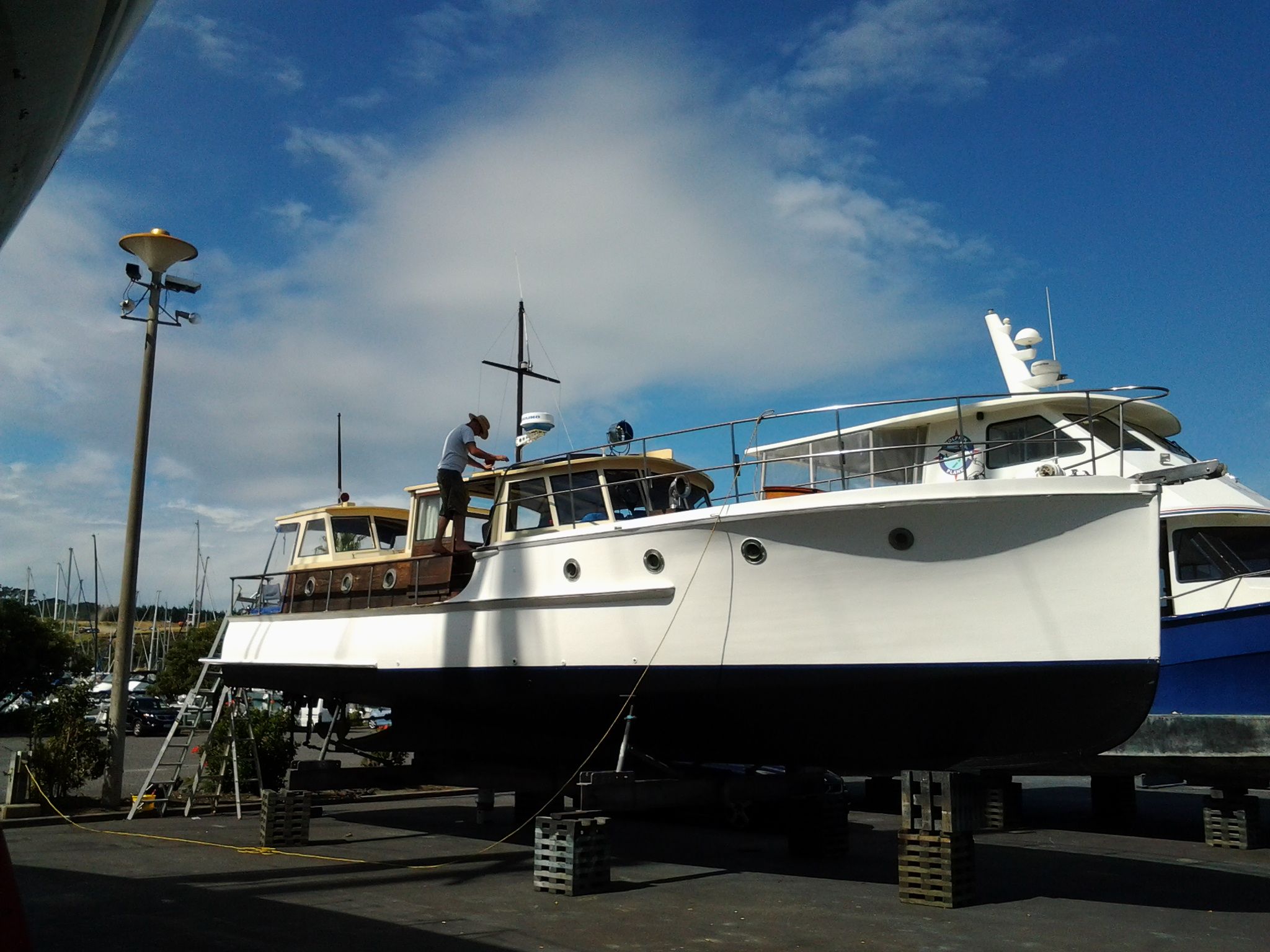
Built & launched by Dick Lang in 1919, LOA 39′, Beam 11′, Draft 3′. Powered by a 180hp Hino, she is rather quick 🙂

Currently owned by John Wright

Colour photo was taken in November 2013 during the CYA Launch Cruise to the Riverhead Hotel.

Meander

Image

MEANDER

This slideshow requires JavaScript.

photo & details ex Harold Kidd

A classic Sam Ford bridge decker of the mid-30s, Meander, seen here about to be craned into the Waitemata on 31st August 1937. She was built by Sam Ford at his Ellerslie property for Syd Guest of Whangarei, 32’ x 9’6” x 3′ and powered by a Graymarine 6-91 de luxe.

She was a stock Ford 32 footer of his “streamlined class” and had been on display at the Auckland Winter Show.

She took part in NAPS out of the Bay of Islands and Whangaroa in 1942-4, skippered by Syd Guest with deputy skipper Murdoch McDonald and crewmen Dick Hutchings, Kelvin Lacy, Jack Cumming, Chris Rogers, Bert Young and Will McNaughton. She had patrol number Z33.

Meander spent most of the intervening years in the North but was bought by Aucklander David Vaasen in 2005.

Photo update (2x colour) from Mark McLaughlin (Mapuna) of Meander underway near Westhaven in 2007.

Ken Rickitts commented that she was an example of Sam Ford at his best, particularly the varnished tuck, very rare in those days, Ford only ever did 1 or 2 that Ken knows of. Fantastic to see her again after over 50 years, a beautful boat – Ken R

Harold Kidd Update

Ken is right about MEANDER, she’s a gem.

Sam Ford is sometimes sneered at for lack of build-quality and poor materials. In fact, you got what you were prepared to pay for and his top-quality boats were top-quality boats. Nobody, however, sneers at his designs which were “state of the art” by their contemporary international standards. Most have lasted, as-built, over the many years since their construction and are still stunning examples of motor-launch design.

I have been researching Sam intensely for some months and am continually impressed by the man.

Maro

This slideshow requires JavaScript.

MARO

photos from Helen & Richard Andrew’s family collection (grand daughter & her husband of Henry Allen -Tiromoana) ex Ken Rickitts.

Ken is fairly certain this is Maro, his thinking is based on the fact that he saw Maro regularly in the mid to later 1940’s & given that the owner of Maro (Les Webber) was close friends of Henry & Alma Allen whose photo collection this photo came from. The NAPS number (329) should provide the answer.

Ken is uncertain who built her but suggests she is 34 – 36 ft long, circa 8 ft 6 inches beam, possibly built by either – Baileys, Dick Lang or even the Lanes (not Garth). Or perhaps none of those.

Les Webber, owner & founder of the Plummer Hat Company in Auckland, owned her in the mid to later 40s until 1950, & possibly for a period before that. He replaced her with the Amakura eventually, in 1950 -1955.

When Ken knew her she had a Graymarine 6 cyl approx 90h.p. petrol engine. She was used very regularly & had not been “fiddled with” as far as I could see, at that time.

Help with a positive ID & any details on her would be appreciated.

Remember – if for what ever reason you can’t reply in the comments section or if you have photos of a vessel – you can email me on the link below – 

waitematawoodys@gmail.com

Harold Kidd Update

It’s MARO all right, but certainly was “fiddled with” and Ken is “Wildly” astray.

1. She was built as the 33 footer THISTLE by M. Forsyth of Bayswater in late 1909, early 1910 

2. Harold Wiles and Percy Howden bought her in the winter of 1922.

3. Wiles seems then to have taken over ownership.

4. Wiles re-engined her with a 40hp Stearns, for which he was NZ agent.

5. Wiles handed her to Colin Wild to rebuild in November 1925, replacing her “compromise stern” with a tuck stern and lengthening her by 3′ 6″ in the process.

6. After the rebuild Wiles renamed her LADY MARGARET.

7. When Wiles commissioned Wild to build LADY MARGARET II in 1928, he sold this launch, LADY MARGARET I, to Dr. C.J. Long.

8. When LADY MARGARET II was launched, Long changed her name to MARO, took out the high-powered Stearns, which went into MOLLIE (later ALCESTIS/RAIONA) and put in a Universal 4 cylinder.

9. She remained in Long’s ownership until just before WW2 when L R H Webber bought her and was her skipper with NAPS in 1942-3 as Z25.

and so on…………………

Kenya II (777)

Image

Kenya II  (777)

KENYA II (777)

photos from Helen & Richard Andrew’s family collection (grand daughter & her husband of Henry Allen -Tiromoana) ex Ken Rickitts. Build & war service details ex Harold Kidd

Kenya II was built for Len Heard by Lidgard Bros and delivered in early 1940 & was in NAPS service in Auckland during the war as Z29. She was also in Fiji between March & July 1942 doing patrol work. She kept her original Fairbanks Morse diesel until at least 1962 when Len Heard re-engined her with a Gardner.

It appears to be Heard in the cockpit of Kenya II. Len owned the confectionary manufacturer ‘Heards of Parnell’. Ken Ricketts remembers him from when he was 11 years old as given his business, Heard always had lots of lollies on his boat, making him very popular with all the young children in the bay.

Also of interest is the unknown older bridge decker in the background to “777” Kenya II. Anyone able to ID her?

B/W photo below taken by Ken Ricketts in Issy Bay, Labour weekend 1948. She was painted light blue at the time.

KENYAII

Lady Joan


LADY JOAN

Ken Rickets took the b/w photo of Lady Joan c.1948>1950, owned at the time by Mr Stan Headland, an insurance broker, whom Ken knew.

In the mid 1940s she had a Ford flathead V8, with 2 side exhausts initially, which were sited well up each side of the hull, below the bridgedeck, with no mufflers. The engine sounded terrible, as you could only hear 1 at a time & as all V8 engines must fire 2 cylinders from the same bank one after the other, it sounded as if the engine was missing badly. The set up was later replaced by 1 stern exhaust in the late 1940s.

Headland then bought Lady Claire in the1950s & sold Lady Joan. She is now in the Sounds, owned by Tony Ryalls who purchased her from Nelson. Currently powered by a new 3cyl. Lombardini which replaced an old 4cyl. Ford. There was a recent write-up on her in Boating NZ.

Any more details from her past would be appreciated.

Update (& photo)  from Zach Matich

Lady Joan was on the Kaipara, owned first by the Mockett family then by Cyril Powell.

Unsure on the dates but I can find out as I know Cyril and his son Royce.

She was powered by a 4 cylinder Ford Ebro and had a good turn of speed.

Going off the photo’s Royce showed me of when they did her up she was

a pretty classy old ship.

Harold Kidd Update

Lady Joan was taken over by NAPS in 1942 with the following crew; CPO Stan Headland (owner and skipper), PO Max Vipond and Stan Thomson (deputy skippers), A.V. Hardley, R.A. Johnstone (AB6690), H.Rees, T. Taylor. Her number was Z11. Her duties were Boom Patrol and Boom Control vessel. Her early history is somewhat enigmatic. I think it’s likely that she was a pre-WW1 34 footer renamed Lady Joan post-WW1.

My first record under that name is in 1921 and there are sporadic entries from then on with owners like J. J. and F. Mackay of Bayswater (1926-1936), the Cashmores some time in the 1930s (although that may have been Lady Jean) and then Stan Headland just before WW2. Headland converted her from a straightstemmer to a raised-foredeck, flared-bow bridgedecker.

Headland kept her until at least 1950. During his ownership she had a 95hp Palmer marine engine (probably a conversion of the Ford Mercury V8 by Palmer). Later owners include W.L. Beattie, J Caulfield, and then on the Kaipara, Bill Woodcock, Pouto (1968), Ivan Mockett, Ruawai (1975) and Cyril & Doug Powell (1985). She was in Helensville as recently as 1995.

Unfortunately there were at least 2 Lady Joans in these parts, which confuses the trail somewhat. I have no images but the National Maritime Museum has some wartime movie footage of her.

THE STORY OF W1 – one of fastest boats ever on the Waitemata

The story below & photos above from Ken Rickets is the accumulation of over 65 years of one mans fascination with this vessel. It all started when Ken was 10 years old & saw her on her moorings, adjacent to the huge flying boat hanger & apron, at Hobsonville Air Force base. This one off experience moved Ken enough to see him for the next 65 years constantly making enquiries & researching the vessel. In 2001 Ken meet with a retired WWII air force officer, who was stationed on her during her wartime service, the officer gave Ken many of the photos above. Then more recently chats with Mr Allright Jnr. the second member of that family to own her, they had her in total for 40 years, & Mr Keith Bellingham who owned her from the mid 1990s to early 2000s provided enough additional insight for Ken to put together this wonderful story about a vessel that spearheaded our WWII air force coastal maritime defenses.

(Note: Harold Kidd accompanied Ken Ricketts when he met with the retired air force officer & may be able to add more details from that encounter)

Read below & enjoy. Alan H

THE STORY OF W1  – as told by Ken Ricketts

W1 was one of 2 identical boats ordered by the RNZAF during WWII for coastal defence duties & they were named W1 & W2.

W1 arrived circa 1939  from England, where she was designed & built to a Scott Payne design.

W2 never got here, the ship that was transporting her to NZ, was torpedoed & sunk, on the way out from the UK.

W1 was powered by 3 x W12 x 1000HP (3 banks of 4 cylinders) marinised Napier Lion aircraft engines, marinised by “Power Marine” in UK. — refer photo. The engines were configured with one either side & one in the centre facing forward, & driving through a Vee drive as there was not enough width to have the 3 engines side by side.

Such was the layout, power & performance of this boat, that it required an engineer to be seated in a padded chair in the engine room with massive ear muffs, whenever she went out,  with a fire extinguisher in his hand. He also also had to control all engine controls including throttles & reverse levers, which were huge long steel arms  standing vertical on the gear boxes of the engines.

On her maiden voyage, after she arrived, it was decided, I am told, that they would go for a run to Tiri, to “try her out,” but such was her petrol consumption that they ran out of fuel at Rangitoto Lighthouse.

While W1 was a “one off” for NZ & in her day, capable of very high speeds (I was told she could do over 50 knots), as evidenced by the photos — not bad for a 64 feet vessel. There were a total of 21 of these craft built & 3 of the early boats went to South Africa & were fitted with 2 Rolls Royce aircraft engines of bigger horsepower than the Napier Lions, but Hubert Scott-Payne had a disagreement with RR & they refused to supply any more engines for the boats, hence the change to Napier Lions.

A smaller 42 foot version was built later & there is one of these in a military museum in the South Island.

She is substantially made of spruce & mahogany & the bridge was more like the flight deck of an aircraft.

I saw her many times after WWII, on her moorings adjacent to the flying boat base & slipway, at Hobsonville airport, when cruising with my parents, Ralph & Wyn Ricketts on their first boat, JULIANA, (1946-49). — I never actually saw her going anywhere, (just wish I had), but obviously she did so, however I think she had almost no use, after the war, until they eventually sold her which I think was circa late 40s or early 50s.

She had a very impressive side exhaust system just above the waterline amidships,  with 2 groups of 3 exhaust outlets one side & 1 group of 3 outlets the other side. — Have not seen many boats around that have that layout.

After the war, she was eventually sold in 1955 by tender to Mr Norm Allright, who lived in Mt Wellington, on the banks of the Panmure River, not far upstream from my parents waters edge home, at No 1 Bridge St Panmure, they could see her from their lounge windows.

Mr Allright Snr., refurbished her to a degree, for pleasure use, when he bought her off the air force & called her “CAROMA”, he also replaced the 3 Napier Lions with a matched pair of counter rotating 671 GM Detroit diesels, she still went well, as you can see in the photos. Later Mr  Allright Jnr. did a splendid job totally & massively refurbishing her in the early 1960s, see photo.

She was sold in the mid 1990s to a Mr Keith Bellingham, who had intended to do a major refasten of her hull, along with other significant work, which was in serious need of attention, however, it proved not to be cost effective & he onsold her to a man in Tauranga, who in turn sold her later to a Waiheke owner, in the later 1990s & she was moored at Waiheke at that time.

She later still, sat on a marina at Bayswater, looking very neglected & painted purple, with her beautiful cabin top, as per the photo above, removed, & generally in a serious state of disrepair, apparently, & she was there until a couple of years or so ago.

I beleive she was taken to the Silverdale industrial area after that & has been moved now, to a private property, address at the moment unknown.

Any info on her current whereabouts would be appreciated.

Harold Kidd Update

Ken is substantially right on all points. However there was a W2, a 28 footer that had been built for the NZ Permanent Air Force for use at Hobsonville to service its DH Gipsy Moth and Fairey IIIF seaplanes. There’s a good book on the subject “The Golden Age of N Z Flying Boats” by Harrison, Lockstone & Anderson. The RNZAF’s W numbering really only started after W1 arrived in 1940.

One of her first tasks was get to the NIAGARA which struck a German mine off the Hen & Chickens on 19th June 1940. The Whangarei launches, Florence among them, were on the scene first but the skipper of W1 ordered them by radio to keep away, ostensibly because of the minefield but really because he wanted the glory of getting there first. The Whangarei boats had towed the ship’s lifeboats clear however by the time W1 arrived, leaving her with only 20 people to bring back to Auckland.

Norman Allright bought her in 1948. She is now called CARROMA.

Nobody ever claimed more than 38 knots for her or her type.

Update – 10/08/2014 from Ken Ricketts

In the original post on W1 Ken spoke of the engineer  that had to be seated in the engine room with ear muffs to supervise & control  the engines & of course to guard against a fire. In the photo below you will see the engineer’s chair in front of the centre engine (3x Napier Lion 1000 HP W12’s each being 3 banks of 4 cylinders).
& the 3 leavers with the black round knobs on each one surrounding the chair. Note the centre engine is sloping forward to drive in to the vee drive unit. The noise must have been unimaginable when they were flat out.

Gearbox photos below show an original vee drive gear box that were fitted to all centre engines with the Napier Lion W12 engines.
Also one photo shows the original engine installation concept of a WI – with the 3 Napier Lion 1000 HP W 12 (3 banks of 4 cylinders) configuration engines.

The photo of the interior of the large boat shed with several boats under construction was taken at Hyde Southampton, U.K. where the British Powerboat Company owned by Hubert Scott-Payne was sited & where all the W1 family of boats were built.
Photo also of Scott-Payne the 1930’s designer of the W1.


UPDATE 08-08-2025 INPUT ex JIM DONALD

“My Uncle Norman Allright was the owner of W1 . Here are a few facts about it as I remember. 

He tendered for the boat in about 1947. I don’t think he was all the fussed about it so tendered $1200 , ( 600 pounds of course) . His was the only tender. 

The boat was on a huge cradle in shed at Hobsonville Air Base. It was then towed around to his mooring he had put down in the Tamaki River opersite his property at the end of Waipuna Rd. His new house on the point had not been built as yet so he was still in the old farm house in Waipuna Road.                     He was a keen Ministry of Works auction attender and purchased a old D9 Caterpillar dozer that had built the Air Field on Gt Barrier Island. With this he constructed a road / track down the beach around the point from his mooring. He brought some Brengun carriers and removed the tracks which he concreted into the beach upside down. On the huge cradle he fitted the solid rubber tyred wheels which ran in the tracks. He then pulled W1 out with the D9. The 3 Napier Lions were then removed as they were useless to him . They ran on AV gas and used horrendous amounts of fuel . They were Supercharged and I think 2 stroke. The story was they could be a bit unreliable anyway and often returned on 2 motors. There was a permanent engineer in Air Force days in the engine room. The fuel tanks which were under the Wheelhouse held 5000 gallons of AV gas. There was no access from from the Wheel house to the forward crew’s cabin as it had water tight bulkheads so you had to go on deck and climb down a ladder. My uncle cut excess holes in the bulkheads. The engineer has his own cabin and head aft af the motors. There was then another compartment with a winch in it and a cable ran out a hole in the stern to winch aircraft which what the were there for. The Napiers were replaced with 2 Gray Marine motors ( GM 671) that were purchased secondhand from Honalulu. These were out of WW2 landing craft and purchased through a chap in Hamilton , Jack Tidd. Of course it had 3 shafts ,props and rudders. The center one removed and plugged up. The boat had no keel at all ( for speed) so the props and gear was very vulnerable. I guess this detracted a bit for the strength of the hull a bit and would explain the many frames / bearers on the cradle, for support. I remember it had a 2 cylinder motor driving a generator so I presume it had 240v but didn’t have it working in my day. I remember in the wheelhouse the incredible bank of guages on the .panel ahead of the wheel the 3 huge Tacos taking pride of place. Of course Norman had to run throttles and gear levers through to the wheel house as these were operated by the engineer down below . My uncle had to go below to the motors to start them as the buttons were mounted on top of the motors ?? Not sure why ? It had a large bank of big batteries but I think only charged from the motors own generators so always seemed to have power trouble meaning very very often the anchor had to be pulled by hand ??? About a 50mm rope and a big chain and anchor so jolly heavy work.

I went away many times on the boat with my cousin Robert Allright who was the second son , Donald being the eldest. No alterations or mods were done to the boat while Norman ran it but after his passing Don ( as we called him ) took over the boat and carried out a major refit which included the new cabin top and flybridge. The motors were removed , overhauled ( at Stevensons workshop at Otahuhu ) an on a Dyno and refitted. This would have been about the late 70s I think? It was at this time it was named ” Carroma” it had no name before that. It was a much nicer and more user friendly craft after that and had more speed with the uprated motors. During the earlier yrs my uncle had built a Jetty , and dinghy shed near the point so the boat was then tied up to it and the mooring pulled up. He had also built a lovely home just above which eventually sadly taken along with some land for the new Waipuna Road bridge. The house that was built mainly of native timber was torn down ??????? I have knowledge of the Carroma after it was sold but glad to hear it’s still about !! The story was they were built for the war only and not meant for longevity???? I remember one-time going up to Walkworth and tieing to the walf there and going for a shop in town. On leaving it was quite a job turning the thing around awning to the length so needed a 3 point turn to go about.                                    Hope this is a bit enlightening for some interested folk.”

Paikea

PAIKEA

Helped take Trinidad last Sunday to the Sandspit boat shed of Greg Lee Boatbuilder’s last Sunday, spied this classic – Paikea – moored just off the wharf at Sandspit. Can anyone shed some  light on her? Poor photos, facing into the sun.

On the trip north passed 4 different large pods of dolphins, the biggest pod was mooching around the moored boats at Sandspit. Photo (iphone) is of one of the smaller dolphins that kept us company for a while off Tiritir.

Harold Kidd Update

PAIKEA was built by Collings & Bell for A.H. Court and launched on 26th January 1921. She was fitted with a 120-150hp Model M Van Blerck 6 cylinder petrol engine (not a straight-eight Packard as is often said). PAIKEA had Chas. Collings’ “concave-convex” type of hard chine design which he made famous with his various FLEETWINGS and whale-chasers. Indeed she was a refinement of the FLEETWING whose image appears in the Collings & Bell section of WW.

PAIKEA was good for 20 knots and can still do it with her present big Iveco/Fiat, as I experienced not long ago at Sandspit. She goes like hell and stable with it.

Alf Court sold her to Hec Marler in 1925 and he sold her to R B & S S Wilson  just pre-WW2. She was in NAPS during WW2 as Z17. .


Tiromoana

TIROMOANA

Designed & built by A (Bill) Couldrey in 1937 for W R Craig, she saw serve with the RNZ Navy & Police during WW2 as a harbour patrol vessel. B/W is on launch day & its fantastic to see her 76 years later so close to her launch day configuration. The ‘solo’ colour photos were taken in Issy Bay at the 2012 CYA Cake Day event. The photo with the launch Joan was taken off North Head just prior to the CYA picnic cruise to Stillwater in 2011 (?)

Russell Ward Comment

Beautiful beautiful ship. Every line is just right -look at that sheer and the line of the cabin tops. Even that turtle deck on the “bikini deck” between the wheelhouse and aft dodger: raised to give the headroom but not at the expense of spoiling the line. The detailing of the windows -the work of one of the real masters. Not many boats look ok from any angle -she does. 

She did time as a police launch too, I seem to recall. I also seem to recall (from a visit in the ’60s) that one could service the trusty Gardner while sitting on the throne -useful bit of multi tasking and clearly another design feature!

An update from Ken Ricketts

An insight into Tiromoana’s – (early years 1939 – circa 1988)

Background

As I sit at my computer, at 76 years old, & reflect back, I have realised, there is no doubt, that this, most beautiful Bill Couldrey, double skinned, (1 fore & aft 1 Diagonal), 37ft, 1937 masterpiece of design & build, has had a profound affect upon me, & substantially directed & affected the entire course of my life, since I was a small boy of 7.

It is absolutely certain, that I would never have been able to make the contributions that I am able to do, to this website, if it were not for my beloved Tiro. Ken Ricketts

Early Ownership

She was built in 1938  for a Mr Craig, he however only owned her for a very short time & sold her to a friend & business associate of my late father, Ralph Ricketts. He was a Mr. Henry Allen who owned The Auckland Handle & Dowel Ltd sited in Manukau Rd, Newmarket. He, & his wife, Mrs Joyce Allen, lived in a large villa right next door to the factory where they brought up their 3 children, Jack, the oldest, (who later owned the beautiful C, ( later F), class keeler, C22 “Turangi,” for many years & his 2 sisters, Mavis the older, & Esme the younger.

Henry A  & Mrs Joyce A, moved to No.4 Suddley St  Orakei in 1946-47 where he lived for the rest of his life.

Henry Allen bought Tiro., shortly before WWII & was destroyed, when the Navy took her initially, & then passed her to the Police shortly after, as a harbour patrol boat. The Police painted her grey, & for the next 3 years Henry A., fought tooth & nail to get her back, eventually succeeding in 1943. Such was his joy & excitement, he didn’t even bother to repaint her, but used her for the rest of the season in her grey Police livery,.

This was the point at which Tiro came in to the lives of my parents & me.

Henry A owned her until he died, but long before this, & not too long after WWII, his children all married, Jack Married a lovely lady called “Doreen,” Mavis Married a young businessman called “Doug Millar,” & Esme married another young businessman, called “Joe Coggan,”

The marriage into the Coggan family seemed to my family to be a not only a great love for Esme, but also almost as great a love of Tiro, & for many years in Henry A’s later life, Joe was always seen at his side, whenever “things had to be done,” Such was his love for this boat.

When Henry A eventually passed away, Joe bought Tiro off the estate, & loved her as Henry had before, for the rest of his life as well.

During Henry A’s stewardship, she was moored her entire life at Westhaven, just off the dinghy launching ramp which was there at that time, right in front of the Auckland Motor Yacht Club & she was right next to that other lovely Couldrey classic “Reremoana.”.

When she passed to Joe C,, he moved her to the Tamaki River, at the bottom of his garden, right on the waters edge’ with riparian rites, to the Tamaki River, in Riverview Rd Panmure, & just 2 minutes around the corner, from my parents who lived at No 1 Bridge St Panmure, also on the waters edge, with riparian rites, & my parents used to look at Tiro., every day on her pile moorings a few yards downstream from their home & their own “Gay Dawn.” She remained there for the entire time Joe’s custody lasted, which was also until he died.

A wonderful pedigree for a wonderful boat

Changes to Tiromoana along the way:

Propulsion

When Tiro was built, she was powered with a green painted 4 cyl Gardner truck Diesel, with a huge open flywheel, & detached gearbox, which I think was made pre the days of the “LW” series of engines, as it had 4 separate cylinder blocks, on a separate crankcase with side inspection covers in the crankcase, & could only be started with the crank handle, & by opening the exhaust valves with the decompression levers, whilst one built up flywheel speed & then closed the compression levers. There was a chain drive from the rear end crankshaft between the oil seal & the flywheel to a shaft along the top of the engine to the front end, & one swung on the handle at the front of the engine.

My father & Henry A were both absolutely outstanding precision engineers, & my father did not think much of anyone swinging on a crank handle to start the engine, so about 1945, with the assistance of the entire very extensive facilities, of Mason & Porter Ltd’s (Masport today), machine shop, of which he was manager, he designed & made an electric starter system, for the Gardner, which, as with everything my father ever made, worked perfectly. Its necessity however, was fairly short lived, because circa 1948-49,  my father & Henry A, jointly removed the 4 cyl Gardner & replaced it with a brand new 5LW Grey painted Gardner marine engine, which is still painted grey as far as I know,  & is now, over 60 years later, once again, as far as I know, is still running like a Rolex. I was on Tiro 4 or 5 years ago & it was still just like new then.

Paint, colour schemes, changes, & modifications

I am really delighted that the successive privileged owners of this aesthetically outstanding craft, have appreciated the traditional wonderful balance & beauty she has always had, in her original design, & have not tried to “improve” her, virtually at all. — a different mast is really about all that is visible on the outside, & when I was on board, she was still virtually original inside as well, long may it continue.

Paint

Tiro was one of the very first pleasure craft in NZ to be spray painted.  Joe C was a craftsman with a spray gun, & began spraying Tiro’s hull every winter when the rest of us were all laboriously brushing away & trying to get rid of the brush marks to make an “eggshell like finish” to our various pride & joys, as we all did in those days, & Joe achieved an unbelievably better job with far less effort. – I never understood why my father never followed his example with his own “Juliana,” & later, “Gay Dawn.?”

Colour Schemes

Tiro has had a small degree of modification done by Joe C., somewhere around the time he took her over from the estate. From memory I think it may actually have happened when Henry A was still alive.

As you will see, in the pics taken by me, in Christmas 1947, at anchor in Mansion House Bay Kawau Island, & Christmas 1949, at speed, entering Bon Accord Harbour, Kawau Island, with her “brand new 5LW,” she originally had totally varnished combings, which Joe later painted through in white, on the aft cabin section, where the 3 oblong windows are.

Actually, I personally like that present concept, however I feel that the pic on the wheeled trolley with her going in to the water, already on the website may be intended to convey that this was her original concept, as at her launching day, which is of course not possible, because of the pics I took, & that colour concept was not introduced until circa the 1970s.

I think it could very well be, this was taken when she was living in the Tamaki River, & she may have been slipped at the Panmure Yacht Club area. (ww comment – the b/w photo was taken from a 1937 newspaper & is at the launch of Tiromoana)

THE RICKETTS FAMILY ASSOCIATION, & SHAPING OF MY LIFE, BY TIRO.

For a number of years my parents rented a batch on the waters edge of Christian Bay Takatu Peninsula on the farm of a Mr Donald Jones. We looked straight in to Mansion House Bay Kawau Island, from our batch.

One morning, during Christmas 1943, this beautiful looking bridge decker painted grey, came across from Mansion House Bay, in to our bay, & would you believe it, the Allens came ashore & invited us out on Tiro for the day. I can still remember being beside myself with excitement, at being invited out on this “huge” boat.

We had a wonderful experience, which I could not know at that time, was to be the first of many over the next 3 years, until my father bought his first boat the “Juliana” in 1946.

My father had been born in to a pioneering boatbuilding family in Nelson dating back to the 1840s & of course was bought up in, & loved boats of many types.

My mother on the other hand was the daughter farming family, new nothing about boats, or cruising on them, but like me, was besotted with this wonderful way of life,

It had been my parents intention to buy a batch of their own after WWII, but after just a very short time, after being introduced to Tiro, she said to dad one day, “Dad, do you think perhaps we could buy a boat instead of a batch after the war?” — Well, you can imagine what my father said & thus my whole life has been focussed on & revolved around this idyllic lifestyle, & will until I die, almost certainly solely, thanks to the Allens, & Tiro.

Nothing I can think of, has had a more profound effect on me, or my life, than this life long passion for cruising on comfortable pleasure launches, (especially at Kawau Island, which is, & always has been, since 7 years old, my favourite place of any part of any country in the world, I have ever been to.)

Now, to get back to the “Allen, Coggan, Family Dynasty.” I am trying to Liaise with Helen Coggan daughter of the now deceased Joe & Esme, to try to  add correct & timing for various things referred to above & will report further if I can achieve this.– I was actually talking to Helen, within the last 18 months  or so, so hope I can locate her again.

In the meantime may “Tiro” continue to grace us all, with her beauty, for another 75 years

Photos added to posting

# 4 ladies standing on tuck of Tiro in 1945 pic holding on to dodger are L to R Miss Mavis Allen, Mrs Wyn Ricketts, Miss Esme Allen, & Mrs Doreen Allen, (Jack Allen’s new wife).

# 2 photos of Tiro at Kawau Island

# Ken Ricketts as “Santa” at 9 years old, Christmas Day 1944 in the bridgedeck of Tiro with Mavis Allen

An Update for Tiromoana’s Owners 17/08/2013

My husband, John, and I are the current custodians of Tiromoana. Photos 1, 2 & 3 are of John and I (Carolyn) cruising the Gulf. Tiro currently resides at Bayswater Marina, although she is currently in “hospital” on the Westpark hardstand, being treated for rising damp and gribbles behind the keel cooling. With her out of the water for awhile, we took the opportunity to get into all the nooks and crannies, and remove accumulated detritus, including six anchors! And, going on the size of the gaffs we found on board, earlier owners must have caught much bigger fish than us.
I must assume that the head has been moved, since vintagesteamer’s day, as we can no longer multitask from the throne. However, the trusty “new” Gardner, installed in the 50’s, is still going strong. Recent changes we have made is the installation of an electric head, and holding tank, and new batteries and charging system.
As I work in the Operations Room at Coastguard, I have great delight in reminding the Maritime Police of our association as Auckland Police Boat #1.
If you see us around the Gulf, do drop by and say hello.
ID this Navy ship

ID this Ship

A little help need – anyone able to name the NZ Navy ship in this 1930 photo ? location possibly near Kawau Island. Photo ex Roger Guthrie, those father Ivan & frien Dean Ellingham were in training at HMNZS Philomel at the time

Update from Russell Ward

Interesting one. Based on the disposition of the masts and the wheelhouse that overhangs the skipper’s accommodation and funnel height, she’d have to be HMNZS Wakakura or the Sanfords trawlers Currell or Cosgrove that were requisitioned in 1939 -notice she has the fishing trawler’s gallows fore and aft. Because of the raised focsle, I’d go for Wakakura. Jack Harker writes a lot about Wakakura in his book The Rockies. She was the navy’s training ship 1925 – 47 and certainly kept the marine repair shops busy with machinery and hull repairs -the latter mostly because of collisions with wharfs or other ships alongside. She was bought by the Tasman Steam Ship Co Ltd in 1947 and was knackered early 1953.

I have asked colleagues who know more than I and will report back if I am wrong.

16.08/2013 –  General consensus from the Workboat Study Group is that she is the Wakakura. Dear old thing. Got a lot of men sea experience ready for WW2. What sort of long range planning is that?

Update / critique from Ray Morey of the above photo – 16/08/2013

“That pic at Mansion House bay, The boat boom is up and the boat ladder is down.boat must be ashore. Bridge wings unclothed, popgun at the ready, monkey island awning ridge pole up but awning only rigged over the cargo boom.Possible party tonight. Trawl gallows in up position , provisioning boom stowed in crutch. All of those earlier ships had cantilevered bridges because the nets were hauled aboard there in the waist. The later vessels had single mast and davits aft for provisioning and workboat/lifeboat. I have another pic of her at the wharf in Auckland and also another of her with a full wheelhouse, the wings have been enclosed and roofed over”.

Lady Margaret (Colin Wild)

LADY MARGARET

She is back in Auckland after quite a few years in the far north. They are numerous posting on her on waitematawoodies, just enter her name in the search panel. But a quick overview – 1927, Colin Wild bridge-decker, 42′, one of THE launches in her day with a wonderful provenance.

Very very pretty, then aren’t all Colin Wild boats 🙂

Will be interesting to see if the Col Wild stable is enough to justify the asking price with potential buyers. Talk around the docks is that she sold for a LOT less last time she was on the market & the term used in the listing to describe the recent work is ‘ a make-over’ so best to view her as a wonderful classic that you could go boating in tomorrow but she is very ‘traditional’ in terms of motor, layout, fittings & finish so at some stage to return her to her best you will have to be visiting the bank manager. She will not sell for the asking price but launches with her provenance & looks do not come on the market often. Take a look at the ‘at sea’ photos – a fine looking vessel.

I will be interested to see how she fares in the current classic wooden boat market. The Logan (do not get much better breeding than that) launch Ngaio recently sold for sub $40,000 & was in similar condition, excluding the fresh paint.

More details here.

http://www.trademe.co.nz/a.aspx?id=620813973

Lady M out on the hard at Gulf Harbour, with her new owner giving her a tickle, Ken R took the photo 22/03/14.

LADY MARGARET - TLC FROM NEW OWNER - 22.3.14

A couple from the new owner

02/07/2014 – Launch date photo below at Colin Wild’s Stanley Bay yard. According to Papers Past the date was 9 Oct 1928, else were on this post we have her as launched in 1927?

I was mooching around Westhaven this afternoon, 17/08/2014 & spied LM on her new berth.

Updated Photo – 15/01/2015

Update 19-02-2020 – photo below of LM c.1962. taken at Okahu Bay
Lady Margaret