Asking woodys to ID the race would be a big ask 🙂 so maybe we just ask that we match the yacht names to the sail numbers. From L>R its – E34 / L18 / A11 / E21 / E11 / A16 / A2 / H6 / B20 .
And if you wondered why we refer the boats as – shes , below might be the answer.
13m Marina Berth For Rent
If anyone is looking for a 13m marina berth at Gulf Harbour? one of the private apartment berths (extra security) is available on a long term / permanent basis. Email address below for details. kenpat@ihug.co.nz
AUCKLAND WOODYS WELCOME HIS MAJESTY’S SHIP photos ex Russell Ward. details ex Harold Kidd
During the discussions on last weeks post on the very fast CMB, Russell sent me the above impressive photos from when HMS Renown (tbc) visited Auckland. An impressive number of woodys featured. How many can we ID? – I have attached a numbered, L>R (1>7) photo below.
There is potentially some confusion as to the date/year of the visit & whether in fact it is HMS Renown or her sister ship HMS Repulse.
Renown came here solo in 1920 with the Prince of Wales and again in 1927 with the Duke & Duchess of York.
Maybe it’s Renown in 1927 but it could be Repulse in 1924 or Renown in 1920 (fyi Luana that can be seen in the photo was launched in late March 1920 only a month before the 1920 visit).
Update from Barry Davis
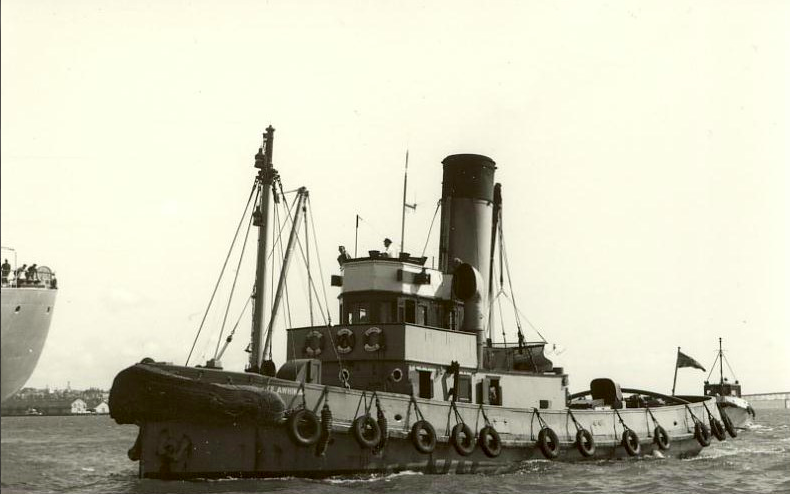
Robin Elliott is correct in saying that this is the 1920 visit of the Renown. Below are a couple of photos from the Auckland Weekly News dated 29 April 1920, unfortunately they are not that clear. The small steamer in the foreground and to the left in the second view is the Onewa, the tug closing in on the bow is the Te Awhina.
24-09-2015 Photo of Te Awhina below – ex Russell Ward
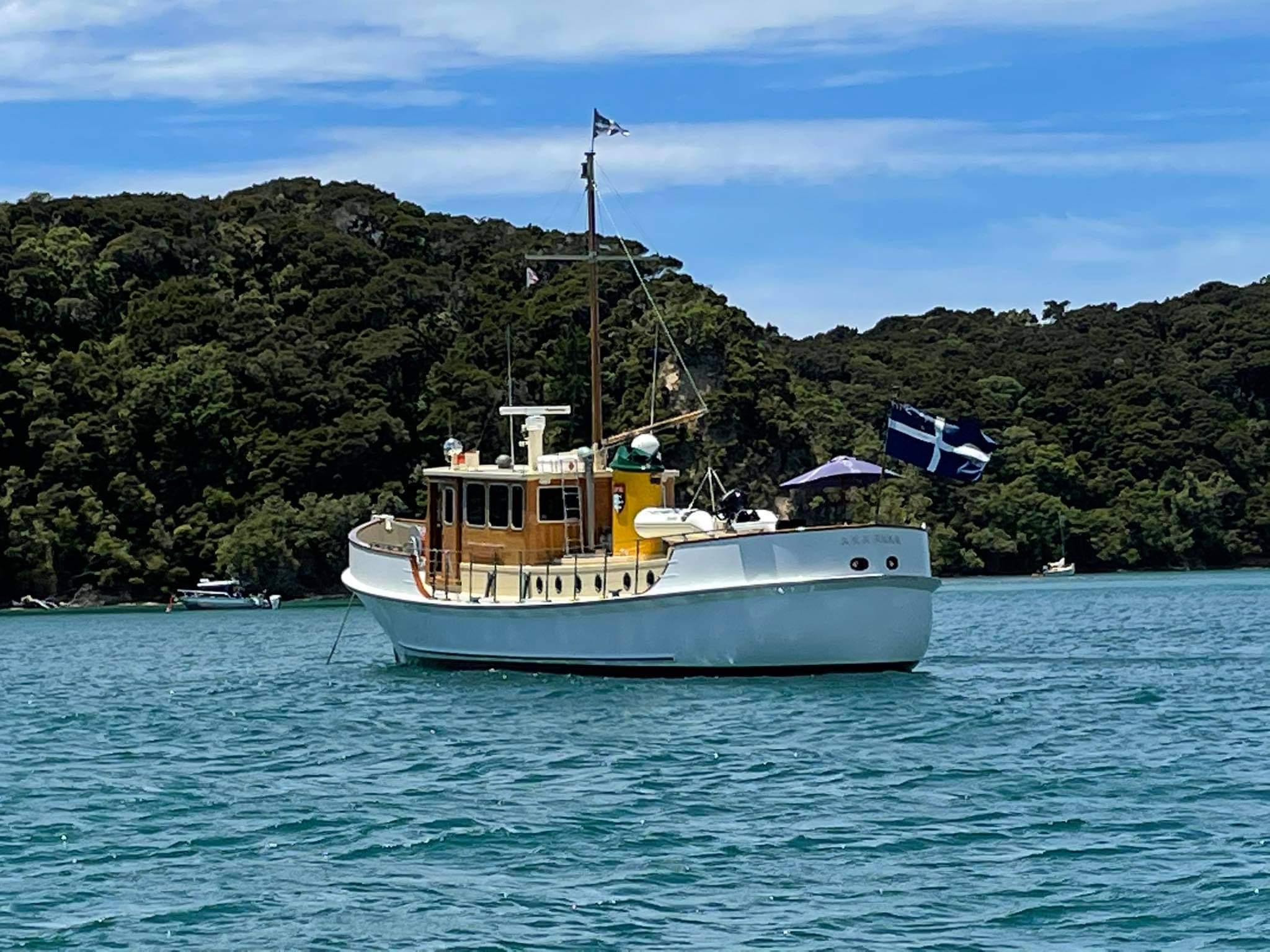
THE RESTORATION OF AKARANA Details & photos below ex Dick & Colleen Fisher. Edited by Alan Houghton. Above photo ex Dean Wright
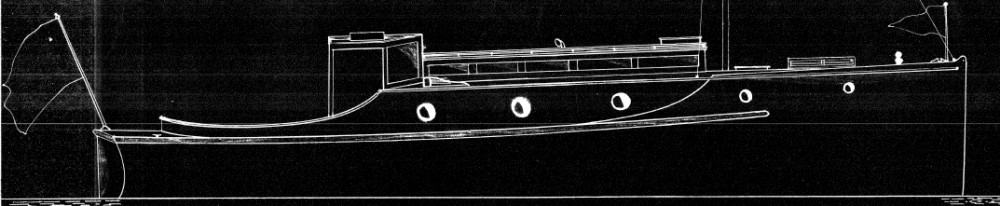
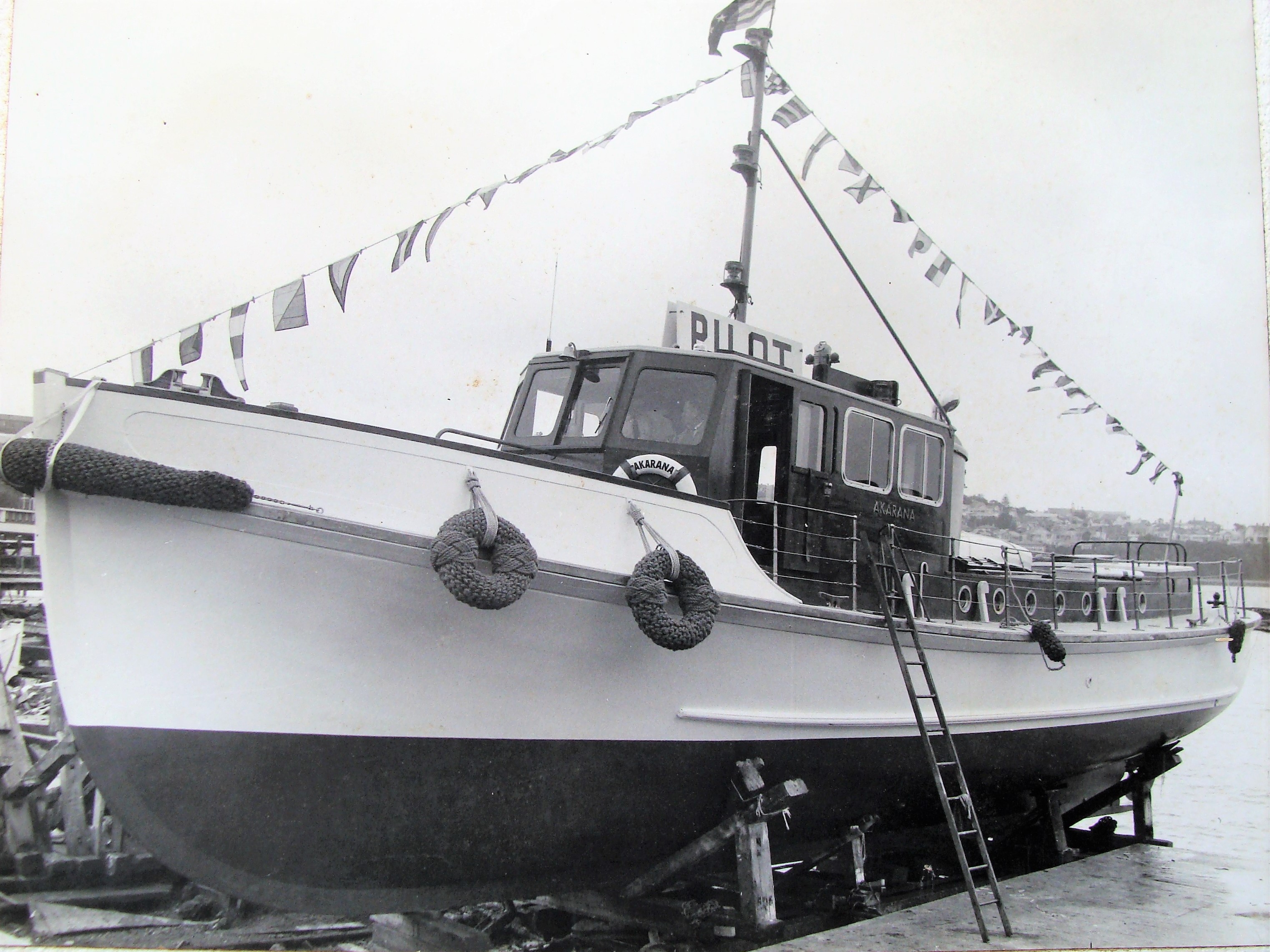
Akarana was designed by A.J. Collings & built by W.G. Lowe in 1960 for the Port of Auckland. They sold her 34 years later in December 1994 to Peter McDonald of Whangarei, Peter (deceased) was a long time friend of Dick Fisher & Dick purchased Akarana off Peter in April 2000. Akarana is built using single skin 1 ¾ inch thick Kauri planking on spotted gum ribs with a hardwood keel & her displacement is 42 ton. W.G. Lowe had the contract to build her & allowed 23,000 man hours for her construction. When Port of Auckland sold her in 1994 she was on engine #6, having worn out 5 engines while working for the Auckland Harbour Board. From a couple of her log books that Dick has he would estimate that she has traveled somewhere between 600,000 + 700,000 miles during her working life as a pilot boat on Auckland harbour. The 8L3B Gardner engine which Dick re-built was originally installed in an oyster dredger based in Bluff. This engine was built by Gardners in 1960. The same year as Akarana. She cruises comfortably at 10 knots. After purchasing her, Dick took Akarana to his workshop at Kamo & then constructed a shed over her. You will see from the photos that shed is a little bit of an understatement 🙂
The photos below will give you an insight into the scale of the project & the stamina, patience & dedication of Dick Fisher in undertaking this restoration. Akarana is a magnificent vessel & a visit to her engine room normally sees most males gob-smacked at the attention to detail & cleanliness that would equal the finest medical operating theaters.
In additional to being a very skilled artisan, Dick is just a seriously good bloke, he once drove down to Auckland from Whangarei so I could show a visiting classic boater from the USA, who was a Gardner nut, over Akarana. You would struggle to find a more hospitable couple afloat than Colleen & Dick Fisher. One day I’ll post on ‘Hamel’ the Fisher families other wee ship 😉
I have captioned the images – scroll over to view, also remember you can enlarge a photo by clicking on it.
At the bottom of the post (part two), for your interest I have included some papers that Dick acquired from the old Auckland Harbour Board.
A. Harbour masters comments prior to letting tenders. B. Some of the requirements for the construction of Akarana. C. AHB reviewing costs. D. Breakdown of building costs. E. Copy of daily log, note the totals for the month of July 1982 were 278 pilots, 510 hours running, & 2791 miles.
Photos below during her build at W.G. Lowe in 1960
W.G. Lowe 1960
W.G. Lowe 1960
W.G. Lowe 1960
As sold by Auckland Harbour Board – 1994
At Westhaven,as sold, Dec 1994
The restoration
April 2000 as purchased by Dick F
Arrives at Kameo
New shed at Kameo
Blasting paint from hull
Blasting paint from interior
Paint off
Old engine removed
Rebuild of wheelhouse & cabin top
Rebuild of wheelhouse & cabin top
New bulwarks
New laminated beltings
Re caulking
Steering compartment
Steering compartment
Teak deck – 1&3/4″
Hatch
Funnel
Some bling
Almost finished
Business end
Rebuilding the engine
Rebuilding 8L3B Gardner
Rebuilding 8L3B Gardner
Rebuilding 8L3B Gardner
Installing engine
Gearbox
8L3B Gardner Installed
Relaunching
Leaving Kameo shed
Ready for launching
New home at Kissing Point Whangarei boatshed
Back in her happy place – April 2005
At home, 2005
Supporting paperwork
Helm Photos
10-04-2018 Update – Photo below of Akarana on launching day. Photo sent in by Paul Drake, taken by his brother Michael.
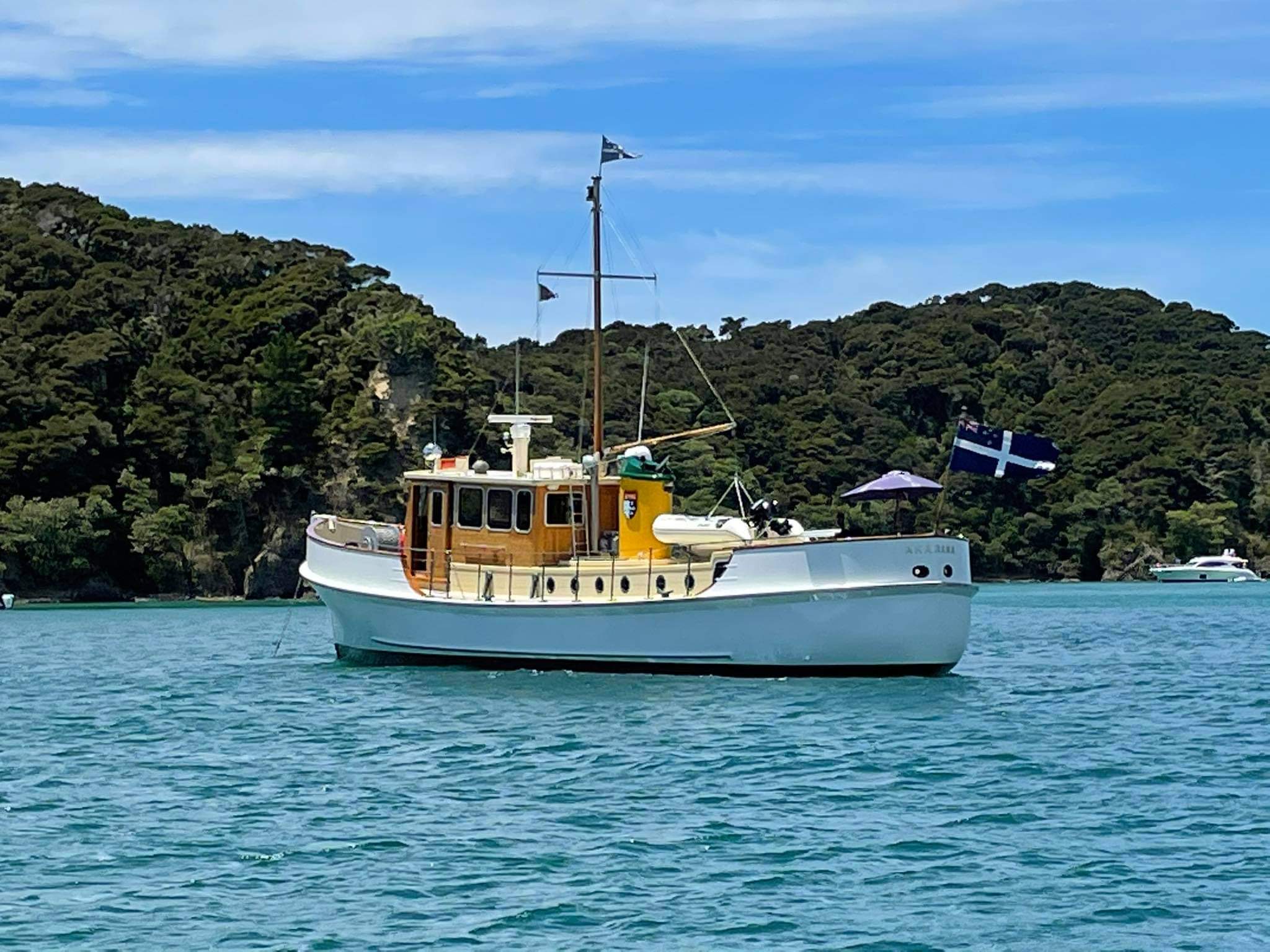
Update 09-01-2021 – Photos below of Akarana in Kent Passage, Bay of Islands – 6th Jan , sent in by Grant Anson
JEUNESSE photos ex John Wicks, ex John Wright, details ex Harold Kidd
The 37 footer Jeunesse was built for W J Harper and launched in March 1919 as Rambler. Harper changed his mind and renamed her Jeunesse by the start of the summer of 1919-20. None of the magazines or newspapers say who built her but Dick Lang seems a fair bet as she was built-in St. Mary’s Bay. Reportage on such things was pretty scant at that time because of the Spanish ‘Flu outbreak. She was fitted with a 40 hp Reutenberg 4 cylinder engine. Harper sold the launch Kotiro when Jeunesse was built. He kept her until 1923 when he sold her to H Hewson. N C McLean & R Kirkwood owned her in 1926. She spent a lot of time in Whangarei after that. In 1951 she was owned by S H R Smith of Onehunga, Richard Leary in 1990, John Wright in 2003 – who still owns her today.
The b&w photo above was apparently first published in the Weekly News in about 1923. There’s no info on it about the photographer, but in John Wicks eyes it’s good enough to be a Winkelmann. The colour photo is relatively recent, and shows her pretty much as she is now – great to see she has remained so true to original design. Also amazing that she has retained the name Jeunesse” for the last 95 years – quite an achievement considering how many changes most of the launches of her era went through.
Today’s post features the Collings & Bell launch Selma which Dick’s grandfather, (H.B.Fisher), had built c1913. Interesting that the ‘photograph’ has had the same enhancement that we saw on the 1911 C & B launch – Dorothy. Refer ww post dated 01-05-2015. C&B must have had the services of a photo re-toucher. All in the days before photoshop 🙂
Dick viewed Selma at Gulf Harbour a while back & reports that she was still in good order.
Now a lot of you will know Dick & his wonderful restored ex Auckland Harbour Board pilot boat – Akarana (photos below ex Dean Wright & yours truly)). Dick is a very clever & talented man & one of his many passions is Gardner engines, he has a collection of 15 Gardner engines ranging in age from 1894 to mid 1980’s. Pictured below is a photo of a Gardner heavy oil marine engine complete with marine gearbox, that Dick is presently restoring. This engine was built by Gardners circa 1913. It is a hot bulb air start 2 stroke developing 24HP at 450 RPM .
FYI – the restoration of Akarana with be featured on ww shortly.
Harold Kidd Input
Sadly, SELMA came ashore at Stanmore Bay on 24th January 2006 and was a total loss. She was 32ft x 8ft and originally had a 3 cylinder 15hp H C Doman marine engine when launched in late 1912 for H.B. Fisher. She was in Mahurangi for several years in the 90’s and early 2000’s with an owner who maintained she was a “Logan”. Weren’t the WW1 British pocket submarines equipped with Gardners like this? My Barton rellies in Nottingham had a lot to do with the fortunes of Gardners by fitting the new “high speed” Gardner diesels to their red Bartons’ buses in the Midlands during the Depression. And of course the North Shore Transport Co (owned by the North Shore Ferry Co) fitted 5LX Gardners to their fleet soon afterwards.
ROBYN GAE video ex Martin Turnwald, details ex Martin T & Harold Kidd, photo ex PapersPast ex Nathan Herbert
The video clip above is a little scratchy but features some good footage of the classic woody, Robyn-Gae, owned by Martin’s father, John Turnwald. There is even a cameo apperance of the 1919 Joe Slattery launch Raiona (at 1:30).
Robyn Gae started life as Water Gipsy & was launched in October 1934 for C. Miller by Cox & Filmer (Speedcraft Boat Co) with dimensions 32ft x 8ft 6in. She was a slightly extended version of a 30 footer built by Cox & Filmer for a Mr. Martin. Miller used Water Gipsy for a while and then she “disappears for a while. Ted Valintine bought her in 1937, renamed her Connie V after Mrs. V, had her lengthened to her final dimension of 38ft, with the provision of a cockpit, coaming and dodger over. The work was undoubtedly done by Lanes who also fitted her with a 6 cyl Chrysler Crown petrol engine in September 1939. That was after the Kawau petrol fire in January 1939 when Valintine scuttled her by chopping a hole in her hull, saving the boat (photos below). Valentine sold her to E.M. Henry & the Lambourne family bought her from Henry in 1939. She remained in the Lambourne family until 1956 or so but Lambourne obligingly changed her name to Robyn Gae on 14/11/49 at the time Lanes launched the second Connie V for Valintine.
She is registered as a “Her Majesty’s Ship” in London.
The Chrysler Crown engine was replaced later by a Commer TS3 two-stroke diesel . The bridge roof was raised about 20 centimeters way back in about 1979 Martin thinks, because a stroll on the bridge always ended with a ding in one’s head . The beams were just that little bit too low and the bridge deck floor had to be raised a bit to accommodate the new engine.
The Commer has since been replaced by a Perkins & with this engine Robyn Gae is able to achieve a true 9.6 knots running a 5 blade prop.
Robyn Gae is for sale – for details contact Martin Turnwald at mturnwald@bluewin.ch
The world is full of idiots & Mathew Dring would be near the top of the list. He appeared in court yesterday for attempting to steal the 1910 H.N. Burgess designed classic launch Florence. As well as being a fool, he has no taste, as Florence was the 3rd vessel he boarded & attempted to steal.
And what did his lawyer say – “his client wanted to change his ways & he wants to plan for his future”, to which the judge said “you present as someone who deeply regrets what happened” – the systems a joke. Mathew Dring (remember that name) was given 6mths. community detention (I think thats what we used to call PD) & $400 reparation. The little thief should serve the 6mths. PD sanding the bottom of boats.
I was sent this movie, filmed in late1929/30’s by the Lambourne brothers (Allan & Alex) nearly 2-1/2 years ago by Roger Guthrie, it was back in the very early days of ww & since then a lot more people have checked onto the site – in fact over 100,000 people. On ww last week I bumped into Peter Stein whose father (also Peter) appeared in the movie. Peter has written a very cool synopsis of the movie & the (now) classic launches that appear in the movie. I suggest you read Peters words & then watch the movie. Enjoy 🙂
The film “Beautiful Waiheke” by Peter Stein
Introduction:
The film was produced by the Lambourne brothers Allan & Alex in the late 1920’s early 1930’s. The Lambournes owned a large furniture shop on the corner of Ponsonby Road and Pompallier Terrace. The Arran Bay house was built in 1910 and remained Lambourne property until 1964 when it was sold to the Jorgensen Family.
Water transport for the Lambournes was the launch “Nga Whare” which is the round bilged craft in the film with the two portholes in her topsides. She was sold when I was a very young boy so I remember little about her.
Our property is next door to the Lambournes. Arran House was built circa 1885 for Andrew and Mary Croll from the Isle of Arran, Scotland. They were two of Waiheke’s pioneers. Andrew was a very fine photographer and albums of his photos can be seen at the Waiheke Historical Society Museum on Onetangi Road. Among the photos are scenes of the Annual Regatta organised by Andrew and held at Arran Bay circa the late nineteenth century. These events were well supported by “boaties” of the day. The albums were kindly donated by the Crolls of Sydney. Mary Croll was a very good artist and she put many scenes of the “bottom end” on canvas. Some of her mural work is still on the walls of one of the bedrooms in Arran House. My father, P.A.S. Stein purchased Arran House from W.J. Connell (owner of Connell’s Bay Store) in 1924 and it has been in our family ever since.
The Waitangi, the launch with mast and crosstree in the film was built in 1923 for Mr Cadman. It was a classic John L. Hacker design with sharp entry and flat stern section. The original owner named her “Karamana”. She had an aeroplane engine in her and we understand she was capable of 25knots which made her one of the fastest launches on the Waitemata at that time. Harold Kidd has a very good photo of her racing on the harbour (added below. AH). In the latter 1920s she ended up on the Tamaki Drive breakwater. My father bought the severely damaged hull and had her restored by Chas Bailey & Sons. He renamed her the “Waitangi” after his father’s steamer the TSS Waitangi of the Northern Steamship Co. My grandfather Peter Anton Stein was a Captain of various Northern Steamship Co. vessels from 1895 to 1908. Chas Bailey told my father that the Waitangi had brought them good luck because the next launch off their slipway was the legendary “Shenandoah”.
The Waitangi was 28 feet long (8.5m), had a beam of 7 foot 3inches (2.2m) and draft of 2 foot 8 inches (.8m). She was built in kauri and the bottom was double skinned from the bow to the wheelhouse. The rest of the vessel was single skinned. Her Auckland mooring was in St Mary’s Bay in front of the Ponsonby Cruising Club at the bottom of St Mary’s Road. Maintenance was carried out at Collings and Bell Boat Builders adjacent to the PCC.
About 1930 my father replaced the old Studebaker engine with a 105hp Kermath marine engine. Allely Bros. of Beaumont Street imported the motor and installed it. It was known as a 6 cylinder flat top. The pistons had a bore of 4” (100mm) and each cylinder had two spark plugs. It was double ignition with one spark plug connected to the magneto and the other one the distributor. Maximum speed was 18kns and at this speed the motor burnt 8 gallons of petrol per hour. Petrol was bought in 4 gallon cans and there were two cans to a box. We still have an old Atlantic box which we use as a vegetable bin at Arran House. Petrol in the early 30s was 1 shilling and six pence a gallon. A 50% rebate brought the price back to a respectable 9 pence a gallon. My father told me that the best run home he achieved was Connell’s Point to Kings Wharf in 1 hour and 12 minutes.
The film:
The film began with shots of the Guthrie family aboard their launch “Alcestis”. It then moved to shots of Arran Bay taken from different location around the Bay. The people setting out down the path are coming from the Lambourne’s house.
The aquaplaning sequence was filmed from the shore and the “Nga Whare” which was the tow boat. My father was the young man with one of the Lambourne girls on his shoulders. Years later I learnt to aquaplane on the same board.
The “Waitangi” then heads to Bulls Bay with my father as pilot. The majority of the film is shot at Bulls Bay (Anita Bay) on the north eastern end of Waiheke. At the northern end of the bay are many small rocky islands and the launches are filmed going through the channels between the rocks. These are not hard to navigate but should be done at ½ tide or more.
The “Coughing Caves” are in the southern point of Bulls Bay. With a northerly swell and incoming tide, waves enter the caves and when the top reaches the ceiling of the cave the air behind it is compressed until it bursts out in a cloud of spray. The boy in the dingy, Reg Crawford, is trying to get as close as he safely can to the emerging spray.
The “Whirl Pool” is in the long reef extending from the northern end of Bulls Bay. Riding the swell in and out of the pool could be quite exciting as seen in the film.
The homeward bound shots of the Waitangi in the storm were taken in the channel between Pakatoa and Waiheke.
Harold Kidd Input from previous ww post
Waitangi was built as KARAMANA for F.B. Cadman in 1923 by Bailey & Lowe to a design by Hacker. KARAMANA = CADMAN in pig maori. She was later bought by Auckland Grammar School teacher P A S Stein and rebuilt as per the 2nd photo below. She was fitted with a war surplus 6 cyl Green sohc aero engine producing 120-140bhp, bore 5.5 ins, stroke 6 ins (you work out the capacity). She was pretty radical.
03-09-2015– comments
1. The Lambourne launch was called NGAWAI I think, not NGA WHARE. She was later bought by the Andrews family on the Hokianga. I remember her as a child during WW2 laid up in a shed with a Chrysler engine. Maybe another NGAWAI but she looks the same. 2. KARAMANA/WAITANGI was built by Bailey & Lowe in 1923, not by Chas. Bailey Jr who built SHENANDOAH in 1929. There’s some conflation there.
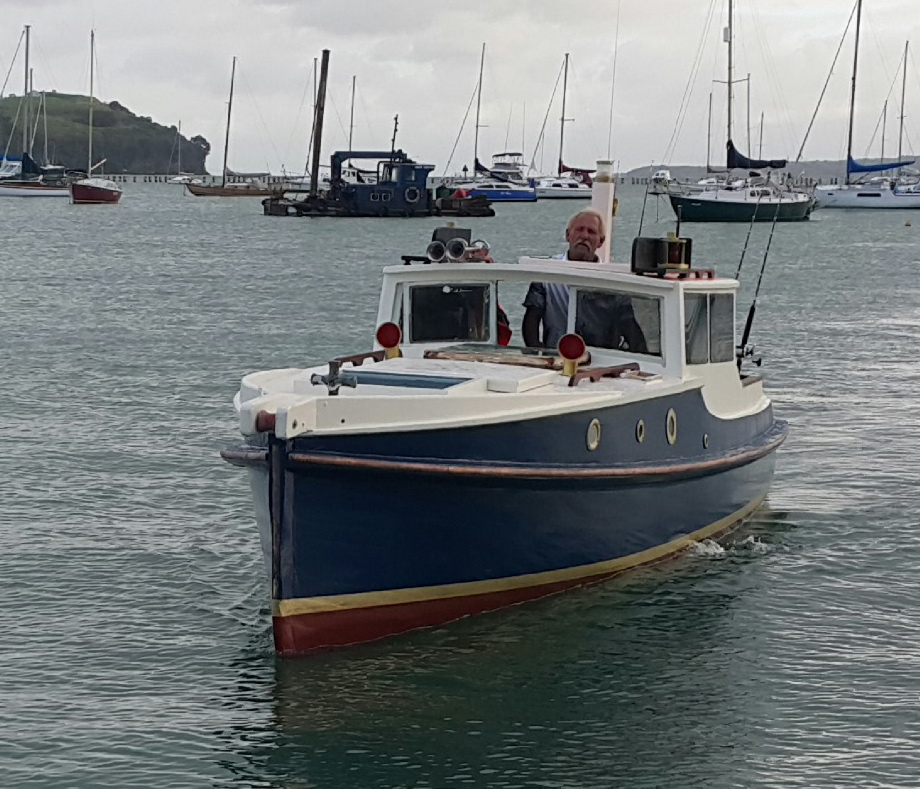
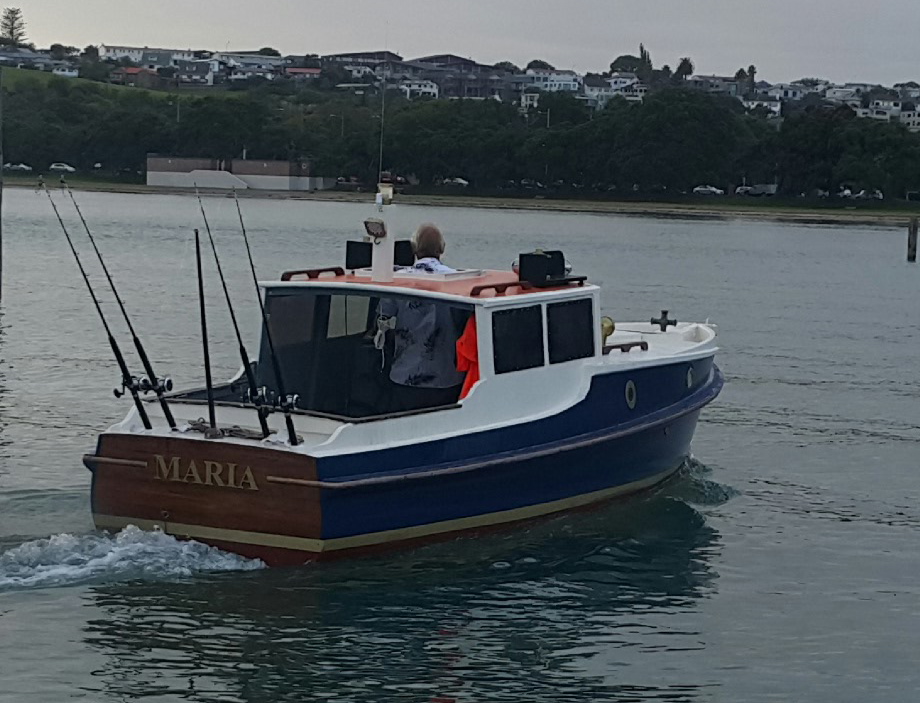
The photos of Maria were sent in by her new owner Nick Voerman, Nick until recently owned Rosemary M. In Nicks words his last project ‘needs lots of love’, I think that an understatement but Nick has a track record of bring these old ladies back to their finery so fingers crossed. Nick has built a model of Maria which I’m sure will be his inspiration for the restoration project. Below are examples of 2 other models Nick has done, one on the 1915 Lanes – Rosemary M & one on the 1923 Bailey & Lowe – Rotomahana
Nick believes Maria (nick named tuk tuk) may have spent time at Kawau Island & possibly moored off Devonport, can anyone add to what Nick / ww knows about her? She is 21′ long & powered by an air-cooled 2 cylinder Lister engine (that will get Baden Pascoe fizzing)
1915 Lanes – Rosemary M
1923 Bailey & Lowe – Rotomahana
11-03-2016 photos ex Nick Voerman
Hows this for a transformation – all finished & re-launched & looking very smart 🙂
JANE – Sailing Sunday photos & details ex Mike O’Dwyer
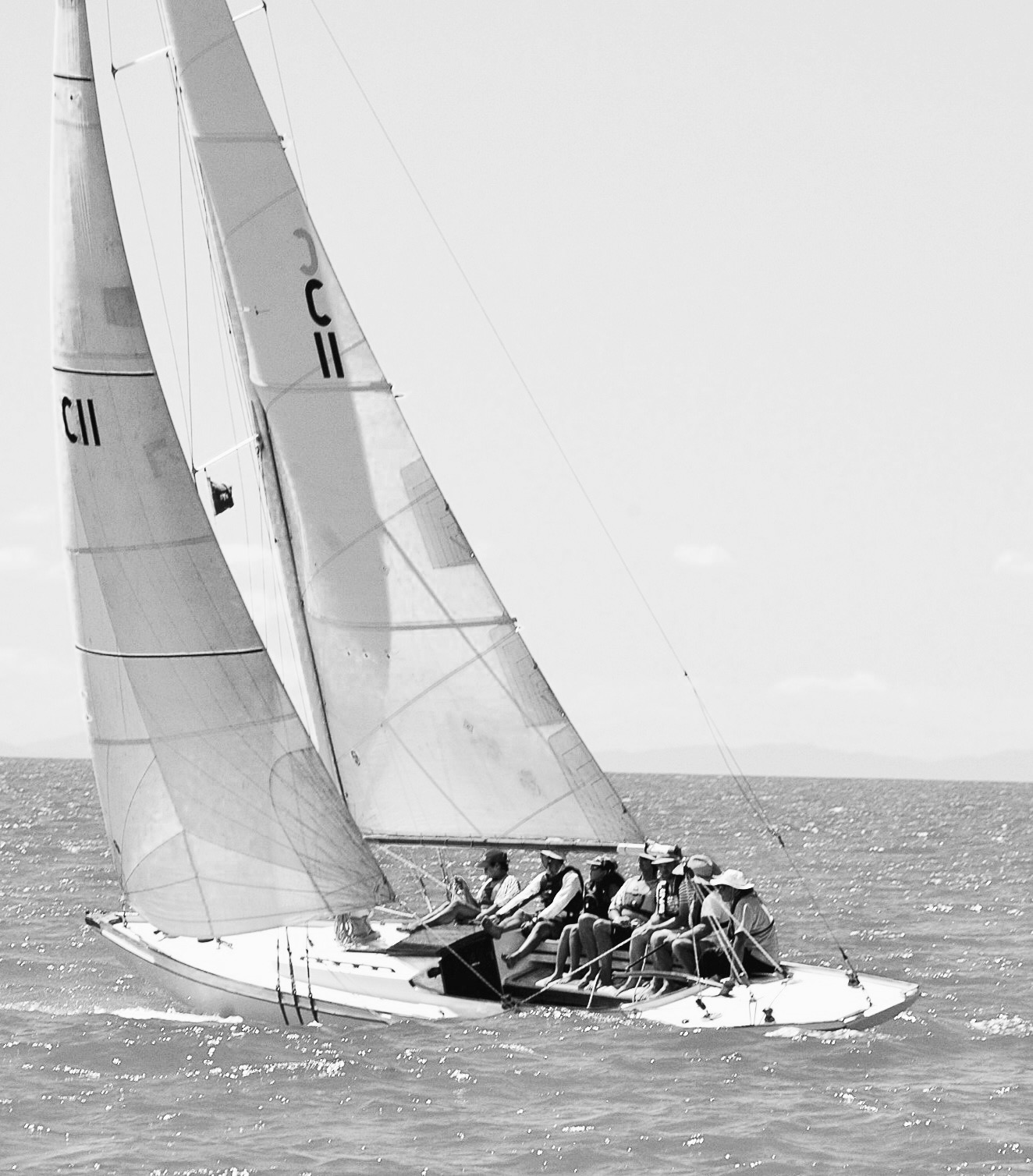
Janet was designed by Chas. Bailey Jr. in 1902 & built by the Sutherland brothers in Domain Street, Devonport*. She is now owned by Andrew Wares, Bruce Isles and Michael O’Dwyer of Hawkes Bay. All friends since childhood with a common interest in sailing who decided to obtain a classic yacht – a day sailer, not too big, something with a bit of provenance that had to look nice. After a year of looking Janet came up and fitted the bill.
Janet was purchased in June 2013, shipped to Napier in April 2014 and relaunched in April 2015 after an eighteen month makeover. Almost all of the work being done by Mike O’Dwyer & with limited spare time saw the project sixteen months longer than expected. A brief overview of the project goes like this – she had six planks replaced, three each side in the garboard area, a certain amount of repair completed on the inner skin, and was fully re-caulked, puttied and painted. The keel and rudder were fared and the floors refastened. The rig was also spruced up with the mast being painted, the boom varnished/painted, fittings newly galvanized and the roller reefing system rebuilt. The owners report she sails beautifully and with improvements and tweaks continuing will only get better. In the first photo above she is seen enjoying her first sail in Napier waters.
The restoration goes like this – Janet was stored at the sailing club hardstand with scaffolding around her, the tarp covering the scaffold was originally rented because they thought they would only be there two months to do a spruce up. Well the best laid plans…. After removing the paint with hand scrapers it was discovered that the wide seams were full of sika around the garboard area, a copper strip covered a dodgy seam, planks that looked like they had lost some fastenings. Further raking of seams revealed very old caulking and putty.
In one of the photos you can see below the dark water stained areas that there was a 10mm gap between the garboard plank and the inner skin. Only one thing for it, full re-caulk, putty and new planks. The bottom three on each side had to be replaced.
In another photo you can see a copper strip covering the seam just above the forward edge of the lead keel, the seam behind this was about 10mm wide and full of gunk. The wooden filler block on the leading edge of the keel also needed to be replaced. When raking out a small section of a seam it started with newer cotton on the outer, as you went deeper the cotton got older until finally the last cotton to come out was like a ribbon. The plank edges were parallel to each other back to the inner skin which made for a narrow deep seam. The seams were paid with a variety of products e.g there was black sika,white sika and putty. Up to five layers of caulking( the stranded type) were removed from some seams.
You can also see the scored waterlines in the hull planks. They counted about six of these either side. Janet had an inboard engine at some stage which could account for some of them.
The varnish product on Janet is Hempel diamond varnish & is a two pot varnish. There are five coats on everything that needed varnishing. The wind vane is home made & works a treat.
Below is an index to some of the photos & her owner talks you thru some of the work. Scroll over the photo to view the number. Also remember you can enlarge the photos by clicking on them 😉
Andrew, Bruce & Michael have done a wonderful job in restoring Janet & hopefully we will see her back on the Waitemata for some of the classic yacht regattas.
PHOTO INDEX: Photo 1 – shows the hull primed and caulked. You can see the lowest three planks that are to be replaced and a rough area where a copper strip was used to cover a wide seam. Photo 2 – the hull above the waterline puttied. Below the waterline redlead paint was added to the putty. Photo 3 – planks removed portside. A couple of the planks literally fell off when the end screws were removed. It must have been the corrosive entities handing hands that kept them on. The inner skin though black from years of bilge water,oil and god knows what else was still sound. Gotta love that kauri. A few kauri shims also fell out,used as packers to take up a few gaps between the skins. I remedied this with lightweight filler mixed in epoxy. Kauri locks also fitted at fore upper end of the lead keel ready for shaping. Photo 4 – Inner skin repaired and first plank fitted. The floor fastenings were replaced also. Photo 5 – Planks awaiting faring. Lots of red lead paste between the skins. Kauri blocks shaped and primed. Photo 6 – Starboard planking underway. Eight new inner skin plank ends were scarfed in place. Photo 7 – Bit of bling – I’m letting this oxidize however as I like the vert de gris look. Aging gracefully. Photo 8 – Just about ready for the water. Still work to do on the rig. Photo 9 – Not a bad looking rear. Photo 10 – Happy boat back in the water after 15 months. Photo 11 – Mast painted by brush. To many scarfs of different coloured timbers so went with the paint option.
*Harold Kidd Input
Angus and William Sutherland lived in Domain Street, Devonport. Angus was a shipwright with Chas. Bailey Jr and had Bailey design two yachts for himself and his sons. The first was JANET in 1902, a 24ft linear rater. The second was the 40 footer WAIONE, built to replace JANET in 1907. She was a 9 metre under the recently-adopted International Rating Rules. Both yachts were built privately by the Sutherlands at their home in Domain Street, not at Bailey’s yard which, until 1912, was at 43 Customs Street West at the foot of Hobson Street. In November 1912 he moved his yard to the new reclamation at Beaumont Street, Freeman’s Bay. Confusion arises sometimes because Chas. Bailey Jr DID design and build a JANET about this time, but it was a 30ft linear rater for J. McMurtrie of Sydney. Even then, some sources say she was a Sibbick design. Your yacht was probably named after the Sydney yacht which was launched in 1901.
03-04-2016 Update – 2016 Art Deco Parade of Sail – A Mark Foy start, Janet claimed line honours.








 waitematawoodys.com #1 for classic wooden boat stories, info, advice & news - updated daily - 15+ million views