The Smuggler’s Cave

THE SMUGGLER’S CAVE

story by Peter Stein, movie ex Roger Guthrie

Back in the early days of ww (2013) I did a post featuring a really cool black & white ‘home’ movie from the late 1920’s. Peter Stein’s father (also Peter) featured in the movie & its production & Peter jnr. has kindly written an article, below, on the movie, the people featured & the location.

The cameramen doing the filming were Alec and Alan Lambourne.  The Lambourne’s house (now owned by the Brooks) is above the jetty in Arran Bay.  They had the jetty  built in the early 1920s.

The three girls were Joan Woollams, Cynthia Restall and Shirley Vicary.  Joan was the dark haired girl who rowed the dinghy.  The Woollams owned the house on the south side of our house (Arran House).  An early scene shows them picnicking at Bulls Bay (Anita Bay) at the north-eastern end of Waiheke.  The “Smuggler’s Cave” is in the main headland between Bulls Bay and Hooks Bay and is easy to find.

The smugglers were my father, Peter Stein who was a Master at Auckland Grammar School from 1918 to 1965.  He was the one on the oar.  The other smuggler was Arthur Nicholson also a Master at Auckland Grammar School who later became the first Headmaster of Tauranga Boys’ College.

Our boat the “Pelican” was their transport.  She was named after Sir Francis Drake’s round the world ship which during the voyage had a name change to the “Golden Hind”.  The Pelican was 14 feet long and was an ex ship’s lifeboat.  She was clinker built.  The motor was a 5hp single cylinder “Du Brie” which gave her a speed of between 4 and 5 knots.  Ignition was the current from 4 large 1.5volt dry cell batteries passing through a coil.  The motor was started by crank handle and had a dog clutch so there was no reverse.

The tender was the dinghy “Beagle” named after Charles Darwin ship “HMS Beagle”.  She was 10 feet long and was heavily planked which made her ideal for boating activities around rocky coastlines.

The Coastguard vessel was the “Waitangi” which I described in my article about “Beautiful Waiheke” (posted on 2 September 2015).  The skipper was my Uncle Tom Stein and his armed assistant was Dean Ellingham another holidayer from Arran Bay.

It must be remembered that this was the late 1920s and home movies were in their infancy.   The cast were a group of people who only came together when they were holidaying at Arran Bay.  My father told me that they all had a most enjoyable time putting it together which is evident from the film.

Special thanks to Roger Guthrie for forwarding this footage to waitematawoodys.

Wynyards (Lushington’s) Bay + Wirihana 1

Wynyards (Lushington’s) Bay
photo ex Mac Taylor Collection

Now I’m sure to some / most of you the bay in the above photo will be very familiar but not to me. I have a good hunch but I’ll let you all chip in. Remember you can click on the image to enlarge & if you click again on the enlarged photo it will zoom in even more.

Wirihana 1
The 2nd part of today’s post is a great photo, below, I found in Mac Taylor’s album, the launch is the first Wirihana (1) – there is a great story found at the link below concerning Wirihana (1), which most likely became Lady Gay (1) + how Wirihana (2) & Lady Gay (2) fitted into the scene. Great reading & a fine example of the ww blog really working.

Wirihana Who ‘Built’ Her?

Update

Seems everyone is right on the button with ID’ing the location – Harold Kidd sent me a link to the Henry Winkelmann photos (post card) ex the Auckland Museum collection below, taken in 1899. It is ‘Rodmershaw’ the residence of Mr Lushington.

I’m very familiar with the location as early one morning during a Mahurangi Regatta weekend, I had to retrieve my #1 kauri clinker dinghy from the beach after it went walkies in the night & washed up there, undamaged. The gods were smiling on me that weekend 🙂

Update from Harold Kidd
The photo below, ex Auckland Museum collection,  shows Mrs Lushington sitting on the ballast of her husband’s Robert Logan-built yacht MURITAI in 1899 at the property.
The 22ft mullet boat on the beach behind MURITAI is the 22 footer BELLE built by Hewson & Melville in 1883 also owned by Lushington. BELLE was converted to a deadwood keel yacht & later renamed LOTUS.

Pam Cundy Input

Pam sent me the photo below of of her partner, George Emtage, grandfather Captain George Samuel Emtage. They lived in a bay just around the corner from the bay shown above and worked for the Lushingtons and the Chandlers on Motuora. The excerpt from the book Jade River tells the story of how George’s family inherited Motuora island.

Crusader & Something Cool To Do This Weekend

CRUSADER
photos ex Mac Taylor collection & Ken Ricketts. Details ex Harold Kidd

Crusader was built for Rev. Jasper Calder and Charlie Goldsboro by Collings & Bell in the winter of 1929, originally without her later bridgedeck. She replaced Calder’s 20ft mullet boat Ngaro. During the 1930’s Calder would hold church services aboard the launch in Mansion House Bay, Kawau Island during the summer cruising season.
The photo (MTC) above shows Crusader running down the harbour on her way to winning the NZ Power-Boat Association’s race for the ‘My Girl Trophy’ for cruisers steered by ladies. The insert is of Miss E Herrick, who was at the helm.

The xmas 1948 photo (KR) below shows Crusader anchored in Mansion House Bay, Kawau Island. By this stage she was sporting a bridgedecker

29-01-2016 photo of CRUSADER (1935) ex Nathan Herbert
Screen Shot 2016-01-31 at 10.56.49 PM
31-01-2016 Update ex Paul Drake
Recent photo of CRUSADER – taken Feb 2015 at Whangamata from on board Paul’s brother Nigel’s launch FREELANCE..

DSC03926
LOST – we are still trying to track down the ‘My Girl Trophy’ so if anyone has it tucked away, drop us a note.

Also if anyone had an old NZ Power-Boat Assn. burgee, I would love one………… you can see it flying on the bow of Crusader (has a propeller in the center). Would swap a ww t-shirt for the burgee 😉

Looking for a classic wooden boat fix in the weekend?

Visit the Classic Yacht & Launch Exhibition at the Viaduct. Hosted by the Tino Rawa Trust.
This years feature designer is Des Townson. The exhibition will showcase the best of his designs in two displays – a static out of water display of the Starling, Zephyr and Mistral sailing dinghies and rafted up on the Visitors Berth will be a selection of bespoke Townson yachts including ‘Serene’, ‘Moonlight’, ‘Talent’, ‘Infinity’ and the one & only launch Des designed ‘Aristos’ will be there as well. You can view more on Aristos here https://waitematawoodys.com/2015/03/09/aristos/

In the exhibition marquee will be half models and memorabilia.

TIMES: Saturday 3rd October and Sunday 4th October between 10am to 4pm. Entry is FREE
LOCATION: Karanga Plaza and Visitors Berth, Viaduct Harbour. (Between Team New Zealand Base and the Viaduct Event Centre).

Lady Sam

LADY SAM

Collings & Bell built Lady Sam in 1925. Approx. 32’ long & constructed of kauri planks. She is powered by a 80hp 6 cyl. BMC diesel.

She underwent a major refit & near complete rebuild in 2002. Home is the Coromandel Harbour. Recently for sale on trademe.

Can we confirm & expand on her history?

Auckland Woodys Welcome His Majesty’s Ship

AUCKLAND WOODYS WELCOME HIS MAJESTY’S SHIP
photos ex Russell Ward. details ex Harold Kidd

During the discussions on last weeks post on the very fast CMB, Russell sent me the above impressive photos from when HMS Renown (tbc) visited Auckland. An impressive number of woodys featured. How many can we ID? – I have attached a numbered, L>R (1>7) photo below.
There is potentially some confusion as to the date/year of the visit & whether in fact it is HMS Renown or her sister ship HMS Repulse.
Renown came here solo in 1920 with the Prince of Wales and again in 1927 with the Duke & Duchess of York.
Maybe it’s Renown in 1927 but it could be Repulse in 1924 or Renown in 1920 (fyi Luana that can be seen in the photo was launched in late March 1920 only a month before the 1920 visit).

Update from Barry Davis

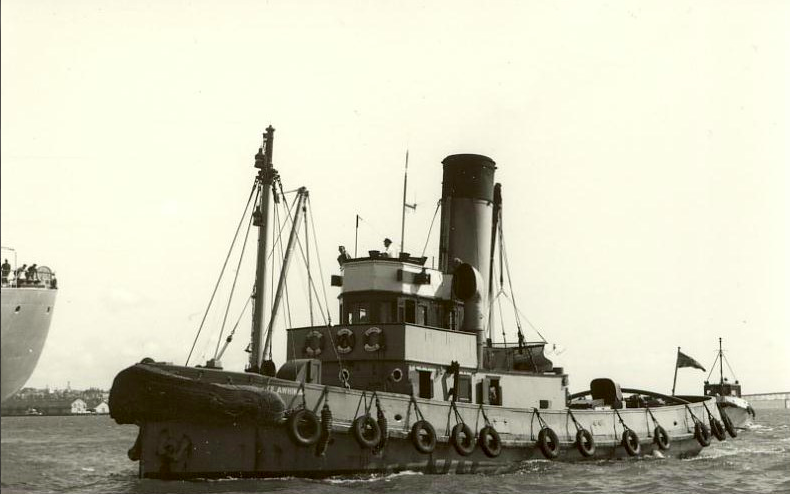
Robin Elliott is correct in saying that this is the 1920 visit of the Renown. Below are a couple of photos from the Auckland Weekly News dated 29 April 1920, unfortunately they are not that clear. The small steamer in the foreground and to the left in the second view is the Onewa, the tug closing in on the bow is the Te Awhina.

24-09-2015 Photo of Te Awhina below – ex Russell Ward

Te Awhina


LA MORENA – Sailing Sunday

LA MORENA – Sailing Sunday

Sometimes you see a boat & just go wow – now everyone has their own taste but today’s yacht rang my bell. Got to love the dinghy & the solar panel 🙂
La Morena is a 95 square metre Skärgårdskryssare. She is a 1922 masterpiece by Gustaf Estlander, the Finnish architect.
The yacht was built in Germany for a Swedish engineer, Frithiof Dahl. He was a building contractor, at that time responsible for the building of Ragnar Östberg’s famous City hall in Stockholm. Under the name Roxane III, the engineer race her during the 1920’s and 30’s, against Kerma and other famous yachts, probably mostly around Sandhamn and Saltsjöbaden. Then the family Graffman own her for almost forty years. They call her La Morena, “the brunette” in Spanish. They sold her to Arne Fyrk and Bengt Helgesson in the late 1970’s, who moved her from Stockholm to Motala and lake Vättern, were she stayed for 20 years. La Morena was almost 60 years old when they bought her. No age for a beauty, but she had worked hard and was in deep need of recondition. Arne and Bengt’s effort saved her for the future. The year 1998 she was back in Stockholm with new owners, who sold her to the present owner in the summer of 2004.

During the winter of 2004-05 an extensive restoration were carried out. It ends with a new keel plank, a new rudder stem and knee, 50 meter new planking, a new stainless steel rudder, a new modern profile of the keel, and high finish of the whole bottom. Damages in the deck and deckhouse were also repaired, as were damages in the mast. The restoration has continued. With the aim to both have a shining and a fast yacht.

The text is Swedish but the photos of the restoration are stunning – link below
http://www.lamorena.se/restoration/

Also as a bonus – click the link to the on-line USA Classic Yacht magazine
http://www.myvirtualpaper.com/doc/ClassicYacht/clasicyacht-septoct2015/2015090801/

MONDAYS WW POST IS A MONTY – THE RESTORATION OF DICK FISHER’S EX. PILOT BOAT, ‘AKARANA’, 40+ photos.

J I Thornycroft Coastal Motor Boat

J I Thornycroft Coastal Motor Boat
photo ex Peter Loughlin ex Historic NZ Photos

Today’s mystery motorboat could be a real challenge – what I can tell you is  (1) its obviously the inner Waitemata with the Devonport Naval Base in the background (2) the launch is fast, very fast (3) the Historic NZ listing says c.1930 but I’d say its earlier than that (4) the seagull above the boat almost definitely had a bowel movement when the boat went by 🙂

All Is Revealed Thanks To Harold Kidd

Harold says that the solution was to identify the cruiser first (REPULSE) and with a little help from Papers Past the rest fell into place. The news clip from the Auckland Star 13 May 1924 below explain all.


19-09-2015 Further reading below (ex Peter Loughlan). The first link is for CMB9 which is under restoration, the second link some specs for the entire series.

http://www.nationalhistoricships.org.uk/register/2430/dcb1

http://www.navypedia.org/ships/uk/brit_c_f_cmb40.htm

The Wellington Scene

THE WELLINGTON SCENE

photos & details ex Harold Kidd & Gavin Pascoe

Some Wellington launches for a change.

Harold recently bought a postcard of a “launch on Auckland Harbour” which was clearly Wellington. Harold keeps in touch with Gavin Pascoe of the Wellington Classic Yacht Trust on anything Wellington so sent him off a copy. Between the two of them they identified her as Phyllis but in passing discussed images of two other similar craft, Doris and Wai-iti.

You can see that they all have a modest  ketch rig and similar configurations.

Phyllis was a 21 footer built at Kilbirnie to a Rudder Mag design by G. Dennis, starting in December 1910 and launching in August 1912. She was still around in early 1916.

Doris was built in Auckland as the 28ft mullet boat Dorothy but was sold to Charlie Moore in Wellington in 1912. He converted her to a deadwood keeler with an auxiliary but she became solely a power boat pretty soon. She was still around in 1929.

Wai-iti was built by Simmonds and Hutson of Wellington in late 1924 and they also built her semi-diesel engine. She was 28ft x 9ft. She lasted until at least WW2.

Harold Kidd Update

PHYLLIS certainly is very pretty, but you’d expect that of a Rudder design.
DOROTHY/DORIS’s cabintop is a bit lumpy, but it was put on in Wellington after she had been converted to a Cook Strait-capable launch from a very basic Auckland-built 28ft fishing mullet boat and form follows function most adequately.
WAI-ITI’s hull form is very sweet but I still can’t get my head around the way her cabin ports are placed, equidistant from the top of the coaming rather than in the middle between the top of the coaming and its bottom (sheer) as is the case in most boats of the time. To me, that’s a little awkward and unsympathetic. This has been commented on before in WW in relation to a possibly amateur-built Wellington launch.

Thetis

THETIS
photos & details from Luke Richardson

Thetis (Greek for Sea Nymph) was launched in Dunedin on the 31st August 1929.  She was built by Mr J McPherson boat builder of Dunedin for Mr Charles Sundstrum.
Thetis was designed by renown naval architect Mr William H Hand Jnr of New Bedford USA.  William ‘Bill’ Hand was the originator of the V-bottom hull type per Thetis.  In addition Hand was an early pioneer of the motor-sailor type. Thetis was designed as a fast day cruiser.
She is 35’1” in length with 8’1” beam, 2’9” draft and a total height of 6’9”. She is a British Registered ship dated 16th August 1929.  The official number is 127819. Her registered tonnage is 4.68 with a Gross Tonnage of 7.57.

Thetis was originally powered by a Chrysler Imperial 6 cylinder petrol engine producing 160hp at 2800rpm.  Later she was re-powered by a Chrysler Royal engine with 140hp.  With a Ford diesel in between she was subsequently re-powered in 2003 with a Mercedes Benz 5 cylinder diesel engine.  That motor is to be replaced now. Documents show Thetis was originally good for 18 knots.  A bigger engine was installed around the war years and its said she has seen 26+ knots.  In current configuration she’s more like 12-13 knots.

Construction is of kauri hull planking and Kowhai frames with teak decks. The cabin was subsequently modified and enclosed by Magnus Smith of Lyttelton, Luke believes the work was done  for Bruce Stewart of Pigeon Bay.

Known Owners
Charles W Sundstrum                         1929-37
Bruce F Stewart (later Sir Bruce)         1937-50
William Carey                                      1950-54
Clarey Beaumont                                1954-57
Des Sinclair                                         1957-67
Laurie Wales                                       1967-1997?
David Martin                                        1997-2006
Brendon Leech                                    2006-2014
Glenn Tod                                            2014-2015
Luke Richardson                                  2015-

Known History
Dunedin to late 1930’s
Pigeon Bay for some 20 years
War Service – she was commandeered by the NZ Navy Naval Auxilliary Patrol Service (NAPS) in WWII and used as a coastal patrol boat.  She commenced service 9th May 1942 and was relieved of duty 23rd February 1944 when the NAPS formally disbanded.  She was assigned the pennant number Z125 and served in the unit based in Lyttelton.  The owner at that time was B.F. Stewart.

Luke purchased her in July 2015 and she is now hauled out of the water for some long overdue TLC.  A period of neglect following the Christchurch earthquakes meant she was long overdue for some maintenance.  Luke would love to know more about any of the owners over the years and any of her history not covered above.

To view more photos & to follow the work, Thetis has a facebook page –  Friends of Thetis

https://www.facebook.com/groups/1608024876125109/

See below an article on Thetis’s launch from the Australasian Motorboat & Yachting Monthly from October 1929. Its a good read 😉

Harold Kidd Input

Charles William Sundstrum was a Dunedin dentist who was a key figure in Dunedin yachting circles for many years. His first launch was the 31ft clinker double-ender VALMAI of 1910 which had a Dunedin-built 5hp Viking engine. He raced her with the Otago Yacht Club including one of their Ocean races to Timaru.
He replaced VALMAI in 1913 with the 40 footer NORANA designed by Joseph Gillanders and built by Miller Bros at Port Chalmers. She had a 16-18hp Jersey Standard marine engine and was a handsome craft. He sold her to Arthur Brett of Auckland in 1927. During WW2 she was taken over by the RNZAF and sent to Fiji for towing work.
THETIS was NORANA’s replacement. Photo of Norana below.

13-05-2017 – Additional Photos ex trademe (Ian McDonald nudge)
 

Beautiful Waiheke – 1930’s Boating Movie with updated story

Beautiful Waiheke – 1930’s Boating Movie

I was sent this movie, filmed in late1929/30’s by the Lambourne brothers (Allan & Alex) nearly 2-1/2 years ago by Roger Guthrie, it was back in the very early days of ww & since then a lot more people have checked onto the site – in fact over 100,000 people. On ww last week I bumped into Peter Stein whose father (also Peter) appeared in the movie. Peter has written a very cool synopsis of the movie & the (now) classic launches that appear in the movie. I suggest you read Peters words & then watch the movie. Enjoy 🙂

The film “Beautiful Waiheke” by Peter Stein

Introduction:

The film was produced by the Lambourne brothers Allan & Alex in the late 1920’s early 1930’s. The Lambournes owned a large furniture shop on the corner of Ponsonby Road and Pompallier Terrace. The Arran Bay house was built in 1910 and remained Lambourne property until 1964 when it was sold to the Jorgensen Family.

Water transport for the Lambournes was the launch “Nga Whare” which is the round bilged craft in the film with the two portholes in her topsides. She was sold when I was a very young boy so I remember little about her.

Our property is next door to the Lambournes. Arran House was built circa 1885 for Andrew and Mary Croll from the Isle of Arran, Scotland. They were two of Waiheke’s pioneers. Andrew was a very fine photographer and albums of his photos can be seen at the Waiheke Historical Society Museum on Onetangi Road. Among the photos are scenes of the Annual Regatta organised by Andrew and held at Arran Bay circa the late nineteenth century. These events were well supported by “boaties” of the day. The albums were kindly donated by the Crolls of Sydney. Mary Croll was a very good artist and she put many scenes of the “bottom end” on canvas. Some of her mural work is still on the walls of one of the bedrooms in Arran House. My father, P.A.S. Stein purchased Arran House from W.J. Connell (owner of Connell’s Bay Store) in 1924 and it has been in our family ever since.

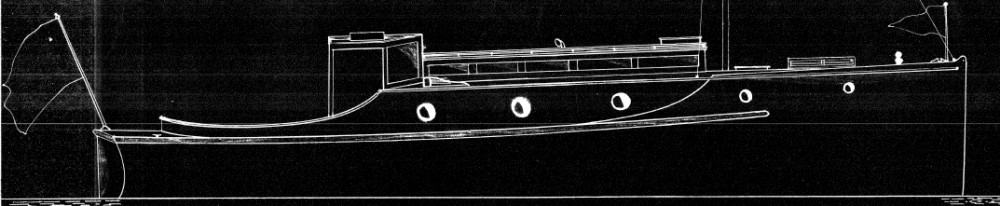
The Waitangi, the launch with mast and crosstree in the film was built in 1923 for Mr Cadman. It was a classic John L. Hacker design with sharp entry and flat stern section. The original owner named her “Karamana”. She had an aeroplane engine in her and we understand she was capable of 25knots which made her one of the fastest launches on the Waitemata at that time. Harold Kidd has a very good photo of her racing on the harbour (added below. AH). In the latter 1920s she ended up on the Tamaki Drive breakwater. My father bought the severely damaged hull and had her restored by Chas Bailey & Sons. He renamed her the “Waitangi” after his father’s steamer the TSS Waitangi of the Northern Steamship Co. My grandfather Peter Anton Stein was a Captain of various Northern Steamship Co. vessels from 1895 to 1908. Chas Bailey told my father that the Waitangi had brought them good luck because the next launch off their slipway was the legendary “Shenandoah”.

The Waitangi was 28 feet long (8.5m), had a beam of 7 foot 3inches (2.2m) and draft of 2 foot 8 inches (.8m). She was built in kauri and the bottom was double skinned from the bow to the wheelhouse.  The rest of the vessel was single skinned. Her Auckland mooring was in St Mary’s Bay in front of the Ponsonby Cruising Club at the bottom of St Mary’s Road. Maintenance was carried out at Collings and Bell Boat Builders adjacent to the PCC.

About 1930 my father replaced the old Studebaker engine with a 105hp Kermath marine engine. Allely Bros. of Beaumont Street imported the motor and installed it.  It was known as a 6 cylinder flat top. The pistons had a bore of 4” (100mm) and each cylinder had two spark plugs. It was double ignition with one spark plug connected to the magneto and the other one the distributor. Maximum speed was 18kns and at this speed the motor burnt 8 gallons of petrol per hour.   Petrol was bought in 4 gallon cans and there were two cans to a box. We still have an old Atlantic box which we use as a vegetable bin at Arran House. Petrol in the early 30s was 1 shilling and six pence a gallon. A 50% rebate brought the price back to a respectable 9 pence a gallon. My father told me that the best run home he achieved was Connell’s Point to Kings Wharf in 1 hour and 12 minutes.


The film:

The film began with shots of the Guthrie family aboard their launch “Alcestis”. It then moved to shots of Arran Bay taken from different location around the Bay. The people setting out down the path are coming from the Lambourne’s house.

The aquaplaning sequence was filmed from the shore and the “Nga Whare” which was the tow boat. My father was the young man with one of the Lambourne girls on his shoulders. Years later I learnt to aquaplane on the same board.

The “Waitangi” then heads to Bulls Bay with my father as pilot. The majority of the film is shot at Bulls Bay (Anita Bay) on the north eastern end of Waiheke. At the northern end of the bay are many small rocky islands and the launches are filmed going through the channels between the rocks. These are not hard to navigate but should be done at ½ tide or more.

The “Coughing Caves” are in the southern point of Bulls Bay. With a northerly swell and incoming tide, waves enter the caves and when the top reaches the ceiling of the cave the air behind it is compressed until it bursts out in a cloud of spray. The boy in the dingy, Reg Crawford, is trying to get as close as he safely can to the emerging spray.

The “Whirl Pool” is in the long reef extending from the northern end of Bulls Bay. Riding the swell in and out of the pool could be quite exciting as seen in the film.

The homeward bound shots of the Waitangi in the storm were taken in the channel between Pakatoa and Waiheke.

Harold Kidd Input from previous ww post

Waitangi was built as KARAMANA for F.B. Cadman in 1923 by Bailey & Lowe to a design by Hacker. KARAMANA = CADMAN in pig maori.
She was later bought by Auckland Grammar School teacher P A S Stein and rebuilt as per the 2nd photo below. She was fitted with a war surplus 6 cyl Green sohc aero engine producing 120-140bhp, bore 5.5 ins, stroke 6 ins (you work out the capacity). She was pretty radical.

03-09-2015– comments

1. The Lambourne launch was called NGAWAI I think, not NGA WHARE. She was later bought by the Andrews family on the Hokianga. I remember her as a child during WW2 laid up in a shed with a Chrysler engine. Maybe another NGAWAI but she looks the same.
2. KARAMANA/WAITANGI was built by Bailey & Lowe in 1923, not by Chas. Bailey Jr who built SHENANDOAH in 1929. There’s some conflation there.