Kawau Island Copper Mine

KAWAU COPPER MINE

If you live in Auckland & own a boat at sometime you will have cruised past the remains of the mine & no doubt wondered how & why it was constructed on this beauitful island in our Hauraki Gulf – well read Russell Wards story below & next time you pass by you will be the ‘clever one’ aboard that knows the answers 🙂 AH
story by Russel Ward
Below is a bit of nostalgia. It is the engine house at the Kawau copper mine when I first saw it a misty day in 1961. A lot of it has fallen since then.
It may be of interest to you all that the pumping engine didn’t actually do much work at all because it became obvious to the engineer in charge that the rock they were having to get though was harder and harder. Moreover the initial expert had grossly overestimated the amount of copper available.
Of great interest is that a beam engine enthusiast in the UK, Kenneth Brown has visited the Kawau pump house and measured it and thus deduced the size of the engine. He is adamant that it was transported back to Cornwall making it the most travelled Cornish pump engine ever. This was a bit early for the Thames miners 20 or so years later, it would have sold readily in NZ. 
Ken Pointon of MOTAT, however is certain that it went over to Australia. Interesting. 
I wrote article below 20 years back, its still good bedside reading. RW

THE KAWAU COPPERMINE AND ITS PUMPING ENGINE – Russell Ward

I first saw the Kawau copper mine in the late 50’s and have nursed a fascination for its history ever since. My primary interests are mechanical and I often wondered what sort of engine had been installed and the nature of its fate. There was an old boiler lying alongside, but it appeared to be much more modern than the engine house. It was evident that the engine house was of a type found in Cornwall and that a beam engine typical of Cornish mines was likely to have been installed. I researched the nature of the workings in the early 1990s and reported on my findings in “Breeze” at the time.

My interest in the old engine was revived in Finland, of all places, where I was attending an EU classic steamships meeting. A chance mention of the Kawau engine to Brian Hillsdon archivist for the Steamboat Association of Great Britain led me to an exchange of correspondence with Kenneth Brown, a member of the Trevithick Society for the Study of Industrial Archaeology in Cornwall. Kenneth kindly sent me a copy of the Society’s journal, which reported on the various attempts to mine copper at Kawau and the possible fate of the pumping engine. I am indebted to the Society for allowing me to draw heavily on this document.

A SHORT HISTORY OF THE MINE

In the 1840s Kawau was bought and settled by the Bon Accord Mining Company of Aberdeen on the strength of its copper deposits, which had been discovered in 1844. Mining started using local labour but, in January 1846, a party of miners arrived from Cornwall with Capt James Ninnis head operations. Ninnis, an able manager, was from a well-known mining family and a strict teetotaller. He founded a flourishing Kawau Total Abstinence Society.

For a time, 200-300 people, miners, surface workers and their families, were living on the island in timber dwellings. At first ore was shipped to Sydney with the intention of sending it to Wales for smelting. However the ore displayed an alarming tendency to spontaneous combustion, not healthy in a wooden ship, which led to the decision to build a smelter on Kawau itself. The copper content could then be raised from 6 to 30 percent making the ore safe to ship to Swansea for final refining.

The copper lode itself lay in the small (though originally much larger) headland we all know, just 18 ft below the surface. As the miners sank shafts the workings inevitably went below sea level. A 12 hp steam engine was bought in NZ and installed to work pumps in one of the shafts and possibly a crusher as well. A horizontal level, or adit, ran into the mine from an opening in the headland above sea level. To provide a greater working area, the miners blasted the cliffs and used the rubble to form a narrow strip retained by wooden piles, which incorporated a wharf to load ships. A longitudinal section of the mine, on a plan drawn by Captain Ninnis in 1848, shows four shafts. Three were inland, each equipped with a horse whim (or gin) for hoisting. Lawyer Frederick Whitaker owned the fourth shaft.

Whitaker seems to have had his share of skulduggery in the young colony. In this instance he managed to obtain from the government the right to mine beyond the high water mark. His workmen, however, were caught red handed mining inland on the other claim. Protracted legal battles ensued, resulting in the company having to buy Whitaker out for £5000. While there was an expectation that the copper deposits extended out under the sea as often happened in Cornwall, the unfortunate consequence of the physical integration of the inland workings with Whitaker’s undersea workings probably hastened the later flooding of the mine.

Ninnis left when his contract expired and his place was taken by Begher a German metallurgist with experience of smelting but not mining. As the mine went deeper, the amounts of water seeping in became ominous. In 1852, with the work at 24 fathoms down, the ingress of seawater overcame the pumps, flooding the mine. Begher set sail for England to persuade the company to put up the cash for increased pumping capacity. At this time, the company was reformed as the North British Australasian Company and management was from London.

A report by mining engineers John Taylor & Sons was optimistic on the prospects for the mine and proposed

“… To send out immediately a Cornish steam engine of sufficient power to drain the mine with facility to a depth of 60 fathoms at least and keep it clear of water even if the present quantity should be doubled.”

It is on record that the 330 ton barque Baltasara was purchased by the North British Australasian Company and despatched from Falmouth in late 1853 or early 1854 with the engine, engineering and mining personnel on board. The Perran Foundry was one of the three major builders of Cornish beam engines and is the only one likely to have shipped an engine from Falmouth. The engine was erected in the engine house and ready for work by 15 July 1854. In 1995 it was deduced from on site measurements that the engine was probably about 36” bore and had a stroke of between 8’ and 8’6”. More of this later.

By August 1854, the new engine had dewatered the mine to the 24-fathom level where the work had ceased three years earlier. Begher was back in charge but a Cornishman Capt Anthony Bray was appointed to oversee the actual mining. The difficulty was that the deeper the mine went, the harder the rock became and the costs escalated. The 34-fathom level was finally reached in September 1855 to find that no payable ore was available. Begher had, moreover, grossly overestimated the quantity of easily workable ore left at the 24-fathom level.

Shortly after, the Sydney agent began refusing to honour Begher’s heavy drafts on the company. The decision to recoup company losses by stripping the assets seems to have taken the English shareholders by surprise. By December 1855, all mining had ceased and the engine had been or was about to be dismantled after little more than a year’s work. The only result was 32 tons of copper ore shipped back to England and a further 50 tons said to be ready for shipment from the smelter.

After this setback, the company sold its mining interests in Australia and concentrated on sheep farming.

The Mining Journal, a weekly newspaper of the period reported quite fulsomely on the recriminations at the shareholders’ meetings that ensued. They reveal a sorry tale of failure of the mine after little more than a year’s activities. As a result Taylor resigned but the directors and Begher seemed to have been primarily responsible for the company losing £30,000 on the venture. The previous company apparently lost £45,000; these were quite substantial sums for the day.

WHAT BECAME OF THE ENGINE?

Following the abandonment of the mine, it seems that the engine was returned to England for sale. The suggestion is that the company hoped to return it to the Perran Foundry for resale. There is no record of it making it back to Perran’s works. The plot thickens a little and the following advertisement, which appeared in the Mining Journal 4 October 1856, is interesting.

FOR SALE

            Mr Little will sell by auction at Devoran in the port of Truro on Monday 13 October next at Twelve o’clock the undermentioned materials all of which will be found in excellent condition (some of the pitwork quite new) and lying on the wharf convenient for shipment:

A steam engine 36″ cylinder, 8½ ft stroke equal beam. Large iron angle bob, with plummer blocks and brasses about 3 tons 31 9ft 3in pumps (ie sections of the rising main)

Then all the pitwork in detail including 12 and 14 in brass plunger poles, 10 and 12in iron buckets 6 and 7in brass buckets and clacks.

May be viewed on application to the Redruth and Chacewater Railway Company’s offices at Devoran

From Kenneth Brown’s measurements, it would appear that this might be the same engine. Certainly the ancillary equipment offered suggests that it was recently removed from a mine. Moreover, it appears that some of this equipment was not associated with the new engine but was from older pumping activities.

The more modern rusty boiler on site dates from a short-lived attempt to rework the mine in 1898-1900 by a Capt Holgate. It features in a picture in the Auckland Museum showing its installation in a lean-to alongside the old engine house. Jet machinery was installed in the shafts for pumping.

I have included a picture scanned from the latest copy to hand of the British journal Old Glory. It is part of an article about a preserved Cornish tin mine. The Levant mine ceased work in 1939, but was reopened and worked again in 1960. Its venerable pumping machinery was taken in hand in 1935 by a group of local enthusiasts and conserved. The National Trust now preserves the mine. Would that we had had some preservation enthusiasts in 1935 over here! Our only enthusiasts were wielding gas axes and chopping our heritage up for the melting pot.

The Kawau copper mine pump house is worthy of rebuilding to its original configuration. It stands as the first major site of very early colonial industrial activity and should be reinstated. Any lobbyists keen to take up the cudgels?

Harold Kidd Update

I had a lot to do with the mine in the 1960s when I acted for a couple of eager fellows who were sold on the idea of recovering the rails in the mine. The mine had run well out under the sea and flooded as soon as the workings ceased. The seawater acted as an electrolyte, depositing the copper from the exposed workings on to the iron trolley rails in a fairly pure form. Despite valiant attempts, the two guys just could not dewater the mine to make it safe enough to get at the rails.
I took a party of Japanese mining engineers to the mine to show them around with a view to raising capital to get the appropriate gear. To impress them (I thought) I turned up in my father’s brand new Datsun Bluebird, one of the first Jap cars sold here. But nothing impressed them, especially not the rough trip to the pumphouse on the tray of a beat-up WW2 GMC truck. Guadalcanal all over again perhaps?
So the copper is still there for the taking…if you’re brave enough!

Winter – yeah right

This slideshow requires JavaScript.

Winter – yeah right

Forecast looked good & I had a wee bit of reading (work) to catch up on so I gave Raindance a fright & slipped the lines on Friday morning & headed down to Waiheke Island. Chris Miller (Rorqual) came down late afternoon. We were rewarded with a great weather, mill pond bay & crystal clear water. Plus not a lot of boats overnighted.

Trinidad – 52′ Salthouse Motor Yacht

Trinidad – 52′ Salthouse Motor Yacht

Launched in 1965, designed by Bob Salthouse, built with 3 skin kauri planking at John Salthouse’s Greenhithe yard. She featured on the cover of the September 1966 edition of ‘Sea Spray’ magazine.
Powered by a 6LX Gardner diesel she cruises comfortably at 8.5>10 knots, with a cruising range of 1000miles. In my mind there are a few things that make a boat a ship, one of them is an ‘engine room’ versus an engine compartment & the second is a ‘workshop’ & the last is a galley that is a separate room – Trinny sports all three of these.
Trinidad is a very spacious vessel with 6’9″ headroom & her wheelhouse enjoys excellent visibility & is one of the most used areas on-board.
Trinidad is a true blue water ship with passages to Australia & a circumnavigation of NZ.
Her owners, Barbara & David Cooke maintain her to a standard that some would say is better than new & she is much admired where ever she drops anchor. AH

The classic wooden boat maintenance myth

This slideshow requires JavaScript.

The classic wooden boat maintenance myth

Every time I talk to a potential (first time) buyer of a wooden classic the one thing I hear again & again is the worry about the time required on maintenance. Yes they require constant TLC but the days of sanding & varnishing, sanding & painting etc etc have been significantly reduced with some of the new (ish) products in the market place. But if working on your boat does not appeal – buy fiberglass.

I believe in beating the drum for good, make that great, products – one of which is Uroxsys (now marketed / sold as AWLWOOD MA) this product has revolutionized the maintenance of exterior clear coated timber. There are boats in the CYA fleet that are in their 6+ year of Uroxsys protection + it looks a million dollars & its easy & quick to apply.
In the marine game you generally get what you pay for, Uroxsys / Awlwood MA not found in the bargain bins at marine chandleries & has recently undergone an international price alignment, but if your are looking for cheap, again maybe that fiberglass boat is a better option for you 🙂
Read the report above from the UK Classic Boat magazines long-term performance test – enough said !! AH

Percy Vos book to be launched

Percy Vos book to be launched

A little bit of a heads up, very very soon we will see the launch of a new book ‘Launching Dreams – Percy Vos – The Boats & His Boys’ by CYA member Baden Pascoe. I have had the pleasure to work with Baden on the production of the publication & its a both a great read & a wonderful pictorial insight into the world of Percy Vos & the people that rubbed up against him.

Its a ‘big’ book so clear some space on the coffee table & start saving the pennies because if you are seriously interested in classic wooden boats – this will be a must have book.
Its on the printing press as we speak so more re publication date soon 🙂
Harold Kidd Comment:

It’s not only a great read but a beautiful thing to hold in the hand; a superbly produced book that glitters at you at all sorts of levels. A complete “must buy” for anyone with a whiff of salt in his or her veins.

An Oops or a mid season bottom clean?

An Oops or a mid season bottom clean?

Someone out there might be able to enlighten us as to what really was happening but by the assembled ‘crowd’ looks more like Shenandoah had been practicing her impact hygrography skills 🙂
I also posted a photo to once again remind us what a magnificent ‘ship’ she was in her heyday.
photos from Roger Guthrie

Charles (Chas) Collings – Designer / Boat Builder

Image

This slideshow requires JavaScript.

Charles (Chas) Collings – Designer / Boat Builder

The story below on Charles Collings’ approach to design in the immediate post-WW1 period has been penned by Harold Kidd.

Charles Collings emerged from World War I with a massive reputation for fast craft. In late 1914, when the war was just a distant rumble in France, he had built the 21ft restricted racer FLEETWING with which he raced and beat the Christchurch boat DISTURBER on the Waitemata in April 1915 at exactly the time of the landings at Gallipoli. He developed his “concave-convex” hull design where the chine hull had a convex (hollow) entry and progressively transitioned though straight to convex at the stern. He was by no means the originator of the idea, but certainly grabbed it as his own through decades of successful planing hulls he built for racing, fast cruising and whale chasing.
There is no doubt that he was well ahead of his time in a local context, although Major Lane was close behind.
By war’s end in 1918 Charles Collings had been a notable war effort contributor as a pal of local motorboat guru Charles Palmer (see ADELAIDE on this site), had lost his partner Alf Bell who had gone to the Walsh Brothers helping them build flying boats at Kohimarama for their flying school (and did not welcome him back afterwards), and was preparing for the post-war boom in large launch building that was inevitably coming, during which he built MARGUERITE, PAIKEA and RUAMANO amongst many others.
I have had a chip at his aesthetics from time to time but, to be fair to the man, he did not have the hindsight we have on the way launch design went and could not know what looks good to us today.
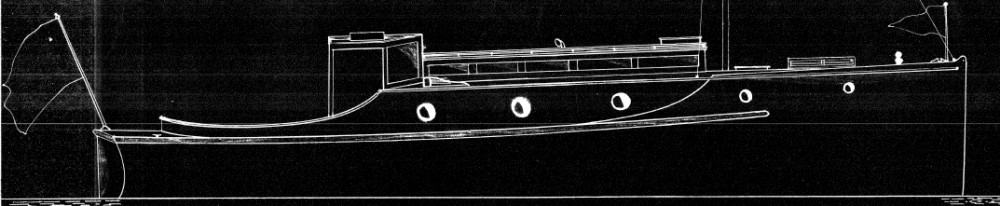
Faced with the design of a fast cruiser, only 32ft loa by 8ft 6in beam, and the desire for headroom in the main cabin, he came up with his second motorboat called FLEETWING (by now a brand for him). She was an extension of the ideas in the 1915 ADELAIDE.
I think, with this second FLEETWING, Collings’ first training as a civil engineer shows through more than his secondary training with Robert Logan Sr. as a shipwright. To obtain headroom he carried the tramtop/clerestory concept to the point IMHO of ugliness, using the parameters of the railway carriage, the electric tram and the motor bus of the time, abandoning completely the parameters of the yacht, even a token attention to which had kept launches aesthetically pleasing until now.
Anyway, see what you think of this image of the second FLEETWING which I have taken from one of Collings’ own glass plates, very decayed, but an amazing insight into the goings on in St Mary’s Bay in late 1920. Collings & Bell’s yard is out of picture to the left, so we see the yards of Dick Lang and Leon Warne close up.
This launch was on TradeMe at Picton recently, erroneously called MISS FLEETWING.

Update: Charles Collings was a very good amateur photographer with excellent gear. After his death in 1946 his glass plates got scattered around in the workshop, many were used for skipping across the Bay, most were smashed one way or another. A very few survived, most cracked or with their emulsion badly decayed. I have a handful more of which a couple are excellent and the definitive shots of his 26ft mullet boat CORONA after her launching in 1936.

PS Leon Warne took over the shed on the right in 1916 from Henry Barton who left for the US with his family because of his anti-war convictions (and had a shocking time on the way). Warne had served his time with Collings & Bell. He painted up the shed very nicely as you can see but was building in St.Mary’s Bay only until c1924 when he and his brother set up in Russell, building and chartering game fishing launches.

Hi Woodys

Quote

Hi waitematawoodys

As ww has been evolving its been pointed out to me that not everyone is au fait with the background to the many design / build gurus that we make reference to.

So we are going to start backgrounding a few of the masters from the past.

Kicking off tomorrow, Harold Kidd has penned a wonderful piece on Charles Collings’ approach to design in the immediate post-WW1 period. AH

Do not marry a farm girl

This slideshow requires JavaScript.

A tale for any waitematawoody considering marriage & also those that are now boat-less.
I found this tale, ‘Something to remember -by James S Pitkin’, a few years ago in the wonderful old 1947 book ‘The Book of Boats’ by William Aitkin. Aitkin saw the book as becoming a quarterly journal but only two issues were printed then publication ceased. You can find / buy copies on ebay & its a collection of short stories & a great read.
I had a copy & one day hopefully the CYA member I lent it to, whose name eludes me, will open the dust cover & see my stamp & return it 🙂
Harold Kidd Update:
A visit to the maritime provinces of Canada and the New England seaboard reveals the similarities between the Canucks, the Down Easters (and other Yankees) and Kiwis; each of these sets of populations originally arrived by sea, mainly in sailing craft; and each traded and gathered their food and went from place to place on the sea. No wonder there is a great fellow feeling between these peoples. There is the same feeling in Brittany and Cornwall too. The sea is at the core of our being.