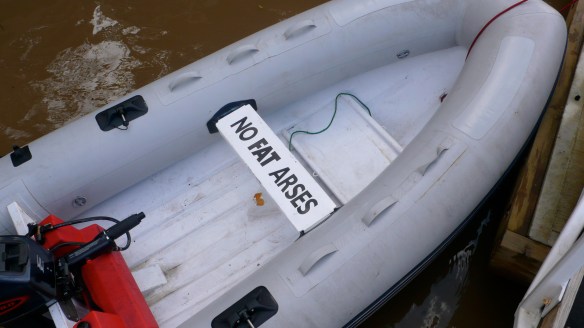
Certainly not wood but it made me laugh 🙂
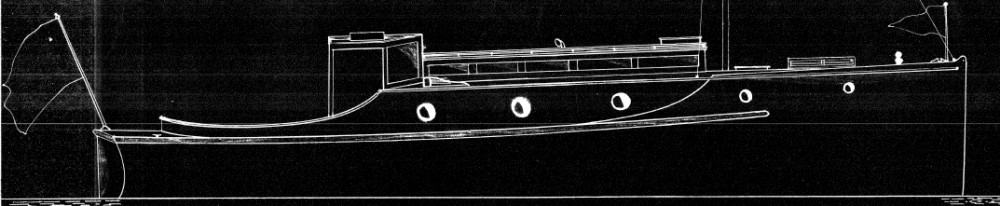
Certainly not wood but it made me laugh 🙂


PEERLESS
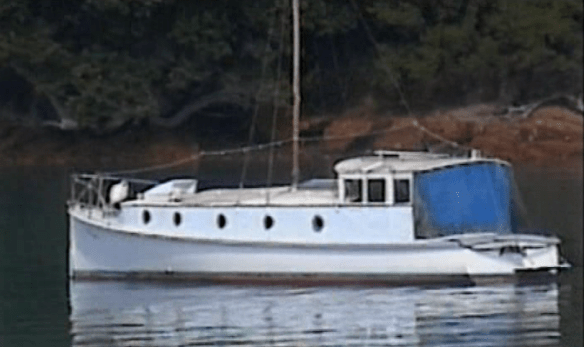
New Photo (Water Gipsy) ex Harold Kidd 16/04/2014

ROBIN GAE (CONNIE V)
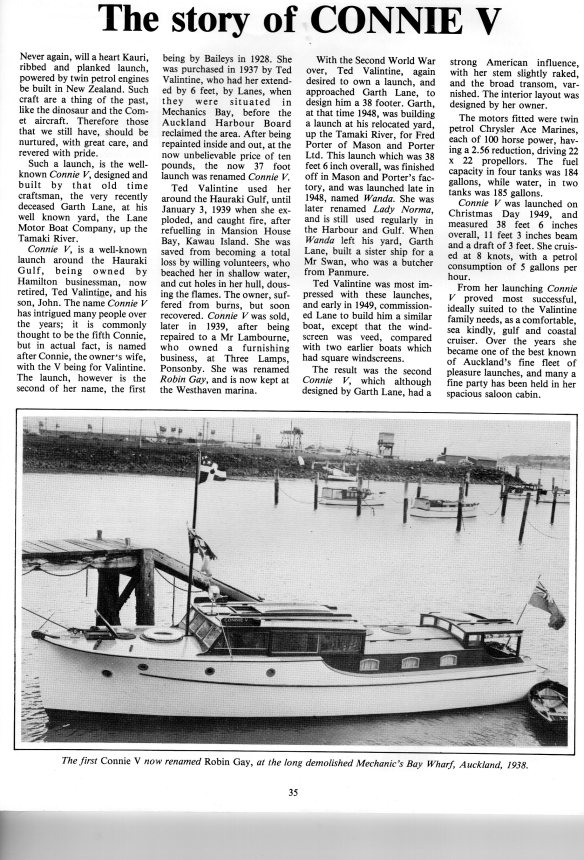
CONNIE V was built by Lane Motor Boat Co in 1949 for Valentine of Hamilton and originally had 2 x Chrysler 75hp Ace engines, hopefully the article reproduces well enough to read. The photo shown in the article was taken in 1938 at the long demolished Mechanics Bay wharf.
Harold Kidd Update 16/04/2014
I’ve had a chance since posting the above to review all the above material and to compare images of WATER GIPSY and CONNIE V. Morrie relies heavily on the Register of British Ships and it leads him into a whole bunch of traps because, for various reasons, the information is frequently dodgy. I’ve discussed this with him before. He infers that CONNIE V was built new in 1935 for Valintine, and that’s exactly what I’ve always thought until now.
WATER GIPSY (another image attached) was launched in October 1934 for C. Miller by Cox & Filmer (Speedcraft Boat Co) with dimensions 32ft x 8ft 6in. She was a slightly extended version of a 30 footer built by Cox & Filmer for one Martin (haven’t identified her yet). Miller used WATER GIPSY for a while (eg Marjorie Miller visited yacht LITTLE JIM from her on 2/2/35) and then she “disappears”.
Now, if you compare my image of WATER GIPSY with the image of CONNIE V in Paul Titchener’s highly erroneous article above (I assume whoever posted it had PT’s copyright permission), which was based solely on family anecdote I imagine, as Paul married Valintine’s daughter, you will clearly observe that the two boats are identical back to the aft end of the clerestory.
It is obvious to me that the truth is in the cracks between the various versions.
I think this is what happened.
WATER GIPSY was obviously a bit of a problem, ergonomically. She had no cockpit, had a pair of davits across the counter, and would have been a pain to handle. Valintine bought her in 1937, renamed her CONNIE V after Mrs. V, had her lengthened to her final dimension of 38ft, with the provision of a cockpit, coaming and dodger over…..much more user friendly. The work was undoubtedly done by Lanes who also fitted her with a Chrysler Crown in September 1939. That was after the Kawau petrol fire in January 1939 when Valintine scuttled her by chopping a hole in her hull, saving the boat. It may also have been after he sold her to E.M. Henry (Lambourne bought her from Henry).
She remained in the Lambourne family until 1956 or so but Lambourne obligingly changed her name to ROBYN GAE on 14/11/49 at the time Lanes launched the second CONNIE V for Valintine.
There’s a whiff of assumption in the above which I detest in others………………….


The launch Caprice & Silver Bay, Waiheke Island


Isle of Arran
NOTE: If ww has broken any copyright or offended anyone by publishing the article, please advise & we will remove it 🙂

Mapuna
A late model classic built by Robert Brooke/Snow Waters in 1961 for Robert’s father-in-law, and designed by his father Jack (John) Brooke. Now owned by CYA member Mark McLaughlin who previously owned Tainui.
Shaped on all Six Sides – a short doco about the craft & philosophy of wooden boat carpentry
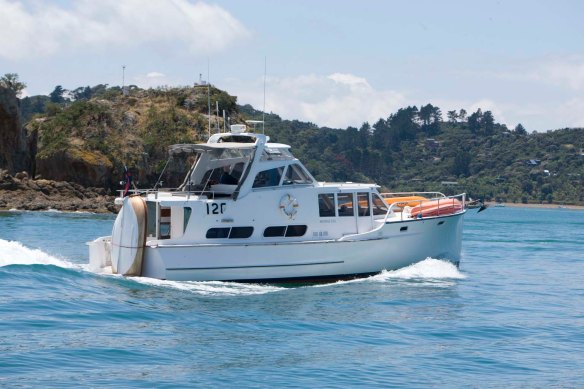
Moanalua
1935 Collings & Bell design / build. To read more about her past & view 40+ photos click this link https://waitematawoodys.com/2016/01/11/moanalua-2/

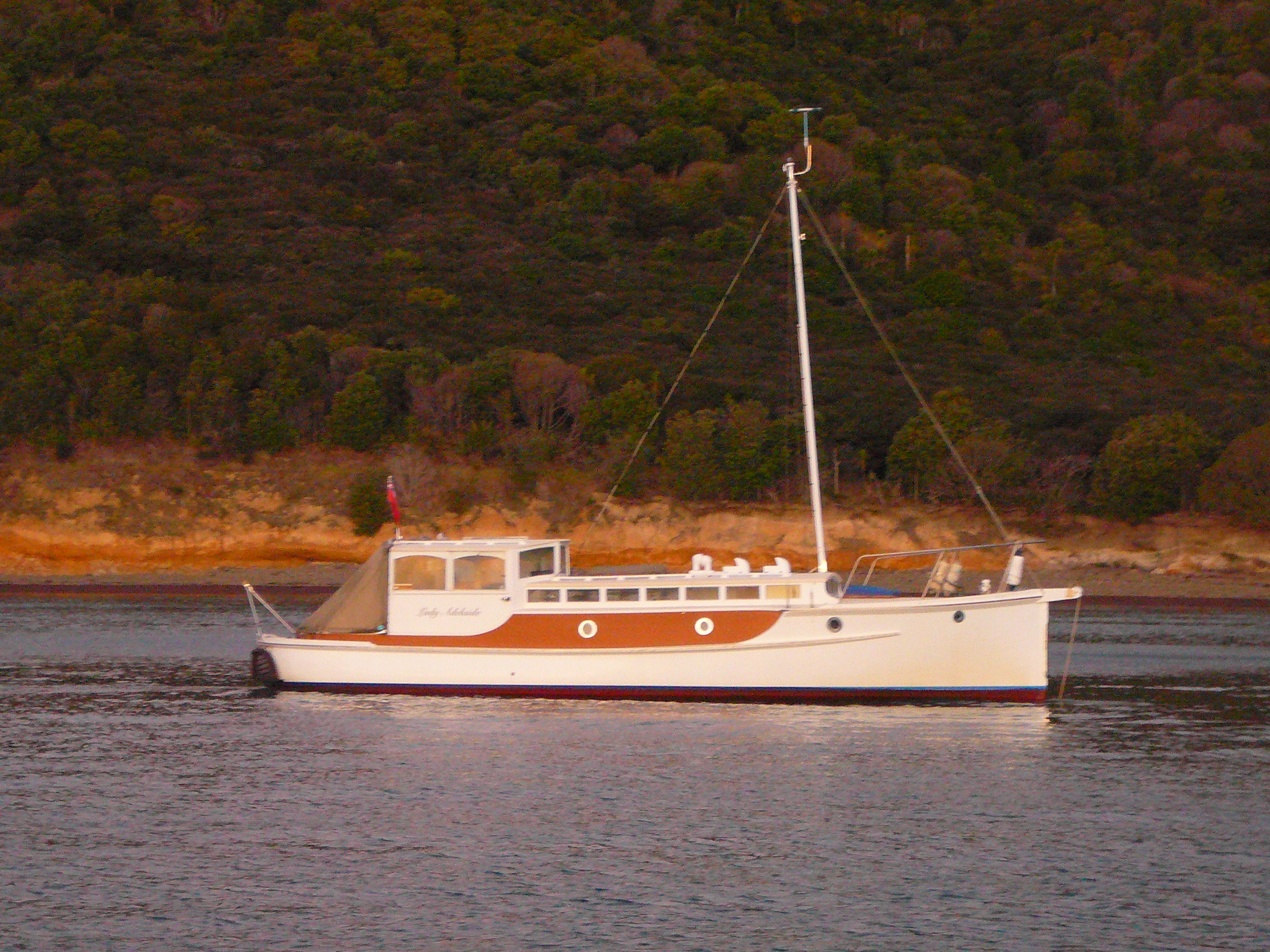
Lady Adelaide
1920’s Dick Lang designed & built. More info would be appreciated.
The original owner Charles Palmer was one of this country’s finest yachtsmen, founding the NZ Power Boat Association in 1905, the Motor Boat Patrol in 1914, the RNZNVR and being an able administrator with the APYMBA and the various yacht clubs until he died.
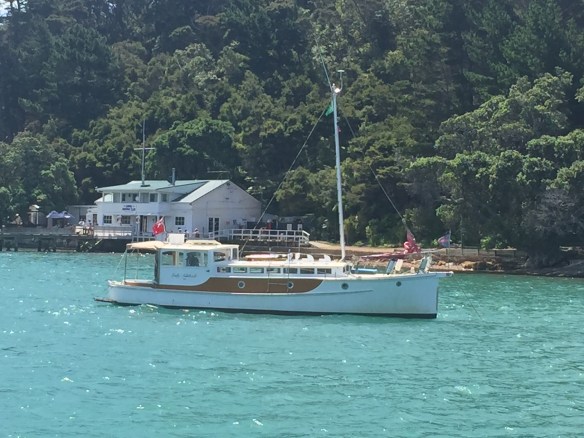
08-01-2016 photo at Kawau Island ex Tom Kane

Hints on removing bottom paint off a wooden hull (ex Baden Pascoe – MV John Dory)
The best time to do a major paint job on the bottom of your boat is when you have it out for a major or minor refit. Just wait long enough and the timber will shrink from under the years of paint and become very easy to remove. Leave this job to the very last as the paint also holds a little moisture in the planking while you are doing the endless list of other jobs.
I started off by placing tarps under the boat to catch all the old paint and then three of us used Linbide (spelling?) scrapers. My friend Jim Mateer has put a long pipe handle on his with a plug in the end and as you scrape, most of the paint flakes run down the centre of the handle. Just empty it every 5 min or so. He sometimes attaches a vacuum cleaner via a soft vac tube, I tell ya, it works very well, I think with the three of us it took about 6 hours work.
I took 23 kg off John Dory and I am very proud to say none of it went into the sea, I disposed of it at Trans Pacific for about $50.00. Then I sanded the surface and gave it 3 coats of International Primercon, one very diluted coat so that it went into the timber, one medium dilution and them a fairly non
diluted coat. The bottom looked so smooth, not bad for an old fishing boat!!
Then I gave it two hard anti fouls in blue and covered it with two soft antifouls. So, when I go to repaint, I just scrub or wet sand off until I see the blue paint. That way I hope to never have to do this again.
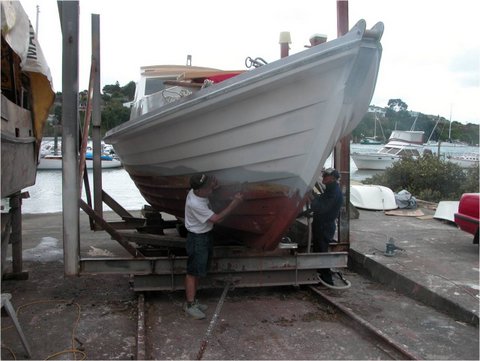
Photo shows Jack Taylor now 92 (going on 60) & Jim Mateer, in his late 70’s working on John Dory.
 waitematawoodys.com #1 for classic wooden boat stories, info, advice & news - updated daily - 15+ million views