Aumoe

Image

Aumoe
The caption says ‘Deep Water Cove’.
Of interest is the special effects applied to b/w photos in the days before colour cameras.

Aumoe

12-07-2019 Input from Deb Green

The photo below is from Tom Wood (Deb’s uncle). Tom owned Aloha.

Picture 008


Wairangi

 
WAIRANGI
 
Story by Ken Ricketts
 
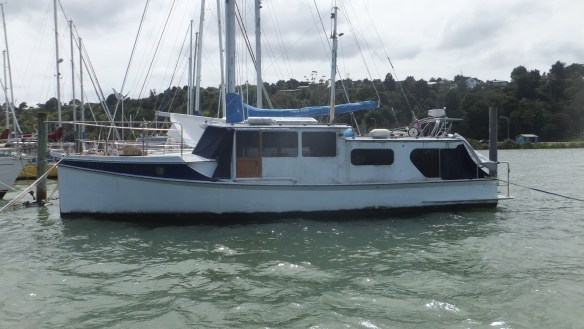
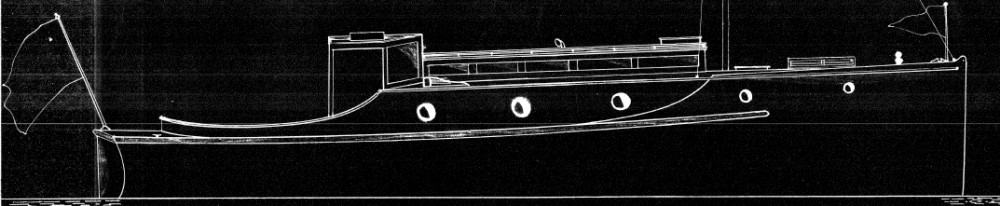
Designed by Wren Carey of Christchurch, as a pleasure craft for himself and his family. She was to be 17 meters long x 4.1 meters beam x 1.9 meter draft with 10 berths in 3 cabins. Her weight is estimated at 35 tons and she is perhaps a little different from other classic launches of that era in that she has a cruiser stern which, in a following sea  is very, very comfortable.
 
Well known boat builder, Andy Millar, of Millar & Tunnage, in Dunedin, was selected by Carey to build her, – which they did, from heart kauri, and completed her in 1934.  It is believed Wren Carey based her in Lyttelton, and mainly cruised Banks Peninsula, but there are photos, which show her in Picton, so Carey and his friends used her in the Marlborough Sounds, probably over the summer holidays. In those pre-war days.
 
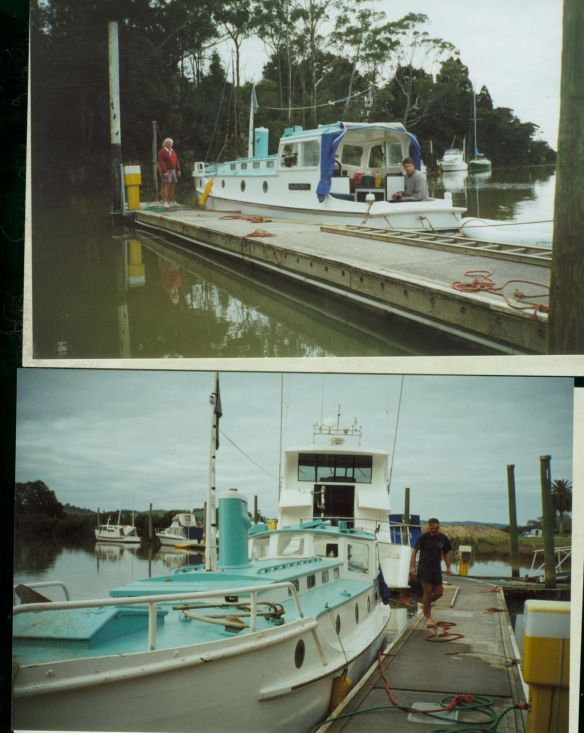
Photos below show she sported 2 masts, the main mast, just in front of the wheelhouse, and the mizzen mast about over what is now the owners cabin, which is fairly well aft.
 
In those days the super structure stopped at the funnel, so access to the lower areas aft, would have been via an external hatchway, just aft of the funnel casing.
 
Her engine was Thornycroft, which must have been used as an auxiliary, with sail being used, when possible.
 
At the outbreak of WW2 she wascommandeered for use by the Lyttelton Harbour Board  as an inspection vessel..
 
At the end of hostilities, she became surplus to requirements, and was handed back to Carey, who then sold her in 1948, to the Lyttelton Harbour Board, (LHB) (refer Russell Ward’s comment below), as their pilot boat, and small tug. The LHB removed the old petrol motor, and installed a brand new Gardner 6L3 marine diesel, which is still operating perfectly today. They had an engineer in the engine room, who manually shifted the gearbox into forward, neutral & astern, on instruction from the skipper on the helm, but today a Morse system is used at the helm, which goes from mechanical, to electrical, to hydraulic, via an ingenious conversion system. She cruises at about 7.5 knots and uses about 6 – 8 litres of diesel an hour. There are very few 115hp marine engines today, with this low consumption figure, and the 4 new fuel tanks installed recently, will hold around 3,500 litres of diesel, which makes her ideal for expedition work or long passages.
 
LHB also removed her sails and the mizzen mast, and installed a radar above the wheelhouse, where the mainsail on its boom would have swung.
 
So began her transformation from a motor sailer, to 100% launch.
 
It can safely be assumed that Wairangi, during time with the LHB, has rubbed up against virtually every passenger and cargo ship visiting Lyttelton, from 1948, to the late 1980’s, when she was sold to Lionel Jeffries, an Auckland businessman, who used her as a pleasure craft. He also extended the superstructure aft, from the funnel casing, to what is  there today, using teak planking, to match the original wheelhouse upper works.
 
He sold her to Lew Ritchie, who used her as a dive and charter boat, out of Tutukaka, in Northland, for a few years, before putting her on the market, and finally selling it to Andrew Jackson, – a retired Auckland businessman, now living in Picton, who immediately started a large scale refit, and refurbishment of the vessel. Sadly, through years of neglect, it proved not possible to keep the exterior teak planks varnished, as many had split and needed filling, so they were painted over. To replace them would have been very costly..
 
Jackson was looking for an old, NZ built, classic launch, to undertake a couple of adventures abroad. At one stage, it looked like funding might appear, for an expedition, to search for the answer to what happened to Amelia Earhart, when she went missing in her epic 1937 round the world flight. A second plan, one which used her in Europe, in a 13 part television series,  looked like it may eventuate, but the worldwide economic downturn, saw both projects shelved.
 
With her low fuel consumption and huge range she is ideal for expedition work, and long range cruising.
 
The vessel has been fully refurbished, to the point, where the Jacksons now live aboard her, in the new Picton marina.
 
She still has her original call sign of ZMTM.
 
She is now for sale,  contact – Andrew Jackson on 021347988.
WAIRANGI 2013 --  BUILT 1934WAIRANGI - PILOT LAUNCH-  CIRCA 1948

New Zealand’s Finest Yacht – Rawhiti

Image

New Zealand's Finest Yacht

Click the link below to view the magnificent restoration of the Logan designed & built – Rawhiti, . Article is as it appeared in the UK Classic Boat magazine. Click bottom left or right side of ‘pages’ to turn. Also clicking on the page will enlarge it (to read text).

http://content.yudu.com/Library/A1vnw3/ClassicBoatFebruary2/resources/30.htm

Lola

LOLA
A unique and incredible boat in our Marlborough Sounds, lives in a purpose built, air-conditioned building, on the waters edge.

‘LOLA’ is a 1962 Riva Tritone Aperto, tritone means the boat uses twin engines and apertos is the large open sunbed on the aft deck. She has a LOA of 27ft and is one of only 15 in the world. It is believed to be the only original Riva in New Zealand, and a stunning example of boat restoration. Only 3000 Rivas were built, between 1950 and 1966.

The restored Riva, has a flared bow, confident lines, a tumblehome hull, gleaming engine and exhaust vents and chrome fittings. It seats up to 10 people, plus two (or more) on the sunbed.

The boat is left-hand drive, and uses independent throttles and gear shifts. The latter are on the steering column, (one on either side), while the horizontal throttles are mounted on the side, to the left.

The two Riva Crusader 350XL V8 5.7L 270 horsepower engines offer agility and smooth manoeuvring. The Riva’s fine entry, chine line and deep forefoot combine for a soft ride, light steering and perfect trim. The Crusaders push the boat to a top speed of around 40 knots.

Features of the now restored Riva, include the brand name set into the boss of the steering wheel, the rear vision mirror, the flagstaff, the fairleads, the navigation lights, the windscreen and the windscreen wipers. The attention to detail involved in the craftsmanship is second to none.

LOLA was restored by Sounds Marine boatyard in Waikawa, where the paint was stripped, and the bottom faired. Topsides, some of the teak and mahogany foredeck needed replacing, and a new kingplank was crafted. The interior was cleaned and repainted.

All of the instrumentation is original Riva gear, with original hand-beaten chrome fittings. Many of these latter pieces required re-chroming. Four coats of International’s Epivar two-pot varnish were used on the completed hull, and the bottom painted.

The engines were removed and reconditioned by a local engineering firm, Boating Marlborough.

Specifications

Length 8.02m
Beam 2.62m
Draft 0.60m
Engines 2 x Riva Crusader 350XL V8 5.7L 270hp
Top Speed 40 knots
Fuel Capacity 476 litres

Video footage at link below (thank you Trade-a-boat)

http://www.tradeaboat.co.nz/news-reviews/2009/5/video-1962-riva-tritone-aperto

Story & photos supplied by Ken Rickets. edited by Alan H

Help needed to ID launch

Image

Help needed to ID launch

A real mixed bag of vessels here. Must have been a regatta or speed boat racing.

Of interest to waitematawoodys is the fine looking launch in the centre with the canoe stern. Can anyone help ID her?

Harold Kidd Update:
There are numerous candidates for the canoe – sterned launch. I will work on ID-ing  her. It’s unusual to have a combination of a raised forward deck, a clerestory, a dodger and a canoe stern on a launch of what…36 feet? In the meantime, some possibilities are RONOMOR, HAZEL, WAHAROA, ROMA and DIXIE.
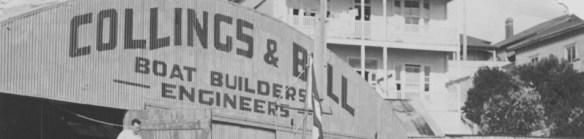
The little outboard racer is FLEETUN built by Collings & Bell in November 1928. That’s probably Charlie Collings handling her.
 
What I can advice is –
1.       It’s a NZPBA event
2.       It’s on the Whau River
3.       It’s some time after March 1928 and before they moved these races to the Panmure Basin in January 1930.


Royal Visit – Britannia

Image

Royal Visit - Brittania

Royal Visit 1963 – Britannia

Photo taken by William (Bill) Fletcher, ex commodore of the Devonport Yacht club, Grant Cardno’s step grandfather.
Fletcher was an active photographer.
While Britannia is an interesting backround boat, waitematawoodys is more interested in the wooden launches in the foreground.
Any input on naming them would be appreciated.

Photo supplied by Grant Cardno

Polaris

POLARIS

Story & photos supplied by Russell Ward

Here is a very interesting little boat that has been out of circulation for a while. I have been looking after her since 2005 and she is a shadow of her former self, but in a stable state.

Polaris, a 25’ pilchard trawler was built for a local fisherman by the name of Pearce by H Pearn & Sons Looe Cornwall 1935. The main engine 2 cyl Kelvin with similar engine as port wing engine. Construction is larch and pitch pine on oak frames. As an economy, the planking was not caulked –just fitted well. Pearce employed crews for both his boats and Polaris fished out of Polperro Cornwall until 1947 when she moved to Penarth Wales –I have one of her life rings with homeport Penrath still visible painted on it. She suffered a bilge fire from wing engine exhaust which was dealt with by sinking the vessel.

She was taken over by a boat builder who converted her into a pleasure boat with a strange cabin. In 1950 she was bought by the coroner  Col Kenneth Treasure of Tenby Wales. We think the good Colonel had her rebuilt with a rather more aesthetic cabin and I have a copy of a post card of her in Brixham

1954 found her in the ownership of one Griff Board with a Lister diesel installed. Board took the ship to Brixham where, in 1956-7 she was spotted by Wally Sharples who had seen her when he went to Brixham to see the Mayflower replica. The vessel had an extensive overhaul.

1958 Sharples, his family and apprentice John Penney emigrated to Adelaide and Polaris was shipped as deck cargo on “Queensland Star” 1960  found Sharples and family with Penney in Auckland along with Polaris which was rigged with a gaff mainsail and moored at Bucklands beach. Sharples cruised extensively in the Hauraki Gulf, Bay of Islands and Whangaraoa. I can remember seeing her round the bottom end in the ‘60s looking as pretty as a picture.

In 1970 Sharples and his wife moved to Opua, Bay of Islands and Polaris was moored there. Sharples died onboard after a fishing trip and the boat passed to his apprentice Penney.  1993 Jack Barber and Faye Christian bought Polaris from Penney. They used her extensively but the years were catching up with the ship and she was brought ashore for extensive hull work. This was well under weigh with the hull timbers almost all replaced when Jack Barber died 30 September 2002.

The son of the first owner was in touch and emailed a picture of her in her original form. Some part of me says she should be finished off like that.

Not often a boat travels so many miles on other boats’ keels. Even more fun is the knowledge of a boat’s travels halfway round the world leaving a lot of people who fell in love with her.