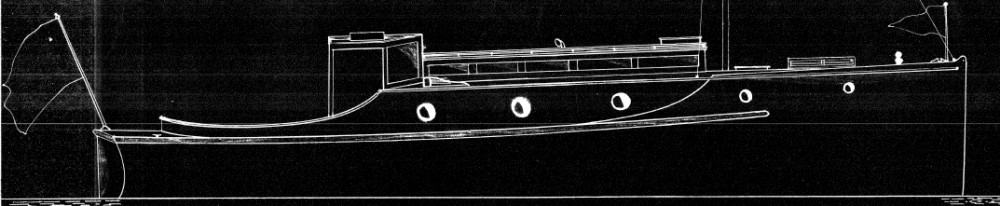
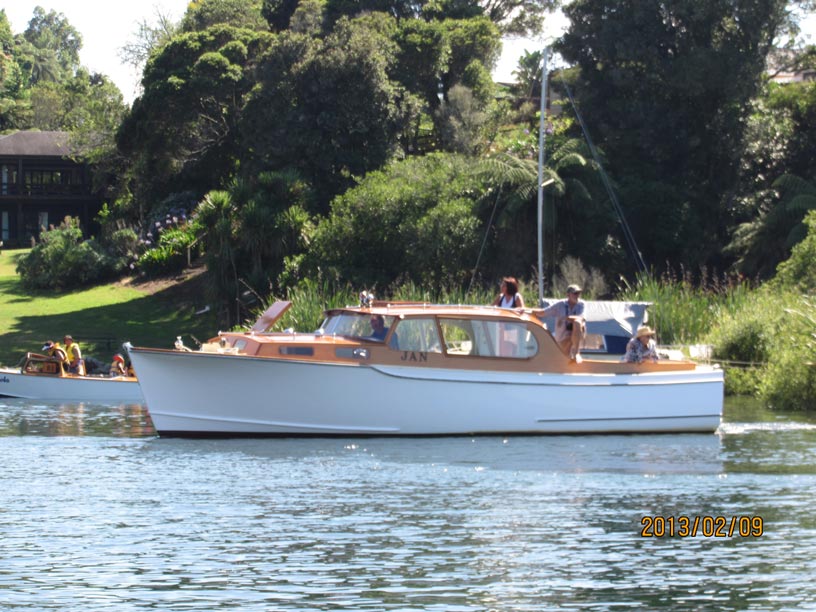
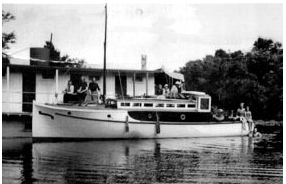
WW has been contacted by Ron Trotter the owner of Valencia built by Baileys. Ron thinks she was built some time in the 1940’s (unlikely, more like 1920’s AH). He was told that it was built for a guy that did the Kawau Island mail run back then but cant get much info about this. The boat is currently moored at Whangamata.
Ron is looking for any info on this boat and or photos of how it was in early days. Reply here in the comments section. Ron’s details are also below.
Ron Trotter – ph 078893374 / 0274316405 / 0274850950wk
Harold Kidd Update
Well, she looks very much like the VALENCIA at Whangarei in an earlier post which a search here under “Valencia” brings up. She was in Whangarei from at least 1927. I think she could have had a name change just before that to the name of the wildly popular paso doble song of the time, “Valencia”.
Maybe however she was new in 1927. It’s possible. I know nothing about a Kawau connection which could be more myth.
Bailey & Lowe is more likely than “Bailey” = Chas. Bailey Jr.
Update #2
It is also possible that she is the VALENCIA built in Tauranga for?/by? L. Oliver in 1926 which he delivered to a Whitianga purchaser in March 1939. There were lots of VALENCIAs after that bloody song came out on 78 after the film came out in March 1926.
Cara Mia, 37.7 ft, was built by Maurice Palmer at Devonport in 1961 & has a 6 cyl. 120h.p. Mitsubishi diesel, present owner has had her for 10 years. Currently for sale on trademe, it might take a while to sell – the listing only says “This boat is for sale. Make an offer” 🙂
On first viewing Ken saw her as a classic 1950’s McCeady, but the owner has strong evidence she is not + the bow portholes are “rounded” at the ends & McGeady’s were always oblong.
The two boat photo is Cara Mia & Arohanui in Coromandel Harbour in 2006
Harold Kidd Update
CARA MIA (proper spelling – fixed) was indeed built by Maurice Palmer of Devonport in 1961 for T. Harrison. She was 36′ x 34’3″ x 10’3″ x 2’9″. Later owners included R.M. Waite and L.W. Moore in Auckland. There was also a CARA MIA gamefishing from Tutukaka owned by Ray Dinsdale but I’m pretty certain it’s another boat.
This CARA MIA’s original engine was a 100hp Fordson diesel.
Palmer was well regarded as a designer/boatbuilder. Included in the yachts he built were the 22ft mullet boats STARDUST (I) and CONTROVERSY and the Stewart 34 PANIA.
27/10/2014 – Chris McMullen Update
I was Morrie Palmers only apprentice. First at his house in Meola Rd Point Chevalier. He then moved his boatbuilding operation to 15 Clarence St Devonport. He purchased an old house that I believe had been the Police Station. He removed all the interior walls as the boats got bigger. The Council building inspectors were not happy. Cara Mia was built in the this old house. She was one of two built drawn by Morrie but definitely based on a Billy Rogers design. I remember Morrie telling me about the advantages of the Rogers flam bow in a launch. He said ” Only Aircraft carriers have flared bows.” I guess (now) he was referring to “Wirihana”. The Flam Bow has more room in a small displacement launch and contrary to what you may think, the extra buoyancy is better in a big head sea. At the time I was only interested in Mullet Boats but I remember most of what he told me. Years later from my own experience. I believe he was right. And yes, We did use large Kauri demolition timber from the Rutland St Drill Hall but not for planking. I did about half my apprenticeship with Morrie until he closed the doors, the balance with Max Carter. Two very good hard working and knowledgeable Tradesmen. I was very fortunate to be an apprentice Wood boat builder in the early 1960’s.when you could still get good Kauri.
Mahurangi Regatta 2007 – Glyn Bird (L) & Romo (Traveler,Jean Gordon) built by Joe Fell 1904
Oct 2005 – thru wreck of Rewa
GLYN BIRD
photos from Russell Ward, Dean Wright,Baden Pascoe,trademe
details from Russell Ward,Baden Pascoe,Ken Ricketts
Built 1909 by Ernie Lane, 54ft long.
Was owned by Parry Bros the tug & scoria people for many years, from the 1930s through till at least the 1972-73.
She is most likely still powered by a 1956, 150h.p., 8 cyl in line, 8L3 Gardner diesel.
She was originally used for a good number of years as the “rubbish boat” by Parrys, collecting & disposing at sea of rubbish from visiting overseas & coastal ships to the Port of Auckland. She was later converted to a tug in the 1950s & used extensively for towing shingle barges from Kaiawa to Auckland, ferrying shingle from the quarry there.
She was converted to a tug by R Lidgard, who also replaced the original little wheelhouse with a larger replacement in the 1950s, now missing (refer below).
She was eventually laid up at Herald Island for quite a period & eventually sold by Parrys, & was sold either by them, or by others in-between, to Russell Ward, who used her for pleasure use.
In Russell’s words “I salvaged her from Herald Island on a stormy night and got her to Westpark where she was slipped and major hull repairs done. I then did a walking refurbishment over about 8 years but it was not a restoration”. Russell had a long love affair with her that ended about three years ago (2010) when he sold her to a Nelson fisherman. During this period she caught fire (wheelhouse) on the hard at Tarakohe.
Glyn Bird has now ended up in the B.O.I. & is for sale on trademe.
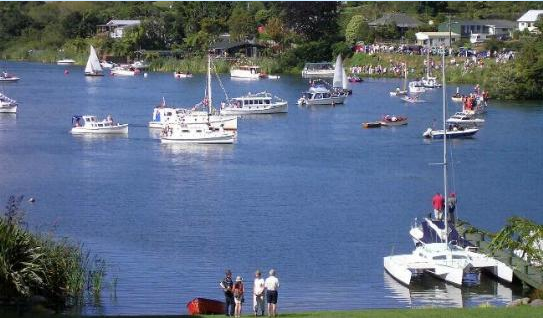
North Island’s Parade of Classic & Wooden Boats – Sat 8th Feb
When an invite to a classic boating event is accompanied with the above photo it would be rude to say no.
So waitematawoodys will heading off to Lake Rotoiti for the 2014 Classic and Wooden Boat Parade. Now this is the North Island event so its just a three hour drive from Auckland.
I have ‘followed’ the event on line for the past 5 > 6 years & its a cracker.
This year is the 17th year it has run & the formula is simple: A parade (on-the-water) to showcase the boats then everyone motors / steams off to a sheltered bay on the lake to enjoy old boats and fine company.
Built by L C Coulthard in 1936. I just ‘discovered the colour photo in my files. There have been other ww posts on her so type her name & the search box to view.
I understand that she might (HDK ??) be featured soon in Boating NZ.
the photos are straight out of the camera / iphone – no enhancements
A lot of ww followers will be back at work today so I thought I would post something to remind you all why we go boating. For several years we have been visiting a wee bay at the bottom end of Waiheke area, not Waiheke itself. Its rather special & ticks most of our boxes. Even has pipis, but the stingrays where not impressed I was collecting 🙂
New Years eve there has become a bit of a tradition. A group of us call it Bev’s Bay but that not its name, its too small & special to name here. The other cool thing was there were only 8 boats in the bay NYE & 5 were wood.
If your viewing this at work, I hope the day is not toooo long & you reward yourself with something cold at the end of it.
Over the xmas/ny period we mooched around Coromandel Harbour for a few days. I can report that the shellfish beds & rock oysters stocks were all good – steamed pipis & fresh shucked oysters + fritters were on the menu several nights. I had not been into the township in years (like 30+) so took the opportunity one day to load Raindance up with several friends off other boats & headed up harbour.
These days the river / creek channel is clearly marked but we played it safe & anchored near the wharf & took two RIB’s that we had towed, up. Along the way there is interesting collection of floating (some just) craft tucked in & around the mangroves.
The town was brilliant, so cool to see a provincial area doing well, the place had a great vibe to it & all the shops appeared to be doing well. The architecture of the main street has not been ‘mucked up’ & its like stepping back in time to the good old days of Main Streets e.g. a hardware store, cafe, chemist, craft store, fish & chip shop, pub, stationary store, pub, land agent, etc.
The highlight for me was the Coromandel Smoking Company, if it comes out of the sea, these guys smoke it – if you are down that way, try the smoked scallops.
Other than the name, I know nothing about Sunbeam/Sea Breeze – so any input would be greatly appreciated.
Harold Kidd Update
There are/were many SUNBEAMS and SEABREEZES, all over NZ. I had a look at that website to see if there’s any information on the boat, where the image was taken etc, but couldn’t find my way through it very well. I kept recoiling at some of the stuff in it, though. Thank goodness WW has peer review processes.
The image is very tiny, but if the launch was photographed as-built, she dates from the period 1920-1928, probably early in that period because the dodger is relatively modest in size.
She looks remarkably Bailey & Lowe to me, but could equally be Dick Lang or a dozen other Auckland builders. Sam Ford is a possibility because he inherited Lang’s moulds and plans when he bought Dick’s business and turned out Lang-style boats until he shifted to Ellerslie and went ultra-modern.
Perhaps the most likely candidate is the Taupo hire launch SUNBEAM of the 1920’s onwards about which I know little but the Drakes will.
Oddly enough there was a SEABREEZE built by Jas. Reid in 1909 and a SUNBEAM built by Bailey & Lowe the same year. Both would have had to be heavily modernised to look like this. That SUNBEAM is currently alive and well in Picton.
Nigel Drake Update
This photo was taken by my father or grandfather in the late1930s and is part of the Drake collection. The location is Boat Harbour in the Western Bays on Lake Taupo. She is tied up alongside the old steamer Tongariro which used to run between Taupo and Tokaanu at the southern end of the lake. Tongariro was converted to fisherman’s accommodation on the opening of the road between Taupo and Tokaanu when her services were no longer required.
Sunbeam was built by Sam Ford, date unknown, for Sid Blake and plied for hire on the lake. 36 feet long, 8 foot 6 inch beam and powered by a 4 cylinder Gray Marine petrol engine. She had a galvanized iron lined engine room to be able to ply for hire. Was one of the first boats on the lake to have a two way radio. Sold to Donald Hunt in 1939 and plied for hire out of Tokaanu until 1952. Left the lake possibly in the mid 1950s.
In the 1980s she was moored in Pilot Bay, Mount Maunganui, and had been used as a fishing boat. Her name had been changed to Sea Breeze and cabin had been changed markedly. In the 1990s she was rebuilt by Tauranga boat builder Barwich Harding and now resides in the Tauranga Marina.
Harold Kidd Update #2
Interesting issues arise here.
SUNBEAM, from the sheer upwards is an almost exact replica of my Bailey & Lowe ROMANCE II (and their 32 footer ROTOMAHANA), same seven clerestory windows, same treatment of the dodger. That’s simply because ROMANCE II was a high-profile fast launch, built to race, and represented the height of style and practicality in 1919. This postwar, post-‘flu epidemic period was a time when few launches had been built since late 1914. People had had a chance to think about what they wanted their post-war launches to look like, to provide in the way of headroom and volume, and how they were to be controlled. The ultra-smart, racy-looking raised-foredeck flushdeckers of 1912-5 were no longer built and most existing ones were easily and speedily modified to get the new look.
The hull of SUNBEAM does appear to have a “knuckle” in the sheer at the bow which is uncharacteristic of Bailey & Lowe. Ken considers it to be a hallmark of Sam Ford. It is certainly strongly reminiscent of his family’s Sam Ford-built JULIANA (formerly WIDGEON, apparently, but of unknown other history). I don’t totally agree with that and make the point again that Ford churned out Dick Lang launches for some years after he took over Lang’s business in 1923 when Dick went to Sydney (mind you he was back soon afterwards, building at St. Mary’s Bay again, alongside Sam).
So is the “knuckle” Sam Ford or Dick Lang???
It was only shortly after this that the US “express cruiser” and “bridgedecker” forms and styles gained attraction and we got LUANA and LADY UNA, for example.
By 1928, say, this 1919-style in ROMANCE II and SUNBEAM, with clerestory or “tramtop”, a minimal dodger and aft-control was becoming very dated, giving way to “sedans” and bridgedeckers of US inspiration.
Harold Kidd Update #3 (13/01/14)
I see that the Taupo boat history site states that “SUNBEAM was built by Sam Ford in 1936 for Sid Blake”. Two things are wrong with that which muddle the situation;
1. SUNBEAM was clearly a product of the early 1920’s not 1936.
2. According to newspaper reports, SUNBEAM was a hire launch on Lake Taupo from at least December 1926.
In fact I have now zeroed in on her as being built by Sam Ford for Blake in early December 1925 and fitted with a 25-35 Model V ohv Gray. I was fooled because the newspaper reports said that Blake (of Taupo) was going to use her for troutfishing on Lake Rotorua. I wonder if she spent a few months at Rotorua?