New Golden Hind

Screen Shot 2016-06-07 at 10.51.17 PM

New Golden Hind
photos ex Gavin Bedggood & Roger Welch

Yesterdays story on ww featured a great photo of several motorboats & yachts on the beach in front of the Deemings Yard in Opua, Bay of Islands. The photo came from the Coralie Hilton collection, Coralie’s maiden name was Deeming (her father) & her mother was a Bedggood, so that’s how Gavin came by these photos.
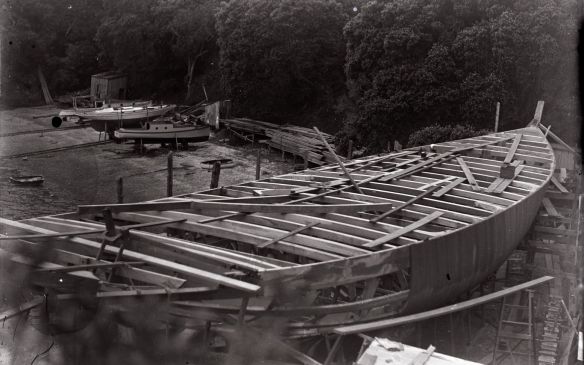
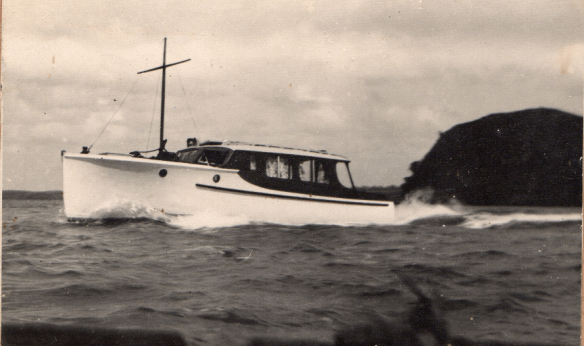
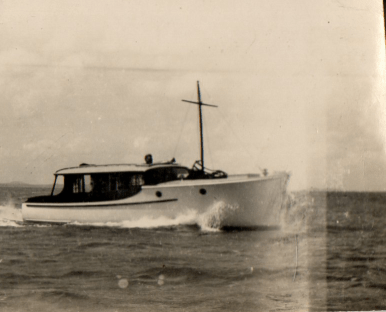
In yesterdays story the ‘main actor’ was the 93′ ketch ‘New Golden Hind’, today I have posted more photos from Coralie’s collection, these ones show her build & post launch.
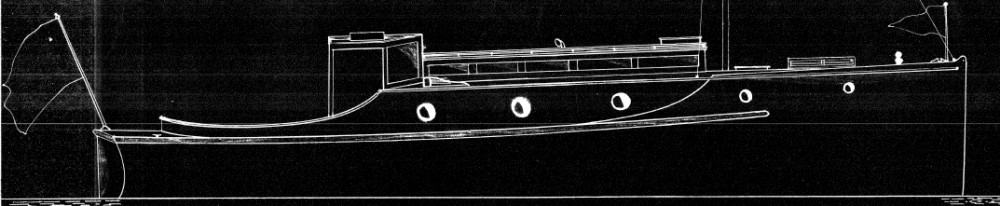
The New Golden Hind was a Chas. Bailey Jr. design & built Deemings for a Mr. Jenkins.

Below is a link to a great blog read about a Pacific cruise aboard the New Golden Hind. The story is by Roger Welch & documents his father, Henry Thomas Welch, on a 1940’s cruise aboard the New Golden Hind to the Pacific Islands . Some of the photos above relate to this story. They are more photos at the link below

http://beyondeyelevel.com/446/aboard-the-golden-hind-1940/  “My Dad, Henry Thomas Welch, was raised in the little country town of Te Awamutu in the Waikato area, the mid North Island of New Zealand. He was an only child, and grew up during the Great Depression. His Dad, Thomas Henry Welch, was by all accounts a hard-working man, with a strong Christian sense of duty to his wife and family. In those days everyone had to work, so it was the case that Dad virtually grew up working in the family butcher shop. I have a framed black and white photograph in my boardroom of Dad on horseback in the 1920s outside the butcher shop. Despite gaining his University Entrance exam (UE) at Hamilton Tech, he was unable to afford to go to University in Auckland. By 1940, at the age of 26,  I suppose that he was frustrated with a small town existence and wanderlust took over. Dad got away to crew on a 90 ft yacht that was sailing to the then remote Pacific Islands, a young man’s dream. As far as I can determine he had no previous sailing experience.  From a short note signed by Mr. Jenkins (the owner of the boat) I  gather Dad signed aboard as a paying crew.  Very much on “a wing and a prayer” as there was precious little money in the family kitty in 1940.

I recount the story of Dad’s trials and tribulations aboard the ketch he called “Golden Hind”, named obviously for the famous ship that carried Sir Francis Drake on his epic voyage around the world. According to a newspaper clipping (“Auckland Star”) at the time the ship was actually named the “New Golden Hind”, and owned by Mr. H. R. Jenkins. The ship was a 94 ft schooner, although subsequently dimensions are given as 93 ft overall, with a 22 ft beam, and 10 ft draft. The ship in the previous year had made a similar trip, which constituted her maiden voyage. According to the “Star”, “She behaved well in all weather encountered, and the engine which was used much of the time as the winds were light, never gave any trouble.” In addition to Mr. Jenkins, and the crew, the party aboard includes Miss Culford Bell, and Mrs. Harrison, of Auckland, Mr. W. E. Mitchell of Nelson, and Mr. Welch, of Te Awamutu.  Dad paid a princely sum of five pounds a week for the trip, as working crew, and in this regard, please see letter in the gallery from Mr. Jenkins”

YESTERDAYS QUIZ WINNER WAS NATHAN HERBERT BEING THE FIRST TO GET

‘New Golden Hind, Chas. Bailey Jr. Deemings, 1939, Okiato (Opua)’

Nathan, well done.  I email you re which framed print you want from Robert Brooke’s boat – Beautiful Boats.

23-06-2016 update from Harold Kidd – photo below of Chas Bailey Jr. wishing Jenkins well on the departure of the yacht on its Pacific voyage.

NGH

waitematawoodys.com hits Two MILLION Views + a Great Prize

ww mystery

waitematawoodys.com hits 2 MILLION Views + a Great Prize 2 be Won

Yesterday saw the waitematawoodys site hit 2 million views, something quite amazing for such a niche topic. As  stated in the site masthead, waitematawoodies was founded upon a desire to tell the stories & a need to archive the history of our classic wooden boats, the craftsman who built them & the characters that owned & crewed on them. A lot of people thought we would run out of content to write about in a few months, well that has not happened & given the size of my email in-box won’t  🙂

One of the things that differentiates waitematawoodys from traditional media is the ability for readers to interact with the site & with each other. So far there have been over 1,500 stories & 10,000 comments posted on the site, if you are one of the many that comments – thank you for your contribution, if you have not commented, maybe its time you did. Everyone has at least one good story to tell 😉

While at the start it was not the intention to create a reference library on classic wooden boats, we have ended up with one & its pretty awesome – I have Harold Kidd to thank for giving me a wee ‘fire-side chat’ about striving to get accurate data on the site. These days you can search by vessel name, designer, builder, year, length, category – launch/yacht/work boat, boats for sale & a lot more. Again if you have not tried the Search Box on waitematawoodys – give it a ago.

Cheers Alan Houghton

WIN – Now I’d like to offer up a very cool prize to mark the 2 million milestone. Regular ww readers will be aware that Robert Brooke recently published his book ‘Beautiful Boats’. Robert has been collecting classic yacht designs for over 50 years, amongst his collection is work from our most talented & recognized designers – Arch Logan, Chas Bailey, Charlie & Alex Collings, Colin Wild, Bert Woolacott, Bob Stewart, Des Townson, Alan Wright & Robert’s father – John Brooke. From his collection Robert has chosen 50 & redrawn each design, tracing off the original drawings to present them in a similar format. To add to the wow factor, Robert used the drawing equipment & ships curves that were once used by either Arch Logan, Charlie & Alex Collings or his father. The 105 page, A4 size book allocates 2 pages to each vessel with specs & photo/s on the left & the drawings – hull lines, profile, half breadths, sections, diagonals & sail plan on the right hand page. We have given away 4 copies of the book on waitematawoodys over the last few weeks, in addition Robert donated a framed 380mm x 300mm rendered print of one of the featured boats. Sample below
SO WOODYS – TODAY’S PRIZE IS YOUR VERY OWN FRAMED PRINT OF THE BOAT OF YOUR CHOICE FROM THE BOOK – BEAUTIFUL BOATS.

LJ

How to enter & a few t&c’s
1. The first woody that can supply the name, designer, builder, year & photo location of the large yacht on the right in the photo above wins the print.
2. Entries must be in the ww comments section & have all 5 answers correct. You can enter as many times as you like.
3. The judges (thats me) decision is final & no correspondence will be entered into.
4. The winner must collect the prize from Auckland.
5. HDK you are excluded – you have already got one 🙂
THE BOOK
If you would like a copy of the book – visit Boat Books at 22 Westhaven Drive, Westhaven, Auckland & grab a copy for yourself, cost is $60. For out of towners or those who refer the web – copies are available on line at https://www.boatbooks.co.nz/
ps I have also held back posting this on ww until 7.00am to give all woodys (not just the night owls) a chance to win 🙂

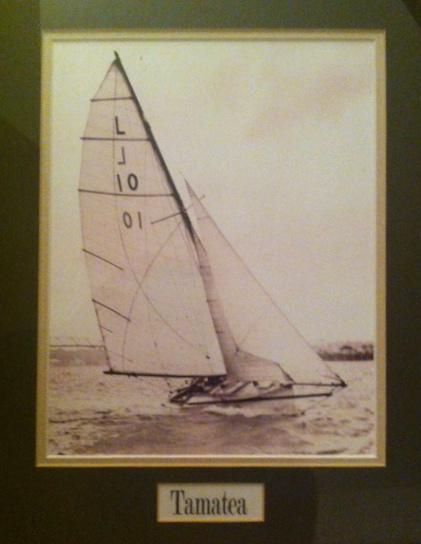
Building the Mullet boat ‘Tamatea’ by Chris McMullen

Tamatea 17

1961 – the build begins @ 67 Waiatarua Road, Remuera

Tamatea 22

Tamatea 1

Tamatea 29


Building the 22’ Mullet boat ‘Tamatea’ – Sailing Sunday

photos & story by Chris McMullen. edited by Alan H

After Chris McMullen saw last weeks ww story on ‘Tamariki’ he contacted me re sharing his ‘Tamatea’ photos that had been languishing in an album kept for him by his dear mother, Vera McMullen. I couldn’t let Chris escape with just sending the photos to me, so I asked him (nicely) to write us a story. Now that’s something he is always a tad hesitant to do, why I don’t know he tells a good yarn. But being the great guy he is, he put pen to paper, in doing so Chris commented that he hoped that bringing these photos into the daylight may encourage others to share their boating or boat building history on waitamatawoodys.

Below is Chris’s story on the building, launch & sailing of the 22′ mullet boat Tamatea. Remember you can enlarge photos by clicking on them 😉

“In the early 1960’s I was apprenticed to boat builder, Morrie Palmer who was also an enthusiastic Mullet boat sailor. Sailing, cruising and Mullet boats were the conversation most lunch breaks.
Morrie had in mind to build a 22ft Mullet boat but family and business commitments at the time, delayed his plans. He had a new steel centre board plate, a profile plan and the offsets of a design for a hull that was supposed to be the Charlie Colling’s design ‘Tamariki’. I am not sure how he got these offsets but the original lines plan were in safe keeping at the R.N.Z.Y.S and not available to anyone at the time.

Morrie encouraged me to build this design and gave me his centre board plate and loaned me the offsets. I managed to scrounge some primitive basic machinery and set out to build the boat. As an 18 year old apprentice boatbuilder I had no money, no car and no girl friend but I was full of enthusiasm and wanted to go sailing. And yes, I had read Johnny Wray’s book. “South Seas Vagabonds” many times.
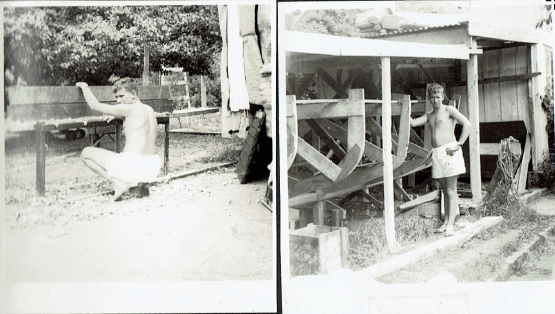
The Tamatea was built in my parent’s back yard at 67 Waiatarua Rd Remuera. These days such a project would not be possible due to the noise regulation’s but in the early 1960’s people were remarkably tolerant and it was not unusual to see half built boats on people’s quarter acre sections.

 Riveting of Tamatea at night was not really fair on the neighbours. I got one complaint by working too late. I had to enlist my friends to back up the nails with a dolly. If they came late, we worked late. I was desperate to get it done. Another source of irritation was my Fathers Desoutter electric drill. It had no suppressor and affected the people who had TV’s. I was the neighbour from Hell for a while.

Now to the photos.

The photos feature some of my friends who helped. Recognised in the photos are
John Jennings, Des Laery, Ken Wilding, Murray Napier, sorry but I can’t remember all the names but Alan Bell and Neil Gillard would have been there. In the dinghy sculling is ‘Snow’ (Neville Stacey) who was / is a well known helpful character; he loved boats and spent much of his time at the ‘Okahu Bay’ hardstand.
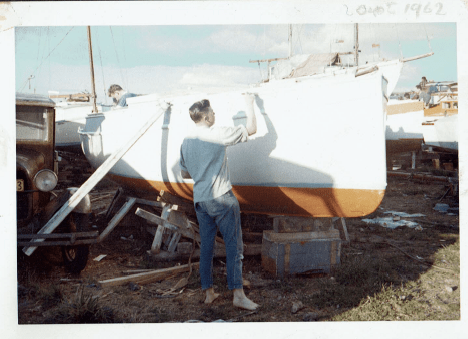
The young man painting the Tamatea in the colour picture is the late John Eastwood. In the same image but in the cockpit is a another young man, John Court, also since deceased. My Model A truck alongside the boat, used as a work bench. The sailing cockpit shot shows Ken Jaspers and with me on the helm. These three guys and John MacDonald built and loaned me gear and helped finish the boat. I guess this was the year after she was launched. I was grateful for their help as I could not afford to run the boat myself at that time.  

You may notice in some of the images, the concrete blocks on the roof of the shed. These allowed me to force rocker (bend) into the keel using a timber prop under the rafters, their weight prevented the roof lifting. Looking at it now, I am lucky the lot never collapsed on top of me.

I never lofted the hull; I just made the temporary frames (moulds) direct from the offsets and cut the plank rabbet’s (rebate) by eye using battens.
The hull was planked with kauri over temporary frames or moulds. The planks were tapered towards the ends like a wooden barrel. The garboard plank was steamed but most was bent cold and edge set. I broke some planks! They should have all been steamed but with my primitive steam box it would have taken too long and I was in a hurry and wanted to go sailing.  
The short planks left out in some of the photos are called stealers and have to be spiled. I remember the frustration of not having a thin plank to use for a spiling batten. I could have borrowed one from my boss but with no car or trailer, how could I get it from Devonport to Remuera on a motorbike?
The ribs were Tanekaha, all steamed and held with riveted copper nails. The centreboard case was demolition kauri held to the keel with galvanised bolts.

Some of the images show the most distinctive feature of a proper Mullet boat – the hollow sections aft and the deep built down deadwood. The boats are a built to certain design and scantling rules.

Tamatea was transported to the water using a trailer kindly loaned by Sandy Sands of Sea Craft and towed by a neighbour Mr Picket with his (at the time) huge truck. A dangerous load? Well maybe, but we got there!

Tamatea was the last planked 22 foot Mullet boat.

My boss, Morrie Palmer forced change to the class rules by building “Controversy” using 3 diagonal layers of ¼” kauri over stringers instead of carvel planking caulked over ribs. Now Mullet boats can now be built in G.R.P.

I was about 18 when I built Tamatea, she was rather amateur built as I was a second year apprentice and although, I thought I knew it all, I was very green. She was built under difficult conditions almost in the open and exposed to the weather, I had very primitive tools and no transport or money to purchase anything other than what went into the boat. Later, I replaced a damaged plank in the “Contessa” built by Cal Crooks and sailed on the”Patiri”built by Bob Harkin. Both these Mullet boats were beautifully built by apprentice boat builders but to be fair, they were older and more experienced than me.

I built the Tamatea for cruising and she was a raised deck Mullet boat. She was very spartan when launched. Second hand sails and a poor rig. We cruised north to Whangaroa the first season but some time later lost the first mast. Insurance paid Baileys to build a new box section oregon mast and my new crew of engineers made all new mast fitting and a set of backstay levers. Their efforts made a huge improvement to the yacht.
Leo Bouzaid (‘Sails & Covers’) built a new dacron mainsail and gave me a year to pay. That was in April 1962 I still have the original invoice for 126 Pounds!

I/we sailed in the Lipton Cup but with poor results. Since then the raised deck has been cut down to a conventional sheer and she has a modern rig. Sailed by others she has won the Lipton Cup a number of times.

Further – looking back to the early 1960’s to give my story some context :-
• I crossed the harbour every day usually on a steam ferry.
• There was six o’clock closing at all bars.
• There were few restaurants where you could buy a drink with your meal.
• A quart bottle of beer cost 2 shilling and sixpence or 3 shillings and sixpence at the   Mansion House, Kawau Island in ‘The Snake Pit’ sly grog bar.
• Many cruising boats carried a rifle on board.
• There were no imports except for essential industries or you could apply for special licence but it would be most likely declined. You could only buy a new car if you had overseas funds.
• A few importers had import licence and charged accordingly.
• There was death duties and high tax.
• There was black and white poor quality TV and manual calculators.
• There were No mobile phones.
• No double insulated power tools.
• No  epoxy  Glue.
• No GRP boats and very few synthetic sails
• No moorings in Matiatia.
• No marinas or travelift’s
• Most pleasure boats were hauled out for the winter.
• There were NO IMPORTED BOATS and you could buy kauri so wooden boat building was a competitive but viable business.”
 

What’s happened at the Dept. of Conservation?

What’s happened at the Dept. of Conservation?

Let me put it another way – When did DOC become just another  revenue grabbing government department ?

The Joe Average NZ citizen used to hold several of the countries government departments in very high standing – the Police, Dept of Conservation, Tourism & Primary Industries. Some departments are less highly rated – IRD, Army, Work & Income to name a few. Well after years of doing amazing things & being on the top podium, DOC are on a very slippery slope to being very un-cool. Now I hear you asking yourself – what’s Houghton on about?. Well read the story below. But first a wee story – I sat on a plane to Wellington a few years ago alongside a very senior police officer – he told me the public’s rating & trust in the police force took a huge dive when they merged with the traffic department. A dive that they have never recovered from, Joe Average (mostly) only ever has positive experiences with the police force. Post the merge the nice local police officer was writing them tickets for minor traffic misdemeanors.

A loud warning to those who are in the habit of trawling a lure while underway in the off chance of bringing in a kahawai… or better still, kingi.

While cruising in glorious weather down to the bottom end of Waiheke last Easter weekend we noticed a largish inflatable approaching us from the starboard quarter with the two aboard furiously taking snap shots, a common occurrence when you own a classic vessel. We politely waved and carried on. The inflatable drew alongside, the couple raised their hands and ordered loudly and officially to “Stop your vessel! Stop your vessel!”  of which we did. Noticing the customary khaki DOC uniforms it suddenly dawned that we were in a spot of trouble. The ultimate sin of trawling into a marine reserve had been committed. The photo taking wasn’t in admiration of our dearly beloved classic launch after all but to provide evidence of our bending, albeit fish less rod dragging through the water of which was immediately wound in. We politely obliged to the female DOCs’ authoritative request to come aboard. She appeared somewhat surprised to find the cockpit bereft of anything remotely fishy or suspicious, not even so much as a net or fish box was in evidence. After what seemed like a lifetime of lengthy questioning and much note taking they were finally satisfied that whilst we were aware of the marine reserve we had completely forgotten to take in our offending lure. Regardless, we had unlawfully trawled into marine reserve waters and had thereby committed an offence.

Friday evening 9th June, a court summons from DOC was hand delivered to our front door. Enclosed, if we wished to accept, was a diversion agreement to be completed and returned with a “donation” by 15th June. Failing to comply would lead to a court appearance or at worst, arrest. Of course we admitted our “offence”, completed and returned the diversion without delay and paid: (1) Reparation costs $250 to DOC  (2) Donation to Project Jonah of $400.00. TOTAL $650.00

Now, whilst we had no alternative but to plead guilty to the charge and ultimately pay a “fine/donation” to a worthy cause the like of Project Jonah, it does seem somewhat unfair that there are many out there who blatantly and regularly take undersized fish, reap more than the given quota etc. and yet somehow manage to sneak under the radar.

The moral of the story is be aware of marine reserves especially while towing a line.

This folks is an incredible example of the abuse of authority – all this misdemeanor deserved was a written warning. Action like this will only turn people off DOC, when a boatie sees a genuine case of law breaking i.e. under size or excessive catch happening, they may now be hesitant to ‘dob’ the offenders in.

Normally I would suggest we all write to the Minister of Conservation but folks the incumbent is none other than Ms. Maggie Barry – so do not waste your time – she is what they call around parliament ‘an oxygen thief’ 😦

Doraine

Doraine (a)

Doraine (b)

DORAINE
photos & details ex Rosemary Robinson

I get lots of emails at ww, which is great, but when I get one that starts off “Hi  Alan, I am the granddaughter of L.C. Coulthard, boat builder of Onehunga.” I get a little excited.

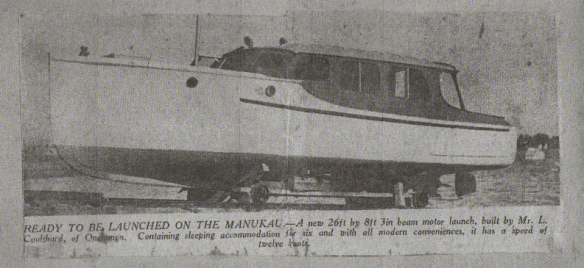
Rosemary went on to tell me that while sorting through her elderly mother’s possessions recently, she came across the original plans of a Coulthard launch, the ‘Doraine’ plus a few photos. Doraine was 26′ in length with a 8’3″ beam & was intended to be the prototype for a ‘reasonably priced family boat’.
Now according to Coulthard’s daughter Elaine (now 93) this launch was last seen on Lake Taupo about 20 years ago.  Rosemary would like to know if Doraine still exists (maybe under a different name?) and whether the current owners would like those plans and copies of old photos?
Apparently her grandfather altered her for a subsequent owner to extend to approximately 28′.

So woodys what do we know about Doraine? L.C. Coulthard launches have been robustly discussed on ww before – click the link below to view/read.

Lucinda

Now woodys you would have been disappointed with me if I had not also asked Rosemary the question “Do you have any other photos?” well I did & the answer was yes – so over the next week I’ll post some more 😉

Doraine launch day

Victory

DSC04592

Screen Shot 2016-06-11 at 3.13.05 PM

VICTORY
photos & details ex Paul & Roger Drake

Saturdays  post on the Kinloch Woodys prompted Paul & Roger to dig out at their collections of old  Taupo postcards. The brothers uncovered some great photos of Victory from the 1940>1950 era. Also read below Paul’s comments on Victory.
The first photo above shows Victory on the beach at Waihaha with her skipper on foredeck – Ernie Taylor, son of builder Jack Taylor.

The second photo shows her hauled out at Nukuhau, where she was built. Probably in the 1940’s, when she was quite new. Now she has a larger wheelhouse, but is not much changed apart from that.
Boat in foreground is Ahuriri – an ex surf boat from Napier.
On the other side of Victory is Romance, then Lady Pat – well documented and discussed on WW.

The photo below is dated 1959  shows Victory on the other side of the Waikato river sporting her original wheelhouse. It was altered some time later.
Behind her with bow showing only is the Logan Ponui also owned by the Taylor’s at the time.
This side of the river at the breastwork is Rangatira (Otehei) on the left  and El Alamein (Ranui) 4th from left.
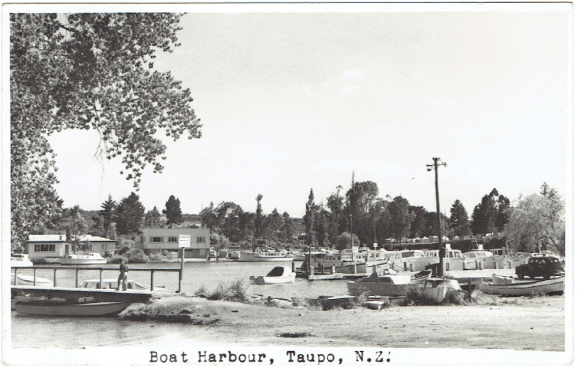
Boat Harbour Taupo

Details on Victory ex Paul Drakes comments on last Saturdays ww post

“VICTORY is very much a lake boat. As Colin says, she was built at Taupo by local boat builder and charter boat skipper Jack Taylor.  She was launched, I believe, in 1942 or 1943. It is said that no power tools were used during her construction. Kauri planks on jarrah ribs with totara  floors. She was built to replace ROMANCE (Bailey and Lowe 1914), who was sold by Jack in 1943. VICTORY became a very busy and popular charter boat. The Taylors sold her in 1982. Although it is said that Jack often wished he had never started building such a large launch (40 feet), assisted by his wife, – his two sons were away at the war – he must have enjoyed her immensely once finished. She was a big step up from the 26 foot 6 inch ROMANCE. VICTORY was perfect for the four or five day charters which were very common in the day. VICTORY is a Jack Taylor design, built from a model which Jack towed behind ROMANCE as he refined the shape. She is of shallow draft – a useful attribute on Taupo  (no tidal rise and fall) – as it allows access to beaches where the drill is to put the bow on the beach and disembark via a ladder (in VICTORY’s case a rather long ladder). She did spend a few years in Auckland (Pine Harbour) during the 1990’s, but for 90% of her 70 plus years she has been at Taupo. She is well looked after and nicely appointed internally.”

Victory June 2016 at Kinloch

P1020091

Laughing Lady Updates

IMG_6611

IMG_6868

Laughing Lady June 2016 Update
photos ex James Dreyer

Chatting with James on-line a while ago I nudged him for an update on LL. As ww followers will know the Lady has been tucked up in the shed at Whangateau Boat yard for over two years getting a serious over-haul from Pam & when in country James + hangers on. James & LL’s co-owners re to be commended on they desire to return LL to her former elegance – below is the note James sent me (slightly edited)

“I was hoping to get some varnish on the topsides before departing offshore and subsequently photographing her looking sharp and shiny but it didn’t happen.  We did, as you know get her in her new coat of Flag Blue.  Unfortunately the port side will need a re-shoot due to some sags – the weather was not in our favor the day we had to spray. We will definitely be in better shape to give a good update in August as we should be well on the way with putting her together.

Pam and I had a bit of a discussion recently and think it is probably worth me commenting on the dark two part LP finish that I have gone with, before the armchair generals and experienced boat builders / owners wade in.  There has been many well qualified comments about the potential for paint failure over the last two years and they have certainly been weighed up and taken onboard.
When LL had her hull rebuild in San Diego, she was taken back to bare wood, re-framed and re-fastened, then impregnated with two coats of epoxy and many seams were splined.  She is tight seamed double planking and the new bottom is double planked and epoxy glued.  The paint system that was applied to her extremely fair hull 10 years ago in San Diego is a two pack epoxy / LP system – Awlgrip above the waterline and International below.  After 10 years sitting in a semi finished state, in the rather extreme conditions of an inland San Diego yard, she had cracked and opened a number of seams, but to be honest, no more than the single pack finishes on the boats around her.  

My concerns were that she would move significantly once parked in the Whangateau shed as she adapted to the cool, moist environment.  Pam repaired various areas that were in need, primarily around the extreme flare and planking twist in the bow, then built a good base of primer.  We let her sit for a year in primer, and surprisingly there was no movement or cracking to speak of.  To strip her back to bare wood was to remove the hundreds of hours of fairing and painting that had been never seen the water even though it was done years before.

On this basis and after much deliberation and discussion, I chose to continue with the two pack system.  The aim from the start was to get her in the water and in use as soon as practicable (as far as restorations go).  

For the first 50 years of her life, she was painted jet black and spent hot summers in the water around Long Island and her winters in a snow covered shed.   After the work in San Diego she was painted Awlgrip royal blue.

We chose Awlcraft Flag blue as the topside color.  Awlcraft has some more give (urethane rather than polyurethane) and can be locally repaired and polished.  My goal was to have her looking as close to original as possible when she launched, and the dark hull is truly striking as I’m sure everyone agrees.

I am well aware that the system will probably show some failures around the seams as she moves.  Its also likely that we will be painting her white in a few years, but to me it makes sense to let her out the door in the current (gorgeous) state and see how she fares.  If need be, we will re-wood her and go single pot, but if not, then a white two part system will continue to be used”

REMEMBER – To enlarge a photo – just click on it 😉

16-07-2016 I received an email from James today with the 2 photos below attached – when LL was launched she was powered by Packard straight 8’s, nowadays is powered by twin Volvo turbo diesels. In his travels overseas James came across the engines below – my response to the email was short – “WALK AWAY & DO NOT LOOK BACK” 🙂

image2

Screen Shot 2016-07-16 at 7.52.03 AM

August 2016 Update (ex James D fb)

It appears with the hull painted its now down to the shiny stuff 🙂

IMG_0455

IMG_0456

01-09-2016 Update ex James fb

Applying 24k gold leaf to the carved details on Laughing Ladys hull. The first arrow head needs a little tidying up, but with some more practice the unique scroll work detail carved into her bow in 1949 to identify her builder is going to look sweeeet!

Screen Shot 2016-09-01 at 5.54.52 AM

Merita – Launch Day

scan007

scan002


scan001

MERITA – Launch Day
photo & details ex Murray Morrissey

Merita has featured in detail on ww before (blue link below to view the story) but when Murray sent me the above collection of photos from when she was built & launched back in 1965 they were just too good to add to the existing post. One photo shows her being towed through the Milford shops on-route to her launch off Milford Beach.
While there is some conflicting/confusing info on the original ww post, what I came tell you is that Murray has confirmed that Merita was built by his father in law – James (Jim) Dymock of Takapuna in his brothers (Bill Dymock) building yard behind the Waitemata Power Board in Taharoto Rd. The family are unsure of the hull design but the cabin top was designed by Brin Wilson. She was launched in 1965 in the Milford Creek where she spend her early days.

LINK >>>>   https://waitematawoodys.com/2015/08/24/merita/

Special thanks to Russell Ward for scanning the original photos.

Miss Ponsonby

to begin with

IMG_7095

MISS PONSONBY
photos ex Charlie North. details ex Harold Kidd

In early May, Charlie North commented on ww that he was currently rebuilding a replica of Miss Ponsonby after acquiring the original boat some years back. Harold chipped in with details on her (below) & I invited Charlie to share the project with us. If you have a good look at some of Charlie’s photos you will see he is a serious collector – I can spot a vintage car, classic motorbike & what a appears to be an E-Type Jag. Remember to click on the photos to enlarge.

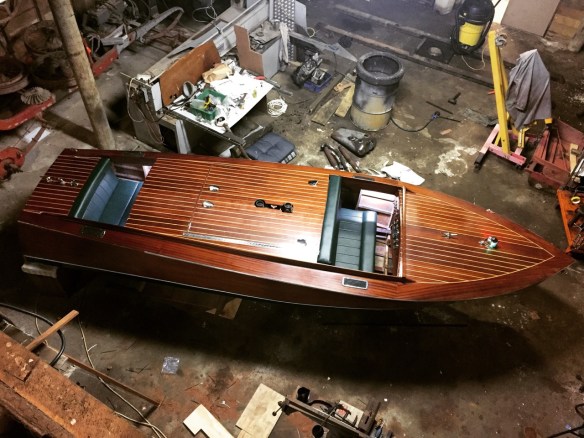
Firstly some history – Miss Ponsonby was built by Sam Granros in late 1932 or early 1933. She took part in the Masport Cup races on the Tamaki River in 1933 nominated by Ponsonby Cruising Club. Her racing number was S21. Her inboard engine was a 100hp Hall-Scott. She had a long handicap and was more a fast runabout than a racer.

Sam Granros was a Finn who came to NZ in 1904. He built a lot of speedboats and launches in St. Mary’s Bay and at 12 Hackett Street, Ponsonby, for example,Hilma, Nurmi, Alma, Ramona, Ramona Jr. (1930), Cygnet I – II – III, Esther, & Miss Ponsonby, all go fast outfits.
Sam later moved to Oneroa and died in 1946.

I’m sure Charlie will add some more details re the engine etc.


DSC00564

IMG_4055

The Bristol Pilot Cutter – Cornubia – Sailing Sunday

The Bristol Pilot Cutter – Cornubia – Sailing Sunday

Today’s post is a 8 minute film on the 1911 66′ bristol pilot cutter Cornubia. Built by J. Slade & Son, Polruan, in the UK, she was restored by current owner Tony Winter in 2009. She is carvel constructed, larch planking on oak frames. The film is wonderfully narrated by Tony Winter.
She is a thing of beauty both on the water & down below.

Anyone know the status of the bristol pilot boat that Peter Brooke is building at his yard in Waimauku?

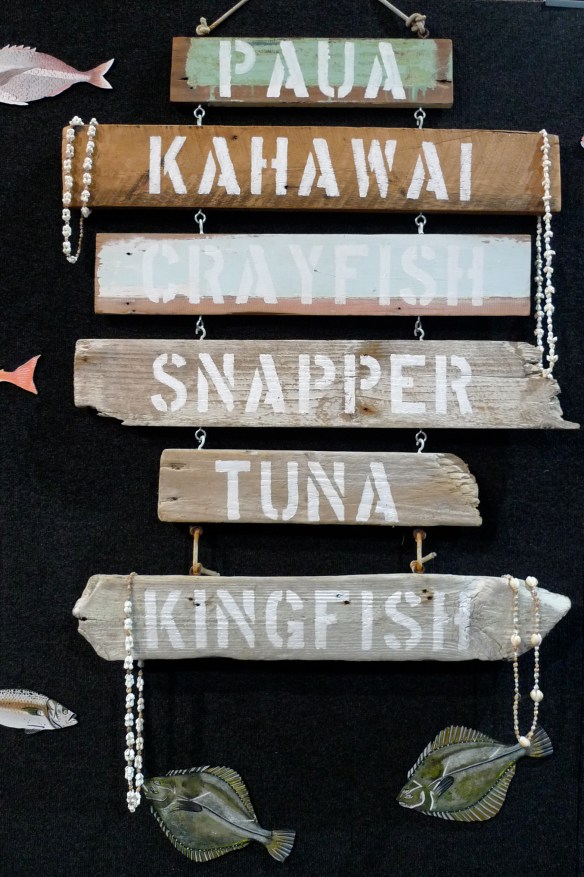
Now if you have ever seen me mooching around in a bay in the dinghy collecting drift wood, if its a tree branch its for the garden. If its a piece of timber its for an old mate, Simon Yates who makes these rather cool signs. He bought an old metal stencil set in the USA (on ebay) & now knocks up the below – they look great at the bach – not for sale, its a labour of love 😉 All the wood on this one I collected last xmas around the gulf.

Si Signs