Little Tasman

LITTLE TASMAN - STARBOARD SIDE - 7.3.16 - 3

LITTLE TASMAN - STARBOARD SIDE - 7.3.16 - 0

LITTLE TASMAN
shed photos & info ex Ken Ricketts. Pt Wells photo ex Mark Edmonds. details ex Harold Kidd. edited a lot by Alan H

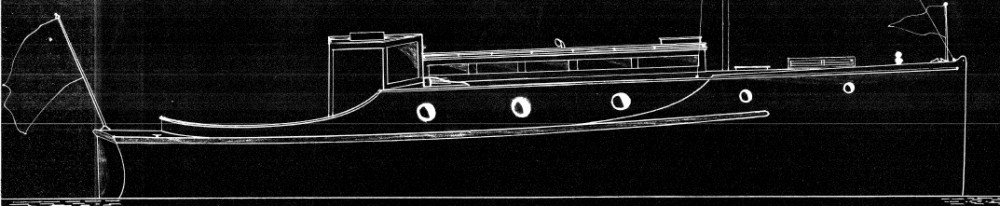
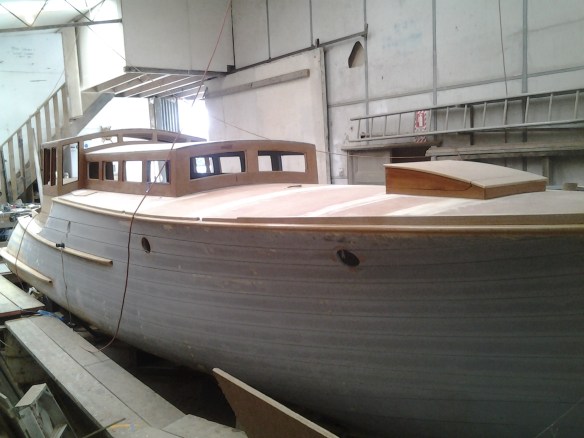
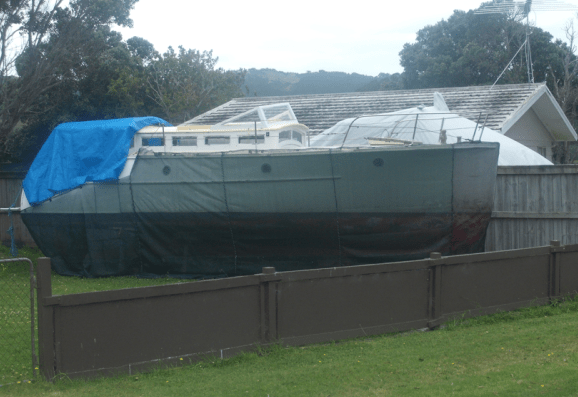
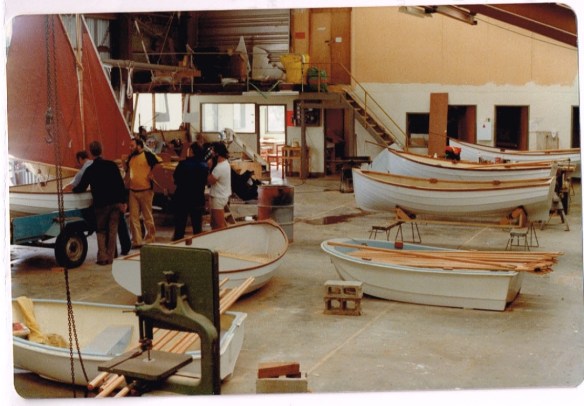
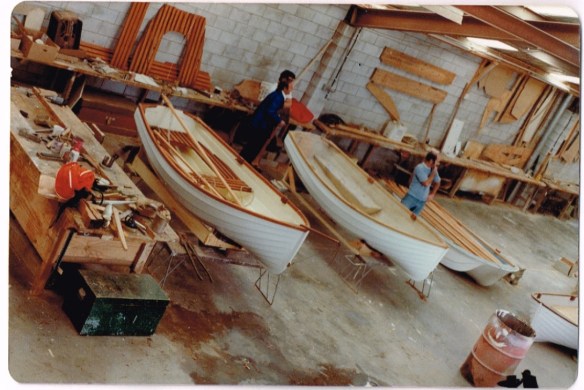
Back in early March Ken Ricketts dropped in to see artisan boat builder Colin Brown at his Omaha yard. Colin & side kick, Josh, have been restoring the rather pretty 26′ Colin Wild launch Little Tasman.  She was named Tasman when built in 1925 for Albert Spencer & changed her name to Little Tasman in 1927 when the bigger Tasman (photo included below) was launched by the same owner/builder. Its said she that LT was a prototype / test boat – Mr Spencer was not short of a few pennies 😉

It is such good news to see whats happening to Little Tasman as she sat on a front lawn at Pt. Wells for a number of years (photo below) & her future was at risk.

Little Tasman at Pt Wells

In Harold Kidd’s words Little Tasman is ‘pure class’ & whats happening in Colin’s shed is also pure class  – the man is one of the best classic friendly tradies out there.

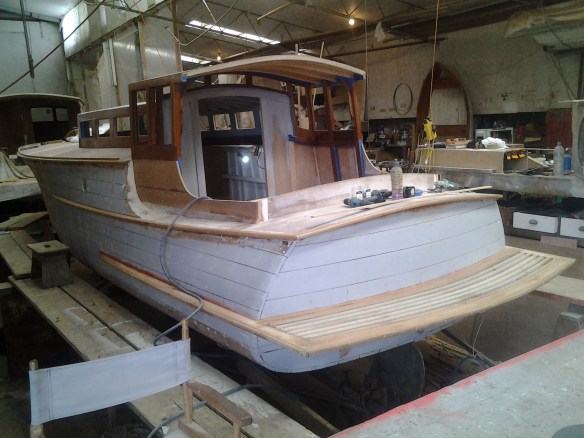
You will see in the above photos that she now has a brand new 4 cyl Nanni 38 hp diesel in place, which should give her a top speed of around 10 knots, with a cruising speed, with her 2 to 1 reduction gear, of around 7 knots. Will be interesting to see her performance as the Nanni is a lot lighter than the old 6 cyl Ford diesel it is replacing.

Her restoration has seen most of her ribs replaced, a full recaulk (no splining), work on the forepeak & bow, a new dodger, very faithfully copied from the original & a full interior refit & partial redesign of the interior layout, for greater space use, & practicality.
Steering will be from the front of the tram top, as it was before, where there will be a large hatch fitted, to the newly replaced, as original, T & G cabin top. Check out the stern photo, classic Colin Wild on show there 🙂

Launch date is fast approaching so we will update on the event.

Read more on her past here      https://waitematawoodys.com/2015/04/20/little-tasman/

Below is a photo of Tasman that I took a few years ago in Sullivans Bay. She is stunner & on a lot of woodys bucket list.

Tasman @ Sullivans Bay

30-06-2016 – Another great photo update from Ken R of Little Tasman’s restoration at Colin Brown’s yard. Remember click on photos to enlarge 😉

Miss Vauxhall

Miss Vauxhall

MISS VAUXHALL
photo ex Robin Elliott

Todays photo of the woody runabout, Miss Vauxhall, is from Robin’s collection of photos from the Whangarei Cruising Club Collection, as far as Robin knows, all are from the 1940’s early 1950’s & and were taken by Palmer Photography in Whangarei (1910-1999). Most by the late Graeme Palmer and possibly some older ones by his father.

While the boy at the helm is deep in concentration he no doubt is having the time of his life. Can any woodys ID the design of the boat & even better whose the skipper ?

16-01-2017 Harold Kidd Input

I’ve just come across an article in Sea Spray  (below) on Dick Hartley in which he discusses, most lucidly, the evolution of his designs. There is the same pic of MISS VAUXHALL as well as her sections, pointing out that he could just as well built her in ply in 1947.


16-08-2020 UPDATE ex Peter Morgan – HDK was correct the boat is a Hartley. Peter M has commented that his father – Jack Morgan, of Paine Bros (North Auckland) Ltd, General Motors dealers in Whangarei, in 1947 asked Richard Hartley, then a young (b. 1920) boat builder in the town, to design and build Miss Vauxhall. She was powered with New Zealand’s only Mercury 25-hp Thunderbolt in-line 4-cyl. 40 cu.in. outboard. Paine Bros stocked and sold Sea Craft clinker dinghies and Mercury outboards. In the above top photo the young skipper is Roger Morgan, aged 11. In the photo below (very low res), supplied by Peter M, taken in the early 1950’s at Russell in front of the Duke of Marlborough Hotel. Jack Morgan is standing in Miss Vauxhall, while son Roger is holding the transom. Miss Vauxhall had a top speed of 27 mph (23.4 knots), measured by timing between the ends of the Paihia and Russell wharves and measuring the distance off a hydrographic chart of the area. Miss Vauxhall could pull water skiers up from a deep-water start on a single ski.

Screen Shot 2020-08-16 at 4.17.26 PM


Sanders Cup Yachts – Sailing Sunday

Jellicoe Class Sanders Cup Boats

Sanders Cup Yachts – Sailing Sunday
photos from ex Mac Taylor Collection

The above photo shows three Jellicoe Class Sanders Cup boats ( X28 – X34 – X45) in full flight on Auckland’s Waitemata Harbour. I have included below the original photos as the resolution weakens on the cropped version above.

Harold Kidd Input

X28 is DESIRE built by Trot Willetts for Ed Croad in 1948ish. Never outstanding.
X34 is BETTINA built by Sam Mason for himself in 1946. She won the Sanders Cup in 1948.
X45 is WHITE HEATHER built by Jim Young for himself in 1949. She won the Sanders Cup in 1949.

My guess is that this is the Auckland Sanders Cup trials of 1949.

Robin will probably be more encyclopaedic than me.

Jellicoe Class Sanders Cup Boats 1

29-03-2016 Input from Jim Young
Confirming photo probably taken in Nov 1948  during the Sanders Cup selection trials.  X45 White Heather J.Young, L.( Wagger)  Riley, .R Lamb , F.(Snow ) Swanberg. All of Northcote.  X34  Bettina,  Sam Mason of Stanley Bay, X28 Desire Eddie Croad of Pt Chevalier.

Buzzard

Screen Shot 2015-10-16 at 7.13.37 AM

Screen Shot 2015-10-16 at 7.13.46 AM

BUZZARD

Buzzard is 1989 22’6″ spirit of tradition launch with a Holmes displacement hull, ply glassed 😦
Powered by 21hp Volvo Penta diesel motor that pushes her along at 5>6 knots. A perfect speed for her home waters of Lake Taupo.

Any of the lake woodys able to tell us more about her?

Steamboat Gypsy

Screen Shot 2016-03-17 at 9.23.05 PM

Screen Shot 2016-03-17 at 9.23.24 PM

STEAMBOAT GYPSY
photos & details ex trademe

Its not often that I do a blatant 4-sale listing on ww but Gypsy is just so adorable that she gets pride of place today on ww.

Gypsy is a 18’4″ beautifully built replica 18 foot steam launch from the 1880’s that has been recently completely restored & is now for sale.
The cold molded 3-skin kauri hull is in perfect condition. It was built by Dave Jackson, now of Warkworth, in 1987.
The machinery is an English Stuart Turner 2 cylinder compound engine built in the 1960s. The boiler was built by Dyer of Penrose in 1987. It burns coal or wood, but prefers coal.
A restored trailer is included that has a new WOF, new tyres, axel & wheel bearings.

A special feature is the copper ‘Windermere Kettle’. This steam kettle heats water in about 10 mins for a hot cup of tea while underway.

Call the owner on 09 4343649 for more information or to view.

The Gypsy Story from previous (1st) owner Russell Ward

Here is her story.

Gypsy was built in late 1987. In those days I had a 12’ clinker dinghy with a 4hp Stuart and longed to make a steamboat. I had bought a Stuart no 6 compound steam engine from the late Les Fitt -a prolific steam modeller. The late Graeme Wilkinson designed a coal burning boiler to suit and it was built in Penrose. Happy daze! All I needed was a suitable hull and that is hard because it has to be burdensome to carry all that weighty machinery. Also it needs to be able to swing a huge prop because a steam engine develops a lot of torque at low speed. Gypsy’s prop was 17 x 23. Most old boats didn’t meet the specs and anyway, I was going to have enough on my hands running the machinery without trying to maintain a rotten old leaky hull. A new hull was the only way.

I had several long talks with Dave Jackson in his gorgeous boatshed  at Sulphur Beach –inland of the then harbour bridge Toll Plaza. Harold will enlighten us about the history of that boatyard. Dave advocated a cold moulded hull so it would be strong and easier to keep clean. A set of lines was the problem. Way back then, there was a dearth of hull lines for steamboats. Nowadays every joe and his dog thinks he can draw one up.

At that time, Pete McCurdy produced a magazine Traditional Small Craft in the ‘80s and it was eagerly read by the small boat people of the day. We are still waiting for the long promised last issue for which I am sure I penned something. In one of the issues was a set of lines and offsets of a dinghy that was kept at Adams Island -one of the Auckland Islands- for any shipwrecked sailors to row to NZ in. Happily she was not needed and was brought to Hobson Wharf for the then fledgling maritime museum. I thought that any boat designed to live in those savage waters probably had what it takes. I discussed the lines with Dave and Gypsy was the result. She lacks the hollow garboards of the original for ease of construction and economy.

I completed the engineering at home and fitted the necessary auxiliary pumps to the engine using original Stuart castings. The choice of the name was a little complicated and a story in itself. There were several sailing Gypsys around but no SL Gypsy. It was a nice dusky sooty sort of name for a steamer.

The Trad Small Craft Society were holding a sail-in at Okahu Bay and i proposed to take Gypsy along to show the gang and also to dip her in the water to pencil in the waterline. All things gang oft aglay as they say and I couldn’t stop myself steaming her up because it was such a bitchy cold day. As I dipped her in the tide, she floated off and I steamed away merrily trying to get used to my new toy. We steamed her around for three hours and I thought she went damn fine. The first picture shows the event: I am the one with a broad smile but no anorak (whatever they are). I never changed a thing from the first launching and she just went well every time as long as the coal was good and the boiler tubes kept clean.

I sold her when we moved house in ’91.  She is a cutey. The box up fwd was put on by the subsequent owner and is a little clumsy to my eye.  I don’t think I’ll have her back: Marie would probably strangle me and the price is way too steep.

04-10-2018 Update ex Russell Ward

Photo below shows Russell’s little steamer Gypsy that David Jackson built in this shed at Sulphur Beach 1987. In the photo we see that the hull planking has just been finished.
What dates the photo is the ‘middle sized’ Ward daughter seen in the photo. Russell commented about the proper tools on show 🙂
finished hull001

Vagrant – Sailing Sunday

VAGRANT – Sailing Sunday
photos from Duncan Elliot, details from Harold Kidd & Robin Elliott. (edited by Alan H)

I was contacted recently by Duncan advising that he had purchased Vagrant off trademe last year & was looking for details on her history.
She had sunk due to a 100mm x 60mm hole in the transom below the bolt on the drop keel box . When Duncan started the repair he a little surprised to find that someone had filled the area with  epoxy from a tube and no fibre. Subsequently this failed & popped out resulting in the trip to Davey Jones locker. Duncan did a temporary repair on the hole
& later cut out the old hole and scarfed a piece in and built a box around the existing box as this was too short i.e. does not go all the way down to the keel and deadwood.
Vagrant she is now back in the water and drawing about 5 litres a water a day. Duncan intends to take her out in a couple of months to do a total re-fit, doing the work myself as he is joiner by trade.

I contacted Harold Kidd & Robin Elliott and asked if they could provide some details on Vagrant for Duncan & true to form, they delivered 🙂
HAROLD
VAGRANT was built by Jack Greenhalgh in 1924 according to MBQ (pretty unreliable). My first hit on the boat is a shade before the 1926 AAR (which was certainly her first race).
She’s in the  list of N’s in NZA of 18/11/25 (as N7).
My guess is built by John/Jack Greenhalgh of Richmond Rd about late 1925 and owned probably with his brother Albert.

ROBIN
I first trip over Vagrant registered as N-7  in the 1926 Anniversary Regatta.
Owners details:
• A. Greenhalgh 1925?/26+?; P. Churton 1932/+?
• On Manukau 1928, registered as number`19′ with Manukau Y & MB Club
• Pennant? 6/10/32: Purchased by Churton who intends to use her for cruising only.
• Re-appears post-war registered as N-17 c1945
• Owner Cyril Hill early 40’s? E.L. (Ernie) Beaver 1945+? D.A.K. Taylor 1949+?; Dick Still 1962?; D.J. Mason 1964/65+?
• Dimensions 1949: 20’x 20’x 9’x 2’10”, 330 sqft gaff rigged, 1ton ballast
• Listed as ‘Unregistered’ 1970
• 1990 on beach, North Harbour Kawau.?
 
There is one photo of her in the Auckland Museum Bond Collection, negative number PH-NEG-C37485 dated 1st February 1947.

Robin helped paint her in 1963 when Dick Still owned her and she was still in gaff at that stage (Or was she?). Dick Still lives in Pakuranga and may have some photos of her from that time.  If anyone knows Dick, give him a nudge re any photos 09-5348158

LOOK OUT for Mondays post  – its on the Lake Rotoiti (Sth Island) antique & classic wooden boat festival, lots of cool boats 😉

Lisa Rose

Screen Shot 2016-01-12 at 8.43.34 PM

LISA ROSE
photos & details ex trademe

Lisa Rose was built by C.E Thompson (Boat Builder & Motor Engineer) in Dargaville to pull out big Kauri logs via rivers.
She measures 22′ & is powered by a 1980 40hp Isuzu diesel, reconditioned in 2010,  the engine is keel cooled, making her an ideal vessel for going up rivers e.g. she can make it up the Puhoi river to the Puhoi Pub.

Lisa Rose is an old boat, possibly c.1940.  Keen to learn more re her past & year of build.

Harold Kidd Input

Charles Eric Thompson was born in 1875 and died in December 1965. A lot of his boat building was at Aratapu but he died living at Beach Road, Dargaville. He was building until late in his life, but even in 1940 he was 65. Nice model of a hull.

Okura Gigs – Sailing Sunday

Okura Gig 49 (9)

Historic photo 01

Historic photo 02

OKURA GIGS
photos & details ex Darren Arthur

We did a post on ww a little while ago about ‘Seabird’ dinghies & this generated chat & subsequent comments about the ‘Okura Gig’. This sparked Darren to contact his wife’s uncle – Dennis Hart, who with his late brother Ray ran Hart Brothers Marine and were behind the Okura Gigs. Darren encouraged Dennis to document their history.
Darren asked me that given that the boats we not wood, was it a potential ww story – after a quick peek at the photos – I replied that there was more than enough wood & bronze to get the ww tick 😉

I have published Dennis’s story below word for word, its a great tale & combined with the above collection of older & recent photos is a cracker read. Enjoy 🙂

THE OKURA GIG:  A Brief History By Dennis Hart

Background

During the late 1800’s the area at Silverdale now known as Millwater included the Grut (pronounced Grew) farm which had access to the Orewa Estuary. Mr Grut had a 10 foot kauri clinker rowing boat, understood to have been built by Bailey & Lowe at Sulphur Point, Northcote. The boat was mostly used for net fishing. Charles St.Croix Grut and Alec Grut later inherited the farm and continued farming until the 1960’s ?

Dennis believes Croix and his wife Merle had the 38ft Wollacott design yacht Iorana, built by Don Wood at his yard in the Orewa Estuary. However the memory can play tricks over time & Dennis would be interested to learn if he is correct in this. The couple then in their late 60’s were the first Weiti Yacht Club members to circumnavigate the globe.

Croix brought the boat to my brother Ray and I at Hart Bros Marine  in the mid to late 70’s for a full restoration to its original configuration as the 70 plus years had taken their toll. We duly completed the ‘no expenses spared’  job resulting in a very pretty and sound rowing boat. We negotiated a deal whereby we could use the boat as a plug and take a mould from it in order to produce the boat in fibreglass , We made no charge for the restoration returning it to Croix and Alex with a fibreglass replica rowing boat each for their general use. The original boat was retired.

I tried to locate the original boat and was told by Croix that he had entrusted it to a gentleman who had promised to donate it to the Maritime Museum. On enquiring there I was told that no such boat had been received. Croix Passed away in November 2012 aged 94.

Building the OG

Because of the tumblehome created by the very pretty wineglass transom the mould had to be in two parts. The original boat had no centrecase so a slot was cut in the keel and a case was moulded in -situ at the same time as fitting the buoyancy thwarts and stern benches . A galvanised steel swinging plate was hinged at the top forward point, raised and lowered  by a stainless wire. After release from the mould Kwila slats were fitted to the thwarts, the inner and outer gun’les were copper riveted together, the thwart  and lodging knees fixed in place followed by the remainder of the fit-out . Two rowing positions were provided, the forw’d pair provided fitting for the side stays.

The rig

The sails were kept as traditional as possible by using ‘tanbark’ coloured sail cloth and braided lacings. The oregon spars were made so that they would fit inside the boat, when not in use. This worked well as a handy sized main was set with the peak well above the mast top. This, coupled, with a boom that overhung the transom and a jib tacked to a short sprit,  giving plenty of sail.  Many of the fittings  that controlled the running rigging (cleats and blocks, were made by hand or modified from Harken traditional range. All other fittings were sourced from the depths of Fosters basement or were bespoke by us of copper, brass or bronze. The gaff jaws were covered in leather. Rope sheets were a light tan poly. The gaff halyard was rove to a bridle to make setting the main more simple.

Development

Like the old harbour ferries the OG has a balanced waterline with fine ends so does not drag water at the transom as the boats bottom lifts the transom clear of the water at the stem of the wineglass.  Fit-out of these boats was kept to an affordable minimum at the time.  As production continued we made some minor modifications and improvements, i.e. separate peak and throat halyards to give better shape control to the main, reefing points and tackle for the main, a change from cane rings to lacing on the luff.  The rudder is if fixed shape with a swivelling tiller, its bottom edge does not extend below the keel line which allows safe beaching.

The sail plan was easy enough to balance on paper.  In practice it showed a slight weather-helm  in fresh airs which was easily adjusted by swinging the centreplate back,  flattening or easing the sails.

Production

The Okura Gig became a ’boutique’ activity.  As a result of the boat tax being imposed in 1979 we reduced the size and scope of our business and closed our fibreglass manufacturing operations and moved our boat shop into the mould shop. We had built about 55 OG’s between 1978 and 1981.  The moulds were taken by Dinghy Developments who resumed production giving the OG a Seabird name.  I believe that they took their version to USA west coast boat shows where they were warmly received. I have no idea how many more were built.

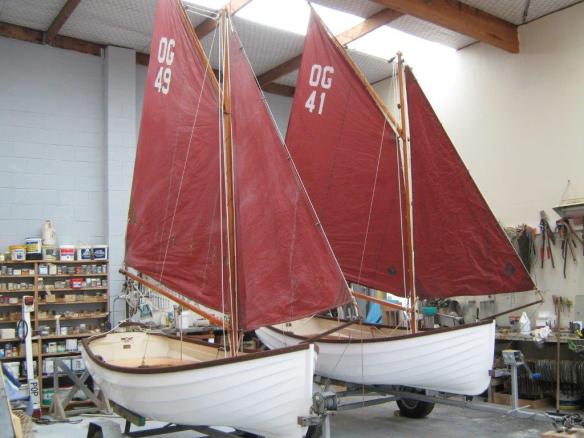
I have  two OG’s,  No. 41 and No 49.  One had spent about 35 years in a wet boatshed at Lake Rotoiti,  it required a complete grind off of the osmosis damage before refitting.  The other is our long time family boat. I have refitted them both to a much higher standard than the originals. They are currently in my shed at Whangaparaoa.  I still sail OG49 occasionally and still find it enjoyable. It really romps sailing just off the wind with the peak halyard eased . OG 41 is too pretty to put in the water. It would make a fine centre piece in a large lounge.

Croix Grut  got to see OG’s 41 & 49 restored and fully rigged before he passed away. Photo below.

Photo0006

Foot note:

I was fortunate to have served my apprenticeship at the Devonport Naval Dockyard commencing in 1958.  Marty Martinengo was in the same intake as I, as was Denis Cantell, in 1958. We have enjoyed  a very solid friendship ever since, as we do with many of the apprentices who were indentured before or since us.   The Dockyard provided a very traditional training in all aspects of boatbuilding and shipwrighting  . It was a very competitive environment with up to 14 apprentices at any one time. My brother Ray Served his time at Lidgard’s and Lane’s before moving to Max Carter. He  moved to Whangaparaoa about 1968 where he started boatbuilding.  I joined him  in 1972.

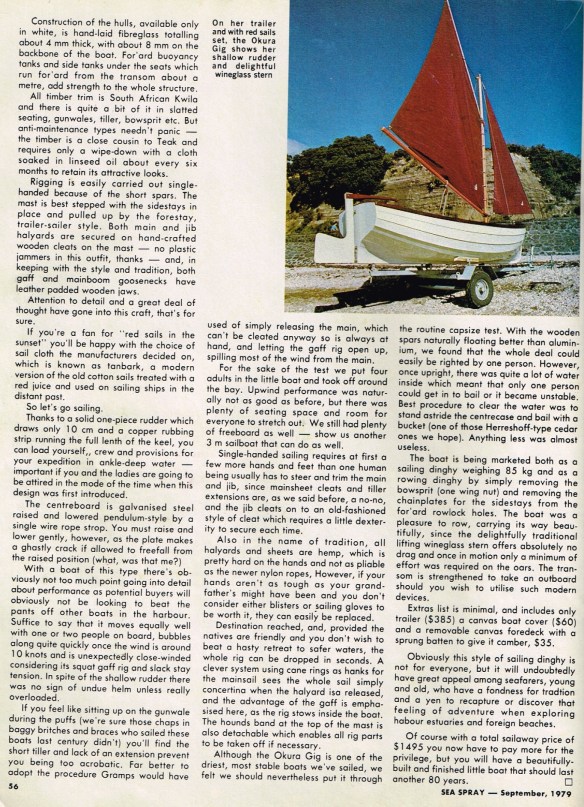
Below is an article reproduced from Sea Spray magazine Sept 1979

Sea Spray Article Sept '79 p1.pdf

Sea Spray Article Sept '79 p2.pdf

Lake Rotoiti Classic and Wooden Boat Parade – 2016 – 150+ photos

P1210884.JPG

Lake Rotoiti Classic and Wooden Boat Parade Weekend – 2016 – 150+ photos

Get comfortable this ones a biggie, 150+ photos from the 2016 Lake Rotoiti Classic and Wooden Boat Parade weekend.

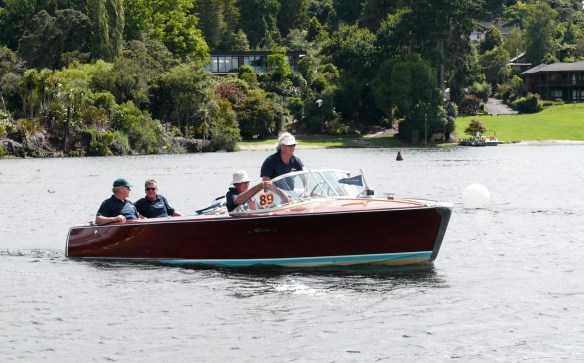
The inclement conditions (lots of H2O) on Saturday resulted in the parade being moved to Sunday, to most this was a positive as it gave everyone more time to socialize. We took the opportunity to mooch around the lake & visit a few lake-side properties. The transport for the day was rather special – 2 of the regular parade attendees, Cathy & Shawn Vennell and Pam & Tim Aurisch had bought their classic cars – a 1960 Dodge & 1956 Chev Bel Air, very impressive tow cars & a cool mode of transport.

So today’s post is a mix of classics – motorboats, day boats, speedboats, steamboats, yachts & cars – Its a visual attempt to give to you a taste of the weekend & showcase the vessels that make up the parade.
Special thanks to the LRC&WBP committee, especially Commodore Grant Cossey, past Commodore Fraser Wilson and the lass that makes it all happen Rachel Jamieson.

Due to another engagement we could not attend the post parade picnic.

Each boat carries a number, to find out more details on any vessel e.g. name, year, owner – refer to this link to a master listing. 2016ParadeEntrantDetails

Enjoy 🙂

Click photos to enlarge 😉

P1220376

Karere III

KARERE III GULF HARBOUR 4.2.16 - 1

KARERE III
details ex Bob Salthouse via Ken Ricketts. photos ex KR

Karere III was designed & built by Bob Salthouse in 1974 of 3 skins of Kauri (one full length & 2 on opposite diagonals) for Logan Colemore-Williams of the very well known  marine products manufacturer of that era, Sonata Laboratories.
Karere III was 53′ long originally & powered by 2 x model 3208  Caterpillar V8 naturally aspirated 210 hp diesels. The same engine was used in single engine installations in many of the Mark One 36′ Corsairs designed by Bob S. & built by Bobs company. Her hull was used as a ‘plug’ for several more boats of the same spec.

She was later lengthened by approximately 6′ to extend her at the stern to around 60′ long. This was done in Picton by Jim Cary, to design work done by & under the direct supervision of Bob Salthouse, whom they flew down to Picton to supervise the project. This is evidenced by the position of the propellers & rudders in photos above of her on the hardstand at Gulf Harbour on 4.2.16.

Bob reports that her speed was increased quite markedly by several knots with the addition of the extra length. Bob also commented that she spent quite a period of time in the Wellington region, but is  now back in Auckland. Kept at Bayswater marina I pass her every time I come & go, in the water she looks even more impressive.

Link to down load the Sea Spray article on her launch Karere III

2016 Lake Rotoiti Classic & Wooden Boat Parade – just back, hundreds of photos to sort thru – be sure to check in Tuesday – a very cool big post coming up.
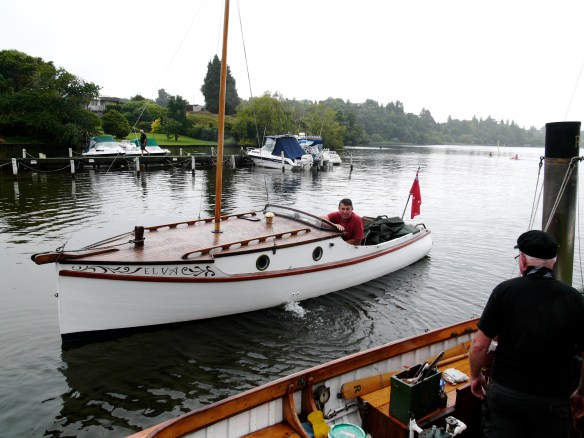
I particularly like the photo below – two woodys having a chat in the rain. On the left Lake Rotoiti Classic & Wooden Boat Association Commodore Grant Cossey in his 1908  Collings & Bell launch ‘Elva’ & Russell Ward in the 1994 steam boat ‘Romany’.

P1210693