Minx

Minx - Wattle Bay 1913

Wattle Bay 1913


MINX
photos & details ex Rosemary Robinson

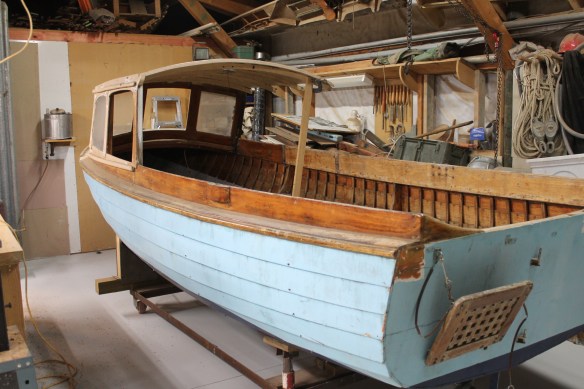
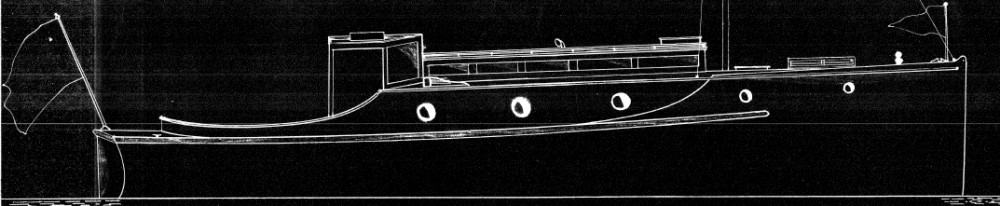
Today’s story is on the L.C. Coulthard built launch Minx, the photos were sent to me by his granddaughter, Rosemary Robinson.
The locations of these photos all appear to be on the Manukau Harbour, I wonder if she ever left the mud & made it over to the sparkling waters of the Waitemata?

I know nothing about Minx so woodys can we help record her history on ww?

Harold Kidd Update – Les Coulthard built MINX for himself in 1913. She was 22ft loa. She was on the Waitemata in 1945 and on the Kaipara as recently as 1999 when Mark Thomas told me she had been sold from Helensville to Dargaville. A very pretty launch, reminiscent of Arch Logan’s work on, say, COQUETTE.


Lincoln Wood Dinghy Restoration (Rebuild)
Harold Kidd sent me the two photos below of a very nice little (8’6”) sailing dinghy built by Lincoln Wood which George Emtage at the Whangateau boat yard is rebuilding for him & Pauline.
The yard is a hive of activity at the moment with some of our finest classics lined up in the creek getting some TLC.

WBY

KUPE

Kupe 2a

New Kupe 4a

KUPE
photos & details ex Rod Prosser

Kupe started life in 1962′, built by the Auckland Harbour Board in their workshop as a vessel for cartography & routine sounding. Was used extensively around / in the construction of the Westhaven Marina area.
She underwent a complete restoration in 2007, by Wooden Boat Workshop cabinet maker Simon Ventura. Rumour has it around $80>90,000 was spent on her restoration, so as expected she is in very smart condition.
Her 30hp Lister Petter LPW3 diesel engine (2007) has no problems pushing the 18′ hull along.

Currently owned by the Classic Yacht Charitable Trust but now surplus to their needs, so they keen to find a new owner for Kupe, she would make a perfect lake boat or a yacht club support vessel for mark-laying, race escort, towing etc. The asking price of around $12,000 is very realistic & reflects the trusts desire to find Kupe a good home.

Read more about her here http://www.classicyachtcharitabletrust.org.nz/trust_boats.htm?boat_id=12

Anyone interested in learning more in regards to possible purchase can make contact via this ww post.

Building the Mullet boat ‘Tamatea’ by Chris McMullen

Tamatea 17

1961 – the build begins @ 67 Waiatarua Road, Remuera

Tamatea 22

Tamatea 1

Tamatea 29


Building the 22’ Mullet boat ‘Tamatea’ – Sailing Sunday

photos & story by Chris McMullen. edited by Alan H

After Chris McMullen saw last weeks ww story on ‘Tamariki’ he contacted me re sharing his ‘Tamatea’ photos that had been languishing in an album kept for him by his dear mother, Vera McMullen. I couldn’t let Chris escape with just sending the photos to me, so I asked him (nicely) to write us a story. Now that’s something he is always a tad hesitant to do, why I don’t know he tells a good yarn. But being the great guy he is, he put pen to paper, in doing so Chris commented that he hoped that bringing these photos into the daylight may encourage others to share their boating or boat building history on waitamatawoodys.

Below is Chris’s story on the building, launch & sailing of the 22′ mullet boat Tamatea. Remember you can enlarge photos by clicking on them 😉

“In the early 1960’s I was apprenticed to boat builder, Morrie Palmer who was also an enthusiastic Mullet boat sailor. Sailing, cruising and Mullet boats were the conversation most lunch breaks.
Morrie had in mind to build a 22ft Mullet boat but family and business commitments at the time, delayed his plans. He had a new steel centre board plate, a profile plan and the offsets of a design for a hull that was supposed to be the Charlie Colling’s design ‘Tamariki’. I am not sure how he got these offsets but the original lines plan were in safe keeping at the R.N.Z.Y.S and not available to anyone at the time.

Morrie encouraged me to build this design and gave me his centre board plate and loaned me the offsets. I managed to scrounge some primitive basic machinery and set out to build the boat. As an 18 year old apprentice boatbuilder I had no money, no car and no girl friend but I was full of enthusiasm and wanted to go sailing. And yes, I had read Johnny Wray’s book. “South Seas Vagabonds” many times.
The Tamatea was built in my parent’s back yard at 67 Waiatarua Rd Remuera. These days such a project would not be possible due to the noise regulation’s but in the early 1960’s people were remarkably tolerant and it was not unusual to see half built boats on people’s quarter acre sections.

 Riveting of Tamatea at night was not really fair on the neighbours. I got one complaint by working too late. I had to enlist my friends to back up the nails with a dolly. If they came late, we worked late. I was desperate to get it done. Another source of irritation was my Fathers Desoutter electric drill. It had no suppressor and affected the people who had TV’s. I was the neighbour from Hell for a while.

Now to the photos.

The photos feature some of my friends who helped. Recognised in the photos are
John Jennings, Des Laery, Ken Wilding, Murray Napier, sorry but I can’t remember all the names but Alan Bell and Neil Gillard would have been there. In the dinghy sculling is ‘Snow’ (Neville Stacey) who was / is a well known helpful character; he loved boats and spent much of his time at the ‘Okahu Bay’ hardstand.
The young man painting the Tamatea in the colour picture is the late John Eastwood. In the same image but in the cockpit is a another young man, John Court, also since deceased. My Model A truck alongside the boat, used as a work bench. The sailing cockpit shot shows Ken Jaspers and with me on the helm. These three guys and John MacDonald built and loaned me gear and helped finish the boat. I guess this was the year after she was launched. I was grateful for their help as I could not afford to run the boat myself at that time.  

You may notice in some of the images, the concrete blocks on the roof of the shed. These allowed me to force rocker (bend) into the keel using a timber prop under the rafters, their weight prevented the roof lifting. Looking at it now, I am lucky the lot never collapsed on top of me.

I never lofted the hull; I just made the temporary frames (moulds) direct from the offsets and cut the plank rabbet’s (rebate) by eye using battens.
The hull was planked with kauri over temporary frames or moulds. The planks were tapered towards the ends like a wooden barrel. The garboard plank was steamed but most was bent cold and edge set. I broke some planks! They should have all been steamed but with my primitive steam box it would have taken too long and I was in a hurry and wanted to go sailing.  
The short planks left out in some of the photos are called stealers and have to be spiled. I remember the frustration of not having a thin plank to use for a spiling batten. I could have borrowed one from my boss but with no car or trailer, how could I get it from Devonport to Remuera on a motorbike?
The ribs were Tanekaha, all steamed and held with riveted copper nails. The centreboard case was demolition kauri held to the keel with galvanised bolts.

Some of the images show the most distinctive feature of a proper Mullet boat – the hollow sections aft and the deep built down deadwood. The boats are a built to certain design and scantling rules.

Tamatea was transported to the water using a trailer kindly loaned by Sandy Sands of Sea Craft and towed by a neighbour Mr Picket with his (at the time) huge truck. A dangerous load? Well maybe, but we got there!

Tamatea was the last planked 22 foot Mullet boat.

My boss, Morrie Palmer forced change to the class rules by building “Controversy” using 3 diagonal layers of ¼” kauri over stringers instead of carvel planking caulked over ribs. Now Mullet boats can now be built in G.R.P.

I was about 18 when I built Tamatea, she was rather amateur built as I was a second year apprentice and although, I thought I knew it all, I was very green. She was built under difficult conditions almost in the open and exposed to the weather, I had very primitive tools and no transport or money to purchase anything other than what went into the boat. Later, I replaced a damaged plank in the “Contessa” built by Cal Crooks and sailed on the”Patiri”built by Bob Harkin. Both these Mullet boats were beautifully built by apprentice boat builders but to be fair, they were older and more experienced than me.

I built the Tamatea for cruising and she was a raised deck Mullet boat. She was very spartan when launched. Second hand sails and a poor rig. We cruised north to Whangaroa the first season but some time later lost the first mast. Insurance paid Baileys to build a new box section oregon mast and my new crew of engineers made all new mast fitting and a set of backstay levers. Their efforts made a huge improvement to the yacht.
Leo Bouzaid (‘Sails & Covers’) built a new dacron mainsail and gave me a year to pay. That was in April 1962 I still have the original invoice for 126 Pounds!

I/we sailed in the Lipton Cup but with poor results. Since then the raised deck has been cut down to a conventional sheer and she has a modern rig. Sailed by others she has won the Lipton Cup a number of times.

Further – looking back to the early 1960’s to give my story some context :-
• I crossed the harbour every day usually on a steam ferry.
• There was six o’clock closing at all bars.
• There were few restaurants where you could buy a drink with your meal.
• A quart bottle of beer cost 2 shilling and sixpence or 3 shillings and sixpence at the   Mansion House, Kawau Island in ‘The Snake Pit’ sly grog bar.
• Many cruising boats carried a rifle on board.
• There were no imports except for essential industries or you could apply for special licence but it would be most likely declined. You could only buy a new car if you had overseas funds.
• A few importers had import licence and charged accordingly.
• There was death duties and high tax.
• There was black and white poor quality TV and manual calculators.
• There were No mobile phones.
• No double insulated power tools.
• No  epoxy  Glue.
• No GRP boats and very few synthetic sails
• No moorings in Matiatia.
• No marinas or travelift’s
• Most pleasure boats were hauled out for the winter.
• There were NO IMPORTED BOATS and you could buy kauri so wooden boat building was a competitive but viable business.”


Doraine

Doraine (a)

Doraine (b)

DORAINE
photos & details ex Rosemary Robinson

I get lots of emails at ww, which is great, but when I get one that starts off “Hi  Alan, I am the granddaughter of L.C. Coulthard, boat builder of Onehunga.” I get a little excited.

Rosemary went on to tell me that while sorting through her elderly mother’s possessions recently, she came across the original plans of a Coulthard launch, the ‘Doraine’ plus a few photos. Doraine was 26′ in length with a 8’3″ beam & was intended to be the prototype for a ‘reasonably priced family boat’.
Now according to Coulthard’s daughter Elaine (now 93) this launch was last seen on Lake Taupo about 20 years ago.  Rosemary would like to know if Doraine still exists (maybe under a different name?) and whether the current owners would like those plans and copies of old photos?
Apparently her grandfather altered her for a subsequent owner to extend to approximately 28′.

So woodys what do we know about Doraine? L.C. Coulthard launches have been robustly discussed on ww before – click the link below to view/read.

Lucinda

Now woodys you would have been disappointed with me if I had not also asked Rosemary the question “Do you have any other photos?” well I did & the answer was yes – so over the next week I’ll post some more 😉

Doraine launch day

Tamariki – Sailing Sunday

Tamariki – Sailing Sunday

photo & details ex Wendy Muir
One of the spin offs in the revival of the classic boating scene has been the increased interest & ownership in smaller ‘day’ boats. At the latest meeting of the Mullet Boat committee at the Ponsonby Cruising Club it was announced that Rob Warring and Martin Robertson announced had acquired the famous 1934 Charles Collings designed mullet boat Tamariki L11. The pair explained their plan to restore her to full race ready condition, this will see her competing against her 1915 class mate Valeria. Both Rob and Martin have the credentials to get this project underway and completed. Both are highly experienced boat builders and mullet boat enthusiasts. Rob has recently restored and relaunched Rangi Manu, so who better to get the job done.  Saving this historic boat is obviously not going to come without effort and cost. Rob and Martin are hoping that there are other enthusiasts out there who will help either with labour or finance. They are not doing this for themselves, but to preserve a very important part of Auckland’s marine heritage.

To read more about the history & current day racing of our Mullet boat’s – click the links below
http://www.stuff.co.nz/sport/boating/76036232/Rekindling-the-mullet-legacy

http://news.mulletboatracing.co.nz/

A Wee Bonus – if you want to see some seriously cool classic yachts & launches – check out the 100+ photos from the 2016 Hurum Trebatfestival in Norway – sooooooo much varnish 🙂

https://flic.kr/s/aHskBTzkeD


Miss Ponsonby

to begin with

IMG_7095

MISS PONSONBY
photos ex Charlie North. details ex Harold Kidd

In early May, Charlie North commented on ww that he was currently rebuilding a replica of Miss Ponsonby after acquiring the original boat some years back. Harold chipped in with details on her (below) & I invited Charlie to share the project with us. If you have a good look at some of Charlie’s photos you will see he is a serious collector – I can spot a vintage car, classic motorbike & what a appears to be an E-Type Jag. Remember to click on the photos to enlarge.

Firstly some history – Miss Ponsonby was built by Sam Granros in late 1932 or early 1933. She took part in the Masport Cup races on the Tamaki River in 1933 nominated by Ponsonby Cruising Club. Her racing number was S21. Her inboard engine was a 100hp Hall-Scott. She had a long handicap and was more a fast runabout than a racer.

Sam Granros was a Finn who came to NZ in 1904. He built a lot of speedboats and launches in St. Mary’s Bay and at 12 Hackett Street, Ponsonby, for example,Hilma, Nurmi, Alma, Ramona, Ramona Jr. (1930), Cygnet I – II – III, Esther, & Miss Ponsonby, all go fast outfits.
Sam later moved to Oneroa and died in 1946.

I’m sure Charlie will add some more details re the engine etc.


DSC00564

IMG_4055

The Mighty P Class – Sailing Sunday

THE MIGHTY P CLASS – Sailing Sunday
ex Yachting NZ

A pictorial history of New Zealand’s mighty P Class yacht

Whilst trolling around the Wellington Classic Yacht Trust facebook page I uncovered the above gem that utilizes the two formats of a slide show and video clips to showcase the history New Zealand’s mighty P-Class featuring images and footage from the 1920s to 2013.
The clip has been assembled by P Class expert and historian Gun Caundle, from photos collected while researching for his book ‘Our Secret Weapon’, a history and stories about the P Class. While 15 minutes long its great viewing & I’m sure most woodys will bothe relate to it & probably recognize some of the people featured. Enjoy 🙂

Looking For A Wooden Boat Project?

20160327_134330

20160327_134450

Looking For A Wooden Boat Project?

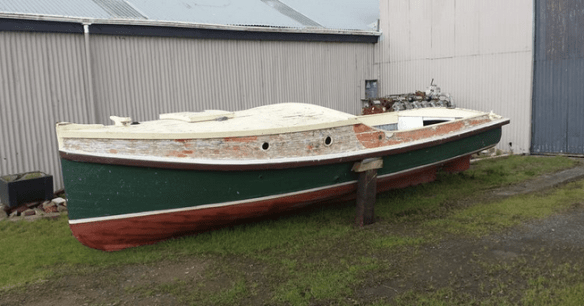
The photos of the above skiff were sent to me by Baden Pascoe. Baden reports that it is a genuine Orkney Island fishing skiff bought back from the Orkney Islands by Baden’s friend Lyle Woods of Whitianga. The skiff was built in Lerwick c.1960/70’s as a training sailing rowing boat for a group similar to Sea Scouts. Her overall length is approx. 16’. The design is closely related to the St Alyes or Fair Isles fishing skiff now used by the NZ Coastal Rowing Association. The boat if restored would make an excellent two person raiding boat. Baden has know doubts she would sail well with a balanced lug rig & Baden told me that the NZ Coastal Rowing group would welcome this lovely boat to our fleet.
Her owner, Lyle, is looking to move the project on to a new owner & is asking a very fair price of $1,000. The not a lot of money for a boat this size & design. In fact on face value its a steal 😉
Baden commented that the NZ Coastal Rowing group would be able to assist with technical details on setting her up for rowing and sailing.

Interested parties can contact Lyle Woods at    lylemandcal@xtra.co.nz

Kauri Clinker

The Bloody Boat 011

The Bloody Boat 070

16′ Kauri Clinker Work Boat
photos & details ex Arthur Neely

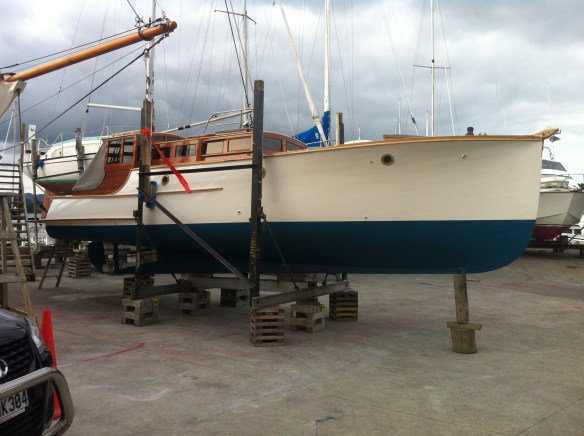
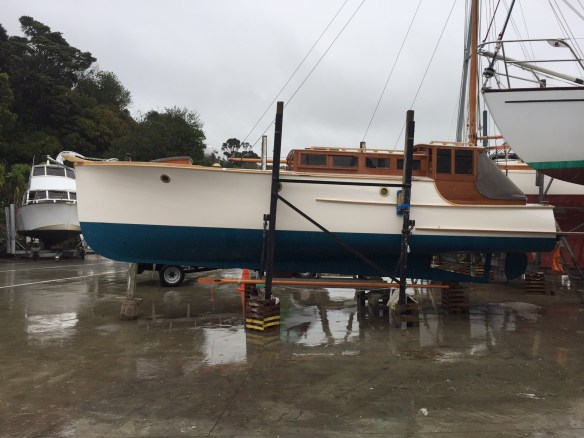
Arthur contacted ww as he has recently started the restoration of the beautiful little clinker work boat featured above and is trying to get some ideas as to her heritage, age, designer, builder etc. He is also keen learn if there is she any historical significance associated to the vessel.

What we know is that she is kauri clinker, 16′ long with a 5’6″ beam and Arthur reports in excellent condition, given her age. She has been in a shed in Hamilton for the past 45 yrs owned by 3 generations of the one extended family. However as is often the case Arthur hasn’t been able to get much of an idea of her lineage before that.

She had a Sea-Mite 4cylinder 20hp petrol engine in her with a shaft drive to a 3 blade fixed prop. Arthur doesn’t think it was the original engine as there are 2 sets of engine mounts visible.
She also had wheel steering installed at some stage, made up of what looks like old tractor parts, but appears to originally had inboard tiller steering.
From old photos Arthur has seen she looks very similar to designs by Logan Bros or Lanes, but he doesn’t know enough to know.
The canvas cover that you see in the photos, Arthur thinks is original.

The only real damage is she doesn’t have a rudder and from what Arthur gleaned from the previous owners, the rudder was damaged and the boat was put in the Hamilton shed for repairs, and that is where she stayed for the past 45 years. The boat is currently in a shed at Dairy Flat, Auckland.

If there are woodys that might be able to help Arthur understand this project better, he would appreciated hearing from you.

Harold Kidd Input

For a start, forget Logan Bros. The last dinghy they built was in 1911 and this boat is 40 years later than that at least. However Arch Logan’s son, Jack Logan, did build many similar launches post WW2 at Stanley Bay. But then, she could have been built by a dozen other very good boatbuilders at that time. Most put their plates on them unless they were retailed by Wisemans for example, when they were usually anonymous.
I think you can forget Lanes too. They had bigger boats to build.

Update from Arthur Neely
The boat was bought by Jock and Edith Graham in 1950 and homed on their property at Graham Rd Puketaha, I understand that is near Hamilton. When Jock died he left the boat to his son John and he has recently gifted the boat to his daughter Vanessa.
The boat was mainly used as a pleasure boat and for fishing on both Lake Rotorua and Lake Rotoiti. Jock bought the boat as he believed that she had been “professional built”. There is some suggestion that the boat had been built in Tauranga but I think this might just be speculation.
To my eye though, there is no doubt that she was built by skilled craftsmen.
I am trying to find out who Jock bought the boat off in 1950 but I think this might be a long-shot, everyone who would know has since died.
There is no evidence of the boat having a name, feedback from the family shows a consistent view that the boat was always called “the bloody boat”.

Little Tasman

LITTLE TASMAN - STARBOARD SIDE - 7.3.16 - 3

LITTLE TASMAN - STARBOARD SIDE - 7.3.16 - 0

LITTLE TASMAN
shed photos & info ex Ken Ricketts. Pt Wells photo ex Mark Edmonds. details ex Harold Kidd. edited a lot by Alan H

Back in early March Ken Ricketts dropped in to see artisan boat builder Colin Brown at his Omaha yard. Colin & side kick, Josh, have been restoring the rather pretty 26′ Colin Wild launch Little Tasman.  She was named Tasman when built in 1925 for Albert Spencer & changed her name to Little Tasman in 1927 when the bigger Tasman (photo included below) was launched by the same owner/builder. Its said she that LT was a prototype / test boat – Mr Spencer was not short of a few pennies 😉

It is such good news to see whats happening to Little Tasman as she sat on a front lawn at Pt. Wells for a number of years (photo below) & her future was at risk.

Little Tasman at Pt Wells

In Harold Kidd’s words Little Tasman is ‘pure class’ & whats happening in Colin’s shed is also pure class  – the man is one of the best classic friendly tradies out there.

You will see in the above photos that she now has a brand new 4 cyl Nanni 38 hp diesel in place, which should give her a top speed of around 10 knots, with a cruising speed, with her 2 to 1 reduction gear, of around 7 knots. Will be interesting to see her performance as the Nanni is a lot lighter than the old 6 cyl Ford diesel it is replacing.

Her restoration has seen most of her ribs replaced, a full recaulk (no splining), work on the forepeak & bow, a new dodger, very faithfully copied from the original & a full interior refit & partial redesign of the interior layout, for greater space use, & practicality.
Steering will be from the front of the tram top, as it was before, where there will be a large hatch fitted, to the newly replaced, as original, T & G cabin top. Check out the stern photo, classic Colin Wild on show there 🙂

Launch date is fast approaching so we will update on the event.

Read more on her past here      https://waitematawoodys.com/2015/04/20/little-tasman/

Below is a photo of Tasman that I took a few years ago in Sullivans Bay. She is stunner & on a lot of woodys bucket list.

Tasman @ Sullivans Bay

30-06-2016 – Another great photo update from Ken R of Little Tasman’s restoration at Colin Brown’s yard. Remember click on photos to enlarge 😉