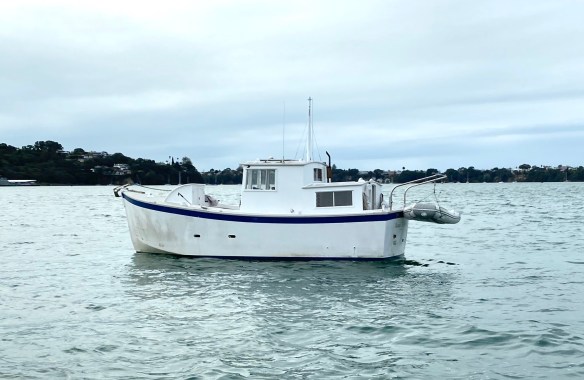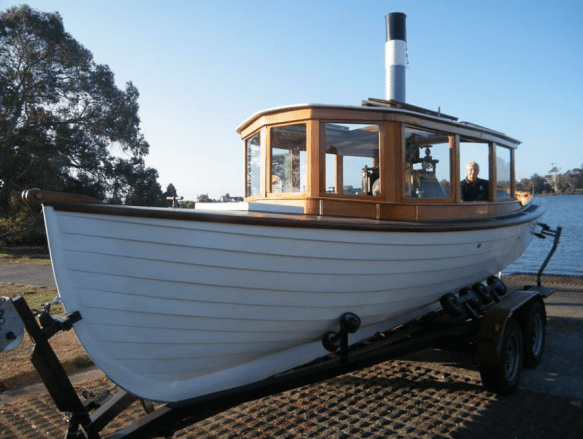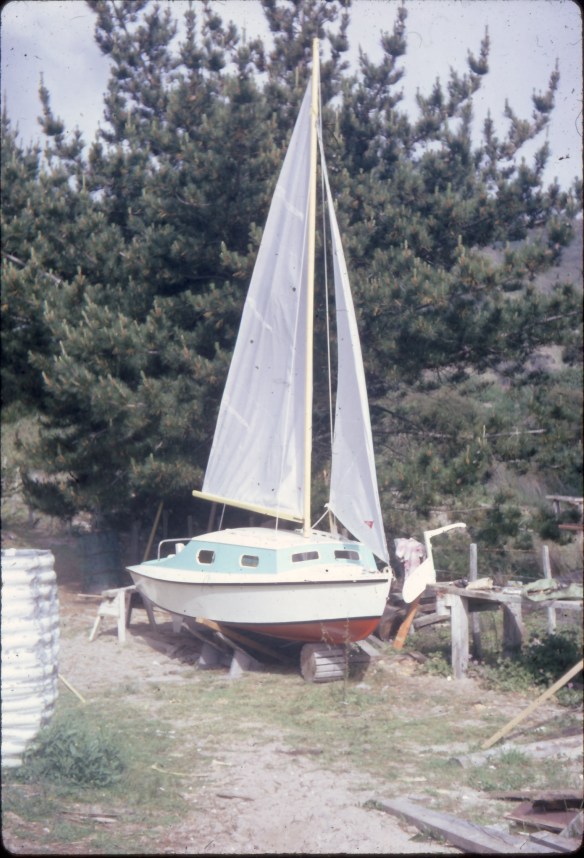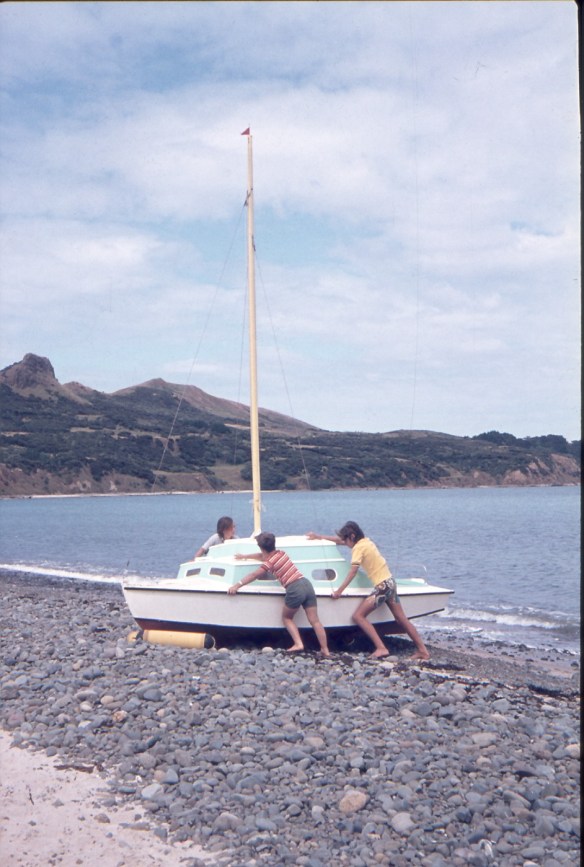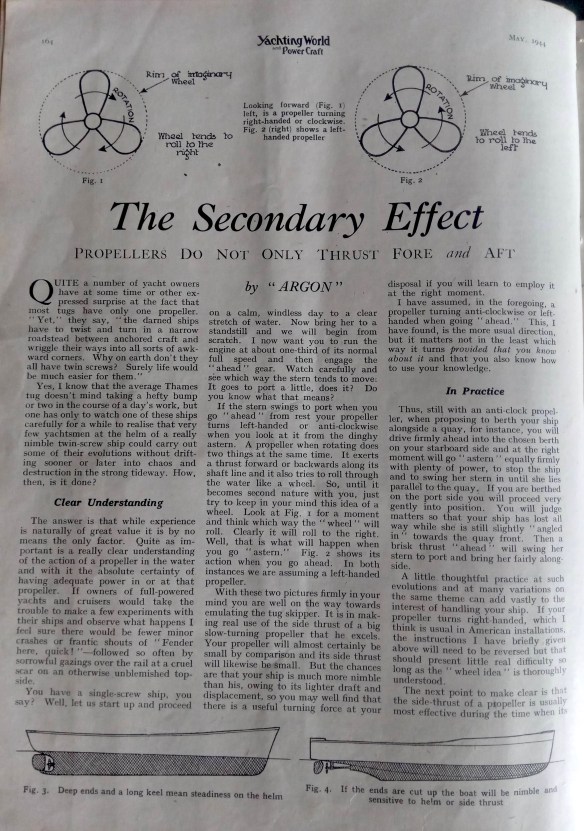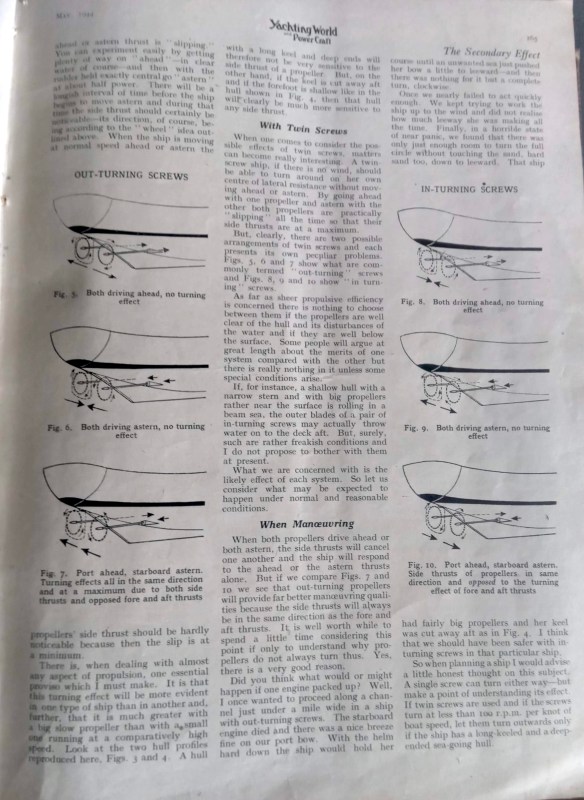


If you have been considering installing a bow thruster or if you occasionally have a berthing oops – read the article below that Chris McMullen sent me – it originally appeared in the May 1944 edition of – Yachting World & Power Craft. It’s been in Chris’s files for years and he uncovered it during lock-down. Chris commented that he felt he should share it. Have a read it explains boat handling in plain English + the analogy of thinking the propeller is a wheel is good. If its too hard to read, drop me an email and I’ll send you it in a larger format. waitematawoodys@gmail.com


LADY GAY (Raindance)
I spend a large chunk of my leisure time, pulling together the waitematawoodys stories that you all get to enjoy each day. One of the coolest parts is connecting people and boats, more often than not – it’s a grandchild looking for grandads old wooden classic or someone who used to crew on a boat and wants to contact with the long lost woodys they boated with. There have been some amazing link-ups, some taking years to surface, a common situation is someone sends in an old photo of a boat, it appears on WW, we generate some intel on the boat, then the story goes into hibernation for a while, sometimes years. Then someone does a google search on an old boats name and bang – up pops the WW story and we are away, they supply more details + photos and then that generates more – its called self populating. With over 5,500,000 views the WW site rates very well with google, also people tend to spend a lot of time on the site so that tells google the site is valued by people, so the boffins at google ‘assist’ the search functionality.
Anyway starting to get boring – yesterday was my day, my turn to be wowed by waitematawoodys. I received an email that stopped the clock. After 13 years of looking for more intel on my boat – Raindance, a gent named William Brown reached out to WW asking for assistance in tracking down a launch named Lady Gay that his father owned in the late 1960’s. Bill’s parents were Correen and James Brown and were lifetime boaties with a flotilla of craft over the years – James was also a former Commodore of the Onerahi Yacht Club and a member of the Whangarei Cruising Club.
One glance at Bill’s photos told me it was Raindance. Bill’s email is below
“It’s been fun during the lockdown to still have the consistency of your regular Waitemata Woodys posts. Thanks for that.
Back at the beginning of March, I won one of your Waitemata Woody T shirts on the Townson 28 quiz and I have been proudly wearing it around my neighbourhood during lockdown. I’ll send a picture in at some stage with perhaps a different story/email to today’s one.
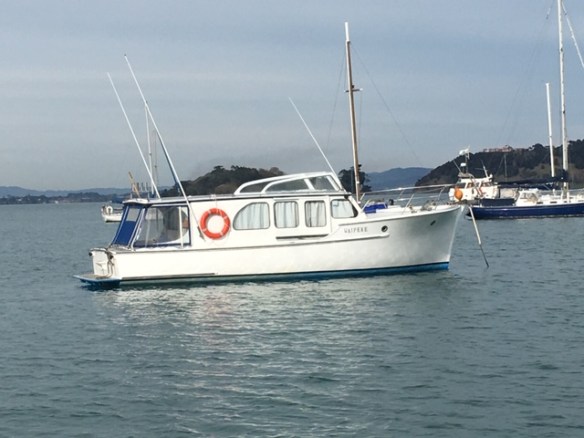
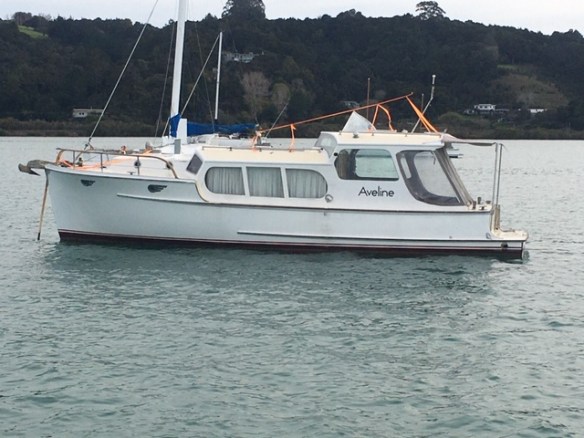
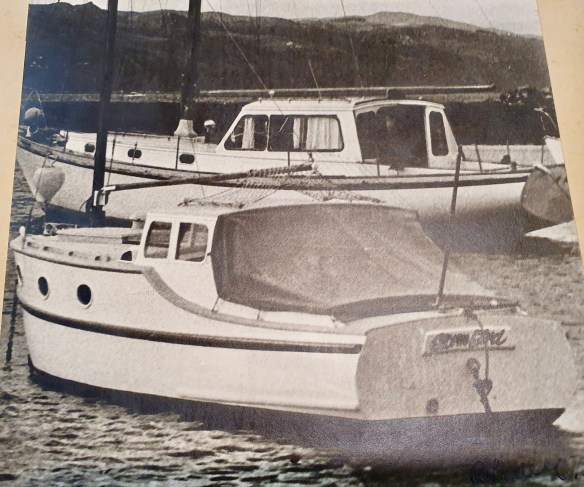
Ok, so I was I digging into my old photos recently and uncovered a couple of pictures (sorry about the quality), of our family’s launch that we owned for about 5 or 6 years in the late 1960s. We knew her then as Lady Gay, but as a youngster I never knew much about her provenance. I am not actually sure my dad knew much of her design or year built either. We used her extensively in the Whangarei harbour for family holidays and fishing trips. The coloured picture has me on the stern, while anchored at Tamaterau and the black and white photo is outside the old quarry in the top of McLeods Bay. I did see her once on the hard at Orakei, so believe she was in Auckland in the 1980s at some stage. She was about 27′ long, narrow and rolled around a bit. Dad fitted stabilizing chocks to her, closed in the canvas in the cockpit and added a decent sized mast, so we could run a stabilizing sail on her. She had a big old Ruston diesel if I remember right, which was incredibly reliable and economical. Those big saloon windows were pretty recognizable, functional, but ugly!
I would be most interested to find out more of the history of this “Lady Gay” ( i realize there are other more famous Lady Gay’s around and not even sure if she was originally given this name or indeed kept it after our ownership. I wonder if she is still going strong today and if so where she is based? Some good family memories were had on her for sure!”
Post lock-down Bill will be visiting his mother (lives in Northland still) and hopefully will obtain more details and photos.
As a result of Bill’s email I have filled in some of the missing pieces of the jigsaw puzzle – but I would love to uncover details from her launch date (c.1928) to the early 1960’s. Hopefully the above photos and details on her owner might jog some memories.
Below I have reproduced what I had previously been able to piece together on the boats past – if I’ve got my wires crossed, please let me know:-)
Lady Gay > Lady Gai > Nona C > Raindance (as at June 2015)
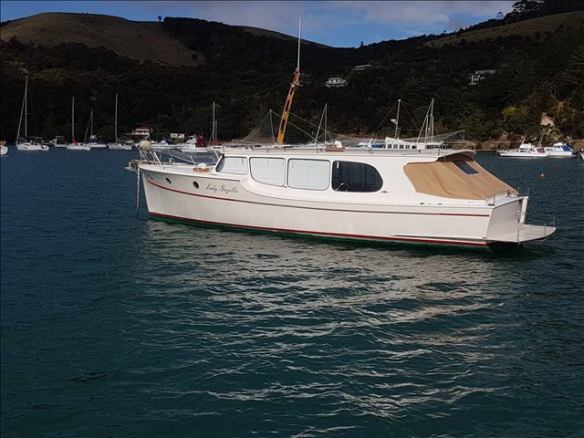
When I purchased the boat in August 2007 she was named ‘Nona C’, after the then owners (Craig Colven, a Auckland Harbour Board pilot boat skipper) daughter. He told me the boat was previously called ‘Lady Gay’. I did not like the name Nona C so was in the process of reverting back to Lady Gay when I was advised of another launch called Lady Gay (owned by Graham Wilson of the Wilson & Horton publishing family), not wanting to confuse things & on the advice of several marine historians I decided to chose a new name & went with ‘RainDance’. Interestingly Graham Wilson was prepared to add II (2) to his launches name.
I was not aware that ‘Gay’ had been changed to the Irish spelling ‘Gai’ until when I was given a copy of the Dunsford Marine Surveyors Ltd pre-purchase survey commissioned in March 2003 by a Dr. Rex Ferris. Had I known about the Gai/Gay I would have retained the Lady Gai name. I obtained Rex Ferris’s address from the survey & did a Google search which resulted in an Auckland District Health Board employment link & I contacted Rex Ferris. Like myself he knew little about her past, there are still huge gaps e.g. the 1930’s > early 1980’s but below is some history I have gained.
I have also spoke in Jan 2010 to Blair Cole (boat builder) refer below.
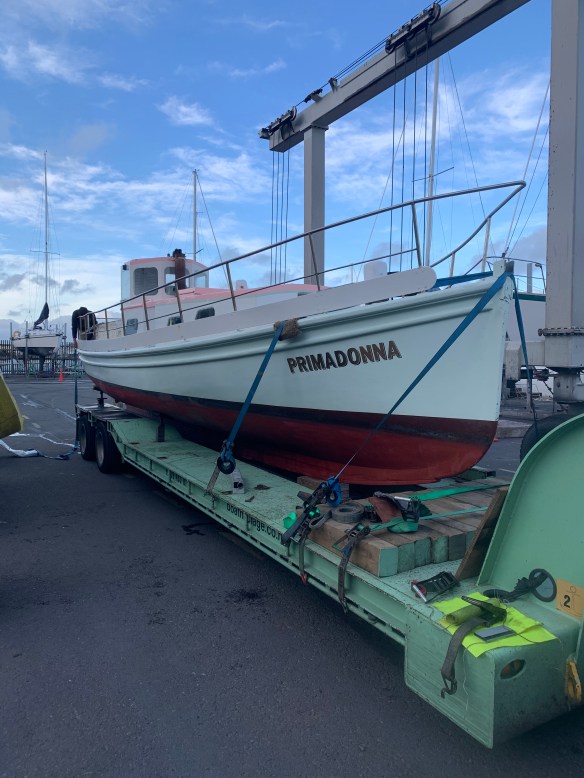
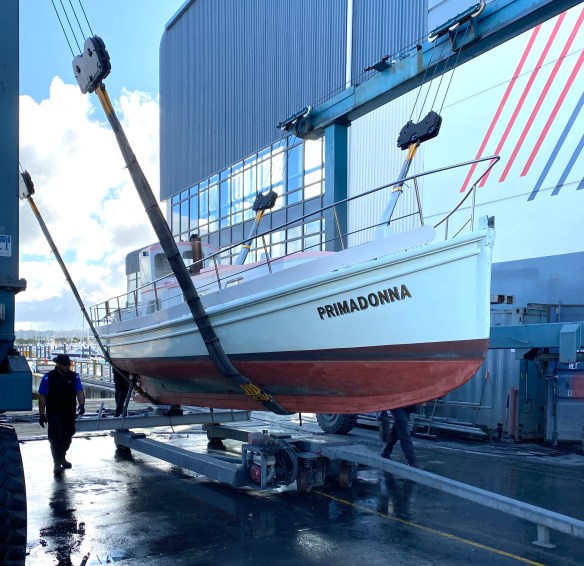
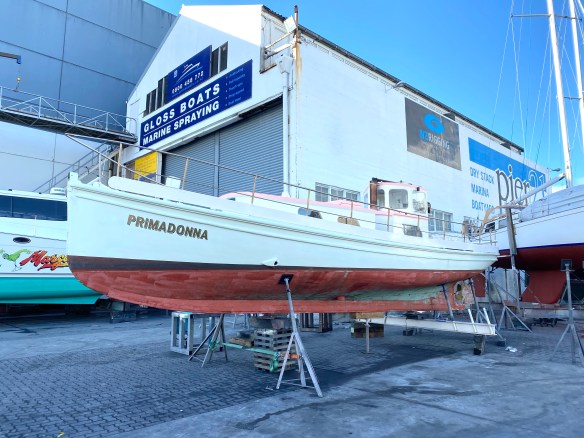
Peter & Ann Gill, the motoring journalist, bought the boat in c.1987 & at the time had a waterfront property in the Upper Harbour (near Paremoremo wharf) with a mooring put down. He saw the boat advertised in ‘Boat Trader’, she was moored in the Tamaki Estuary & he purchased her for about $7,000. He can’t remember the name of the owner but was told the boat was built by Lane Motor Boats in 1928, there is however some discussion that she may have been built by ‘Collings & Bell’. She had a single cylinder Bukh diesel engine, which was started via a decompression lever & hand cranking. The owner told Peter that she had been based at Great Barrier Island as a ‘long-liner’ fishing boat for many years prior to him buying her. When she was moored off Peters house, she took on quite a bit of water, and it was necessary for him to go out as often as twice a week and operate the manual bilge pump. He hired a tradesman who specialized in old boats and he decided that it was the stern gland that was the problem. Peter her hauled out and they filled the stern gland with tallow. It was not a one hundred percent fix & she continued to take on water. Peter was never very comfortable with the boat & to use his words ‘we never went far in her’. She was not a pretty boat in those days with a cabin top that looked like it had been made from a ply-wood car case. (Photos below)

I have spoken to Peter several times & while he is very friendly & chatty about the boat he is very elusive about when & to whom he sold her. The reason for this is that either Peter or the next owner (?) let her sink on her mooring in the upper harbour & she remain submerged for several weeks. Given the swallow, sheltered tidal nature of the mooring this had no major negative effect on the boat.
The next chapter is amusing – the mast only of the boat was visible from the Salthouse Boat Builders yard at Greenhite & the tradesman there were running a sweep-stake as to how long she would remain submerged before the owner rescued her. During this period two of the Salthouse apprentices – Blair Cole & Kelly Archer (who both went on to become well respected boat builders in their own right) hatched a plan to buy the boat. They tracked down the owner & both approached him independently, Kelly advised it would cost $3,000 to re-float the boat. Blair then approached the owner & offered an as-is-where-is price of $2,000. The owner accepted Blair’s offer. The boat was hauled out at Salthouse’s yard, she later moved to Blair’s house where he undertook a major restoration (John Salthouse told me at a CYA function once that he had a ‘guiding’ hand in the process).
Between 1988>89 Blair spent in excess of 1800 hours on the restoration – the work involved replacing the ply wood box cabin top with a more sympathetic tram top & doghouse. The two bronze port holes were added to the front of the cabin, along with the bronze mushroom deck vents, new twin plastic fuel tanks, a reconditioned 58hp Ford engine, new shaft, new 2 blade prop, new hydraulic steering (since replaced), anchor winch (since replaced). Extensive new ribs & sister ribs where fitted & her seams were re-caulked. All windows where replaced & new bunks fitted. He also removed her alloy mast & built & fitted the current oregon pine mast. The duck-board was also added. The s/s rod holders on her stern (since removed) came off the old Salvation Army launch.
Blair & his wife cruised the Gulf extensively in the boat in the 1990’s. Blair is a little hazy on whom & when he sold the boat to but thinks it was to someone who lived in Kumeu & they only keep the boat for less than 2 years. They probably sold it Dr. Rex & Sharron Ferris.
In 2003 Rex Ferris purchased her post the Dunstan marine survey (photo below during survey) but it appears he did not address any of the ‘faults’ identified in the survey. Rex Ferris spoke to Blair Cole (Cole Marine Services) in June 2003 & Blair confirmed the restoration work he undertook. Blair also confirmed that she was named Lady Gai.

(Unknown ownership / date photos)


In 2005 the boat was for sale on the hard at Bayswater Marina, I looked at her but she would have been too much of a burden for me at the time. The boat was purchased by Craig Colven who undertook hull work (replaced some planking, caulking, ribs, floors & keel bolts, as identified in the 2003 survey) & installed a new 45hp 4-cylinder Daidong diesel motor & replacement of all major machinery, electrics and plumbing. Including a freezer, new 3-blade prop, shaft bearings, bilge pumps. Devonport craftsmen’s Robbie Robertson (deceased) & Charlie Webley undertook the work.
Craig, over a 2 year period commissioned this work but never completed her, his wife did not share his passion for the sea & I purchased her in August 2007 for what I considered a bargain given what Craig Colven had spent on her in time & money. (Photo below when I purchased her)

I then undertook over the next few years what is called a rolling restoration i.e. I used the boat each summer but hauled her out in winter & continued the project. I retained the services of then Milford based wooden boat builder Geoff Bagnall for the big stuff, there were several areas (stem, cockpit decks, doghouse windows) of rot that needed to be removed plus we made her more ‘comfortable’ in terms of helm seat, doghouse hatch layout etc. New auto anchor winch & bow launcher were installed along with forward hatch porthole to improve light in forward cabin. I rolled my sleeves up on the rest.
I’m thankful for the care bestowed on the boat over the years – everyone that has rubbed up to her has helped get her thru the last 92 years.
(Recent – AH ownership photos)


And one of the two Lady Gay’s 🙂

29-09-2020 UPDATE


Woodys On Tour – Halls Boat Yard, New York
A few years ago, woodys Jim and Karin Lott were ‘parked up’ with the masts on deck in their kauri ketch – Victoria, on the Hudson River. More specifically in the middle of New York State in a city called Albany. The Lott’s waited there for three weeks for the Erie Canal to open. Jim commented that Albany definitely does not feature on anyone’s ‘place to go’ list. They were not alone as Wellington old salt Richard Watt and his wife Enid anchored alongside them in their launch (photo below of both boats), as well as dozens of other impatient US and Canadian sailors.
To while away the time they hired a car and headed to Lake George to look at woodies at Halls Boatyard, one of the many inland homes of wooden boats in New York. Jim commented that floating boat garages are common in North America and they spent several hours admiring a sea of varnished ash, cedar, spruce and mahogany. There was a slipway and boatyard all under cover inside the shed complex. The yard specialises in rebuilding and restoring classic motor-launches but a few yachts were getting the same TLC.
After the long wait, the canal stayed closed so they had to forgo the Great Lakes and continued up the Hudson. Eventually they locked into Lake Champlain and down the Richelieu River to the St Lawrence near Montreal in Canada.


Rarangi

Marline

Yesterday’s Project


21-04-2020 Harold Kidd Update – The 1938 date is a canard gleaned from “Mullet Boats ‘n Quotes” at page 46. Newspaper reports of the time say she was under construction by J. Graham of Otahuhu for his son Scott Graham in September 1939. Scott Graham was her original owner and raced her until the 1941 Lipton Cup when she was described as “new” and then in the Anniversary Regatta a week or so later.
Billy Matthews was shown as owner in the APYMBA records for 1946.
Graham Cole of Karaka Bay and L Good owned her in 1946. They sold to Ross Weaver of Whangarei c1948.S Hammond of Regina St Grey Lynn owned her in 1952. S Daniels of Webber St Grey Lynn in 1953. M Aitken of Mt Roskill in 1973. Ray Esdale Northcote c1980 followed by Howard Pascoe of course.
22-04-2020 – Robin Elliott Input – Ah … Mullet Boats N Quotes. Duck soup.
I don’t think she actually went into the water until some time in 1940, hence the ‘new’ tag in the 1941 Lipton Cup Report. I have an unconfirmed note that J. Graham and S. Graham were respectively the father and brother of Mark Graham the Kiwi rugby League Player – but he was not born until 1955, so I am not sure.
Regatta Programmes:
Billy Matthews entered her as Zamira in the 1946 Anniversary regatta, she came 6th across the line from 12 starters. He entered her as Ngahere in the 1947 Regatta so the name change was ‘possibly’ from the start of the 1946/47 season although he could have changed the name the day before the placed his regatta entry in January 1947. 🙂
Messrs Cole & Good enter her in the 1948 and 1949 Regattas, R. Weaver in the 1950 Regatta.
No regatta mentions until S. Hammond enters her in the 1953 and 1954 AAR
Nothing until 1961 AAR when entered by ‘Naylor, and then 1962, 1963 by N.E. ‘Taylor’
Other Registered owners were : K.W. Skinner, Wharf Rd, Herne Bay 1955+?; R.E.(N.E.?) Naylor, Hauraki St, Birkenhead 1960?/63+?; Munro 1966+?; M. O’Brien, Cameron St Ponsonby 1966+?; M.C. Chitty, East Coast Rd Browns Bay. 1968+?; H.L. Whitcombe, Onewa Rd Northcote 1970+?; M. Aitken, Tory St, Mt Roskill 1973+?
After that, darkness descends as the Auckland Yachting Assn stopped publishing their year books (or rather no one has given me anything after 1973.)


Question is – can a boat be considered to be a premise?
Checking the mooring strop, flapping halyards, bilge pumps etc is part of normal boat security, particularly when grumpy weather is forecast or has just been.”


Chatting with Tinopai (2hrs north of Auckland) based woody Greg Schultz he tells me advancing old age has forced him to make the reluctant decision to pass on one of my most prized possessions.
Greg built this boat about 10 yrs ago off the original 1905 Arch Logan plans (modified by Chapman1921). Construction is clinker lapstrake using 6mm ply with epoxy glued laps which gives a good lightweight watertight hull (originals leaked like sieves and weighed a ton). All other timbers are kauri and totara. He also added 3 buoyancy compartments for added safety (2 side seats & forward compartment all epoxy sealed inside). Greg commented that she has only been sailed approx. a dozen times.
The Silver Fern class (12’6″) was designed as a training boat for teenagers before they moved on to the bigger M class and is therefore almost a miniature ‘Emmie’.
Spars and rigging are s/s and sails by Fife. Pivoting centerboard and rudder for shallow water sailing. Permanent reef lines for shortening sail without coming ashore.
Woodys this is a stunning boat to both look at and sail so if you are frustrated with paying big marina fees and the hassles of organizing crew – maybe now is the time to add a woody to the fleet so that you can sail single handed or take the grand kids for a sail.


CLASSICO
A few weeks ago I was tipped off by Adrian Pawson that one of his buddies – James Ledingham, had ‘acquired’ a very special Frostbite named Classico, one of things that makes her special is that she was built but never launched, so effectively is a new boat. Adrian is the owner of – Kiteroa, the ex Brooke family boat, which Adrian has restored and ’tweaked’ a little, thats her in the photos with the orange hull.
I was onto James quick smart to get more details. But before that I have to say how cool it is to see these ‘young’ sailors getting into the classic wooden dinghy sailing scene. The guys sail out of Taikata Sailing Club in West Auckland (Te Atatu), on a good Sunday there are upwards of 15 Frostbites racing. Both Adrian and James would be too modest to say this – but both work at the very pointy (high tech) end of world sailing, which makes their passion for these woodys even more special 🙂
Adrian also supplied for our review (see below) a copy of Doug Sharp’s secret copy of the ‘Frostbite Go Fast Tips’ by Kevin Lidgard.
I’ll let James tell the story –
“Recently I was fortunate enough to purchase ‘Classico’ a wooden frostbite dinghy.
What made this boat unique, aside from her immaculate timber detailing, was that she was brand new and had never been sailed. Something of a rarity in the frostbite class these days.
‘Classico’ is the result of a labour of love by her builder and previous owner David Strickett (Brother in law of Rex Maddren – a well-known Frostbite sailor and champion in his day). Looking for a wooden boat project and with a love of the clinker style, the Frostbite dinghy was a natural choice for David to get stuck into. Having picked up his wooden boat building skills at Carrington Tech under the guidance of Robert Brooke (son of Jack Brooke, who designed the original frostbite back in 1937) he was certainly well equipped to tackle such a build. Robert helped him source some temporary frames from Wakatere Boating Club and he got stuck in.
The boat is built in kauri, the majority of which was sourced from a farmer in Mangamuka, just south of Kaitia. The exception was the single piece transom, which came from a kauri slab that David already had in his garage.
Many hands make light work and during the build David sought help with the planking and ribbing from Robin Dew, who had built several wooden Frostbites himself. Whangarei boat builder Nick Rodokal also lent a hand in constructing the gunwhale, having previously built David a Lotus 9.2 (Pursuit).
David kitted the boat out with modern aluminum spars, a Quantum Mylar sail, and the latest Harken deck gear. Adding a touch of performance to the classic kauri hull.
It was a bittersweet moment to launch ‘Classico’ down at Taikata Sailing Club on the first Sunday of March 2020, ahead of the regular afternoon sailing. She would have been equally at home in a museum (or the lounge!) and once wet and raced, unlikely to ever be quite be as immaculate again. However, they are such great boats to sail I was looking forward to getting out and seeing what she could do. She was appropriately blessed by another frostbite legend, Doug Sharp, and champagne was poured. A successful first sail ensued with minimal leaking.
While the quality of the boat couldn’t be faulted her performance was an unknown. However, she certainly seems to be fast (when the skipper sends her in the right direction) so far grabbing a 2nd in the first race of the Taikata Sailing Club winter series held earlier in March.
I plan to race her regularly down at Taikata Sailing Club, where the Frostbite fleet is thriving – with 12+ boats on the start line every fortnight. Wooden boat enthusiasts are welcome to come down to the club and have a yarn. There are a good number of well-kept and restored timber Frostbites amongst the fleet, and no shortage of stories!
The name ‘Classico’ stems from a holiday dinner in Tuscany where David and his wife were enjoying a bottle of traditional Chanti wine – Chianti ‘Classico’.”


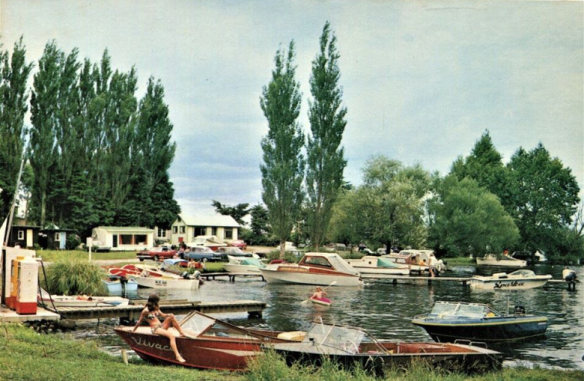
(Launches – L>R) Lady Eileen, Crusader, Makura (ID ex K Rickets)


Bay Of Islands 1950’s Gallery