PATIKI YACHTS – SAILING SUNDAY photo ex Michael O’Dwyer
The rather serene photo above shows a number of Patiki yachts tied up in Ahuriri Lagoon, it was taken just 4 days before the February 3rd 1931 Napier earthquake. The earthquake reduced the size of the lagoon considerably when the seabed in the area lifted (up to 2.7 metres just north of Napier) spelling the end of lagoon sailing to the far Poraiti hills. The photo is hanging on the wall at the Napier Sailing Club.
Updated – to appease Robin E I have added a wee bit more sailing to ‘sailing sunday’ 🙂
Kahurangi (below x2) at Napier – Michael O’Dwyer commented that the Patiki Kahurangi was last owned by a current NSC member Peter Parvin, about 30 years ago. He had replaced some broken ribs and had it moored in a creek awaiting further work. Unfortunately some scallywags deciding to go for an adventure untied it and let drift off into a storm grate which destroyed it.
Peter told Michael they had sailed her once in about 10 knots of breeze and recalls it being quite scary with her massive rig and no ballast.
Maroondah (below) off Westshore Beach
Some Chat
Yesterday several classic launch owners & friends went to Waiheke Island for the inaugural Oyster Festival held at the Rangihoua Estate Olive Grove, the day was a brilliant mix of live music, fine local wines & craft beers + the most succulent Te Matuku Bay oysters cooked every which way. And for the non oyster lovers there were plenty of other dishes to sample.
On route we had a a little scare that thankfully was a false alarm, while motoring along approx. 1k from the island we spotted something in the water & turned around. It was a body & the mood on board sobered up pretty fast, closer inspection revealed it was a dummy that Coast Guard had planted as part of an exercise. There was a note explaining this attached to the dummy. All very relived that the day was not going to be distributed by a ‘floater’.
The Des Townson Story & The 2015 Classic Yacht & Launch Exhibition – Part 2 – Sailing Sunday
Today’s post features the yachts, both keel & trailer, that are on display at the Tino Rawa Trust hosted exhibition & gives you a peek at the collection of memorabilia & models also on display.
The show is open today from 10.00am > 4.00pm at the Viaduct – details in yesterdays post (scroll down). So if you are looking for something to do post chapel ;-), come on down.
I’ll let the photos tell the story. Enjoy
Remember click on only photo to enlarge 😉
Tony Stevenson
John Macfarlane
Sue Townson
Bill Townson
Brian Peet
Martin Tusker, Tony Stevenson, Peter Montgomery, Greg Fenwick
Updated – dropped down to the exhibition late this afternoon, primarilly because Colin Pawson told me I had over looked the best Townson yacht on show – Caper. I did have one photo of her, but most of the time I do what I’m told 🙂 so back I went.
So glad I went back & introduced myself to the owner & had a wee tour – simply stunning, & yes would get my best in show. Check out the bilge photo, I suspect the pump does not see a lot of use, a duster would be all that is required 😉
I also had a peek on-board the launch Aristos, she too is a work of art.
Yesterday I was privileged to attend the opening of the 2015 Classic Yacht & Launch Exhibition, now if you have been living under a stone & are not aware of this annual event hosted by Tony Stevenson & the Tino Rawa Trust, the concept is simple but a winner. Each year one of our wooden boat designers is profiled & a collection of their craft is assembled & displayed. In recent years profiled designers have been – Jack Brooke & Colin Wild, in 2015 the event celebrates the life & work of Des Townson MNZM. In the nicest way, Des Townson was a freak, every boat from a 2.4m pram dinghy to a 12m cruiser/racer he designed was a work of art. A Townson will always be the prettiest yacht in the bay, their classic styling & purity of form was a winner on launch day & remains so to this day, over 3,500 Townson yachts have been built – that alone is impressive.
Today on ww I have featured Des’s one & only motorboat, Aristos, the 11.4m displacement launch built by Noel May. Tomorrow I will open the flood gates & post photos from the opening function & the fleet of stunning yachts on display at the Viaduct.
The event runs today & tomorrow, between 10am & 4.00pm at the Viaduct, alongside the draw bridge & in front of the old Team NZ base, entry is free & if you are passionate about beautiful boats you need to be there – the collection of craft on & off the water & Townson memorabilia is amazing.
As part of the celebration – the Tino Rawa Trust have produced a glossy journal profiling Des Townson’s life & designs – its available at the exhibition marquee for $20 & this wonderful publication complied by John Macfarlane, has to be, a must have in your collection. I have two copies to give away to woodys – I’ll make it simple, the first two woodys that correctly name the design of the Townson yacht that was the most popular i.e the most built (excluding the Electron model yachts)- I’ll give you a clue- it shared its name with a popular model of automobile, wins a copy. Because some of you struggle to work out how to use the ww comments section 🙂 I’ll split the prizes – one via email entry at waitematawoodys@gmail.com & one via entry in the comments section. You can only enter once 😉
Now Aristos – even with the addition of a flying bridge & her once varnished coamings hidden under battleship grey paint, she is a Townson & that means that no matter what angle you view her, she is simply beautiful. Why only one was built I do not know, maybe there is a story there?
So folks, make your way to the waterfront this weekend & take advantage to this once only exhibition that showcases one of our most successful & talented craftsman.
Now the owner of Aristos, Ray Haydon, is a very clever & talented man with his hands – a wee example of his skills can be seen on the bow of Aristos, Ray has designed & crafted an anchor turner (ensures the anchor is presented correctly when retrieving by winch) – it looks a little like a big bottle opener, but I can assure you it will be ‘fit for purpose’. Rather than paying for the imported Italian ones, someone needs to market Ray’s design 😉
Asking woodys to ID the race would be a big ask 🙂 so maybe we just ask that we match the yacht names to the sail numbers. From L>R its – E34 / L18 / A11 / E21 / E11 / A16 / A2 / H6 / B20 .
And if you wondered why we refer the boats as – shes , below might be the answer.
13m Marina Berth For Rent
If anyone is looking for a 13m marina berth at Gulf Harbour? one of the private apartment berths (extra security) is available on a long term / permanent basis. Email address below for details. kenpat@ihug.co.nz
AUCKLAND WOODYS WELCOME HIS MAJESTY’S SHIP photos ex Russell Ward. details ex Harold Kidd
During the discussions on last weeks post on the very fast CMB, Russell sent me the above impressive photos from when HMS Renown (tbc) visited Auckland. An impressive number of woodys featured. How many can we ID? – I have attached a numbered, L>R (1>7) photo below.
There is potentially some confusion as to the date/year of the visit & whether in fact it is HMS Renown or her sister ship HMS Repulse.
Renown came here solo in 1920 with the Prince of Wales and again in 1927 with the Duke & Duchess of York.
Maybe it’s Renown in 1927 but it could be Repulse in 1924 or Renown in 1920 (fyi Luana that can be seen in the photo was launched in late March 1920 only a month before the 1920 visit).
Update from Barry Davis
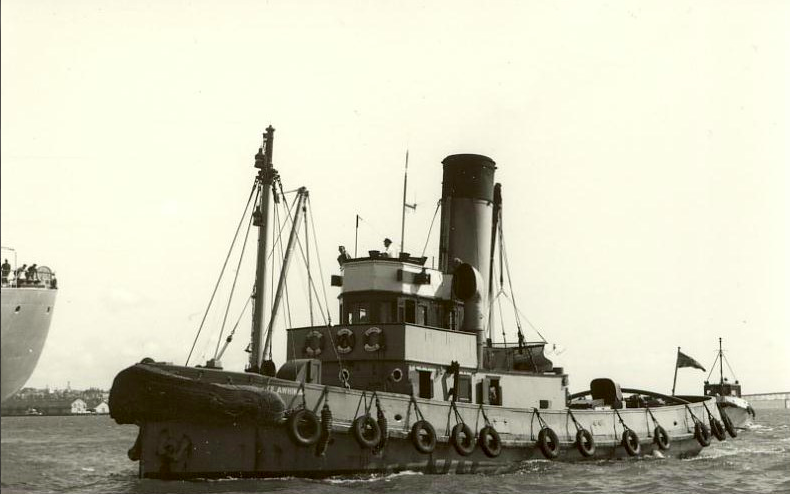
Robin Elliott is correct in saying that this is the 1920 visit of the Renown. Below are a couple of photos from the Auckland Weekly News dated 29 April 1920, unfortunately they are not that clear. The small steamer in the foreground and to the left in the second view is the Onewa, the tug closing in on the bow is the Te Awhina.
24-09-2015 Photo of Te Awhina below – ex Russell Ward
Stella was built by Lanes of Totara North in the mid 1950s. Benjamin (Ben) Le Clerc, farmer of Otara, Helena Bay, bought her from Lanes. Stella was 32 ft, built of kauri, with a petrol motor and set up as a game boat. Later, while moored at Helena Bay, a petrol explosion occurred which blew out the forward hatch. She sat on the beach for three months while having a 40 h,p, diesel motor installed.
Disaster struck again on the 21st April 1963 when Ben was returning from a fishing trip with eight men on board, and a catch of 13 hapuka. The boat hit a rock off the Wide Berth (Limerick, Rimiriki) Islands. A mayday signal was sent which was picked up at Russell and Port Charles. In the meantime the boat broke up and the men clambered onto a rock. The first to answer the mayday call were Jack Foote of Footes Bay and Mr J.D Prestney, manager of Mimiwhangata. A runabout was sent out, which laboured to the mainland with 11 people on board. Mr Prestney was off-loaded at Mimiwhangata. He raced to his Landrover and flashed his headlights to attract the attention of the Kitty Vane which was approaching from Tutukaka.
Meanwhile the other ten proceeded towards Helena Bay where disaster struck again. The runabout struck a submerged reef and began to sink. All had to abandon ship once again and cling to a small dinghy which was being towed. It was 3 a.m. before they reached the mainland again. 21 year old Glenys Foote was the heroine of the event. She rowed the dinghy that transferred the men from the rocks to the runabout, and then later rowed the 8 men to shore while Ben swam.
So woodys can anyone add to the history of Stella. Was she salvaged or slipped away to Davey Jones locker? There is some confusion as to her length some say 32′ others 38′, can anyone confirm?
Harold Kidd Input
STELLA apparently WAS a total loss when she went aground on the Limericks, Wide Berth Island, on 21/4/1963, that is according to Madge Malcolm’s book “Where it all began”, but the wreck doesn’t appear in “Shipwrecks of NZ”. She was then owned by B.C. Le Clerc of Helena Bay and was a 38ft bridgedecker. I think she was probably supplied by Lanes at Totara North but was undoubtedly built by Lanes at Auckland, despite the Sam Ford-type waist windows.
WHERE IS THIS WOODYS GATHERING? photo ex Harold Kidd
Today’s photo was taken in the period 1895-1905 & is ‘around’ the Waitemata.
What say you woodys – whats the location?
Article ex Paperpast from the NZ Herald 3 Jan 1896 (ex Harold Kidd)
Also a wee bonus today – Martin Turnwald, son of CYA member John Turnwald (MV Robyn Gae), who now resides in Switzerland, has sent in a c.1993 video of the William C Daldy. We see the crew was firing up the boilers to turn the old girl around on the wharf and Martin and then girlfriend, (now wife) were on board to watch.
Grail Dancer, launched at Thetis Island in 2000 to a design from 1866.
Morseby III at Cowichan, Vancouver Island.
Salmon purse seiner Coastal Pride at Matlakatia, Alaska.
Salmon trolling fleet, Sitka, Alaska.
MV Teal, built 1927 for North West fisheries patrol, restored 1999, at Taku Harbour, Alaska.
Fishing boats in retirement, Wrangell, Alaska.
WOODEN BOATS OF THE INSIDE PASSAGE
Story & photos by CYA NZ member Denis O’Callahan (owner of MV Tasman)
Today’s post tells the story of Judy & Denis O’Callahan’s adventure cruise – its a great read, so I’ll let Denis tell the story. Enjoy 🙂
“In April 2000 I was invited by a Canadian friend to help launch a boat which his brother Wayne had built on Thetis Island in the Strait of Georgia near Vancouver. The “Grail Dancer” is 48’ on the deck, ketch rigged and based on the lines of the “Emma C Berry”, a 150 year old traditional fishing boat now preserved at the Mystic Seaport Museum, Connecticut. Wayne works as a wooden boat builder and restorer who at that time was restoring historic paddle steamers at Fort Dawson and Whitehorse on the Yukon River during the summer. During the winter he worked on the “Grail Dancer” which took him 14 years to complete. This trip was a great experience which gave me an inkling of what a wonderful cruising ground the Inside Passage to Alaska would be. This was further reinforced when I read the great book, “Passage to Juneau” by Johnathan Raban.
Eventually this year my wife Judy and I planned a visit to Vancouver and Alaska, including an adventure cruise of the Inside Passage. Our first stop was Vancouver, from where we took a float plane to Victoria on Vancouver Island to spend a couple of days with friends who live near Nanaimo. On the way north from Victoria we called in at the small fishing port of Cowichan where I was able to see a converted fishing boat, “Morseby III”, which belongs to a guy I know who lives at Mangawhai. We flew back to Vancouver from Nanaimo and had a couple of days there including a visit to the excellent Maritime Museum. Here there is preserved the wooden auxiliary schooner St Roch, built in 1928 in Vancouver and operated by the Royal Canadian Mounted Police. In 1942 St Roch completed the first voyage from the Pacific to the Atlantic through the Northwest Passage, 27 months from Vancouver to Halifax and spending 2 winters in the ice. In Halifax her engine was upgraded from 150hp to 300hp and she made the return journey in 1944 in 86 days.
Next we boarded the Alaska Marine Highway ferry “Columbia” for a 2 night, 1 day voyage from Bellingham to Ketchikan. This was rather like a Cook Strait ferry and while we had a comfortable cabin many hardy souls camped in deck, fixing their tents down with duct tape. We saw a number of other boats during this trip, huge barges laden with containers and trucks, cruise ships, fishing boats, pleasure boats and some of the contestants in the inaugural “Race to Alaska” (R2AK). R2AK is open to any kind of boat without an engine, from kayaks to racing trimarans, 750 miles from Port Townsend to Ketchikan. First prize, $10,000, second prize, a set of steak knives. The ferry passed through many spectacular narrows and channels and at Bella Bella we stopped while the crew lowered the anchors to demonstrate compliance with US Coast Guard requirements.
Ketchikan is a busy port town with floating docks and other marine facilities. However during the summer it is dominated by up to 4 giant cruise ships visiting each day. A large marina (“floats” in the local lingo) accommodates a variety of fishing and pleasure craft. The salmon fishing boats are divided into 3 types, purse seiners which go for large volume, low value fish, gill netters which aim for better quality and trollers which target the top quality product. Long-liners target halibut, a kind of gigantic deep water flounder which can grow up to 200kg.
We took a 10 day adventure cruise on the “Alaska Dream”, a 104’ catamaran, rather like a Waiheke ferry with cabins for 40 passengers and a crew of 17. We strongly recommend this as a way to see the Inside Passage. Activities included walks ashore, railway excursions, kayaking and even swimming. We saw amazing wild life, indigenous culture, glaciers and fishing ports, including Sitka, Skagway, Haines, Juneau, Petersburg, Wrangell, Thorne Bay, Matlakatia and Ketchican. In every port there were numerous classic wooden fishing vessels in varying states of preservation. I would estimate that 90% of the working fishing boats around the Inside Passage are of wooden construction. The plentiful supply of rot resistant old growth Yellow Cedar and Western Red Cedar no doubt accounts for the durability of these vessels”
I was sent this movie, filmed in late1929/30’s by the Lambourne brothers (Allan & Alex) nearly 2-1/2 years ago by Roger Guthrie, it was back in the very early days of ww & since then a lot more people have checked onto the site – in fact over 100,000 people. On ww last week I bumped into Peter Stein whose father (also Peter) appeared in the movie. Peter has written a very cool synopsis of the movie & the (now) classic launches that appear in the movie. I suggest you read Peters words & then watch the movie. Enjoy 🙂
The film “Beautiful Waiheke” by Peter Stein
Introduction:
The film was produced by the Lambourne brothers Allan & Alex in the late 1920’s early 1930’s. The Lambournes owned a large furniture shop on the corner of Ponsonby Road and Pompallier Terrace. The Arran Bay house was built in 1910 and remained Lambourne property until 1964 when it was sold to the Jorgensen Family.
Water transport for the Lambournes was the launch “Nga Whare” which is the round bilged craft in the film with the two portholes in her topsides. She was sold when I was a very young boy so I remember little about her.
Our property is next door to the Lambournes. Arran House was built circa 1885 for Andrew and Mary Croll from the Isle of Arran, Scotland. They were two of Waiheke’s pioneers. Andrew was a very fine photographer and albums of his photos can be seen at the Waiheke Historical Society Museum on Onetangi Road. Among the photos are scenes of the Annual Regatta organised by Andrew and held at Arran Bay circa the late nineteenth century. These events were well supported by “boaties” of the day. The albums were kindly donated by the Crolls of Sydney. Mary Croll was a very good artist and she put many scenes of the “bottom end” on canvas. Some of her mural work is still on the walls of one of the bedrooms in Arran House. My father, P.A.S. Stein purchased Arran House from W.J. Connell (owner of Connell’s Bay Store) in 1924 and it has been in our family ever since.
The Waitangi, the launch with mast and crosstree in the film was built in 1923 for Mr Cadman. It was a classic John L. Hacker design with sharp entry and flat stern section. The original owner named her “Karamana”. She had an aeroplane engine in her and we understand she was capable of 25knots which made her one of the fastest launches on the Waitemata at that time. Harold Kidd has a very good photo of her racing on the harbour (added below. AH). In the latter 1920s she ended up on the Tamaki Drive breakwater. My father bought the severely damaged hull and had her restored by Chas Bailey & Sons. He renamed her the “Waitangi” after his father’s steamer the TSS Waitangi of the Northern Steamship Co. My grandfather Peter Anton Stein was a Captain of various Northern Steamship Co. vessels from 1895 to 1908. Chas Bailey told my father that the Waitangi had brought them good luck because the next launch off their slipway was the legendary “Shenandoah”.
The Waitangi was 28 feet long (8.5m), had a beam of 7 foot 3inches (2.2m) and draft of 2 foot 8 inches (.8m). She was built in kauri and the bottom was double skinned from the bow to the wheelhouse. The rest of the vessel was single skinned. Her Auckland mooring was in St Mary’s Bay in front of the Ponsonby Cruising Club at the bottom of St Mary’s Road. Maintenance was carried out at Collings and Bell Boat Builders adjacent to the PCC.
About 1930 my father replaced the old Studebaker engine with a 105hp Kermath marine engine. Allely Bros. of Beaumont Street imported the motor and installed it. It was known as a 6 cylinder flat top. The pistons had a bore of 4” (100mm) and each cylinder had two spark plugs. It was double ignition with one spark plug connected to the magneto and the other one the distributor. Maximum speed was 18kns and at this speed the motor burnt 8 gallons of petrol per hour. Petrol was bought in 4 gallon cans and there were two cans to a box. We still have an old Atlantic box which we use as a vegetable bin at Arran House. Petrol in the early 30s was 1 shilling and six pence a gallon. A 50% rebate brought the price back to a respectable 9 pence a gallon. My father told me that the best run home he achieved was Connell’s Point to Kings Wharf in 1 hour and 12 minutes.
The film:
The film began with shots of the Guthrie family aboard their launch “Alcestis”. It then moved to shots of Arran Bay taken from different location around the Bay. The people setting out down the path are coming from the Lambourne’s house.
The aquaplaning sequence was filmed from the shore and the “Nga Whare” which was the tow boat. My father was the young man with one of the Lambourne girls on his shoulders. Years later I learnt to aquaplane on the same board.
The “Waitangi” then heads to Bulls Bay with my father as pilot. The majority of the film is shot at Bulls Bay (Anita Bay) on the north eastern end of Waiheke. At the northern end of the bay are many small rocky islands and the launches are filmed going through the channels between the rocks. These are not hard to navigate but should be done at ½ tide or more.
The “Coughing Caves” are in the southern point of Bulls Bay. With a northerly swell and incoming tide, waves enter the caves and when the top reaches the ceiling of the cave the air behind it is compressed until it bursts out in a cloud of spray. The boy in the dingy, Reg Crawford, is trying to get as close as he safely can to the emerging spray.
The “Whirl Pool” is in the long reef extending from the northern end of Bulls Bay. Riding the swell in and out of the pool could be quite exciting as seen in the film.
The homeward bound shots of the Waitangi in the storm were taken in the channel between Pakatoa and Waiheke.
Harold Kidd Input from previous ww post
Waitangi was built as KARAMANA for F.B. Cadman in 1923 by Bailey & Lowe to a design by Hacker. KARAMANA = CADMAN in pig maori. She was later bought by Auckland Grammar School teacher P A S Stein and rebuilt as per the 2nd photo below. She was fitted with a war surplus 6 cyl Green sohc aero engine producing 120-140bhp, bore 5.5 ins, stroke 6 ins (you work out the capacity). She was pretty radical.
03-09-2015– comments
1. The Lambourne launch was called NGAWAI I think, not NGA WHARE. She was later bought by the Andrews family on the Hokianga. I remember her as a child during WW2 laid up in a shed with a Chrysler engine. Maybe another NGAWAI but she looks the same. 2. KARAMANA/WAITANGI was built by Bailey & Lowe in 1923, not by Chas. Bailey Jr who built SHENANDOAH in 1929. There’s some conflation there.
LOST – The MY GIRL Trophy + Good News on Margaret S
This ones going to test the collective memory base of the all the woodys out there. We are looking for a trophy that was linked 80+years ago to the NZ Power Boat Association, I’m talking here about the old NZPBA, with races that involved real wooden boats – not the lumps of fiberglass with oversized outboards on the back they race today.
The trophy was the ‘My Girl’ trophy & was donated by a Mr. C. (Tui) Waldron to replace the ‘Burt Cup’. There are numerous press clipping that mention events where the cup was contested, won or presented. I have attached copies below for your reference / interest.
Despite all the searching no photo can be found of the cup.
The present-day owner of the launch ‘My Girl’, who the cup was named after, Jason Prew would like to track down the whereabouts of the cup & any information on what became of it. While the cup itself may not have survived, someone out there must know something about its past. Launches that have won the trophy include – Taura, Tasman & Crusader. Crusader was owned by the Rev Jasper Calder & was steered to victory by Miss Edna Herick. It appears that in several of the events that the trophy was offered up, one of the conditions of racing was the vessel had to be steered by a woman.
Launches that have raced for the trophy include – Taura, Aumoe, Edwina, Tasman, Nautilus, Ramona, Crusader, Wailani, Lady Margaret & Wanderloo.
So folks anyone able to help out in the hunt??
Note: Photo above taken during a Victoria Cruising Club annual regatta, year & boats unknown. Romance II could be the launch on the left. Photo ex ‘Sir George Grey Special Collection (Auckland Libraries)
Good News About Margaret S
SAMSUNG
CYA member Alan Good reports that the Collings & Bell launch Margaret S, built as Marne c.1918/19 that has been moored off Bayswater marina breakwater for several years has found a new owner – sailmaker Bud Nalder, the photo above shows her being towed from BW to Whakatakataka Bay (OBC) where she will be hauled out & undergo restoration. Knowing Bud’s skills & level of craftsmanship, Margaret S is in very good hands.
For more details / photos on her https://waitematawoodys.com/?s=Margaret+S&submit=Search
Now moored in Whakatakataka Bay (photo Mark Edmonds)




 waitematawoodys.com #1 for classic wooden boat stories, info, advice & news - updated daily - 15+ million views