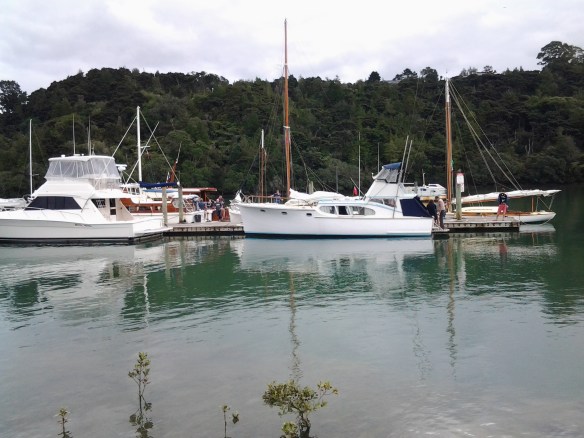
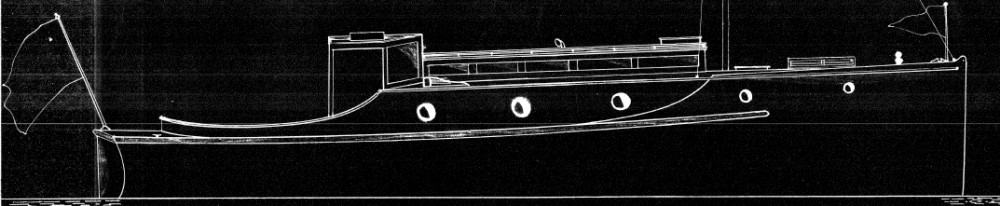
Stella was built by Lanes of Totara North in the mid 1950s. Benjamin (Ben) Le Clerc, farmer of Otara, Helena Bay, bought her from Lanes. Stella was 32 ft, built of kauri, with a petrol motor and set up as a game boat. Later, while moored at Helena Bay, a petrol explosion occurred which blew out the forward hatch. She sat on the beach for three months while having a 40 h,p, diesel motor installed.
Disaster struck again on the 21st April 1963 when Ben was returning from a fishing trip with eight men on board, and a catch of 13 hapuka. The boat hit a rock off the Wide Berth (Limerick, Rimiriki) Islands. A mayday signal was sent which was picked up at Russell and Port Charles. In the meantime the boat broke up and the men clambered onto a rock. The first to answer the mayday call were Jack Foote of Footes Bay and Mr J.D Prestney, manager of Mimiwhangata. A runabout was sent out, which laboured to the mainland with 11 people on board. Mr Prestney was off-loaded at Mimiwhangata. He raced to his Landrover and flashed his headlights to attract the attention of the Kitty Vane which was approaching from Tutukaka.
Meanwhile the other ten proceeded towards Helena Bay where disaster struck again. The runabout struck a submerged reef and began to sink. All had to abandon ship once again and cling to a small dinghy which was being towed. It was 3 a.m. before they reached the mainland again. 21 year old Glenys Foote was the heroine of the event. She rowed the dinghy that transferred the men from the rocks to the runabout, and then later rowed the 8 men to shore while Ben swam.
So woodys can anyone add to the history of Stella. Was she salvaged or slipped away to Davey Jones locker? There is some confusion as to her length some say 32′ others 38′, can anyone confirm?
Harold Kidd Input
STELLA apparently WAS a total loss when she went aground on the Limericks, Wide Berth Island, on 21/4/1963, that is according to Madge Malcolm’s book “Where it all began”, but the wreck doesn’t appear in “Shipwrecks of NZ”. She was then owned by B.C. Le Clerc of Helena Bay and was a 38ft bridgedecker. I think she was probably supplied by Lanes at Totara North but was undoubtedly built by Lanes at Auckland, despite the Sam Ford-type waist windows.
WHERE IS THIS WOODYS GATHERING? photo ex Harold Kidd
Today’s photo was taken in the period 1895-1905 & is ‘around’ the Waitemata.
What say you woodys – whats the location?
Article ex Paperpast from the NZ Herald 3 Jan 1896 (ex Harold Kidd)
Also a wee bonus today – Martin Turnwald, son of CYA member John Turnwald (MV Robyn Gae), who now resides in Switzerland, has sent in a c.1993 video of the William C Daldy. We see the crew was firing up the boilers to turn the old girl around on the wharf and Martin and then girlfriend, (now wife) were on board to watch.
Grail Dancer, launched at Thetis Island in 2000 to a design from 1866.
Morseby III at Cowichan, Vancouver Island.
Salmon purse seiner Coastal Pride at Matlakatia, Alaska.
Salmon trolling fleet, Sitka, Alaska.
MV Teal, built 1927 for North West fisheries patrol, restored 1999, at Taku Harbour, Alaska.
Fishing boats in retirement, Wrangell, Alaska.
WOODEN BOATS OF THE INSIDE PASSAGE
Story & photos by CYA NZ member Denis O’Callahan (owner of MV Tasman)
Today’s post tells the story of Judy & Denis O’Callahan’s adventure cruise – its a great read, so I’ll let Denis tell the story. Enjoy 🙂
“In April 2000 I was invited by a Canadian friend to help launch a boat which his brother Wayne had built on Thetis Island in the Strait of Georgia near Vancouver. The “Grail Dancer” is 48’ on the deck, ketch rigged and based on the lines of the “Emma C Berry”, a 150 year old traditional fishing boat now preserved at the Mystic Seaport Museum, Connecticut. Wayne works as a wooden boat builder and restorer who at that time was restoring historic paddle steamers at Fort Dawson and Whitehorse on the Yukon River during the summer. During the winter he worked on the “Grail Dancer” which took him 14 years to complete. This trip was a great experience which gave me an inkling of what a wonderful cruising ground the Inside Passage to Alaska would be. This was further reinforced when I read the great book, “Passage to Juneau” by Johnathan Raban.
Eventually this year my wife Judy and I planned a visit to Vancouver and Alaska, including an adventure cruise of the Inside Passage. Our first stop was Vancouver, from where we took a float plane to Victoria on Vancouver Island to spend a couple of days with friends who live near Nanaimo. On the way north from Victoria we called in at the small fishing port of Cowichan where I was able to see a converted fishing boat, “Morseby III”, which belongs to a guy I know who lives at Mangawhai. We flew back to Vancouver from Nanaimo and had a couple of days there including a visit to the excellent Maritime Museum. Here there is preserved the wooden auxiliary schooner St Roch, built in 1928 in Vancouver and operated by the Royal Canadian Mounted Police. In 1942 St Roch completed the first voyage from the Pacific to the Atlantic through the Northwest Passage, 27 months from Vancouver to Halifax and spending 2 winters in the ice. In Halifax her engine was upgraded from 150hp to 300hp and she made the return journey in 1944 in 86 days.
Next we boarded the Alaska Marine Highway ferry “Columbia” for a 2 night, 1 day voyage from Bellingham to Ketchikan. This was rather like a Cook Strait ferry and while we had a comfortable cabin many hardy souls camped in deck, fixing their tents down with duct tape. We saw a number of other boats during this trip, huge barges laden with containers and trucks, cruise ships, fishing boats, pleasure boats and some of the contestants in the inaugural “Race to Alaska” (R2AK). R2AK is open to any kind of boat without an engine, from kayaks to racing trimarans, 750 miles from Port Townsend to Ketchikan. First prize, $10,000, second prize, a set of steak knives. The ferry passed through many spectacular narrows and channels and at Bella Bella we stopped while the crew lowered the anchors to demonstrate compliance with US Coast Guard requirements.
Ketchikan is a busy port town with floating docks and other marine facilities. However during the summer it is dominated by up to 4 giant cruise ships visiting each day. A large marina (“floats” in the local lingo) accommodates a variety of fishing and pleasure craft. The salmon fishing boats are divided into 3 types, purse seiners which go for large volume, low value fish, gill netters which aim for better quality and trollers which target the top quality product. Long-liners target halibut, a kind of gigantic deep water flounder which can grow up to 200kg.
We took a 10 day adventure cruise on the “Alaska Dream”, a 104’ catamaran, rather like a Waiheke ferry with cabins for 40 passengers and a crew of 17. We strongly recommend this as a way to see the Inside Passage. Activities included walks ashore, railway excursions, kayaking and even swimming. We saw amazing wild life, indigenous culture, glaciers and fishing ports, including Sitka, Skagway, Haines, Juneau, Petersburg, Wrangell, Thorne Bay, Matlakatia and Ketchican. In every port there were numerous classic wooden fishing vessels in varying states of preservation. I would estimate that 90% of the working fishing boats around the Inside Passage are of wooden construction. The plentiful supply of rot resistant old growth Yellow Cedar and Western Red Cedar no doubt accounts for the durability of these vessels”
I was sent this movie, filmed in late1929/30’s by the Lambourne brothers (Allan & Alex) nearly 2-1/2 years ago by Roger Guthrie, it was back in the very early days of ww & since then a lot more people have checked onto the site – in fact over 100,000 people. On ww last week I bumped into Peter Stein whose father (also Peter) appeared in the movie. Peter has written a very cool synopsis of the movie & the (now) classic launches that appear in the movie. I suggest you read Peters words & then watch the movie. Enjoy 🙂
The film “Beautiful Waiheke” by Peter Stein
Introduction:
The film was produced by the Lambourne brothers Allan & Alex in the late 1920’s early 1930’s. The Lambournes owned a large furniture shop on the corner of Ponsonby Road and Pompallier Terrace. The Arran Bay house was built in 1910 and remained Lambourne property until 1964 when it was sold to the Jorgensen Family.
Water transport for the Lambournes was the launch “Nga Whare” which is the round bilged craft in the film with the two portholes in her topsides. She was sold when I was a very young boy so I remember little about her.
Our property is next door to the Lambournes. Arran House was built circa 1885 for Andrew and Mary Croll from the Isle of Arran, Scotland. They were two of Waiheke’s pioneers. Andrew was a very fine photographer and albums of his photos can be seen at the Waiheke Historical Society Museum on Onetangi Road. Among the photos are scenes of the Annual Regatta organised by Andrew and held at Arran Bay circa the late nineteenth century. These events were well supported by “boaties” of the day. The albums were kindly donated by the Crolls of Sydney. Mary Croll was a very good artist and she put many scenes of the “bottom end” on canvas. Some of her mural work is still on the walls of one of the bedrooms in Arran House. My father, P.A.S. Stein purchased Arran House from W.J. Connell (owner of Connell’s Bay Store) in 1924 and it has been in our family ever since.
The Waitangi, the launch with mast and crosstree in the film was built in 1923 for Mr Cadman. It was a classic John L. Hacker design with sharp entry and flat stern section. The original owner named her “Karamana”. She had an aeroplane engine in her and we understand she was capable of 25knots which made her one of the fastest launches on the Waitemata at that time. Harold Kidd has a very good photo of her racing on the harbour (added below. AH). In the latter 1920s she ended up on the Tamaki Drive breakwater. My father bought the severely damaged hull and had her restored by Chas Bailey & Sons. He renamed her the “Waitangi” after his father’s steamer the TSS Waitangi of the Northern Steamship Co. My grandfather Peter Anton Stein was a Captain of various Northern Steamship Co. vessels from 1895 to 1908. Chas Bailey told my father that the Waitangi had brought them good luck because the next launch off their slipway was the legendary “Shenandoah”.
The Waitangi was 28 feet long (8.5m), had a beam of 7 foot 3inches (2.2m) and draft of 2 foot 8 inches (.8m). She was built in kauri and the bottom was double skinned from the bow to the wheelhouse. The rest of the vessel was single skinned. Her Auckland mooring was in St Mary’s Bay in front of the Ponsonby Cruising Club at the bottom of St Mary’s Road. Maintenance was carried out at Collings and Bell Boat Builders adjacent to the PCC.
About 1930 my father replaced the old Studebaker engine with a 105hp Kermath marine engine. Allely Bros. of Beaumont Street imported the motor and installed it. It was known as a 6 cylinder flat top. The pistons had a bore of 4” (100mm) and each cylinder had two spark plugs. It was double ignition with one spark plug connected to the magneto and the other one the distributor. Maximum speed was 18kns and at this speed the motor burnt 8 gallons of petrol per hour. Petrol was bought in 4 gallon cans and there were two cans to a box. We still have an old Atlantic box which we use as a vegetable bin at Arran House. Petrol in the early 30s was 1 shilling and six pence a gallon. A 50% rebate brought the price back to a respectable 9 pence a gallon. My father told me that the best run home he achieved was Connell’s Point to Kings Wharf in 1 hour and 12 minutes.
The film:
The film began with shots of the Guthrie family aboard their launch “Alcestis”. It then moved to shots of Arran Bay taken from different location around the Bay. The people setting out down the path are coming from the Lambourne’s house.
The aquaplaning sequence was filmed from the shore and the “Nga Whare” which was the tow boat. My father was the young man with one of the Lambourne girls on his shoulders. Years later I learnt to aquaplane on the same board.
The “Waitangi” then heads to Bulls Bay with my father as pilot. The majority of the film is shot at Bulls Bay (Anita Bay) on the north eastern end of Waiheke. At the northern end of the bay are many small rocky islands and the launches are filmed going through the channels between the rocks. These are not hard to navigate but should be done at ½ tide or more.
The “Coughing Caves” are in the southern point of Bulls Bay. With a northerly swell and incoming tide, waves enter the caves and when the top reaches the ceiling of the cave the air behind it is compressed until it bursts out in a cloud of spray. The boy in the dingy, Reg Crawford, is trying to get as close as he safely can to the emerging spray.
The “Whirl Pool” is in the long reef extending from the northern end of Bulls Bay. Riding the swell in and out of the pool could be quite exciting as seen in the film.
The homeward bound shots of the Waitangi in the storm were taken in the channel between Pakatoa and Waiheke.
Harold Kidd Input from previous ww post
Waitangi was built as KARAMANA for F.B. Cadman in 1923 by Bailey & Lowe to a design by Hacker. KARAMANA = CADMAN in pig maori. She was later bought by Auckland Grammar School teacher P A S Stein and rebuilt as per the 2nd photo below. She was fitted with a war surplus 6 cyl Green sohc aero engine producing 120-140bhp, bore 5.5 ins, stroke 6 ins (you work out the capacity). She was pretty radical.
03-09-2015– comments
1. The Lambourne launch was called NGAWAI I think, not NGA WHARE. She was later bought by the Andrews family on the Hokianga. I remember her as a child during WW2 laid up in a shed with a Chrysler engine. Maybe another NGAWAI but she looks the same. 2. KARAMANA/WAITANGI was built by Bailey & Lowe in 1923, not by Chas. Bailey Jr who built SHENANDOAH in 1929. There’s some conflation there.
LOST – The MY GIRL Trophy + Good News on Margaret S
This ones going to test the collective memory base of the all the woodys out there. We are looking for a trophy that was linked 80+years ago to the NZ Power Boat Association, I’m talking here about the old NZPBA, with races that involved real wooden boats – not the lumps of fiberglass with oversized outboards on the back they race today.
The trophy was the ‘My Girl’ trophy & was donated by a Mr. C. (Tui) Waldron to replace the ‘Burt Cup’. There are numerous press clipping that mention events where the cup was contested, won or presented. I have attached copies below for your reference / interest.
Despite all the searching no photo can be found of the cup.
The present-day owner of the launch ‘My Girl’, who the cup was named after, Jason Prew would like to track down the whereabouts of the cup & any information on what became of it. While the cup itself may not have survived, someone out there must know something about its past. Launches that have won the trophy include – Taura, Tasman & Crusader. Crusader was owned by the Rev Jasper Calder & was steered to victory by Miss Edna Herick. It appears that in several of the events that the trophy was offered up, one of the conditions of racing was the vessel had to be steered by a woman.
Launches that have raced for the trophy include – Taura, Aumoe, Edwina, Tasman, Nautilus, Ramona, Crusader, Wailani, Lady Margaret & Wanderloo.
So folks anyone able to help out in the hunt??
Note: Photo above taken during a Victoria Cruising Club annual regatta, year & boats unknown. Romance II could be the launch on the left. Photo ex ‘Sir George Grey Special Collection (Auckland Libraries)
Good News About Margaret S
SAMSUNG
CYA member Alan Good reports that the Collings & Bell launch Margaret S, built as Marne c.1918/19 that has been moored off Bayswater marina breakwater for several years has found a new owner – sailmaker Bud Nalder, the photo above shows her being towed from BW to Whakatakataka Bay (OBC) where she will be hauled out & undergo restoration. Knowing Bud’s skills & level of craftsmanship, Margaret S is in very good hands.
For more details / photos on her https://waitematawoodys.com/?s=Margaret+S&submit=Search
Now moored in Whakatakataka Bay (photo Mark Edmonds)
Hows this for a cool idea, in the old days boaties used to rally around & hold an orphans day, where they took orphans (what a horrible sounding word) out on their boats for a magic day out. Not much chance of that happening now with all the PC rules & do-gooders out there.
In my early 20’s I sailed (on a Davidson 28, I know fiberglass) with one of life’s real characters, his name was Kaye Raymond Thode & someone should have written a book about that man, in my circle of yachting friends he was a legend. This was in the days of no cell phones & the skipper Dennis Ross had a few simple rules:
1. The boat leaves the dock at x.xxam, miss the boat & you had better find another boat to sail on for the next race
2. Anything discussed on the boat, stays on the boat
3. When away, personal hygiene was non negotiable – you weren’t even allowed to fa_t
4. Meals were always very civilized & you had to wear a shirt & sit at the table & no elbows on the table etc
5. Talking with a mouth full of food earned you a clipped ear
Well none of these rules applied to Kaye, he was uncontrollable BUT we all loved him & if his life tales had been published it would have been another Johnny Wray book.
I’m still bound by Rule #2 so my lips are sealed on the tales but you could be sitting on the rail, Kaye didn’t like that but there was no chance of ever getting Ron Lusty out of the cockpit & I don’t think the skipper, Dennis Ross, ever went forward of the mast 🙂 & Kaye would drop a clanger like “I grew up in an orphanage, we were poor & so all the kids were sent to an orphanage”, then later I hear from someone else that from his early 20’s Kaye organized a Xmas boating picnic for the kids at the orphanage he had attended – the picnic was really something with Kaye as Santa handing out amazing presents. I understand it was the biggest thing in the kids year. Kaye could be a total rogue but he had a heart of gold. Saying that when I knew him he was single, having been tossed out by his wife for diving drunk into a childs swimming pool & almost paralyzing himself, & my mother was a widower & I made it very clear to Kaye if I ever saw his car outside mums house I would shoot him 🙂
Today’s photo c1950’s was sent to me by Ken Rickett’s ex Dianne Hopson & is of Orphan Day. Ken Rickett’s reports that some of the boats that were involved every year were Valsan (Arnold Baldwin – Valsan, was a key mover in the events), Rehia (again Bill Ryan – Rehia, was also heavily involved), Hukarere , Gay Dawn, Tasman, Lady Eileen, Margaret S, Apache, Tiromoana, Lady Joan, Aurora, Moanalua, Faye,Royal Falcon & a lot of others.not sure if its the same day as Kaye’s but it must have been a blast for the kids. Somewhere in that fleet is the launch Hukarere.
SOUTHERN BAY 1994 Replica of a 1904 Truscott Mfg. Co Steam Launch. Compromise hull and 33 sq ft. Propane fired vertical tube boiler.
WAITEMATAWOODYS TRIP REPORT FROM OVERSEAS
Today’s photos & story came in from James Dreyer, who along with the extended family currently have Laughing Lady at the Whangateau Traditional Boat Yard. Jame’s work / travel take him off-shore a lot & in late May he was in the USA & put together a little story on the Southern California wooden boating scene. I’ll let James tell it. Enjoy 🙂
Remember if you click on a photo it will enlarge & you can read the captions. Scrolling over also reveals the captions.
“Back in late May, my father Barry & I headed to San Diego to spend a few weeks working on my Rhodes 33 “Therapy” and to visit the some of the 160 odd small breweries in the County, just to ensure their IPA’s were up to scratch. San Diego is known as the home of craft brewing, with each brewery having a tasting room and kitchen, or if not, bringing in a different gourmet food truck each night. Needless to say the hard work sanding and laying Uroxsys/Awlwood in the Southern Californian heat was well balanced with hydrating activities. And yes, the beer is so good, it was mind bottling (to coin a phrase).
While we were there I got in touch with Ralph Rodheim, the owner of another Rhodes 33 “Madness”.
I was hoping to head north to his place on Balboa Island / Newport Beach, to take some measurements and hopefully go for a sail. As luck would have it, the Balboa Yacht Club’s second inaugural Wooden Boat Festival was on during the final weekend of our visit, and Ralph was both an organising Chairman, entrant, and judge. This was a perfect opportunity to give the worn down finger tips, and high calorie intake a rest, while seeing how economical our rental Prius Hybrid could be heading North on the Pacific Highway to Newport. We left early, and stopped at a diner on the way for some bad coffee and an overcooked bacon muffin. This was California after all.
The show was just brilliant. A very Interesting variety of boats, interesting characters and live music.
I bumped into a number of “Rhodes people” and we swapped stories and info about the history of the class and how our restorations were coming along.
Above are some photos of the various boats, some I am lacking much info on, so my apologies in advance. If anyone wants more info on a certain boat, I am more than happy to respond with what I have, or get some more info from friends.
I thoroughly recommend viewing the following collection of photos from the event: http://bycwoodenboatfestival.com/schedule-of-events/ They are beautifully shot and feature a whole lot of boats I didnt photograph, and many of their interiors.”
REVELRY 1951 Stephens Bros. Cruiser 42’
REVELRY
HUMBLE 1902 Thames River Launch 52′
GRACIE 1950 Ed Monk Bridge Deck Cruiser 36’ Monk was a master of streamlining and this little cruiser was just gorgeous, especially with its two wooden kayaks and dinghy. Built for exploring the Pacific Northwest.
GRACIE
MADNESS 1948 Rhodes 33 One Design Philip Rhodes / South Coast Boat Building Co.
LAST CALL 1948 Chris Craft Holiday 24′
CHIEF 1947 Chris Craft “Red & White” Express Cruiser 25′
FIRECRACKER 38’ Grand Craft 2003 Replica of a 1928 Chris Craft
SPARKLE A super cute Philip Rhodes designed 17’ Electric Skiff Originally tender to the 77’ Rhodes Motor Sailer SEA DIAMOND Built at Abeking & Rasmussen in 1956.
SPARKLE
HUNGRY BLONDE 1949 20’ Chris Craft Owned by the owner of Hungry Blonde winery. This was my pick of the show.
HUNGRY BLONDE
S WONDERFUL 1939 Chris Craft 19’
FOUR BELLS 1955 36’ Rybovich Sportfish #16 Rybovich boats are the Rolls royce of sport fishers. The first being built for Earnest Hemingway and featuring the first fly bridge and outriggers.
Four Bells
FOUR BELLS aft cockpit steering station. Whoar…
BLAIR BARRY 1926 Fay & Bowen Saint Lawrence River Launch 26′
BLAIR BARRY
JOYFUL Bill Dunlaps beautifully home build, yet to see the water. 16ft Whitehall
A lovely clinker / lapstrake dinghy
AWESOME. Oldsmobile V8, turning an original, custom built 1 into 2 Vee drive gearbox and twin screws.
Awesome
Barry Dreyer posing on the aft deck of the Schooner America Replica.
SOUTHERN BAY 1994 Replica of a 1904 Truscott Mfg. Co Steam Launch.
ONO Dawn Boat Co. 1929 New York Commuter Yacht & Florida Sport fisher Twin Detroit 6/71s
ROSE WILDER 1968 Sparman & Stephens / Canteri Sangermani Sloop Carvel construction, fin keel, skeg hung rudder
A little taste of Southern California: Big trucks offset by Hybrids and Solar panels.
Chris McMullen & his 1898 reproduction Herrreshoff steam boat
One of Chris’s experiments
Otira- 1902 Logan Bros
And of a few photos of one of the prettiest boats on the Waitemata – Wirihana, the 1933 Colin Wild launch.
A Visit to Chris McMullen’s Boat Shed
Yesterday was a biggie on the wooden boating front – Barbara Cooke & myself organized for the Classic Yacht Association a visit to Chris McMullen’s workshop & boat shed. I have posted photos of the shed & its contents on ww before & ww has published several of Chris’s posts on the topic of electrochemical damage to wooden boats – but it was special for the members to meet the man himself & hear him speak on his past, his current passions / projects & future plans. The reproduction 1898 Herreshoff steam launch project just has to be one of the best kiwi ‘can-do’ tales around. The day she hits the water will be a very special occasion, I just hope I’m around to see it 😉
Today two things stood out for me: 1. The turn-out of two wooden boating icons – John Salthouse & Max Carter 2. The healthy number of sub 35 year old guys with a new found passion for classic wooden boats in attendance
If your a CYA member & you didn’t make the effort to come to the event – more fool you – as one of your most respected members said to me “today was a privilege, Chris is a one of a kind, his practical knowledge on boat building and engineering is unique”.
In my time as CYA launch captain one of my personal goals was to help deliver up events & access to people & ‘cool stuff’ that people would not normally have access to without being CYA members – from the comments & the smiles as people where departing today, Barb & I got it right today 🙂
To read / view more on Chris, his boats & the topic of electrochemical damage to wooden boats just enter – Chis McMullen – in the ww search box 😉
Following on from yesterdays post on the Logan motor-sailer ‘Eva’ which was pictured tied up at the wharf at Moturekareke Island & had the Logan mullety ‘Cora’ alongside, I have been sent a selection of stunning photos of Cora at the island in 2010 & under sail. Bob has owned her for 23 years (since 1992) & purchased her from a close family friend of Ivan Anderson, who inherited her from Charlie Hansen in 1944. Charlie being the resident ‘hermit’ on the island that unsuccessfully shuttled ‘Rewa’ as a seawall. Bob has done a wonderful job returning Cora to a look more fitting a 100+ year old lady. Harold Kidd told Bob that Cora was one of the few mullettys that flew topsails. Also included is one of Cora sailing along with SY Nina, that sadly went missing in the Tasman with the loss of all crew on board. This photo was taken during the Russell Tall Ships and Classic race.
At some stage today the counter on the watematawoodys.com blog site will tick over & show that people have viewed the site 1,000,000 times.
I choose the above photo for todays post because to me it captures what the classic wooden boat movement was / is all about. Its got everything there – motor boats, yachts, dinghies, people hanging out having a good time – there is even a dog 🙂 . The location is obviously Mansion House Bay at Kawau Island. The photo was sent to me by Robert Brooke & is from his father’s, Jack Brooke, stunning collection. (click on the photo to enlarge)
When I look back at the first few posts on waitematawoodys its amazing how we have evolved & now how big the audience is both in terms of numbers & the geographical reach.
I would like to thank all the followers of the site, but special thanks must go to everyone that sends in material (photos & info). Doing a daily post can be a little challenging at times but just when I start to panic, an email arrives from someone with some old photos of granddads boat. I would also like to thank Harold Kidd who gave me a swift kick in the backside 2 years ago in terms of getting serious about the site & the accuracy of the content. I would be embarrassed to say how many hours I had to spend to go back & populate the existing posts in terms of year, designer,builder etc but now the site is the #1 reference tool for New Zealand classic wooden boats. But that is a by-product, the real success of the site is that everyday it delivers to people something fun & enjoyable to read & interact with, something that puts a smile on their face.
Way did I start waitematawoodys ? – well the idea came to me via my involvement in the NZ Classic Yacht Association, the CYA is a great club but like most small clubs it can be seen as slightly cliquish, we do so many neat things but the audience is small & there are so many more people out there with an interest in wooden boats. With the birth of social media networks, stuff (photos, stories, info) that had previously been packed away, could now be available to anyone with a computer or smart phne. The future was all about content being on-line & easy to access. It was also about being collaborative. With the advent of personal websites (called blogs) people like myself are able to create a communication channel that has no boundaries. But more importantly blogs are able to be managed/controlled so that they remain true to the topic, which in the case of waitematawoodys is – the study & appreciation of classic wooden boats & the desire to tell the stories behind them & the people who built them, owned them & crewed on them. At the start the content was all about motor boats but as the audience has grown the readers now have a broader interest in all classic wooden boats & things related to them.
Why did I call it waitematawoodys – now I could put my advertising hat on & rabbit on about what the words mean to people but the simple truth is its just a cool name & looks great on a tee-shirt 🙂
I still get a buzz out of posting daily & from the feedback I get, so do you. But folks – do not hold back on spending stuff to me, some of it in isolation may not be enough for a post but I file it & then bang, someone else sends me something on the same topic & we have a story.
Again thanks for being part of waitematawoodys & remember – its all about wooden boats.
Cheers Alan
ps below is an advertisement I made to plug membership of the CYA (you should join up) the photo (ex Chris Miller) shows we are still enjoying these wonderful craft. If you look hard that’s me in my number one clinker dinghy – I say #1 because there are a few………….. 🙂