Takohe – Sailing Sunday

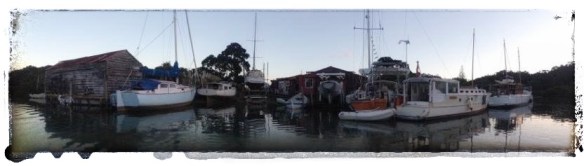
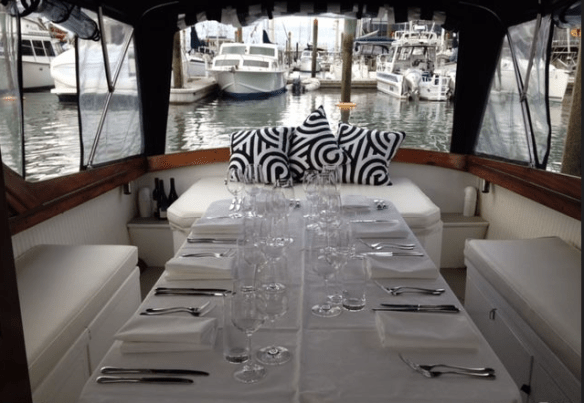
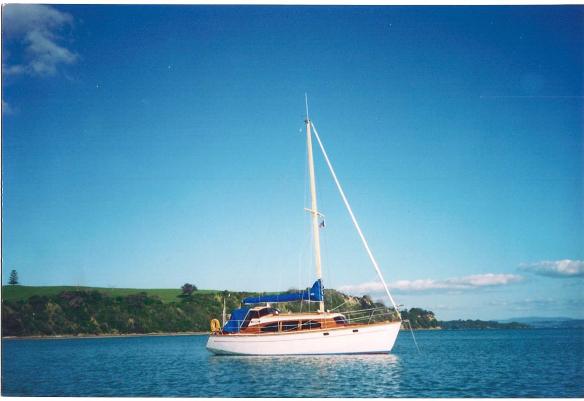
Takohe in Islington bay

Islington Bay

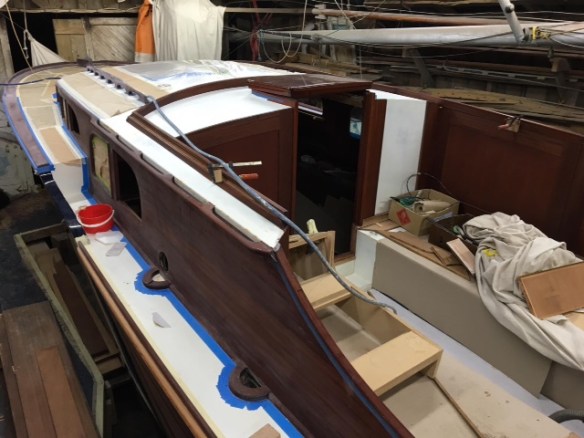
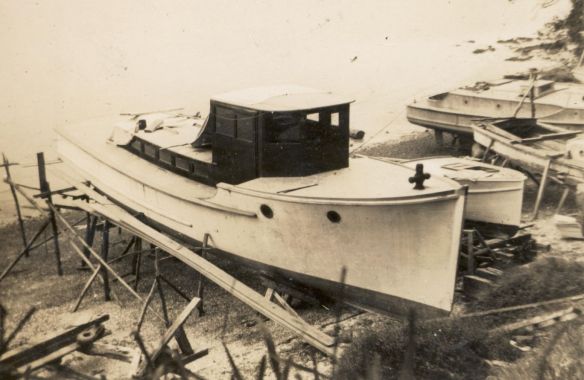
Takohe winter refit 2 1993

Winter 1993 at Milford

TAKOHE – Sailing Sunday
photos & details ex Allan Johnson

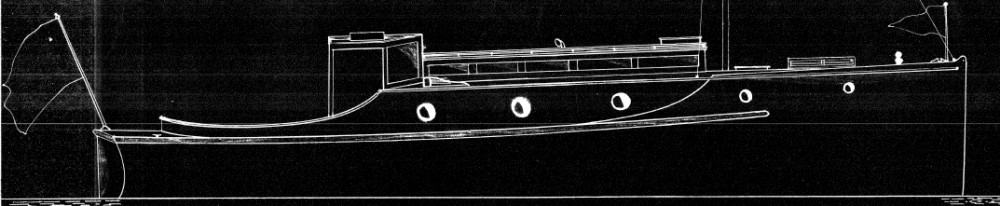
I was contacted last week by Allan who was looking for details on his father’s (Max Johnson) John Gladden designed bilge keeler, Takohe.
Takohe is a 28′ & started life as a kit built project for Ray Driver, a school teacher at Westlake Boys High School (Ray was also Allan’s old wood work teacher). Sadly Ray passed away before he could finish the boat and through the grapevine Max Johnson ended up purchasing the unfinished hull and finished it off. At the time Allan had just finished his apprenticeship at the Devonport Dockyard as a boat builder and had worked for John Gladden, before going on his never ending OE. The boat needed a mast and Max was keen on an enclosed cockpit, as designed they normally had an open cockpit. Allan commented that he was press ganged into doing the work but really enjoy doing these jobs for his father. She was launched c.1972.

Some years after launching, possibly in 1993, Max got John Gladden to lengthen her water line and make a boarding platform with a transom door to ease boarding from the dinghy, this also helped her speed as she ended up with a cleaner stern exit.

Before Max passed away he sold her to a gent in Whangarei. Allan did see her there in the early 2000’s but that was the last he saw Takohe.
Allan only got a day trip on her before his OE & now lives in Canada. But his parents had many good days sailing around Auckland.

Allan google searched the vessel & uncovered the details below from Yachting NZ. So woodys can we help Allan learn more about Takohe’s past & where she is today ? Is the owner listed still current?

Boat Details – Takohe
Sail Number: 1472
Designer : J Gladden
Boat Type: Other
Owner name: I & E Needham

ps nice to see that in 23 years what is now Geoff Bagnall’s Milford yard has hardly changed –  still one of the few commercial railway haul-outs in Auckland with a working wooden boat builder alongside – we like that 🙂  The creek looks a little cleaner 😉

25-08-2016 Input from Allan Johnson
Today I was going through the books that I have had in storage for the past 5 years and was surprised to find the last log book for Takohe. I thought that this would be still with my sister in NZ.

From the last entries into the Takohe Log book dated 1998 05-04
Sold to:
Ivan James Craig NEEDHAM
Erin Frances NEEDHAM
3 Cockburn Street, Onerahi, Whangarei, 0110 , New Zealand
Ph #: 09-436-xxxx

I did a search on Google.NZ and found the following:
http://www.newzealandcorps.com/corp/45241.html

I J C NEEDHAM CARRIERS LIMITED
This company was registered at the same address as above.
This company does not seem to exist anymore removed from register 2002-09-10.

The last entry in the log of Takohe: (Dad’s Log book).
1998-06-15:
Takohe left Milford marina in fine weather after a stormy weekend of waiting to get out. Went as far as Kawau.
1998-06-16 Takohe on to Whangarei – 10 hours
Ivan rang to confirm arrival in Whangarei, very happy with Takohe’s performance.

Also from searching “I Needham” on google.nz the following reference shows up in 2012.

From the NZ Herald / Northland Age  2012-08-09
http://www.nzherald.co.nz/northland-age/news/article.cfm?c_id=1503402&objectid=11071376

Boaties rally for shipwrecked mate
A Far North man whose pride and joy ran aground and sank on his first outing said last week that he had been overwhelmed by the kindness of Whangaroa’s boating community.

Rob Clarke bought the 65-year-old kauri fishing boat Taramea and was taking it from Auckland to his home at Kaimaumau, on the Rangaunu Harbour, when disaster struck while he was taking shelter from wild weather in the Matangirau arm of the Whangaroa Harbour. The anchor dragged in the night, leaving the boat stuck fast on the shore at 4.20am with a metre-long gash in the hull.

Rob, a young crewman and a dog were rescued by Whangaroa Coastguard and a fisherman known only as Bill after their situation worsened suddenly that afternoon and they were forced to make a mayday call.

Neither men nor dog came to harm, but Rob was left with the thorny problem of owning a damaged boat stuck in an isolated bay.

Taramea was originally used for fishing in the deep south, Rob buying her with the idea of doing her up and eventually living on board.

A small group of volunteers have been doing their best to see that can still happen.

As of Friday commercial fisherman Mark Giles had given up five days of his time to help out (while refusing payment). Whangaroa boatie Ivan ‘The Terrible’ Needham and other locals also turned out, Mark’s fishing boat Destiny and Ivan’s 16-metre yacht Masada between them managing to pull Taramea off the sand and tow it, partly submerged, to the boat ramp at Whangaroa.

By Wednesday evening she was on the mud near the boat ramp, but with only the tip of her mast above water.

Unable to shift her any further, Mark went door-knocking around Kaeo in the hope of borrowing a winch. Instead Martin ‘Mooch’ Rudolph, of Mooch Transport, offered his digger and his time without charge, and Kaeo Transport lent a low-loader to get it to Whangaroa.

On Thursday morning a Coastguard volunteer diver got a rope around the stricken boat so Mooch could drag her up the beach and flip her over so the gash in the hull was above water. It was then a race against the tide as Rob and helpers fashioned a makeshift patch and seal to make the hull watertight.

The plan was then to drag the boat further up the beach on the incoming tide, set her upright and start pumping her out.

Rob, stoic despite the heartbreaking end to his maiden trip, said he owed his helpers “huge thanks.”

“I’d love them to be recognised for what they’ve done,” he said.

“It’s not just my case. It’s a regular thing. Mark has given up five days’ work and says he doesn’t want to be paid.

“He’s done everything, from conceiving the idea and fielding scepticism to getting materials and running his boat around.”

Mooch Rudolph said helping out had merely been his “good deed for the day,” while Ivan Needham, who lives on his yacht, said he hated to see a boat in such an unhappy predicament.
Minx

Minx - Wattle Bay 1913

Wattle Bay 1913


MINX
photos & details ex Rosemary Robinson

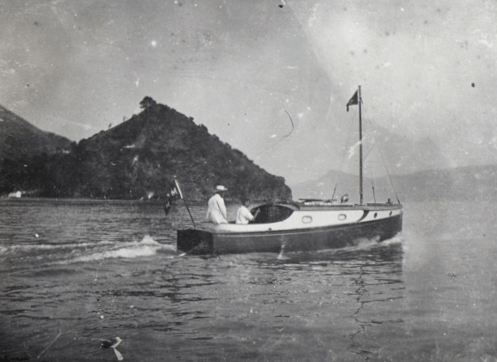
Today’s story is on the L.C. Coulthard built launch Minx, the photos were sent to me by his granddaughter, Rosemary Robinson.
The locations of these photos all appear to be on the Manukau Harbour, I wonder if she ever left the mud & made it over to the sparkling waters of the Waitemata?

I know nothing about Minx so woodys can we help record her history on ww?

Harold Kidd Update – Les Coulthard built MINX for himself in 1913. She was 22ft loa. She was on the Waitemata in 1945 and on the Kaipara as recently as 1999 when Mark Thomas told me she had been sold from Helensville to Dargaville. A very pretty launch, reminiscent of Arch Logan’s work on, say, COQUETTE.


Lincoln Wood Dinghy Restoration (Rebuild)
Harold Kidd sent me the two photos below of a very nice little (8’6”) sailing dinghy built by Lincoln Wood which George Emtage at the Whangateau boat yard is rebuilding for him & Pauline.
The yard is a hive of activity at the moment with some of our finest classics lined up in the creek getting some TLC.

WBY

Building the Mullet boat ‘Tamatea’ by Chris McMullen

Tamatea 17

1961 – the build begins @ 67 Waiatarua Road, Remuera

Tamatea 22

Tamatea 1

Tamatea 29


Building the 22’ Mullet boat ‘Tamatea’ – Sailing Sunday

photos & story by Chris McMullen. edited by Alan H

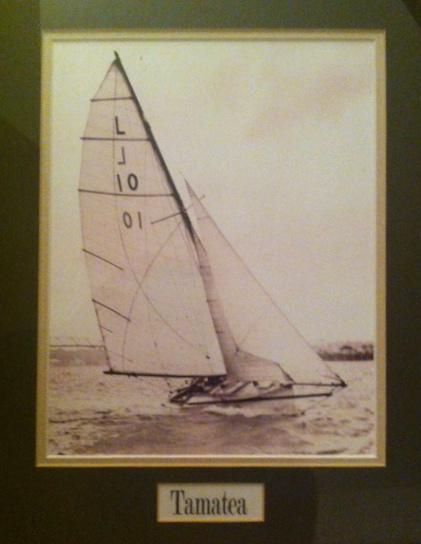
After Chris McMullen saw last weeks ww story on ‘Tamariki’ he contacted me re sharing his ‘Tamatea’ photos that had been languishing in an album kept for him by his dear mother, Vera McMullen. I couldn’t let Chris escape with just sending the photos to me, so I asked him (nicely) to write us a story. Now that’s something he is always a tad hesitant to do, why I don’t know he tells a good yarn. But being the great guy he is, he put pen to paper, in doing so Chris commented that he hoped that bringing these photos into the daylight may encourage others to share their boating or boat building history on waitamatawoodys.

Below is Chris’s story on the building, launch & sailing of the 22′ mullet boat Tamatea. Remember you can enlarge photos by clicking on them 😉

“In the early 1960’s I was apprenticed to boat builder, Morrie Palmer who was also an enthusiastic Mullet boat sailor. Sailing, cruising and Mullet boats were the conversation most lunch breaks.
Morrie had in mind to build a 22ft Mullet boat but family and business commitments at the time, delayed his plans. He had a new steel centre board plate, a profile plan and the offsets of a design for a hull that was supposed to be the Charlie Colling’s design ‘Tamariki’. I am not sure how he got these offsets but the original lines plan were in safe keeping at the R.N.Z.Y.S and not available to anyone at the time.

Morrie encouraged me to build this design and gave me his centre board plate and loaned me the offsets. I managed to scrounge some primitive basic machinery and set out to build the boat. As an 18 year old apprentice boatbuilder I had no money, no car and no girl friend but I was full of enthusiasm and wanted to go sailing. And yes, I had read Johnny Wray’s book. “South Seas Vagabonds” many times.
The Tamatea was built in my parent’s back yard at 67 Waiatarua Rd Remuera. These days such a project would not be possible due to the noise regulation’s but in the early 1960’s people were remarkably tolerant and it was not unusual to see half built boats on people’s quarter acre sections.

 Riveting of Tamatea at night was not really fair on the neighbours. I got one complaint by working too late. I had to enlist my friends to back up the nails with a dolly. If they came late, we worked late. I was desperate to get it done. Another source of irritation was my Fathers Desoutter electric drill. It had no suppressor and affected the people who had TV’s. I was the neighbour from Hell for a while.

Now to the photos.

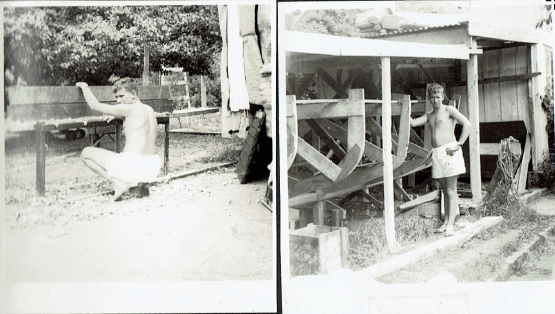
The photos feature some of my friends who helped. Recognised in the photos are
John Jennings, Des Laery, Ken Wilding, Murray Napier, sorry but I can’t remember all the names but Alan Bell and Neil Gillard would have been there. In the dinghy sculling is ‘Snow’ (Neville Stacey) who was / is a well known helpful character; he loved boats and spent much of his time at the ‘Okahu Bay’ hardstand.
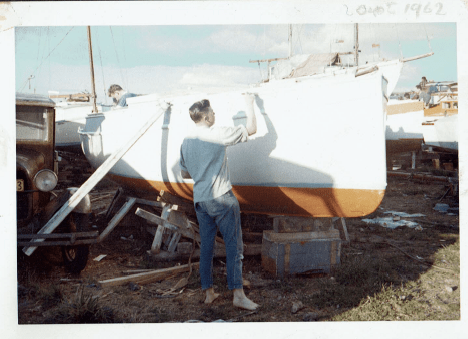
The young man painting the Tamatea in the colour picture is the late John Eastwood. In the same image but in the cockpit is a another young man, John Court, also since deceased. My Model A truck alongside the boat, used as a work bench. The sailing cockpit shot shows Ken Jaspers and with me on the helm. These three guys and John MacDonald built and loaned me gear and helped finish the boat. I guess this was the year after she was launched. I was grateful for their help as I could not afford to run the boat myself at that time.  

You may notice in some of the images, the concrete blocks on the roof of the shed. These allowed me to force rocker (bend) into the keel using a timber prop under the rafters, their weight prevented the roof lifting. Looking at it now, I am lucky the lot never collapsed on top of me.

I never lofted the hull; I just made the temporary frames (moulds) direct from the offsets and cut the plank rabbet’s (rebate) by eye using battens.
The hull was planked with kauri over temporary frames or moulds. The planks were tapered towards the ends like a wooden barrel. The garboard plank was steamed but most was bent cold and edge set. I broke some planks! They should have all been steamed but with my primitive steam box it would have taken too long and I was in a hurry and wanted to go sailing.  
The short planks left out in some of the photos are called stealers and have to be spiled. I remember the frustration of not having a thin plank to use for a spiling batten. I could have borrowed one from my boss but with no car or trailer, how could I get it from Devonport to Remuera on a motorbike?
The ribs were Tanekaha, all steamed and held with riveted copper nails. The centreboard case was demolition kauri held to the keel with galvanised bolts.

Some of the images show the most distinctive feature of a proper Mullet boat – the hollow sections aft and the deep built down deadwood. The boats are a built to certain design and scantling rules.

Tamatea was transported to the water using a trailer kindly loaned by Sandy Sands of Sea Craft and towed by a neighbour Mr Picket with his (at the time) huge truck. A dangerous load? Well maybe, but we got there!

Tamatea was the last planked 22 foot Mullet boat.

My boss, Morrie Palmer forced change to the class rules by building “Controversy” using 3 diagonal layers of ¼” kauri over stringers instead of carvel planking caulked over ribs. Now Mullet boats can now be built in G.R.P.

I was about 18 when I built Tamatea, she was rather amateur built as I was a second year apprentice and although, I thought I knew it all, I was very green. She was built under difficult conditions almost in the open and exposed to the weather, I had very primitive tools and no transport or money to purchase anything other than what went into the boat. Later, I replaced a damaged plank in the “Contessa” built by Cal Crooks and sailed on the”Patiri”built by Bob Harkin. Both these Mullet boats were beautifully built by apprentice boat builders but to be fair, they were older and more experienced than me.

I built the Tamatea for cruising and she was a raised deck Mullet boat. She was very spartan when launched. Second hand sails and a poor rig. We cruised north to Whangaroa the first season but some time later lost the first mast. Insurance paid Baileys to build a new box section oregon mast and my new crew of engineers made all new mast fitting and a set of backstay levers. Their efforts made a huge improvement to the yacht.
Leo Bouzaid (‘Sails & Covers’) built a new dacron mainsail and gave me a year to pay. That was in April 1962 I still have the original invoice for 126 Pounds!

I/we sailed in the Lipton Cup but with poor results. Since then the raised deck has been cut down to a conventional sheer and she has a modern rig. Sailed by others she has won the Lipton Cup a number of times.

Further – looking back to the early 1960’s to give my story some context :-
• I crossed the harbour every day usually on a steam ferry.
• There was six o’clock closing at all bars.
• There were few restaurants where you could buy a drink with your meal.
• A quart bottle of beer cost 2 shilling and sixpence or 3 shillings and sixpence at the   Mansion House, Kawau Island in ‘The Snake Pit’ sly grog bar.
• Many cruising boats carried a rifle on board.
• There were no imports except for essential industries or you could apply for special licence but it would be most likely declined. You could only buy a new car if you had overseas funds.
• A few importers had import licence and charged accordingly.
• There was death duties and high tax.
• There was black and white poor quality TV and manual calculators.
• There were No mobile phones.
• No double insulated power tools.
• No  epoxy  Glue.
• No GRP boats and very few synthetic sails
• No moorings in Matiatia.
• No marinas or travelift’s
• Most pleasure boats were hauled out for the winter.
• There were NO IMPORTED BOATS and you could buy kauri so wooden boat building was a competitive but viable business.”


Shalom

SHALOM B.O.I. CHRISTMAS 2014

SHALOM
photos ex Barbara Cooke & Ken Ricketts. KR-details edited by Alan H

During the recent CYA meet-up at the Salthouse Boat Yard at Greenhite, we got to see Greg Salthouse’s own launch ‘Shalom’ up close. She was built in 1973 in Browns Bay by local boat builder T K Atkinson as his own personal boat. When launched she was approx.  42′ but while in the ownership of her 2nd owner, Howard Collier, she had an extra 6′ added on by a now non-existent company, in Whangarei.
She is powered by 2 x 350 hp Yanmar diesels & has a top speed  of around 25 knots & cruises comfortably at 17/18 knots. A wee bit faster than his father-in-laws magnificent classic – Trinidad.

Greg & Delayne Salthouse have owned Shalom for 3 years & commented that although T K Atkinson built her for himself, she was owned by Collier most of her life e.g. 25>30 years. Collier kept her at Whangarei during this period. Greg believes she was built to a design ex the American designer, Ray Hunt.

A while ago I (Alan H) was aboard & Greg has sprinkled some of the Salthouse yard magic on her, mainly modernizing the interior to better suit his young family. For 48′ she  is a very big boat. When I was aboard I was in company of Colin Pawson, one of the marine trades most fastidious technicians & he was impressed enough by the T K Atkinson’s workmanship that he was heard to mutter ‘I’d own her’, enough said 😉
While she is sporting a penthouse, it is very ‘light’ in appearance & almost gets a tick 😉

Laughing Lady Updates

IMG_6611

IMG_6868

Laughing Lady June 2016 Update
photos ex James Dreyer

Chatting with James on-line a while ago I nudged him for an update on LL. As ww followers will know the Lady has been tucked up in the shed at Whangateau Boat yard for over two years getting a serious over-haul from Pam & when in country James + hangers on. James & LL’s co-owners re to be commended on they desire to return LL to her former elegance – below is the note James sent me (slightly edited)

“I was hoping to get some varnish on the topsides before departing offshore and subsequently photographing her looking sharp and shiny but it didn’t happen.  We did, as you know get her in her new coat of Flag Blue.  Unfortunately the port side will need a re-shoot due to some sags – the weather was not in our favor the day we had to spray. We will definitely be in better shape to give a good update in August as we should be well on the way with putting her together.

Pam and I had a bit of a discussion recently and think it is probably worth me commenting on the dark two part LP finish that I have gone with, before the armchair generals and experienced boat builders / owners wade in.  There has been many well qualified comments about the potential for paint failure over the last two years and they have certainly been weighed up and taken onboard.
When LL had her hull rebuild in San Diego, she was taken back to bare wood, re-framed and re-fastened, then impregnated with two coats of epoxy and many seams were splined.  She is tight seamed double planking and the new bottom is double planked and epoxy glued.  The paint system that was applied to her extremely fair hull 10 years ago in San Diego is a two pack epoxy / LP system – Awlgrip above the waterline and International below.  After 10 years sitting in a semi finished state, in the rather extreme conditions of an inland San Diego yard, she had cracked and opened a number of seams, but to be honest, no more than the single pack finishes on the boats around her.  

My concerns were that she would move significantly once parked in the Whangateau shed as she adapted to the cool, moist environment.  Pam repaired various areas that were in need, primarily around the extreme flare and planking twist in the bow, then built a good base of primer.  We let her sit for a year in primer, and surprisingly there was no movement or cracking to speak of.  To strip her back to bare wood was to remove the hundreds of hours of fairing and painting that had been never seen the water even though it was done years before.

On this basis and after much deliberation and discussion, I chose to continue with the two pack system.  The aim from the start was to get her in the water and in use as soon as practicable (as far as restorations go).  

For the first 50 years of her life, she was painted jet black and spent hot summers in the water around Long Island and her winters in a snow covered shed.   After the work in San Diego she was painted Awlgrip royal blue.

We chose Awlcraft Flag blue as the topside color.  Awlcraft has some more give (urethane rather than polyurethane) and can be locally repaired and polished.  My goal was to have her looking as close to original as possible when she launched, and the dark hull is truly striking as I’m sure everyone agrees.

I am well aware that the system will probably show some failures around the seams as she moves.  Its also likely that we will be painting her white in a few years, but to me it makes sense to let her out the door in the current (gorgeous) state and see how she fares.  If need be, we will re-wood her and go single pot, but if not, then a white two part system will continue to be used”

REMEMBER – To enlarge a photo – just click on it 😉

16-07-2016 I received an email from James today with the 2 photos below attached – when LL was launched she was powered by Packard straight 8’s, nowadays is powered by twin Volvo turbo diesels. In his travels overseas James came across the engines below – my response to the email was short – “WALK AWAY & DO NOT LOOK BACK” 🙂

image2

Screen Shot 2016-07-16 at 7.52.03 AM

August 2016 Update (ex James D fb)

It appears with the hull painted its now down to the shiny stuff 🙂

IMG_0455

IMG_0456

01-09-2016 Update ex James fb

Applying 24k gold leaf to the carved details on Laughing Ladys hull. The first arrow head needs a little tidying up, but with some more practice the unique scroll work detail carved into her bow in 1949 to identify her builder is going to look sweeeet!

Screen Shot 2016-09-01 at 5.54.52 AM

Merita – Launch Day

scan007

scan002


scan001

MERITA – Launch Day
photo & details ex Murray Morrissey

Merita has featured in detail on ww before (blue link below to view the story) but when Murray sent me the above collection of photos from when she was built & launched back in 1965 they were just too good to add to the existing post. One photo shows her being towed through the Milford shops on-route to her launch off Milford Beach.
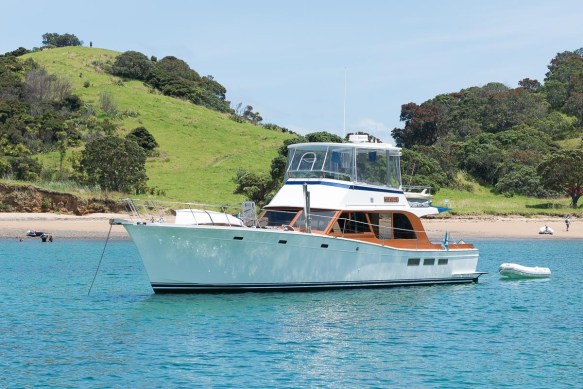
While there is some conflicting/confusing info on the original ww post, what I came tell you is that Murray has confirmed that Merita was built by his father in law – James (Jim) Dymock of Takapuna in his brothers (Bill Dymock) building yard behind the Waitemata Power Board in Taharoto Rd. The family are unsure of the hull design but the cabin top was designed by Brin Wilson. She was launched in 1965 in the Milford Creek where she spend her early days.

LINK >>>>   https://waitematawoodys.com/2015/08/24/merita/

Special thanks to Russell Ward for scanning the original photos.

Ka-iwa

Screen Shot 2016-06-02 at 5.56.18 AM

Screen Shot 2016-06-02 at 5.55.28 AM

KA- IWA

photos ex trademe

Not all classic woody owners are content with sub 10 knot cruising, well if that’s you & your looking for hassle free woody boating at the speed of light today’s post on Ka-iwa the 28′ Mason Clipper will appeal. Built in 1968 she is a true kiwi classic, with a great maritime history being originally owned by the Stevenson Family & possibly the first twin engine Mason. She has some serious off shore racing history, therefore was built very strong & in bad weather, leaves most boats in her wake. Post racing is was then returned to the Mason yard in Auckland & a custom hard top made. Then retired to Stevenson’s bach up north as their holiday launch.

Powered by twin 350hp, Chev’s Ka-iwa will do over 45 knots, but is happy to cruise at 25 knots at low revs. She underwent an extensive bare wood restoration approx 5 yrs ago & as you will see from the photos also received a total refit inside. The Mason Clippers are very family friendly kiwi classics & this one can sleep upwards of 8. At her length she is a perfect dry-stack boat, which helps solve the where do I keep her dilemma.

So woodys if you own an oil (petrol) well & are into retro classics that go like a cut cat – Ka-iwa could be for you


Mystery Launch at Opua

Selwyn Deeming  3

Mystery Launch at Opua
photo ex Deeming family collection via Gavin Bedggood

The above photo was taken at the Deemings yard at Opua. We are not sure of the year or the ID of any of the boats. Any woods able to help out?

And a wee bonus – click the link below to view the latest (May>June 2016) issue of the USA on-line Classic Yacht magazine, lots of woody photos & stories in this issue 😉

http://www.myvirtualpaper.com/doc/ClassicYacht/classic-yacht-may-june-2016/2016052501/

Screen Shot 2016-06-02 at 8.48.55 PM

04-06-2016 Photos of Arline ex B Worthington via Ken Ricketts

Miss Ponsonby

to begin with

IMG_7095

MISS PONSONBY
photos ex Charlie North. details ex Harold Kidd

In early May, Charlie North commented on ww that he was currently rebuilding a replica of Miss Ponsonby after acquiring the original boat some years back. Harold chipped in with details on her (below) & I invited Charlie to share the project with us. If you have a good look at some of Charlie’s photos you will see he is a serious collector – I can spot a vintage car, classic motorbike & what a appears to be an E-Type Jag. Remember to click on the photos to enlarge.

Firstly some history – Miss Ponsonby was built by Sam Granros in late 1932 or early 1933. She took part in the Masport Cup races on the Tamaki River in 1933 nominated by Ponsonby Cruising Club. Her racing number was S21. Her inboard engine was a 100hp Hall-Scott. She had a long handicap and was more a fast runabout than a racer.

Sam Granros was a Finn who came to NZ in 1904. He built a lot of speedboats and launches in St. Mary’s Bay and at 12 Hackett Street, Ponsonby, for example,Hilma, Nurmi, Alma, Ramona, Ramona Jr. (1930), Cygnet I – II – III, Esther, & Miss Ponsonby, all go fast outfits.
Sam later moved to Oneroa and died in 1946.

I’m sure Charlie will add some more details re the engine etc.


DSC00564

IMG_4055

The Mighty P Class – Sailing Sunday

THE MIGHTY P CLASS – Sailing Sunday
ex Yachting NZ

A pictorial history of New Zealand’s mighty P Class yacht

Whilst trolling around the Wellington Classic Yacht Trust facebook page I uncovered the above gem that utilizes the two formats of a slide show and video clips to showcase the history New Zealand’s mighty P-Class featuring images and footage from the 1920s to 2013.
The clip has been assembled by P Class expert and historian Gun Caundle, from photos collected while researching for his book ‘Our Secret Weapon’, a history and stories about the P Class. While 15 minutes long its great viewing & I’m sure most woodys will bothe relate to it & probably recognize some of the people featured. Enjoy 🙂