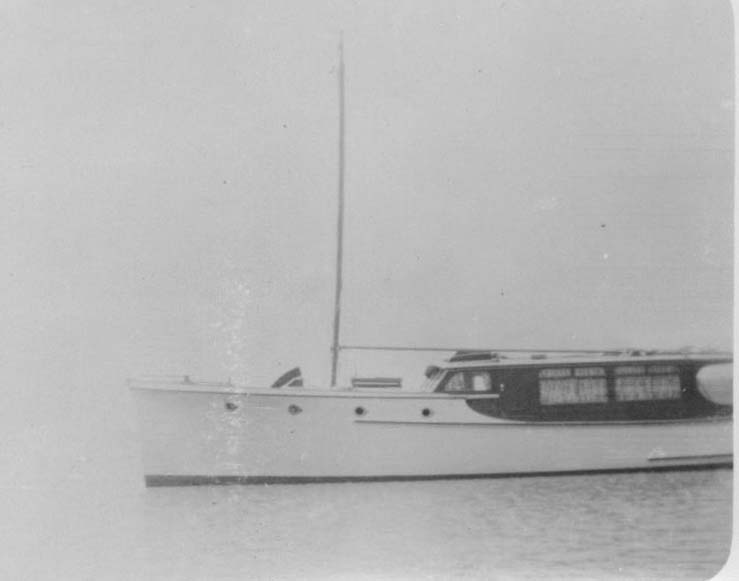
Lady Eileen

LADY EILEEN

Looking to get into the classic wooden boating scene ? Lady Eileen  is now offered for sale & offers outstanding value for money for a vessel of her size ( L=48.9′ / B=13.4′ / D=3.9′ / 18 tons) &  fit-out. refer trademe listing link below for full details.

A fine example of a Shipbuilders / SupaCraft triple skinned kauri launch. Lady Eileen was launched in 1947 & is a sister ship to Rakanoa, Mahara & Rosemary II.

Given her size & fit-out ‘live-aboard’ is an option.

http://www.trademe.co.nz/a.aspx?id=676584140

More of Lady Crossley

Lady Crossley update photos

I was sent from the owners yesterday these brilliant photos from re-launch day, they were too good to ‘bury’ in the last post. Plus a great b/w photo from her her launch day in 1948.  Enjoy 🙂

Lady Crossley

LADY CROSSLEY

photos ex David Cooke

Sunday 15th Dec (2013) saw another of the CYA’s classic launch fleet re-launched after sending the winter at Opua under the care of Opua master boat builder Craig McInnes. Colin Wild designed & built Lady Crossley in 1947 & if he was looking down yesterday he would have been a very happy man. Lady Crossley is simply magnificent & her owners Margo & Jamie Hudson launched in a style that Col Wild would have approved of – canon fire, lots of flag & lots of champagne.

Lady Crossley was built for the Seager Bros who were the agents for Crossley diesels. She was sold to Vic & Rob Sanders in 1956 & they installed new Gardner 6LW’s into her in 1957. Which I understand she still has to this day.

Congratulations to Hudsons & all the craftspeople that have worked on her – Colin Wild boats are special, this one is now VERY special.

It almost goes without saying that the wow factor came out of a Awlwood MA (Uroxsys) can 🙂

Kenya II (777)

Image

Kenya II  (777)

KENYA II (777)

photos from Helen & Richard Andrew’s family collection (grand daughter & her husband of Henry Allen -Tiromoana) ex Ken Rickitts. Build & war service details ex Harold Kidd

Kenya II was built for Len Heard by Lidgard Bros and delivered in early 1940 & was in NAPS service in Auckland during the war as Z29. She was also in Fiji between March & July 1942 doing patrol work. She kept her original Fairbanks Morse diesel until at least 1962 when Len Heard re-engined her with a Gardner.

It appears to be Heard in the cockpit of Kenya II. Len owned the confectionary manufacturer ‘Heards of Parnell’. Ken Ricketts remembers him from when he was 11 years old as given his business, Heard always had lots of lollies on his boat, making him very popular with all the young children in the bay.

Also of interest is the unknown older bridge decker in the background to “777” Kenya II. Anyone able to ID her?

B/W photo below taken by Ken Ricketts in Issy Bay, Labour weekend 1948. She was painted light blue at the time.

KENYAII

‘Black Watch’ & The Rev. Jasper Calder

This slideshow requires JavaScript.

 Black Watch & The Rev. Jasper Calder

photos & info ex Ken Ricketts. Edited by Alan H

Black Watch was either built for, or bought new, by the late Rev. Jasper Calder an Anglican sea loving vicar.

Ken Ricketts first saw Black Watch under construction in c.1947-48 on the port side of the creek, in the right hand corner of Leigh Harbour. She was at the stage of completed hull & combings, with no or little paint, her hull was built of very narrow Kahikatea planking & from memory kauri combings. She was as she appears in the photo except that she was initially painted completely black.

Black Watch was actually Calder’s second boat, the first being a 1925-30 vintage bridge decker, approx. 38 ft., called Crusader, that he owned in the 1930s. Ken recalls his father, Ralph Ricketts, when he was cruising on the Glennifer with the late Trevor Davis, attending impromptu church services on board Crusader along with many other boaties of the day. The crews would all tie their dinghies to the stern of the Crusader for the ‘church’ service most Sunday mornings in Mansion House Bay, Kawau Island over the warm summer months. You can see Crusader marked in Ken’s photo, taken Xmas 1948, of Mansion House Bay.

Ken commented that Calder did not have a lot of money to spend on his boats & love of the sea & Black Watch’s original engines were one 6 cyl Perkins diesel & one Ford V8 (probably both second hand.)

Black Watch was bought by Gordon Cole from Calder’s estate in c.1952-53. Cole owned Black Watch until c.1958-9, when he purchased Wanda II. Cole changed both Black Watch & Wanda II’s names to Lady Norma. (Black Watch/Lady Norma possibly later became Lady Alisa).

Note: Calder towards the end of his life, acquired an interest in an unfinished 75 foot H.D.M.L. naval vessel, which was the only one the navy disposed of for many years, which Ken believes was still under construction when WWII ended, so the Navy sold her possibly unfinished. Calder named her Black Watch as well.

Ken sighted the Calder’s H.D.M.L. recently at Bayswater on a swing mooring, in an extremely neglected state. Previous to this Ken had seen her in the 1980s, tied to a wharf in Schoolhouse Bay, Kawau Island, where see remained most of the time, for a number of years. She had then & possibly still has, twin 6 cyl Perkins diesels. She was modified many years ago in the 1970/80s to a type of semi motor sailer with 2 masts & a semi clipper bow.

Harold Kidd Update

CRUSADER was built for Rev. Jasper Calder and Charlie Goldsboro by Collings & Bell in the winter of 1929, originally without her later bridgedeck. She replaced Calder’s 20ft mullet boat NGARO.

I wonder who built the first BLACK WATCH for him?

Calder had two HDMLs, both called BLACK WATCH. The first, Q1349, was returned to Navy in July 1952 and has since reverted to BLACK WATCH. All RNZN HDMLs were built in North America, none were “under construction when WW2 ended”.

Jasper Calder died in 1956.

Bayswater Dec 2014

Corsair

The Frostbite – Corsair

photos by Alan H 

At the recent Classic Yacht and Launch Exhibition  at the Viaduct, the 2013 event  showcased the acclaimed designers Jack Brooke & Bob Stewart. One of the outstanding boats on display was Paul Baragwanath’s exquisitely restored Frostbite ‘Corsair’, the attention to detail was just amazing, even featuring her original restored 1945 trailer. Corair was built by Jack Brooke in 1945 for Don Winston.

02-02-2018 Input from Paul Baragwanath

“She was built in 1946 for my grandfather, Don Winstone, and named after the planes he flew in WWII. The Frostbite class was designed in 1938 by Jack Brooke, and Corsair was built by him too. A few years back I tracked her down – derelict, but pretty much whole, in Nelson. We knew it was Corsair from the name let / inlaid into the middle thwart and the Corsair aeroplane profile in the for’d thwart. Teak in Kauri. Kauri hull. Oregon spars. Pohutukawa knees. Mahogany cappings. Teak and kauri floor grate. Australian hardwood rudder stock and kauri rudder. Kahikatea centre-board (from her time in the Waikato?). Mahogany mast supports. Brian Kidson who had owned did a good deal of work preparing and restoring the hull before she came north to Auckland for the woodwork to be completed by Jack’s son, master wooden boatbuilder Robert Brooke.

We restored the chrome hardware (Onehunga Electro Platers / Bumper Repairs – brilliant), re-created missing elements (Morris Sheet Metal and another engineer) including the lettering on the stern, restored the original 1946 mast, Frank Warnock created a traditional sail by hand, and I did the low-skill bits, and brought it all together. Ropes from Classic Marine in the UK. Other parts from Harken Fosters.

Robert designed a period road trailer with 1939 pressed steel Standard 10 wheels that I found on Trademe (Marlborough Sounds), and a friend who is a sculptor, David McCracken, made the trailer. I believe the Frostbite was NZ’s first specifically-designed trailer class – with it’s split / gunter rig – so a period trailer and launching trolley are part of it. It was the last class designed that you sit in, rather than on.

Robert’s lifetime of experience and eye resulted in what you can see – from the handmade wooden blocks, fine plank lines, floating thwarts, the traditional flick-bailer, right up to the pheasant feather pennant / wind vane atop the mast.

The colour is Eau de N’il – Water of the Nile – with a forest green waterline. My grandfather liked green – he also had a runabout named Amber (1950s 17 foot Greymarine engine) with a green waterline. Traditional white below the waterline. The interior is white house-paint up to the thwarts which sets off the varnish above that.

We don’t tend to race – wooden blocks, wooden grate, 1946 mast and rudder… but do sail off Narrowneck in Auckland, and Tutukaka, Ngunguru and Whangaumu Bay up north.

I put together a small book on the restoration – a few years ago now. The aim was to get her to A level condition – which we did, and she won the best restoration at the Lake Rotoiti (Nelson) classic boat show – and then to just enjoy her. She’s a delight to sail. Predictable, responsible and beautifully balanced. On the wind in a chop a for’d hand is useful for bailing!”


Turakina

TURAKINA

When I ask Peter Brookes to send me some photos from the re-launch on Thursday at Pier 21 of the C-Class Turakina (C77), I did not expect to receive all these wonder shots showing the major re-fit Peter has just completed on her. As we have come to expect from Mr Brookes she is simply stunning & another of our classics that now joins a very special group that should have a bronze plate that reads ‘Restored by Brookes Boatbuilders’.

Turakina was designed by Arnold ‘Bill’ Couldrey and built in 1949 Leo H Clark . She is double skin kauri – 30′ / 8′ / 5′. Turakina is a sister ship to Tuirangi (C35). Bill Couldrey was a protege of Arch Logan. These 2 vessels look like clones of Tawera and Gypsy.

Photos of the re-fit can be viewed here     www.classicsail.net

(Little Jim can be seen waiting patiently for her turn in the shed)

Tawhiri

TAWHIRI

photos & details below ex Ken Ricketts

Built c.1946 by Roy Lidgard in their shed, at Smelting House Bay, Kawau Island. Note similarities to Ted Coopers Awarua. Tawhiri is a little shorter at approx. 36ft. & AWARUA 37ft. Unsure who she was built for, Harold Kidd might be able to help here?

Tawhiri originally had a 4 cyl Lister diesel, (painted bottle green) installed in a box which formed the table in the middle of the main cabin area. Roy Lidgard installed Listers in quite a few boats of that era, another went into the Wainunu for Clive Power, to which Kens father later fitted an electric self starter system for Clive c.1949-50.

At one stage she belonged to a Euan Berger, ex Air NZ cabin crew, whom Ken knew in the1970s-80s. Berger replaced the Lister with a 6 cyl. Ford diesel, (after which she floated about 6 inches higher in the water in the bow, the Lister must have weighed a thousand tons) Tim Lees may have done the engine change.

Ken last saw Tawhiri a couple of years ago, in a scoria & building merchants yard in Karapiro Drive at Whangaparaoa, where she sat for a few months.

Ken took the photo in the water at Christmas 1948, in Mansion House Bay, Kawau Island. The other was taken on a slip, adjacent to the Panmure Yacht Club, by the look of the background, (which Ken can identify well with, as his father was commodore of that club), Ken recalls the photo was sent to him for I.D. , possibly by Harold Kidd & is not sure when it was taken but it was long time ago as the area is quite different there now.

Ken is interested to hear if anyone knows anything more of Tawhiri’s life.

Harold Kidd Update

Lloyd’s Yacht Register says she was built by Lidgards Shipyards in 1947 and was named TAWHIRI II. However I think 1946 is right as because her first owner,  Jim Inkster, registered her with the Squadron in the 1945-46 year. Jim Inkster had owned the yachts DAISY, SCOUT and had the 38 footer TANGAROA built by Percy Vos in 1936, so TAWHIRI was TANGAROA’s postwar replacement. Her original engine was a 1945-built 3 cylinder 30hp Lister diesel, about all you could get at the time, and that stayed in her until at least 1964. Her official APYMBA dimensions were 35’x33’x10’6″x2’9″ which vary from the Thames Measurement dimensions given in the LYR entry. In 1964 Stuart Clark registered her as a British Registered Ship under #191807 from which I have drawn her engine details.

Jim Inkster sold her to A.J. Noakes in 1950-51. Later owners I know of were D.D. Brown (1962), Stuart G. Clark (1964) and Muir (later Sir Muir) Chilwell QC (1970). Berger must have been after Muir.

THE STORY OF W1 – one of fastest boats ever on the Waitemata

The story below & photos above from Ken Rickets is the accumulation of over 65 years of one mans fascination with this vessel. It all started when Ken was 10 years old & saw her on her moorings, adjacent to the huge flying boat hanger & apron, at Hobsonville Air Force base. This one off experience moved Ken enough to see him for the next 65 years constantly making enquiries & researching the vessel. In 2001 Ken meet with a retired WWII air force officer, who was stationed on her during her wartime service, the officer gave Ken many of the photos above. Then more recently chats with Mr Allright Jnr. the second member of that family to own her, they had her in total for 40 years, & Mr Keith Bellingham who owned her from the mid 1990s to early 2000s provided enough additional insight for Ken to put together this wonderful story about a vessel that spearheaded our WWII air force coastal maritime defenses.

(Note: Harold Kidd accompanied Ken Ricketts when he met with the retired air force officer & may be able to add more details from that encounter)

Read below & enjoy. Alan H

THE STORY OF W1  – as told by Ken Ricketts

W1 was one of 2 identical boats ordered by the RNZAF during WWII for coastal defence duties & they were named W1 & W2.

W1 arrived circa 1939  from England, where she was designed & built to a Scott Payne design.

W2 never got here, the ship that was transporting her to NZ, was torpedoed & sunk, on the way out from the UK.

W1 was powered by 3 x W12 x 1000HP (3 banks of 4 cylinders) marinised Napier Lion aircraft engines, marinised by “Power Marine” in UK. — refer photo. The engines were configured with one either side & one in the centre facing forward, & driving through a Vee drive as there was not enough width to have the 3 engines side by side.

Such was the layout, power & performance of this boat, that it required an engineer to be seated in a padded chair in the engine room with massive ear muffs, whenever she went out,  with a fire extinguisher in his hand. He also also had to control all engine controls including throttles & reverse levers, which were huge long steel arms  standing vertical on the gear boxes of the engines.

On her maiden voyage, after she arrived, it was decided, I am told, that they would go for a run to Tiri, to “try her out,” but such was her petrol consumption that they ran out of fuel at Rangitoto Lighthouse.

While W1 was a “one off” for NZ & in her day, capable of very high speeds (I was told she could do over 50 knots), as evidenced by the photos — not bad for a 64 feet vessel. There were a total of 21 of these craft built & 3 of the early boats went to South Africa & were fitted with 2 Rolls Royce aircraft engines of bigger horsepower than the Napier Lions, but Hubert Scott-Payne had a disagreement with RR & they refused to supply any more engines for the boats, hence the change to Napier Lions.

A smaller 42 foot version was built later & there is one of these in a military museum in the South Island.

She is substantially made of spruce & mahogany & the bridge was more like the flight deck of an aircraft.

I saw her many times after WWII, on her moorings adjacent to the flying boat base & slipway, at Hobsonville airport, when cruising with my parents, Ralph & Wyn Ricketts on their first boat, JULIANA, (1946-49). — I never actually saw her going anywhere, (just wish I had), but obviously she did so, however I think she had almost no use, after the war, until they eventually sold her which I think was circa late 40s or early 50s.

She had a very impressive side exhaust system just above the waterline amidships,  with 2 groups of 3 exhaust outlets one side & 1 group of 3 outlets the other side. — Have not seen many boats around that have that layout.

After the war, she was eventually sold in 1955 by tender to Mr Norm Allright, who lived in Mt Wellington, on the banks of the Panmure River, not far upstream from my parents waters edge home, at No 1 Bridge St Panmure, they could see her from their lounge windows.

Mr Allright Snr., refurbished her to a degree, for pleasure use, when he bought her off the air force & called her “CAROMA”, he also replaced the 3 Napier Lions with a matched pair of counter rotating 671 GM Detroit diesels, she still went well, as you can see in the photos. Later Mr  Allright Jnr. did a splendid job totally & massively refurbishing her in the early 1960s, see photo.

She was sold in the mid 1990s to a Mr Keith Bellingham, who had intended to do a major refasten of her hull, along with other significant work, which was in serious need of attention, however, it proved not to be cost effective & he onsold her to a man in Tauranga, who in turn sold her later to a Waiheke owner, in the later 1990s & she was moored at Waiheke at that time.

She later still, sat on a marina at Bayswater, looking very neglected & painted purple, with her beautiful cabin top, as per the photo above, removed, & generally in a serious state of disrepair, apparently, & she was there until a couple of years or so ago.

I beleive she was taken to the Silverdale industrial area after that & has been moved now, to a private property, address at the moment unknown.

Any info on her current whereabouts would be appreciated.

Harold Kidd Update

Ken is substantially right on all points. However there was a W2, a 28 footer that had been built for the NZ Permanent Air Force for use at Hobsonville to service its DH Gipsy Moth and Fairey IIIF seaplanes. There’s a good book on the subject “The Golden Age of N Z Flying Boats” by Harrison, Lockstone & Anderson. The RNZAF’s W numbering really only started after W1 arrived in 1940.

One of her first tasks was get to the NIAGARA which struck a German mine off the Hen & Chickens on 19th June 1940. The Whangarei launches, Florence among them, were on the scene first but the skipper of W1 ordered them by radio to keep away, ostensibly because of the minefield but really because he wanted the glory of getting there first. The Whangarei boats had towed the ship’s lifeboats clear however by the time W1 arrived, leaving her with only 20 people to bring back to Auckland.

Norman Allright bought her in 1948. She is now called CARROMA.

Nobody ever claimed more than 38 knots for her or her type.

Update – 10/08/2014 from Ken Ricketts

In the original post on W1 Ken spoke of the engineer  that had to be seated in the engine room with ear muffs to supervise & control  the engines & of course to guard against a fire. In the photo below you will see the engineer’s chair in front of the centre engine (3x Napier Lion 1000 HP W12’s each being 3 banks of 4 cylinders).
& the 3 leavers with the black round knobs on each one surrounding the chair. Note the centre engine is sloping forward to drive in to the vee drive unit. The noise must have been unimaginable when they were flat out.

Gearbox photos below show an original vee drive gear box that were fitted to all centre engines with the Napier Lion W12 engines.
Also one photo shows the original engine installation concept of a WI – with the 3 Napier Lion 1000 HP W 12 (3 banks of 4 cylinders) configuration engines.

The photo of the interior of the large boat shed with several boats under construction was taken at Hyde Southampton, U.K. where the British Powerboat Company owned by Hubert Scott-Payne was sited & where all the W1 family of boats were built.
Photo also of Scott-Payne the 1930’s designer of the W1.


UPDATE 08-08-2025 INPUT ex JIM DONALD

“My Uncle Norman Allright was the owner of W1 . Here are a few facts about it as I remember. 

He tendered for the boat in about 1947. I don’t think he was all the fussed about it so tendered $1200 , ( 600 pounds of course) . His was the only tender. 

The boat was on a huge cradle in shed at Hobsonville Air Base. It was then towed around to his mooring he had put down in the Tamaki River opersite his property at the end of Waipuna Rd. His new house on the point had not been built as yet so he was still in the old farm house in Waipuna Road.                     He was a keen Ministry of Works auction attender and purchased a old D9 Caterpillar dozer that had built the Air Field on Gt Barrier Island. With this he constructed a road / track down the beach around the point from his mooring. He brought some Brengun carriers and removed the tracks which he concreted into the beach upside down. On the huge cradle he fitted the solid rubber tyred wheels which ran in the tracks. He then pulled W1 out with the D9. The 3 Napier Lions were then removed as they were useless to him . They ran on AV gas and used horrendous amounts of fuel . They were Supercharged and I think 2 stroke. The story was they could be a bit unreliable anyway and often returned on 2 motors. There was a permanent engineer in Air Force days in the engine room. The fuel tanks which were under the Wheelhouse held 5000 gallons of AV gas. There was no access from from the Wheel house to the forward crew’s cabin as it had water tight bulkheads so you had to go on deck and climb down a ladder. My uncle cut excess holes in the bulkheads. The engineer has his own cabin and head aft af the motors. There was then another compartment with a winch in it and a cable ran out a hole in the stern to winch aircraft which what the were there for. The Napiers were replaced with 2 Gray Marine motors ( GM 671) that were purchased secondhand from Honalulu. These were out of WW2 landing craft and purchased through a chap in Hamilton , Jack Tidd. Of course it had 3 shafts ,props and rudders. The center one removed and plugged up. The boat had no keel at all ( for speed) so the props and gear was very vulnerable. I guess this detracted a bit for the strength of the hull a bit and would explain the many frames / bearers on the cradle, for support. I remember it had a 2 cylinder motor driving a generator so I presume it had 240v but didn’t have it working in my day. I remember in the wheelhouse the incredible bank of guages on the .panel ahead of the wheel the 3 huge Tacos taking pride of place. Of course Norman had to run throttles and gear levers through to the wheel house as these were operated by the engineer down below . My uncle had to go below to the motors to start them as the buttons were mounted on top of the motors ?? Not sure why ? It had a large bank of big batteries but I think only charged from the motors own generators so always seemed to have power trouble meaning very very often the anchor had to be pulled by hand ??? About a 50mm rope and a big chain and anchor so jolly heavy work.

I went away many times on the boat with my cousin Robert Allright who was the second son , Donald being the eldest. No alterations or mods were done to the boat while Norman ran it but after his passing Don ( as we called him ) took over the boat and carried out a major refit which included the new cabin top and flybridge. The motors were removed , overhauled ( at Stevensons workshop at Otahuhu ) an on a Dyno and refitted. This would have been about the late 70s I think? It was at this time it was named ” Carroma” it had no name before that. It was a much nicer and more user friendly craft after that and had more speed with the uprated motors. During the earlier yrs my uncle had built a Jetty , and dinghy shed near the point so the boat was then tied up to it and the mooring pulled up. He had also built a lovely home just above which eventually sadly taken along with some land for the new Waipuna Road bridge. The house that was built mainly of native timber was torn down ??????? I have knowledge of the Carroma after it was sold but glad to hear it’s still about !! The story was they were built for the war only and not meant for longevity???? I remember one-time going up to Walkworth and tieing to the walf there and going for a shop in town. On leaving it was quite a job turning the thing around awning to the length so needed a 3 point turn to go about.                                    Hope this is a bit enlightening for some interested folk.”
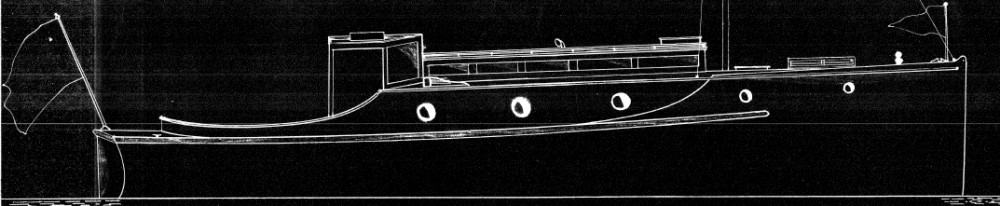
Tiromoana – a peek into her past

A peek into Tiromoana’s past

photos ex Ken Ricketts

A collection of photos assembled by Ken Ricketts showing Tiromoana in the 1940’s, 50’s & 60’s.

Photos: In Police ‘grey’ – 1943 / With steam ferry in Tamaki River c1960 / On the slip at Okahu Bay c1950 / Okahu Bay c1950 with Henry & Mrs Allen in cockpit / In her modern livery at Coggan jetty c late 1960 / Rickett family aboard xmas 1945