Recently Geoff spotted the launch Islay II on ww & contacted me to advise that approx. eight years ago while dinghy sailing around Bon Accord Harbour he identified the Isla II as the launch, Maewa, his father, Ted Cooper (E.R. Cooper), built in the years 1936, 37, 38. Geoff was invited aboard & the interior inspection positively confirmed the history of the launch. The then owner told Geoff that when he bought her he was told she was built by Billy Rogers in 1953. Somewhere along the way her cabin has been rebuilt and she has been extended as she is longer now.
Geoff’s father had the use of Billy Rogers shed at the bottom of Curren Street, Herne Bay on the beach to build her. The photos above, during construction, confirm to Geoff that Islay II is the Maewa.
Can any woodys input more on her past? She ‘resided’ in Milford Marina (creek) for a period in recent years. Her present owner has had her for approx 2 years.
On the original Islay II ww post Harold Kidd commented that he had Billy Rogers 1956?, alongside her name in his files, could this have been when the rebuilt cabin & water line extension was done? In my eye, as launched, she was a very smart launch 🙂
The photo below of Islay II was taken by Dean Wright in Te Uenga Bay (part of Parekura Bay), Northland.
Until seeing the above photo I was not aware that we built anything like this sedan runabout in NZ. The Meteor was owned by Mr. W. Goodfellow & cost approx. £1,600 to build. She was 30′ long & capable of a speed of 30 mph. The forward closed cockpit had seating for 8 persons & was upholstered in grey leather.
So woodys – who built her, when, what powered her & what became of her?
Harold Kidd Update
METEOR was built for William Goodfellow in May 1931 by Sam Ford. She was 30ft x 7ft and constructed of Honduras mahogany with a double-skinned bottom. Her original power was a 225hp Kermath. She was capable of 30mph. He kept her in one of the sheds in Ngapipi Road where her nameplate is still on the wall. Goodfellow sold her to the NZ Coastguard Service just before WW2 when she was taken over by the military. The Government disposed of her by tender in May 1945. Lanes remodelled her for Beamish-White for use on Lake Okataina where she was kept as a tourist attraction for many years. I have a nice pic of her there which I’ll send to Alan. She’s still around; no doubt other WW followers can bring her up to date.
I took the photo below, of her old name board – while visiting one of the Ngapipi Rd boat sheds to view Matareka II, back on March 2014.
ROBYN GAE video ex Martin Turnwald, details ex Martin T & Harold Kidd, photo ex PapersPast ex Nathan Herbert
The video clip above is a little scratchy but features some good footage of the classic woody, Robyn-Gae, owned by Martin’s father, John Turnwald. There is even a cameo apperance of the 1919 Joe Slattery launch Raiona (at 1:30).
Robyn Gae started life as Water Gipsy & was launched in October 1934 for C. Miller by Cox & Filmer (Speedcraft Boat Co) with dimensions 32ft x 8ft 6in. She was a slightly extended version of a 30 footer built by Cox & Filmer for a Mr. Martin. Miller used Water Gipsy for a while and then she “disappears for a while. Ted Valintine bought her in 1937, renamed her Connie V after Mrs. V, had her lengthened to her final dimension of 38ft, with the provision of a cockpit, coaming and dodger over. The work was undoubtedly done by Lanes who also fitted her with a 6 cyl Chrysler Crown petrol engine in September 1939. That was after the Kawau petrol fire in January 1939 when Valintine scuttled her by chopping a hole in her hull, saving the boat (photos below). Valentine sold her to E.M. Henry & the Lambourne family bought her from Henry in 1939. She remained in the Lambourne family until 1956 or so but Lambourne obligingly changed her name to Robyn Gae on 14/11/49 at the time Lanes launched the second Connie V for Valintine.
She is registered as a “Her Majesty’s Ship” in London.
The Chrysler Crown engine was replaced later by a Commer TS3 two-stroke diesel . The bridge roof was raised about 20 centimeters way back in about 1979 Martin thinks, because a stroll on the bridge always ended with a ding in one’s head . The beams were just that little bit too low and the bridge deck floor had to be raised a bit to accommodate the new engine.
The Commer has since been replaced by a Perkins & with this engine Robyn Gae is able to achieve a true 9.6 knots running a 5 blade prop.
Robyn Gae is for sale – for details contact Martin Turnwald at mturnwald@bluewin.ch
I was sent this movie, filmed in late1929/30’s by the Lambourne brothers (Allan & Alex) nearly 2-1/2 years ago by Roger Guthrie, it was back in the very early days of ww & since then a lot more people have checked onto the site – in fact over 100,000 people. On ww last week I bumped into Peter Stein whose father (also Peter) appeared in the movie. Peter has written a very cool synopsis of the movie & the (now) classic launches that appear in the movie. I suggest you read Peters words & then watch the movie. Enjoy 🙂
The film “Beautiful Waiheke” by Peter Stein
Introduction:
The film was produced by the Lambourne brothers Allan & Alex in the late 1920’s early 1930’s. The Lambournes owned a large furniture shop on the corner of Ponsonby Road and Pompallier Terrace. The Arran Bay house was built in 1910 and remained Lambourne property until 1964 when it was sold to the Jorgensen Family.
Water transport for the Lambournes was the launch “Nga Whare” which is the round bilged craft in the film with the two portholes in her topsides. She was sold when I was a very young boy so I remember little about her.
Our property is next door to the Lambournes. Arran House was built circa 1885 for Andrew and Mary Croll from the Isle of Arran, Scotland. They were two of Waiheke’s pioneers. Andrew was a very fine photographer and albums of his photos can be seen at the Waiheke Historical Society Museum on Onetangi Road. Among the photos are scenes of the Annual Regatta organised by Andrew and held at Arran Bay circa the late nineteenth century. These events were well supported by “boaties” of the day. The albums were kindly donated by the Crolls of Sydney. Mary Croll was a very good artist and she put many scenes of the “bottom end” on canvas. Some of her mural work is still on the walls of one of the bedrooms in Arran House. My father, P.A.S. Stein purchased Arran House from W.J. Connell (owner of Connell’s Bay Store) in 1924 and it has been in our family ever since.
The Waitangi, the launch with mast and crosstree in the film was built in 1923 for Mr Cadman. It was a classic John L. Hacker design with sharp entry and flat stern section. The original owner named her “Karamana”. She had an aeroplane engine in her and we understand she was capable of 25knots which made her one of the fastest launches on the Waitemata at that time. Harold Kidd has a very good photo of her racing on the harbour (added below. AH). In the latter 1920s she ended up on the Tamaki Drive breakwater. My father bought the severely damaged hull and had her restored by Chas Bailey & Sons. He renamed her the “Waitangi” after his father’s steamer the TSS Waitangi of the Northern Steamship Co. My grandfather Peter Anton Stein was a Captain of various Northern Steamship Co. vessels from 1895 to 1908. Chas Bailey told my father that the Waitangi had brought them good luck because the next launch off their slipway was the legendary “Shenandoah”.
The Waitangi was 28 feet long (8.5m), had a beam of 7 foot 3inches (2.2m) and draft of 2 foot 8 inches (.8m). She was built in kauri and the bottom was double skinned from the bow to the wheelhouse. The rest of the vessel was single skinned. Her Auckland mooring was in St Mary’s Bay in front of the Ponsonby Cruising Club at the bottom of St Mary’s Road. Maintenance was carried out at Collings and Bell Boat Builders adjacent to the PCC.
About 1930 my father replaced the old Studebaker engine with a 105hp Kermath marine engine. Allely Bros. of Beaumont Street imported the motor and installed it. It was known as a 6 cylinder flat top. The pistons had a bore of 4” (100mm) and each cylinder had two spark plugs. It was double ignition with one spark plug connected to the magneto and the other one the distributor. Maximum speed was 18kns and at this speed the motor burnt 8 gallons of petrol per hour. Petrol was bought in 4 gallon cans and there were two cans to a box. We still have an old Atlantic box which we use as a vegetable bin at Arran House. Petrol in the early 30s was 1 shilling and six pence a gallon. A 50% rebate brought the price back to a respectable 9 pence a gallon. My father told me that the best run home he achieved was Connell’s Point to Kings Wharf in 1 hour and 12 minutes.
The film:
The film began with shots of the Guthrie family aboard their launch “Alcestis”. It then moved to shots of Arran Bay taken from different location around the Bay. The people setting out down the path are coming from the Lambourne’s house.
The aquaplaning sequence was filmed from the shore and the “Nga Whare” which was the tow boat. My father was the young man with one of the Lambourne girls on his shoulders. Years later I learnt to aquaplane on the same board.
The “Waitangi” then heads to Bulls Bay with my father as pilot. The majority of the film is shot at Bulls Bay (Anita Bay) on the north eastern end of Waiheke. At the northern end of the bay are many small rocky islands and the launches are filmed going through the channels between the rocks. These are not hard to navigate but should be done at ½ tide or more.
The “Coughing Caves” are in the southern point of Bulls Bay. With a northerly swell and incoming tide, waves enter the caves and when the top reaches the ceiling of the cave the air behind it is compressed until it bursts out in a cloud of spray. The boy in the dingy, Reg Crawford, is trying to get as close as he safely can to the emerging spray.
The “Whirl Pool” is in the long reef extending from the northern end of Bulls Bay. Riding the swell in and out of the pool could be quite exciting as seen in the film.
The homeward bound shots of the Waitangi in the storm were taken in the channel between Pakatoa and Waiheke.
Harold Kidd Input from previous ww post
Waitangi was built as KARAMANA for F.B. Cadman in 1923 by Bailey & Lowe to a design by Hacker. KARAMANA = CADMAN in pig maori. She was later bought by Auckland Grammar School teacher P A S Stein and rebuilt as per the 2nd photo below. She was fitted with a war surplus 6 cyl Green sohc aero engine producing 120-140bhp, bore 5.5 ins, stroke 6 ins (you work out the capacity). She was pretty radical.
03-09-2015– comments
1. The Lambourne launch was called NGAWAI I think, not NGA WHARE. She was later bought by the Andrews family on the Hokianga. I remember her as a child during WW2 laid up in a shed with a Chrysler engine. Maybe another NGAWAI but she looks the same. 2. KARAMANA/WAITANGI was built by Bailey & Lowe in 1923, not by Chas. Bailey Jr who built SHENANDOAH in 1929. There’s some conflation there.
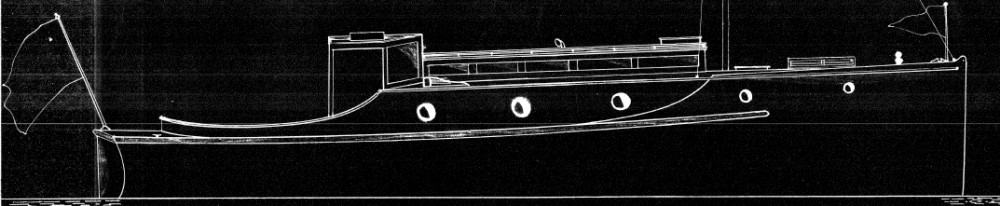
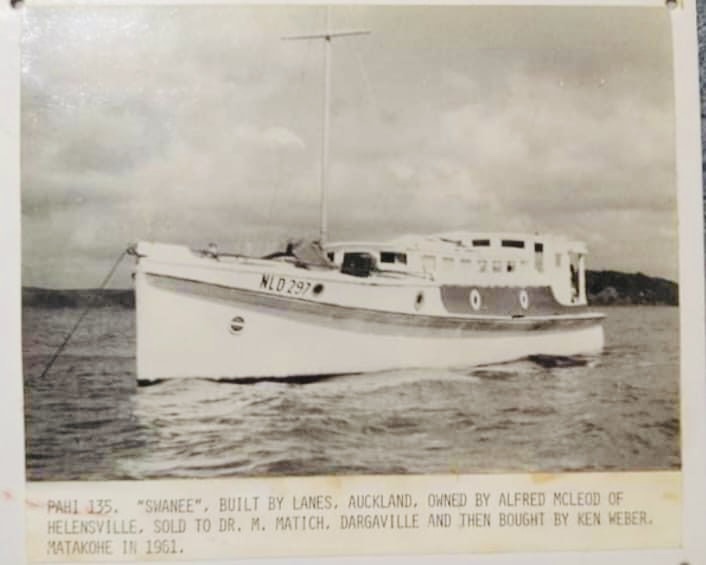
While the exact details of who designed & built today’s launch Swanee are unclear, she is rather unique in that she has remained in that same family for over 50 years. Built from kauri she is 33′ long with 8’9″ beam & 2’8″ draft, currently powered by a 60hp Ford diesel.
You can see from the photos that she is very well appointed with everything one needs for comfortable cruising – electric flush toilet, freezer/frig, electric capstan & all the safety gear.
Over their period of ownership the Weber have ensured Swanee remained in great condition with a major 2 year out-of-water refit in 1970 that saw her re-ribbed with pohutukawa (you could back then 🙂 ) & new topsides. In 2004/5 her topsides were glassed & 2 pot painted & she was rewired.
Owner Ralph understands, from his mother, that she was built c.1920 in Auckland for Sanfords. Then later sold to the McLeod family of Helensville. Then she went to Dargaville and then owned by Matich Bros and later by Dr Maurice Matich. The Weber family, Ken & June, bought Swanee in 1961 and now ownership is with their son Ralph Weber of Matakohe. Currently moored at Pahi.
Ralph commented that Harold Kidd had previously mentioned that she may possibly have been the – ‘Sister Lola’ & built by Bailey & Lowe, if so she ‘raced’ with the Ponsonby Cruising Club.
Ralph sent ww photos of Swanee over a year ago & contacted me recently to say that unfortunately life has moved on & the family have had to make the difficult decision to sell Swanee after 50+ years of ownership, so today’s post has a degree of sadness but could offer a lot of happiness to someone looking to buy a classic launch. For a 33′ launch, Swanee is a lot of boat, you can see in the photos that there is no shortage of living area & she comfortably sleeps 5. After 50 years you end up nothing what works best & where on a boat 😉
Boat aesthetics is a very personal thing & with some people practicality is #1, but if I was buying her I would be off to see a good sympathetic wooden boat builder like Geoff Bagnall & returning her cabin windows to a style a little more in keeping with a 1920’s classic. People forget that these old girls are wood & the cost of a wee bit of restoration like this would not be great. After all there is little else that needs doing to her.
She sports rather a racy (flat aft) bottom so with a bigger motor I would imagine she would perform very well.
So woodys – can we find a buyer for Swanee or know something that is looking for a classic wooden launch? Being based currently at Pahi she does present some interesting scenarios e.g. you could keep her there for a few seasons & have a floating family bach. A group of guys could get together & buy a good fishing / man bach on the Kaipara. Or simple put her on a truck & return her to the Waitemata.
Now I do not normally like to talk money in ww posts but the overall 2nd hand boating market is just so soft that when I think something is great value, I will – well woodys someone could own Swanee for less than $30K. , that is real value, you could not build a garage for that.
If you or anyone you know could be interested – contact Ralph, initially via email on weber.bros@xtra.co.nz
Also interested in any info /photos on her past.
Harold Kidd Input
SWANEE was certainly built as SISTER LOLA pre-October 1920, possibly by Harvey or DIck Lang. I don’t know where the Bailey & Lowe reference came in, although Bailey & Tyer did build a 33 footer (unusual dimension) just pre WW1. Lang too had built a 33 footer in 1916 and just could have used those moulds. I can’t find a direct report of her owner as SISTER LOLA but am pretty sure she’s the boat reported in the Auckland Star of 28th August 1920. If so, her hull was built professionally and she was finished off by her first owners Pavitt brothers and Verran at Bayswater. There again the Verrans were Northcote people and Bailey & Tyer were at Hall’s Beach, Northcote Point. She was sold to Arthur Sandford of Vine St., Ponsonby in late 1922, early 1923. He changed her name to SWANEE probably after the Al Jolson song “Swanee”. Sandford was, for a time, a professional Vaudeville artist and no doubt sang that song on stage. She had a 6 cylinder Studebaker car engine in 1925. Sandford sold her to Alfred McLeod some time between 1934 and 1939. McLeod joined the Squadron with her in 1939. She then had a 30hp Hercules engine which he replaced with a 100hp Meadows ohv 6 in 1947/8 (probably a war-surplus engine). The rest of her history on the Kaipara is well-known. There’s a big dose of conjecture in the above. I’ll check with the Verran family.
Update 30-08-2015
B/W photo added above ex Ian Miller whose wife Rosalind’s late father, Doug Hazard, crewed on Swanee in the 1930’s
Update 06-03-2023 – photo below ex Kauri museum, Matakohe via Diane Wilkinson fb
(The) COLLEEN photo & details from Janine Leighton
The above photos were sent to me by Janine Leighton, the granddaughter of Charles Aspden who built (or co-built) the launch (The) Colleen in the 1930’s. Charles was living at Northcote Point then. Notes on the back of the photos record that the vessel was apparently sold in c.1939 to Charles Shelley (sp?), an Auckland furrier.
Janine & ww would like to know what happened to her post this & does she still exist?
06-03-2021 Harold Kidd Input – Designed and built by Arnold (Bill) Couldrey for Charles Aspden.
Leisure Hour – Sailing Sunday photos ex John Wicks
Today’s boat is the 1937 Jimmy Reid built Leisure Hour, currently owned by John Wright & has just undergone one of John’s legendary make-overs. But to quote John Wicks, John W has discovered that sailing isn’t his thing & will remain faithful to his classic launch Jeunesse, so Leisure Hour is for sale. A great opportunity for someone wanting a rather nice little historic keeler.
I’m ‘borrowing’ below some info from an article Harold Kidd & Robin Elliott published on the Reid family & their boats, it appeared way back in 2001 in Boat NZ.
Jimmy Reid started building the 32′ Leisure Hour, his first keel boat, in 1936 & launched her in 1937. Its assumed his father (James Sr.) helped with the design. She was a beamy (9′) ketch & was registered as C41, that later changed to D14. Jimmy did some occasional cruising/racing with Akarana & rarely missed an Anniversary Regatta. He sold her in 1945 & back in 2001 she was moored in the Milford Creek.
So folks – can we fill in some of the holes in her past?
A Question – Neil Chalmers wondered if the building of ‘Leisure Hour’ was inspired by the famous ‘Idle Hour’ sailed by the American Dwight Long . ‘ Idle Hour’ visited Auckland in 1935 during a circumnavigation. The ‘Leisure Hour’ appears to be a similar type to ‘Idle Hour’. Neil dug out his copy of Dwight Long’s ‘Sailing all the seas in Idle Hour’ . His first stop in NZ was at Shakespeare Bay , Whangaparoa , he mentions seeing Mr Shakespeare’s yacht – could it be the CYA ‘Frances’.
Photo below of Idle Hour at Moturekereka.
03-08-2015 Input from Shamus Fairhall
I know Leisure Hour was owned by the Les and Jan Parkinson at some stage in the 1980s. Les brought her in a poor state and put considerable time in to making her sparkle again. Les and Jan were also the owners of our 1936 launch Sequoia in the late 1960s. Sadly Les is now deceased but he was always famous for his restoration skills with old Jags and military jeeps etc through his business Parky Jags. Photo below of Leisure Hour during his ownership and i will pass a link on to Jan as she may well have some detail to add.
SOUTHERN BAY 1994 Replica of a 1904 Truscott Mfg. Co Steam Launch. Compromise hull and 33 sq ft. Propane fired vertical tube boiler.
WAITEMATAWOODYS TRIP REPORT FROM OVERSEAS
Today’s photos & story came in from James Dreyer, who along with the extended family currently have Laughing Lady at the Whangateau Traditional Boat Yard. Jame’s work / travel take him off-shore a lot & in late May he was in the USA & put together a little story on the Southern California wooden boating scene. I’ll let James tell it. Enjoy 🙂
Remember if you click on a photo it will enlarge & you can read the captions. Scrolling over also reveals the captions.
“Back in late May, my father Barry & I headed to San Diego to spend a few weeks working on my Rhodes 33 “Therapy” and to visit the some of the 160 odd small breweries in the County, just to ensure their IPA’s were up to scratch. San Diego is known as the home of craft brewing, with each brewery having a tasting room and kitchen, or if not, bringing in a different gourmet food truck each night. Needless to say the hard work sanding and laying Uroxsys/Awlwood in the Southern Californian heat was well balanced with hydrating activities. And yes, the beer is so good, it was mind bottling (to coin a phrase).
While we were there I got in touch with Ralph Rodheim, the owner of another Rhodes 33 “Madness”.
I was hoping to head north to his place on Balboa Island / Newport Beach, to take some measurements and hopefully go for a sail. As luck would have it, the Balboa Yacht Club’s second inaugural Wooden Boat Festival was on during the final weekend of our visit, and Ralph was both an organising Chairman, entrant, and judge. This was a perfect opportunity to give the worn down finger tips, and high calorie intake a rest, while seeing how economical our rental Prius Hybrid could be heading North on the Pacific Highway to Newport. We left early, and stopped at a diner on the way for some bad coffee and an overcooked bacon muffin. This was California after all.
The show was just brilliant. A very Interesting variety of boats, interesting characters and live music.
I bumped into a number of “Rhodes people” and we swapped stories and info about the history of the class and how our restorations were coming along.
Above are some photos of the various boats, some I am lacking much info on, so my apologies in advance. If anyone wants more info on a certain boat, I am more than happy to respond with what I have, or get some more info from friends.
I thoroughly recommend viewing the following collection of photos from the event: http://bycwoodenboatfestival.com/schedule-of-events/ They are beautifully shot and feature a whole lot of boats I didnt photograph, and many of their interiors.”
REVELRY 1951 Stephens Bros. Cruiser 42’
REVELRY
HUMBLE 1902 Thames River Launch 52′
HUMBLE 1902 Thames River Launch 52′
GRACIE 1950 Ed Monk Bridge Deck Cruiser 36’ Monk was a master of streamlining and this little cruiser was just gorgeous, especially with its two wooden kayaks and dinghy. Built for exploring the Pacific Northwest.
GRACIE
MADNESS 1948 Rhodes 33 One Design Philip Rhodes / South Coast Boat Building Co.
MADNESS 1948 Rhodes 33 One Design Philip Rhodes / South Coast Boat Building Co.
LAST CALL 1948 Chris Craft Holiday 24′
CHIEF 1947 Chris Craft “Red & White” Express Cruiser 25′
CHIEF 1947 Chris Craft “Red & White” Express Cruiser 25′
FIRECRACKER 38’ Grand Craft 2003 Replica of a 1928 Chris Craft
SPARKLE A super cute Philip Rhodes designed 17’ Electric Skiff Originally tender to the 77’ Rhodes Motor Sailer SEA DIAMOND Built at Abeking & Rasmussen in 1956.
SPARKLE
HUNGRY BLONDE 1949 20’ Chris Craft Owned by the owner of Hungry Blonde winery. This was my pick of the show.
HUNGRY BLONDE
S WONDERFUL 1939 Chris Craft 19’
FOUR BELLS 1955 36’ Rybovich Sportfish #16 Rybovich boats are the Rolls royce of sport fishers. The first being built for Earnest Hemingway and featuring the first fly bridge and outriggers.
Four Bells
FOUR BELLS aft cockpit steering station. Whoar…
BLAIR BARRY 1926 Fay & Bowen Saint Lawrence River Launch 26′
BLAIR BARRY
JOYFUL Bill Dunlaps beautifully home build, yet to see the water. 16ft Whitehall
A lovely clinker / lapstrake dinghy
AWESOME. Oldsmobile V8, turning an original, custom built 1 into 2 Vee drive gearbox and twin screws.
Awesome
Barry Dreyer posing on the aft deck of the Schooner America Replica.
SOUTHERN BAY 1994 Replica of a 1904 Truscott Mfg. Co Steam Launch.
ONO Dawn Boat Co. 1929 New York Commuter Yacht & Florida Sport fisher Twin Detroit 6/71s
ROSE WILDER 1968 Sparman & Stephens / Canteri Sangermani Sloop Carvel construction, fin keel, skeg hung rudder
A little taste of Southern California: Big trucks offset by Hybrids and Solar panels.
Another photo from Jason Prew’s camera during his trip up the Tamaki River with Otira to the recent Chris McMullen workshop CYA visit. On route Jason photographed some of the many moored wooden boats.
Lady Ava, originally named Miss Ava, she was built by Ernie Lane at Picton in 1931. She has appeared on ww before (link below). I wonder if her grey colour is a ‘between coats’ finish, she certainly looked smart when white 😉
Chris McMullen & his 1898 reproduction Herrreshoff steam boat
One of Chris’s experiments
Otira- 1902 Logan Bros
Otira- 1902 Logan Bros
And of a few photos of one of the prettiest boats on the Waitemata – Wirihana, the 1933 Colin Wild launch.
A Visit to Chris McMullen’s Boat Shed
Yesterday was a biggie on the wooden boating front – Barbara Cooke & myself organized for the Classic Yacht Association a visit to Chris McMullen’s workshop & boat shed. I have posted photos of the shed & its contents on ww before & ww has published several of Chris’s posts on the topic of electrochemical damage to wooden boats – but it was special for the members to meet the man himself & hear him speak on his past, his current passions / projects & future plans. The reproduction 1898 Herreshoff steam launch project just has to be one of the best kiwi ‘can-do’ tales around. The day she hits the water will be a very special occasion, I just hope I’m around to see it 😉
Today two things stood out for me: 1. The turn-out of two wooden boating icons – John Salthouse & Max Carter 2. The healthy number of sub 35 year old guys with a new found passion for classic wooden boats in attendance
If your a CYA member & you didn’t make the effort to come to the event – more fool you – as one of your most respected members said to me “today was a privilege, Chris is a one of a kind, his practical knowledge on boat building and engineering is unique”.
In my time as CYA launch captain one of my personal goals was to help deliver up events & access to people & ‘cool stuff’ that people would not normally have access to without being CYA members – from the comments & the smiles as people where departing today, Barb & I got it right today 🙂
To read / view more on Chris, his boats & the topic of electrochemical damage to wooden boats just enter – Chis McMullen – in the ww search box 😉




 waitematawoodys.com #1 for classic wooden boat stories, info, advice & news - updated daily - 15+ million views