Unknown's avatar

About Alan Houghton - waitematawoodys.com founder

What is Waitemata Woodys all about? We provide a meeting point for owners and devotees of classic wooden boat. We seek to capture the growing interest in old wooden boats and to encourage and bring together all those friendly people who are interested in the preservation of classic wooden vessels for whatever reason, be it their own lifestyle, passion for old boats or just their view of the world. We encourage the exchange of knowledge about the care and restoration of these old boats, and we facilitate gatherings of classic wooden boats via working together with traditionally-minded clubs and associations. Are you a Waitemata Woody? The Waitemata Woodies blog provides a virtual meeting point for lovers of classic and traditional wooden boats.
 If you are interested in our interests and activities become a follower to this blog. The Vessels Featured The boats on display here (yes there are some yachts included, some are just to drop dead stunning to over look) require patrons, people devoted to their care and up keep, financially and emotionally . The owners of these boats understand the importance of owning, restoring and keeping a part of the golden age of Kiwi boating alive. The boats are true Kiwi treasure to be preserved and appreciated.

Time For Some Fresh Air

A LETTER TO RICK McCAY

I was going to email the below to Rick in reply to his post yesterday in the comments section concerning ‘an increasing level of vitriol and the use of quite unpleasant language when dealing with vague or inaccurate information’ on ww. But I decided to post it for all to read.

Firstly –  Hi Rick, thanks for the praise re the site, I value it coming from you.

Thanks for raising your concerns – before I address those let me explain a few things. I try not to edit / influence what appears in the comments section of ww, someones first comment on ww is always moderated e.g. to ensure they are not a spammer & their comments are related to the ww site & its content,  but after that they can enter comments ‘live’. Its a bit ‘chat-room’ like. I can chose the number of comments that appear ‘live’ on the site at any given time, you may have noticed that comments drop off as new ones are added. As comments do not get captured in the ww search function its a good place for debate around a topic, if a comment is factual & interesting & will add value to the original post, I will transfer it over to the original post.

One of the big pluses of the blog format is that only the blogger (person that set it up) can post on the site, this keeps the site focused & not dragged off onto random unrelated topics, this is very important to retaining the readers & keeping them coming back each day/week. With ww this has worked well & I now have a very good feel for what content works & when best to post particular content.

Now onto the big pink elephant sitting in the room 🙂 no point beating around the bush, the issue is Ken Rickets & Harold Kidd. I have hundreds to people who send me information & photos but these two are very productive. In their own way, each have contributed to the growth of ww, in the early days Harold took me to task re the accuracy of the data & I spent weeks (nights) back tracking, correcting & cross referencing content – the kick in the bum from Harold resulted in the site becoming an amazing reference tools for classic wooden boats & most things associated with it. Harold is New Zealand’s foremost marine / nautical historian & most published author -the site needs a resource like Harold & I am very appreciative of his input in keeping the site & myself focused, we are lucky to have him on ww. I told him once that I was going print a business card for him & under his name it would say ‘Stubbornly Traditional’, that is how I view Harold & I think it perfectly suits one of his roles in the classic boating movement.
Now the other party – Ken Rickets, what Ken initially bought to ww was a collection of old b/w photos, dating back to his boating youth when he had what appears to be almost unlimited access to a camera & film (a luxury in those days), over the years Ken added to his collection. When Ken was emailing me these photos everything was fine but then Ken got addicted (as have a lot of people) to ww & he started writing supporting copy for the photos, this is where things started to go a little wobbly – Kens writing style & frequent repetition of certain matters was not well received by readers, without boring you with details I can see how each post performs in terms of how many people open it, how long they spend on each post etc. End result I had to step in & have for a long time been editing / re-writing all Kens copy.
Then Ken started writing (live & unedited) in the comments section which resulted in topics dying off as people were had low interest in a lot of what was written. I started editing these comments also. Now you might ask – why did I bother doing all this editing – 2 reasons. (1) To protect the credibility of the ww site (2) I believed that Ken had valuable content that deserved to be seen.
Now Ken is no angel – in the past he has been ‘suspended’ on the site for breaking agreements we had & is currently on total moderation i.e. he is unable to write ‘live’ in the comments section. His writings are all moderated & where necessary edited. I have also had a lot of negative feedback about his ‘dock-side’ manner when gathering information.

I’m a trusting person & I tend to believe what people tell me, so I used to assume that the copy that Ken supplied about boats & events to be correct but unfortunately with Ken a lot is based on memories from his youth, which was a long time ago, so things get a little (or a lot) muddled & on top of this Ken started practicing what journalists used to call ‘interviewing his own typewriter’. A combination of embellishing the story & not having access to people (most deceased) to validate the data has resulted in a high percentage of confusing & misleading data being published.
Numerous ww readers have been contacting me & challenging Kens writings, the most frequent being Harold Kidd, as you would expect as he is, as my son would say ‘The Man’ when it comes to detail. ww needs Harold & others to ensure the ww content is as accurate as possible. The fact Harold chooses to draw attention to any mistakes via the ww comments section is healthy, it encourages debate & that is a good thing.  Now Harold’s delivery can be cutting at times but its my belief this is driven out of frustration that one individual continues to offend & makes no attempt to change their ways.

What have I learnt along the way – ww is lucky to have Harold Kidd on-board. I have learnt that Ken Rickets is a passionate collector of material related to motor boats (launches) but his passion & strength is in the visual platform (photos) not in the written word (details). Now he will disagree but ww has shown this is the case.

Going forward I have put in place some steps that should reduce Harold’s need to correct comments, but I hope he continues to. This involves further moderation of Kens writing,  if he can not substantiate claims or is unprepared to admit he knows nothing e.g. “This a very cool photo I took in 1948, I know nothing about the vessel or the location, can anyone help” – then I will do that for him. If he gets frustrated with this – then he can do what anyone can & stop being a ww blog follower. I hope not.

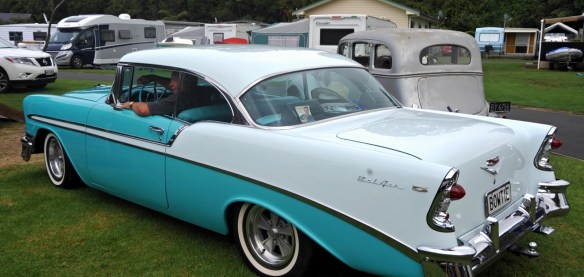
Now lets finish this post on a upbeat – Rick has impeccable taste in wheels & keels – see below 🙂

Where is this woodys gathering?

WHERE IS THIS WOODYS GATHERING?
photo ex Harold Kidd

Today’s photo was taken in the period 1895-1905 & is ‘around’ the Waitemata.
What say you woodys – whats the location?

Article ex Paperpast from the NZ Herald 3 Jan 1896 (ex Harold Kidd)

Also a wee bonus today – Martin Turnwald, son of CYA member John Turnwald (MV Robyn Gae), who now resides in Switzerland, has sent in a c.1993 video of the William C Daldy. We see the crew was firing up the boilers to turn the old girl around on the wharf and Martin and then girlfriend, (now wife) were on board to watch.


Thetis

THETIS
photos & details from Luke Richardson

Thetis (Greek for Sea Nymph) was launched in Dunedin on the 31st August 1929.  She was built by Mr J McPherson boat builder of Dunedin for Mr Charles Sundstrum.
Thetis was designed by renown naval architect Mr William H Hand Jnr of New Bedford USA.  William ‘Bill’ Hand was the originator of the V-bottom hull type per Thetis.  In addition Hand was an early pioneer of the motor-sailor type. Thetis was designed as a fast day cruiser.
She is 35’1” in length with 8’1” beam, 2’9” draft and a total height of 6’9”. She is a British Registered ship dated 16th August 1929.  The official number is 127819. Her registered tonnage is 4.68 with a Gross Tonnage of 7.57.

Thetis was originally powered by a Chrysler Imperial 6 cylinder petrol engine producing 160hp at 2800rpm.  Later she was re-powered by a Chrysler Royal engine with 140hp.  With a Ford diesel in between she was subsequently re-powered in 2003 with a Mercedes Benz 5 cylinder diesel engine.  That motor is to be replaced now. Documents show Thetis was originally good for 18 knots.  A bigger engine was installed around the war years and its said she has seen 26+ knots.  In current configuration she’s more like 12-13 knots.

Construction is of kauri hull planking and Kowhai frames with teak decks. The cabin was subsequently modified and enclosed by Magnus Smith of Lyttelton, Luke believes the work was done  for Bruce Stewart of Pigeon Bay.

Known Owners
Charles W Sundstrum                         1929-37
Bruce F Stewart (later Sir Bruce)         1937-50
William Carey                                      1950-54
Clarey Beaumont                                1954-57
Des Sinclair                                         1957-67
Laurie Wales                                       1967-1997?
David Martin                                        1997-2006
Brendon Leech                                    2006-2014
Glenn Tod                                            2014-2015
Luke Richardson                                  2015-

Known History
Dunedin to late 1930’s
Pigeon Bay for some 20 years
War Service – she was commandeered by the NZ Navy Naval Auxilliary Patrol Service (NAPS) in WWII and used as a coastal patrol boat.  She commenced service 9th May 1942 and was relieved of duty 23rd February 1944 when the NAPS formally disbanded.  She was assigned the pennant number Z125 and served in the unit based in Lyttelton.  The owner at that time was B.F. Stewart.

Luke purchased her in July 2015 and she is now hauled out of the water for some long overdue TLC.  A period of neglect following the Christchurch earthquakes meant she was long overdue for some maintenance.  Luke would love to know more about any of the owners over the years and any of her history not covered above.

To view more photos & to follow the work, Thetis has a facebook page –  Friends of Thetis

https://www.facebook.com/groups/1608024876125109/

See below an article on Thetis’s launch from the Australasian Motorboat & Yachting Monthly from October 1929. Its a good read 😉

Harold Kidd Input

Charles William Sundstrum was a Dunedin dentist who was a key figure in Dunedin yachting circles for many years. His first launch was the 31ft clinker double-ender VALMAI of 1910 which had a Dunedin-built 5hp Viking engine. He raced her with the Otago Yacht Club including one of their Ocean races to Timaru.
He replaced VALMAI in 1913 with the 40 footer NORANA designed by Joseph Gillanders and built by Miller Bros at Port Chalmers. She had a 16-18hp Jersey Standard marine engine and was a handsome craft. He sold her to Arthur Brett of Auckland in 1927. During WW2 she was taken over by the RNZAF and sent to Fiji for towing work.
THETIS was NORANA’s replacement. Photo of Norana below.

13-05-2017 – Additional Photos ex trademe (Ian McDonald nudge)


How Waitematawoodys Works

Might Be Time For An Explanation On The Process Behind Waitematawoodys And A Call For Content

Firstly ww is a blog and a blog is simply a way to share information and thoughts on a subject and create a community around that blog. Unlike social media platforms (facebook, forums etc) you can create a blog in any way you choose, its a personal space and more importantly you can control when & how a message (post) appears. Its a little like a magazine in that an editor controls the look and content and the magazine reader just reads what is published. How a blog can differ is that the reader (or follower as they are called) can have the ability to interact (comment) and even supply content for consideration. But unlike social media the follower can not publish content direct. One of the reasons for this is to keep the blog focussed on its reason for being and not get hijacked off on unrelated (boring) subjects.

Alan Houghton (photo below) is the founder of the ww blog, Alan decides the content that appears each day. This content is a combination of stuff he knows about or has access to and stuff sent to him by others and while Alan holds the tiller, waitematawoodys is all about you, not him. Your comments, photos and stories are what make it all happen. All ww is, is a window into the amazing world of classic wooden boats.

As the blog has grown in popularity, now over 1.2 million views, more and more people have started to submit content to ww, this is very cool and we encourage contributions. Its a great day when the blog & its followers are able to uncover for people details on a vessel from their past. So please keep sending in your photos, film, words and questions about the diverse vessels, people, history, events and activities that make up our unique community. The address to email them to is waitematawoodys@gmail.com

The only thing we ask is that you clearly state what you know to be fact and what is memory based. Material based on the memory is great but we are all getting on and things can get a little murky, but ww files away everything and at some stage someone else could send in something that backs up the murky bits.

Note: waitematawoodys does not have staff or ‘official’ writers, there are a few enthusiastic people out there that submit information regularly and others that help with authenticating facts but we would encourage you all to have a look in the bottom draw for that old photo album and send in anything you think might be suitable.
A tip – rather than telling it to someone that might give the impression that they are knowledge and have the ability to get the story posted on ww, just send it direct to ww.

Ngaio – Sailing Sunday

Ngaio – Sailing Sunday
photo ex Nathan Herbert

Todays photos were taken in early Jan 2015 by Nathan & are from Tutukaka. The hauled out ‘yacht’ has an interesting set up – 2 masts + game poles 🙂
I have to say it looks a great spot to haul out.

Anyone able to shed some light on the boat?

No longer a mystery – its Ngaio, designed by Jim Mason in 1941 – photos below from Dean Wright

Harold Kidd Input

In case Ian doesn’t post, she was designed and built by Jim Mason at Grey Street, Whangarei from a half model and launched in 1941. She was partly mobilised in 1942 by NAPS and crewed by Jim Mason, skipper, Tom McKinnon, deputy skipper, and Jack Carpenter, Bob Baker, Peter Roberts and Ian Crawshaw. Her NAPS number was Z40.
These NAPS boats did a great job during wartime when German commerce raiders and minelayers were busy around New Zealand at the start and were followed by Jap submarines checking us out. The Whangarei boats were in the most likely place for trouble.
Lovely boat.

Input from owner & son of builder, Ian Mason

A following up on Harolds post on Ngaio,all correct I might add. She was built over a two year period. She is carvel planked in kauri over kowhai ribs and pohutukawa stem, stern and floors. Her first engine was a 6 cylinder Delage out of a car owned by my father. When it was replaced in 1957 by an air cooled Enfield they got more for the scrap than Dad originally paid for the car. When she was built kauri was 3 pound 15 shillings per 100 super feet and the copper nails were the equivalent of 75c per pound. The original suit of sails cost 25 pound from Sails and Covers. In those days she carried 750 sq ft of sail. Since the Enfield she has been powered by a Ruston, Bedford and now a 6BB1 Isuzu. I installed this in 1995  and we have had 7000 trouble free hours since. I first went aboard Ngaio when I was 4 months old. I have 4 children and 9 (to date) grand children and they all love her as much as those  that have gone before. I think she will keep the same name and family ownership for a while yet.


Woody Trip Report – Inside Passage Cruise

WOODEN BOATS OF THE INSIDE PASSAGE

Story & photos by CYA NZ member Denis O’Callahan (owner of MV Tasman)

Today’s post tells the story of Judy & Denis O’Callahan’s adventure cruise – its a great read, so I’ll let Denis tell the story. Enjoy 🙂

 “In April 2000 I was invited by a Canadian friend to help launch a boat which his brother Wayne had built on Thetis Island in the Strait of Georgia near Vancouver. The “Grail Dancer” is 48’ on the deck, ketch rigged and based on the lines of the “Emma C Berry”, a 150 year old traditional fishing boat now preserved at the Mystic Seaport Museum, Connecticut. Wayne works as a wooden boat builder and restorer who at that time was restoring historic paddle steamers at Fort Dawson and Whitehorse on the Yukon River during the summer. During the winter he worked on the “Grail Dancer” which took him 14 years to complete. This trip was a great experience which gave me an inkling of what a wonderful cruising ground the Inside Passage to Alaska would be. This was further reinforced when I read the great book, “Passage to Juneau” by Johnathan Raban.

Eventually this year my wife Judy and I planned a visit to Vancouver and Alaska, including an adventure cruise of the Inside Passage. Our first stop was Vancouver, from where we took a float plane to Victoria on Vancouver Island to spend a couple of days with friends who live near Nanaimo. On the way north from Victoria we called in at the small fishing port of Cowichan where I was able to see a converted fishing boat, “Morseby III”, which belongs to a guy I know who lives at Mangawhai. We flew back to Vancouver from Nanaimo and had a couple of days there including a visit to the excellent Maritime Museum. Here there is preserved the wooden auxiliary schooner St Roch, built in 1928 in Vancouver and operated by the Royal Canadian Mounted Police. In 1942 St Roch completed the first voyage from the Pacific to the Atlantic through the Northwest Passage, 27 months from Vancouver to Halifax and spending 2 winters in the ice. In Halifax her engine was upgraded from 150hp to 300hp and she made the return journey in 1944 in 86 days.

Next we boarded the Alaska Marine Highway ferry “Columbia” for a 2 night, 1 day voyage from Bellingham to Ketchikan. This was rather like a Cook Strait ferry and while we had a comfortable cabin many hardy souls camped in deck, fixing their tents down with duct tape. We saw a number of other boats during this trip, huge barges laden with containers and trucks, cruise ships, fishing boats, pleasure boats and some of the contestants in the inaugural “Race to Alaska” (R2AK). R2AK is open to any kind of boat without an engine, from kayaks to racing trimarans, 750 miles from Port Townsend to Ketchikan. First prize, $10,000, second prize, a set of steak knives. The ferry passed through many spectacular narrows and channels and at Bella Bella we stopped while the crew lowered the anchors to demonstrate compliance with US Coast Guard requirements.

Ketchikan is a busy port town with floating docks and other marine facilities. However during the summer it is dominated by up to 4 giant cruise ships visiting each day. A large marina (“floats” in the local lingo) accommodates a variety of fishing and pleasure craft. The salmon fishing boats are divided into 3 types, purse seiners which go for large volume, low value fish, gill netters which aim for better quality and trollers which target the top quality product. Long-liners target halibut, a kind of gigantic deep water flounder which can grow up to 200kg.

We took a 10 day adventure cruise on the “Alaska Dream”, a 104’ catamaran, rather like a Waiheke ferry with cabins for 40 passengers and a crew of 17. We strongly recommend this as a way to see the Inside Passage. Activities included walks ashore, railway excursions, kayaking and even swimming. We saw amazing wild life, indigenous culture, glaciers and fishing ports, including Sitka, Skagway, Haines, Juneau, Petersburg, Wrangell, Thorne Bay, Matlakatia and Ketchican. In every port there were numerous classic wooden fishing vessels in varying states of preservation. I would estimate that 90% of the working fishing boats around the Inside Passage are of wooden construction. The plentiful supply of rot resistant old growth Yellow Cedar and Western Red Cedar no doubt accounts for the durability of these vessels”

Tapui

TAPUI
photos ex Chris Leech

The above photos show the Salthouse launch, Tapui. When these were taken she was owned by the late Ian Ward and Frank Gimson (both life members of the DYC). I’ll let Chris Leech chip in with the story on the prank that two DYC members played on Ian. The two perpetrators were Rob Wallace & Bob Thompson. The painting is a classic David Barker & now hangs in the DYC clubrooms, as the ‘Ian Ward Memorial Trophy’, for I understand a DYC launch Log Rally – won by Chris Leech in Castaway (Islander) .

The photos below are from her launching at DYC

Can we uncover anymore details on Tapui & where she is these days?

Harold Kidd Input

I first came across Ian Ward when we were founder members of the Pupuke Boating Club which operated off Takapuna Beach from a flagstaff on Muir Douglas’ beachfront house. We raced a motley collection of centreboarders, Zeddies, IA’s, Silver Ferns, and miscellaneous sailing dinghies. Ian was about 14 and a character already. Others of his age included David Barker, Adrian Greatorex, Paul Rusden and Bondy. We saw the meteoric Roberts brothers with their crack Zeddie TAWAKI and Murray Follas with his 1st Div IAs KHAMA then THUNDERBIRD on occasion. At first John Chapple and I raced my IA TUNA, a Zeddie whose name I forget, then a succession of Pennants and Q Class 12 footers, GLEE/CAPRICE, DIXIE and finally FLAMINGO with which John won the Interdominion 12 footer Champs 3 or 4 times in a row. John later designed the CHEROKEE class for the Club.
Ian was a considerable character and that was reflected in TAPUI and her exploits over the years.

photos (ex tradeaboat) added.

Just received a current photo ex Mike Quilter, not a bad sailor 😉 , who now owns Tapui & has removed the flying bridge 🙂 – there will be a ww t-shirt in the mail to Mike, anyone that gets the chainsaw out deserves a reward.

Attempt To Steal Classic Launch Florence

Attempt To Steal Classic Launch Florence

The world is full of idiots & Mathew Dring would be near the top of the list. He appeared in court yesterday for attempting to steal the 1910 H.N. Burgess designed classic launch Florence. As well as being a fool, he has no taste, as Florence was the 3rd vessel he boarded & attempted to steal.
And what did his lawyer say – “his client wanted to change his ways & he wants to plan for his future”, to which the judge said “you present as someone who deeply regrets what happened” – the systems a joke. Mathew Dring (remember that name) was given 6mths. community detention (I think thats what we used to call PD) & $400 reparation. The little thief should serve the 6mths. PD sanding the bottom of boats.

Read details here    http://www.stuff.co.nz/auckland/local-news/71674729/Hapless-thief-tried-to-steal-two-boats-from-Auckland-marina

ps I have tagged the thief’s name in the post so if anyone ever google searches him, his little escapade with come up 🙂

Lady Mary

LADY MARY
photos & details ex trademe

Lady Mary is currently listed on trademe & unless the owner updates the listing, will remain there a while i.e. almost zero details on the boat. So woodys who built her & when?

What we do know is she is 22’9″ long with a kauri carvel planked hull. Currently powered by a 30hp Volvo Penta diesel. At approx. 23′ you wouldn’t want too many people up top 🙂

The cradle she is hauled out on is familiar to me – its at Geoff Bagnall’s Milford yard,  Raindance has spent time in that cradle 😉

Beautiful Waiheke – 1930’s Boating Movie with updated story

Beautiful Waiheke – 1930’s Boating Movie

I was sent this movie, filmed in late1929/30’s by the Lambourne brothers (Allan & Alex) nearly 2-1/2 years ago by Roger Guthrie, it was back in the very early days of ww & since then a lot more people have checked onto the site – in fact over 100,000 people. On ww last week I bumped into Peter Stein whose father (also Peter) appeared in the movie. Peter has written a very cool synopsis of the movie & the (now) classic launches that appear in the movie. I suggest you read Peters words & then watch the movie. Enjoy 🙂

The film “Beautiful Waiheke” by Peter Stein

Introduction:

The film was produced by the Lambourne brothers Allan & Alex in the late 1920’s early 1930’s. The Lambournes owned a large furniture shop on the corner of Ponsonby Road and Pompallier Terrace. The Arran Bay house was built in 1910 and remained Lambourne property until 1964 when it was sold to the Jorgensen Family.

Water transport for the Lambournes was the launch “Nga Whare” which is the round bilged craft in the film with the two portholes in her topsides. She was sold when I was a very young boy so I remember little about her.

Our property is next door to the Lambournes. Arran House was built circa 1885 for Andrew and Mary Croll from the Isle of Arran, Scotland. They were two of Waiheke’s pioneers. Andrew was a very fine photographer and albums of his photos can be seen at the Waiheke Historical Society Museum on Onetangi Road. Among the photos are scenes of the Annual Regatta organised by Andrew and held at Arran Bay circa the late nineteenth century. These events were well supported by “boaties” of the day. The albums were kindly donated by the Crolls of Sydney. Mary Croll was a very good artist and she put many scenes of the “bottom end” on canvas. Some of her mural work is still on the walls of one of the bedrooms in Arran House. My father, P.A.S. Stein purchased Arran House from W.J. Connell (owner of Connell’s Bay Store) in 1924 and it has been in our family ever since.

The Waitangi, the launch with mast and crosstree in the film was built in 1923 for Mr Cadman. It was a classic John L. Hacker design with sharp entry and flat stern section. The original owner named her “Karamana”. She had an aeroplane engine in her and we understand she was capable of 25knots which made her one of the fastest launches on the Waitemata at that time. Harold Kidd has a very good photo of her racing on the harbour (added below. AH). In the latter 1920s she ended up on the Tamaki Drive breakwater. My father bought the severely damaged hull and had her restored by Chas Bailey & Sons. He renamed her the “Waitangi” after his father’s steamer the TSS Waitangi of the Northern Steamship Co. My grandfather Peter Anton Stein was a Captain of various Northern Steamship Co. vessels from 1895 to 1908. Chas Bailey told my father that the Waitangi had brought them good luck because the next launch off their slipway was the legendary “Shenandoah”.

The Waitangi was 28 feet long (8.5m), had a beam of 7 foot 3inches (2.2m) and draft of 2 foot 8 inches (.8m). She was built in kauri and the bottom was double skinned from the bow to the wheelhouse.  The rest of the vessel was single skinned. Her Auckland mooring was in St Mary’s Bay in front of the Ponsonby Cruising Club at the bottom of St Mary’s Road. Maintenance was carried out at Collings and Bell Boat Builders adjacent to the PCC.

About 1930 my father replaced the old Studebaker engine with a 105hp Kermath marine engine. Allely Bros. of Beaumont Street imported the motor and installed it.  It was known as a 6 cylinder flat top. The pistons had a bore of 4” (100mm) and each cylinder had two spark plugs. It was double ignition with one spark plug connected to the magneto and the other one the distributor. Maximum speed was 18kns and at this speed the motor burnt 8 gallons of petrol per hour.   Petrol was bought in 4 gallon cans and there were two cans to a box. We still have an old Atlantic box which we use as a vegetable bin at Arran House. Petrol in the early 30s was 1 shilling and six pence a gallon. A 50% rebate brought the price back to a respectable 9 pence a gallon. My father told me that the best run home he achieved was Connell’s Point to Kings Wharf in 1 hour and 12 minutes.


The film:

The film began with shots of the Guthrie family aboard their launch “Alcestis”. It then moved to shots of Arran Bay taken from different location around the Bay. The people setting out down the path are coming from the Lambourne’s house.

The aquaplaning sequence was filmed from the shore and the “Nga Whare” which was the tow boat. My father was the young man with one of the Lambourne girls on his shoulders. Years later I learnt to aquaplane on the same board.

The “Waitangi” then heads to Bulls Bay with my father as pilot. The majority of the film is shot at Bulls Bay (Anita Bay) on the north eastern end of Waiheke. At the northern end of the bay are many small rocky islands and the launches are filmed going through the channels between the rocks. These are not hard to navigate but should be done at ½ tide or more.

The “Coughing Caves” are in the southern point of Bulls Bay. With a northerly swell and incoming tide, waves enter the caves and when the top reaches the ceiling of the cave the air behind it is compressed until it bursts out in a cloud of spray. The boy in the dingy, Reg Crawford, is trying to get as close as he safely can to the emerging spray.

The “Whirl Pool” is in the long reef extending from the northern end of Bulls Bay. Riding the swell in and out of the pool could be quite exciting as seen in the film.

The homeward bound shots of the Waitangi in the storm were taken in the channel between Pakatoa and Waiheke.

Harold Kidd Input from previous ww post

Waitangi was built as KARAMANA for F.B. Cadman in 1923 by Bailey & Lowe to a design by Hacker. KARAMANA = CADMAN in pig maori.
She was later bought by Auckland Grammar School teacher P A S Stein and rebuilt as per the 2nd photo below. She was fitted with a war surplus 6 cyl Green sohc aero engine producing 120-140bhp, bore 5.5 ins, stroke 6 ins (you work out the capacity). She was pretty radical.

03-09-2015– comments

1. The Lambourne launch was called NGAWAI I think, not NGA WHARE. She was later bought by the Andrews family on the Hokianga. I remember her as a child during WW2 laid up in a shed with a Chrysler engine. Maybe another NGAWAI but she looks the same.
2. KARAMANA/WAITANGI was built by Bailey & Lowe in 1923, not by Chas. Bailey Jr who built SHENANDOAH in 1929. There’s some conflation there.