The Cole Boats – Black Watch, Wanda II (Lady Norma), Colmana

Gordon Cole & His Boats

photos & info from Ken Rickets with input from Adrienne & Malcolm Cole. Edited by Alan H

During his boating era Gordon Cole was a very successful furniture retailer (Coles Furnishers, Otahuhu) & the Cole family were dedicated launchies of the very highest order, owning at least 3 boats – Black Watch & Wanda II (note: Cole changed both boats names to Lady Norma & to confuse matters more, when Cole sold Black Watch she became either Lady Ailsa or Lady Alisa. Wanda II / Lady Norma’s name was later changed back to Wanda by subsequent owners) & later a 3rd one, Colmana.

Black Watch

Black Watch was painted completely black when Cole purchased her off the estate of the late Rev. Jasper Calder c.1952-53. When purchased she was moored in the Tamaki River & in a very neglected, unused state. The Cole family had to do a lot of bilge pumping until they hauled her out of the water, which they did almost immediately, at the Lane Motor Boat Co. slip. The entire Cole family, Gordon, his late wife Norma & older children, Malcolm & Adrienne all worked very hard along with some of the Lane staff, for many months, to convert Black Watch into Lady Norma as she is in the photo. Lane’s fitted the flying bridge at the same time as the general overhaul & upgrade. Cole later replaced the original engines ( Ford petrol V8 & the Perkins Diesel) with two x 6 cyl. Ford diesels, which son Malcolm Cole recalls, were painted blue.

They owned her from c.1952-53 until c.1958-59.

Wanda II

Had two sets of engines & while Ken Ricketts is not sure when the two 4 cyl. BMCs were fitted, he recalls that while out on her one day over Christmas 1960, she definitely still had her original Scripps 6 cyl. 90hp petrol engines at that time & by the look of the vapor at the stern in the B/W photo of her under way, she had them when that photo was taken. Gordon Cole can be seen clearly with his head through the hatch, naturally very proudly, at the helm.

Colmana

Was the last of their boats & built for them in Tauranga by Donald Brothers & launched in 1974.

‘Black Watch’ & The Rev. Jasper Calder

This slideshow requires JavaScript.

 Black Watch & The Rev. Jasper Calder

photos & info ex Ken Ricketts. Edited by Alan H

Black Watch was either built for, or bought new, by the late Rev. Jasper Calder an Anglican sea loving vicar.

Ken Ricketts first saw Black Watch under construction in c.1947-48 on the port side of the creek, in the right hand corner of Leigh Harbour. She was at the stage of completed hull & combings, with no or little paint, her hull was built of very narrow Kahikatea planking & from memory kauri combings. She was as she appears in the photo except that she was initially painted completely black.

Black Watch was actually Calder’s second boat, the first being a 1925-30 vintage bridge decker, approx. 38 ft., called Crusader, that he owned in the 1930s. Ken recalls his father, Ralph Ricketts, when he was cruising on the Glennifer with the late Trevor Davis, attending impromptu church services on board Crusader along with many other boaties of the day. The crews would all tie their dinghies to the stern of the Crusader for the ‘church’ service most Sunday mornings in Mansion House Bay, Kawau Island over the warm summer months. You can see Crusader marked in Ken’s photo, taken Xmas 1948, of Mansion House Bay.

Ken commented that Calder did not have a lot of money to spend on his boats & love of the sea & Black Watch’s original engines were one 6 cyl Perkins diesel & one Ford V8 (probably both second hand.)

Black Watch was bought by Gordon Cole from Calder’s estate in c.1952-53. Cole owned Black Watch until c.1958-9, when he purchased Wanda II. Cole changed both Black Watch & Wanda II’s names to Lady Norma. (Black Watch/Lady Norma possibly later became Lady Alisa).

Note: Calder towards the end of his life, acquired an interest in an unfinished 75 foot H.D.M.L. naval vessel, which was the only one the navy disposed of for many years, which Ken believes was still under construction when WWII ended, so the Navy sold her possibly unfinished. Calder named her Black Watch as well.

Ken sighted the Calder’s H.D.M.L. recently at Bayswater on a swing mooring, in an extremely neglected state. Previous to this Ken had seen her in the 1980s, tied to a wharf in Schoolhouse Bay, Kawau Island, where see remained most of the time, for a number of years. She had then & possibly still has, twin 6 cyl Perkins diesels. She was modified many years ago in the 1970/80s to a type of semi motor sailer with 2 masts & a semi clipper bow.

Harold Kidd Update

CRUSADER was built for Rev. Jasper Calder and Charlie Goldsboro by Collings & Bell in the winter of 1929, originally without her later bridgedeck. She replaced Calder’s 20ft mullet boat NGARO.

I wonder who built the first BLACK WATCH for him?

Calder had two HDMLs, both called BLACK WATCH. The first, Q1349, was returned to Navy in July 1952 and has since reverted to BLACK WATCH. All RNZN HDMLs were built in North America, none were “under construction when WW2 ended”.

Jasper Calder died in 1956.

Bayswater Dec 2014

A Woody Weekend

Woody Weekend on the Waitemata

The Waitemata Harbour was a pretty magical place this Labour weekend – we had an impressive collection of wooden classics visiting.

The classic 1929 motor yacht Nahlin, owned by industrial designer / inventor James Dyson is currently berthed alongside the CYA’s Heritage Landing. Nahlin has a very impressive history of ownership & was once ‘The Royal Yacht’ – details on her history & restoration at the link below.

http://www.glwatson.com/detail/Nahlin__Classic_Motor_Yacht/527/26.aspx

We also had the ‘Tall Ships’ berthed at Princess Wharf for the long weekend & their arrival & departure was very impressive.

At the other end of the scale the super yacht (ship) ‘A’ was anchored in the middle of the harbour, this boat divides people into to camps – love it or hate it – me I love it. One of the crew skills is the ability to abseil – thats how they clean the windows 🙂

And even my favorite woody made it off the marina for 3 days of spring boating.

Florence Rose

Image

Florence Rose

Florence Rose

Designed by Billy Rogers & built in1966 by Chas Bailey. Current owners B & G Diggle.
photo taken in Station Bay, Motutapu Island. 26/10/13

Anyone able to supply more info on her past?

Harold Kidd Update #1

I always thought that FLORENCE ROSE, like her sisterships IOWANA and LOLENE was designed and built by Billy Rogers. Charles Bailey Jr was of course long dead in 1966 but the remnants of the company he founded was staggering on under Winstones, then Dromgool’s ownership. But was that company into building new stuff, to other people’s designs in 1966? 

Andrew Pollard will know.

Is this yet another launch myth?

# 2 

Andrew was as surprised as I was with the suggestion that FLORENCE ROSE was built by Baileys. I’ll get hold of Geoff Rogers and ask him.

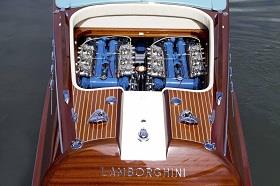
Riva with amazing twin Lamborghini engines

Video

A post for James Mobberley at Moon Engines – he (& I) will like this – a lot 🙂 Turn your sound up.

00100065-0000-0000-0000-000000000000_00000065-06d9-0000-0000-000000000000_20131007222656_Riva Aquarama Lamborghini

Back in 1968, Ferruccio Lamborghini ordered a custom Aquarama model from the legendary racing boat/yacht builder Riva.

For Ferruccio’s Aquarama, Riva installed a pair of the 4.0-liter V12 engines that at the time were being used in Lamborghini’s first road car, the iconic 350GT, its power and custom open-pipe exhaust made it the most unique Aquarama ever built.

Following Ferruccio Lamborghini’s death in 1993, enthusiasts speculated over the fate of what is now known as the Riva Aquarama Lamborghini. Most assumed the Aquarama Lamborghini was lost to time, until a Dutch Riva collector found it hidden under tarps in a boatyard. In 2010, the collector sent the boat off to Riva World, a world-famous shop in Holland specializing in the restoration of Riva boats. Now three years, 25 coats of lacquer, and two replacement 350GT V12 engines later, the Riva Aquarama Lamborghini has roared back to life.

The restoration brought legendary figures together from both Lamborghini and Riva’s past. The Ferruccio Lamborghini Museum in Italy had one of the two original Aquarama Lamborghini engines in its collection, but it took the involvement of Lino Morosini, head of Riva’s engine division in the 1960s, and the late Bob Wallace, Lamborghini test driver and developer, to recreate the modifications performed to the V12 engines for maritime use.

Riva World’s Sandro Zani sourced two 350GT engines (one from the U.S.) while his team rebuilt and restored the Aquarama Lamborghini’s wooden hull from top to bottom, and inside out. The twin-V12s carry the Aquarama Lamborghini to a top speed of 48 knots (as opposed to the 40-knot top speed of the standard V8-equipped Aquarama), with peak torque available from 1500 rpm.

The restoration wrapped up early this year, and after a few tests in the Netherlands, the Riva Aquarama Lamborghini returned to Italy this summer. Watch the youtube movie to see the Aquarama Lamborghini in action; if nothing else, it’s worthwhile for the hellacious sound the V12s make when the boat is pushed flat out.

Corsair

The Frostbite – Corsair

photos by Alan H 

At the recent Classic Yacht and Launch Exhibition  at the Viaduct, the 2013 event  showcased the acclaimed designers Jack Brooke & Bob Stewart. One of the outstanding boats on display was Paul Baragwanath’s exquisitely restored Frostbite ‘Corsair’, the attention to detail was just amazing, even featuring her original restored 1945 trailer. Corair was built by Jack Brooke in 1945 for Don Winston.

02-02-2018 Input from Paul Baragwanath

“She was built in 1946 for my grandfather, Don Winstone, and named after the planes he flew in WWII. The Frostbite class was designed in 1938 by Jack Brooke, and Corsair was built by him too. A few years back I tracked her down – derelict, but pretty much whole, in Nelson. We knew it was Corsair from the name let / inlaid into the middle thwart and the Corsair aeroplane profile in the for’d thwart. Teak in Kauri. Kauri hull. Oregon spars. Pohutukawa knees. Mahogany cappings. Teak and kauri floor grate. Australian hardwood rudder stock and kauri rudder. Kahikatea centre-board (from her time in the Waikato?). Mahogany mast supports. Brian Kidson who had owned did a good deal of work preparing and restoring the hull before she came north to Auckland for the woodwork to be completed by Jack’s son, master wooden boatbuilder Robert Brooke.

We restored the chrome hardware (Onehunga Electro Platers / Bumper Repairs – brilliant), re-created missing elements (Morris Sheet Metal and another engineer) including the lettering on the stern, restored the original 1946 mast, Frank Warnock created a traditional sail by hand, and I did the low-skill bits, and brought it all together. Ropes from Classic Marine in the UK. Other parts from Harken Fosters.

Robert designed a period road trailer with 1939 pressed steel Standard 10 wheels that I found on Trademe (Marlborough Sounds), and a friend who is a sculptor, David McCracken, made the trailer. I believe the Frostbite was NZ’s first specifically-designed trailer class – with it’s split / gunter rig – so a period trailer and launching trolley are part of it. It was the last class designed that you sit in, rather than on.

Robert’s lifetime of experience and eye resulted in what you can see – from the handmade wooden blocks, fine plank lines, floating thwarts, the traditional flick-bailer, right up to the pheasant feather pennant / wind vane atop the mast.

The colour is Eau de N’il – Water of the Nile – with a forest green waterline. My grandfather liked green – he also had a runabout named Amber (1950s 17 foot Greymarine engine) with a green waterline. Traditional white below the waterline. The interior is white house-paint up to the thwarts which sets off the varnish above that.

We don’t tend to race – wooden blocks, wooden grate, 1946 mast and rudder… but do sail off Narrowneck in Auckland, and Tutukaka, Ngunguru and Whangaumu Bay up north.

I put together a small book on the restoration – a few years ago now. The aim was to get her to A level condition – which we did, and she won the best restoration at the Lake Rotoiti (Nelson) classic boat show – and then to just enjoy her. She’s a delight to sail. Predictable, responsible and beautifully balanced. On the wind in a chop a for’d hand is useful for bailing!”


Mystery Launch 23/10

Image

This slideshow requires JavaScript.


photos ex Ron W & Harold Kid

Harold thinks its a Collings & Bell work boat but we are all scratching our heads to ID her any further. When you consider there were 1000’s of these ‘little’ launches built, we might be scratching for a while 🙂

Harold has sent in a better pic of the launch which he took off  the Collings & Bell original glass plate. You can see a square-rigger in the background.

Harold Kidd Update

I have always thought that this is probably C. & B. of which there were 3, this one being launched in November 1912. I have a much better copy of this image with more background.The other two were 20 footers of the same general configuration but the 1912 version was a 32 footer. Maybe it’s a 20 footer? The sidelight boxes look pretty large.  I’m pretty certain it’s a Chas Collings negative from his quarter-plate camera but I’ve always thought it was a later image as it is associated in my Collings collection with images from the 1930s. I’ll check with other pics.

Update #2

She’s not any of the 3 C. & B.’s but very similar. The last of the C. & B.s had the same little dodger (a very early example of a dodger installed ab initio), the same bollard forward, but her foredeck was raised. Tentatively, I think this is OZONE, built for Fred Woolley in June 1912, probably off the same moulds as the 32ft C. & B. This OZONE is NOT to be confused with the Percy McIntosh-built OZONE which did a lot of game-fishing in the Bay of Islands and is now rumoured to be at Mahurangi. This OZONE (if it is her) was a total wreck at Tawharanui Point, Takatu in January 1930.

Juliana > Marjorie Rosa

JULIANA > MARJORIE

photos & details ex Ken Ricketts. Edited by AH

Juliana was built in 1930 by Sam Ford & owned by Ralph & Wyn Ricketts from 1946 to 1956. She went to Whangarei for a few years when sold & then to the Algie family at Algies Bay from about 1972 to 1995. She was sold to a fisherman in New Plymouth for several years & ended up back at Tamaki River about 2006 as a bare hull absolutely nothing in her.

Bought by present owner Fraser Wilson as a bare neglected hull, with no bulkheads, engine, underwater gear, mast or anything else. Wilson has just undertaken a major 3 year restoration /rebuild on her by boatbuilder Tony Mitchell in his shed at Lake Rotoiti where she will now reside. Ken’s comment was ‘while unrecognizable as Juliana, in my view stunning in her own right’.

Propulsion History

1930 (Original) — 4cyl Thornycroft “T” head converted petrol truck engine c1925

1948 — 6 cyl Leyland “Cub” Diesel 90 HP (29.4 B.H.P. RAC rating), installed by owner Ralph Ricketts

1956 — 4 cyl Buda Marine Diesel (ex Arcturas — Built by Mc Geady c1952 for John Warren & replaced by Warren with 6 cyl Ford) installed by owner Ralph Ricketts

c1978 — 6 cyl 100 hp Ford Diesel fitted by owner Brian Algie

2013 (October) 3 cyl  brand new Lombardini Diesel approx 60hp installed for Fraser Wilson by Tony Mitchell boat builder

Photos

1. The black & white photo of her hauled out was taken in Judges Bay by the Parnell Baths in 1947, by Ken Ricketts.

2. The sepia photo shows Ken Ricketts on board Juliana c.1947

3. The ‘all white’ photo is the bare hulk prior to the current rebuild.

4. Colour photos are from her relaunch as Marjorie Rosa

AH comment – she is very stunning & will be the belle of the lake, but if was me I would have followed Sam Fords original design a little more closely. But beauty is, as they say ‘in the eyes of the beholder’