A QUESTION FOR WOODY BOATERS – Why have a mast on a classic motor boat*
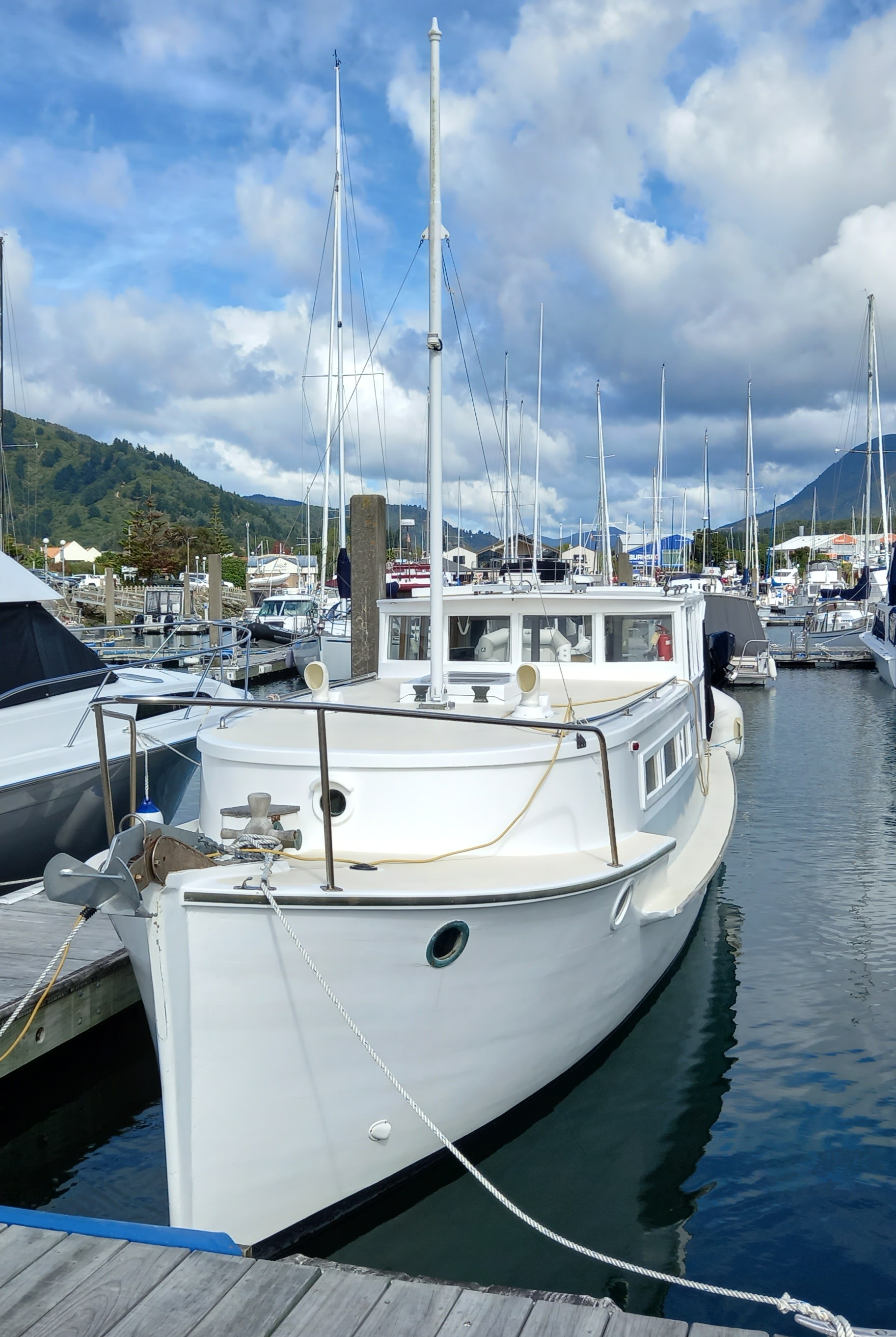
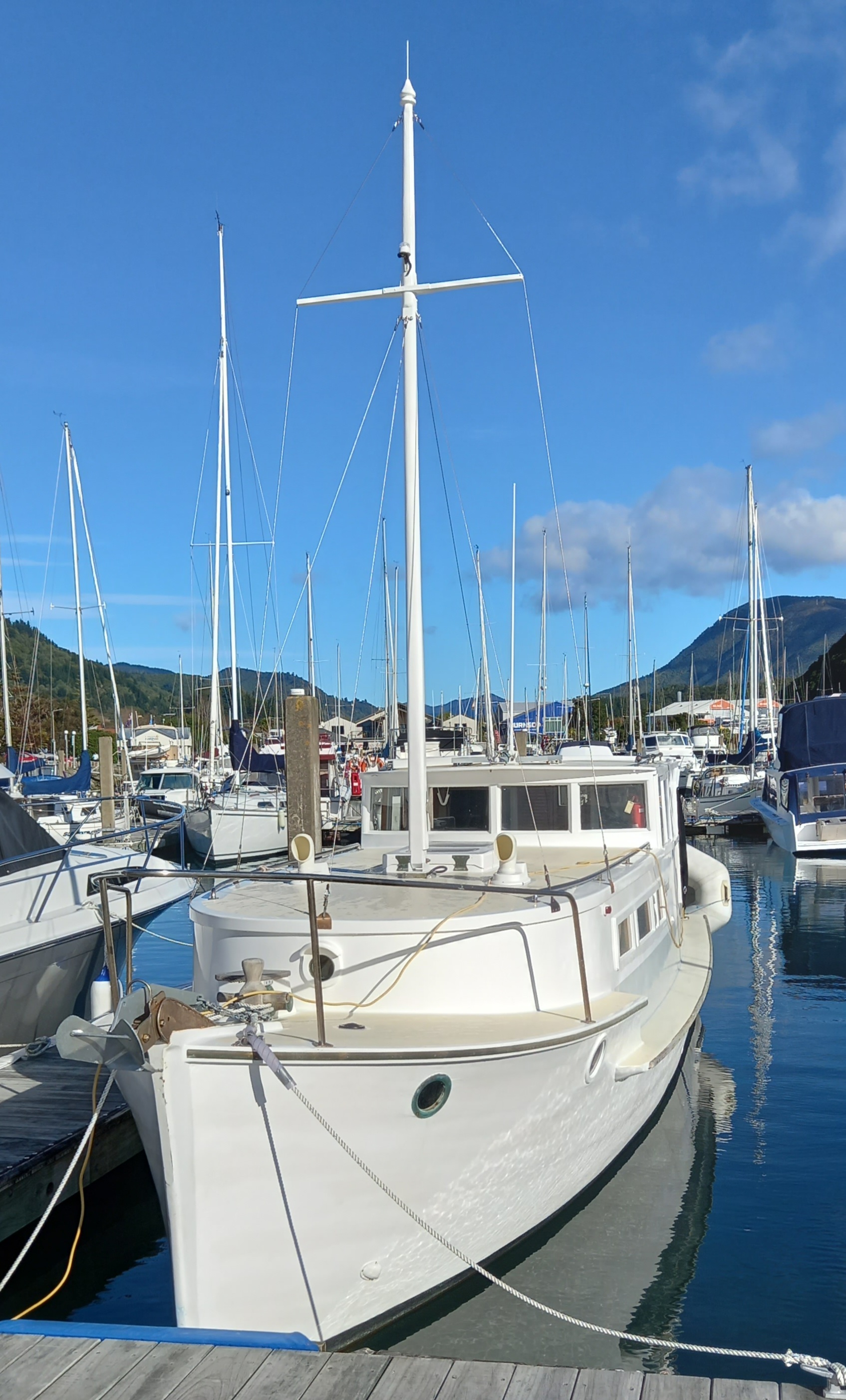
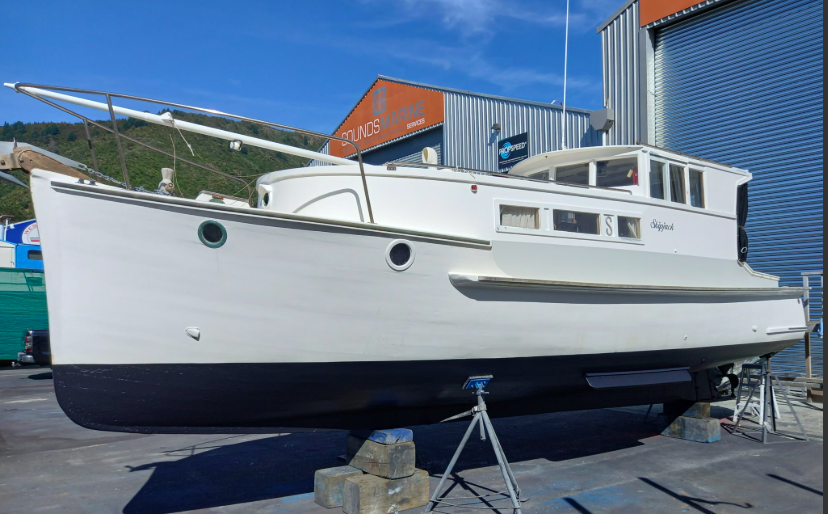
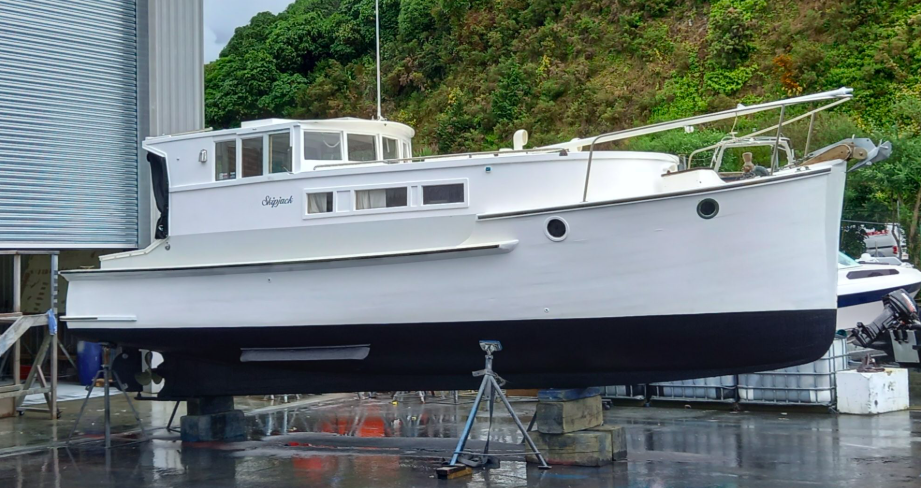
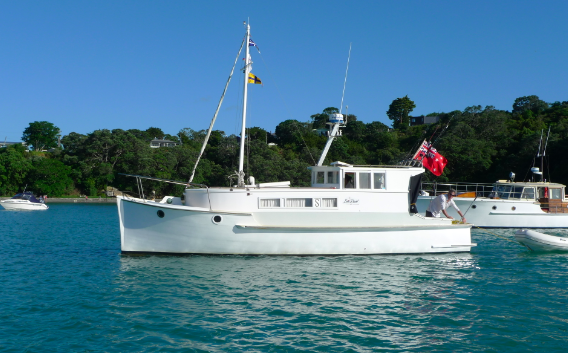
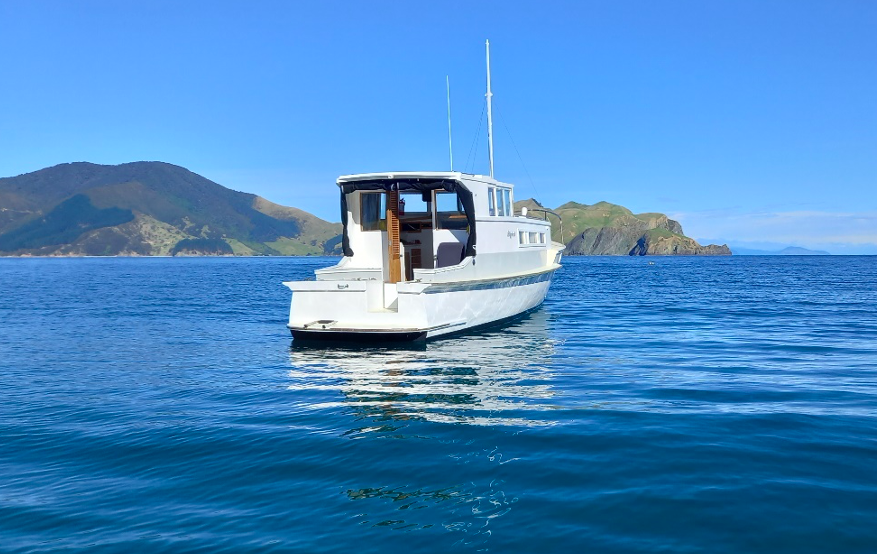
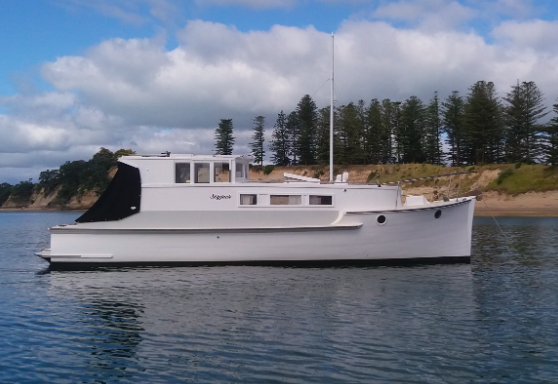
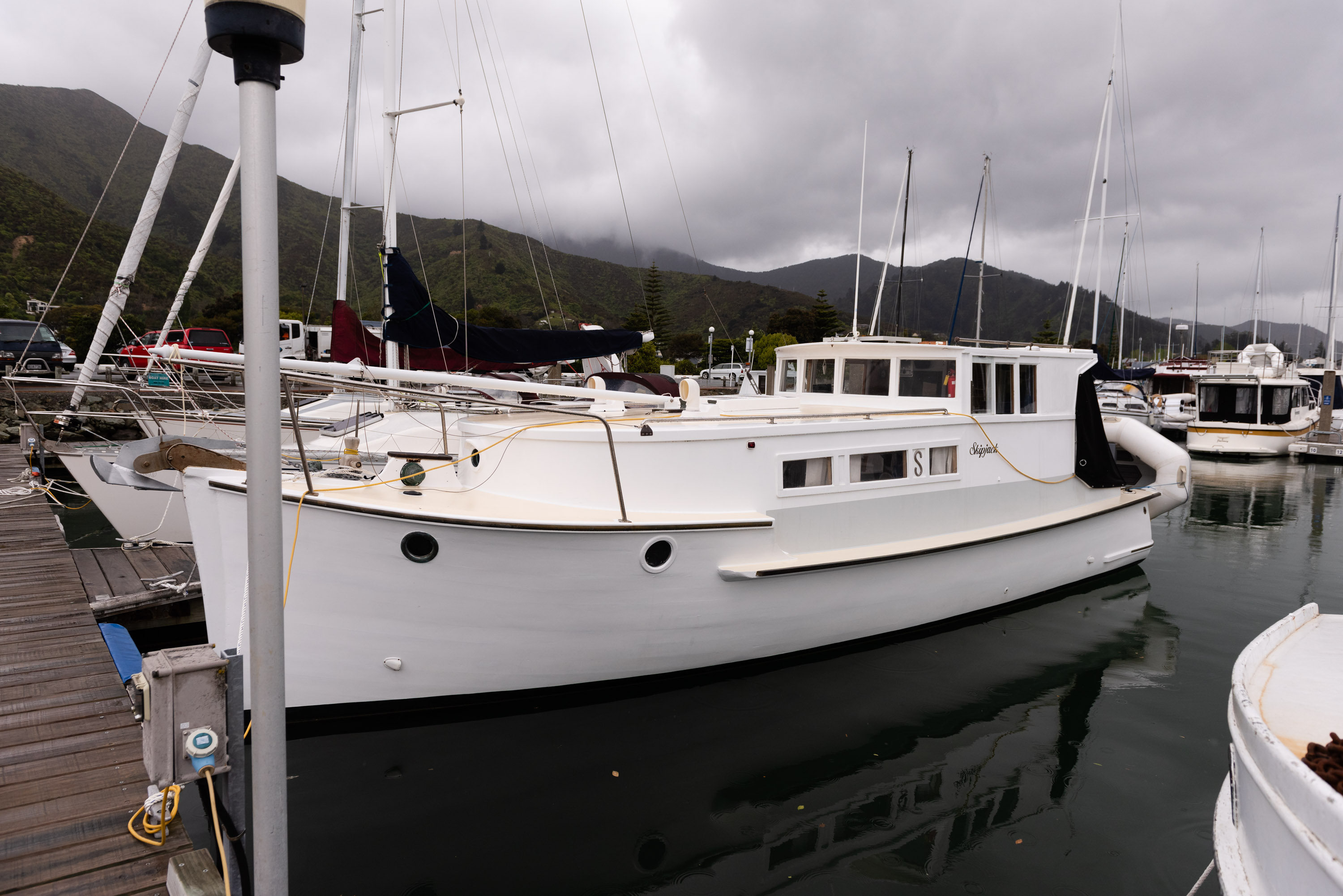
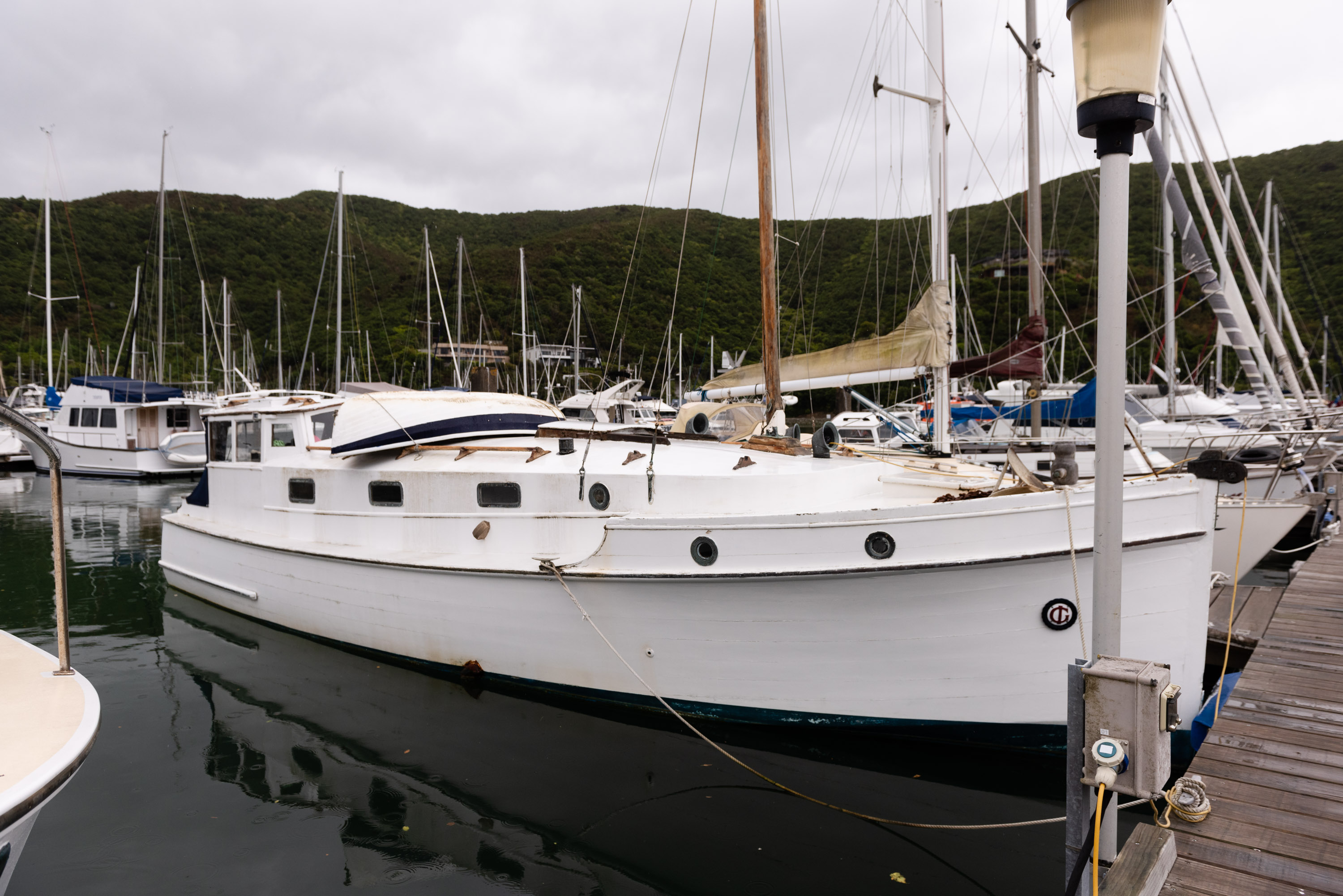
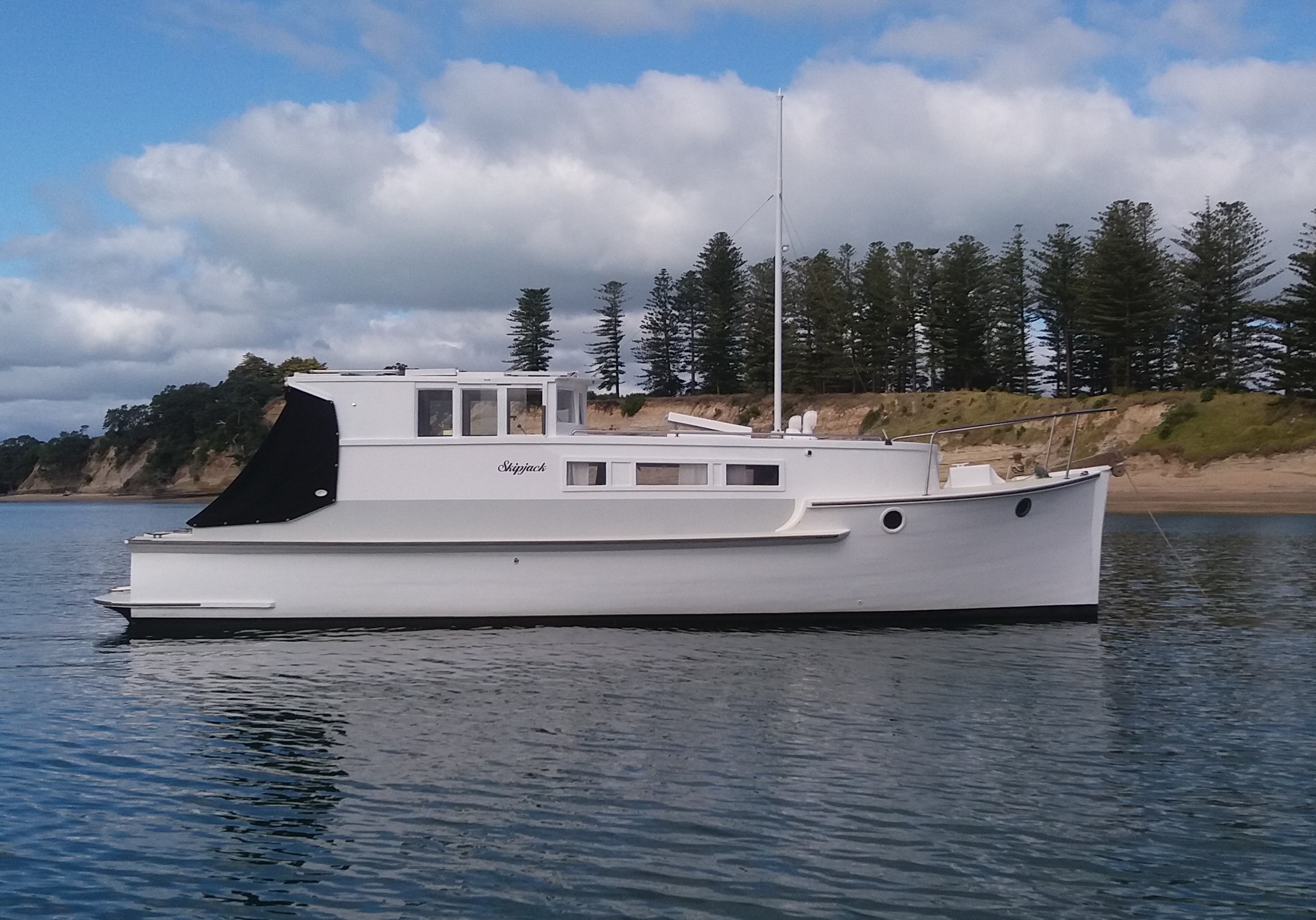
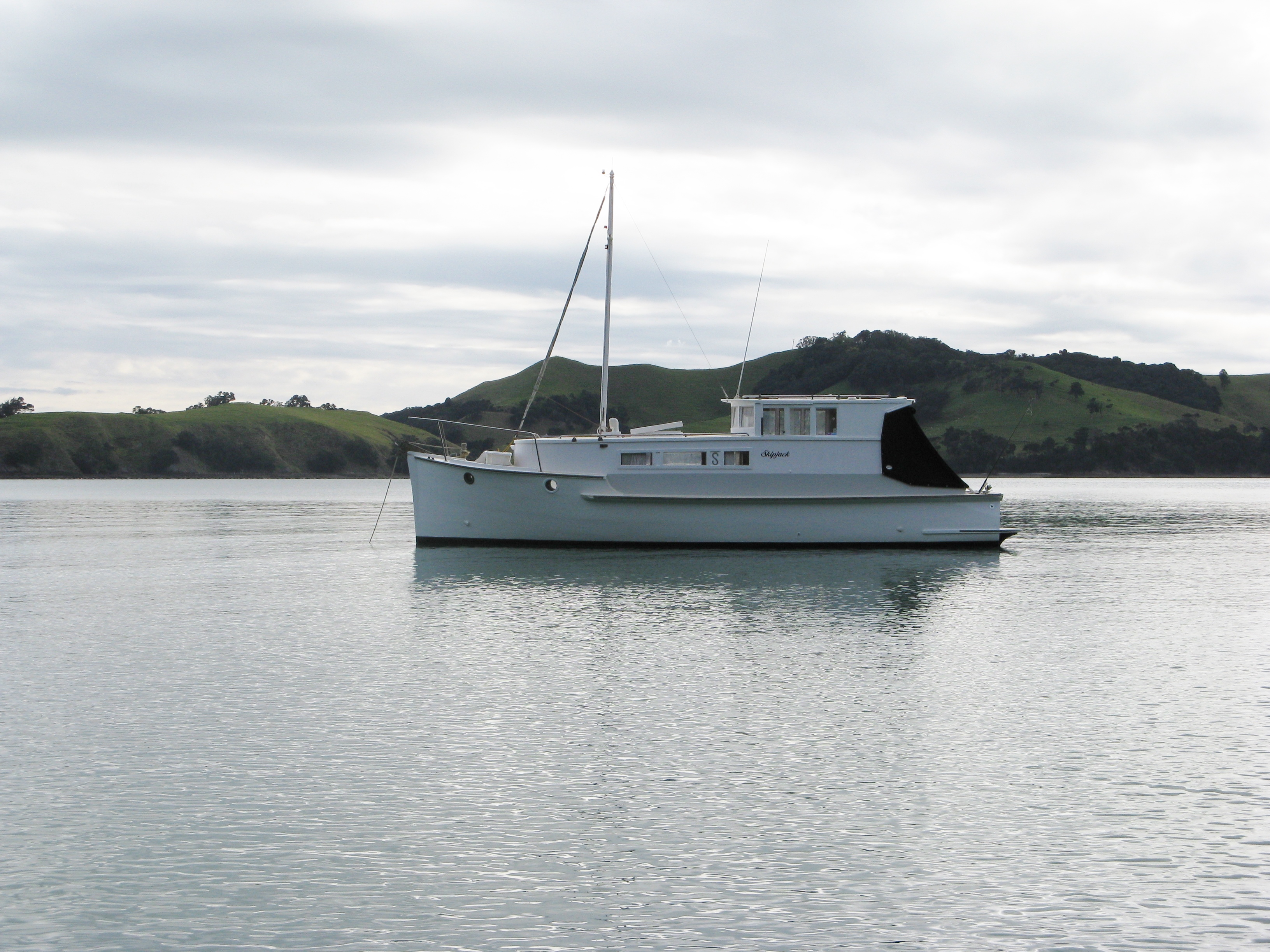
Can You Spot The Difference Between The Two Photos Above Of SKIPJACK ?
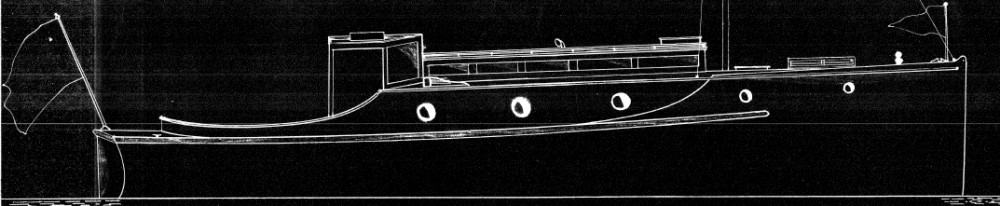
*It is something I get asked a lot, mainly when someone is restoring a classic wooden launch and trying to decide if they should reinstate the wooden mast that they have seen in older b/w photos. My answer is always yes and this based on the belief the mast was never about sailing power — it served practical, traditional, and aesthetic purposes. It was used to hoist navigation and signal flags, support lights or an awning, and sometimes rig a small boom for lifting dinghies or stores. A few launches even set a steadying sail to ease rolling in a swell.
But most importantly, to me, reinstalling a mast preserves originality and gives a launch a proper profile and balances her shape — and adds character. So in short: not for sailing power, but for utility, stability, and looks.
Still on the topic and focussing on the area of stability, during the week Greg Billington the owner of the 1918 Chas Bailey built launch – SKIPJACK contacted me following up on the story we did on SKIPJACK. Greg had two things he wanted to share – 1. SKIPJACK was no longer for sale, he had seen the light and decided to keep her ✔️ – we liked that.
And 2. Share a recent experience around masts on old classic launches – I’ll hand over to Greg to tell the story:
“I thought I would share something that may be of interest to readers. Along the lines of ‘a little knowledge is a dangerous thing…’
I was offshore on one occasion when a beam sea knocked the boat over such that I had this thought – ‘that heavy wooden mast must go.’ I had this thought because it appeared that bringing the mast back up was an issue. It wasn’t, obviously. Nevertheless, I thought I would lower the centre of gravity and improve the righting moment with a shorter, lighter mast. So, I installed an alloy mast, which did make the boat significantly stiffer, but sometimes more than I wanted.
After much thought and further reading, I decided that the original wooden mast must have made the boat more tender i.e. slowing and dampening roll and therefore making for a more comfortable ride. Guess what? It did. So, I am attaching a couple of pics showing the alloy mast, and then the old wooden mast back where it belongs and I can say that the motion in any sea is considerably improved. Which goes to show, and I don’t mind admitting, that the boat builder knew far more than me.”
And woodys for the record the 2nd photo above is the wooden mast 😉
Earlier this year the 33’ launch – SKIPJACK made an appearance on tme (thanks Ian McDonald) at the time we were told that SKIPJACK was built in 1918 by Chas Bailey. During her life she has twice been ‘modified’ to create more headroom in the wheelhouse and cabin.
Forward motion is via a 80hp Ford Dover diesel engine that gets her along at a comfortable 7.5 knots.
SKIPJACK has had several home ports having spent time in Auckland and now calls Waikawa marina in Picton home.
The launch has made several appearances on WW, the most recent back in July 2019, link below, when she was relocating south (by road). In a previous life was was named SEA DEVIL. https://waitematawoodys.com/2019/07/26/skipjack-sea-devil/
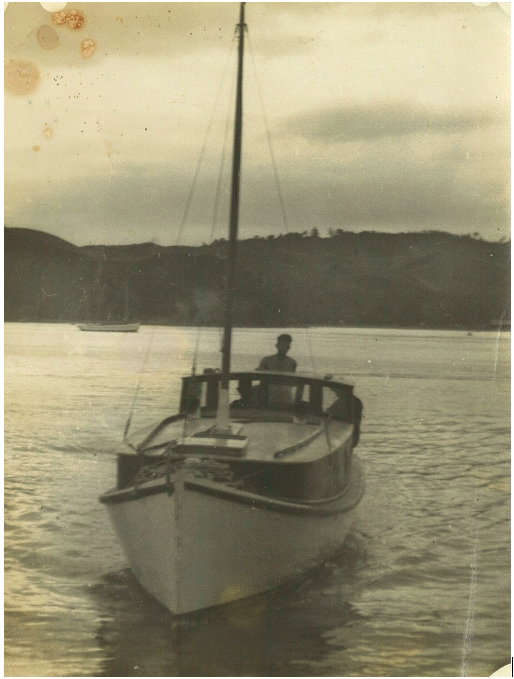
Hi Alan – nice to see Skipjack, nee Sea De’il featured in a recent post. Perhaps I can clarify re your question about whether James Hoey’s boat is in fact Skipjack? You are quite correct that the length has changed. Many things have changed with this boat since she was launched! The owner/guardian before me, which is pre-2016, was Brent Gribble of AkzoNobel Paints. Brent and his father had a major stern modification carried out by Glenn Burnnand of Burnnand Marine in Auckland. This increased her length to 10 metres, with a square, step-through transom and with a fish cleaning s/s basin built-in. Prior to Brent’s ownership, Sea Devil, as she was called then, was a restoration project for Captain Vern Tonks in Whangarei. I received the boat’s original history from Winston Hoey, via Brent. Winston recorded that Sea De’il was built and designed by Chas Bailey circa 1918, for James Hoey and his son Cecil (Born 1901). The boat was used for transport from Whangarei to Reotahi Meat Works, near where the family bach was located. She was powered originally by a flat head Dodge or Desoto gear, and the first doghouse was added in 1928.
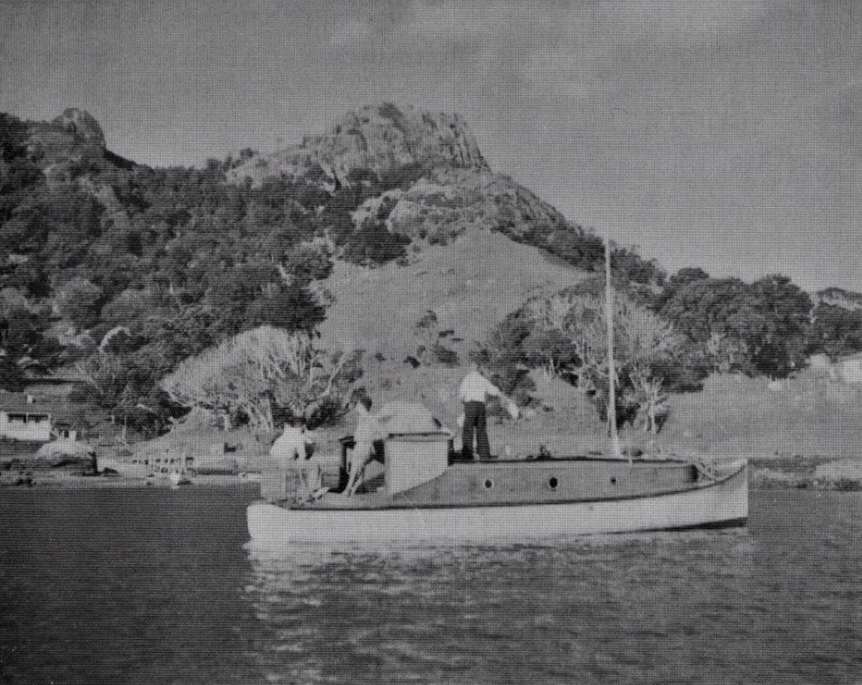
Cecil Hoey in stern of “Sea De’il” in Whangarei Harbour
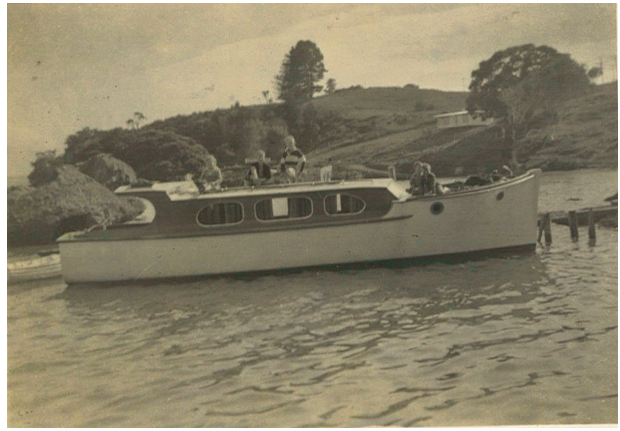
Subsequently, Dec 1951 – ship wrights Angus Henderson and Bill Naggs – built a new cabin to create more head room. They also created the step-up foredeck, and added the lead board on the bow. This was built of Kowhai timber and each rib in the boat was replicated – doubling the ribs in the hull to strengthen for the extension, and a bronze rudder was cast in Whangarei. At this time too, a 4-cylinder Ruston Engine was fitted.
After the refit and new topsides in 1952
In 2005, after hearing she was destined for the tip, Captain Vern Tonks took her on as his “passionate hobby”. Captain Tonks was quoted saying, “She’s a piece of Whangarei’s history that requires restoring. It’s quite amazing really how many of them are lying around the country, sticking out from under covers, in various states of disrepair. We are a very strong nation of boating people and unfortunately a lot of these crafts have become non-existent and some of them are nice classic vessels”
Vern expected that he had a two-year project. He completely gutted her and started rebuilding the structure, keeping the original portholes, installing a new wheel house with the engine under the floor and a couple of bilge keels to dampen rolling. “Three or four trailer loads have gone to the dump out of her. She’s been derelict for so long and from what I’ve found there was a lot of things that weren’t up to spec in the construction. Someone somewhere along the way has put a lot of veneered Rimu custom wood into her, which is allergic to water and of course it all went rotten. So, I got to the stage where all the timber I’ve had sitting around is coming to good use”
Vern also changed the name back to the English meaning of Sea Devil. Sadly though, one month before finishing her, with plans to compete in the Classic Boat fishing completion in Whangaroa Harbour, Vern passed away in 2008.
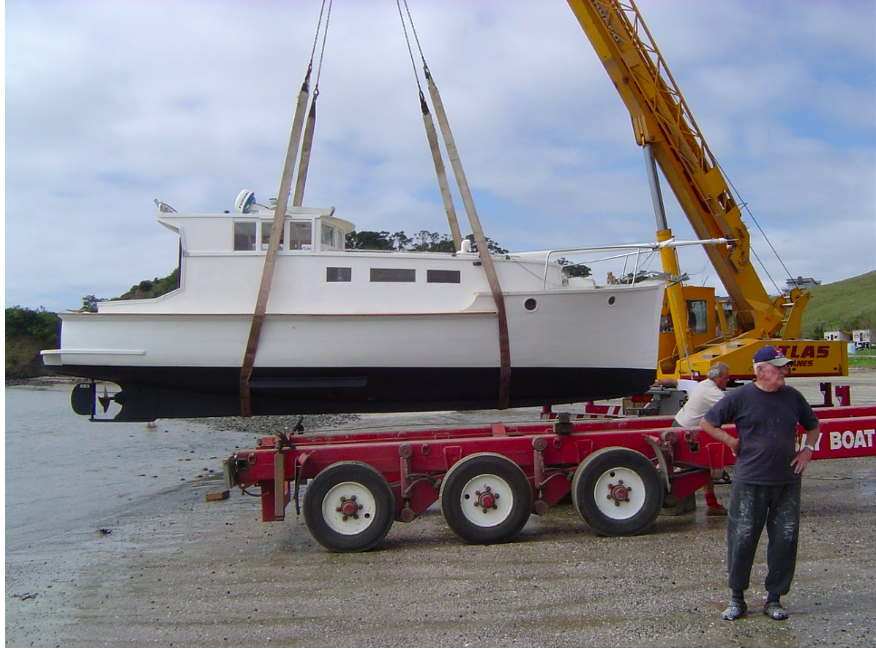
This is when Brent and Sarina Gribble took over the project, and with the help of widow June Tonks and close friend of Vern’s and Brent’s – Steve Ekman, they completed the refit, and in June 2008, she was launched on the beach at Oakura at low tide – going back in the water for the first time in 23 years. After a time, Brent took her to the Outboard Boating Club, onto a swing mooring in the Okahu Lagoon, and as mentioned, I purchased her and kept her there before moving her in 2019 to her current berth in the Waikawa Marina in the Sounds.
June 2008, Oakura Beach Whangaruru, Peter Gribble in foreground
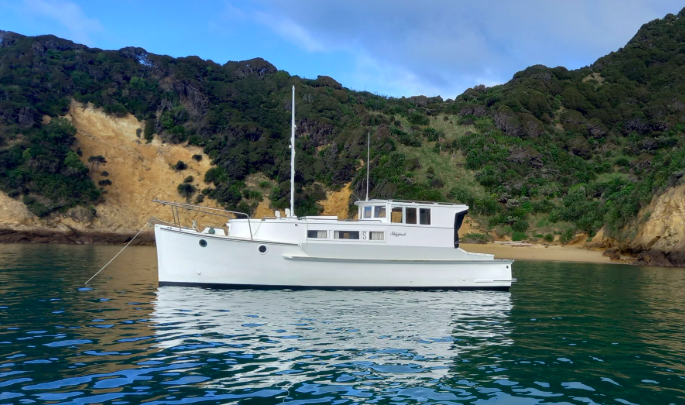
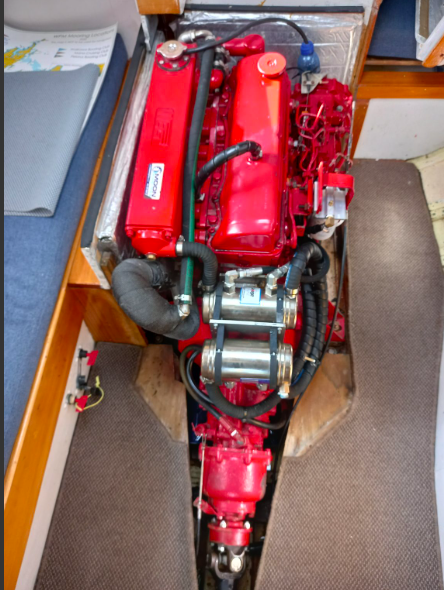
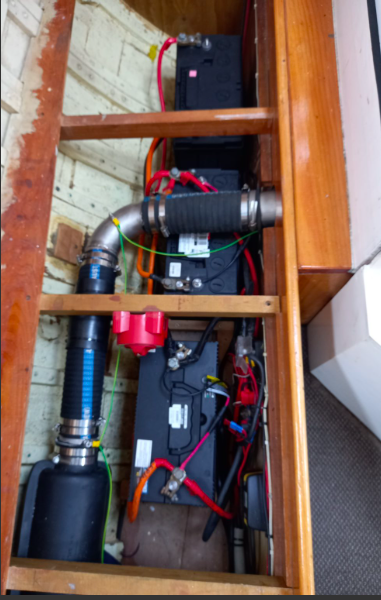
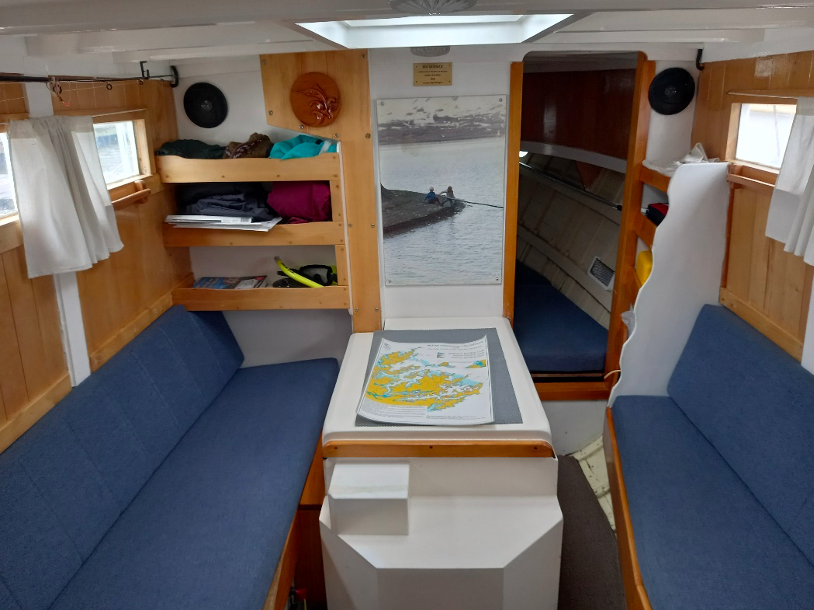
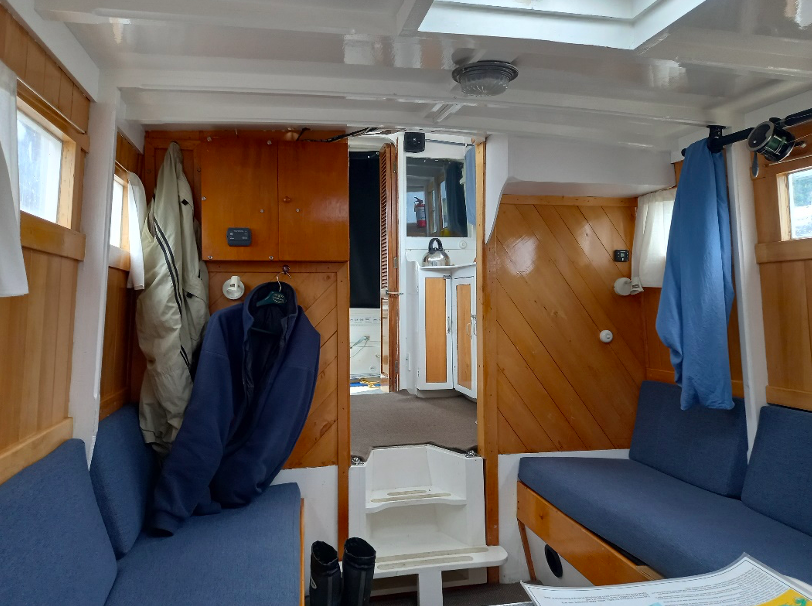
Like all classic boats, and especially those of considerable age, Skipjack has had lots of work done to suit the inclinations of the various owners and simply to keep her seaworthy. Since I’ve been taking care of her, I’ve concentrated primarily on improving the mechanical side of things – which has included all keel-bolt replacement (which you reported at the time), new prop and shaft, new gearbox shaft and universal, new steering, all engine seals and engine mounts replaced (Ford Dover 80hp), new water-pump and tanks (replacing an old copper hot water cylinder!), new stove, Eberspacher diesel heater (which in the Sounds makes winter cruising a doddle…), replacement of all topside decks, new mast, large holding tank and shore pump-out fitting, new electric toilet, new oil cooler and all hosing upgraded, all s/s exhaust system and dry riser…you get the picture! Something always needs to be done. But these days, Skipjack is very seaworthy and much loved! The pic below shows her recently, in Greville Harbour on the western side of D’Urville Island – a trip of around 250kms. Skipjack cruises at 7.5 knots at the engine’s optimum rpm of 1,800.
Todays woody launch has had several names and appeared on WW numerous times, links below to a couple of those stories.
Thanks to Harold Kidd back in 2016 (refer screen grab below) we learnt that when launched she was named Sea De’il, most likely after a well known race horse of the time.
Lots of colour photos from thru out her recent years but we had never seen her as launched. Yesterday while doing a deep dive in the WW archives I found a press clipping that shown the launch at anchor at Reotahi, Whangarei Harbour in the late 1920’s.
Owned at the time by Jim Hoey her first owner. There has been a lot of speculation re a possible builder so I won’t go down that rabbit hole 🙂
The launch was 30’6” in length, full length kauri planking but must have been stretched at some stage as some sources have her at 33’.
When launched she was a workboat and whilst primarily working in and around Whangarei Harbour she was a frequent visitor to Kawau, Great Barrier Island, Mokohinau & the Hen & Chicken islands.
NOTE: I’m interested to hear debate on whether the two boats above are actually the same, now that we have an early photo of Sea De’il, there are a few features that do not gel in my eyes – thoughts?
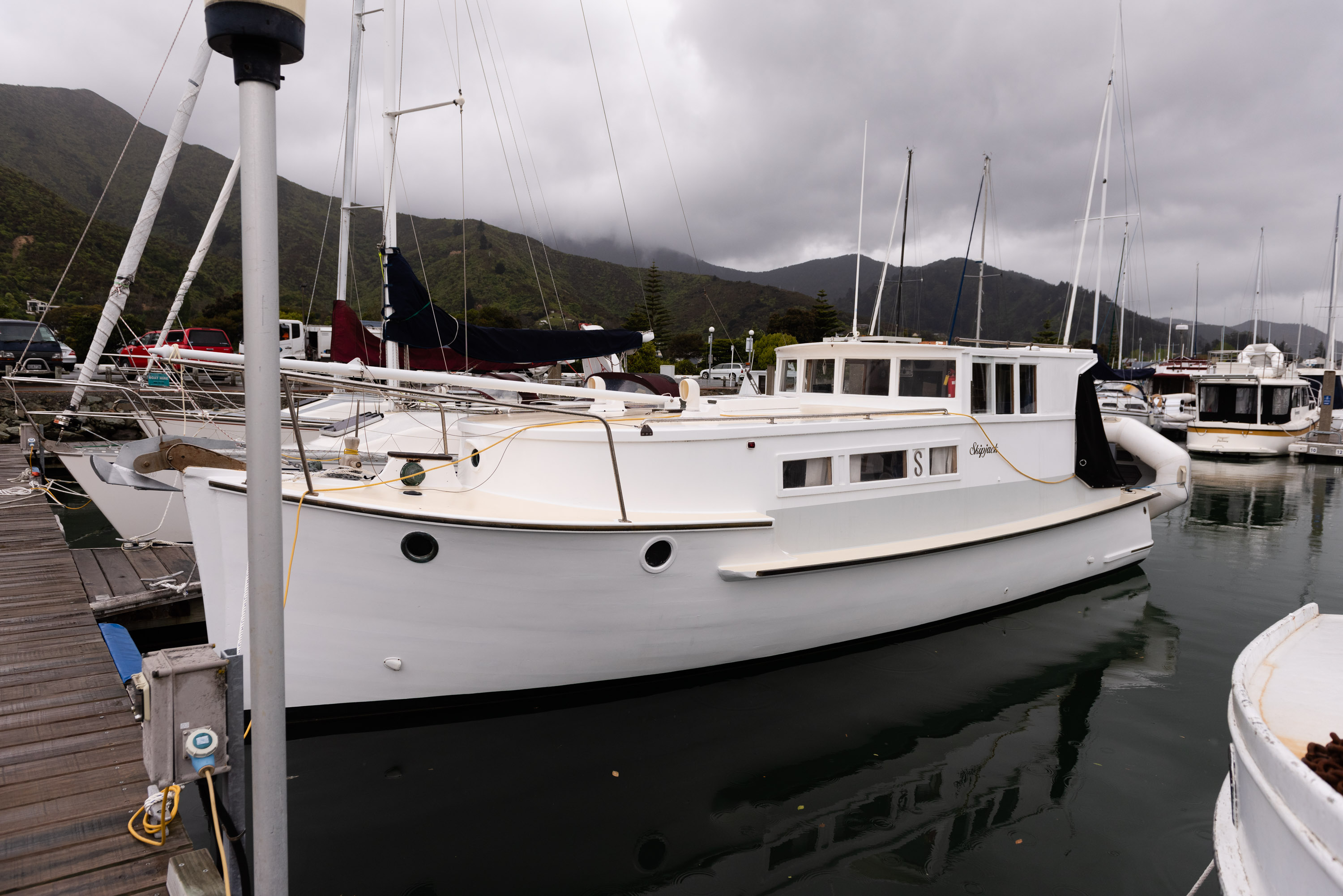
Following up on Mondays story based on Dean Wrights photo gallery for Waikawa Bay marina, I was contacted by Greg Billington in regard to a photograph featured of his boat – the 33’ Baily built ‘Skipjack’. I’ll let Greg tell the story –
“You will see in the photo (number two above) that the mast is down, it is hinged because I formerly kept her in the Okahu Lagoon, which meant going under the Tamaki bridge. It is a new alloy mast, by the way, and considerably shorter than the former very heavy timber mast. On the occasion, some years ago that I laid it on its side in a beam sea crossing Bream Bay, I decided the timber mast was too much deadweight to bring back up! However, that the mast is hinged is convenient for a rather unexpected reason. I discovered that in winds around 20 knots, the new mast would vibrate. My first thought was to adjust the stays, but it made no difference. Then I learned about ‘vortex shedding.’ You may know that this can occur around any cylinder and in fact has caused the failure of even very large structures. At certain wind speeds, vortices form on the downwind side and create vibration. As it happens, it is easily remedied by doing a couple of turns of a rope or stay around the mast. In the marina I just lower the mast to the bow rail.
I’ve had Skipjack in Waikawa for 3 years now. Assuming that many Auckland boaties may not know too much about the Sounds, I thought some comparisons might be of interest. The Sounds comprise nearly 20 per cent of our total coastline – so lots of scope for exploring. However, it contrasts with the Gulf in several ways. First, it is adjacent to Cook Strait. Need I say more? On one occasion I spent three days in a bay because I couldn’t leave. It was not possible to see the other side of the Sound through the williwas. Another time I was alarmed by a crash and found my inflatable had been picked up by the wind and hurled into the stern. The slack painter was promptly severed by the prop and I watched with incredulity as the dinghy took off and literally flew for about 50 metres.
Then there’s the tides. It is a strange spectacle seeing enormous surface turbulence above depths of 50 plus metres, and for a Gulf boatie, being above 140m depth less than half a click offshore seems most peculiar. Then there’s the challenge of anchoring. Most boaties here rely on the network of club moorings because the magnificent hills of the Sounds, tend to go straight down. The Gulf is blessed with great bottom for anchoring. The Sounds are not! And finally, the water temperature…where I habitually dropped the pick in one of many bays in the Gulf islands and dived over for a decent swim, here, on a blistering hot day in mid-summer, one plunges in – and out! But the low temperature probably explains why good antifouling can go a couple of years and need nothing more than a soft waterblast. There are no goddamn barnacles!
But lest you think this is not a great place to boat, I include a pic of Skipjack anchored in Mistletoe Bay“.
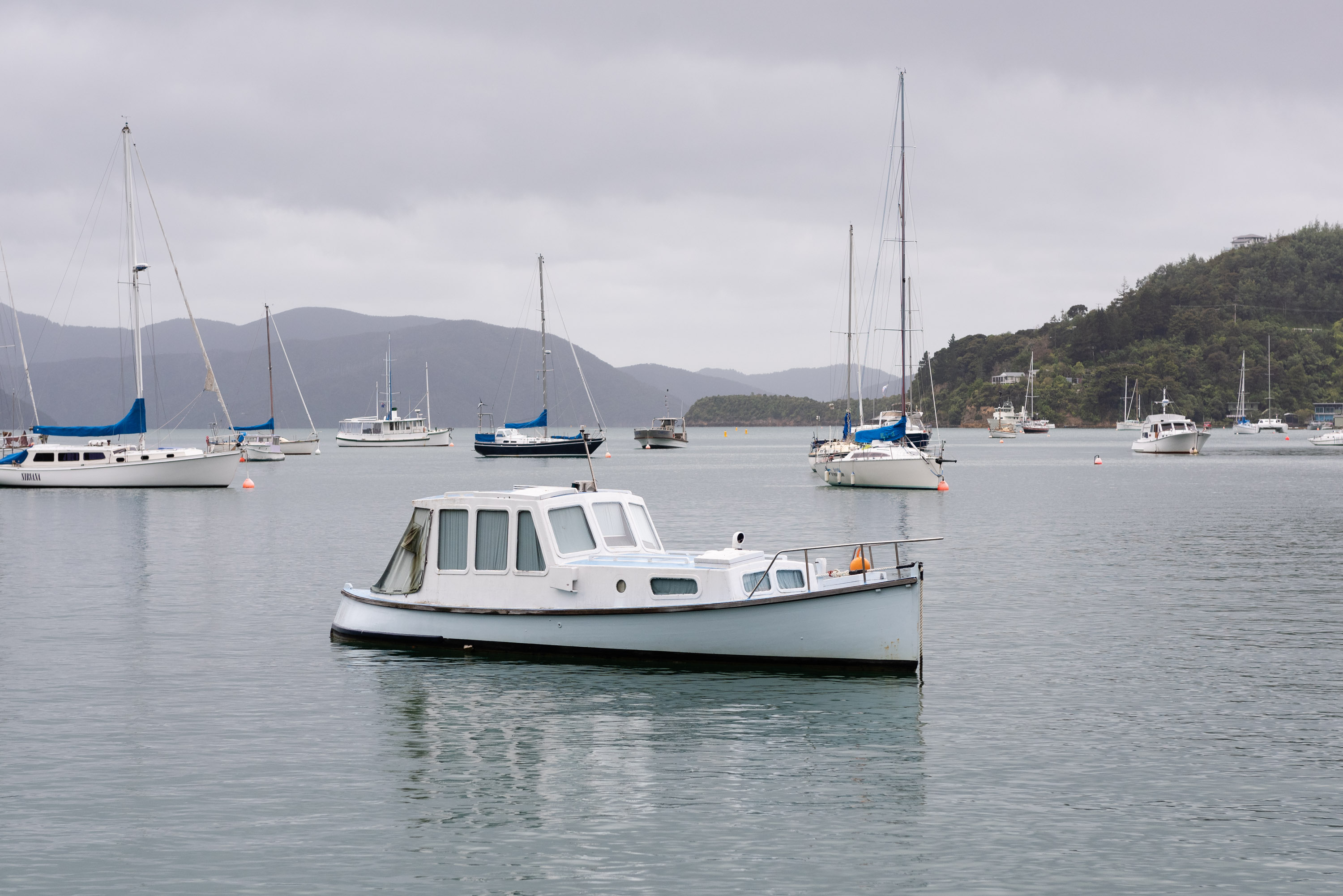
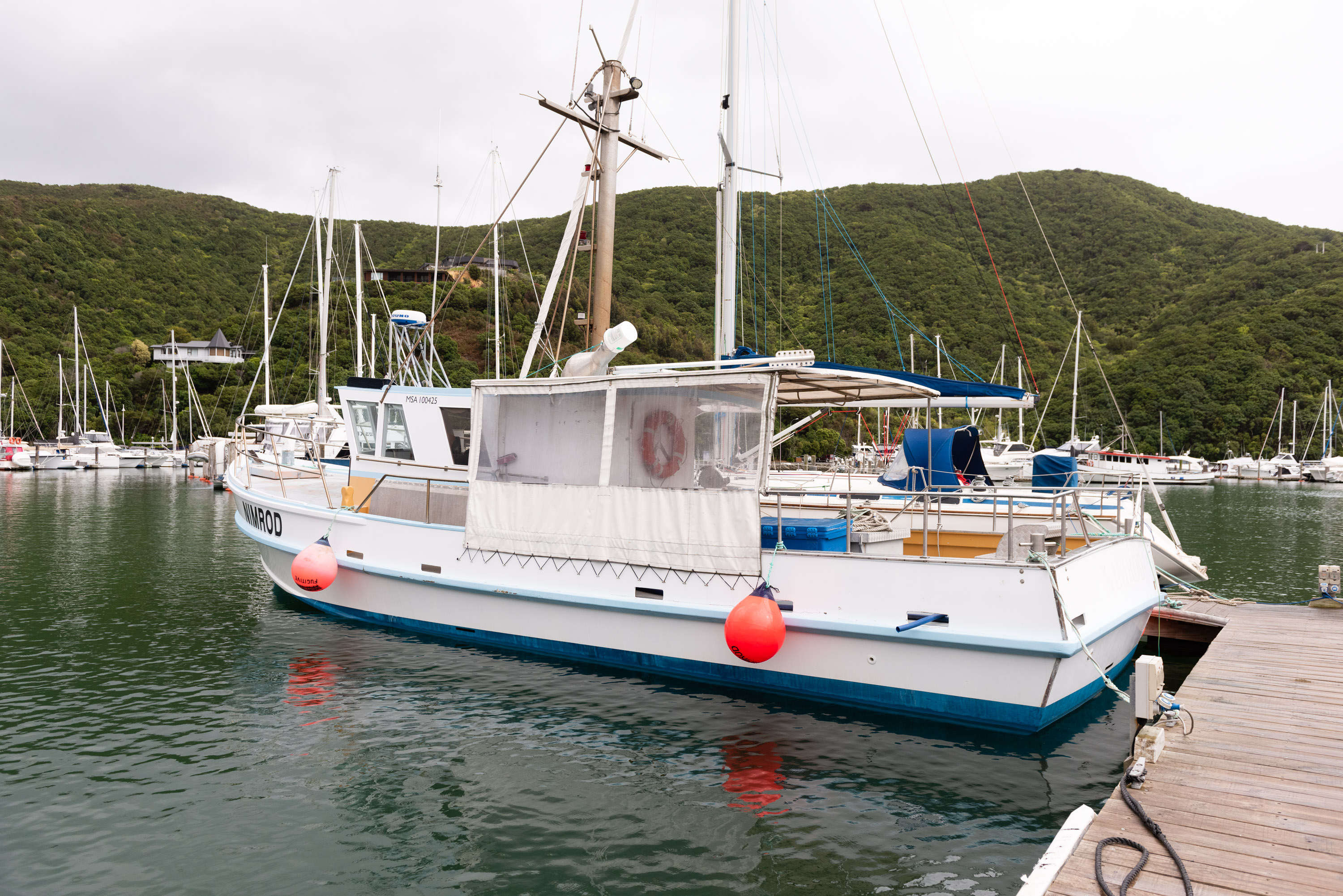
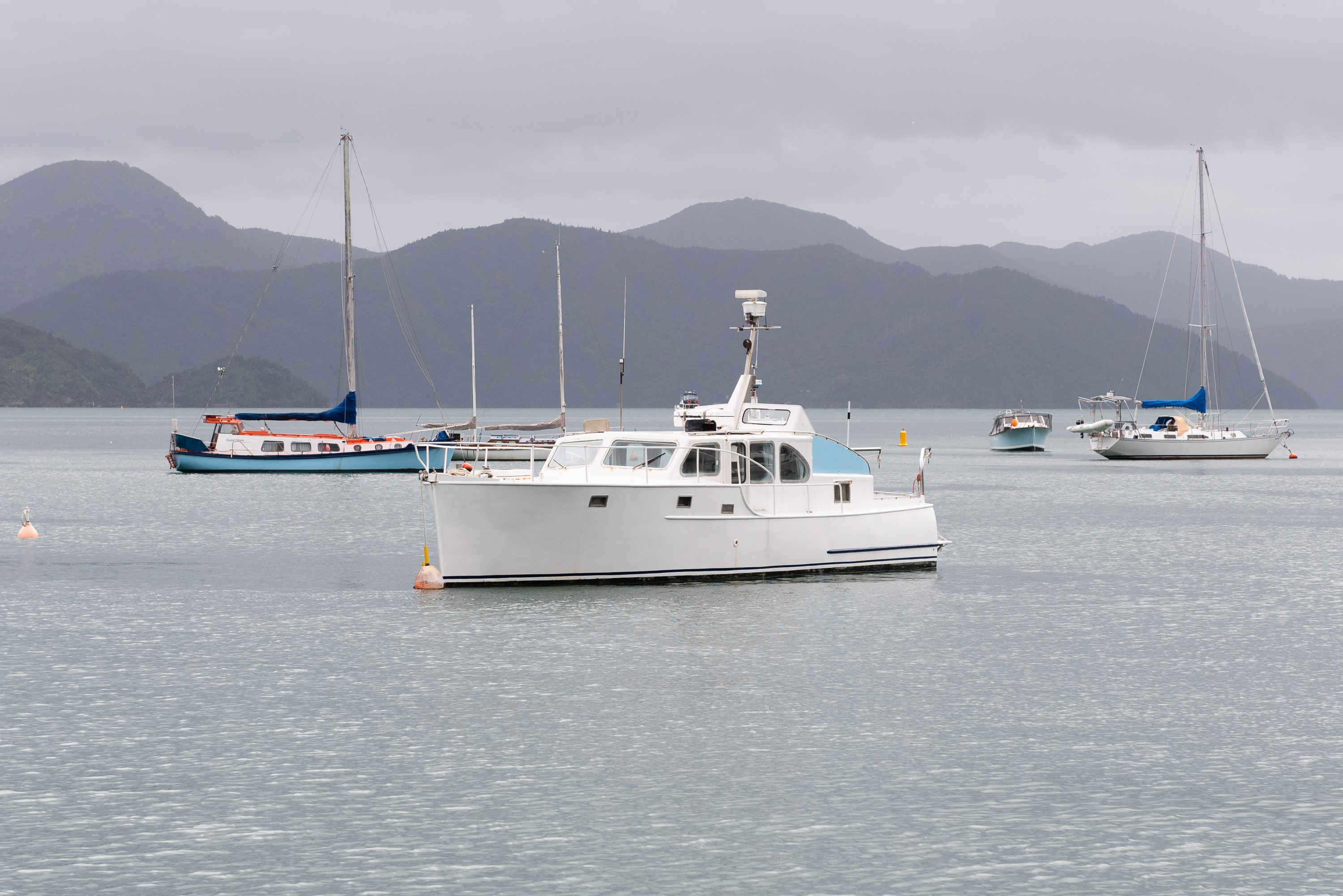
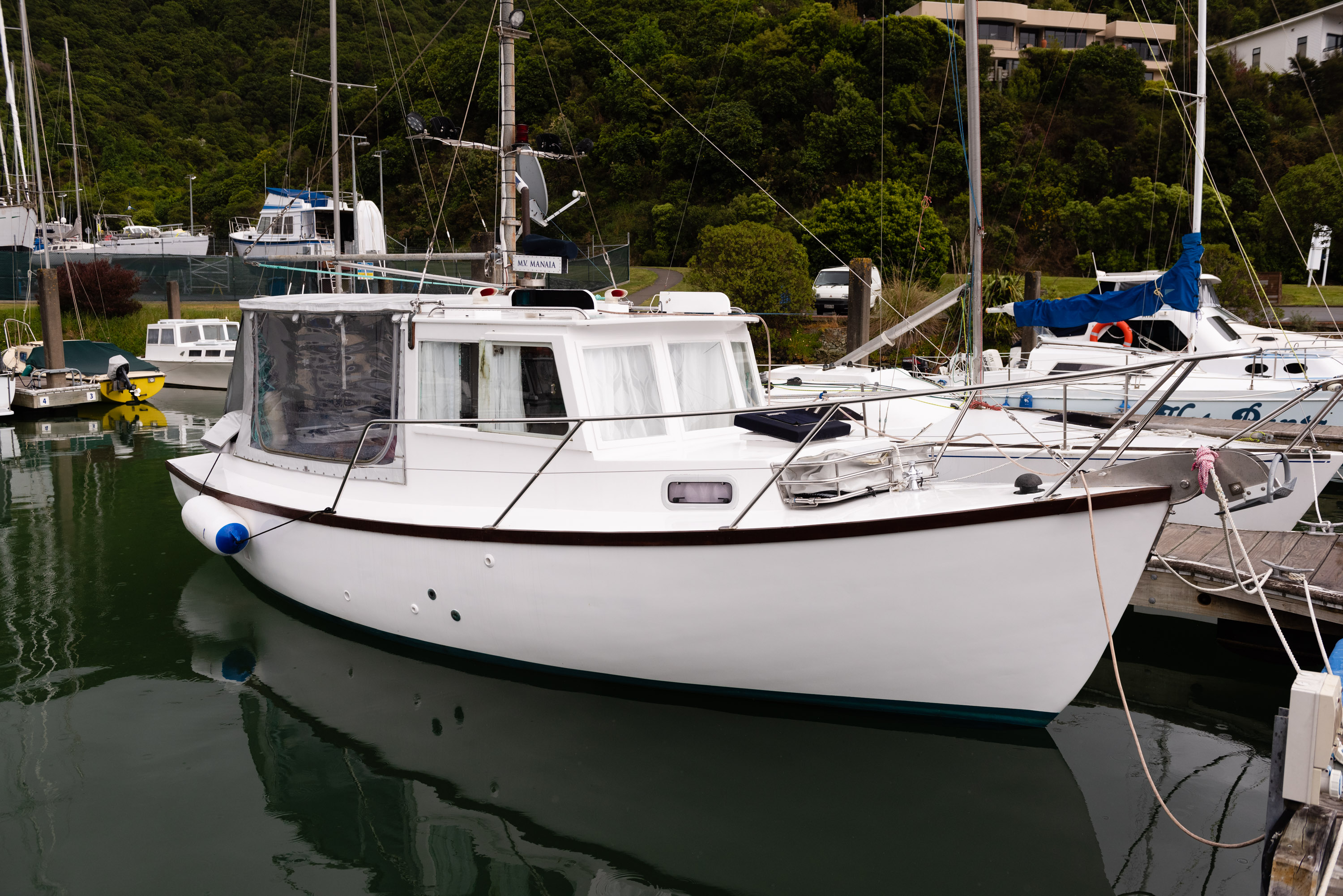
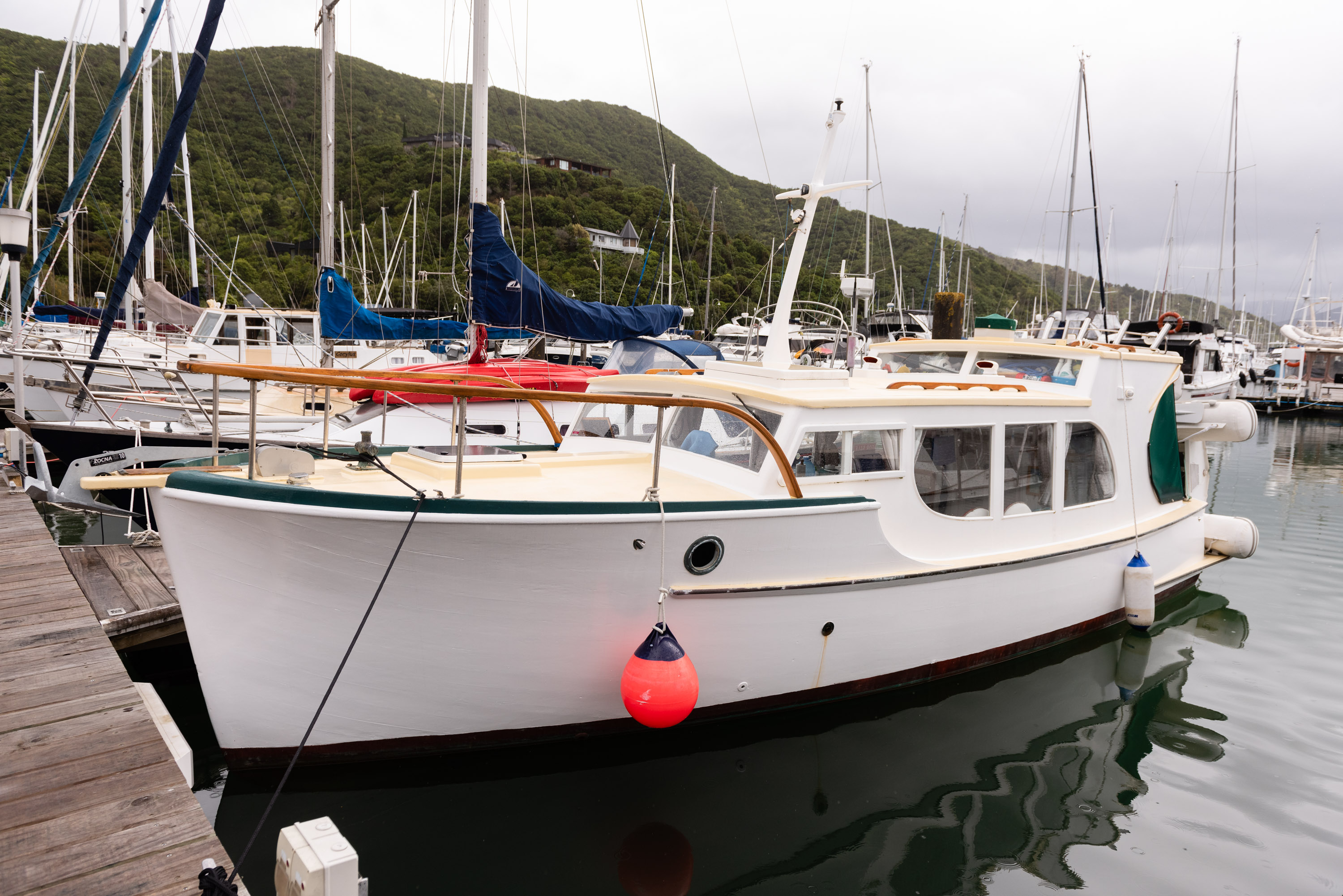
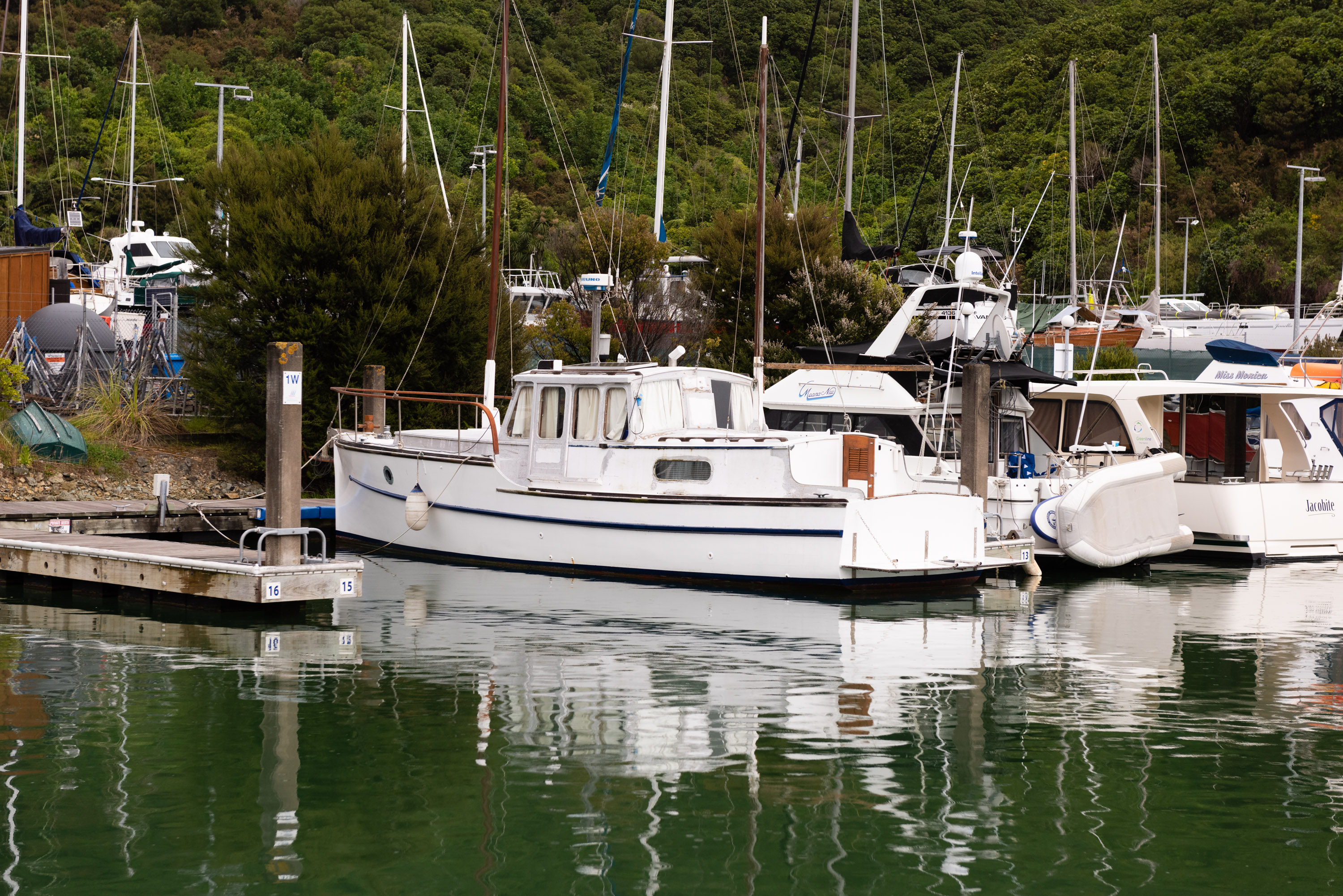
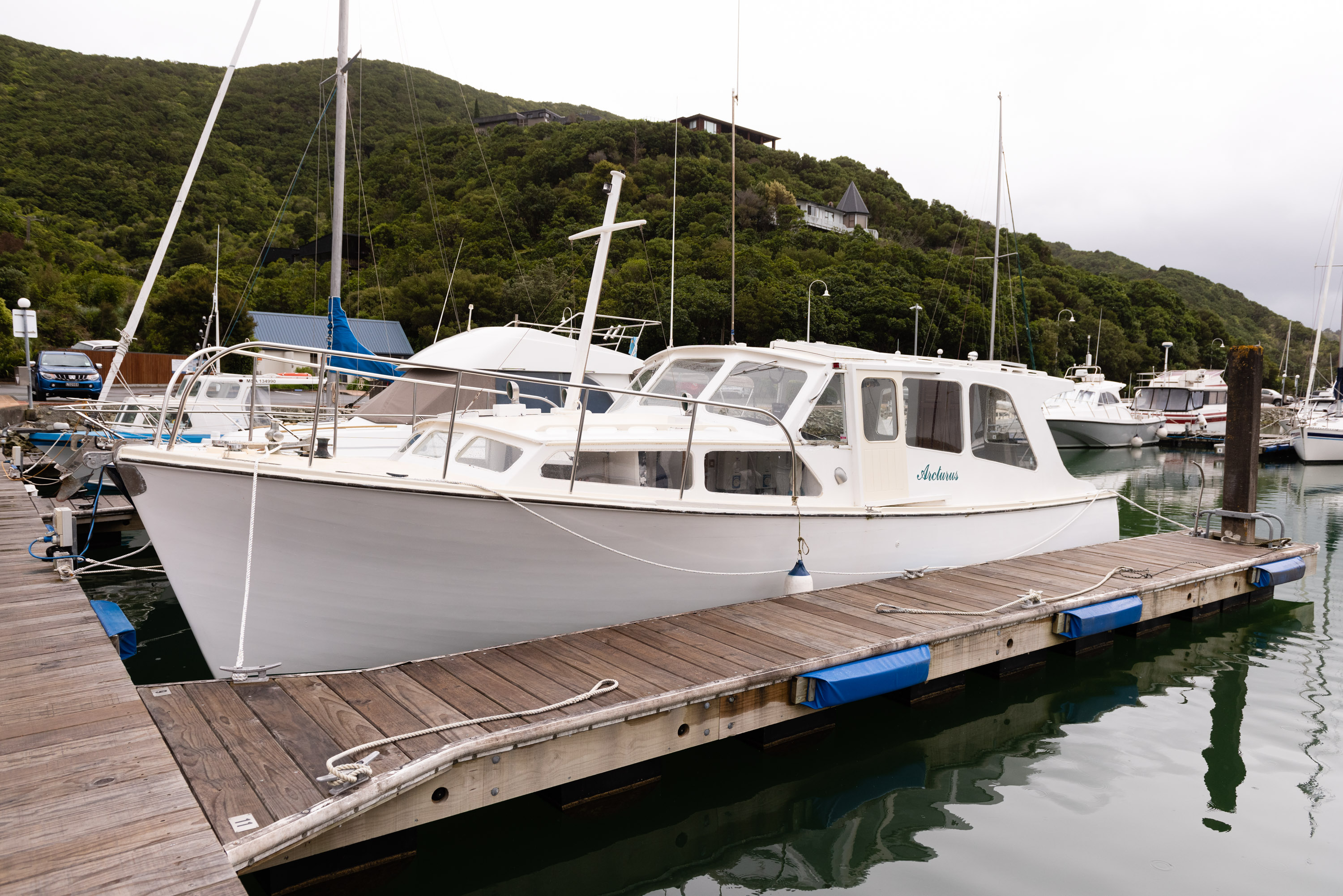
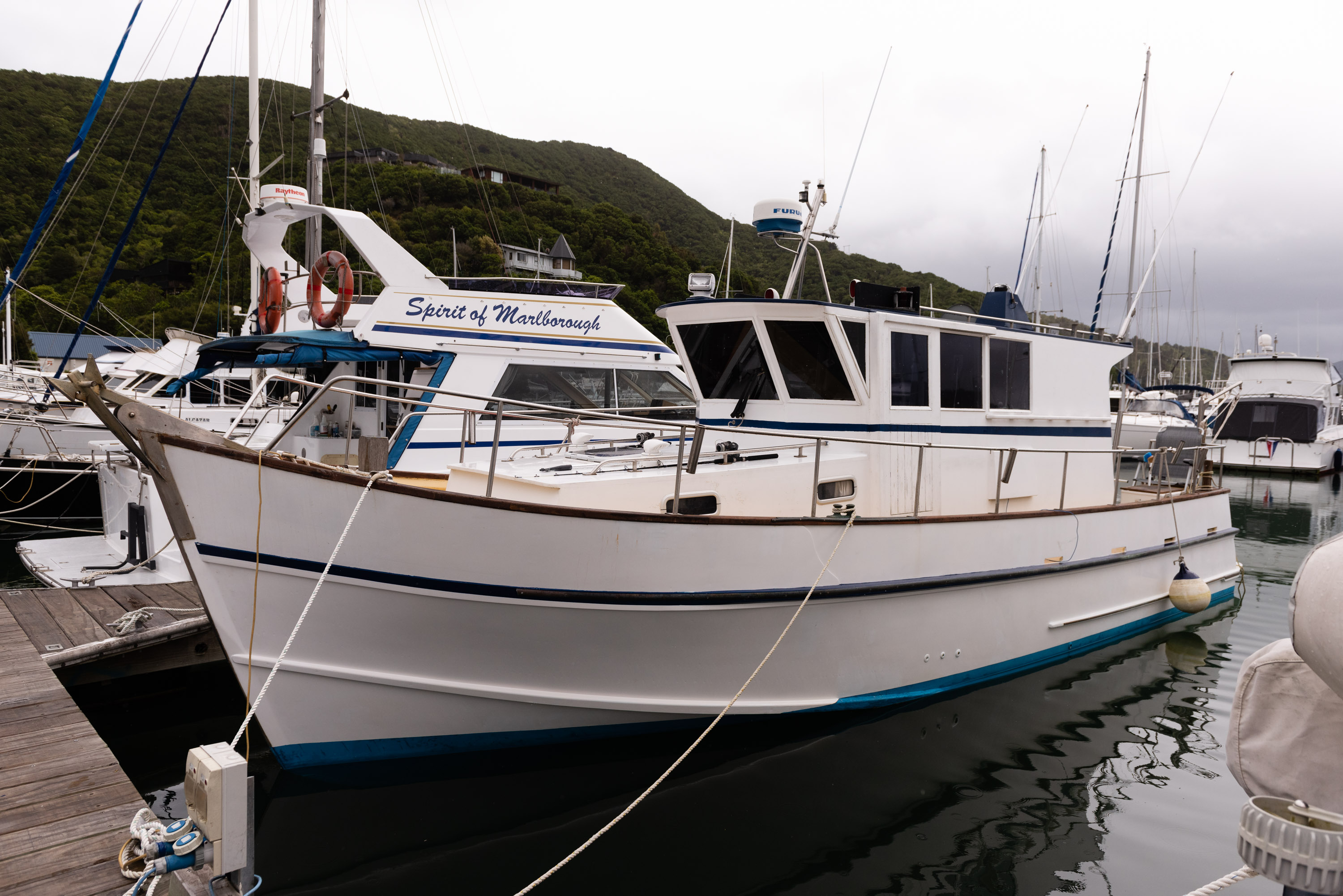
Following on from last Mondays story where we shared Dean Wright’s recent Southern trip and a gallery of photos from the Havelock marina todays photo gallery comes to us from the Waikawa marina. Some stunning woodys and remember – click on photos to enlarge 😉
A lot of woodys that are new to WW and they will morph into WW stories in their own right.
Enjoy 🙂
13-12-2022 INPUT EX MARK MCLAUGHLIN
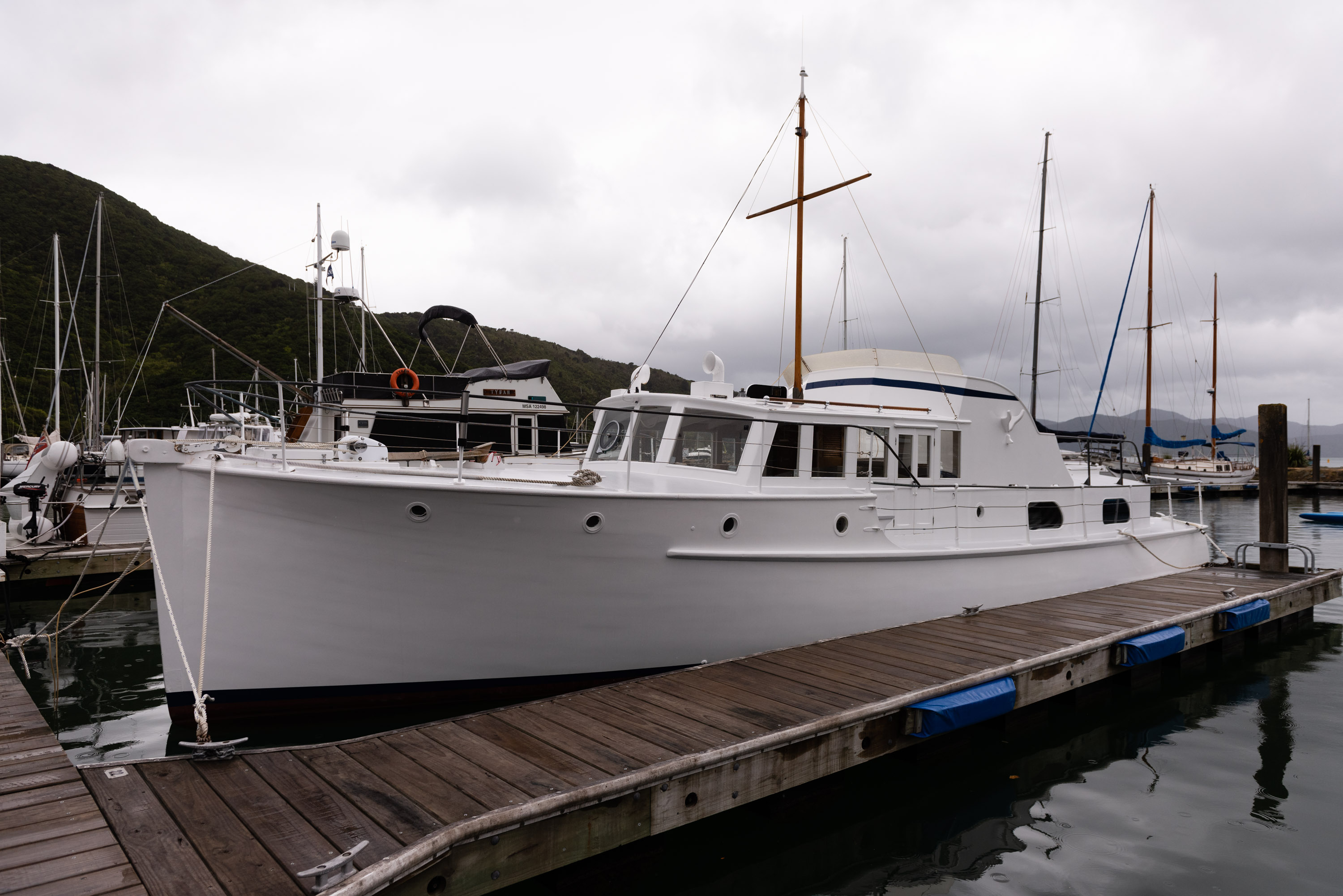
The big bridgedecker with 4 ports is RAHEMO (launched as Strathmore), built by Dick Lang.
Others I can positively identify are (from the top):
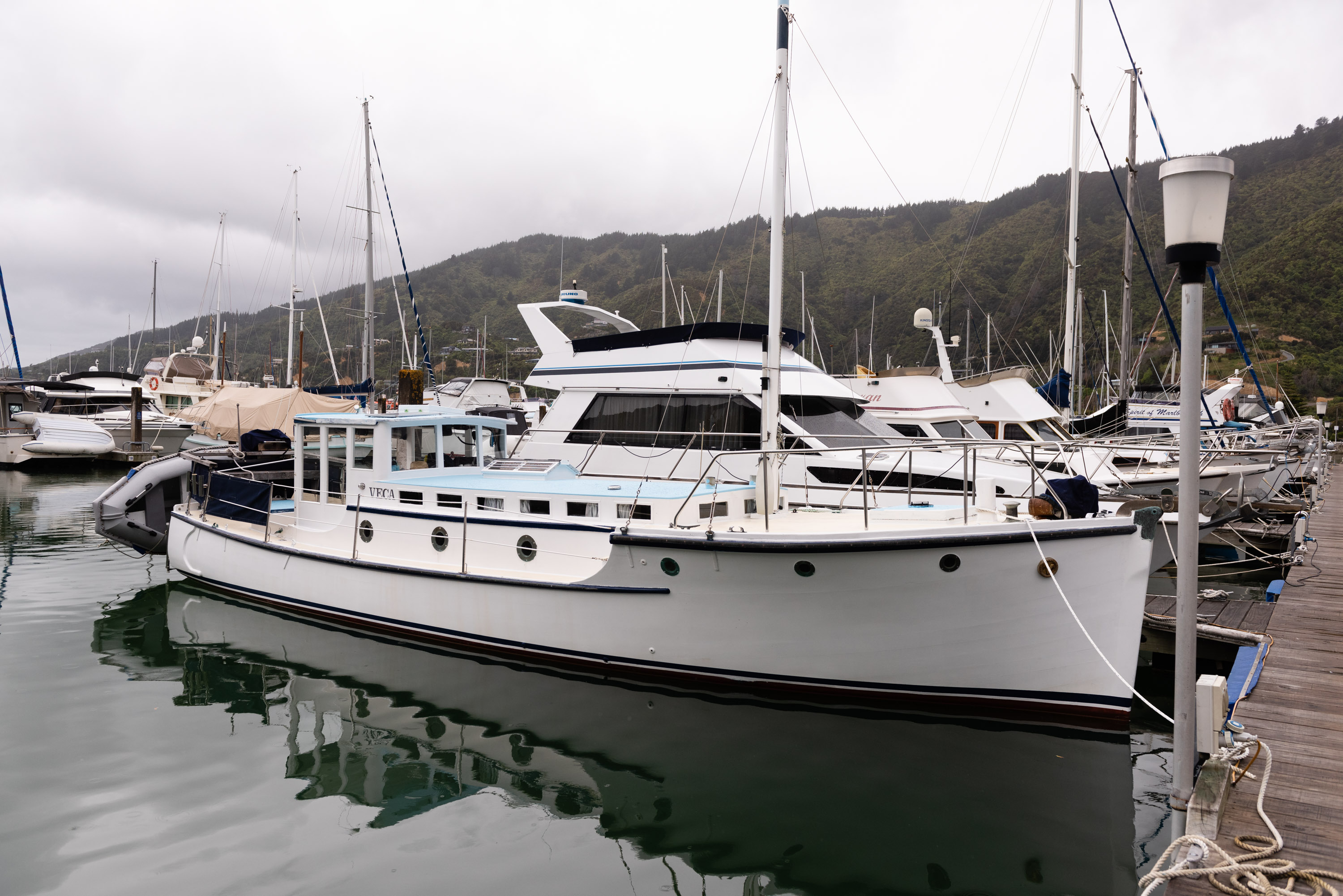
VECA (Arthur Sang)
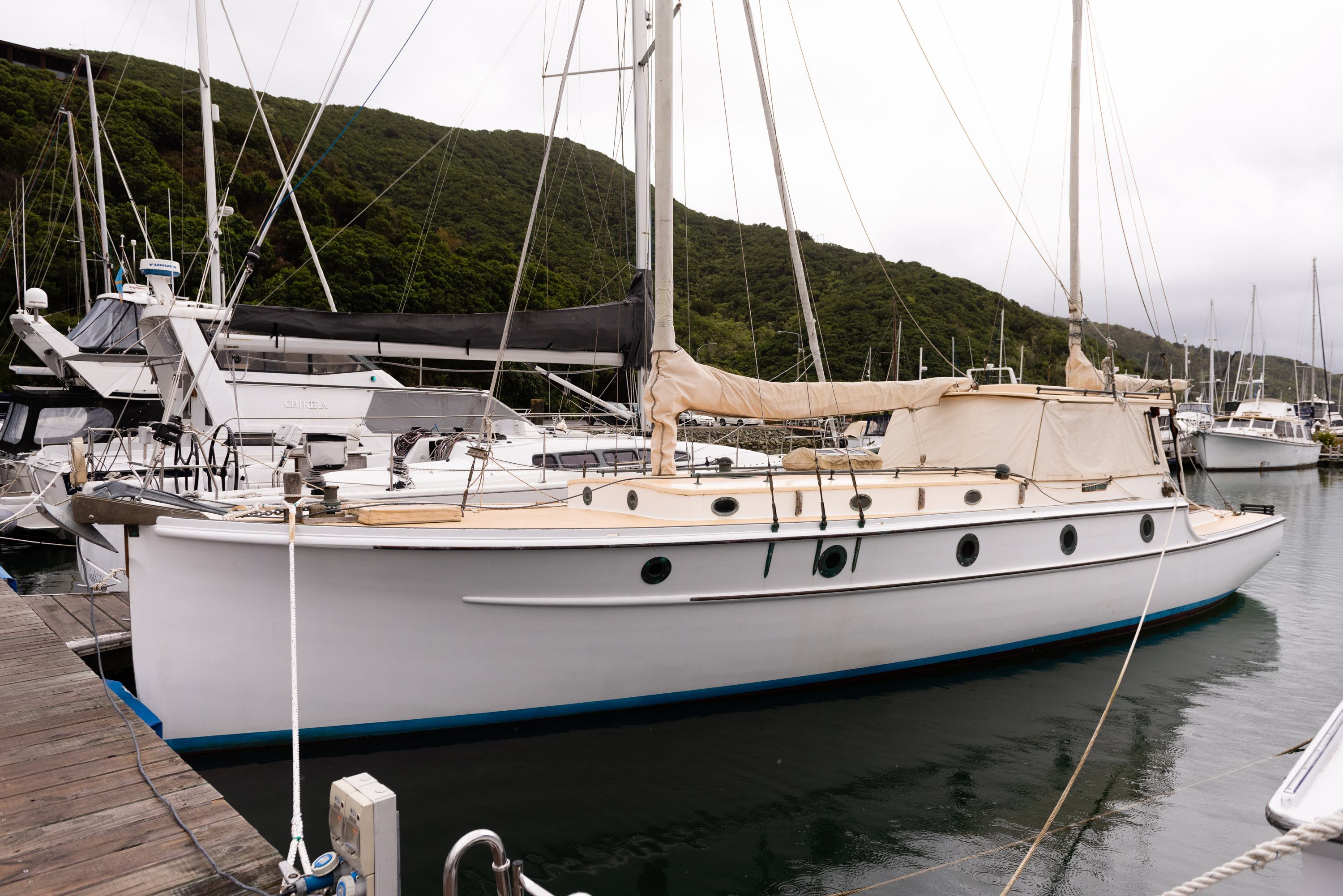
VAGABOND (Joe Jukes)
?
?
?
RAHEMO/STRATHMORE (Dick Lang)
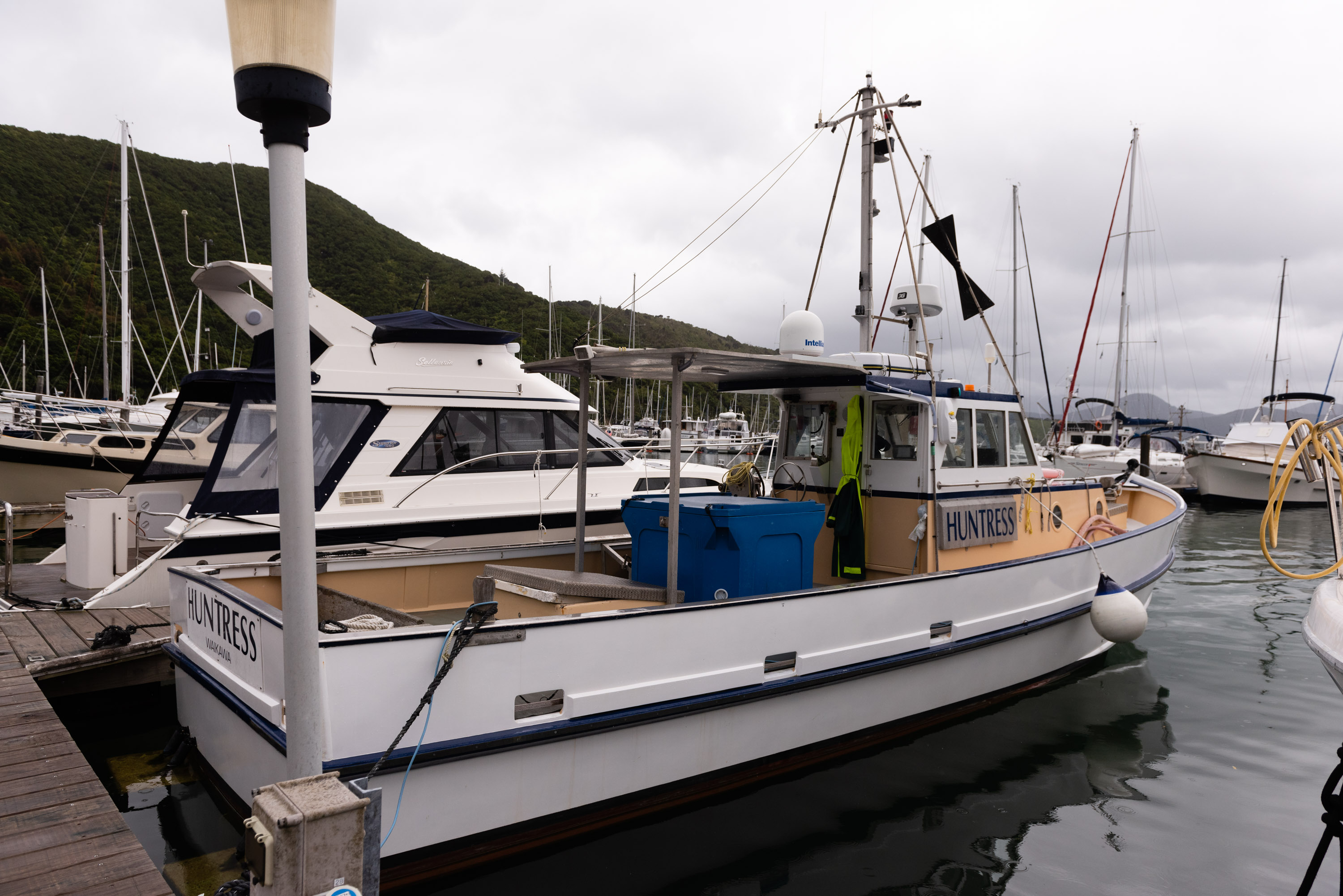
HUNTRESS (possibly McManaway designed/built?)
VARUA (Bob Swanson)
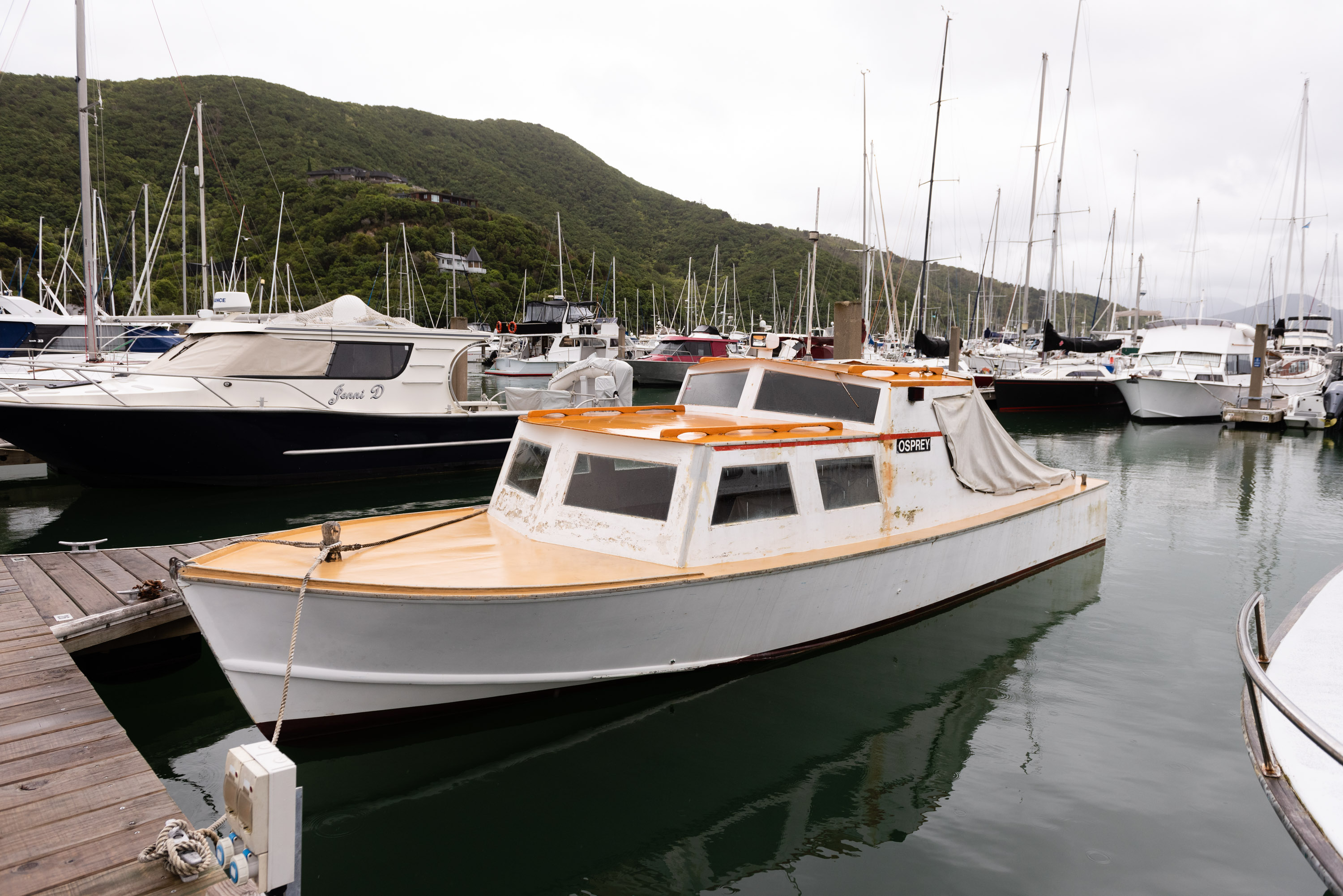
OSPREY (Harold Saunders)
PALOMINO (Bob Swanson)
TOANUI (Roger Carey)
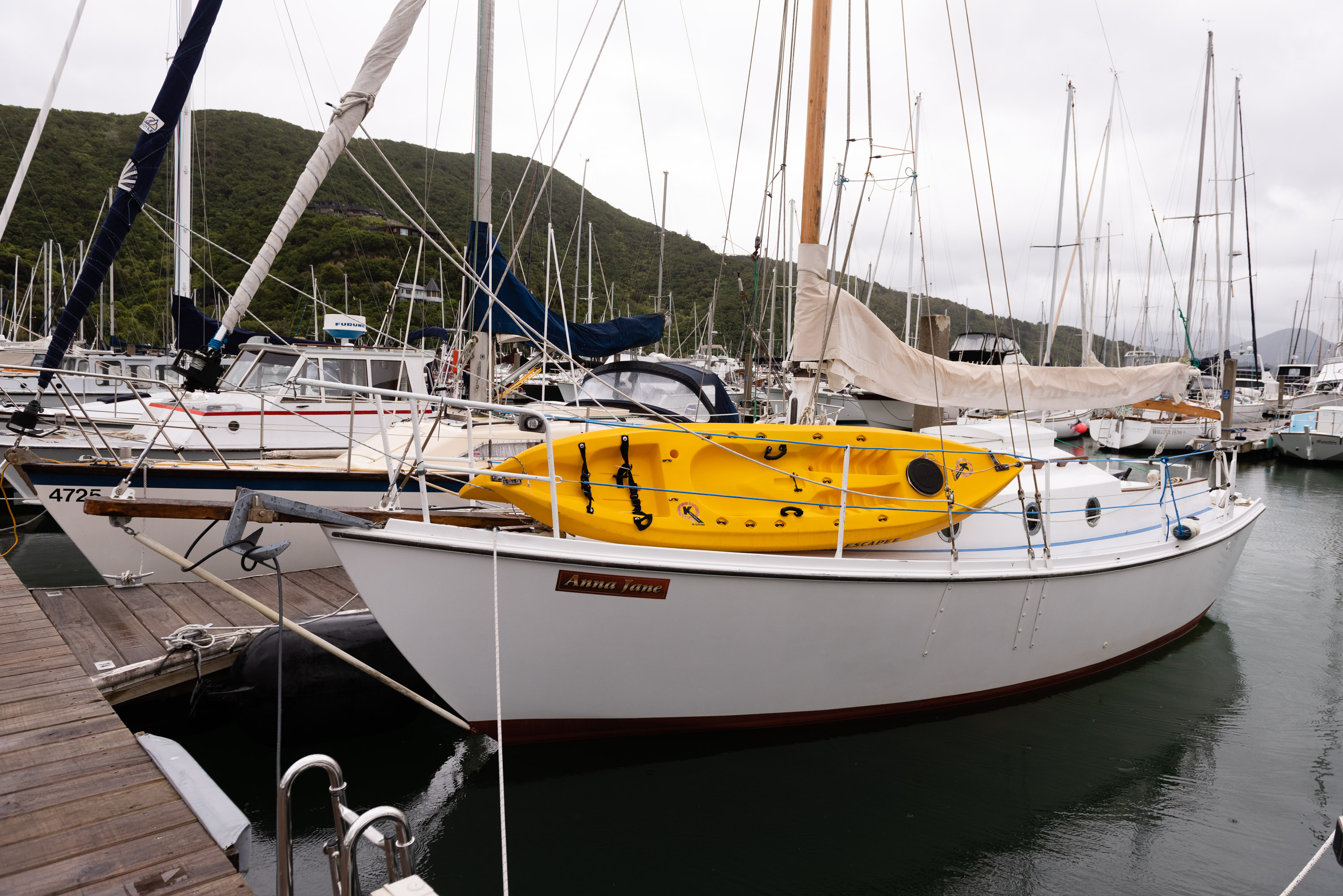
Yacht ANNA JANE (?)
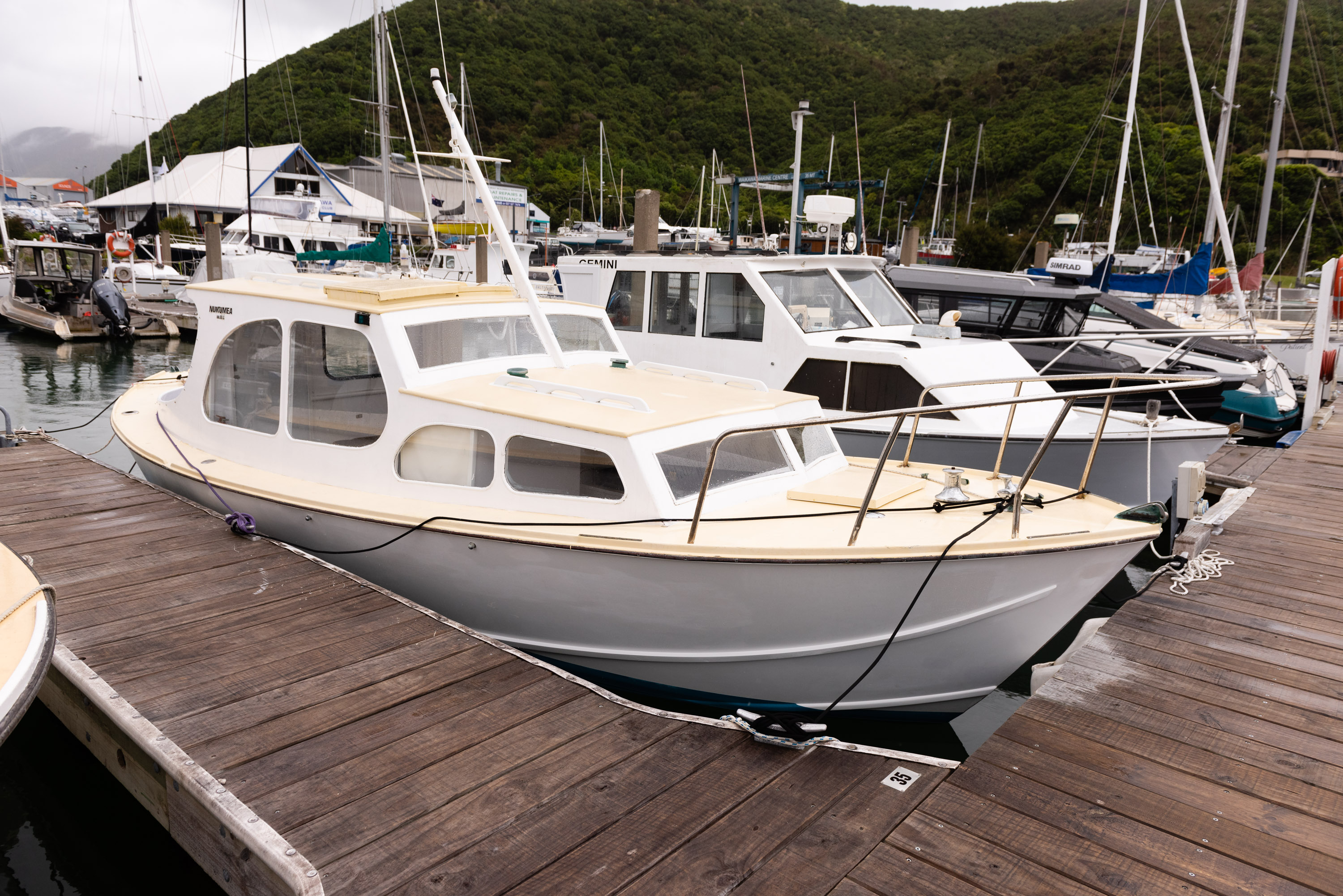
NUKUMEA (American “Bartender” design by George Calkins)
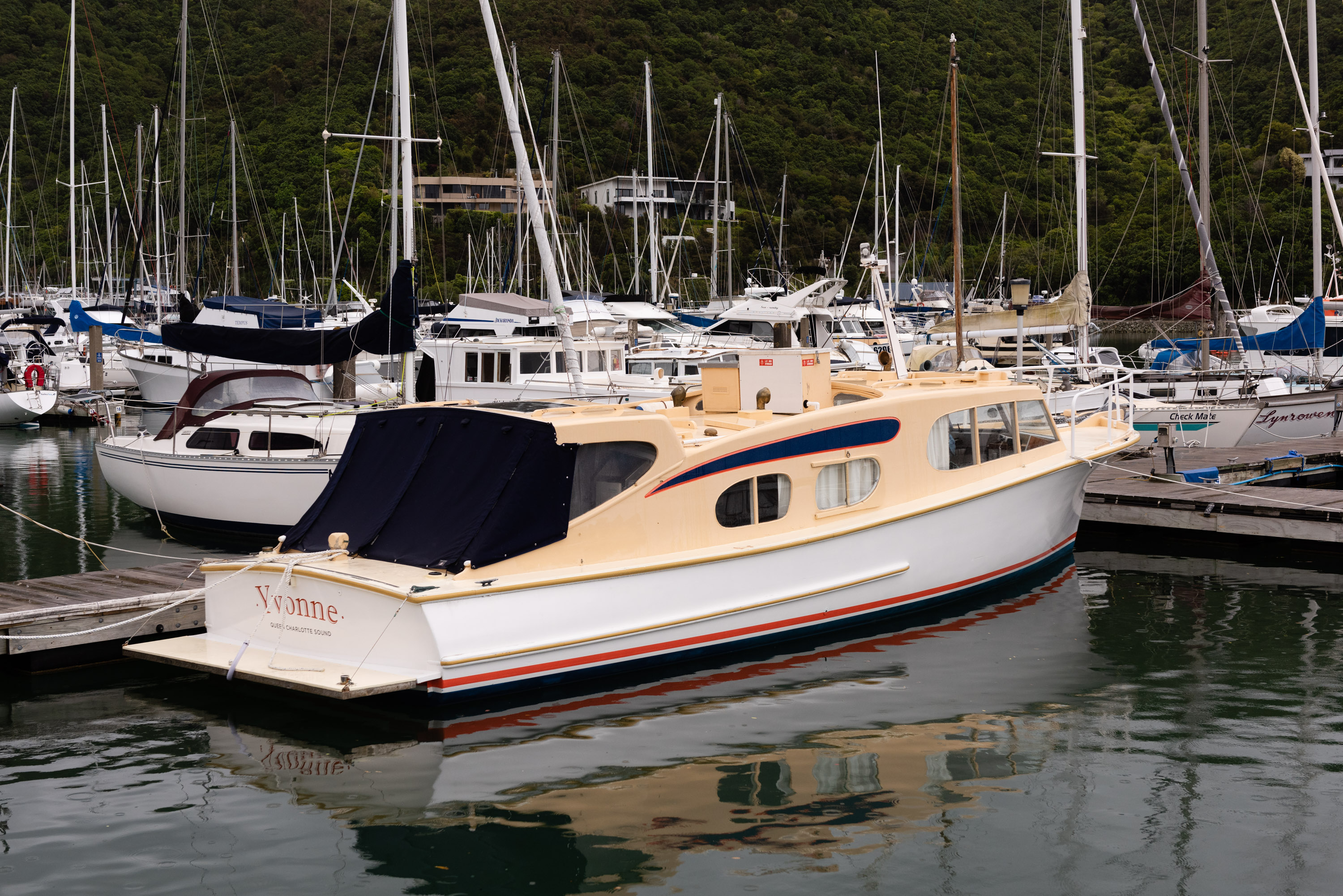
YVONNE (Bob Swanson)
PEARL (?)
Unknown fishing boat
KATOOMBA (Dorman Engineering, Nelson – not wood, built in Corten Steel!!)
Unknown (possibly Bruce Askew?)
CORYLUS (Bruce Askew)
TAREPO (launched TAREPA)
ARCTURUS (McGeady)
? (looks like a McManaway or Morgan fishing boat design?)
? (under the covers)
CRISTINA (Athol Burns)
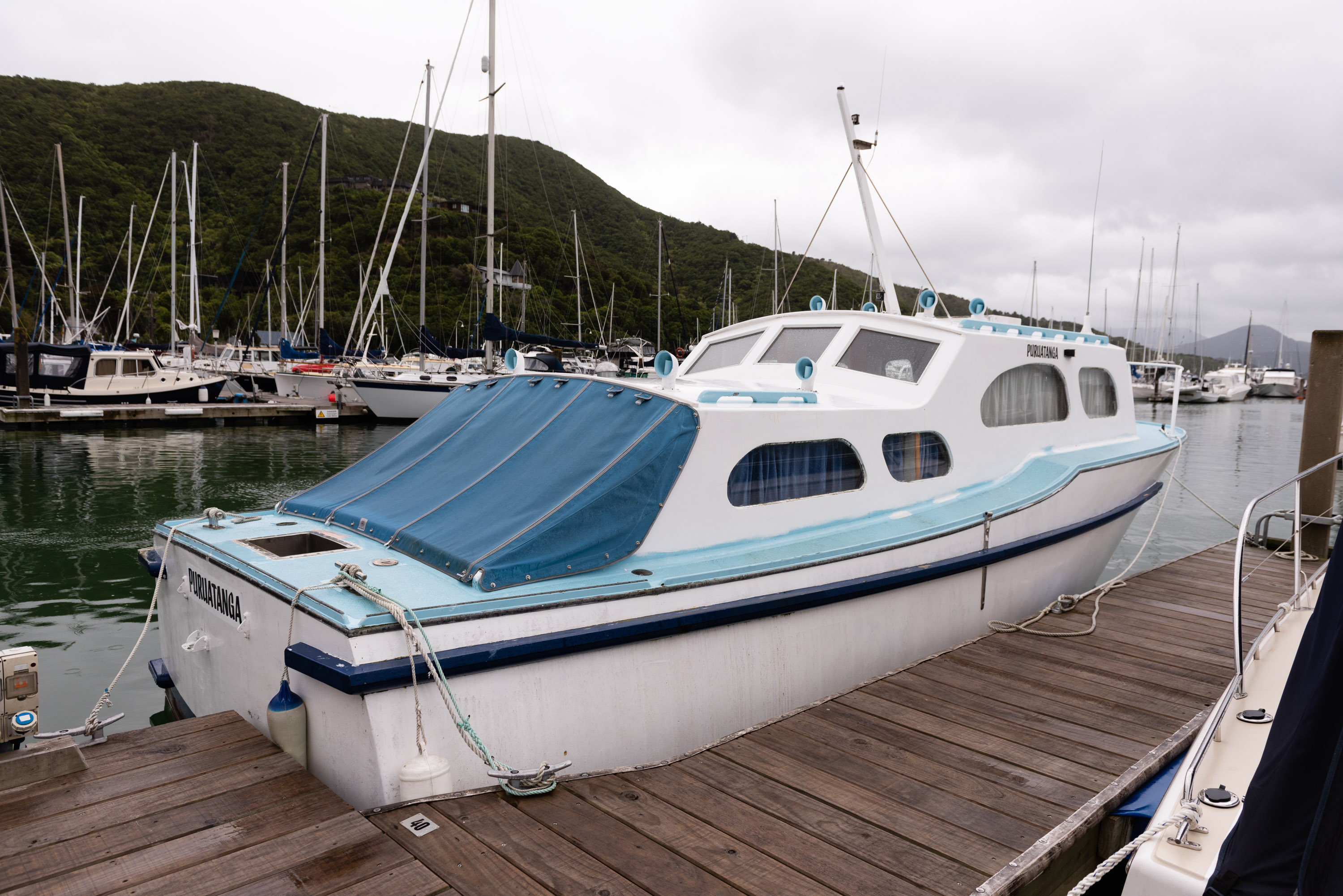
PURUATANGA (launched as MARIANJO)
Most of these have featured previously on WW, so a quick look in the search bar will glean more details if interested.
Woody Greg Bilington contacted me recently re his launch – Skipjack, formerly named Sea Devil, when owned by Brent Gribble.
In Greg’s words, Shipjack is a 100-year-old, unpretentious 33′ Bailey. Greg has sent in an update on the recent maintenance / restoration that he has undertaken on the woody. I’ll let Greg tell the story (with a wee bit of editing)
“I knew that Skipjack took on some water, but since the hull was sound, I wasn’t overly concerned and focused initially on mechanicals, which included replacing the prop, shaft, cutlass bearing, universal etc. In time, I decided we needed to stifle the ingress of water – and as anyone who has ever had a leaky anything will know, this can be a challenging task. Skin fittings, which were the first suspects had all been replaced and properly backed, but whilst necessary, did not made a beakerful of a difference. The stuffing box seemed a likely candidate, and though it was due for re-packing, this too, could not account for the increasing amount of work being done by the bilge pump.
So, we hauled out at the Landing to pressure test the shaft log, and again drew a blank. It was at that point that Grant Hendry – then working at Orakei Marina, seized hold of the keel behind the rudder and discovered to my great alarm that he could move it centimetres either way! This gave rise to a nightmare or two about soft timber the length of the boat – but in any event, was almost certainly the source of the problem.
Nevertheless, if the timber was sound and further inspection indicated that it was, then that left the keel bolts. For me this was an unexpected discovery, but I daresay it shouldn’t have been. Manganese bronze bolts subject to galvanic action for a century, and with ball-peened fastenings on the bottom of the keel, might be expected to be well past their use-by date. The problem about this of course, was that there was a Ford Dover sitting over several of them.
With an elderly woody, as we know, once started, one must persevere. So, in due course, Moon Engines removed the motor – at which time I should add, James and his team did a sterling job replacing all seals (which had begun to leak) and generally gave it a proper birthday.
Meanwhile, boat builder Glenn Burnnand knocked out the old bolts, and confirmed that they were very much the sorrier for wear. Thinned and with numerous hair-line fractures, they were hanging on by the skin of their teeth. Don Burnnand made new bolts, each with a damned big washer and nut, and when Glenn cranked these up, the mission was accomplished. The keel locked up as tight as the day she was built – and possibly tighter. I’ve included a pic to show the difference between the two…
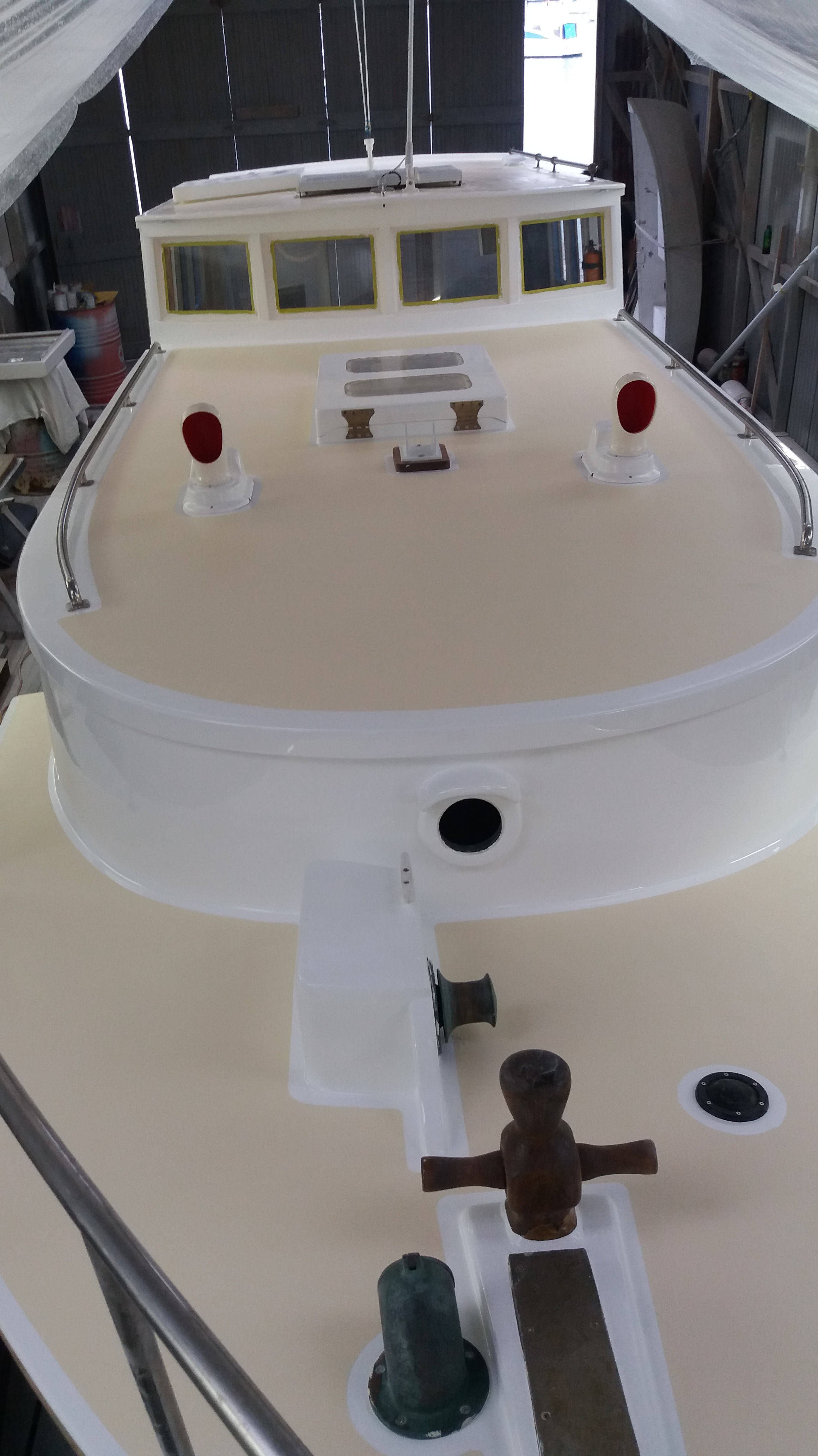
Burnnand Marine also removed the old glass from the deck-planking, over-laid these with marine ply, re-glassed and painted. A superb job. In my view it’s worthwhile giving a plug to those tradesmen you can rely on completely – and he is one of them. Providing you can drop your mast – since you must pass under the Tamaki Bridge (entry to the Outdoor Boating Club) – access to Shed 10 on Ngapipi Road is very easy.
Long story short, the bilge pump is having a well-earned rest, bolts are good for another century, and I sleep even more soundly on the water.”
You can read / see more on Skipjack at the WW links below
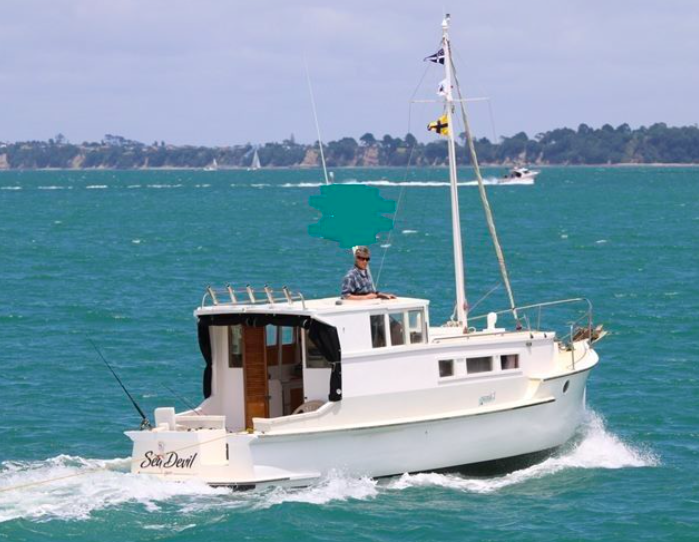
Now if the above launch looks a little familiar thats because she has appeared here before under the name some ‘Sea Devil’.
Owner Greg Billington purchased Sea Devil from Brent Gribble, who, with his father Peter, owned her this past 8 or so years. Sadly Peter has passed away and Brent was ready to return to his passion, which is sailing. Now the name Sea Devil we are told is the English for ‘Dea De’il,’ which is Gaelic for Sea Devil – as she was named by the original owner in 1918. Vern Tonks of Whangarei named her for the English name when he began her refurbishment around 2000. Refer link below to view her during the 2000 restoration & read more expanded details about her.
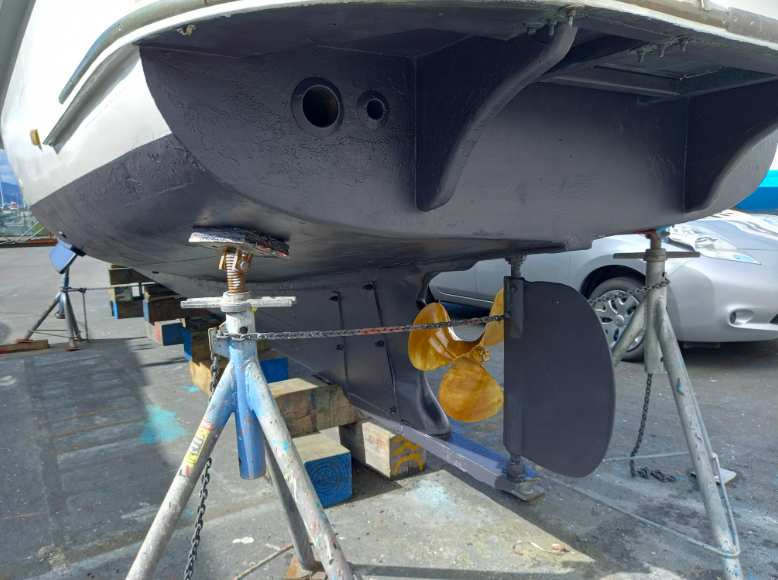
Over the past month (August 2016) Skipjack has been given a further refit which has involved a new muffler, dry riser and fuel tank sight glasses by Moon Engines; new propeller by Bri-ski and shaft extension by Kevin Bradley to ensure a good match with the engine and transmission; removal of the radar mast, and electrics overhauled by Roger Crabtree; hull and hull fittings, engine box insulation, new stove etc restored or replaced and bilge keels fared by Glenn Burnnand, Eberspacher heater fitted by Blair Hannay, and new steering fitted by Grant Henry.
I have to say the loss of the radar mast has been a big improvement to her looks. Now if the photo of the bilge keel is post faring, they must have been very agricultural before this 🙂 I would question the size & positioning of her bilge keels, I have studied & spoken to numerous boat builders about them & these ones appear to be very short & mounted high to the water line. I am seriously considering removing the ones fitted to my launch, Raindance – its a double edged sword, they will have a negative effect on boat speed but is that offset by their ability to reduce roll – I suppose there is only one way to find out…………
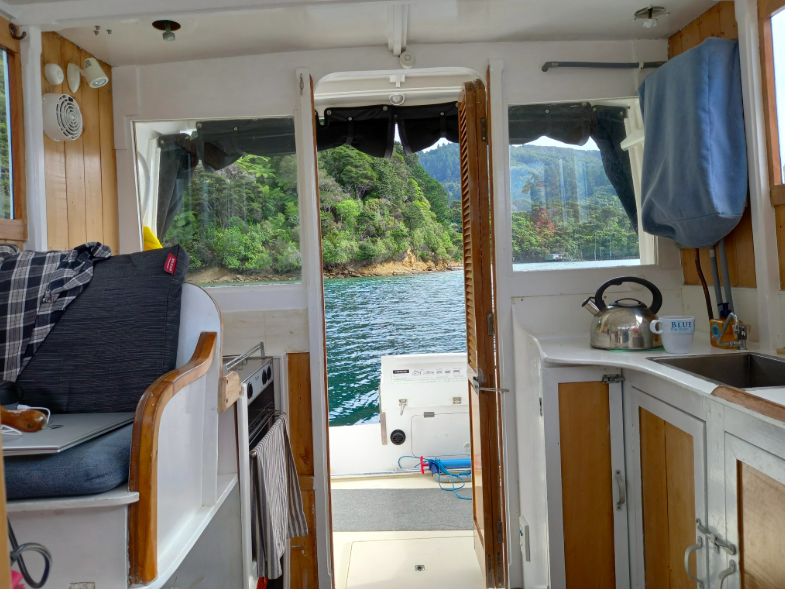
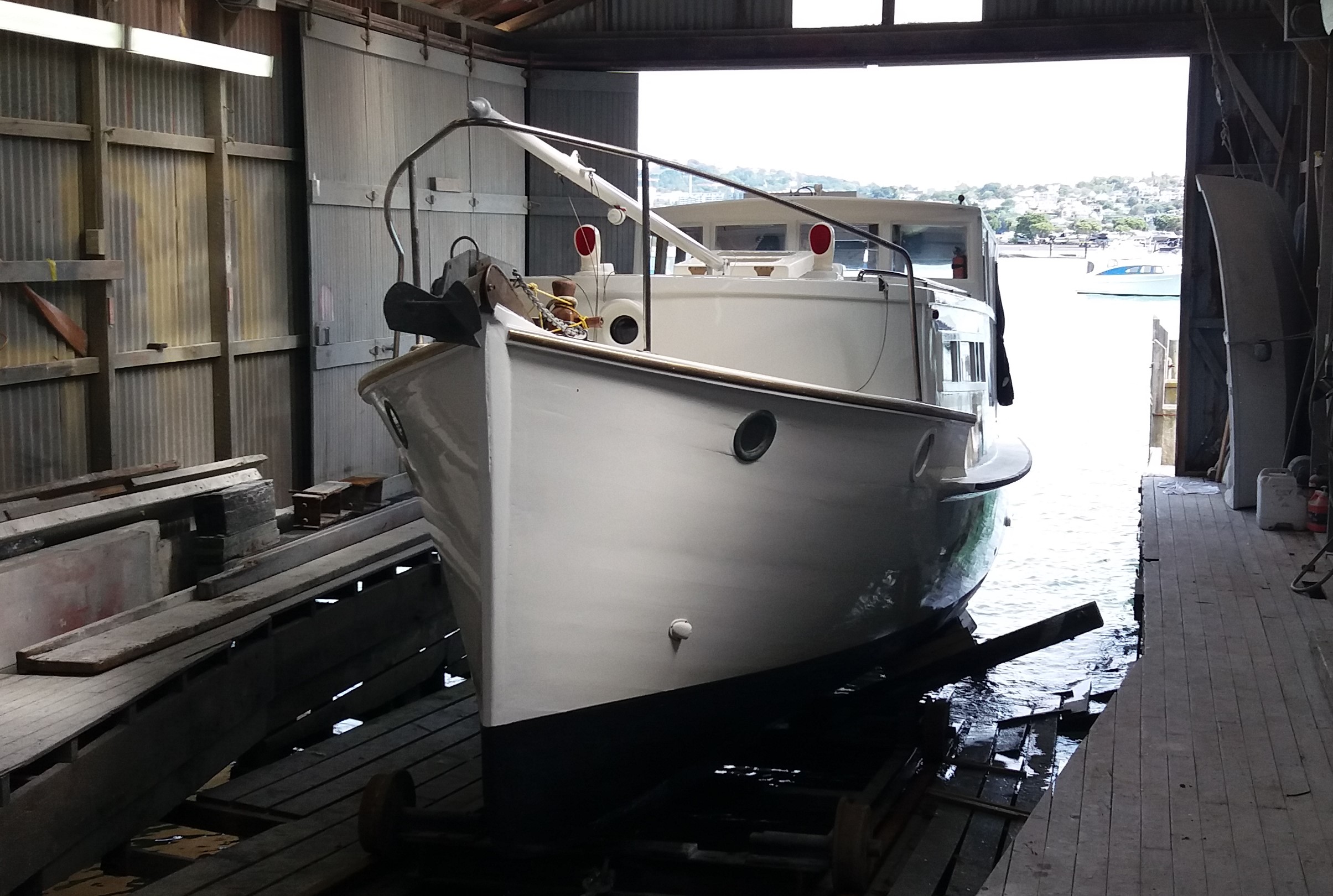
In the above photos we see her in the Burnnand boat shed at Ngapipi Rd, on Orakei Marina and in Circular Bay.





















 waitematawoodys.com #1 for classic wooden boat stories, info, advice & news - updated daily - 15+ million views