Acquiesce Sinks

Acquiesce Sinks

On the sea wall at Okahu Bay, broken its mooring – until there is a positive ID, I wont say who it is but I suspect its one of the Norm Beetson’s 4 sisters 😦

Update @ 6.30pm – yes sadly its Acquiesce. She featured on ww in February. https://waitematawoodys.com/2015/02/25/11397/

Hopefully recoverable but my spotter says it did not look good.

Update 29/04/2015

Update again 29/04/2015

Memories of Supreme Craft

My Memories of Supreme Craft by Ben Hipkins
Story & photo sent to ww by Karen Moren/Lyn McGeady ex Ben Hipkins

(Disclaimer: Story as from memory)

This is a great read & compliments all the recent McGeady/Supreme posts on ww – read on & enjoy Ben’s story. Alan H

Mac McGeady – (A good Boatbuilder and Designer)

“I first met ‘Mac’ in 1955 at his boat factory in 1A Summer Street, Ponsonby. I was 16 years old and I now know he would have been 55.

‘Mac’ was a very intimidating looking man to me and I had a daunting job to convince him that I was the right boy for him to apprentice.

When I started work (at £2-16-0 a week!), the staff comprised of five men. Mac, Barney Glasgow, Peter Williams, Bluey Jacobsen, Graeme Kitchen and me.

Graeme Kitchen had been in the same class as me at Takapuna Grammar School and had started with Mac McGeady as an apprentice a couple of months before me. He had suggested that ‘Supreme Craft’ was a good yard to work in and to ask Mr. McGeady if I could work for him. It took some time to wear Mac down but eventually he took me on.

The first boat I saw in the boat yard was AQUARIUS, a game fisher for a Bay of Islands client. She was 38ft with twin gray marine engines and capable of 16 knots on trials.

The second boat was AUSTRALIS 42ft twin screw launch for Jack Plowman.

The third boat was ASTRA 30ft launch for Mr. Percy Ward.

The fourth boat was AMARYLLIS 40ft twin screw for Mr. H.T. Morton.

The fifth boat was a 38ft launch for Mr. Stan Suter. I can’t remember the name of this boat.

Graeme Kitchen had left by this time and did not complete his indentures. Bluey Jacobsen and Peter Williams had also left.

Mac had sold his twin screw launch AQUILA to Mr. Chub Sibun.

At this time 1959, Mr Norman Fairly came into our lives. He owned a 26ft plywood boat named REEL EM IN built by Don Norton and used to game fish from Tauranga and up to the Poor Knights area. He convinced Mac McGeady to skipper this boat to Mercury Islands and Mercury Bay area. Fairley and Bert Jones were car dealers and visited our boat factory quite often.

Mac had decided to build a boat for himself and designed a forty foot launch for this purpose.
At this time, only Barney Glasgow remained in the work force and myself. We took on a new apprentice, Gary Wheeler, a good keen boy.

When this boat was planked and ready for superstructure and decks to be constructed, Mac and Mr. Fairley agreed for Fairley to purchase the boat and for it to be finished to Fairleys’ requirements. This boat was named CHALLENGER. At this time it was noted that neither Lila or I knew of this ‘deal’. Mac seemed confused about this whole episode.

McGeady had been a good boss and a fair person but now seemed to be confused and unable to work effectively.
The after work drink session would become an ordeal as Mac would not leave until all the alcohol was gone. The business was failing and many of the suppliers were concerned.

Another boat was built (by me and Gary). This boat was 38ft designed by me. She was called WAIMARU and owned by Mr. A.C Gray.

On the shakedown cruise of this boat, Mac acted very strangely, staying at the helm exclusively, not sharing the controls at all. At the conclusion of the trip, we entered the boat harbour of Okahu Bay in the dark when Mac opened the throttle to full speed. The speed limit in this harbour was 4 knots – no wash.
Fortunately we, crew removed Mac from the wheel and no damage was done. All on board were most concerned with Mac’s behaviour and all agreed he needed medical help.

We received an order from Mr. Wal Brebner for a 30ft launch which Gary Wheeler and I built.

Our accountant Athol Nigro laid down the law regarding SUPREME CRAFT. He stated that I must make Mac work, must stop him drinking and smoking or have him retire and buy SUPREME CRAFT myself. What choice!!! I couldn’t make him work, I couldn’t make him stop drinking and smoking. I could leave……….. so I did.

I worked for Alan Williams yard at Milford. This was a good change for me and I was well respected.

After a year or so it was 1961, I received an offer from Mac to return to SUPREME CRAFT and receive a 50% shareholding and ran the factory; this I accepted.

We received an order for a 43ft motor launch from Mr. Stan Horner. This was a twin screw bridge deck boat with a fly bridge. The name of this boat was ALTAIR and was launched in November 1961.

Mac’s condition deteriorated and he was very confused and at this time we received an order from Gordon Collie for a 48ft bridge deck motor launch.
Mac still had the ability to design the hull. This boat was too big to build in the factory in Summer Street, so we built the backbone and frames in the factory and built the boat in a shed supplied by Mr Collie on a poultry farm at Pakuranga.

Gary Wheeler and I built the hull up to deck level and Gordon and his cousin Ralph laid the decks and built the superstructure and furniture, a truly excellent job. The name of this boat was RANGIORA.

By this time, Mac could not drive and was incapable of getting about. Lila was his carer.

At the Accountants insistence, I bought the remaining shares and Mac retired. He and Lila went to Snells Beach to live.

Mac’s career with SUPREME CRAFT began in 1936 and ended in 1962. He was a skilled man and good designer.
There are many mysteries regarding his early years and his birth in Pilliga NSW, his time in Fiji, his time in the motor business and the formation of SUPREME CRAFT in 1936.

The future of SUPREME CRAFT is a story that needs to be told.

After RANGIORA was completed, Gary and I returned to the factory in Summer Street to begin work on a 36ft launch which had been ordered by Mr. Len Buckby of Fodenway Motors at Penrose. This boat was powered by a Foden engine.

As construction proceeded the owners were most interested in the progress and quality of materials being used. This boat was called WHITE CLOUD.
Mr Buckley and his accountant called on me and announced that he would like to become owner of SUPREME CRAFT with Fodenway Motors supplying engines and me building the boats.

I thought this would provide stability and security for the future and agreed to the proposal. Almost as soon as this was done, the factory building in Summer Street was sold and we had to move!. We rented a factory in Archers Road, off Wairau Road, Takapuna.

We built a 36ft motor launch for Mr. Stuart Dalton in this factory. This boat was called, SCEPTRE. We also built a 36ft sister ship for Mr. Fred Bales called VENTURE.

Our relationship with Fodenway Motors grew and as they were situated at Penrose, they were keen to relocate SUPREME CRAFT closer to their business of truck assembly so we were moved again and rented a shed at the Lane Motorboat site at Panmure.
There we built a 34ft Express Cruiser for Mr John Furley. This boat was called, NIKASIA. Fodenway Motors had orders for a 43ft passenger launch and a 36ft cruiser.

Decimal currency was coming to New Zealand and disaster struck with a financial downturn. Fodenway Motors two orders were lost and they decided to liquidate SUPREME CRAFT.

I then took up a position in a ship yard in Suva, Fiji and after this, moved to Australia where we still live”.
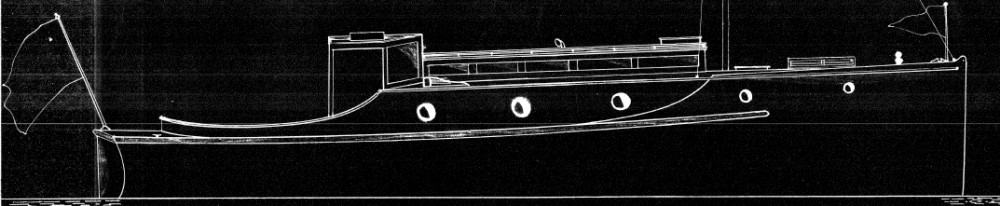
Anyone Seen This Dinghy?

Stolen Dinghy

I don’t normally do this on ww but a neighbour at Bayswater Marina has just reported that their boat at Bayswater was busted into yesterday. Among other things, an inflatable was taken. It is unusual –red colour. Photo & details below. Owners contact is Jillian at    jillianradford@gmail.com

Update – dinghy found, but still lots of gear taken 😦

The Wreck of Teddy – Sailing Sunday

Is This The Wreck Of Teddy?

photos & info ex Chris McMullen

Recently Chris McMullen was sorting through a box of old photos from the Wilson, Gould family & came across the two above showing wreckage of some vessel. Pretty hard to tell where or what vessel but Chris feels that the presence of an horizon makes one think it is not in the harbour. Also yacht B16 seems to feature in some other photos.
Chris commented that the gentleman in the image looks rather like the helmsman in Paul Gilberts (Weekly News) photo of the early Wirihana.

Chris wonders, could it be the yacht Teddy wrecked on south east end of Kawau?. He can’t recognize any of the structure to determine whether its a yacht or launch but notes the quite heavy planking. He did a wee bit of on-line searching & found these press clippings on the wreck of Teddy from the Sydney Morning Herald, March 10 1932 (refer below)

This slideshow requires JavaScript.


Could the Wilson’s have taken some photos, while away on Wirihana (1) for their NZ Herald and The Weekly News? That may explain why the photos are in box.

Chris felt he had seen one of the wreck photos some where else & looked in his copy of “Little Ships” by Ronald Carter.  There are two photos of the Teddy, she was a Norwegian Pilot cutter. The big heavy sawn frames clear in the wreck photo are not typical of a New Zealand built vessel.  She had a big heavy mast and that ties in with that in the other wreck photo.

So the question of the day is – has Chris answered his own question?

As an aside Teddy was featured in Johnny Wray’s book South Seas Vagabond.

Update – Photo below from Chris Leech – he read with interest the article on the Teddy. And located a photo taken at the DYC (age unknown) showing her on the slip. Noting the article extract above it may have been about the same time – 1931?

Lest We Forget

 Lest We Forget

The Gallipoli campaign was failure, 1 in 5 of the NZ force were killed, 1 in 3 were wounded. 100 years later its easy for the historians to look back & say that the campaign show cased the Kiwi attitude & attributes & helped define us as a nation but the truth is 130,842 young men from both sides lost their lives in vain. When you read the personal stories from our troops it was just a total balls up. Imagine this, the casualties we so high & the stench from the dead so bad, both sides agreed to a cease fire so they could attempt to bury their dead. Sometimes I think we overlook that the ‘enemy’ almost lost twice the number of men ‘we’ did.
When you look at the numbers – maybe, just maybe, today’s ‘smart’ wars are not all bad.

If your on the water today, raise your glass to the 14,000 Kiwis that climbed into those little boats & rowed ashore. And for the 2,779 that had a one way ticket, raise your glass again 😉

A Cruise on Matanui – as told by Jack Brooke

A Cruise on Matanui – as told by Jack Brooke

WW thanks Robert Brooke for supplying this article that his father wrote ( one of  many) about cruising in Matanui.
When Joe Kissin had Matanui, Robert used to do a lot of work on Matanui. Joe was a very close friend of the Brooke family and was also very involved with the Wakatere Boating Club and served time as Commodore. He also served on the RNZYS committee. Matanui was a regular “Finishing Boat “ for the squadron cruising races.

You can view / read more about Matanui by using the ww search box 😉

A trip to Watchman Is, Cuvier Is and Great Barrier Island –  12,13,14 July 1952
I quote Jack Brooke – “My only excuse for typing out these stories is the thrill and pleasure they give me in re-living them the second time around, some twenty or thirty years later.
Joe’s launch,Matanui, was a single skin, round bilge vessel of theold type. Her dimensions were – Length: 42 feet, Beam: 11ft 6 ins, Draught: 4ft 6ins, Displacement: 18 tons.
Matanui had several engines from 45 to 70 horsepower, giving her a speed of 8 to 9 knots”

Saturday

4 p.m. Left moorings to fuel up at Westhaven.

5.30 p.m. Alongside Devonport Wharf to load stores.

6.00 p.m. Tossed out of Masonic Hotel!

7.05 p.m.Got Jerry from home and put to sea.

9.30 p.m. Abeam outer Noises, wind still light south.

11.00 p.m. Turned in, Watchman light on bow – moon just up beautiful night. Wind out here a light to moderate southwesterly.

12.45 a.m. Woken up by rattle of anchor chain – Joe has decided to have a fish on the NE side of Watchman, just three lengths off! It is still a fine night, with a light southwesterly wind setting up a slight roll around the Dog. Caught the first fish – a grandfather hapuku, 6 inches long, but Joe still shouted! The others caught a few good cod and a four foot shark. Turned in.

6.30 a.m. I was woken to the beat of the old Kelvin diesel with which the Matanui was then equipped. It was about as old as its owner and even more stubborn! It started on petrol, and then ran on almost anything, from hair oil to boiler crude! The ship was under way, heading out east for Cuvier. The wind was now a light southeasterly and dawn was just breaking. It was a cold winter morning and we were doing 7 to 8 knots in a moderate sea. The crew had caught a few large snapper, but no hapuku off the Watchman and Joe decided to try fishing a pinnacle some miles outside Cuvier – if he could find it! So we were on our way.

9.00 a.m. The sun is shining and it is a beautiful day – the Mercuries are showing up away to the south and Cape Barrier is abeam to the northwest. Cuvier is lifting up out of the water ahead. A whale is blowing at regular intervals on our port bow and is crossing our course. It passed two lengths away, leaving a distinct oil slick on our bows.

10.15 a.m. Cuvier abeam, we are running down a quartering sea past the southeast bay – there doesn’t appear to be a wharf, only a crane and landing steps on a long rock. We ran round to the northwest side and anchored close in, the depth being about 9 fathoms. We had breakfast, caught some whopping blue cod and a snapper or two.

11.30 a.m. Brought the anchor and set out to the northeast to find Joe’s 30 fathom shoal. We steamed for about 40 minutes on 010. The average depth hereabouts was 60 fathoms and Joe had brought a wire fathometer, which we were expected to use to find his patch. It proved to be far too heavy, taking at least a quarter of an hour to reel in. So we decided to drift fish in 60 fathoms. Good snapper fishing but no hapuku. We fished for about an hour, then decided to return to Cuvier and visit the lighthouse keeper. We landed at 2.30, the wind had now dropped right away. We were a long way out to sea, so we left Jerry on board as an anchor watch and left the old Kelvin idling. Jerry also cleaned the fish! We went ashore and made our way up to the lighthouse and signed the visitors book. Three families were there then (1952) looking after the light and everything was in first class order. The western bay has a striking steeple like rock locally known as the ‘Monument’. A rock, awash at low water is in the centre of the bay, where good shelter can be found in winds from the south and east.

4.00 p.m. Left Cuvier for Great Barrier

4.30 p.m. Sunset. Barrier purple and black, also Cape Colville, far to the south. It is still almost flat calm with little swell and almost no wind. A beautiful night, but dark! The steward has been busy, and the wheelhouse is warm, what could be better! I am giving the Barrier coast about three-quarters of a mile clearance to avoid a rock between Cape Barrier and Tryphena. In the fading light profiles are important, Anvil Island and the Pig Islands are standing up like teeth on the western horizon. I recognised Tryphena by the profile of its southwest point and we altered course to enter the quiet harbour.

6.30 p.m. We tied up alongside Tryphena wharf on the eastern side of the bay. It was a calm clear night, with hundreds of fish jumping in the bay. And so to bed.

Monday 5.30 a.m. Up and away! The Kelvin was a bit sluggish in the chill of the morning, but finally got the message and rumbled away contentedly as we headed for the Watchman in a light but cold southeasterly. We arrived off the south side of the Watchman, but NO HAPUKU. So we left the Watchman at 8.30 a.m. and set off for home. As we got clear of the Cape and into the Gulf, a fresh southwesterly sprang up and in no time at all we were bashing into a short steep sea right on the nose! Making 7 knots at 900 rpm.

10.30 a.m. Waiheke just in sight – appears to be a fog bank over the mainland – heavy haze over the lower end of Waiheke.

11.00 a.m. Dropped anchor in 8 fathoms between Gannet Rock and Thumb Point. No good – soft juicy mud!

12 noon – left for D’Urville Rock Ooe’s spot!) – Even worse! Left for home.

1.30 p.m. Lunch in Crusoe Passage. Fog over Auckland – even light fog here! Little wind now but plenty of tide – no fish! Left for home again, bucking a strong ebb tide arrived at 5.00 p.m.. Emptied out of Masonic Hotel 6.00 p.m. Home at last 6.15 p.m.!


Manuwai

MANUWAI – a Wellingtonwoody
photos & details Paul Kerr-Hislop

Todays post is a Wellingtonwoody & her owner Paul Kerr-Hislop understands Manuwai was built in Porirua in 1960 by Paul Bradey for the Mexted family of Tawa to a Shipbuilders design.
LOA is 30’8” & beam 10’6”. She has a 1 1/4” kauri planked hull which has a hard chine and flat bottom towards the stern presumably to enable semi-planing. A 140hp 135T Perkins diesel engine linked to the prop shaft via a vee drive provides a cruising speed of 9-10 knots and a top speed of around 13 knots. The engine compartment is ventilated by a couple of rather beautiful solid copper vents to two cowls on the cabin roof.

The Mexteds kept the boat on Lake Taupo for around twenty years before it was returned to Porirua and the Mana Marina. There it was used for a few more years by the Mexted family before changing hands and moving to Picton. The boats log book mentions a few trips between Picton and Christchurch in the late 1980’s and subsequently, Paul understands the boat was used by the GP in Havelock (south) to do his rounds in Kenepuru and Pelorus Sounds.

Paul purchased Manuwai in Picton in 2009 and moved her to Mana Marina shortly after. The hull is still in pristine condition observed when they stripped back the paint to the bare wood. She is a very sturdy boat – ideal for Wellington and Cook Strait conditions. Manuwai is now in Picton on the “catwalk” jetty and is used in the commute to Pauls Sounds property in Resolution Bay.

Barra Dee

BARRA DEE
photos & details ex John Wicks

Barra Dee is currently hauled out at Westpark (now called Hobsonville Marina) & John estimates that she is approx 11>12m in length. Her owner nothing about her past other than she was most likely built in the 1960’s, her shape would support this.
Judging by how far forward the prop and (temporarily removed) rudder are, John thinks that she’s been lengthened. If so, whoever did it did a good job; it’s not immediately apparent and the sheer hasn’t been allowed to sag towards the stern.

Can anyone enlighten us & the owner on her past?

ps she may be 4sale if anyone is interested.

Cleone

CLEONE
photos & details ex Ken Ricketts. edited by Alan H
Cleone is thought to have been built in the 1950’s by Jim Young to a Couldrey design & her current owner Bruce Orborn believes she was the first launch that Jim Young built. Her specs are 30′ long by 10′ 6″ beam. She presently has a 4 cyl 72 hp Ford Diesel, which may be original. Orborn has owned her for approx 15 years & bought her off a Mr Stubbs who had her he believes for about 8 years & who had bought her off people called Armitage, who apparently bought her off the original owner Bert Follas.

Orbon commented that she spent some of her early life in Whakatakataka Bay & was using one of the sheds in the bay in her earlier years. She later moved to Devonport, during this period the present owner, first went out on her aged 10 yrs, with his family, who were friends of the Follas’s.
Cleone later moved to Milford Marina where she has been moored for all her life under the Stubbs & Orborn stewardship.

Anyone able to confirm the design/build details & add to the history of Cleone?

Harold Kidd Update

Arnold (Bill) Couldrey designed CLEONE for Bert Follas in 1948 and had her built by Jim Young a little later, probably launched in 1950. She originally had a petrol engine, later replaced with a Ford diesel. Follas owned her until about 1963 when M. Alison of Waitangi Rd, Onehunga bought her. John Grainger owned her from 1975 to 1987. I have a bunch of pics during his ownership. John Stubbs bought her in 1989. His story was that CLEONE was the first boat Jim Young built when he came out of his apprenticeship because she was the size of his shed.

New photos added 14-06-2015. Alan H

Little Tasman

LITTLE TASMAN
details from Russell Ward

Russell was the bearer of some great news last week – the Colin Wild built Little Tasman, has found a new owner. Over the last few years numerious woodys have sent me photos of Little Tasman hauled out at Point Wells. I’m told a while ago a 4sale sign appeared, now I wish I had know – there are a few woodys out there that would have snapped up a Colin Wild built launch with the provenance that LT has. Wild built her for Albert Spencer & she was called Tasman & was a trial for his next (larger) boat also called Tasman so #1 then became Little Tasman. In the sepia photo above she looks to have a good turn of speed – I don’t imagine Albert Spencer would not have been chugging around the harbour at 7 knots 🙂

I’ll let Russell time his tale about Little Tasman.

“My memories of her go back to the mid ‘60s when all was Radio Hauraki, psychedelia, Beach Boys, Strolling Bones and Beatles. Oh and sheilas. Boats were somewhere in there and Bon Accord harbour was the stage. Mansion House was still privately run and the authorities didn’t know about the “Snake Pit”. There were usually several mullet boats nosed into the beach and crews in varying stages of recovery/rehydration. You couldn’t get your anchor to hold reliably in the bay because of all the bottles on the bottom!

The Kawau Yacht Club was pretty moribund, although the AMYC were making preliminaries to taking it on (my old man was on the committee of AMYC) so we had great hopes.
Mrs Lidgard was in residence, Skip Lawler had the Fairmile Ngaroma alongside the wharf for a while, and the Comettis had a fantastic garden. My potted history of the Christmas holidays.

The Ward family (no relation) had Little Tasman at that time and it was party time. If I said that one of the mullet  boats that had rafted alongside one memorable noisy night, was pushing off at just before sunrise because “they didn’t want to get us mulletties a bad name”, you get the picture.

But enough of that (it was just to get the old salts of Cobweb Corner reminiscing about their misspent youths). I have always been keen on machinery and when Harold Kidd mentioned that Little Tasman had a Stearns, I wondered what sort of engine they made. No pictures in my books. It was pretty obvious that there must have been classy because they were going into classy boats. American of course. And Stearns Knight made sleeve valve engines for their cars, the assumption that there was a connection was there. But no, no relation.

I contacted an old colleague in the US to see what he could find. And Richard Durgee sent me a raft of pics and adverts (refer below). They are 1924 and 26 so just right timing. I am fascinated that they have an amazingly modern head. Prod rod of course and the combustion chamber apparently in the piston.  You remember –what the Chrysler invented in the ‘70s for the Chrysler Hemi! Nuthin’ new out there, son. ’S all been dun before apart from nukes. Most marine engines were side valve –slower flame propagation and plenty of low down torque”.

Remember click image to enlarge