Now this wee ship (she is a ship) has been on WW before but she is such a honey & now for sale so she deserves an encore 🙂
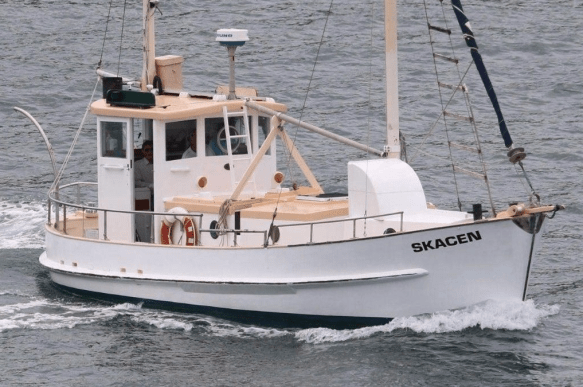
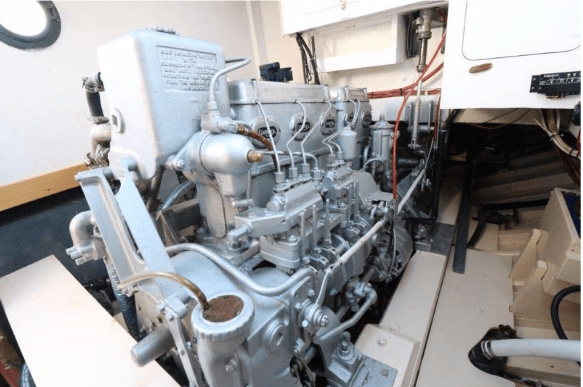
Skacen measures 36’ with a beam of 10’7” & draws 4’11”. Zoom zoom comes from a 5LW Gardner (of course).
She was built by Salthouse in 1973, with a carvel kauri hull. You will see from the above photos she is very well fitted out with lots of character.
In the photos you may have picked up something strange – on the port side her name is Skagen & on the starboard its Skacen ?
As Ian McDonald commented when he sent me the trademe link – not many boats of her size have a walk-in engine room.
She would be perfect for a couple wanting mooch around the NZ coast in almost any weather, as she spent over 10 years in commercial fishing on New Zealand’s East Coast.
Woody – David Glen has advised that she was moored in the Whangapoua Harbour, off Matarangi Wharf, for the best part of the last 20 years. She was owned by a local resident who worked in the local forests. She caught David’s eye at Matarangi in 1990’s and she appeared to be well maintained, but seldom used.
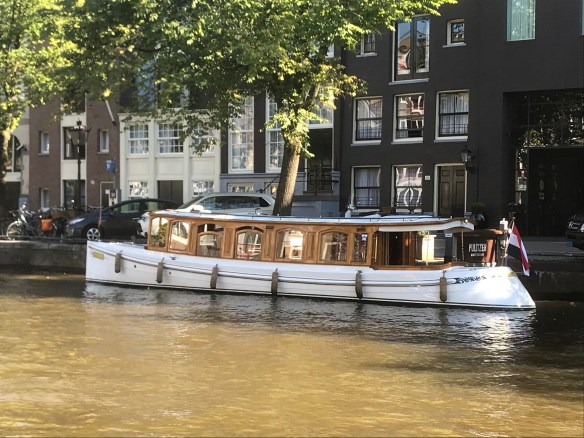
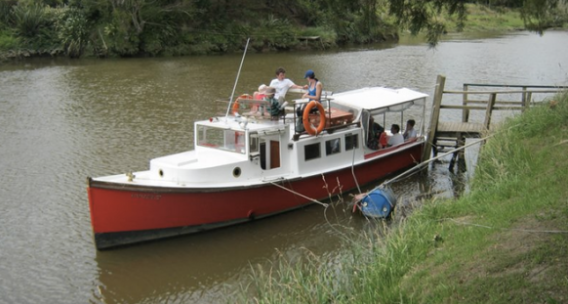
And speaking of David Glen, he sent me yesterday the photo below from Amsterdam of this lovely, what I assume is a hire boat. Loving the top & down windows.
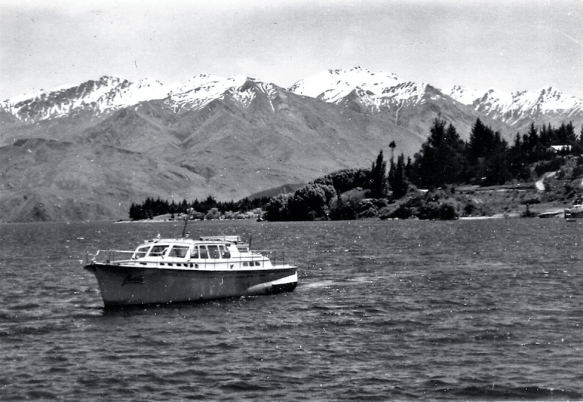
The above photo of Malibu on Lake Wanaka comes to us via Len Redwood’s fb page.
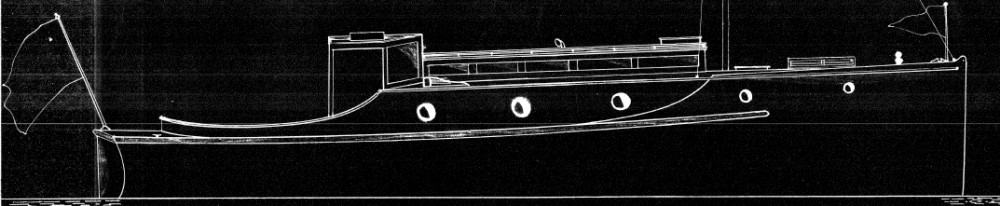
Ken Ricketts has commented that from her looks, she is almost certainly a late 1940’s > 1950’s Ship Builders design.
Can we ID her & find out what became of her?
Harold Kidd Input – She’s actually MALIBU 2, built by Shipbuilders in 1952 for Graham West and shipped down via Dunedin by WAIPIATA in 1955. She operated on Wanaka until December 1968 when she was relocated to Stewart Island. Her dims were 40′ x 12′ x 3′ and she had a Perkins 6 cylinder diesel. Corrected. AH
Whitianga Mystery Launch + Akarana Launch Day ‘Home’ Movie
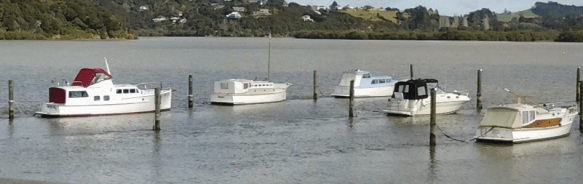
Great photo above dated December 1950 of a lot of pleasure craft at Whitianga – the question is can we ID the white launch in the middle of the photo? Baden Pascoe will chip in, I’m sure 🙂
The Launching of Akarana
I was sent the above 2 minute ‘home’ movie by Ngairene Rogers of the launching of the 1960 Auckland pilot boat Akarana, designed by A.J. Collings & built by W.G. Lowe. Ngairene promised me the a copy of the movie approx. 8 months ago & I was pleasantly surprised when it arrived in the post. I’m sure Dick & Colleen Fisher, owners of Akarana, will be rapt to view it. So thank you Ngarene for sharing it with us.
(sorry about the ‘tattoo’s the middle off the screen – the price you pay for free hosting)
Ngairene’s brother Wade worked on Akarana when he was an apprentice in the early 1960s. He also did all the interior and detail work on Deodar (the harbour police launch), Ngairene commented that Wade was such a good boatbuilder that all the wealthy “yachties” used to ask that he be the one to work on their precious yachts, even though he was an apprentice.
The movie is in two parts, one section in black and white and the other in colour. There are also a few of bits of the boatbuilders clowning around (or working?), such as putting a plank of wood into a steamer.
Ngairene occasionally is in contact with one of the apprentices (Ross MacIntosh) featured in the movie, Ross lives in the Auckland suburb of Mt Roskill. In the movie Ross is the one wearing a pale short sleeved shirt and (short) brown shorts with a hammer sticking out of the belt on the left side – he walks away from the camera at one point then looks back over his shoulder and bends his left arm backwards as if waving.
You can view/read more on Dick Fisher’s restoration of Akarana here
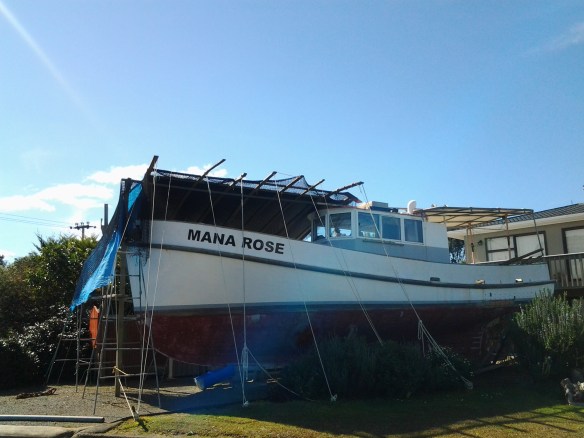
Ken Ricketts sent in the selection of photos above from a recent trip (car) up North to the Bay of Islands.
An eclectic mix of craft – some known, some not – we see Manuia in the Waitangi Inlet, Mana Rose hauled out on her owners Opua front lawn, the salty wee ship Weitox.
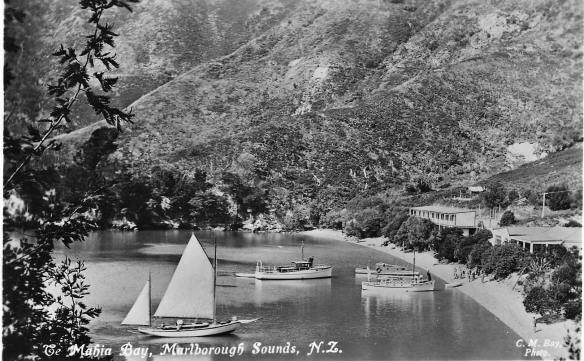
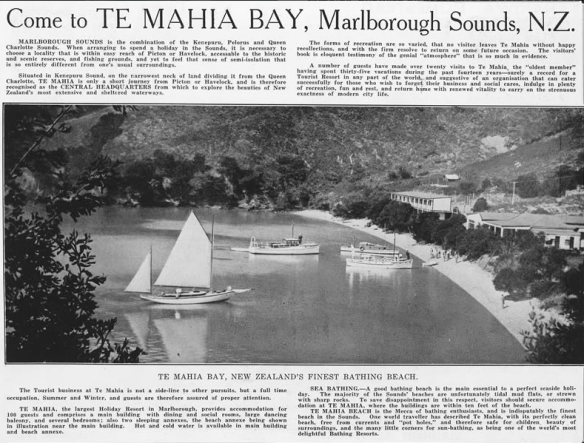
Todays photo comes to us via Lew Redwoods fb & is of Te Mahia Bay in the Marlborough Sounds. Its tagged C.M. Bay, so possibly they were the photographer.
Captured in the bay is an impressive collection of woodys, hopefully one of our followers with southern roots will be able to ID the craft for us.
The photo was used in a newspaper article (see below) promoting the Te Mahia Bay holiday resort.
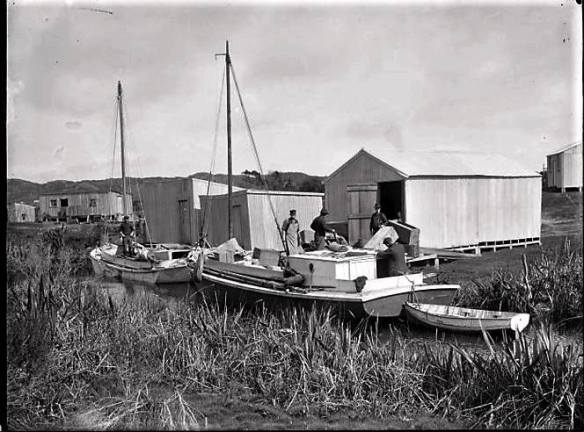
Today’s photo ex Lew Redwood’s fb shows two woodys alongside the boat sheds at Wiahopo in the Far North. Wiahopo is situated at the upper reaches of the Houhora Harbour & was a big kauri gum field area.
The photo is tagged 1910-39 & attributes ownership as ‘Nortwood’s Ark & Harold Wagener’s Oi.
Harold Kidd Input – Don’t know about ARK but she’s obviously a small square bilge scow. OI is actually the cargo launch OEI, built for H.B. Wagener of Pukenui by T.M. Lane & Sons at Mechanics Bay (NOT Totara North) in 1910. She was fitted with a 7hp Standard engine (hardly zoom zoom). Dims were 36’6″x10’x2’8″. Arthur Subritzky delivered her north in November 1910 taking 25 hours Auckland-Mangonui.
I have been recently contacted by Bernard Rhodes in regard to the yacht Kate – I’ll let Bernard tell the story –
“From the 1860s onwards, sailing cutters, schooners and ketches gradually replaced Maori canoes as the principal means of transport around our coasts, till steamers in turn replaced them for passengers, and scows for bulk cargoes.
The Kate is a rare part of our nautical heritage, being one of only 3 of this once common type still in existence as far as we know. (Her near sister Rewa is displayed indoors in the Auckland Maritime museum, and the Undine is still sailing in the Bay od Islands).
When the Waiheke Working Sail Charitable Trust took over the Kate in 2013 she had a recently added cabin with full headroom and an 8” deep false keel. These made her suitable for conversion into a small sail training ship, giving today’s youth an opportunity to experience travel much as it was 150 years ago.
The restoration and re-purposing are now well under way – the work about 60% complete and the funding 50% with the big ticket items such as engine, sails and compliance to come.
We need another $60,000 to get her sailing.
The Kate’s history and an account of our progress can be found on our website, http://www.waihekeworkingsail.org, click on the brochure at the top. Much of her history was lost the last time she sank, but a surprising number of people have contacted us with stories of her, and we welcome any more.
Earlier this year we hauled her out a second time and fitted a lead ballast keel and new rudder, among many other tasks. The addition of the cabin has raised the centre of gravity, and the boom needs to be above head height for safety, so the 1 tonne external lead keel will compensate, giving her adequate stability and near-original performance.
The accommodation has been designed for 6 trainees, a master and mate. We anticipate running 5-day Youth Development voyages for 13- to 15- year olds, based on the wonderful programme developed by the Spirit of Adventure Trust. With her relatively small size and simplicity, by the end of the voyage the trainees will be handling the ship themselves, under supervision. The sense of achievement and satisfaction they gain from this will stay with them for the rest of their lives.
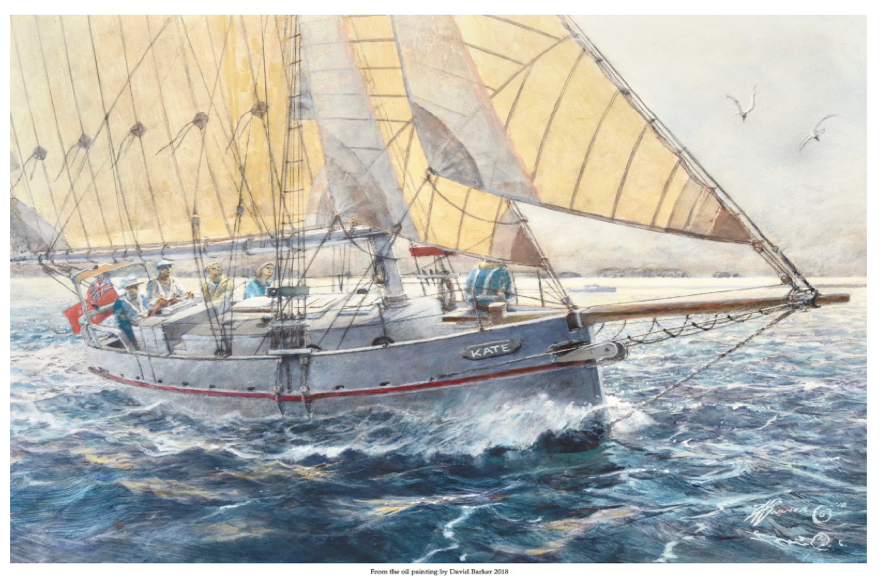
Recently I re-connected with an old friend, marine artist David Barker, as he visited Waiheke on his launch “Feather”.
I talked of the vision of “Kate” as she will be, outward bound under full sail with a bunch of trainees aboard, and he agreed to do a painting encapsulating the dream.
I have long admired his talent for depicting boats and the sea, for giving an almost magical touch to a beautiful seascape, and I’m excited to be able to share this with you.
You are invited to subscribe to a strictly limited edition of 100 numbered, signed prints suitable for framing. $225.00 each.
When all subscriptions are sold, a draw of one number will win the original framed oil painting, generously donated by David.
This fund is to be spent exclusively on the restoration of the ‘Kate’ for youth sail training on Waiheke Island.”
For an informative card with bank details for payment, a ticket for the draw and for delivery of the print, please email your postal address to info@waihekeworkingsail.org.
Harold Kidd Input – She was built in 1896 by Thompson & Sons as a sailing fishing boat, and owned successively by J.F. Smith, J Moros (1900) then as a launch by Morgan Bros at Helensville from 1913, Bill and Archie Curel from about 1920. They fitted a K2 Kelvin in 1932 and owned her until WW2 at least at Helensville. To say she’s a near sister of REWA and (by implication) UNDINE is pretty far-fetched (to be polite).
13-10-2021 Update – looking very smart, back under sail
The launch Cygnet has just popped up on trademe (thanks Ian McDonald) & while the listing makes no reference to her past, given the location of Motueka, one would have to assume that she is the ex Mokau River work boat, previously featured on WW (photo below), with a lot of work done to her.
Details – she is approx. 30’ in length, made of kauri carvel construction in c.1960s. Her zoom zoom comes from a Lombardini 87hp diesel that pushes her along at a cruising speed of 8.5 knots, max 10 knots approx.
In her previous appearance on WW, Harold Kidd commented that she was built in Auckland and shipped down to Waitara for Sjolund of Mokau in July 1913, She was described as “on the tunnel style” 34ft in length, 7ft 6in in beam with a draft of 12 ins unloaded and 18ins with a two ton load. No hint of builder but Baden Pascoe thinks she is by T.M. Lane and Sons and that seems entirely likely. She was meant for the then flourishing Mokau River trade. Sjolund had several launches.
You can view / read more on her at the WW link below.
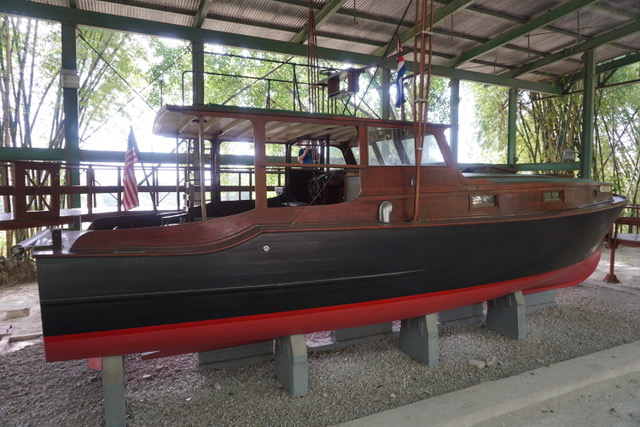
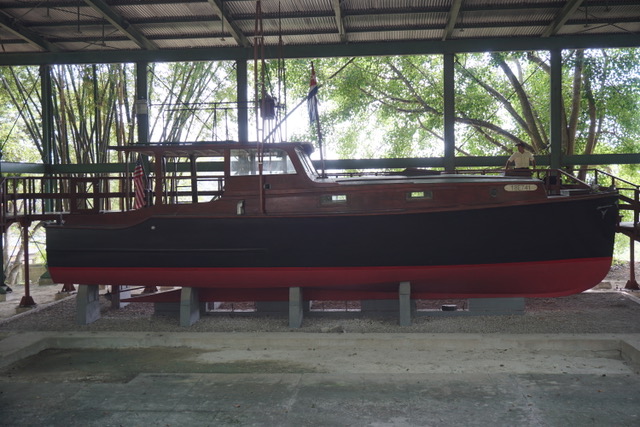
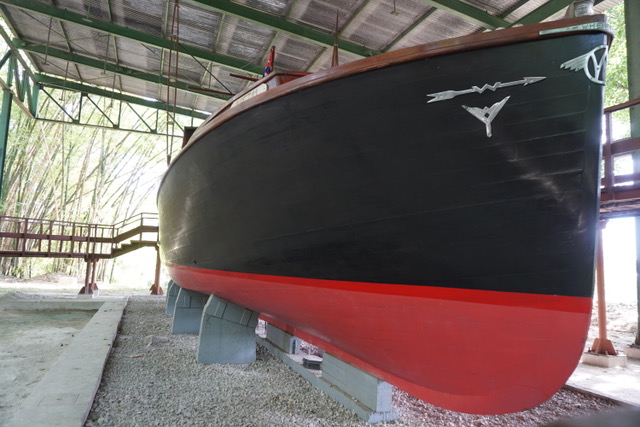
A little while ago woody Rod Marler was in Cuba, while there he visited the Ernest Hemingway museum & photographed – ‘Pilar’, Hemingway’s 38’ sport fisher. Built by the Wheeler Boatyard, Brooklyn New York and launched in 1934.
Below is a great read on the history of the boat, published courtesy of the Hemingway Home website, as are the b/w photos below.
“Returning to Key West from an African safari in 1934, Ernest Hemingway stopped off in New York to take a few meetings. At one with the editor of Esquire, Arnold Gingrich, Hemingway was given a $3300 advance for some short stories. He promptly took himself out to Coney Island to the Wheeler Shipyard and used the cash as down payment on a customized yacht.
Wheeler was known and rewarded for producing exceptional hand-crafted wooden boats. It had begun producing a pleasure yacht called the Playmate in 1920 and been very successful (the model would be produced until 1939.) Hemingway’s modifications to the 38-foot version he ordered included a live fish well and a wooden roller spanning the transom to aid in hauling fish aboard. He also requested extra large fuel tanks so he could stay at sea for longer periods of time. The boat had two motors – a 75hp for traveling and a 40hp for trolling. And he requested a flying bridge. The photo above shows Hemingway atop that flying bridge as Pilar pulls out of Havana harbor.
The finished yacht cost $7500 and was brought to Key West and christened Pilar. (Not only the name of the heroine in For Whom the Bell Tolls, Pilar is also the nickname for then-wife Pauline.) Through Key West friend and hardware store owner, Charles Thompson, Hemingway gained permission to dock her at the Navy Yard (the Navy was barely using it at the time.) This put the ship at dock only a few blocks from Hemingway’s home on Whitehead Street.
In 1940, when Ernest and Pauline divorced and he subsequently married Martha Gelhorn (whom he’d met at Sloppy Joe’s,) they relocated to Cuba and bought Finca Vigia (Lookout Farm) the home on a hilltop overlooking Havana. Pilar was docked at Cojimar, a small fishing village east of Havana, which was the inspiration for Ernest Hemingway’s The Old Man and the Sea.
When he left Cuba in 1960 with fourth wife, Mary he knew he’d be back. But the Bay of Pigs invasion in 1961 cut off his return and separated him from his beloved Pilar. After Hemingway’s death in July of that year, his widow gave the ship to Gregorio Fuentes who had served as her captain. Fuentes also served as the basis for the character Santiago, in The Old Man and The Sea and passed away in 2002 at the age of 104.
Today, Finca Vigia is a museum where Pilar is on display atop the tennis courts with a walkway encircling her so visitors can view the interior.”














 waitematawoodys.com #1 for classic wooden boat stories, info, advice & news - updated daily - 15+ million views