Woody Trip Report – Inside Passage Cruise

WOODEN BOATS OF THE INSIDE PASSAGE

Story & photos by CYA NZ member Denis O’Callahan (owner of MV Tasman)

Today’s post tells the story of Judy & Denis O’Callahan’s adventure cruise – its a great read, so I’ll let Denis tell the story. Enjoy 🙂

 “In April 2000 I was invited by a Canadian friend to help launch a boat which his brother Wayne had built on Thetis Island in the Strait of Georgia near Vancouver. The “Grail Dancer” is 48’ on the deck, ketch rigged and based on the lines of the “Emma C Berry”, a 150 year old traditional fishing boat now preserved at the Mystic Seaport Museum, Connecticut. Wayne works as a wooden boat builder and restorer who at that time was restoring historic paddle steamers at Fort Dawson and Whitehorse on the Yukon River during the summer. During the winter he worked on the “Grail Dancer” which took him 14 years to complete. This trip was a great experience which gave me an inkling of what a wonderful cruising ground the Inside Passage to Alaska would be. This was further reinforced when I read the great book, “Passage to Juneau” by Johnathan Raban.

Eventually this year my wife Judy and I planned a visit to Vancouver and Alaska, including an adventure cruise of the Inside Passage. Our first stop was Vancouver, from where we took a float plane to Victoria on Vancouver Island to spend a couple of days with friends who live near Nanaimo. On the way north from Victoria we called in at the small fishing port of Cowichan where I was able to see a converted fishing boat, “Morseby III”, which belongs to a guy I know who lives at Mangawhai. We flew back to Vancouver from Nanaimo and had a couple of days there including a visit to the excellent Maritime Museum. Here there is preserved the wooden auxiliary schooner St Roch, built in 1928 in Vancouver and operated by the Royal Canadian Mounted Police. In 1942 St Roch completed the first voyage from the Pacific to the Atlantic through the Northwest Passage, 27 months from Vancouver to Halifax and spending 2 winters in the ice. In Halifax her engine was upgraded from 150hp to 300hp and she made the return journey in 1944 in 86 days.

Next we boarded the Alaska Marine Highway ferry “Columbia” for a 2 night, 1 day voyage from Bellingham to Ketchikan. This was rather like a Cook Strait ferry and while we had a comfortable cabin many hardy souls camped in deck, fixing their tents down with duct tape. We saw a number of other boats during this trip, huge barges laden with containers and trucks, cruise ships, fishing boats, pleasure boats and some of the contestants in the inaugural “Race to Alaska” (R2AK). R2AK is open to any kind of boat without an engine, from kayaks to racing trimarans, 750 miles from Port Townsend to Ketchikan. First prize, $10,000, second prize, a set of steak knives. The ferry passed through many spectacular narrows and channels and at Bella Bella we stopped while the crew lowered the anchors to demonstrate compliance with US Coast Guard requirements.

Ketchikan is a busy port town with floating docks and other marine facilities. However during the summer it is dominated by up to 4 giant cruise ships visiting each day. A large marina (“floats” in the local lingo) accommodates a variety of fishing and pleasure craft. The salmon fishing boats are divided into 3 types, purse seiners which go for large volume, low value fish, gill netters which aim for better quality and trollers which target the top quality product. Long-liners target halibut, a kind of gigantic deep water flounder which can grow up to 200kg.

We took a 10 day adventure cruise on the “Alaska Dream”, a 104’ catamaran, rather like a Waiheke ferry with cabins for 40 passengers and a crew of 17. We strongly recommend this as a way to see the Inside Passage. Activities included walks ashore, railway excursions, kayaking and even swimming. We saw amazing wild life, indigenous culture, glaciers and fishing ports, including Sitka, Skagway, Haines, Juneau, Petersburg, Wrangell, Thorne Bay, Matlakatia and Ketchican. In every port there were numerous classic wooden fishing vessels in varying states of preservation. I would estimate that 90% of the working fishing boats around the Inside Passage are of wooden construction. The plentiful supply of rot resistant old growth Yellow Cedar and Western Red Cedar no doubt accounts for the durability of these vessels”

Tapui

TAPUI
photos ex Chris Leech

The above photos show the Salthouse launch, Tapui. When these were taken she was owned by the late Ian Ward and Frank Gimson (both life members of the DYC). I’ll let Chris Leech chip in with the story on the prank that two DYC members played on Ian. The two perpetrators were Rob Wallace & Bob Thompson. The painting is a classic David Barker & now hangs in the DYC clubrooms, as the ‘Ian Ward Memorial Trophy’, for I understand a DYC launch Log Rally – won by Chris Leech in Castaway (Islander) .

The photos below are from her launching at DYC

Can we uncover anymore details on Tapui & where she is these days?

Harold Kidd Input

I first came across Ian Ward when we were founder members of the Pupuke Boating Club which operated off Takapuna Beach from a flagstaff on Muir Douglas’ beachfront house. We raced a motley collection of centreboarders, Zeddies, IA’s, Silver Ferns, and miscellaneous sailing dinghies. Ian was about 14 and a character already. Others of his age included David Barker, Adrian Greatorex, Paul Rusden and Bondy. We saw the meteoric Roberts brothers with their crack Zeddie TAWAKI and Murray Follas with his 1st Div IAs KHAMA then THUNDERBIRD on occasion. At first John Chapple and I raced my IA TUNA, a Zeddie whose name I forget, then a succession of Pennants and Q Class 12 footers, GLEE/CAPRICE, DIXIE and finally FLAMINGO with which John won the Interdominion 12 footer Champs 3 or 4 times in a row. John later designed the CHEROKEE class for the Club.
Ian was a considerable character and that was reflected in TAPUI and her exploits over the years.

photos (ex tradeaboat) added.

Just received a current photo ex Mike Quilter, not a bad sailor 😉 , who now owns Tapui & has removed the flying bridge 🙂 – there will be a ww t-shirt in the mail to Mike, anyone that gets the chainsaw out deserves a reward.

Attempt To Steal Classic Launch Florence

Attempt To Steal Classic Launch Florence

The world is full of idiots & Mathew Dring would be near the top of the list. He appeared in court yesterday for attempting to steal the 1910 H.N. Burgess designed classic launch Florence. As well as being a fool, he has no taste, as Florence was the 3rd vessel he boarded & attempted to steal.
And what did his lawyer say – “his client wanted to change his ways & he wants to plan for his future”, to which the judge said “you present as someone who deeply regrets what happened” – the systems a joke. Mathew Dring (remember that name) was given 6mths. community detention (I think thats what we used to call PD) & $400 reparation. The little thief should serve the 6mths. PD sanding the bottom of boats.

Read details here    http://www.stuff.co.nz/auckland/local-news/71674729/Hapless-thief-tried-to-steal-two-boats-from-Auckland-marina

ps I have tagged the thief’s name in the post so if anyone ever google searches him, his little escapade with come up 🙂

Beautiful Waiheke – 1930’s Boating Movie with updated story

Beautiful Waiheke – 1930’s Boating Movie

I was sent this movie, filmed in late1929/30’s by the Lambourne brothers (Allan & Alex) nearly 2-1/2 years ago by Roger Guthrie, it was back in the very early days of ww & since then a lot more people have checked onto the site – in fact over 100,000 people. On ww last week I bumped into Peter Stein whose father (also Peter) appeared in the movie. Peter has written a very cool synopsis of the movie & the (now) classic launches that appear in the movie. I suggest you read Peters words & then watch the movie. Enjoy 🙂

The film “Beautiful Waiheke” by Peter Stein

Introduction:

The film was produced by the Lambourne brothers Allan & Alex in the late 1920’s early 1930’s. The Lambournes owned a large furniture shop on the corner of Ponsonby Road and Pompallier Terrace. The Arran Bay house was built in 1910 and remained Lambourne property until 1964 when it was sold to the Jorgensen Family.

Water transport for the Lambournes was the launch “Nga Whare” which is the round bilged craft in the film with the two portholes in her topsides. She was sold when I was a very young boy so I remember little about her.

Our property is next door to the Lambournes. Arran House was built circa 1885 for Andrew and Mary Croll from the Isle of Arran, Scotland. They were two of Waiheke’s pioneers. Andrew was a very fine photographer and albums of his photos can be seen at the Waiheke Historical Society Museum on Onetangi Road. Among the photos are scenes of the Annual Regatta organised by Andrew and held at Arran Bay circa the late nineteenth century. These events were well supported by “boaties” of the day. The albums were kindly donated by the Crolls of Sydney. Mary Croll was a very good artist and she put many scenes of the “bottom end” on canvas. Some of her mural work is still on the walls of one of the bedrooms in Arran House. My father, P.A.S. Stein purchased Arran House from W.J. Connell (owner of Connell’s Bay Store) in 1924 and it has been in our family ever since.

The Waitangi, the launch with mast and crosstree in the film was built in 1923 for Mr Cadman. It was a classic John L. Hacker design with sharp entry and flat stern section. The original owner named her “Karamana”. She had an aeroplane engine in her and we understand she was capable of 25knots which made her one of the fastest launches on the Waitemata at that time. Harold Kidd has a very good photo of her racing on the harbour (added below. AH). In the latter 1920s she ended up on the Tamaki Drive breakwater. My father bought the severely damaged hull and had her restored by Chas Bailey & Sons. He renamed her the “Waitangi” after his father’s steamer the TSS Waitangi of the Northern Steamship Co. My grandfather Peter Anton Stein was a Captain of various Northern Steamship Co. vessels from 1895 to 1908. Chas Bailey told my father that the Waitangi had brought them good luck because the next launch off their slipway was the legendary “Shenandoah”.

The Waitangi was 28 feet long (8.5m), had a beam of 7 foot 3inches (2.2m) and draft of 2 foot 8 inches (.8m). She was built in kauri and the bottom was double skinned from the bow to the wheelhouse.  The rest of the vessel was single skinned. Her Auckland mooring was in St Mary’s Bay in front of the Ponsonby Cruising Club at the bottom of St Mary’s Road. Maintenance was carried out at Collings and Bell Boat Builders adjacent to the PCC.

About 1930 my father replaced the old Studebaker engine with a 105hp Kermath marine engine. Allely Bros. of Beaumont Street imported the motor and installed it.  It was known as a 6 cylinder flat top. The pistons had a bore of 4” (100mm) and each cylinder had two spark plugs. It was double ignition with one spark plug connected to the magneto and the other one the distributor. Maximum speed was 18kns and at this speed the motor burnt 8 gallons of petrol per hour.   Petrol was bought in 4 gallon cans and there were two cans to a box. We still have an old Atlantic box which we use as a vegetable bin at Arran House. Petrol in the early 30s was 1 shilling and six pence a gallon. A 50% rebate brought the price back to a respectable 9 pence a gallon. My father told me that the best run home he achieved was Connell’s Point to Kings Wharf in 1 hour and 12 minutes.


The film:

The film began with shots of the Guthrie family aboard their launch “Alcestis”. It then moved to shots of Arran Bay taken from different location around the Bay. The people setting out down the path are coming from the Lambourne’s house.

The aquaplaning sequence was filmed from the shore and the “Nga Whare” which was the tow boat. My father was the young man with one of the Lambourne girls on his shoulders. Years later I learnt to aquaplane on the same board.

The “Waitangi” then heads to Bulls Bay with my father as pilot. The majority of the film is shot at Bulls Bay (Anita Bay) on the north eastern end of Waiheke. At the northern end of the bay are many small rocky islands and the launches are filmed going through the channels between the rocks. These are not hard to navigate but should be done at ½ tide or more.

The “Coughing Caves” are in the southern point of Bulls Bay. With a northerly swell and incoming tide, waves enter the caves and when the top reaches the ceiling of the cave the air behind it is compressed until it bursts out in a cloud of spray. The boy in the dingy, Reg Crawford, is trying to get as close as he safely can to the emerging spray.

The “Whirl Pool” is in the long reef extending from the northern end of Bulls Bay. Riding the swell in and out of the pool could be quite exciting as seen in the film.

The homeward bound shots of the Waitangi in the storm were taken in the channel between Pakatoa and Waiheke.

Harold Kidd Input from previous ww post

Waitangi was built as KARAMANA for F.B. Cadman in 1923 by Bailey & Lowe to a design by Hacker. KARAMANA = CADMAN in pig maori.
She was later bought by Auckland Grammar School teacher P A S Stein and rebuilt as per the 2nd photo below. She was fitted with a war surplus 6 cyl Green sohc aero engine producing 120-140bhp, bore 5.5 ins, stroke 6 ins (you work out the capacity). She was pretty radical.

03-09-2015– comments

1. The Lambourne launch was called NGAWAI I think, not NGA WHARE. She was later bought by the Andrews family on the Hokianga. I remember her as a child during WW2 laid up in a shed with a Chrysler engine. Maybe another NGAWAI but she looks the same.
2. KARAMANA/WAITANGI was built by Bailey & Lowe in 1923, not by Chas. Bailey Jr who built SHENANDOAH in 1929. There’s some conflation there.

Tomif – Sailing Sunday

TOMIF – Sailing Sunday
photos & details ex Don Kurylko & the WoodenBoat Forum

Now I have been a fan/follower of the USA WoodenBoat Magazine’s on-line forum for a long time, it was my go-to place for advice & guidance on most things to do with classic wooden boats. The secret was being able to ID who was handing out advice based on experience & who was sitting in a farm house 5,000 from the sea & had never owned a boat. There have been some amazing build projects & some real characters on-line. If you have not visited the forum I would encourage you to.

Everyone has their favourite stories (called threads) but one of best & longest running is the tale of Don Kurylko & the build of his 45′ cold moulded, topmast gaff cutter.  Below you will find the link to the WBF thread on Tomfi – lofting started back in 1981 & she came out of her shed earlier this year, yep thats 34 years 🙂  Don says that works out at close to 16,000 hours or 8 years of full time labour.

The story of Don test lofting in the snow is just one of many amusing tales – I’ll let Don tale it :-

“One day, a couple of winters before I started building, I found myself going a bit stir crazy and needed something to perk up my spirits. We were living in a small log cabin out in the boonies, without electricity, and there wasn’t much in the way of entertainment to be had. So, I grabbed a set of plans I had bought from designer Tom Colvin and headed out to the small pasture behind our place. I made up some long battens and “lofted” out the accommodations plan full size to see how it would fit. The snow was perfect. It had been really cold and the surface was so hard and crusty that you could walk on it without fear of breaking through. Once I got all the lines laid out, I filled them in with ashes from the wood stove. In a few hours I had a virtual boat that I could walk around in. It was fun and the drawing lasted for several weeks before it snowed again and covered it up. I guess there are some advantages to Canadian winters after all”.

The above photo collection is just a selection from the 100’s on Don’s Tomfi thread – if its raining today, I’ve probably ruined (or made) your day.

http://forum.woodenboat.com/showthread.php?123343-More-photos-of-Don-Kurylko-s-new-boat

SPECS:

LOA: 45’
LOD: 34’
DWL: 29’
BEAM: 10’
DRAFT 5’
DISP: 18,000 lbs
D/L: 333
BALLAST: lead – outside 5,600 lbs – inside 1000 to 2000 lbs, as required
B/D: 36% @ 6600 lbs; 42% @ 7600 lbs
SA working: 800 sq. ft. (SA/D: 18.5)
SA 3 lowers: 695 sq. ft. (SA/D: 16)

Janet – Sailing Sunday

JANE – Sailing Sunday
photos & details ex Mike O’Dwyer

Janet was designed by Chas. Bailey Jr. in 1902 & built by the Sutherland brothers in Domain Street, Devonport*. She is now owned by Andrew Wares, Bruce Isles and Michael O’Dwyer of Hawkes Bay. All friends since childhood with a common interest in sailing who decided to obtain a classic yacht – a day sailer, not too big, something with a bit of provenance that had to look nice. After a year of looking Janet came up and fitted the bill.

Janet was purchased in June 2013, shipped to Napier in April 2014 and relaunched in April 2015 after an eighteen month makeover. Almost all of the work being done by Mike O’Dwyer & with limited spare time saw the project sixteen months longer than expected. A brief overview of the project goes like this – she had six planks replaced, three each side in the garboard area, a certain amount of repair completed on the inner skin, and was fully re-caulked, puttied and painted. The keel and rudder were fared and the floors refastened. The rig was also spruced up with the mast being painted, the boom varnished/painted, fittings newly galvanized and the roller reefing system rebuilt. The owners report she sails beautifully and with improvements and tweaks continuing will only get better. In the first photo above she is seen enjoying her first sail in Napier waters.

The restoration goes like this – Janet was stored at the sailing club hardstand with scaffolding around her, the tarp covering the scaffold was originally rented because  they thought they would only be there two months to do a spruce up. Well the best laid plans…. After removing the paint with hand scrapers it was discovered that the wide seams were full of sika around the garboard area, a copper strip covered a dodgy seam, planks that looked like they had lost some fastenings. Further raking of seams revealed very old caulking and putty.

In one of the photos you can see below the dark water stained areas that there was a 10mm gap between the garboard plank and the inner skin. Only one thing for it, full re-caulk, putty and new planks. The bottom three on each side had to be replaced.

In another photo you can see a copper strip covering the seam just above the forward edge of the lead keel, the seam behind this was about 10mm wide and full of gunk. The wooden filler block on the leading edge of the keel also needed to be replaced.  When raking out a small section of a seam it started with newer cotton on the outer, as you went deeper the cotton got older until finally the last cotton to come out  was like a ribbon. The plank edges were parallel to each other back to the inner skin which made for a narrow deep seam. The seams were paid with a variety of products e.g there was black sika,white sika and putty. Up to five layers of caulking( the stranded type) were removed from some seams.

You can also see the scored waterlines in the hull planks. They counted about six of these either side. Janet had an inboard engine at some stage which could account for some of them.

The varnish product on Janet is Hempel diamond varnish & is a two pot varnish. There are five coats on everything that needed varnishing. The wind vane is home made & works a treat.

Below is an index to some of the photos & her owner talks you thru some of the work. Scroll over the photo to view the number. Also remember you can enlarge the photos by clicking on them 😉

Andrew, Bruce & Michael have done a wonderful job in restoring Janet & hopefully we will see her back on the Waitemata for some of the classic yacht regattas.

Mike will be posting some updates & photos on the CYA Forum – link below http://classicyacht.org.nz/cyaforum/topic/janet-back-in-action/

PHOTO INDEX:
Photo 1 – shows the hull primed and caulked. You can see the lowest three planks that are to be replaced and a rough area where a copper strip was used to cover a wide seam.
Photo 2 – the hull above the waterline puttied. Below the waterline redlead paint was added to the putty.
Photo 3 – planks removed portside. A couple of the planks literally fell off when the end screws were removed. It must have been the corrosive entities handing hands that kept them on.
The inner skin though black from years of bilge water,oil and god knows what else was still sound. Gotta  love that kauri. A few kauri shims also fell out,used as packers to take up a few gaps between the skins.
I remedied this with lightweight filler mixed in epoxy. Kauri locks also fitted at fore upper end of the lead keel ready for shaping.
Photo 4 – Inner skin repaired and first plank fitted. The floor fastenings were replaced also.
Photo 5 – Planks awaiting faring. Lots of red lead paste between the skins. Kauri blocks shaped and primed.
Photo 6 – Starboard planking underway. Eight new inner skin plank ends were scarfed in place.
Photo 7 – Bit of bling – I’m letting this oxidize however as I like the vert de gris look. Aging gracefully.
Photo 8 – Just about ready for the water. Still work to do on the rig.
Photo 9 – Not a bad looking rear.
Photo 10 – Happy boat back in the water after 15 months.
Photo 11 – Mast painted by brush. To many scarfs of different coloured timbers so went with the paint option.

*Harold Kidd Input

Angus and William Sutherland lived in Domain Street, Devonport. Angus was a shipwright with Chas. Bailey Jr and had Bailey design two yachts for himself and his sons. The first was JANET in 1902, a 24ft linear rater. The second was the 40 footer WAIONE, built to replace JANET in 1907. She was a 9 metre under the recently-adopted International Rating Rules.
Both yachts were built privately by the Sutherlands at their home in Domain Street, not at Bailey’s yard which, until 1912, was at 43 Customs Street West at the foot of Hobson Street. In November 1912 he moved his yard to the new reclamation at Beaumont Street, Freeman’s Bay.
Confusion arises sometimes because Chas. Bailey Jr DID design and build a JANET about this time, but it was a 30ft linear rater for J. McMurtrie of Sydney. Even then, some sources say she was a Sibbick design.
Your yacht was probably named after the Sydney yacht which was launched in 1901.

03-04-2016 Update – 2016 Art Deco Parade of Sail –  A Mark Foy start, Janet claimed line honours.

FullSizeRender (65)

LOST – The MY GIRL Motorboat Racing Trophy + Good News on Margaret S

LOST – The MY GIRL Trophy + Good News on Margaret S

This ones going to test the collective memory base of the all the woodys out there. We are looking for a trophy that was linked 80+years ago to the NZ Power Boat Association, I’m talking here about the old NZPBA, with races that involved real wooden boats – not the lumps of fiberglass with oversized outboards on the back they race today.

The trophy was the ‘My Girl’ trophy & was donated by a Mr. C. (Tui) Waldron to replace the ‘Burt Cup’. There are numerous press clipping that mention events where the cup was contested, won or presented. I have attached copies below for your reference / interest.
Despite all the searching no photo can be found of the cup.

The present-day owner of the launch ‘My Girl’, who the cup was named after, Jason Prew would like to track down the whereabouts of the cup & any information on what became of it. While the cup itself may not have survived, someone out there must know something about its past. Launches that have won the trophy include – Taura, Tasman & Crusader. Crusader was owned by the Rev Jasper Calder & was steered to victory by Miss Edna Herick. It appears that in several of the events that the trophy was offered up, one of the conditions of racing was the vessel had to be steered by a woman.
Launches that have raced for the trophy include – Taura, Aumoe, Edwina, Tasman, Nautilus, Ramona, Crusader, Wailani, Lady Margaret & Wanderloo.

So folks anyone able to help out in the hunt??

Note: Photo above taken during a Victoria Cruising Club annual regatta, year & boats unknown. Romance II could be the launch on the left. Photo ex ‘Sir George Grey Special Collection (Auckland Libraries)

Good News About Margaret S

CYA member Alan Good reports that the Collings & Bell launch Margaret S, built as Marne c.1918/19 that has been moored off Bayswater marina  breakwater for several years has found a new owner – sailmaker Bud Nalder, the photo above shows her being towed from BW to Whakatakataka Bay (OBC) where she will be hauled out & undergo restoration. Knowing Bud’s skills & level of craftsmanship, Margaret S is in very good hands.
For more details / photos on her https://waitematawoodys.com/?s=Margaret+S&submit=Search

Now moored in Whakatakataka Bay (photo Mark Edmonds)

imagejpeg_0


Orphans Day

ORPHAN DAY

Hows this for a cool idea, in the old days boaties used to rally around & hold an orphans day, where they took orphans (what a horrible sounding word) out on their boats for a magic day out. Not much chance of that happening now with all the PC rules & do-gooders out there.

In my early 20’s I sailed (on a Davidson 28, I know fiberglass) with one of life’s real characters, his name was Kaye Raymond Thode & someone should have written a book about that man, in my circle of yachting friends he was a legend. This was in the days of no cell phones & the skipper Dennis Ross had a few simple rules:

1. The boat leaves the dock at x.xxam, miss the boat & you had better find another boat to sail on for the next race
2. Anything discussed on the boat, stays on the boat
3. When away, personal hygiene was non negotiable – you weren’t even allowed to fa_t
4. Meals were always very civilized & you had to wear a shirt & sit at the table & no elbows on the table etc
5. Talking with a mouth full of food earned you a clipped ear

Well none of these rules applied to Kaye, he was uncontrollable BUT we all loved him & if his life tales had been published it would have been another Johnny Wray book.

I’m still bound by Rule #2 so my lips are sealed on the tales but you could be sitting on the rail, Kaye didn’t like that but there was no chance of ever getting Ron Lusty out of the cockpit & I don’t think the skipper, Dennis Ross, ever went forward of the mast 🙂  & Kaye would drop a clanger like “I grew up in an orphanage, we were poor & so all the kids were sent to an orphanage”, then later I hear from someone else that from his early 20’s Kaye organized a Xmas boating picnic for the kids at the orphanage he had attended – the picnic was really something with Kaye as Santa handing out amazing presents. I understand it was the biggest thing in the kids year. Kaye could be a total rogue but he had a heart of gold. Saying that when I knew him he was single, having been tossed out by his wife for diving drunk into a childs swimming pool & almost paralyzing himself, & my mother was a widower & I made it very clear to Kaye if I ever saw his car outside mums house I would shoot him 🙂

Today’s photo c1950’s was sent to me by Ken Rickett’s ex Dianne Hopson & is of Orphan Day. Ken Rickett’s reports that some of the boats that were involved every year were Valsan (Arnold Baldwin – Valsan, was a key mover in the events), Rehia (again Bill Ryan – Rehia, was also heavily involved),  Hukarere , Gay Dawn, Tasman, Lady Eileen, Margaret S, Apache, Tiromoana, Lady Joan, Aurora, Moanalua, Faye,Royal Falcon &  a lot of others.not sure if its the same day as Kaye’s but it must have been a blast for the kids. Somewhere in that fleet is the launch Hukarere.

How many other classic’s can we ID?

Thank God Diesel Engines Came Along

Thank God Diesel Engines Came Along

Its a wonder not more of the early motor boats didn’t blow up, Ken Ricketts sent me the photo above (ex Dianne Hopson – Ravenhall era) of Silver Spray with three  4 gallon tins of petrol on deck. And the chances are that the blokes would all have been smokers as well.

The Guthrie family were very inventive with their empty containers – photos below of baby Hugh Guthrie, grandson of Hugh Douglas Guthrie, c.1925 taking a bath aboard Alcestis. You would like to think that the tins were well cleaned before being taken ashore and used as a stove cum bbq…….. Roger Guthrie who sent me the photos said “the scorched bush in the background must have been from a “previous person” – yeah right 🙂
The gent tendering the fire is the grandfather, Hugh Douglas Guthrie born 1883, aged 42 in this photo.

El Alamein / Ranui

EL ALAMEIN (now RANUI)

Photos ex owner Sarah Looner & details ex Ken Ricketts, edited by Alan H

Ranui (originally named El Alamein) is 32’ with a 10’ 6” beam & was built in Auckland by Mac McGeady (Supreme Craft) & launched on the 29th January 1945, for the use of returned servicemen from World War II, who were convalescing at Rotorua Convalescent Hospital. She was built for & by donated the Patriotic Fund, of the Joint Council of the Red Cross & St John, with a shallow draft for her day & designed specifically for use on Lake Rotoiti & was capable of seating up to 40 people. The handing over ceremony was apparently a very formal occasion, according to newspaper writings of the day, with dignitaries of the era, of the ilk of the late Sir Earnest Davis, in attendance.

She was originally built as an open boat, with a smallish cabin, as per the photo & with a bunk room forward.

For the first 4 years of her life Ranui was captained by a William Pollock, & was apparently a familiar sight on the lake, carrying up to 40 convalescing soldiers, many in wheelchairs, on lake excursions, as part of their rehabilitation, to help ease them back in to civilian life.

As the numbers of ex service patients had dropped off by 1949, Ranui was sold in August 1949, to a Ron Martin & the proceeds of the sale, were returned to the Patriotic Fund. He had her trucked to Lake Taupo on the 24th August 1949. Ken feels that it was probably Ron Martin who changed her name from El Alamein to RANUI. He also had a full cabin top fitted to her, 2 years after purchase, by a long time local resident Noel East & was also the first person to have her surveyed.

The next owner, was from Hawkes bay, who used her privately, before on selling her to one of Taupo’s most well known commercial boat operators, Jim Storey. He had her surveyed again & used her for many years commercially, taking fisher people & tour parties sightseeing or fishing on Lake Taupo.

In 1980 Graham Twiss purchased her & he continued what Jim Storey had started for another 34 years.

These days she is maritime surveyed for 23 passengers & has recently been refurbished & revived by the present owners Jamie & Sarah Looner & is looking rather smart.

 NOTE: She is recorded as having a 15 hp engine when built, & Ken would like to make a deviation to the story to explain what he believes is the situation & details of the “15hp” engine. Up to the mid/later 1940s, many British made engines, had their horsepower rated on the English, “RAC” rating basis, which is quite different from the now almost universal, “SAE” rating basis of today, worldwide. For example we had the 1937 Austin 7’s & 1946 Morris Eight cars rated on the RAC system, & by the late 1940s we had the Austin A40’s being 40 hp on the SAE rating, (about 12 to 14 hp on the RAC rating). Ken believes the El Alamein/Ranui originally had a British made engine, RAC rated, as she would have hardly moved with an SAE rated “15hp engine.” The 15hp RAC engine, would have been around 40 to 60 hp on the present day rating system. A Ford diesel presently powers her.

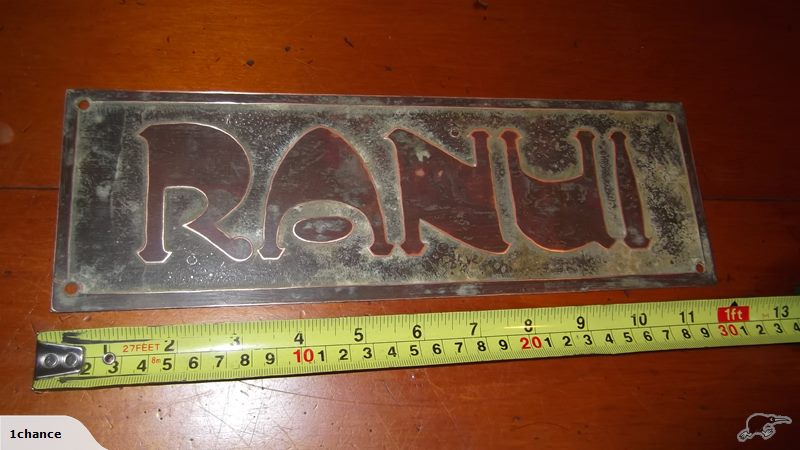
Now a totally random question 🙂 Pam at the Whangatea Traditional Boat yard picked the below up on trademe – unusual font, anyone able to say which Ranui this was off, if a boat – could have been from the west Auckland Ranui area. photo

Photo below taken by Ken Ricketts in Feb. 2013 @ Lake Taupo