Lady Crossley

LADY CROSSLEY

photos ex David Cooke

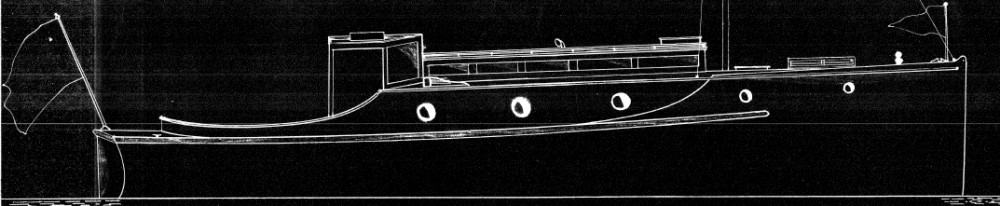
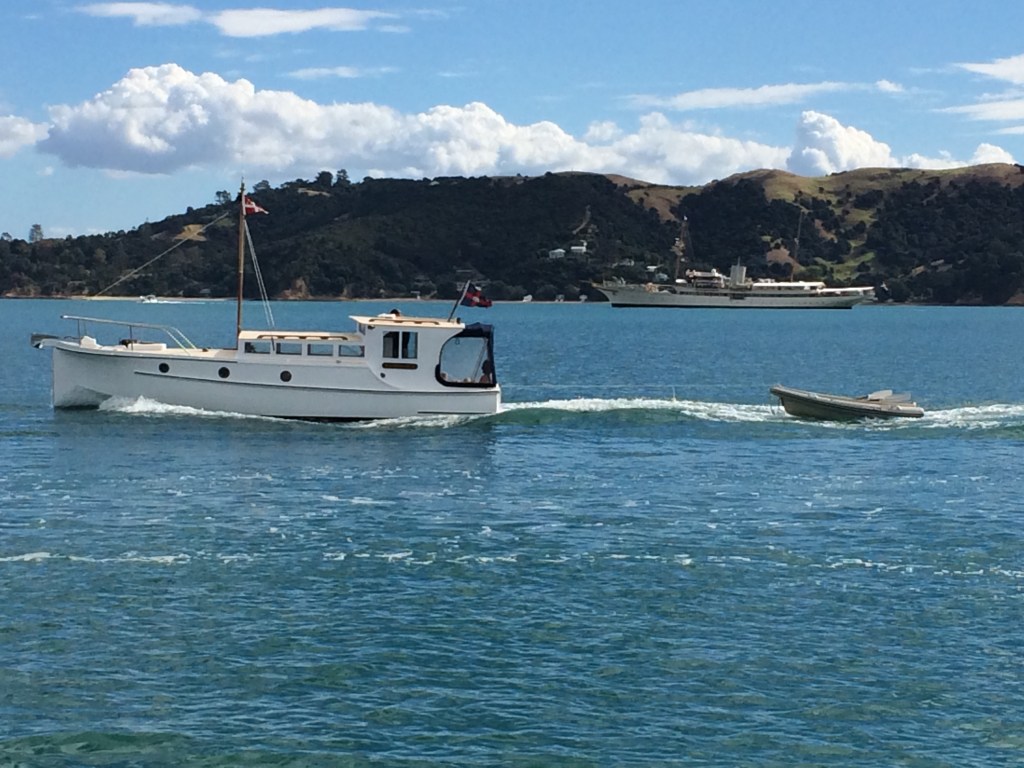
Sunday 15th Dec (2013) saw another of the CYA’s classic launch fleet re-launched after sending the winter at Opua under the care of Opua master boat builder Craig McInnes. Colin Wild designed & built Lady Crossley in 1947 & if he was looking down yesterday he would have been a very happy man. Lady Crossley is simply magnificent & her owners Margo & Jamie Hudson launched in a style that Col Wild would have approved of – canon fire, lots of flag & lots of champagne.

Lady Crossley was built for the Seager Bros who were the agents for Crossley diesels. She was sold to Vic & Rob Sanders in 1956 & they installed new Gardner 6LW’s into her in 1957. Which I understand she still has to this day.

Congratulations to Hudsons & all the craftspeople that have worked on her – Colin Wild boats are special, this one is now VERY special.

It almost goes without saying that the wow factor came out of a Awlwood MA (Uroxsys) can 🙂

CYA Patio Bay Race Weekend / Xmas Party


CYA Patio Bay Race Weekend / Xmas Party 

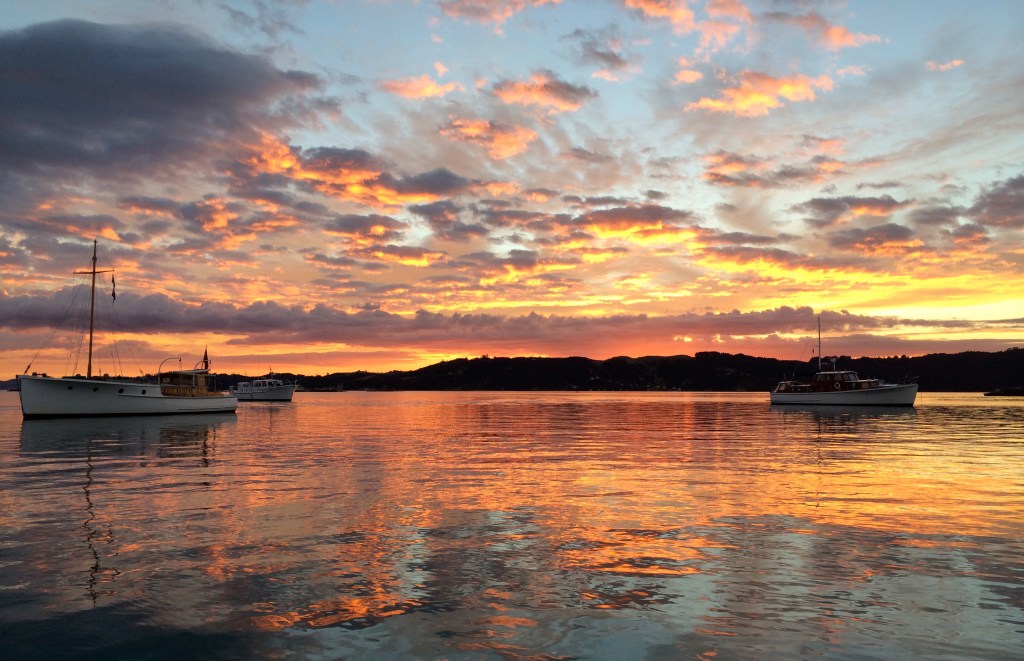
A fantastic weekend  – as always – nice boats, nice weather & nice people. 

This year we had approx. 60 classic’s in the bay & over 200 people went ashore for the post race CYA Xmas party at Bert & Margaret Woollcotts bach.

In the launch race (mark-foy start) the placings were – 1st & winner of the Rudder Centennial Cup – Sterling (Brett Evans), 2nd Strathalan (Keith Munro), 3rd Kumi (Hayden Afford)

I’ll let the photos tell the story of the weekend.

Enjoy

More great photos from John Bertenshaw here

http://classicyacht.org.nz/forum/viewtopic.php?f=10&t=2327

The Rudder Cup

Image

The Rudder Cup

The article below was penned by Harold Kidd with the intention of creating interest among the classic launch community to re-run the 1908 race in 2008 to celebrate the centenary of the event. As tends to happen with most things HDK puts his name to, the 2008 race happened.
Pauline & Harold Kidd donated a cup, the Rudder Cup Centennial Trophy for the race & now each year CYA launches race to Patio Bay for the cup. Today is that day so it seems appropriate to feature the 1908 race. I very proud to have Raindances name on the cup (2012 winner).

Enjoy the read & thank you Pauline & Harold. Alan H

THE GREAT LAUNCH RACE OF 1908 – The Rudder Cup race around Sail Rock

The Rudder Cup launch race around Sail Rock and back, a distance of 108 nautical miles, was set to start off Queen Street Wharf at 10 pm on Saturday 12th December 1908. All week the weather in the Gulf had been heavy, all day a stiff southerly blew, but at sunset this died to a flat calm. Shortly before the start, a light westerly breeze came up and that quarter prevailed throughout the race. The Squadron race committee made a serious mistake. Despite the fact that the weather was clearly settling, it decided to apply the heavy weather handicaps, handicaps that made the larger, more powerful launches give big time allowances to the smaller fry. Happily, for the moment, and for the peace of mind of the faster contestants, the handicaps were sealed.

Of the 14 entrants, only 12 made it to the start. The brand new 42 footer Alleyne, owned by Arthur Brett, Commodore of the New Zealand Power Boat Association, scratched for some undisclosed reason and so did Leo Walsh’s Kelvin, with a slight engine problem.

The massed flying start was a pretty sight as eleven of the twelve launches throbbed their way, “with the cyclonic whirring of gas engines”, said the Star, down the Waitemata, around North Head and into a calm but very dark night. Floral had been first over the line but James Reid in Seabird took the lead by North Head. Eliza had a problem restarting her engine and was trailing behind. The moon rose in the East as the launches approached Tiri and droned on into the night, the little fleet now becoming strung out with only their nearest competitors in sight. There was a beam swell and sea off Kawau but it moderated, then got up again when a fresh westerly kicked in as they entered Bream Bay.

At 0414 on Sunday morning Seabird was the first to round Sail Rock and turn for home. She was followed by Matareka, 26 minutes behind, then Alice leading the main bunch a few minutes later. The Herald reported the rest of the race,

The run home was uneventful, the westerly wind off Waipu beach being left behind and a southerly with a bumpy sea being run into at Whangaparaoa Passage. Seabird gained on all the launches and Matareka also improved her position, but neither of the leading boats had sufficient in hand to secure a win.

But, until it was all over, and the handicaps opened, neither skipper knew that.

Alleyne met Seabird as she rounded North Head, out on her own, and she came tearing up the harbour to finish at 1030, cheered by a very few of the NZPBA faithful on the wharf that Sunday morning. Seabird was 53 minutes ahead of Matareka which was 28 minutes ahead of Alice. All the remaining boats had finished by just after 1300 in the following order, Wanderer, Maroro, Kotiro, Eliza, Vanora, Floral, Winsome, Waipa and Petrel. Seabird averaged well over 8 knots for the run, a great turn of speed for the time, point to point in the open sea.

When the handicaps were opened it was found that Seabird had to concede a time allowance of 3hrs 23 min to Maroro, something that was impossible in the conditions. The handicap results were Maroro 1st, Winsome 2nd, Petrel 3rd and Alice 4th. So the Rudder Cup went to the Matheson brothers of Maroro.

Not surprisingly, there was much criticism of the outcome. Some said that Seabird was the moral victor, some said that Chas Bailey’s Alice had performed best in comparison with the others having regard to her size and horsepower and should have won with proper handicapping, all said that the handicappers had done a bad job. A protest was lodged with the Squadron but failed. The real winner was the reputation of the motor launch and of the marine engines of the day. The Herald said,

The race is considered by motor launch owners as a triumph for the reliability of the motor boat. Twelve boats went round the course, and not one engine is reported to have stopped throughout the long run of from 12½ to 15 hours.

But the fun was not yet over. Immediately after the race, Harry Adams issued a challenge to Maroro, “or any other competitor” to a race from Queen Street Wharf around a buoy off Russell Wharf and back, non-stop, 240 nautical miles, for ₤50 a side, a preposterous sum at the time. Adams was taking a shot at James Reid and Seabird. Possibly he was driven by the need to dispel doubts about the Auckland-built Adams Kiwi engine in Eliza which had played up at the start of the Rudder Cup race. James Reid accepted at once.

Arthur Brett was stakeholder, starter and judge. Eliza’s crew consisted of Capt. Ted McLeod, master of the Northern Steamship Co’s coaster Clansman as skipper, Bill Cook, later of the Whangamumu whaling station, navigator, Fred Reynolds, of Whangarei, engineer, and Charlie Mitchell as engineer’s mate. Harry Hopper stayed ashore. James Reid employed Capt. J. Quinn, master of the auxiliary schooner Endeavour, as pilot and had as crew K. and H. Boyd, A. Tyer, and E. Akersten.

There was nothing like a big wager to stir interest in the Colonial heart so there was considerable attention paid when the race started off Queen Street Wharf at 0750 on Saturday 30th January 1909, the day after the Auckland Anniversary Regatta.

James Reid told the Star,

“The boats got away to an even start, but one at once knew that something was wrong with the Seabird; there seemed no life in her. The Buffalo came alongside us, and beat us easily, showing that there was really something out of order. The Eliza was drawing right away from us, and we were sure now that we had seaweed on our propeller. We reversed the engines several times, and tried her again, but could not shake it off.”

Buffalo was a new launch built by Reid’s younger brother David and was much lower powered than Seabird. Seabird carried on until Takatu Point when Reid stopped the engine. Ken Boyd went overboard and cleared the totally fouled prop with a boathook. By then Eliza was out of sight, but they gradually hauled her in. Off Bream Head the weather rolled in thick. Seabird felt her way up the coast, rounded the buoy off Russell Wharf at 2340 and then Capt. Quinn stood her out to sea till daylight when they briefly picked up the Poor Knights. Through lifting mist they raised Sail Rock in clear weather and steamed straight home from there at full revolutions. She did the 54 nautical miles in 6 hours 15 minutes, averaging a cracking 8.64 knots and crossed the finish line at 1638 on the Sunday.

On board Eliza, the Kiwi engine never missed a beat. She rounded the Russell buoy at 2250, 50 minutes ahead of Seabird. Her report made much of a rough trip home in a rising easterly,

Aboard the Eliza, one lurch threw two five-gallon drums of oil across the engine-room floor, and another threw the engineer right across his engine. The launch went under the Hen to get smooth water, to enable her to fill her oil tanks, and owing to the rough sea she went outside Piercy Island to get calmer water.

Eliza finished at 1425, 2 hours 13 minutes ahead of Seabird to win the wager.

James Reid pooh-poohed Eliza’s rough weather talk.

“I must contradict the report that both boats were knocked about in the sea. …we did not get a drop of water on the decks.”

And that was that. The reliability of the modern internal combustion marine engine had been further enhanced, there had been some heroics to suit the taste of the time, and honour was satisfied all round. But the story doesn’t end there.

It will come as no surprise to readers of Vintage Viewpoint and our books that, almost a hundred years after the Rudder Cup race, the main protagonists of 12th and 13th December 1908 are still soldiering on.

Eliza was run by Harry Hopper for some years and was bought by brothers J.T. and J.W. Mason of Whangarei in 1920, renamed Kumi, Maori for a fabulous monster, like a taniwha. They sold her to the Whangarei Harbour Board in 1929 and she stayed on strength as a tug and pilot boat, skippered by Archie McKenzie, for many years. Recently vet Haydon Afford of Taupaki bought her and rebuilt her.

James Reid sold Seabird in 1910. She stayed in Auckland in various hands until the cyclone of 1917 when she came ashore in St Mary’s Bay and was badly chafed. Charles Collings bought her and rebuilt her, then sold her to Turnbull of Lyttelton. From Lyttelton, where she spent many years as a harbour ferry, she gravitated to Nelson. She has recently been bought by Steve Thomas, a Nelson marine broker who first sailed in her in Golden Bay as a boy 25 years ago and fell in love with her.

Maroro remained with the Mathesons until 1920. She then went through a series of owners, reading like a Who’s Who of launchies of the time; W.J. Quelch, Sam Leyland, Wilkie Wilkinson, T. Macindoe; but she eventually went fishing and is currently owned by David Owen of Okupu, Great Barrier. She is hauled out directly opposite the wharf, needing a new owner desperately. She is highly restorable and highly original, the only changes from her 1908 configuration being a sensible and neat dodger put on by Lanes in 1920, beltings put on to work as a long-liner and the inevitable mechanical updates.

Of the remaining entrants, Matareka is sound and loved by the Fenelon family in Auckland. We saw a photograph recently of a launch in a shed up North that is Petrel or her twin. Wanderer is very like the Wanderer owned by Terry Curel on the Kaipara in the 1960s and may still exist. Fred Cooper sold Winsome to engineer and wheeler-dealer Peter A. Smith in 1914 and she disappears, probably with a name change, because Bailey & Lowe built a tuck stern Winsome for J.H. Foster in 1918, the boat that has been owned by the Pickmere family of Whangarei continuously since 1923.

Bailey & Lowe sold Floral in 1909 to Capt. J.S. Clark for use as a passenger and cargo launch on the Whitford run. Again, she probably still exists under a different name. We have a candidate to follow up, last seen on the hard at Coromandel. The big Vanora was sold by Lindsay Cooke to Maurice O’Connor of the Thistle Hotel in 1912. He fitted a 30hp Auckland-built Twigg engine and sold her to the Government in late 1913. We do not know her subsequent fate.

Alleyne became Daisy in the hands of W. de Renzy of Ponsonby in 1916 then went to E.J. Kelly, a stalwart of the Ponsonby Cruising Club in 1918. By then the Lozier had been replaced by a 30hp Twigg. Kelly sold her to Sanfords in 1927, so we suppose she finished her days as a long-liner. Waipa was a mystery, even at the time of the race, but we are pretty sure that she is the pretty little double-ender in a recent Boating NZ trade ad.

W.J. Harper sold Kotiro to Frank Chapman in 1919 and she became Ahuareka. We lose track of her in 1937. Bailey sold Alice to Tonga in March 1910. Kelvin carried the name on when Walsh sold her to Reg Shepherd. By then there were so many launches with the name Kelvin throughout the country that following her history is impossible.

Of the 14 entrants in the Rudder Cup, 4 definitely exist, Waipa is a probable, at least 2 more are likely and we think there’s a fair chance half the others may lurk under a new name on a mooring, up some tidal creek or in someone’s backyard.

A Special Woody Weekend

A Special Woody Weekend

Today was a special day on the woody boating front – Baden Pascoe officially launched his book ‘Launching Dreams – Percy Vos – The Boat & His Boys’ at the Royal New Zealand Yacht Squadron. We saw over 300 of the classic boating fraternity & people connected to Percy Vos – family, friends & ex work mates join together to celebrate the event & rub shoulders. Great speeches but the key message of the day came from John Street to Sir Bob Harvey (Chairman of Waterfront Auckland) & that was that the Vos Shed project was LONG over due & action was need NOW. Todays audience certainly agreed 🙂

A few photos from the launch / morning tea.

Copies in your local book-store now or from Baden on badenhp@xtra.co.nz


Percy Vos – The Boats & His Boys

AN INVITE TO MORNING TEA

CYA member Baden Pascoe has written a magnificent pictorial and historical record that celebrates the life of Auckland businessman and renowned boatbuilder Percy Vos, his boats and the people who worked with him – ‘Launching Dreams – Percy Vos – The Boats & His Boys’

Baden’s interest in Percy Vos is fueled by the Pascoe family association to the Vos yard. Baden’s father, Howard Pascoe, a very talented centre board sailor and boatbuilder, worked for Percy in the 1940’s.

To quote Harold Kidd here on waitematawoodys “it’s not only a great read but a beautiful thing to hold in the hand; a superbly produced book that glitters at you at all sorts of levels. A complete “must buy” for anyone with a whiff of salt in his or her veins”

There is an open invitation to all lovers of classic yachts, launches & work boats to attend a morning tea to celebrate the launch of the book. The event will also be a wonderful opportunity to rub shoulders with some of the legends that worked at Vos and you will be able to buy an autographed copy of Launching Dreams. If you can’t make the morning tea, check out the major book sellers who have copies, the perfect Christmas gift for all waitematawoodys.

Venue : Royal New Zealand Yacht Squadron – Dinghy Locker – Westhaven

Date: Sunday 24th November – this Sunday

Time: 10a.m.

CYA Launch Cruise to Riverhead Hotel

CYA Launch Cruise to Riverhead Hotel

Sunday 10 November saw 18 classic launches cruise to the historic Riverhead Hotel on the banks of the upper Waitemata Harbour. This bi-annual event is one of the most popular on the Classic Yacht Associations calendar & saw around 150 people making the trip (some by car) to enjoy a BBQ lunch in the hotels garden bar.

My were joined on-route by the just completed & launched St. Ayles skiff, built for CYA member Mike Mahoney (Tawera) at the NZ Traditional Boat Building School. Details here http://nzcoastalrowing.org

A Woody Weekend

Woody Weekend on the Waitemata

The Waitemata Harbour was a pretty magical place this Labour weekend – we had an impressive collection of wooden classics visiting.

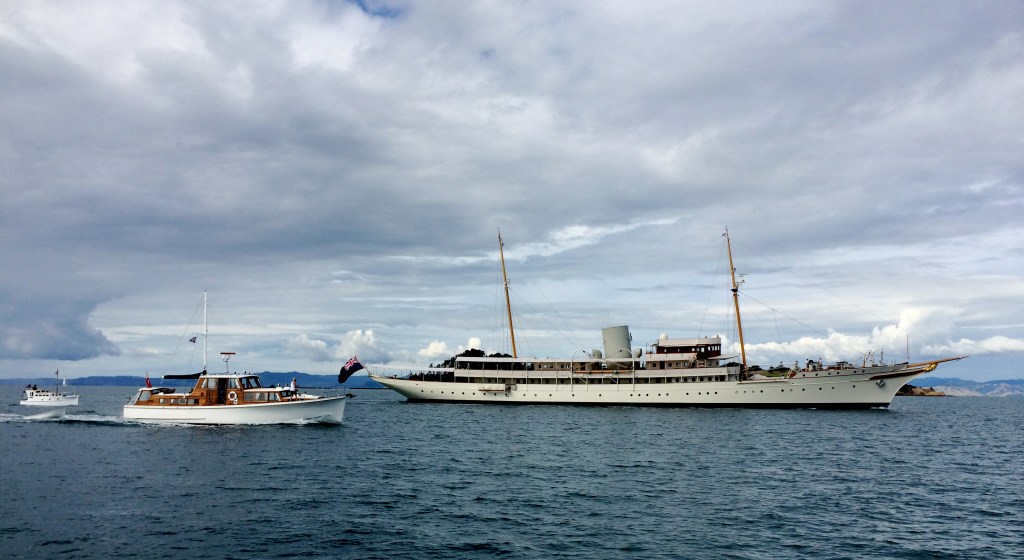
The classic 1929 motor yacht Nahlin, owned by industrial designer / inventor James Dyson is currently berthed alongside the CYA’s Heritage Landing. Nahlin has a very impressive history of ownership & was once ‘The Royal Yacht’ – details on her history & restoration at the link below.

http://www.glwatson.com/detail/Nahlin__Classic_Motor_Yacht/527/26.aspx

We also had the ‘Tall Ships’ berthed at Princess Wharf for the long weekend & their arrival & departure was very impressive.

At the other end of the scale the super yacht (ship) ‘A’ was anchored in the middle of the harbour, this boat divides people into to camps – love it or hate it – me I love it. One of the crew skills is the ability to abseil – thats how they clean the windows 🙂

And even my favorite woody made it off the marina for 3 days of spring boating.

Corsair

The Frostbite – Corsair

photos by Alan H 

At the recent Classic Yacht and Launch Exhibition  at the Viaduct, the 2013 event  showcased the acclaimed designers Jack Brooke & Bob Stewart. One of the outstanding boats on display was Paul Baragwanath’s exquisitely restored Frostbite ‘Corsair’, the attention to detail was just amazing, even featuring her original restored 1945 trailer. Corair was built by Jack Brooke in 1945 for Don Winston.

02-02-2018 Input from Paul Baragwanath

“She was built in 1946 for my grandfather, Don Winstone, and named after the planes he flew in WWII. The Frostbite class was designed in 1938 by Jack Brooke, and Corsair was built by him too. A few years back I tracked her down – derelict, but pretty much whole, in Nelson. We knew it was Corsair from the name let / inlaid into the middle thwart and the Corsair aeroplane profile in the for’d thwart. Teak in Kauri. Kauri hull. Oregon spars. Pohutukawa knees. Mahogany cappings. Teak and kauri floor grate. Australian hardwood rudder stock and kauri rudder. Kahikatea centre-board (from her time in the Waikato?). Mahogany mast supports. Brian Kidson who had owned did a good deal of work preparing and restoring the hull before she came north to Auckland for the woodwork to be completed by Jack’s son, master wooden boatbuilder Robert Brooke.

We restored the chrome hardware (Onehunga Electro Platers / Bumper Repairs – brilliant), re-created missing elements (Morris Sheet Metal and another engineer) including the lettering on the stern, restored the original 1946 mast, Frank Warnock created a traditional sail by hand, and I did the low-skill bits, and brought it all together. Ropes from Classic Marine in the UK. Other parts from Harken Fosters.

Robert designed a period road trailer with 1939 pressed steel Standard 10 wheels that I found on Trademe (Marlborough Sounds), and a friend who is a sculptor, David McCracken, made the trailer. I believe the Frostbite was NZ’s first specifically-designed trailer class – with it’s split / gunter rig – so a period trailer and launching trolley are part of it. It was the last class designed that you sit in, rather than on.

Robert’s lifetime of experience and eye resulted in what you can see – from the handmade wooden blocks, fine plank lines, floating thwarts, the traditional flick-bailer, right up to the pheasant feather pennant / wind vane atop the mast.

The colour is Eau de N’il – Water of the Nile – with a forest green waterline. My grandfather liked green – he also had a runabout named Amber (1950s 17 foot Greymarine engine) with a green waterline. Traditional white below the waterline. The interior is white house-paint up to the thwarts which sets off the varnish above that.

We don’t tend to race – wooden blocks, wooden grate, 1946 mast and rudder… but do sail off Narrowneck in Auckland, and Tutukaka, Ngunguru and Whangaumu Bay up north.

I put together a small book on the restoration – a few years ago now. The aim was to get her to A level condition – which we did, and she won the best restoration at the Lake Rotoiti (Nelson) classic boat show – and then to just enjoy her. She’s a delight to sail. Predictable, responsible and beautifully balanced. On the wind in a chop a for’d hand is useful for bailing!”


Some stunning Woodys from afar – 100+ photos

Image

Some stunning Woodys from afar

Its a long way from the Waitemata but theres some good woodys here – the Mid-Atlantic Small Craft 2013 Festival. Links to the 3 days of photos, below – Enjoy 🙂

http://www.eyeinhand.com/Marginalia/2013/10/08/mascf-2013-friday/

http://www.eyeinhand.com/Marginalia/2013/10/08/mascf-2013-saturday-morning/

http://www.eyeinhand.com/Marginalia/2013/10/09/mascf-2013-saturday-race/

Don Brooke at the Classic Yacht & Launch Exhibition speaking about Jack Brooke & Bob Stewart

Video

VIDEO ONE – Don Brooke speaking at the 2013 CYA Classic Yacht & Launch Exhibition, hosted by the Tino Rawa Trust, which showcased the acclaimed designers Jack Brooke & Bob Stewart. Both Don & Robert Brooke spoke briefly at the launch ‘morning tea’ about their father Jack & fellow yacht designer Bob Stewart. Also view VIDEO TWO (below) which features of Don’s brother Robert, speaking on the same topic.