Sometimes you see a boat & just go wow – now everyone has their own taste but today’s yacht rang my bell. Got to love the dinghy & the solar panel 🙂
La Morena is a 95 square metre Skärgårdskryssare. She is a 1922 masterpiece by Gustaf Estlander, the Finnish architect.
The yacht was built in Germany for a Swedish engineer, Frithiof Dahl. He was a building contractor, at that time responsible for the building of Ragnar Östberg’s famous City hall in Stockholm. Under the name Roxane III, the engineer race her during the 1920’s and 30’s, against Kerma and other famous yachts, probably mostly around Sandhamn and Saltsjöbaden. Then the family Graffman own her for almost forty years. They call her La Morena, “the brunette” in Spanish. They sold her to Arne Fyrk and Bengt Helgesson in the late 1970’s, who moved her from Stockholm to Motala and lake Vättern, were she stayed for 20 years. La Morena was almost 60 years old when they bought her. No age for a beauty, but she had worked hard and was in deep need of recondition. Arne and Bengt’s effort saved her for the future. The year 1998 she was back in Stockholm with new owners, who sold her to the present owner in the summer of 2004.
During the winter of 2004-05 an extensive restoration were carried out. It ends with a new keel plank, a new rudder stem and knee, 50 meter new planking, a new stainless steel rudder, a new modern profile of the keel, and high finish of the whole bottom. Damages in the deck and deckhouse were also repaired, as were damages in the mast. The restoration has continued. With the aim to both have a shining and a fast yacht.
J I Thornycroft Coastal Motor Boat photo ex Peter Loughlin ex Historic NZ Photos
Today’s mystery motorboat could be a real challenge – what I can tell you is (1) its obviously the inner Waitemata with the Devonport Naval Base in the background (2) the launch is fast, very fast (3) the Historic NZ listing says c.1930 but I’d say its earlier than that (4) the seagull above the boat almost definitely had a bowel movement when the boat went by 🙂
All Is Revealed Thanks To Harold Kidd
Harold says that the solution was to identify the cruiser first (REPULSE) and with a little help from Papers Past the rest fell into place. The news clip from the Auckland Star 13 May 1924 below explain all.
19-09-2015 Further reading below (ex Peter Loughlan). The first link is for CMB9 which is under restoration, the second link some specs for the entire series.
Harold recently bought a postcard of a “launch on Auckland Harbour” which was clearly Wellington. Harold keeps in touch with Gavin Pascoe of the Wellington Classic Yacht Trust on anything Wellington so sent him off a copy. Between the two of them they identified her as Phyllis but in passing discussed images of two other similar craft, Doris and Wai-iti.
You can see that they all have a modest ketch rig and similar configurations.
Phyllis was a 21 footer built at Kilbirnie to a Rudder Mag design by G. Dennis, starting in December 1910 and launching in August 1912. She was still around in early 1916.
Doris was built in Auckland as the 28ft mullet boat Dorothy but was sold to Charlie Moore in Wellington in 1912. He converted her to a deadwood keeler with an auxiliary but she became solely a power boat pretty soon. She was still around in 1929.
Wai-iti was built by Simmonds and Hutson of Wellington in late 1924 and they also built her semi-diesel engine. She was 28ft x 9ft. She lasted until at least WW2.
Harold Kidd Update
PHYLLIS certainly is very pretty, but you’d expect that of a Rudder design. DOROTHY/DORIS’s cabintop is a bit lumpy, but it was put on in Wellington after she had been converted to a Cook Strait-capable launch from a very basic Auckland-built 28ft fishing mullet boat and form follows function most adequately. WAI-ITI’s hull form is very sweet but I still can’t get my head around the way her cabin ports are placed, equidistant from the top of the coaming rather than in the middle between the top of the coaming and its bottom (sheer) as is the case in most boats of the time. To me, that’s a little awkward and unsympathetic. This has been commented on before in WW in relation to a possibly amateur-built Wellington launch.
Thetis (Greek for Sea Nymph) was launched in Dunedin on the 31st August 1929. She was built by Mr J McPherson boat builder of Dunedin for Mr Charles Sundstrum.
Thetis was designed by renown naval architect Mr William H Hand Jnr of New Bedford USA. William ‘Bill’ Hand was the originator of the V-bottom hull type per Thetis. In addition Hand was an early pioneer of the motor-sailor type. Thetis was designed as a fast day cruiser.
She is 35’1” in length with 8’1” beam, 2’9” draft and a total height of 6’9”. She is a British Registered ship dated 16th August 1929. The official number is 127819. Her registered tonnage is 4.68 with a Gross Tonnage of 7.57.
Thetis was originally powered by a Chrysler Imperial 6 cylinder petrol engine producing 160hp at 2800rpm. Later she was re-powered by a Chrysler Royal engine with 140hp. With a Ford diesel in between she was subsequently re-powered in 2003 with a Mercedes Benz 5 cylinder diesel engine. That motor is to be replaced now. Documents show Thetis was originally good for 18 knots. A bigger engine was installed around the war years and its said she has seen 26+ knots. In current configuration she’s more like 12-13 knots.
Construction is of kauri hull planking and Kowhai frames with teak decks. The cabin was subsequently modified and enclosed by Magnus Smith of Lyttelton, Luke believes the work was done for Bruce Stewart of Pigeon Bay.
Known Owners
Charles W Sundstrum 1929-37
Bruce F Stewart (later Sir Bruce) 1937-50
William Carey 1950-54
Clarey Beaumont 1954-57
Des Sinclair 1957-67
Laurie Wales 1967-1997?
David Martin 1997-2006
Brendon Leech 2006-2014
Glenn Tod 2014-2015
Luke Richardson 2015-
Known History
Dunedin to late 1930’s
Pigeon Bay for some 20 years
War Service – she was commandeered by the NZ Navy Naval Auxilliary Patrol Service (NAPS) in WWII and used as a coastal patrol boat. She commenced service 9th May 1942 and was relieved of duty 23rd February 1944 when the NAPS formally disbanded. She was assigned the pennant number Z125 and served in the unit based in Lyttelton. The owner at that time was B.F. Stewart.
Luke purchased her in July 2015 and she is now hauled out of the water for some long overdue TLC. A period of neglect following the Christchurch earthquakes meant she was long overdue for some maintenance. Luke would love to know more about any of the owners over the years and any of her history not covered above.
To view more photos & to follow the work, Thetis has a facebook page – Friends of Thetis
See below an article on Thetis’s launch from the Australasian Motorboat & Yachting Monthly from October 1929. Its a good read 😉
Harold Kidd Input
Charles William Sundstrum was a Dunedin dentist who was a key figure in Dunedin yachting circles for many years. His first launch was the 31ft clinker double-ender VALMAI of 1910 which had a Dunedin-built 5hp Viking engine. He raced her with the Otago Yacht Club including one of their Ocean races to Timaru. He replaced VALMAI in 1913 with the 40 footer NORANA designed by Joseph Gillanders and built by Miller Bros at Port Chalmers. She had a 16-18hp Jersey Standard marine engine and was a handsome craft. He sold her to Arthur Brett of Auckland in 1927. During WW2 she was taken over by the RNZAF and sent to Fiji for towing work. THETIS was NORANA’s replacement. Photo of Norana below.
13-05-2017 – Additional Photos ex trademe (Ian McDonald nudge)
I was sent this movie, filmed in late1929/30’s by the Lambourne brothers (Allan & Alex) nearly 2-1/2 years ago by Roger Guthrie, it was back in the very early days of ww & since then a lot more people have checked onto the site – in fact over 100,000 people. On ww last week I bumped into Peter Stein whose father (also Peter) appeared in the movie. Peter has written a very cool synopsis of the movie & the (now) classic launches that appear in the movie. I suggest you read Peters words & then watch the movie. Enjoy 🙂
The film “Beautiful Waiheke” by Peter Stein
Introduction:
The film was produced by the Lambourne brothers Allan & Alex in the late 1920’s early 1930’s. The Lambournes owned a large furniture shop on the corner of Ponsonby Road and Pompallier Terrace. The Arran Bay house was built in 1910 and remained Lambourne property until 1964 when it was sold to the Jorgensen Family.
Water transport for the Lambournes was the launch “Nga Whare” which is the round bilged craft in the film with the two portholes in her topsides. She was sold when I was a very young boy so I remember little about her.
Our property is next door to the Lambournes. Arran House was built circa 1885 for Andrew and Mary Croll from the Isle of Arran, Scotland. They were two of Waiheke’s pioneers. Andrew was a very fine photographer and albums of his photos can be seen at the Waiheke Historical Society Museum on Onetangi Road. Among the photos are scenes of the Annual Regatta organised by Andrew and held at Arran Bay circa the late nineteenth century. These events were well supported by “boaties” of the day. The albums were kindly donated by the Crolls of Sydney. Mary Croll was a very good artist and she put many scenes of the “bottom end” on canvas. Some of her mural work is still on the walls of one of the bedrooms in Arran House. My father, P.A.S. Stein purchased Arran House from W.J. Connell (owner of Connell’s Bay Store) in 1924 and it has been in our family ever since.
The Waitangi, the launch with mast and crosstree in the film was built in 1923 for Mr Cadman. It was a classic John L. Hacker design with sharp entry and flat stern section. The original owner named her “Karamana”. She had an aeroplane engine in her and we understand she was capable of 25knots which made her one of the fastest launches on the Waitemata at that time. Harold Kidd has a very good photo of her racing on the harbour (added below. AH). In the latter 1920s she ended up on the Tamaki Drive breakwater. My father bought the severely damaged hull and had her restored by Chas Bailey & Sons. He renamed her the “Waitangi” after his father’s steamer the TSS Waitangi of the Northern Steamship Co. My grandfather Peter Anton Stein was a Captain of various Northern Steamship Co. vessels from 1895 to 1908. Chas Bailey told my father that the Waitangi had brought them good luck because the next launch off their slipway was the legendary “Shenandoah”.
The Waitangi was 28 feet long (8.5m), had a beam of 7 foot 3inches (2.2m) and draft of 2 foot 8 inches (.8m). She was built in kauri and the bottom was double skinned from the bow to the wheelhouse. The rest of the vessel was single skinned. Her Auckland mooring was in St Mary’s Bay in front of the Ponsonby Cruising Club at the bottom of St Mary’s Road. Maintenance was carried out at Collings and Bell Boat Builders adjacent to the PCC.
About 1930 my father replaced the old Studebaker engine with a 105hp Kermath marine engine. Allely Bros. of Beaumont Street imported the motor and installed it. It was known as a 6 cylinder flat top. The pistons had a bore of 4” (100mm) and each cylinder had two spark plugs. It was double ignition with one spark plug connected to the magneto and the other one the distributor. Maximum speed was 18kns and at this speed the motor burnt 8 gallons of petrol per hour. Petrol was bought in 4 gallon cans and there were two cans to a box. We still have an old Atlantic box which we use as a vegetable bin at Arran House. Petrol in the early 30s was 1 shilling and six pence a gallon. A 50% rebate brought the price back to a respectable 9 pence a gallon. My father told me that the best run home he achieved was Connell’s Point to Kings Wharf in 1 hour and 12 minutes.
The film:
The film began with shots of the Guthrie family aboard their launch “Alcestis”. It then moved to shots of Arran Bay taken from different location around the Bay. The people setting out down the path are coming from the Lambourne’s house.
The aquaplaning sequence was filmed from the shore and the “Nga Whare” which was the tow boat. My father was the young man with one of the Lambourne girls on his shoulders. Years later I learnt to aquaplane on the same board.
The “Waitangi” then heads to Bulls Bay with my father as pilot. The majority of the film is shot at Bulls Bay (Anita Bay) on the north eastern end of Waiheke. At the northern end of the bay are many small rocky islands and the launches are filmed going through the channels between the rocks. These are not hard to navigate but should be done at ½ tide or more.
The “Coughing Caves” are in the southern point of Bulls Bay. With a northerly swell and incoming tide, waves enter the caves and when the top reaches the ceiling of the cave the air behind it is compressed until it bursts out in a cloud of spray. The boy in the dingy, Reg Crawford, is trying to get as close as he safely can to the emerging spray.
The “Whirl Pool” is in the long reef extending from the northern end of Bulls Bay. Riding the swell in and out of the pool could be quite exciting as seen in the film.
The homeward bound shots of the Waitangi in the storm were taken in the channel between Pakatoa and Waiheke.
Harold Kidd Input from previous ww post
Waitangi was built as KARAMANA for F.B. Cadman in 1923 by Bailey & Lowe to a design by Hacker. KARAMANA = CADMAN in pig maori. She was later bought by Auckland Grammar School teacher P A S Stein and rebuilt as per the 2nd photo below. She was fitted with a war surplus 6 cyl Green sohc aero engine producing 120-140bhp, bore 5.5 ins, stroke 6 ins (you work out the capacity). She was pretty radical.
03-09-2015– comments
1. The Lambourne launch was called NGAWAI I think, not NGA WHARE. She was later bought by the Andrews family on the Hokianga. I remember her as a child during WW2 laid up in a shed with a Chrysler engine. Maybe another NGAWAI but she looks the same. 2. KARAMANA/WAITANGI was built by Bailey & Lowe in 1923, not by Chas. Bailey Jr who built SHENANDOAH in 1929. There’s some conflation there.
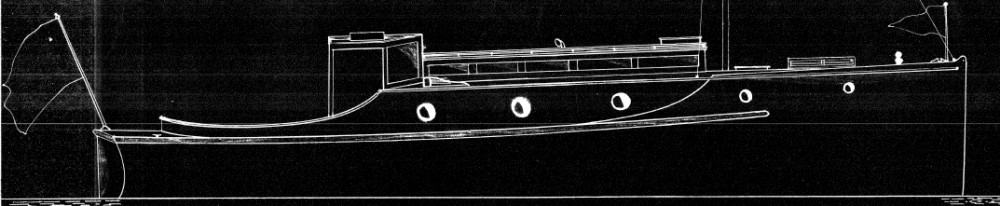
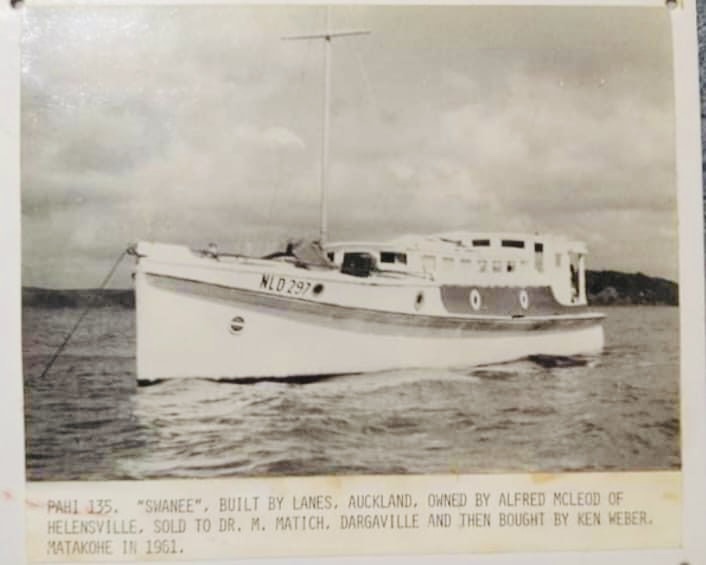
While the exact details of who designed & built today’s launch Swanee are unclear, she is rather unique in that she has remained in that same family for over 50 years. Built from kauri she is 33′ long with 8’9″ beam & 2’8″ draft, currently powered by a 60hp Ford diesel.
You can see from the photos that she is very well appointed with everything one needs for comfortable cruising – electric flush toilet, freezer/frig, electric capstan & all the safety gear.
Over their period of ownership the Weber have ensured Swanee remained in great condition with a major 2 year out-of-water refit in 1970 that saw her re-ribbed with pohutukawa (you could back then 🙂 ) & new topsides. In 2004/5 her topsides were glassed & 2 pot painted & she was rewired.
Owner Ralph understands, from his mother, that she was built c.1920 in Auckland for Sanfords. Then later sold to the McLeod family of Helensville. Then she went to Dargaville and then owned by Matich Bros and later by Dr Maurice Matich. The Weber family, Ken & June, bought Swanee in 1961 and now ownership is with their son Ralph Weber of Matakohe. Currently moored at Pahi.
Ralph commented that Harold Kidd had previously mentioned that she may possibly have been the – ‘Sister Lola’ & built by Bailey & Lowe, if so she ‘raced’ with the Ponsonby Cruising Club.
Ralph sent ww photos of Swanee over a year ago & contacted me recently to say that unfortunately life has moved on & the family have had to make the difficult decision to sell Swanee after 50+ years of ownership, so today’s post has a degree of sadness but could offer a lot of happiness to someone looking to buy a classic launch. For a 33′ launch, Swanee is a lot of boat, you can see in the photos that there is no shortage of living area & she comfortably sleeps 5. After 50 years you end up nothing what works best & where on a boat 😉
Boat aesthetics is a very personal thing & with some people practicality is #1, but if I was buying her I would be off to see a good sympathetic wooden boat builder like Geoff Bagnall & returning her cabin windows to a style a little more in keeping with a 1920’s classic. People forget that these old girls are wood & the cost of a wee bit of restoration like this would not be great. After all there is little else that needs doing to her.
She sports rather a racy (flat aft) bottom so with a bigger motor I would imagine she would perform very well.
So woodys – can we find a buyer for Swanee or know something that is looking for a classic wooden launch? Being based currently at Pahi she does present some interesting scenarios e.g. you could keep her there for a few seasons & have a floating family bach. A group of guys could get together & buy a good fishing / man bach on the Kaipara. Or simple put her on a truck & return her to the Waitemata.
Now I do not normally like to talk money in ww posts but the overall 2nd hand boating market is just so soft that when I think something is great value, I will – well woodys someone could own Swanee for less than $30K. , that is real value, you could not build a garage for that.
If you or anyone you know could be interested – contact Ralph, initially via email on weber.bros@xtra.co.nz
Also interested in any info /photos on her past.
Harold Kidd Input
SWANEE was certainly built as SISTER LOLA pre-October 1920, possibly by Harvey or DIck Lang. I don’t know where the Bailey & Lowe reference came in, although Bailey & Tyer did build a 33 footer (unusual dimension) just pre WW1. Lang too had built a 33 footer in 1916 and just could have used those moulds. I can’t find a direct report of her owner as SISTER LOLA but am pretty sure she’s the boat reported in the Auckland Star of 28th August 1920. If so, her hull was built professionally and she was finished off by her first owners Pavitt brothers and Verran at Bayswater. There again the Verrans were Northcote people and Bailey & Tyer were at Hall’s Beach, Northcote Point. She was sold to Arthur Sandford of Vine St., Ponsonby in late 1922, early 1923. He changed her name to SWANEE probably after the Al Jolson song “Swanee”. Sandford was, for a time, a professional Vaudeville artist and no doubt sang that song on stage. She had a 6 cylinder Studebaker car engine in 1925. Sandford sold her to Alfred McLeod some time between 1934 and 1939. McLeod joined the Squadron with her in 1939. She then had a 30hp Hercules engine which he replaced with a 100hp Meadows ohv 6 in 1947/8 (probably a war-surplus engine). The rest of her history on the Kaipara is well-known. There’s a big dose of conjecture in the above. I’ll check with the Verran family.
Update 30-08-2015
B/W photo added above ex Ian Miller whose wife Rosalind’s late father, Doug Hazard, crewed on Swanee in the 1930’s
Update 06-03-2023 – photo below ex Kauri museum, Matakohe via Diane Wilkinson fb
Today’s post is the 26′, 1925 Colin Wild designed / built Little Tasman, who until recently had been hiding under a trap at Point Wells. Now she is tucked away in boat builder Colin Brown’s shed at Omaha & getting a major fright 🙂
I love it when we see an old girl undergoing this degree of restoration – well done the new owner. I know there will be several woodys very happy to see today’s post.
Nathan – that Kawau race fleet is starting to look healthy, you & Jason P need to shake a leg if you want to be on the start line 🙂
Lots more on Little Tasman here https://waitematawoodys.com/2015/04/20/little-tasman/
Crispin has owned the 1926 Collings & Bell launch Manaaki since 2013. Manaaki’s specs are – length: 11m, beam: 2.5m, draft: 1m & her current engine is a 1970’s Lees Marine Ford diesel 75hp. She is carvel planked, with full-length 32mm heart kauri planks over steam bent and laminated ribs, with less than 200mm spacing.
She cruises at 8knts. & tops out at around 12knts. but unlike some other boats of her era, Manaaki has more of planing hull & is flat at the stern & could do up to 16knts. with the right engine.
She is one of 6 boats build for the Zane Grey fleet – Alma G, Otehei & Avalon were the names of some of her sisters. Manaaki was originally fitted with a petrol Redwing engine.
Crispin has been involved with the boat since he was a child, (now 29). He bought her off the Hunt family. Like most of us he is always keen to find out stories and collect any old photo’s and history of the boat. She lived in the Whangaroa for around 30 years & there are a few photo’s of Manaaki on wall of the pub & records of all her catches in the Game Club up there.
Electrochemical Wood Damage
Crispin came across the ww article about electrochemical damage & the timing was great as he is having problems with it occurring on Manaaki. It’s mainly happening in the area where the prop shaft sleeve comes through the keel under the floor. The kauri fluffs up around this area and he get lots of salt crystals. Thanks to the ww article he is hoping to get on top of this as it’s just started over the last 3 years.
If anyone knows the boat or has any old photo’s send them into ww, Crispin would also be interested in getting in contact with anyone from the boats past.
24-02-2018 Manaaki was anchored alongside me today at Motuihe Island, looking very smart 🙂
Its a wonder not more of the early motor boats didn’t blow up, Ken Ricketts sent me the photo above (ex Dianne Hopson – Ravenhall era) of Silver Spray with three 4 gallon tins of petrol on deck. And the chances are that the blokes would all have been smokers as well.
The Guthrie family were very inventive with their empty containers – photos below of baby Hugh Guthrie, grandson of Hugh Douglas Guthrie, c.1925 taking a bath aboard Alcestis. You would like to think that the tins were well cleaned before being taken ashore and used as a stove cum bbq…….. Roger Guthrie who sent me the photos said “the scorched bush in the background must have been from a “previous person” – yeah right 🙂
The gent tendering the fire is the grandfather, Hugh Douglas Guthrie born 1883, aged 42 in this photo.
The photo above of the 1927 Colin Wild Linda was sent to me by Dean who took the shot at his friend, Lenore Bauern’s, place. Lenore is Bill Swales sister-in-law, the son of Roy Swales a past owner of Linda. Lenore says the shot was taken before Roy owned her.
Linda has featured several times on ww & will continue to because she is such a stunning vessel, perfect from every angle. You can view/read more on her by clicking on this link https://waitematawoodys.com/?s=Linda&submit=Search
Anyone game to attempt to ID some of the crew?
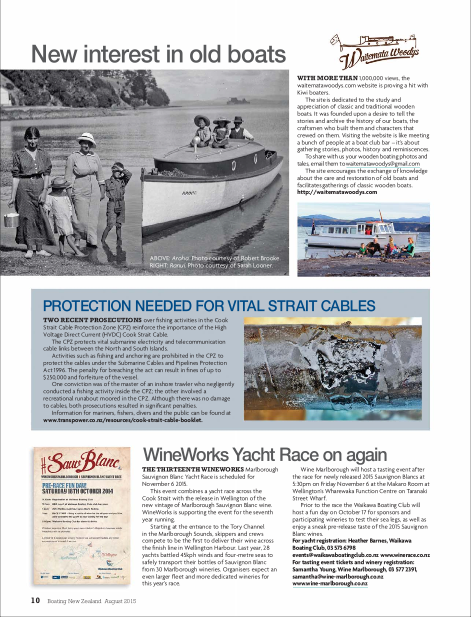
Nice also to see ww getting a plug in the August issue of Boating NZ (below) & in a nice segue, Linda above was restored by Robert Brooke & in the magazine article, the b/w photo of Aroha has Robert’s father,Jack (John) in-frame 🙂
Harold Kidd Input
It’s clear that this photograph was taken when she was new and in the hands of her first owner, E.J. (“Manny”) Kelly, who was a Squadron member as well as being Commodore of Ponsonby Cruising Club. I think he’s flying the Squadron flag above hie PCC flag officer’s burgee as a matter of correct protocol as the Squadron is the senior club (a well as being a “Royal”). So that’ll be Kelly in pride of place at the wheel.
Emanuel John Kelly (1876-1960) was a long-term launch owner. He ran a business as a metal founder and engineer and lived in Shelly Beach Road, Herne Bay. He had LINDA built by Colin Wild in October 1927 and kept her until Roy Swales of N Z Leadworks bought her. Before LINDA, though, Manny had the 42ft launch DAISY from mid1916 to February 1927. She had been built built for Arthur Brett as ALLEYNE (V) by Tyler & Harvey in November 1908, a double-ender of the Logan Bros type. She started life with a 20hp 2 cylinder Lozier, then moved up to a 30hp 3 cylinder locally-built Twigg in 1919 (I wonder if Kelly did the castings for W.R. Twigg?) (Twigg was killed and eaten by a lion on safari in Rhodesia in November 1925, which is somewhat topical).




 waitematawoodys.com #1 for classic wooden boat stories, info, advice & news - updated daily - 15+ million views