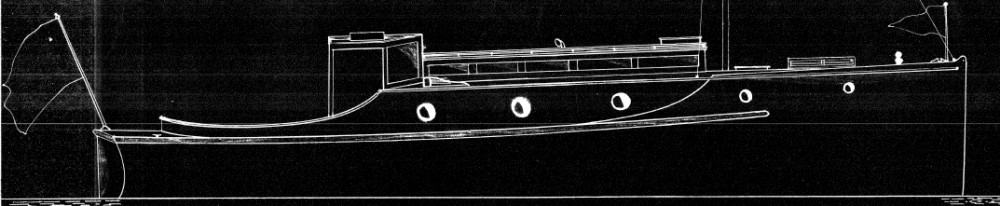
The story of the creation & demise of the launch Tiarri

The story of the creation & demise of the launch Tiarri

photo & words by Ken Ricketts. Edited by Alan H

Apologies for the reproduction of the photos but they are over 30 years old & when taken were most likely back then, just quick snaps. Also please excuse the length of this post, but if you knew Ken you would be amazed how short it is – good editing 🙂 AH

The idea of the “conception” of Tiarri (pronounced Tie-are-i {as in ink}, came to me one Saturday in September 1974, with a chance invitation on to ‘Eros’ (later known as Lady Kiwi) whilst we were at North Harbour Ponui Island, for the weekend, in my 31’ 1953 R Lidgard launch Flying Scud.

My ex partner & I enjoyed a delightful afternoon with the original owners of Eros, Mr. & Mrs. Alf Broadhead, on their lovely 2 year old 40 ft Vindex, built for them by Orams of Whangarei, in fibreglassed kauri & powered by 2 x 165 hp Perkins V8 diesels. She was the first 40 ft Vindex ever built.

During the afternoon, the feel of Eros grew on me & right then I took the decision that one day in the not too distant future I would also have a 40 ft Vindex built. Thus the planning had begun.

During the next 2 years I acquired a set of plans from Jim Young, called tenders & eventually gave the job to a boat builder named Neeley from Howick. She was also to be built of fibreglassed tannelised kauri, with varnished sappelle mahogany combings & interior, with white formica cabin tops, above laminated mahogany beams, glued to 2 layers of pre-stressed & glued marine kauri plywood cabin tops.

I also believe, that almost all things, can be improved with knowledge, thought, planning & experience & I was of the view, that Jim Young’s Vindex design, was one of the ultimate designs of the day, however, he specified a beam of 13ft for a 40 ft boat, which was the spec that Eros was built to, whilst I was of the view, having had over 35 years of boating experience myself, at that time, along with my late father, Ralph Ricketts, who was the son of a pioneer boatbuilding family in Nelson, who had had a whole lifetime of experience before me, (about 65 years), that the beam should be 14 ft 6 inches, so that was her spec.

We increased the extra beam after the 4th frame, to retain the original lovely fine Vindex entry in to the water, which is what allowed the Vindexs to be so dainty & slice through the water so gracefully & comfortably, She never ever came down hard on a wave even at full speed. She also cruised 4 knots faster then Eros, with the same engines & same construction methods, so I like to think we must have done something right. Am not sure if Jim Young ever agreed with me, or even accepted that she was indeed a real Vindex, (professionals can sometimes have difficulty in accepting that occasionally amateurs can sometimes, tweak things, a little, to make them even a little better & since we achieved an extra 4 knots, in the same base boat & engines, I like to think we made a difference. The interior roominess was increased enormously, as well. We could have a sit down dinner for 16 & 4 couples dancing at the same time in the main cabin. She slept 10 very comfortably, to allow for the children that were in the family at that time & their friends, (they were all teenagers).

Building started in November 1976, in an unused hay shed on a Whitford farm, where Neeley built her, to the point of a rough unfinished hull. Little did I know what I was letting myself in for, when this all started. I found I had paid for nearly ¾’s of a boat & had less than 1/4 of it finished.

Unfortunately she had to be moved out of the hay shed, as the farmer only made it available to the builder for a set time & for about the next 7 months she sat out in the weather, covered only by an old tarpaulin & seemed to me to be slowly becoming firewood. Mean while the builder & I went through the ordeals of the justice system with the boat being eventually made available to me, thanks to justice being done.

The next problem, was what to do with her, where to take her & could she be saved, after her time in the elements.

I think God must have had his hand on me, as by chance, I had had some business dealings with members of a family, who had relatives, (a father & son), who were not only boating enthusiasts, but also unbelievably professional people at almost all of the important aspects of building boats, to the very highest of standards. The younger one, had already, a year or 2 earlier, built himself a very similar to Tiarri, 40 ft Vindex style boat, powered by 2 x Cummins V8 diesels & done a wonderful job. He also worked on many other boats on their family property at Whangateau, (by Leigh), where they still live. Their names are the late Rex Collings Snr. & Rex Collings Jnr., who still lives there.

These 2 very wonderful people, took me & my hulk under their wing, as it were, & allowed me to put her in a lean to, which had been built on to the side of their boat building shed, Rex Jnr. is a brilliant boat builder, refrigeration engineer, marine engineer, fitter & turner, electronics expert, welder, & a master of almost all trades associated with boats & boating. And like my precision engineer father, Ralph Ricketts, a perfectionist in all he did, who also had most of the skills of Rex C Jnr., & they did, & thoroughly enjoyed, it seemed to me, doing much work together, on all engineering aspects of Tiarri, in Rex’s beautifully equipped engineering workshop on his property.

After arriving at Whangateau, the first undertaking was initially doing fairly extensive surface cracking repairs to the skins of the hull timber, which all had to be glued & repaired, a laborious slow painstaking process, to get the perfection of the hull surface they achieved, in repairing weather damage.

Then they embarked on to making & fitting her full keel (deadwood) of laminated beautiful totara, the very best timber, I have always believed, for deadwoods on launches, both keel & timber type were something I insisted on. I did not want to risk her sitting on her propellers if she went aground, also it naturally also helped to make her easy to steer. She was a joy to steer & control & increased in stability in  big seas.

Then next, came fitting of her engine beds, at which time, her engines arrived from my parents basement garage workshop, where they had been stored for a couple of years. They were lifted in with a Hiab crane.

At this point, the bulkheads were also fitted, along with & the forward & side decks, all the underwater gear, vee struts for the propeller shafts, rudders & rudder glands & stocks, steering system, propeller shafts, shaft logs,  & skin fittings (where the shafts leave the boat under water & intermediate shaft bearings to avoid any possibility of whipping & vibration). All precision engineered in 316grade stainless steel & fitted by the 2 fantastic artisans, Rex C., & my dad.

At this point, they were unable to take Tiarri any further, because of the height restriction of the shed roof, so we then had to wait 2 or 3 months until Barry Jones artisan boat builder of Matakana, our third member of her team of ‘boatbuilding surgeons’ could fit her in to his big, full height shed.

She was approximately 6 months in Barry J’s shed, where she had her combings & cabin tops built, furniture built in, flying bridge fitted, engine installation completed, wiring installed, exhaust system installed, 12 c. ft. deep freeze & Kelvinator household refrigerator, Coroma brand, domestic toilet & all those other things that go to make up a beautiful boat, right to the last things, like Sanderson linen squabs, mid green body carpet throughout, — she was themed in green e.g curtains, crockery, cutlery & so on..

In her early days in Barry J’s shed, we filled the gearboxes with red gearbox oil & accidentally spilled a tiny quantity into the bilge.

A few days later, Barry summoned me to Warkworth, to view an “important discovery.”

To my horror, as I looked at a point under the boat, indicated by Barry, I saw on the, at that stage, unpainted keel, a large red stain, gearbox oil. I could not believe what I was seeing. We discovered that the 1st builder had tried to short circuit the construction process & I presume cost & had only applied the glue that held her together to one skin of her 2 skin kauri hull. The glue must be applied to both skins of the hull, as, with a sandwich, one puts butter on both slices of bread, & there were large areas of delamination where the glue had not adhered to the other skin, thus making the boat a potential deathtrap.

I was destroyed at this point & once again thought this can’t be happening, after all we have already been through & I saw my boating world once again collapsing around me.

However none of us were experts to advise on a problem of this nature, so I instructed the person I believed to be the leading & one of the most experienced & knowledgeable boat surveyors in NZ, to do a full survey of Tiarri. Harry Pope spent many hours tapping, looking, taking sample plugs of the hull. His decision & report said that, if all the paint were removed from the hull (it was fully painted & a terrible long & dusty job to remove) to expose the existing bronze skin fastenings, holding the skins to the stringers which were used to hold the skins together, whilst the glue dried & then refastening the hull with 2” x No. 16 gauge silicon bronze screws, that would make the boat far stronger & give it much greater structural integrity, than any hull which was held together by just properly applied glue.

You can imagine how relieved & overjoyed I was to have this news.

The final blight on the building process was the introduction by Robert Muldoon, of his boat & caravan tax of 20% on the cost of all un-launched brand new vessels, as at the 17th of May 1979.

By this point along the journey Tiarri’s cost had risen by probably several hundred percent on original projections & budgeted funding.

Well to carry on, I was particularly upset, because Tiarri had reached the stage where the engine installation was totally finished, the hull & combings were complete outside, the steering system was completed, & she could have been put in the water, taken for a short run, & then taken out & completed, without tax, as she would have been used, if only I could have known the day before, what was going to happen.

I had a number of very amicable & constructive meetings, with the departmental officer in charge of boat taxing, a Mr. Ken Shirley, who was particularly sympathetic & as helpful as the law allowed & in the end we had to pay sales tax only on work done after the 17th May & not the whole project, which saved what could have been a very large sum of un-budgeted money, to find at that time.

Tiarri left on Matakana on 18th October 1979 to make the trip via State Highway 1, over the Harbour Bridge to Half Moon Bay, where she was launched 2 days later, after a blessing by the late Dean John Rymer, of The Holy Trinity Cathedral, Auckland.

And now, as you all know, Tiarri entered the world, to become a beautiful & loved, graceful lady & join the other beautiful ladies of the sea, that grace our shores, in our paradise we call the Hauraki Gulf. She remained part of our family, until I was forced to sell her, when life took me overseas to live a good number of years later.

Sadly, Tiarri’s final chapter was written, when she became she first shipwreck of the millennium at 3am on New Years morning 2000 when subsequent owners left Tiarri unattended, off Opape Beach, East Cape, for the night, whilst they went ashore to celebrate the arrival of the millennium. A northeast gale sprang up; she came ashore on Opape Beach & was severely damaged, but not wrecked. Tiarri was then unfortunately given to a ‘boat builder’ (unskilled) to rebuild, but (in my view) was destroyed by cutting the bottom out of her. This act was to be the sad end of Tiarri .

Obituary:

My late father had only one short trip in Tiarri & took the helm only once, on launching day, for a little run, just a short distance down the Tamaki River, past Bucklands Beach & back. – It was terrible weather that day, so we just stayed on the marina, at Half Moon Bay. Tragically, he passed away 3 weeks later.

I will never forget him, his love of the sea, & most of all his love for my mother, Tiarri, & me.


waitematawoody talks on our maritime heritage

P1120035
As part of Auckland’s Heritage Festival, Harold Kidd – NZ’s leading maritime historian & waitematawoody spoke at the RNZYS tonight on the topic ” Explore the Waitematā Harbour’s commercial and recreational maritime history”

I have attempted below to summarize Harolds talk – this is just the overview, his narrative & supporting photos made the evening one of the most informative & enjoyable talks I have been to. There was not a spare seat in the room & everyone left with a smile on their face – well done Harold & Pauline.

1. The Early Period – 1840 to 1870, which saw the the european reliant on the maori for fish & produce, the development of the boat building industry & the arrival on the scene of regattas & match races.
2. Between 1870 & 1900 with the first pure yachts (versus work boats) we saw the emergence of yacht clubs & proliferation of ‘organised’ regattas.Competition was fierce in the yacht building industry & the export of yachts was happening. We also saw the increased use of kauri & the arrival of the diagonal construction method.
Open sailing boats & the rise of the mullet boat as a ‘type’ were new to the scene.
3.The 1900’s to 1920 – this period was noted for the racing of mullet boats as a class, the first centre boarders & the building & launching of over 3,000 motor boats / launches. This period was also ‘effected’ by WW1 & the influenza epidemic.
4.The 1920’s to 1945 – a post war boom & bust & then boom again marked this era. We had the rise of the one-design & restricted centre board classes. Launch & keel boat building continued to boom in the 1930’s.
5.1945 – 1965 – period marked by the postwar boom & the arrival of new materials. This saw a boom in keel boat construction for racing & offshore cruising. Yachts clubs continued to proliferate. Designers took advantage of the new materials. We started to become more involved in International contests.
6. 1965 + Increasing sophistication in design & use of materials. International racing success. The America’s Cup. All this saw NZ at the forefront of the worlds yacht design & construction.

The Gull Story

Video

The Gull Story

Now this is a hoot, a bunch of yachties with way to much spare time on their hands 🙂 The ‘boat’ does not really qualify to be a waitematawoody but the Seagull does.

The movie was actually the ‘secret’ first test of their Seagull racing boat, shot down at Henderson Creek Rowing Club, end of Te Atatu Peninsula. The boat was built for next years ‘Great Waikato Seagull Race’, the 30th anniversary of the race.

Credits:
All editing & production by: Nina Wells @ Working Edge Pictures
Facials in boat guy: Adrian J Thompson
Girl in boat: Nina Wells
Motor carrying guy: James Leddingham
Boat builder/crew: Adrian Pawson

Adrian Pawson Update: We’ve decided that the boat is a keeper for the moment. So we’ve made some performance enhancing mods, added a foredeck, some minimal framing and even entertaining the possibility of a paint job. Taking her down to Whangamata next weekend for her debut race. A round the island off-shore event…. So got a couple of weeks to grow a beard, take up smoking a tobacco pipe and source a yellow PVC raincoat. Standard entry requirements apparently.


Rewa (the hulk) + launches

Image

Rewa (the hulk) + launches

Rewa the hulk

photo ex Dave Jackson

The above photo is of the Rewa hulk and as you can see the masts are still standing. Dave thinks it’s before the WW2.

Harold commented that it looks like a Navy Liberty boat, cutter alongside Rewa.

Comments from Russell Ward on Rewa:
Rewa was bought for a fiver by Charlie Hansen who lived a hermit’s life at Moturekareka . Rewa was a beautiful ship with a lot of life left in her but alas, there was no need for that sort of ship any more.
She was towed to the exposed bay intended as a wave break. She sank in the wrong place but still continues to meet her intended purpose.
Parts of her rigging went into Johnny Wray’s boat Ngataki in exchange for provisions (read South Sea Vagabonds –a ripping yarn).
She was slowly leveled off over the years. Farnsworths tore a lot of steel out of her in the ’60s.
And there she lies, making the ultimate sacrifice. I shudder to think of the prospect of getting a resource consent to do this these days!

THE STORY OF W1 – one of fastest boats ever on the Waitemata

The story below & photos above from Ken Rickets is the accumulation of over 65 years of one mans fascination with this vessel. It all started when Ken was 10 years old & saw her on her moorings, adjacent to the huge flying boat hanger & apron, at Hobsonville Air Force base. This one off experience moved Ken enough to see him for the next 65 years constantly making enquiries & researching the vessel. In 2001 Ken meet with a retired WWII air force officer, who was stationed on her during her wartime service, the officer gave Ken many of the photos above. Then more recently chats with Mr Allright Jnr. the second member of that family to own her, they had her in total for 40 years, & Mr Keith Bellingham who owned her from the mid 1990s to early 2000s provided enough additional insight for Ken to put together this wonderful story about a vessel that spearheaded our WWII air force coastal maritime defenses.

(Note: Harold Kidd accompanied Ken Ricketts when he met with the retired air force officer & may be able to add more details from that encounter)

Read below & enjoy. Alan H

THE STORY OF W1  – as told by Ken Ricketts

W1 was one of 2 identical boats ordered by the RNZAF during WWII for coastal defence duties & they were named W1 & W2.

W1 arrived circa 1939  from England, where she was designed & built to a Scott Payne design.

W2 never got here, the ship that was transporting her to NZ, was torpedoed & sunk, on the way out from the UK.

W1 was powered by 3 x W12 x 1000HP (3 banks of 4 cylinders) marinised Napier Lion aircraft engines, marinised by “Power Marine” in UK. — refer photo. The engines were configured with one either side & one in the centre facing forward, & driving through a Vee drive as there was not enough width to have the 3 engines side by side.

Such was the layout, power & performance of this boat, that it required an engineer to be seated in a padded chair in the engine room with massive ear muffs, whenever she went out,  with a fire extinguisher in his hand. He also also had to control all engine controls including throttles & reverse levers, which were huge long steel arms  standing vertical on the gear boxes of the engines.

On her maiden voyage, after she arrived, it was decided, I am told, that they would go for a run to Tiri, to “try her out,” but such was her petrol consumption that they ran out of fuel at Rangitoto Lighthouse.

While W1 was a “one off” for NZ & in her day, capable of very high speeds (I was told she could do over 50 knots), as evidenced by the photos — not bad for a 64 feet vessel. There were a total of 21 of these craft built & 3 of the early boats went to South Africa & were fitted with 2 Rolls Royce aircraft engines of bigger horsepower than the Napier Lions, but Hubert Scott-Payne had a disagreement with RR & they refused to supply any more engines for the boats, hence the change to Napier Lions.

A smaller 42 foot version was built later & there is one of these in a military museum in the South Island.

She is substantially made of spruce & mahogany & the bridge was more like the flight deck of an aircraft.

I saw her many times after WWII, on her moorings adjacent to the flying boat base & slipway, at Hobsonville airport, when cruising with my parents, Ralph & Wyn Ricketts on their first boat, JULIANA, (1946-49). — I never actually saw her going anywhere, (just wish I had), but obviously she did so, however I think she had almost no use, after the war, until they eventually sold her which I think was circa late 40s or early 50s.

She had a very impressive side exhaust system just above the waterline amidships,  with 2 groups of 3 exhaust outlets one side & 1 group of 3 outlets the other side. — Have not seen many boats around that have that layout.

After the war, she was eventually sold in 1955 by tender to Mr Norm Allright, who lived in Mt Wellington, on the banks of the Panmure River, not far upstream from my parents waters edge home, at No 1 Bridge St Panmure, they could see her from their lounge windows.

Mr Allright Snr., refurbished her to a degree, for pleasure use, when he bought her off the air force & called her “CAROMA”, he also replaced the 3 Napier Lions with a matched pair of counter rotating 671 GM Detroit diesels, she still went well, as you can see in the photos. Later Mr  Allright Jnr. did a splendid job totally & massively refurbishing her in the early 1960s, see photo.

She was sold in the mid 1990s to a Mr Keith Bellingham, who had intended to do a major refasten of her hull, along with other significant work, which was in serious need of attention, however, it proved not to be cost effective & he onsold her to a man in Tauranga, who in turn sold her later to a Waiheke owner, in the later 1990s & she was moored at Waiheke at that time.

She later still, sat on a marina at Bayswater, looking very neglected & painted purple, with her beautiful cabin top, as per the photo above, removed, & generally in a serious state of disrepair, apparently, & she was there until a couple of years or so ago.

I beleive she was taken to the Silverdale industrial area after that & has been moved now, to a private property, address at the moment unknown.

Any info on her current whereabouts would be appreciated.

Harold Kidd Update

Ken is substantially right on all points. However there was a W2, a 28 footer that had been built for the NZ Permanent Air Force for use at Hobsonville to service its DH Gipsy Moth and Fairey IIIF seaplanes. There’s a good book on the subject “The Golden Age of N Z Flying Boats” by Harrison, Lockstone & Anderson. The RNZAF’s W numbering really only started after W1 arrived in 1940.

One of her first tasks was get to the NIAGARA which struck a German mine off the Hen & Chickens on 19th June 1940. The Whangarei launches, Florence among them, were on the scene first but the skipper of W1 ordered them by radio to keep away, ostensibly because of the minefield but really because he wanted the glory of getting there first. The Whangarei boats had towed the ship’s lifeboats clear however by the time W1 arrived, leaving her with only 20 people to bring back to Auckland.

Norman Allright bought her in 1948. She is now called CARROMA.

Nobody ever claimed more than 38 knots for her or her type.

Update – 10/08/2014 from Ken Ricketts

In the original post on W1 Ken spoke of the engineer  that had to be seated in the engine room with ear muffs to supervise & control  the engines & of course to guard against a fire. In the photo below you will see the engineer’s chair in front of the centre engine (3x Napier Lion 1000 HP W12’s each being 3 banks of 4 cylinders).
& the 3 leavers with the black round knobs on each one surrounding the chair. Note the centre engine is sloping forward to drive in to the vee drive unit. The noise must have been unimaginable when they were flat out.

Gearbox photos below show an original vee drive gear box that were fitted to all centre engines with the Napier Lion W12 engines.
Also one photo shows the original engine installation concept of a WI – with the 3 Napier Lion 1000 HP W 12 (3 banks of 4 cylinders) configuration engines.

The photo of the interior of the large boat shed with several boats under construction was taken at Hyde Southampton, U.K. where the British Powerboat Company owned by Hubert Scott-Payne was sited & where all the W1 family of boats were built.
Photo also of Scott-Payne the 1930’s designer of the W1.


UPDATE 08-08-2025 INPUT ex JIM DONALD

“My Uncle Norman Allright was the owner of W1 . Here are a few facts about it as I remember. 

He tendered for the boat in about 1947. I don’t think he was all the fussed about it so tendered $1200 , ( 600 pounds of course) . His was the only tender. 

The boat was on a huge cradle in shed at Hobsonville Air Base. It was then towed around to his mooring he had put down in the Tamaki River opersite his property at the end of Waipuna Rd. His new house on the point had not been built as yet so he was still in the old farm house in Waipuna Road.                     He was a keen Ministry of Works auction attender and purchased a old D9 Caterpillar dozer that had built the Air Field on Gt Barrier Island. With this he constructed a road / track down the beach around the point from his mooring. He brought some Brengun carriers and removed the tracks which he concreted into the beach upside down. On the huge cradle he fitted the solid rubber tyred wheels which ran in the tracks. He then pulled W1 out with the D9. The 3 Napier Lions were then removed as they were useless to him . They ran on AV gas and used horrendous amounts of fuel . They were Supercharged and I think 2 stroke. The story was they could be a bit unreliable anyway and often returned on 2 motors. There was a permanent engineer in Air Force days in the engine room. The fuel tanks which were under the Wheelhouse held 5000 gallons of AV gas. There was no access from from the Wheel house to the forward crew’s cabin as it had water tight bulkheads so you had to go on deck and climb down a ladder. My uncle cut excess holes in the bulkheads. The engineer has his own cabin and head aft af the motors. There was then another compartment with a winch in it and a cable ran out a hole in the stern to winch aircraft which what the were there for. The Napiers were replaced with 2 Gray Marine motors ( GM 671) that were purchased secondhand from Honalulu. These were out of WW2 landing craft and purchased through a chap in Hamilton , Jack Tidd. Of course it had 3 shafts ,props and rudders. The center one removed and plugged up. The boat had no keel at all ( for speed) so the props and gear was very vulnerable. I guess this detracted a bit for the strength of the hull a bit and would explain the many frames / bearers on the cradle, for support. I remember it had a 2 cylinder motor driving a generator so I presume it had 240v but didn’t have it working in my day. I remember in the wheelhouse the incredible bank of guages on the .panel ahead of the wheel the 3 huge Tacos taking pride of place. Of course Norman had to run throttles and gear levers through to the wheel house as these were operated by the engineer down below . My uncle had to go below to the motors to start them as the buttons were mounted on top of the motors ?? Not sure why ? It had a large bank of big batteries but I think only charged from the motors own generators so always seemed to have power trouble meaning very very often the anchor had to be pulled by hand ??? About a 50mm rope and a big chain and anchor so jolly heavy work.

I went away many times on the boat with my cousin Robert Allright who was the second son , Donald being the eldest. No alterations or mods were done to the boat while Norman ran it but after his passing Don ( as we called him ) took over the boat and carried out a major refit which included the new cabin top and flybridge. The motors were removed , overhauled ( at Stevensons workshop at Otahuhu ) an on a Dyno and refitted. This would have been about the late 70s I think? It was at this time it was named ” Carroma” it had no name before that. It was a much nicer and more user friendly craft after that and had more speed with the uprated motors. During the earlier yrs my uncle had built a Jetty , and dinghy shed near the point so the boat was then tied up to it and the mooring pulled up. He had also built a lovely home just above which eventually sadly taken along with some land for the new Waipuna Road bridge. The house that was built mainly of native timber was torn down ??????? I have knowledge of the Carroma after it was sold but glad to hear it’s still about !! The story was they were built for the war only and not meant for longevity???? I remember one-time going up to Walkworth and tieing to the walf there and going for a shop in town. On leaving it was quite a job turning the thing around awning to the length so needed a 3 point turn to go about.                                    Hope this is a bit enlightening for some interested folk.”

Blokes & their boats

Blokes & their boats

Sailing ‘pond’ yachts has been a hotly contested hobby for as long as the models bigger cousins have been around. Des Townson took it to another level with his radio controlled Electron yacht, production of which continues today under the expert hands of CYA deputy chairman Bruce Tantrum. Racing takes place at several venues across Auckland, details on upcoming events & Bruce’s contact details found here http://www.electron.co.nz/#

Some rather nice dinghies on display in the b/w photo, I imagine the dinghy maneuvering was an ‘event’ in its own right.

b/w photo ex classicboatsnz

The 5 Knot Rule

The 5 Knot Rule

Seems that some boaties have been flaunting this rule for years. The photo above is another example of how some of our forebears did little for the cross-cultural motor boat / yacht relationship 🙂

Thanks to Harold Kidd for this photo

Yachts ‘versus’ Motor Boats

Yachts ‘versus’ Motor Boats 

29 Jan 1953 – the day it all turned to custard

Now its commonly accepted that a lot of yachties do not hold motor boat owners in very high regard, hopefully its a little different with the CYA members, but even to this day, fathers are telling little Johnny that he would have won the local yacht club Opti race if it had not been for that bl_ _ _y launch that went past.

I think Harold Kidd summed the situation well in the book ‘Southern Breeze’ (published 1999) – extract below:

“Launches were originally considered an integral part of the sport of yachting and civilized it, providing comfortable, safe & (initially) segregated accommodation for the former yachting widows & the children.

Soon, yachtsmen assimilated the new order. Launch owners went out of their way to render assistance to yachts in distress & provide a welcome tow home in flat calms. The relationship, however, between yachtsmen & launchmen was always a little flawed by the affected superiority of the yachtsmen who deprecated launches as ‘stinkpots’, but the truth was that most of the crews were interchangeable, well-know to each other & experienced in both branches of the sport. That situation prevailed during the ‘classic’ period to 1960, but the advent thereafter of fast planing craft in the hands of often totally inexperienced owners diminished to some extent the mutual respect between yachtsmen & powerboat owners”

 In my search for cool photos for waitematawoodys I have uncovered photographic evidence that it happened 7 years earlier than Harold thought, evidence of the exact day & event it all turned pear shape – 29 January 1953, Auckland Anniversary Regatta.

See photo above, the displacement launch in the middle of the photo is all good, the speed boat in the bottom right……………. you can just imagine the language aboard the yachts 30 seconds after this photo was taken.

From this day on we were all tarred with the same brush 🙂

A proud NZ maritime family – the Guthrie’s

This slideshow requires JavaScript.

The Guthrie’s

CYA member Graham Guthrie & brother Roger’s great grand father, Henry Guthrie, settled in Dunedin in July 1864 from Largo in Scotland. He married Isabella Graham in 1866 & became a ship owner & broker. Most of the ships owned by Henry initially were jointly owned with mainly with his younger brother Walter. Sir William Larnach (Larnach Castle, Dunedin) was another co-owner & several joint ships can be viewed today on the walls of the castle. One joint ship has the claim of taking the 1st shipment of frozen lamb to Britain.

However from 1878 he was essentially the sole owner of the vessels.The Laira an iron barque built in Sunderland,England was owned by Henry from 1889 to 1893.
A large number of ship passed through his hands in his role as a broker. He was a member of the Otago Harbour Board in 1879-1883 and 1892-1894.
It appears that he was bankrupted in the late1880’s but all their children received a sound education and the family lived a settled and comfortable life.
Henry died  on 21st April 1913 in Rattray  St Dunedin as he was walking up the steep hill to his home.
The photo above shows the ship Alcestis when she ran aground in Otago Harbour c1880. This ship ‘gave’ its name to the Guthrie family launch, Alcestis (photo attached), which features frequently on this site.
Update / photo from Russell Ward – photo of an unidentified tug -possibly ‘Dunedin’ – towing Alcestis out of Otago after her grounding.
I guess she lived to sail another day unlike many of them on that coast.
photos & details ex Roger Guthrie

Kawau Island Copper Mine

KAWAU COPPER MINE

If you live in Auckland & own a boat at sometime you will have cruised past the remains of the mine & no doubt wondered how & why it was constructed on this beauitful island in our Hauraki Gulf – well read Russell Wards story below & next time you pass by you will be the ‘clever one’ aboard that knows the answers 🙂 AH
story by Russel Ward
Below is a bit of nostalgia. It is the engine house at the Kawau copper mine when I first saw it a misty day in 1961. A lot of it has fallen since then.
It may be of interest to you all that the pumping engine didn’t actually do much work at all because it became obvious to the engineer in charge that the rock they were having to get though was harder and harder. Moreover the initial expert had grossly overestimated the amount of copper available.
Of great interest is that a beam engine enthusiast in the UK, Kenneth Brown has visited the Kawau pump house and measured it and thus deduced the size of the engine. He is adamant that it was transported back to Cornwall making it the most travelled Cornish pump engine ever. This was a bit early for the Thames miners 20 or so years later, it would have sold readily in NZ. 
Ken Pointon of MOTAT, however is certain that it went over to Australia. Interesting. 
I wrote article below 20 years back, its still good bedside reading. RW

THE KAWAU COPPERMINE AND ITS PUMPING ENGINE – Russell Ward

I first saw the Kawau copper mine in the late 50’s and have nursed a fascination for its history ever since. My primary interests are mechanical and I often wondered what sort of engine had been installed and the nature of its fate. There was an old boiler lying alongside, but it appeared to be much more modern than the engine house. It was evident that the engine house was of a type found in Cornwall and that a beam engine typical of Cornish mines was likely to have been installed. I researched the nature of the workings in the early 1990s and reported on my findings in “Breeze” at the time.

My interest in the old engine was revived in Finland, of all places, where I was attending an EU classic steamships meeting. A chance mention of the Kawau engine to Brian Hillsdon archivist for the Steamboat Association of Great Britain led me to an exchange of correspondence with Kenneth Brown, a member of the Trevithick Society for the Study of Industrial Archaeology in Cornwall. Kenneth kindly sent me a copy of the Society’s journal, which reported on the various attempts to mine copper at Kawau and the possible fate of the pumping engine. I am indebted to the Society for allowing me to draw heavily on this document.

A SHORT HISTORY OF THE MINE

In the 1840s Kawau was bought and settled by the Bon Accord Mining Company of Aberdeen on the strength of its copper deposits, which had been discovered in 1844. Mining started using local labour but, in January 1846, a party of miners arrived from Cornwall with Capt James Ninnis head operations. Ninnis, an able manager, was from a well-known mining family and a strict teetotaller. He founded a flourishing Kawau Total Abstinence Society.

For a time, 200-300 people, miners, surface workers and their families, were living on the island in timber dwellings. At first ore was shipped to Sydney with the intention of sending it to Wales for smelting. However the ore displayed an alarming tendency to spontaneous combustion, not healthy in a wooden ship, which led to the decision to build a smelter on Kawau itself. The copper content could then be raised from 6 to 30 percent making the ore safe to ship to Swansea for final refining.

The copper lode itself lay in the small (though originally much larger) headland we all know, just 18 ft below the surface. As the miners sank shafts the workings inevitably went below sea level. A 12 hp steam engine was bought in NZ and installed to work pumps in one of the shafts and possibly a crusher as well. A horizontal level, or adit, ran into the mine from an opening in the headland above sea level. To provide a greater working area, the miners blasted the cliffs and used the rubble to form a narrow strip retained by wooden piles, which incorporated a wharf to load ships. A longitudinal section of the mine, on a plan drawn by Captain Ninnis in 1848, shows four shafts. Three were inland, each equipped with a horse whim (or gin) for hoisting. Lawyer Frederick Whitaker owned the fourth shaft.

Whitaker seems to have had his share of skulduggery in the young colony. In this instance he managed to obtain from the government the right to mine beyond the high water mark. His workmen, however, were caught red handed mining inland on the other claim. Protracted legal battles ensued, resulting in the company having to buy Whitaker out for £5000. While there was an expectation that the copper deposits extended out under the sea as often happened in Cornwall, the unfortunate consequence of the physical integration of the inland workings with Whitaker’s undersea workings probably hastened the later flooding of the mine.

Ninnis left when his contract expired and his place was taken by Begher a German metallurgist with experience of smelting but not mining. As the mine went deeper, the amounts of water seeping in became ominous. In 1852, with the work at 24 fathoms down, the ingress of seawater overcame the pumps, flooding the mine. Begher set sail for England to persuade the company to put up the cash for increased pumping capacity. At this time, the company was reformed as the North British Australasian Company and management was from London.

A report by mining engineers John Taylor & Sons was optimistic on the prospects for the mine and proposed

“… To send out immediately a Cornish steam engine of sufficient power to drain the mine with facility to a depth of 60 fathoms at least and keep it clear of water even if the present quantity should be doubled.”

It is on record that the 330 ton barque Baltasara was purchased by the North British Australasian Company and despatched from Falmouth in late 1853 or early 1854 with the engine, engineering and mining personnel on board. The Perran Foundry was one of the three major builders of Cornish beam engines and is the only one likely to have shipped an engine from Falmouth. The engine was erected in the engine house and ready for work by 15 July 1854. In 1995 it was deduced from on site measurements that the engine was probably about 36” bore and had a stroke of between 8’ and 8’6”. More of this later.

By August 1854, the new engine had dewatered the mine to the 24-fathom level where the work had ceased three years earlier. Begher was back in charge but a Cornishman Capt Anthony Bray was appointed to oversee the actual mining. The difficulty was that the deeper the mine went, the harder the rock became and the costs escalated. The 34-fathom level was finally reached in September 1855 to find that no payable ore was available. Begher had, moreover, grossly overestimated the quantity of easily workable ore left at the 24-fathom level.

Shortly after, the Sydney agent began refusing to honour Begher’s heavy drafts on the company. The decision to recoup company losses by stripping the assets seems to have taken the English shareholders by surprise. By December 1855, all mining had ceased and the engine had been or was about to be dismantled after little more than a year’s work. The only result was 32 tons of copper ore shipped back to England and a further 50 tons said to be ready for shipment from the smelter.

After this setback, the company sold its mining interests in Australia and concentrated on sheep farming.

The Mining Journal, a weekly newspaper of the period reported quite fulsomely on the recriminations at the shareholders’ meetings that ensued. They reveal a sorry tale of failure of the mine after little more than a year’s activities. As a result Taylor resigned but the directors and Begher seemed to have been primarily responsible for the company losing £30,000 on the venture. The previous company apparently lost £45,000; these were quite substantial sums for the day.

WHAT BECAME OF THE ENGINE?

Following the abandonment of the mine, it seems that the engine was returned to England for sale. The suggestion is that the company hoped to return it to the Perran Foundry for resale. There is no record of it making it back to Perran’s works. The plot thickens a little and the following advertisement, which appeared in the Mining Journal 4 October 1856, is interesting.

FOR SALE

            Mr Little will sell by auction at Devoran in the port of Truro on Monday 13 October next at Twelve o’clock the undermentioned materials all of which will be found in excellent condition (some of the pitwork quite new) and lying on the wharf convenient for shipment:

A steam engine 36″ cylinder, 8½ ft stroke equal beam. Large iron angle bob, with plummer blocks and brasses about 3 tons 31 9ft 3in pumps (ie sections of the rising main)

Then all the pitwork in detail including 12 and 14 in brass plunger poles, 10 and 12in iron buckets 6 and 7in brass buckets and clacks.

May be viewed on application to the Redruth and Chacewater Railway Company’s offices at Devoran

From Kenneth Brown’s measurements, it would appear that this might be the same engine. Certainly the ancillary equipment offered suggests that it was recently removed from a mine. Moreover, it appears that some of this equipment was not associated with the new engine but was from older pumping activities.

The more modern rusty boiler on site dates from a short-lived attempt to rework the mine in 1898-1900 by a Capt Holgate. It features in a picture in the Auckland Museum showing its installation in a lean-to alongside the old engine house. Jet machinery was installed in the shafts for pumping.

I have included a picture scanned from the latest copy to hand of the British journal Old Glory. It is part of an article about a preserved Cornish tin mine. The Levant mine ceased work in 1939, but was reopened and worked again in 1960. Its venerable pumping machinery was taken in hand in 1935 by a group of local enthusiasts and conserved. The National Trust now preserves the mine. Would that we had had some preservation enthusiasts in 1935 over here! Our only enthusiasts were wielding gas axes and chopping our heritage up for the melting pot.

The Kawau copper mine pump house is worthy of rebuilding to its original configuration. It stands as the first major site of very early colonial industrial activity and should be reinstated. Any lobbyists keen to take up the cudgels?

Harold Kidd Update

I had a lot to do with the mine in the 1960s when I acted for a couple of eager fellows who were sold on the idea of recovering the rails in the mine. The mine had run well out under the sea and flooded as soon as the workings ceased. The seawater acted as an electrolyte, depositing the copper from the exposed workings on to the iron trolley rails in a fairly pure form. Despite valiant attempts, the two guys just could not dewater the mine to make it safe enough to get at the rails.
I took a party of Japanese mining engineers to the mine to show them around with a view to raising capital to get the appropriate gear. To impress them (I thought) I turned up in my father’s brand new Datsun Bluebird, one of the first Jap cars sold here. But nothing impressed them, especially not the rough trip to the pumphouse on the tray of a beat-up WW2 GMC truck. Guadalcanal all over again perhaps?
So the copper is still there for the taking…if you’re brave enough!