
CORONA CHRISTMAS CRUISE 1938/8
photo collection ex Peter Nunn
CORONA CHRISTMAS CRUISE 1938/8
photo collection ex Peter Nunn
Recollections of Kawau Island – By Bob Edwards
Bob Edwards lived on Kawau for a ‘number’ of years (he was the ferrymaster at one stage) & this is a record of his recollections of those times. It was given to Keith Presland & typed by Flo Presland (I love the old typewriter font & hand corrections)
This was forward to ww by Ken Ricketts & I have posted the tale because I agree with KR in that much of the history contained herein may be lost forever, if this is not recorded in a formal way. While not all wooden boat related, Kawau is a special place to most of us & I’m sure this 15 page tale will be an enjoyable read for most of you.
Click on the link (blue text) below to view / read – enjoy 🙂
KAWAU MEMORIES -BOB EDWARDS RESIDENT FROM 1940s TO EARLY 70s
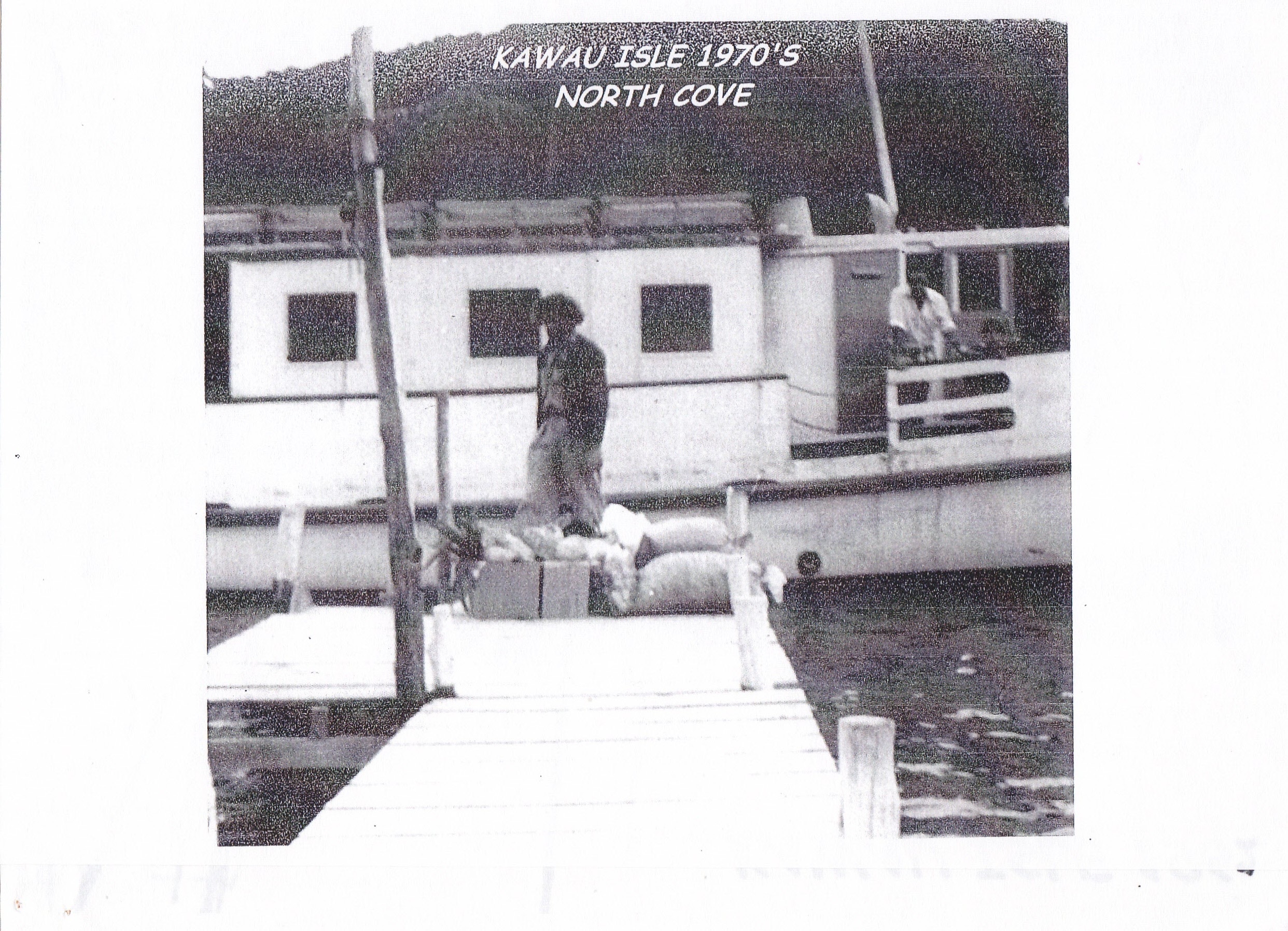
photo of Bob Edwards on-board ‘Kawau Isle’ at North Cove c1970’s
Harold Kidd Update
It’s a great piece of local history with some brilliant, spare tales. A few comments. NANCIBEL was built by Bailey & Lowe in 1920 and was not a conversion of Andros’ open boat. “Emptage” is Emtage of course of Motuora who had the launch ILA/OLA. “Bunty” Palmer married a Nops. Unless I’m confusing the several KORORAs, this KORORA was built by David Reid in 1907 for Judge Seth-Smith and was later MURIWAI, then OSTEND before reverting to KORORA. She had been used by the RNZAF who had bought/hired her from Whakatane in 1943. She then had a K2 Kelvin which was undoubtedly replaced in service by the standard armed forces issue of a Chrysler.
PS Spero Andros sold NANCIBEL to Gubbs shortly after his wife Molly (Kathleen Mary) died in February 1941. Gubbs’ first day of operation was 11th June 1941.
A Neat Idea from Baden Pascoe
This is great stuff. Let’s ask any readers if they can find photos of the boats mentioned in the articles. I remember the “Mairie” (not sure if the spelling is correct) very well. One of the Harrison boys ran her out of Whitianga. Last time I saw her she was on the hard up at Te Atatu as an unfinished project. Shame, nice little boat. One day my brother Mitch and I were steaming with her in a big sea out by the Twins (in Mercury Bay), man could she roll!
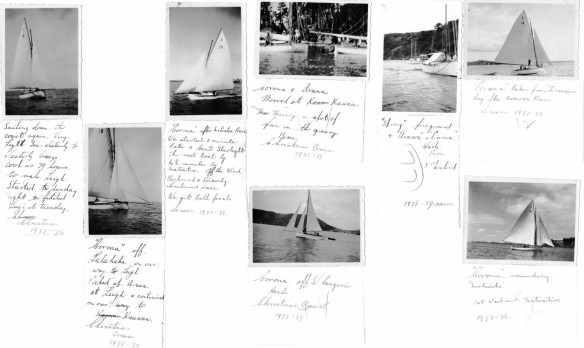
Corona Christmas Cruise 1938/9 (#2 in series of 4)
CORONA CHRISTMAS CRUISE 1938/8
photo collection ex Peter Nunn
A Peek Inside The Clyde Quay Boat Sheds
In my real life, I have one outside of ww 🙂 , I get to work with some very talented people, in 2013 one of my clients partnered with New Zealand’s award winning consumer lifestyle magazine – ‘NZ Life & Leisure’ on a marketing initiative. Just before xmas I was in their offices & they said “hey we have an article in our upcoming Jan/Feb issue that would interest you & your ww readers. So folks here it is a pictorial insight into the Wellington’s Clyde Quay boat sheds, where several CYA members (Phillipa Durkin & Gavin Pascoe) hang out. The passion & enthusiasm that the Gavin & Phillipa, along with the other Wellington Classic Yacht Trust members have is amazing & we should all take a lead from them.
The mag goes on sale today so grab a copy at your local, you can also see more at their never cool website http://nzlifeandleisure.co.nz
You can find out more about the WCYT here http://www.wcyt.org.nz


WAIHAPE
colour photos ex Dean Wright – info ex Ken Ricketts
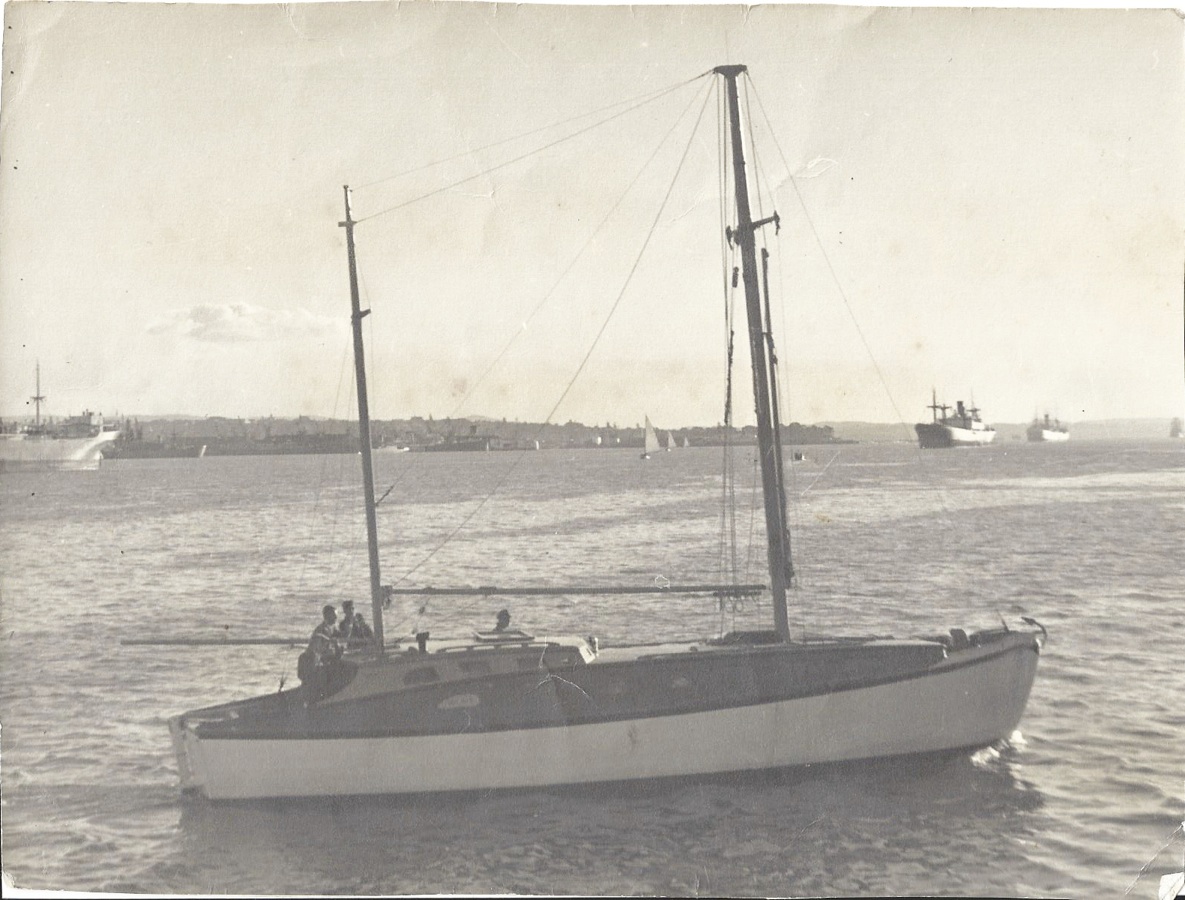
b/w photo ex Harold Kidd ex Keith Munro
Ken thinks Waihape was the last boat Johnny Wray built in the later 1940s > early 1950s. He lived on her for many years, based at Surfdale, Waiheke, although he did sail around NZ & the Pacific in her fairly extensively. She had a fairly distinctive aft wheelhouse/doghouse which instantly “clicked” when he saw Dean’s photo.
Ken is certain he recalls seeing her in the mud at Surfdale on the L.H.S side of the bay coming in from the sea. There is even a mention of her in a write up “fun map” of Waiheke on a website Ken discovered.
Can anyone confirm this was in fact Johnny Wray’s last boat?
Harold Kidd Update
She certainly looks like the 44 footer WAIHAPE which Johnny Wray launched in December 1948, the last big boat he built. He put some unusual features into her. From his RNZAF experience she was fitted out with an aircraft-type control panel and had twin engines, small Kelvins I think. She took him to Tonga and back a couple of times and had a fair spread of sail.
14-05-2016 – A message from Helen Lee
My name is Helen Lee and as a teenager I had several cruises on Waihape with Johnny Wray, my parents Cynthia and Jerry Wilcox, my brother Michael Wilcox and once with my cousin Mike Lambert.
I have wonderful memories of these trips [early1960’s] and a few treasured photos. I realized when i saw the ww photos of Waihape that mine are all taken on the boat, not ‘of ‘ the boat. However you may like to see them.
Johnny was a long time friend of my Dad’s as they were both living in Lucerne Road as young men and Dad had worked with Johnny when he was building his first boat, Ngataki.
The photo below taken at Mansion House, Kawau Island, is Johnny trying to look like the coconut he is holding.

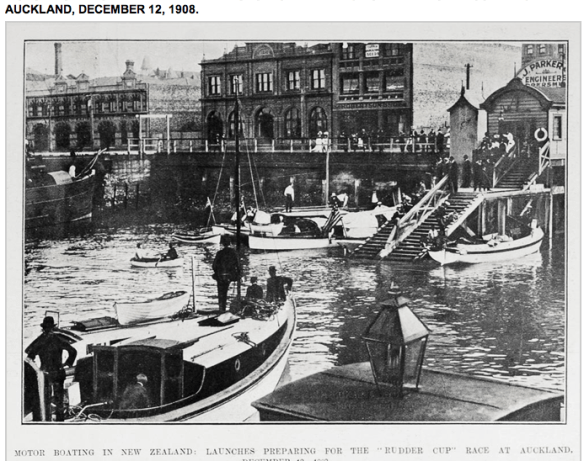
The article below was penned by Harold Kidd with the intention of creating interest among the classic launch community to re-run the 1908 race in 2008 to celebrate the centenary of the event. As tends to happen with most things HDK puts his name to, the 2008 race happened.
Pauline & Harold Kidd donated a cup, the Rudder Cup Centennial Trophy for the race & now each year CYA launches race to Patio Bay for the cup. Today is that day so it seems appropriate to feature the 1908 race. I very proud to have Raindances name on the cup (2012 winner).
Enjoy the read & thank you Pauline & Harold. Alan H
THE GREAT LAUNCH RACE OF 1908 – The Rudder Cup race around Sail Rock
The Rudder Cup launch race around Sail Rock and back, a distance of 108 nautical miles, was set to start off Queen Street Wharf at 10 pm on Saturday 12th December 1908. All week the weather in the Gulf had been heavy, all day a stiff southerly blew, but at sunset this died to a flat calm. Shortly before the start, a light westerly breeze came up and that quarter prevailed throughout the race. The Squadron race committee made a serious mistake. Despite the fact that the weather was clearly settling, it decided to apply the heavy weather handicaps, handicaps that made the larger, more powerful launches give big time allowances to the smaller fry. Happily, for the moment, and for the peace of mind of the faster contestants, the handicaps were sealed.
Of the 14 entrants, only 12 made it to the start. The brand new 42 footer Alleyne, owned by Arthur Brett, Commodore of the New Zealand Power Boat Association, scratched for some undisclosed reason and so did Leo Walsh’s Kelvin, with a slight engine problem.
The massed flying start was a pretty sight as eleven of the twelve launches throbbed their way, “with the cyclonic whirring of gas engines”, said the Star, down the Waitemata, around North Head and into a calm but very dark night. Floral had been first over the line but James Reid in Seabird took the lead by North Head. Eliza had a problem restarting her engine and was trailing behind. The moon rose in the East as the launches approached Tiri and droned on into the night, the little fleet now becoming strung out with only their nearest competitors in sight. There was a beam swell and sea off Kawau but it moderated, then got up again when a fresh westerly kicked in as they entered Bream Bay.
At 0414 on Sunday morning Seabird was the first to round Sail Rock and turn for home. She was followed by Matareka, 26 minutes behind, then Alice leading the main bunch a few minutes later. The Herald reported the rest of the race,
The run home was uneventful, the westerly wind off Waipu beach being left behind and a southerly with a bumpy sea being run into at Whangaparaoa Passage. Seabird gained on all the launches and Matareka also improved her position, but neither of the leading boats had sufficient in hand to secure a win.
But, until it was all over, and the handicaps opened, neither skipper knew that.
Alleyne met Seabird as she rounded North Head, out on her own, and she came tearing up the harbour to finish at 1030, cheered by a very few of the NZPBA faithful on the wharf that Sunday morning. Seabird was 53 minutes ahead of Matareka which was 28 minutes ahead of Alice. All the remaining boats had finished by just after 1300 in the following order, Wanderer, Maroro, Kotiro, Eliza, Vanora, Floral, Winsome, Waipa and Petrel. Seabird averaged well over 8 knots for the run, a great turn of speed for the time, point to point in the open sea.
When the handicaps were opened it was found that Seabird had to concede a time allowance of 3hrs 23 min to Maroro, something that was impossible in the conditions. The handicap results were Maroro 1st, Winsome 2nd, Petrel 3rd and Alice 4th. So the Rudder Cup went to the Matheson brothers of Maroro.
Not surprisingly, there was much criticism of the outcome. Some said that Seabird was the moral victor, some said that Chas Bailey’s Alice had performed best in comparison with the others having regard to her size and horsepower and should have won with proper handicapping, all said that the handicappers had done a bad job. A protest was lodged with the Squadron but failed. The real winner was the reputation of the motor launch and of the marine engines of the day. The Herald said,
The race is considered by motor launch owners as a triumph for the reliability of the motor boat. Twelve boats went round the course, and not one engine is reported to have stopped throughout the long run of from 12½ to 15 hours.
But the fun was not yet over. Immediately after the race, Harry Adams issued a challenge to Maroro, “or any other competitor” to a race from Queen Street Wharf around a buoy off Russell Wharf and back, non-stop, 240 nautical miles, for ₤50 a side, a preposterous sum at the time. Adams was taking a shot at James Reid and Seabird. Possibly he was driven by the need to dispel doubts about the Auckland-built Adams Kiwi engine in Eliza which had played up at the start of the Rudder Cup race. James Reid accepted at once.
Arthur Brett was stakeholder, starter and judge. Eliza’s crew consisted of Capt. Ted McLeod, master of the Northern Steamship Co’s coaster Clansman as skipper, Bill Cook, later of the Whangamumu whaling station, navigator, Fred Reynolds, of Whangarei, engineer, and Charlie Mitchell as engineer’s mate. Harry Hopper stayed ashore. James Reid employed Capt. J. Quinn, master of the auxiliary schooner Endeavour, as pilot and had as crew K. and H. Boyd, A. Tyer, and E. Akersten.
There was nothing like a big wager to stir interest in the Colonial heart so there was considerable attention paid when the race started off Queen Street Wharf at 0750 on Saturday 30th January 1909, the day after the Auckland Anniversary Regatta.
James Reid told the Star,
“The boats got away to an even start, but one at once knew that something was wrong with the Seabird; there seemed no life in her. The Buffalo came alongside us, and beat us easily, showing that there was really something out of order. The Eliza was drawing right away from us, and we were sure now that we had seaweed on our propeller. We reversed the engines several times, and tried her again, but could not shake it off.”
Buffalo was a new launch built by Reid’s younger brother David and was much lower powered than Seabird. Seabird carried on until Takatu Point when Reid stopped the engine. Ken Boyd went overboard and cleared the totally fouled prop with a boathook. By then Eliza was out of sight, but they gradually hauled her in. Off Bream Head the weather rolled in thick. Seabird felt her way up the coast, rounded the buoy off Russell Wharf at 2340 and then Capt. Quinn stood her out to sea till daylight when they briefly picked up the Poor Knights. Through lifting mist they raised Sail Rock in clear weather and steamed straight home from there at full revolutions. She did the 54 nautical miles in 6 hours 15 minutes, averaging a cracking 8.64 knots and crossed the finish line at 1638 on the Sunday.
On board Eliza, the Kiwi engine never missed a beat. She rounded the Russell buoy at 2250, 50 minutes ahead of Seabird. Her report made much of a rough trip home in a rising easterly,
Aboard the Eliza, one lurch threw two five-gallon drums of oil across the engine-room floor, and another threw the engineer right across his engine. The launch went under the Hen to get smooth water, to enable her to fill her oil tanks, and owing to the rough sea she went outside Piercy Island to get calmer water.
Eliza finished at 1425, 2 hours 13 minutes ahead of Seabird to win the wager.
James Reid pooh-poohed Eliza’s rough weather talk.
“I must contradict the report that both boats were knocked about in the sea. …we did not get a drop of water on the decks.”
And that was that. The reliability of the modern internal combustion marine engine had been further enhanced, there had been some heroics to suit the taste of the time, and honour was satisfied all round. But the story doesn’t end there.
It will come as no surprise to readers of Vintage Viewpoint and our books that, almost a hundred years after the Rudder Cup race, the main protagonists of 12th and 13th December 1908 are still soldiering on.
Eliza was run by Harry Hopper for some years and was bought by brothers J.T. and J.W. Mason of Whangarei in 1920, renamed Kumi, Maori for a fabulous monster, like a taniwha. They sold her to the Whangarei Harbour Board in 1929 and she stayed on strength as a tug and pilot boat, skippered by Archie McKenzie, for many years. Recently vet Haydon Afford of Taupaki bought her and rebuilt her.
James Reid sold Seabird in 1910. She stayed in Auckland in various hands until the cyclone of 1917 when she came ashore in St Mary’s Bay and was badly chafed. Charles Collings bought her and rebuilt her, then sold her to Turnbull of Lyttelton. From Lyttelton, where she spent many years as a harbour ferry, she gravitated to Nelson. She has recently been bought by Steve Thomas, a Nelson marine broker who first sailed in her in Golden Bay as a boy 25 years ago and fell in love with her.
Maroro remained with the Mathesons until 1920. She then went through a series of owners, reading like a Who’s Who of launchies of the time; W.J. Quelch, Sam Leyland, Wilkie Wilkinson, T. Macindoe; but she eventually went fishing and is currently owned by David Owen of Okupu, Great Barrier. She is hauled out directly opposite the wharf, needing a new owner desperately. She is highly restorable and highly original, the only changes from her 1908 configuration being a sensible and neat dodger put on by Lanes in 1920, beltings put on to work as a long-liner and the inevitable mechanical updates.
Of the remaining entrants, Matareka is sound and loved by the Fenelon family in Auckland. We saw a photograph recently of a launch in a shed up North that is Petrel or her twin. Wanderer is very like the Wanderer owned by Terry Curel on the Kaipara in the 1960s and may still exist. Fred Cooper sold Winsome to engineer and wheeler-dealer Peter A. Smith in 1914 and she disappears, probably with a name change, because Bailey & Lowe built a tuck stern Winsome for J.H. Foster in 1918, the boat that has been owned by the Pickmere family of Whangarei continuously since 1923.
Bailey & Lowe sold Floral in 1909 to Capt. J.S. Clark for use as a passenger and cargo launch on the Whitford run. Again, she probably still exists under a different name. We have a candidate to follow up, last seen on the hard at Coromandel. The big Vanora was sold by Lindsay Cooke to Maurice O’Connor of the Thistle Hotel in 1912. He fitted a 30hp Auckland-built Twigg engine and sold her to the Government in late 1913. We do not know her subsequent fate.
Alleyne became Daisy in the hands of W. de Renzy of Ponsonby in 1916 then went to E.J. Kelly, a stalwart of the Ponsonby Cruising Club in 1918. By then the Lozier had been replaced by a 30hp Twigg. Kelly sold her to Sanfords in 1927, so we suppose she finished her days as a long-liner. Waipa was a mystery, even at the time of the race, but we are pretty sure that she is the pretty little double-ender in a recent Boating NZ trade ad.
W.J. Harper sold Kotiro to Frank Chapman in 1919 and she became Ahuareka. We lose track of her in 1937. Bailey sold Alice to Tonga in March 1910. Kelvin carried the name on when Walsh sold her to Reg Shepherd. By then there were so many launches with the name Kelvin throughout the country that following her history is impossible.
Of the 14 entrants in the Rudder Cup, 4 definitely exist, Waipa is a probable, at least 2 more are likely and we think there’s a fair chance half the others may lurk under a new name on a mooring, up some tidal creek or in someone’s backyard.
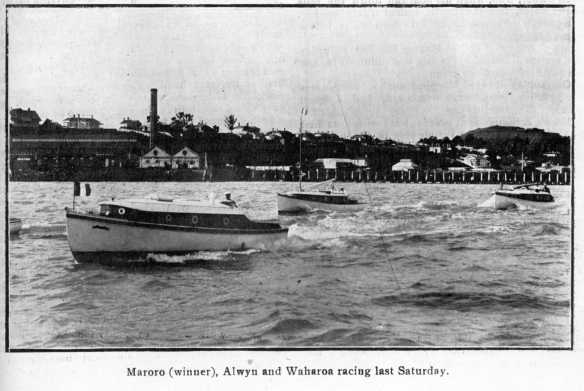
Maroro (leading)
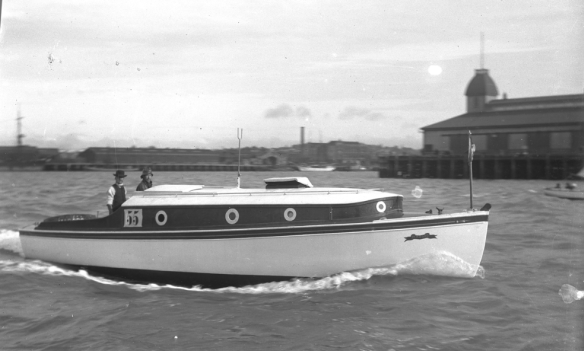
Maroro
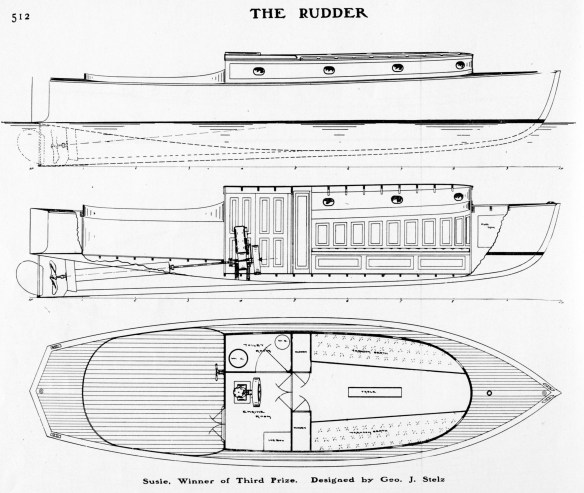
Susie
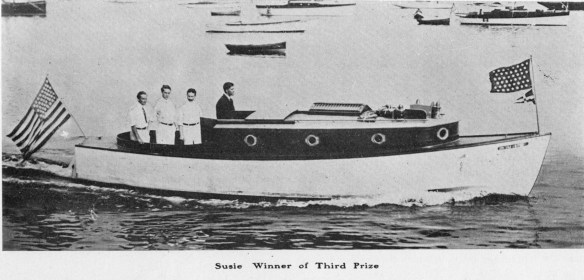
Susie
MARORO
photos & details ex Harold Kidd & Alan H
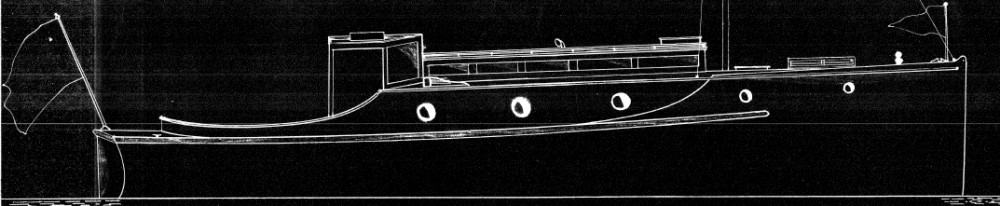
This story starts in 1907 when an Auckland family (Matheson brothers) built in St Marys Bay on Aucklands waterfront a 32 ft launch MARORO (flying fish in Maori). Her plans came from the USA Rudder Magazine and she was therefore rather unusual in design in the local New Zealand context. Maroro has a great history but her claim to fame was she won the Rudder Cup, a night race around Sail Rock & back, held on the 12th December 1908.
Fast forward 100+ years (August 2009) & Harold Kidd, Colin Pawson & myself flew to Great Barrier Island to check out Maroro where she was ‘resting’ at Okupa in Blind Bay, you can view photos from that trip on this link http://classicyacht.org.nz/forum/viewtopic.php?f=4&t=652&hilit=Maroro
Maroro was subsequently transported back to Auckland & is now resting again at Marco Scuderi’s yard in Helensville, while her fate is decided. You will see in the Great Barrier photos she was / is as they say in the real estate game – a little distressed. There are lots of posting on the Classic Yacht Association NZ forum on Maroro if you are interested http://classicyacht.org.nz/forum
The purpose of this waitematawoodys posting is to reveal that at long last the original plans for Maroro have been tracked down by super sleuth Harold Kidd, who obtained a copy of the August 1906 edition of the Rudder magazine off Ebay. Featured were the basic layout /plans of a motor launch named Susie. She was 3rd in the Knickerbocker YC long distance power boat ocean race in June 1906, the 2boats that finished ahead of her were much bigger & more powerful. When you compare the photos of Maroro & Susie , disregard the cabin top & focus on the bow & stern, they are almost identical. It would appear that the Matheson brothers were impressed with Susie’s performance in the Knickerbocker race & built a clone.
The above photos include a shot of Susie , the plans, a photo of Maroro winning a race on the Waitemata Harbour & a rather spectacular close up shot of Maroro. What do you think – peas in a pod? (you can freeze the slideshow by clicking on a photo)
Note: the discovery of these layout / plans could help decide the future of Maroro.


A Special Woody Weekend
Today was a special day on the woody boating front – Baden Pascoe officially launched his book ‘Launching Dreams – Percy Vos – The Boat & His Boys’ at the Royal New Zealand Yacht Squadron. We saw over 300 of the classic boating fraternity & people connected to Percy Vos – family, friends & ex work mates join together to celebrate the event & rub shoulders. Great speeches but the key message of the day came from John Street to Sir Bob Harvey (Chairman of Waterfront Auckland) & that was that the Vos Shed project was LONG over due & action was need NOW. Todays audience certainly agreed 🙂
A few photos from the launch / morning tea.
Copies in your local book-store now or from Baden on badenhp@xtra.co.nz
VIDEO ONE – Don Brooke speaking at the 2013 CYA Classic Yacht & Launch Exhibition, hosted by the Tino Rawa Trust, which showcased the acclaimed designers Jack Brooke & Bob Stewart. Both Don & Robert Brooke spoke briefly at the launch ‘morning tea’ about their father Jack & fellow yacht designer Bob Stewart. Also view VIDEO TWO (below) which features of Don’s brother Robert, speaking on the same topic.
VIDEO TWO – Robert Brooke speaking at the 2013 CYA Classic Yacht & Launch Exhibition, hosted by the Tino Rawa Trust, which showcased the acclaimed designers Jack Brooke & Bob Stewart. Both Robert & Don Brooke spoke briefly at the launch ‘morning tea’ about their father Jack & fellow yacht designer Bob Stewart. Also view VIDEO ONE (above) which features of Roberts brother Don, speaking on the same topic
 waitematawoodys.com #1 for classic wooden boat stories, info, advice & news - updated daily - 15+ million views