Screen Shot 2014-04-30 at 5.31.57 PM

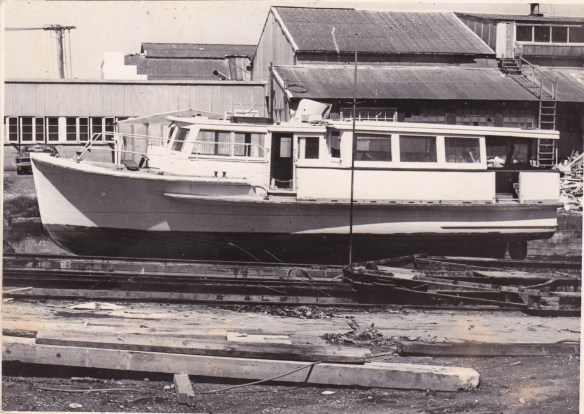
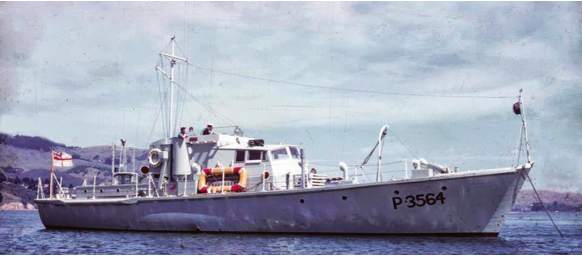
HMNZS KOURA

A clip from a chat between Russell Ward & Alan H
photo ex Basil Rutherford collection

Anywhere else in the world , these ladies would be being restored & proudly on display.
Instead another one is about to be slaughtered at Paeroa or Thames on 14 May or thereabouts.
It has reached the end of a sad trot of indifferent ownership and has been given her marching orders from the Maritime Park. It is a shame because when Paeroa were given her, she was one of the better ones the Navy had.
Tarapunga died a few weeks ago. Another whose name escapes me did some impact hydrography in Milford Sound last week.

Manga is making her last sacrifice at Helensville .
These eminently useable boats are vanishing at a rate.
Paea is going strong and may be the beneficiary of Koura’s parts.

The simply lesson here is that old boats have got to be kept working. If not they just rot away.

Interested in reading more on all things Motor Launch, be they serving in the Navy or in civvy hands. (over 250 photo’s and 50+ stories and tech data / links to other ML pages) Check out the link below
 

http://rednaz1958.blogspot.com/2016/03/composite-list-of-hdmls-still-active.html

The 2014 Great Annual Waikato Seagull Regatta

The 2014 Great Annual Waikato Seagull Regatta

story by Adrian Pawson
photos ex Nina Wells (Working Edge Pictures)

I make no excuses for the length of this post, its such a great yarn it needs to be told. Read about Adrian Pawson & James Ledingham’s challenge to win the great Seagull race.
Grab a cup of what ever your poison is & enjoy 🙂 Alan H
The 2014 running of the ‘Great Annual Seagull Regatta’ was once again able to start at the base of the Karapiro hydro dam this year thanks to higher water levels and a helping hand from cyclone Lucy. At first light the keen regulars milled around in the dark waiting for the nod to proceed to the start area. Not having much in the way of patience, Team Paris with our trusty carbon fibre creation held above our heads, jumped the fence and trundled our way down the metal dam track to the starting area to secure the pole position on the dam beach.

The first day’s task consists of a 45Nm jaunt starting at the base of Karapiro hydro dam, battling through a series of rapids, then through picturesque canopy covered viaducts, leading into a fast and furious left hander into Leamington pool on the outskirts of Cambridge.  From there we howl our way down through Hamilton, Ngarawahia Taupiri, Huntly, Ohinewai and under the Rangiriri bridge finish line to post our first days effort on the regatta time sheet,

Our start was scheduled for 9:30am, half an hour after the 4.5 dinghy class. Our division start was knocked back half an hour while a few of the old boys finished up mixing their final choice of 2 stroke brew and the mandatory pre-race cuppa’s.  Come 9:55am, and having completed a couple of nervous pre-race leaks into the nearby bushes,  were all on the water and circling with the current waiting for the lights to go out signalling the start of the race. As you can imagine, at the base of the dam air movement is at a minimal.  Normally this wouldn’t cause much of a problem. However 15 seagulls burning 10:1 2 stroke and running rich on low revs, can produce a significant quality of smoke! The environmental situation 30 seconds out from the gun was starting to look like a bad day in Beijing with greatly reduced visibility!  When the flag finally dropped and 15 tiny carburettors were finally allowed to open wide, the exact direction of the dam exit was in some debate. Some of us got it right and some were not so lucky!  But for the moment Team Paris was looking good and we shot off towards the first set of rapids in the lead.

Much to our surprise we were pulling away from our fellow seadogs and all our hard work and testing seemed to be paying off. We sped around bends and navigated the rapids leaving a majestic trail of blue smoke in our wake. We hugged the river banks and rock walls for maximum current benefit and for the moment our performance was looking quite spectacular!  We had long ago lost sight of our competitors by the time howled our way under the first Hamilton bridge. Even more pleasing was that we could smell the sweet exhaust fumes of the 4.5 dinghy division ahead and knew that we were catching them quickly. We were drunk on our sense of self satisfaction, and with the knowledge that our beloved Paris Hilton Mk2 was clearly a weapon, we were all smiles as we tucked into our packed lunches and took time waved to the well-wishers on the river banks.

Three hours had elapsed as we passed under the second Hamilton bridge, but a quick glance at the taco revealed that we had lost 100rpm. This is normal we told ourselves. The motor was running hot and maybe some tolerance issues had come into play.  A seagull usually doesn’t run at 5000rpm, and for us some drop off was acceptable. We assured ourselves that we were still fast.  10 minutes later we lost another 100rpm. Our smug smiles quickly faded and we realised we could be developing a problem on the good ship Paris….. Half an hour later we had bled 1000rpm and the relationship between crew members had descended into short bursts of 4 letter words with periodic apportionments of who might be to blame for this catastrophic short coming.

Paris was shaking like an F&P washing machine from 1980’s. Our seagull was not in a happy place at all. It was obvious that we had terminal gearbox problems. A quick call to our support team and a frenzied exchange of lat and long data revealed our position and proximity to a public road. Our best option was 3 km away. We were down to 1500rpm and our hopes of a record breaking finish were going up in smoke – literally!  Then our trusty 1971 seagull ground to a halt and the shaking and grinding was replaced with a terrible silence. We were moving gently downstream but for all racing purposes we were stationary.

We knew we were sitting on a very healthy lead and the call was made to start paddling. We took turns as we had a bit of distance to cover and maximum stamina was required to get us to our rendezvous waypoint, and to our much treasured spare engine. We paddled for 30 mins and that river bank couldn’t come soon enough. I finally jumped out to navigate the willows with the road in sight. I had to get over one of those annoying electric horse fences and through a paddock to the highway. I had horse shit on my wetsuit boots and I was knacked from paddling. But I made it to the side of the highway. A couple of seconds past and I could see the Southern Spars transit van and our now very valuable spare engine coming towards me.

Doors were flung open and with hands on spare motor I was re-energized. We were back in business. Across the field, over the bastard horse fence, through the willows and back into Paris. James had the stuffed 1st motor off already and the spare was on route to the transom. In the process of swapping over fuel lines we lost half a litre of fuel into the boat. The cockpit of Paris now took on the traction characteristics of a stinking and highly flamable ice rink. As with every low budget program we had only one ‘nice’ prop, so that came off the 1st engine with the intention of being slid cleanly onto the spare motor. It went on about 5mm and stopped. (I decided that I wasn’t into taking the blame so poor ol’ James wore it) …….F@#* James, did you ream the bush for the spare engine shaft…..? I can’t believe you didn’t ream the bush. That was your only job this morning!  F@#*! Hammering with vice grips got us down another 2mm but that was a waste of time. I slid around and wrestled with the prop in this stinking pool of 2 stroke fuel that now shushed around in Paris’s cockpit. My nice 2010 Oracle leggings were covered in oil and I imagined the waterproof lining peeling off like had happened to my Aigle during a similar situation testing. My leggings were probably now rooted. Apart from the Oracle logo I really like those leggings. I wasn’t about to part with $400 for a new pair either. Then from behind came the competition. They had finally caught up with us. Somehow the prop went on but not before I cut my hands on the precision sharpened leading edges. So with blood and oil on our fancy North 3DL tool bags and a couple of frantic pulls on the starter cord, we were off!

5 mins later the spare engine died.  I also tried to blame this on James but he wasn’t wearing it this time….. We elected to go to the river bank. We could see another road and we knew a rescue was on the cards if we couldn’t come up with a plan C. We decided that our best option was to gamble that the 1st engine power head was still ok and our terminal problem was confined to the gearbox. So off comes the gearbox on the spare engine and she was mated onto the 1st engine. This took 20 mins meaning the competition was well down the track before we were back on the river and moving.

We were back at 4800rpm and chasing hard. We knew were faster than the sea dogs but we had a lot of work to do. The decision was made to ignore the overwhelming petrol smell and lie down in the boat in the name of reduced windage. We were flying along at a respectable 12 knots as the calming effects of the fumes went some way to restoring the friendship between James and I after that unfortunate blaming episode.  But we were back in the race and it was game on.

By the time we made the Rangariri bridge we were only 15 mins behind the leaders, and knowing that we had a significant speed advantage, the race was far from over! Tomorrow we would take the fight back to the seadogs and our pride would be restored. But right now there was work to be done. We had a bit on to clean Paris and have her back in race trim for tomorrow.

Upon disassembly of the 1st engine gearbox we found a pile of gear teeth in the bottom of the case and a distinct absence of oil. Seems like 3 hours was all it took to empty a full box worth into the river. When the oil was gone the countdown to self-destruction started…… Our experience in the garage back home taught us that it’s normal for a seagull drops its guts over the period of a few days, but 3 hours wasn’t quite right. Oh well, we were running a pretty loose setup. Maybe the spare box was better. We filled that one up and got stuck into the beers. Tomorrow was to be another day.

to be continued tomorrow on ww ……

To add a little bit of perspective to the above – read below Adrian Pawsons notes

My partner Nina and I are in the process of cutting together a documentary leading up to and then centring around the 30th Waikato seagull regatta. Fortunately Nina is a professional film maker, so the end result will hopefully be a high quality 90 minute feature length doco aimed at a spot in the NZ international film festival. We not eligible for any kind of funding, so we’ve had to take a ‘just do it’ approach and pay our own way. But we think it’s a film than needs to be made. An event like this attracts some very eccentric characters, so content isn’t a problem. However we did need a first time team to complete the cross section, so against all better judgement, James and I became it. James and I know a little bit about sailing boats but this was our first crack at anything with a motor, so it was bound to be a shambles worthy of filming. We both work at Southern Spars so we quietly built Paris in one corner of the workshop hoping that by the time the ridicule and jeering got too bad we’d be just about done. Aside from our own struggles to get one over the seasoned campaigners (who we affectionately refer to as the seadogs) we’ve spent the last year driving all over the country filming these fellas in their secret seagull tuning sheds. The film will follow 6 seadogs their individual quirks and their various challenges just to make the start line.

The real shame is that we can’t show any video material prior to the film festival as any stray footage will void our entry. At last count we’re about 60mins deep and our 6 seadogs have been pure gold so far! They’re hilarious, but at the same time exceptionally crafty old roosters that typify the ‘Burt Munro’ type attitude towards life. So fingers crossed we nail the last 30 mins from this year’s race footage and end up with something nice to do them justice.
I’m back

Image

I'm back

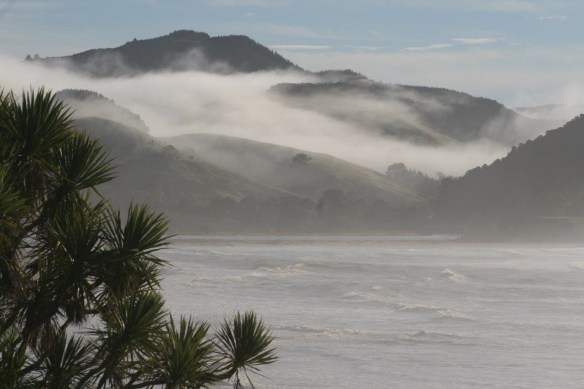
Well I’m back – I hope the sudden absence of ww posts was not too much of an issue. I’ll make it up in the next few days., I have a couple of monty tales to share with you. I was enjoying a non boating holiday at a place called Akitio, a coastal settlement on the lower east cape (Nth Island). Other than some tarsal on a few of the roads it has remained almost untouched in the last 100+ years. The photo above, taken by our host David Plummer, shows how wild & otherworldly at can be. A special place that delivered on my holiday wish list – dog friendly, beach walks, open fire, driftwood to collect, great food & nice company.

Went to an amazing country hotel , the Pongaroa Hotel, we missed the local ‘Hunt’ by a day, but I have included below a photo of a previous year. They get 800+ hunters entered & the main street is just lined with the kill. Not a good event for the vegetarians out there 🙂

The 9 1/2 hr drive was draining but it does keep the day trippers away 🙂

ps For Baden Pascoe, I include a photo of a Lister engine that was center stage at the pub.

Why would you moor off Devonport YC?

Wee bit of a blow this morning – a trimaran moored off DYC broke its mooring & ended up on the beach at Windsor Reserve. Bounced off the sea wall first & amazingly the wall came second. The (un-official) mayor of Devonport, Simon Gundry was there directing operations & CYA member Chris Leeche’s son Daniel, came to the rescue with some lines from the Navy to secure the vessel.

Further proof of the blow (50+knots) was the flag pole on the downtown ferry building (photo ex David Plummer)

Bayswater In Its Prime

Image

Bayswater In Its Prime

Bayswater In Its Prime

Not sure of the year but most likely when the Takapuna Boating Club used to haul members’ boats on the northern land that is now a park (of sorts). Russell Ward says it was a lovely little place to work on boats and he hauled a few there before the Bayswater Marina developer and Takapuna City Council conned TBC out of it.

Speaking of being conned, do not start me on the control TBC has over the building on the foreshore, that is a con job 😦

Harold Kidd Update

The building has an interesting history. The Takapuna Boating Club was formed in 1914 to promote mainly centre board sailing in Shoal Bay and, of course, made its mark on New Zealand yachting history by commissioning Bob Brown to produce the design of the “Takapuna” 12ft 6in monotype “flattie” for competition by boys and girls, which became the “Zeddie”. About 1920 the club’s members secured the lease of the site at Bayswater and bought a tannery building at Panmure which they transported by barge and rebuilt into a magnificent three-storeyed clubhouse.
Very popular dances were held on the street-level floor every Saturday night. During my youth Benny Levin was the bandleader but rock and roll wrecked the music/dancing scene in the late fifties. I did get to sub on string bass with the band from time to time and it was a swinging group, mainly using stock orchestrations.
Later the dancefloor was taken over by Shore Sails as a loft.

Young-Old Man’s Blather.

Russel Ward aka Mr Steam + boat builder Joe Wheeler

Today’s post is to quote the writer (Russell Ward) a ditty on his teenage boating years & sheds some light on the Bayswater boat builder, Joe Wheeler, who is largely unsung but deserves attention.Click the link below to view/read the story/photos.

Harold Kidd knows more about Joe and can be sure to chip in on this one.

Pour yourself a cup of tea & enjoy the story 🙂

Click this link (blue text) to view Young-old man’s blather

Russell in his element

P1160647_2

Joe Wheelers last boat built -seen here at Stillwater

joewheelerlatsboat

Aotearoa II

Image

Aotearoa II

AOTEAROA II

details & photo ex Ken Ricketts

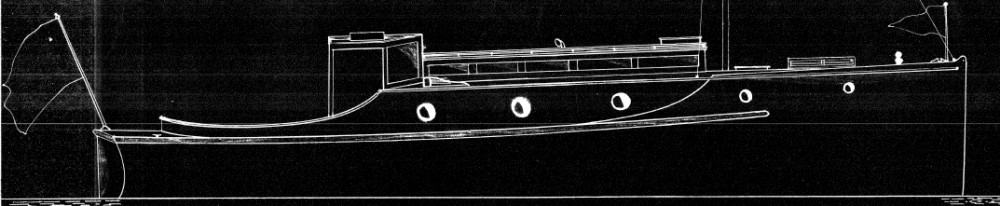
Aotearoa was the ‘night launch’ for many years before the Harbour Bridge, which used to take North Shore folk home through the night from the launch steps in town, after the ferry services stopped around midnight, & was operated by Eric Harrison, who after the Harbour Bridge went in to service, moved Aotearoa to Kawau. There she became part of the ferry services to the Sandspit & also did Auckland to Kawau trips. She was bought off Harrison & owned for a short period by Rick Brown, who onsold her to Gordon Brown, (no relation as far as Ken knows). Gordon Brown also ran her as ferry service to Kawau fo a few years & was ultimately squeezed out by Harry Julian who tried to totally control Kawau logistics for a number of years.

She was originally powered by 2 x 100hp 6cyl. naturally aspirated Fords which were later replaced by Eric Harrison with 2 x 6 cyl. turbo 165hp Volvos.

Ken suspects she may have been built by R Lidgard, can anyone add to this or confirm?

Anodes – yes/no ?

Image

Anodes - yes/no ?

Anodes – yes/no ?

If you wanted some visual proof that some form of anode protection is desirable on some vessels (covering my ass here……..) – look no further than the above photo. I’m told the sump was worse.

Usual story – boat left on mooring unattended, bilge pump not working, a ‘wee’ bit of water in the bilge & as James Mobberley at Moon Engines said when I showed him the photo, the engine was performing the role of anode 😦

Laughing Lady

LAUGHING LADY

A ‘new’ lady from the USA joins the NZ classic fleet. But first stop is the Whangateau Traditional Boat yard. Click any image to enlarge.

Luders built the motorboat Laughing Lady in Connecticut in 1949 as a day fishing boat for a wealthy American socialite. A few years later she sold it to David Gardiner, who considered himself the 16th Lord of Gardiners Island. The island has an interesting history. As Americas largest private island, It had been in the family ever since his ancestor, the English settler Lion Gardiner, bought it from the Montaukett Indians in 1639 for ”one large dog, one gun, some powder and shot, some rum and several blankets”. He also obtained a charter for the island from King Charles I of England. Captain Kidd once buried treasure there, and the family withstood several attacks by pirates. Gardiner used the Laughing Lady to commute from the Island to New York where he worked as a stockbroker and also across to the up market Hamptons to ferry his guests to the Island, including Jacqui Kennedy-Onassis. Before David Gardiner passed away in 2004 the boat was sold and transported to a yard in San Diego where it underwent significant restoration of the hull before the restoration eventually stalled.

Enter Kiwis, Michael & Katy his sister-in-law who have both worked in the yachting industry and found a love for old boats working as crew on the historic 142 foot Dutch built Feadship Istros and also crewing aboard Fife yachts in various classic yacht regattas around the Mediterranean. They were looking for a small-scale project of their own and found the Laughing Lady languishing in a yacht yard in San Diego last year. They made an offer and the boat was theirs. The boat was then loaded onto a cargo ship in Los Angeles and shipped to Tauranga in March 2014, then towed on a large trailer up to Whangateau in early April (refer photos above). After being shoehorned into the main shed at Whangateau Traditional Boat yard, work will now commence returning the lady back to her former glory.

Luders stopped making boats in the 1980’s but had a fine pedigree in boat building, pioneering hot molded construction and the use of plywood during WWII.  The yard built and designed, fast commuter yachts, Navy patrol boats, tugs, launches and racing yachts including the 1962 America’s Cup winner Weatherly.

Laughing Lady is 32 foot long and was originally powered by Packard straight 8’s, nowadays is powered by twin Volvo turbo diesels.

Built of double planked cedar and mahogany with oak framing and a unique hot molded cabin trunk, she still has the basin that was used for shaving on the way to work and cast bronze fish fighting chairs. The boat will be kept as original as possible, but they will add some modern navigational equipment and something to cook on for overnight trips. Aside from that there is a lot of wiring, wood working, plumbing, paint and varnish to be done before she is completed and back on the water and turning heads as a fishing boat on her new home – the Hauraki Gulf.

Waitematawoodys will follow the work her owners will be undertaking with the assistance of Pam & George at the Whangateau Traditional Boat yard.

This might be easier to read


Whangateau Traditional Boats Regatta – Part One

Whangateau Traditional Boats Regatta – Part One

This is the coolest thing happening, down under, in the traditional wooden boating world – if you have not been to Tramcar Bay, you need to ask yourself how serious you are about wooden boats.
photos Shane Anderson, Mark Lever, Alan Wallace & Phillip Jones

Clicking on the photos above will enlarge them 😉

Saturday March 8th was the 12th year that Whangateau Traditional Boats has hosted a regatta at Tramcar Bay Whangateau.  The regatta was initiated by Russell Ward who in the early days focused on steamboat maintenance.  Russell held 2-3 regattas before Pam Cundy and George Emtage started repairing their first boats at the historic boat building sheds 9 years ago.

Whangateau Traditional Boats are involved with the preservation and restoration of classic and traditionally built wooden boats, both big & small. George and Pam (both boat builders) have amassed a fleet of traditional planked small craft.  Some purchased, many donated, some saved from the tip but all needing their restoration skills. The regatta is a perfect venue for Pam & George to showcase these boats & provides the local community with the opportunity to participate. The craft are offered for the publics use, as they want to create opportunities and acceptance of our traditional wooden boat heritage. These craft are complementary to the ongoing survival of the historic boatbuilding shed and yard.

On regatta day some arrive with their own small boats, others help and crew on the WTB fleet, many just enjoy the spectacle and a day on the beach.  Among the small boats held by WTB are 7 x Z class, 3 x Idle Alongs, 1 x Frostbite, 3 x Cadet training boats, 2 x Dory’s, 1 x S class open 16ft, 1 x T class open 14ft & then some.

Bridging the gap between these small boats and some of the larger boats WTB are restoring is Desdimona, an 18ft Mullet boat seen in some of the photos.

The conditions on the Saturday were near perfect – full sun, high tide at 1.00 pm & a light 5 knot breeze.

The historic red sheds sit amongst the mangroves on Tramcar Bay. The beach is very tidal with enough water for small boats approx 1.5 hours either side of high tide. So the regatta is a brief 2-3 hours of sailing time & the format is casual – sail it, row it, talk it. All levels & ages of sailors & rowers are welcome. But keep an eye on your watch, get the timing wrong & there’s a long walk over the mud flats. The regatta is a great get together for the local boating community. Pam and George generously host the event with the historic boat building sheds open on the beach. The March regatta was so popular another will be held very soon – date tbc.

Enjoy the photos, more tomorrow 🙂