Little Tasman

LITTLE TASMAN
details from Russell Ward

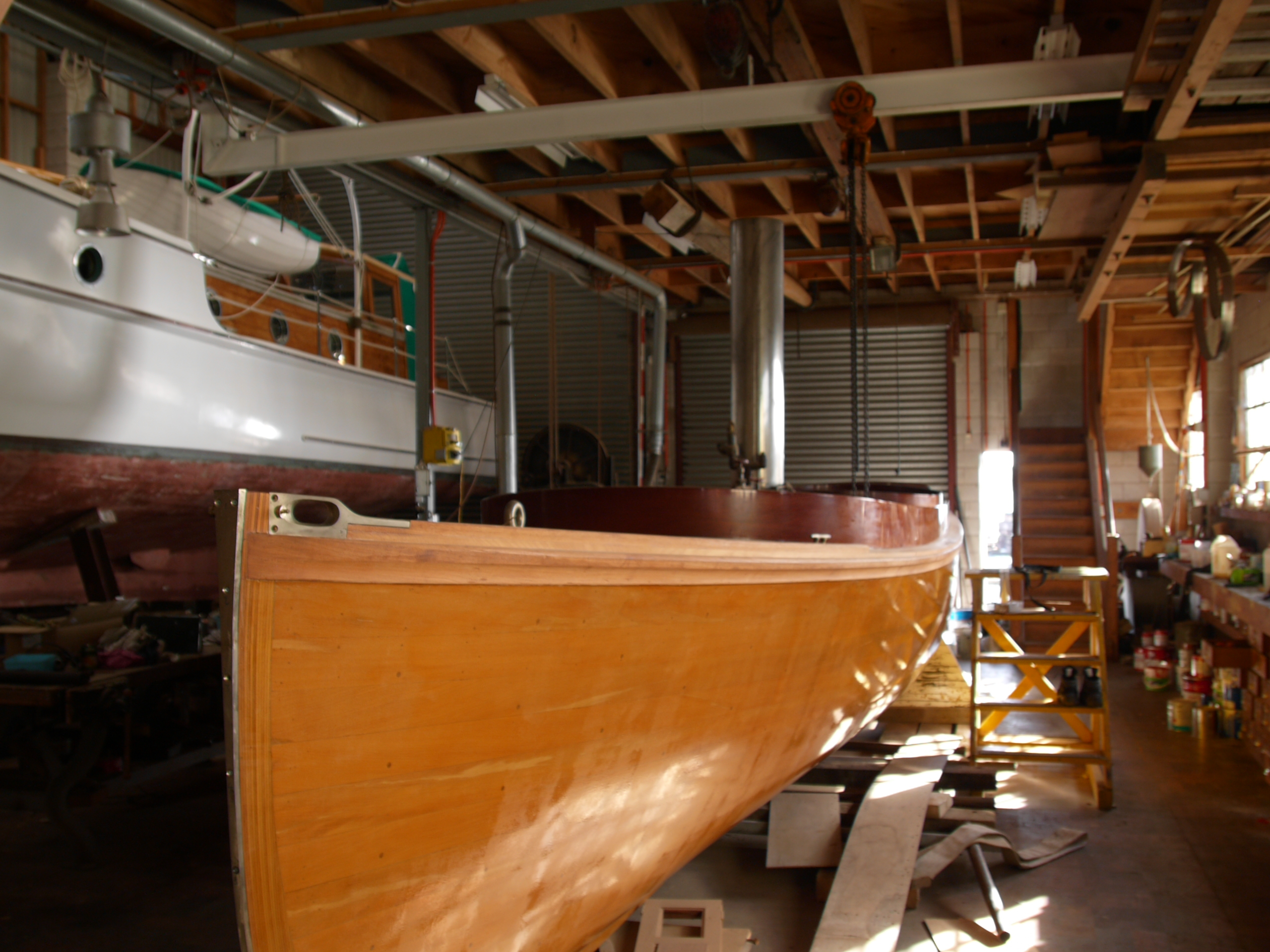
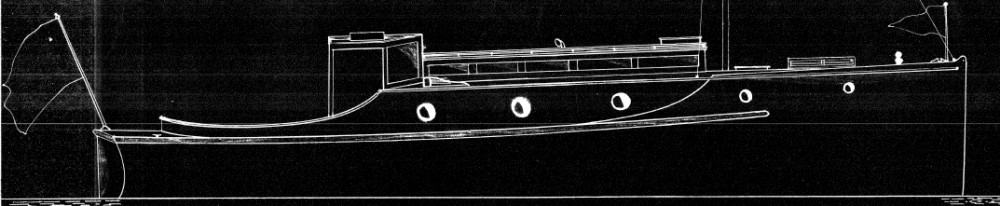
Russell was the bearer of some great news last week – the Colin Wild built Little Tasman, has found a new owner. Over the last few years numerious woodys have sent me photos of Little Tasman hauled out at Point Wells. I’m told a while ago a 4sale sign appeared, now I wish I had know – there are a few woodys out there that would have snapped up a Colin Wild built launch with the provenance that LT has. Wild built her for Albert Spencer & she was called Tasman & was a trial for his next (larger) boat also called Tasman so #1 then became Little Tasman. In the sepia photo above she looks to have a good turn of speed – I don’t imagine Albert Spencer would not have been chugging around the harbour at 7 knots 🙂

I’ll let Russell time his tale about Little Tasman.

“My memories of her go back to the mid ‘60s when all was Radio Hauraki, psychedelia, Beach Boys, Strolling Bones and Beatles. Oh and sheilas. Boats were somewhere in there and Bon Accord harbour was the stage. Mansion House was still privately run and the authorities didn’t know about the “Snake Pit”. There were usually several mullet boats nosed into the beach and crews in varying stages of recovery/rehydration. You couldn’t get your anchor to hold reliably in the bay because of all the bottles on the bottom!

The Kawau Yacht Club was pretty moribund, although the AMYC were making preliminaries to taking it on (my old man was on the committee of AMYC) so we had great hopes.
Mrs Lidgard was in residence, Skip Lawler had the Fairmile Ngaroma alongside the wharf for a while, and the Comettis had a fantastic garden. My potted history of the Christmas holidays.

The Ward family (no relation) had Little Tasman at that time and it was party time. If I said that one of the mullet  boats that had rafted alongside one memorable noisy night, was pushing off at just before sunrise because “they didn’t want to get us mulletties a bad name”, you get the picture.

But enough of that (it was just to get the old salts of Cobweb Corner reminiscing about their misspent youths). I have always been keen on machinery and when Harold Kidd mentioned that Little Tasman had a Stearns, I wondered what sort of engine they made. No pictures in my books. It was pretty obvious that there must have been classy because they were going into classy boats. American of course. And Stearns Knight made sleeve valve engines for their cars, the assumption that there was a connection was there. But no, no relation.

I contacted an old colleague in the US to see what he could find. And Richard Durgee sent me a raft of pics and adverts (refer below). They are 1924 and 26 so just right timing. I am fascinated that they have an amazingly modern head. Prod rod of course and the combustion chamber apparently in the piston.  You remember –what the Chrysler invented in the ‘70s for the Chrysler Hemi! Nuthin’ new out there, son. ’S all been dun before apart from nukes. Most marine engines were side valve –slower flame propagation and plenty of low down torque”.

Remember click image to enlarge

Lady Jade

LADY JADE
photos & details ex John Sankey & John Pryor

A ‘new’ classic was launched last weekend at Hamilton’s Landing on the Mahurangi River.

Lady Jade at 39′ is a Dave Jackson design and there are a further 3 sister ships currently under construction locally.
Her hull was started by local boating identity Col Bell and purchased by Andrew Hamilton when Col struck health problems.
She was worked on by both Andrew and his son Grant over the last year or so. The Hamilton Family have been boat builders and farmers on the Mahurangi for at least 5 generations, starting as scow builders and there are currently 3 generations still living on the property. They have been launching boats at this very un-marina launch site for 150+ years.

The mast on Lady Jade came from the wrecked (rescued & restored) Logan yacht Gypsy. Her bow roller is from the ex Logan lifeboat Tuna. She is powered by a 6lxb. Gardener, an ex show engine from Gardner UK. Supposedly, the last Gardener ever built.

The Minerva

THE MINERVA
A great read by Russell Ward
In my youth –well I’m still young ain’t I? – I used to admire a lovely old counter-sterned boat that used to moor in the Wade River. It is now not on the cruising agenda, but we quite often used to call in as part of a cruise. Sometimes if it was a really lumpy trip across to Tiri, we’d sneak down the Whangaparaoa Peninsula and sneak our way up to Stillwater to lick our wounds. There was a thriving motor camp and store there and at night the silence was profound.  Just nature all around. The tide was very strong and every day, about sunset, an old Labrador dog used to ease himself into the river and swim across to the Stillwater side. He would end up miles down river because of the tide and we never saw his return swim. Maybe he had a girlfriend or food source over on the other side. The term “dogged determination” sprang to mind.

But I digress. Moored just under the headland that is upstream of the WBC moorings was a fine old ship. She had the rather gracious name of  “The Minerva”.


(From Steamers Down the Fith by the late Bill Laxon).

Built as an Auckland harbour ferry in 1910, she was relatively shallow draft to cope with the creeks and estuaries. She was fitted with a coal fired scotch boiler and two 14 nhp compound engines made by George Fraser and Sons -a pioneer Auckland engineering company. This firm ran from 1862 -1955 and was a major builder of the heavy machinery a developing country needed especially when there was gold to be found in them there hills. For those interested, there is an early 1900 reference to the company at http://paperspast.natlib.govt.nz/cgi-bin/paperspast?a=d&d=NZH19000926.2.72.8.  The firm transmogrified into Tappenden Motors in the ‘50s and the asset stripping raids occasioned by Rogernomics sealed the company’s fate. It was under the spaghetti junction down from the University’s Owen Glenn Building.

The Minerva’s time on the Auckland Harbour came to an end in 1922 and she was taken round to the Kaipara (where her shallow draft was an asset) by Charles West to be converted to a tug for towing timber to the McLeod’s mills. As an aside, John McLeod was the first settler in Helensville. A sawmiller, he built his wife Helen a stately villa. And you always wondered why it as called Helensville.

The good ship steamed until the late 1940s. With an abundance of timber scraps, it had been good economics to keep her in steam. Now when I used to see The Minerva in the 1950>60s in the Waiti River, she had been diseasiled but I subsequently found out that her boiler went to a market gardener down south and one of her engines was left abandoned on the Helensville wharf up to the mid 1950s. As Bill Durham said in Steamboats and Modern Steam Launches “Come and get ‘em”. Alas the boiler has yet to be found and everyone seems to have forgotten her engine.  Anyone who knows where it is can happily contact me and all will be treated in confidence.

The Minerva’s time as a workboat came to an end in 1945 when she was converted to the pleasure boat I knew. Lewis McLeod retired and took her over to the milder east coast where I first met her. She went seriously downhill when she was sold for commercial fishing and even worse things in 1964. The Minerva presently lies under cover at Kerikeri somewhat north of here and a group is fighting to restore her.  As an aside Russell would love to know how she got the name The Minerva.

(as an aside, the writer Peter Gill, of the great story above in the ‘Bay Chronicle’ was a previous owner of my old girl Raindance, named Lady Gay (Gai?) in Peter’s day)


Restoring & Installing a Gardner in Arethusa

Restoring & Installing a Gardner in Arethusa

story & photos ex Dean Wright

It not often I get sent info on a boat & it jumps the queue & appears on ww the next day. If you have been following on ww the rolling restoration Dean has been doing on Arethusa over the last few years you would know two things, Arethusa is in very good hands & Deans a very talented commercial photographer. So the links below to Deans latest project – the restoration of a Gardner 4LW & subsequent installation in Arethusa are well worth check out.

Restoration     http://deanwright.co.nz/arethusa/log-arethusa/152-gardner-4lw-diesel-restoration.html

Installation      http://deanwright.co.nz/arethusa/log-arethusa/154-installing-the-gardner.html

Some history below

Arethusa ticked over 96 this year. She started life as a gaff rigged cutter, built by Bob Brown (designer of the Z class) at Sulphur Beach, Northcote. She’s carvel planked kauri, 33′ 4″ LOA with a 12′ Beam. With the aid of a fair bit of ballast she weighs 10 tonnes. She’s had an interesting life, more details here http://deanwright.co.nz/history.html

Chris McMullen Herreshoff Steam Launch – Part 2 (the engine)

The building of a replica 1898 Nathanael Herreshoff triple expansion steam engine – as told by Chris McMullen.

CMcM SteamLaunch AH6

The Herreshoff engine is a triple expansion type with cylinders 3-1/2” x 5”x 8” with a 4-1/2” stroke. It is a smaller version of that depicted in the L Francis Herreshoff book ‘The Wizard Of Bristol’ page 228.

The engine is very different to what the textbooks on the subject show. Everything designed by Nathanael Herreshoff seems to be that way. He certainly never copied traditional thinking but worked it out for him self.

Those interested may notice the two crankshafts gear driven one to one. The right hand one drives the piston valves. Going astern is effected by sliding bush or sleeve within the driven gear activated by a lever, this rotates the valve C/S to a new position. The bush, gear and shaft required machining male and female three start threads, left and right hand 8” pitch!  Not easy. The threads have / had to be cut on a planer using a dividing head coupled to the motion. Modern cars use a camshaft driven by a timing belt, similar to Herreshoff but remember this engine was designed in 1898!  The engine is very short to allow the crankshaft to be supported by two bearings and also to prevent loss of heat as the exhaust steam travels from one cylinder to the next, thus trying to reduce pressure loss.

If you look at the image of the crankshaft casting (below) you will notice the overhung balance weights. Notice the lack of material in the web between the second and third journal. The crank can’t be ground and there is no easy way to machine the metal designed to be eliminated by casting.  Casting this crank was a mission in SG iron. To cast it in steel (with 1/4” to the foot possible contraction) is going to be more difficult to achieve the correct length.

H.M.C.O had an outside foundry cast their steel but I notice in reading a recent article on Herreshoff Anchors they did have problems with their steel castings.

The base of the engine is a bronze casting to hold oil. The engine max revs are about 700 so the engine will have to be enclosed or throw oil everywhere.

There are good drawings available for this engine but no tolerances are given. I guess the fitters knew what was required. The original drawings were coloured to show the different materials, as was normal drafting practice.  The prints I got were black and white and difficult to read. No layers as in CAD drawing.

The Boiler is a three-drum type with curved tubes. It is similar to a Yarrow Type boiler. All the circulation is achieved in the tubes, the outer tubes being cooler than the inner. Once the circulation starts it continues. This was proven by Yarrows experiment in the early 1900’s. So Herreshoff and Yarrow, an ocean apart, came to similar conclusions. The upper drum of the boiler is 8“ OD, the lower drums 4-1/2” all with 5/16” wall. The 1/2“ tubes are expanded. Not easy to do up a tube just over 4” ID.

The boiler was built under survey. The working pressure is 250 PSI.

There are no pumps on the engine. The boiler is fed and the cooled exhaust condensate is removed for reuse by an independent steam driven combined feed and air pump. These pumps were the only item on the launch not made in house by H.M.C.O.  There were no drawings of these Marsh Pumps made by The American Steam Pump Co., Battle Creek Mitch. I copied mine from ‘Vapo’, an incredibly clever but simple pump with two moving parts but very difficult to manufacture.

I should add there has been no fabrication. Everything has been cast in iron or bronze.

Again this interesting project has been done for no other reason than for my own personal satisfaction.  I guess Prof. Evers Burtner’s comments (see copy of magazine article below), I quote “It is too bad that this engine is so complicated that amateurs would not be tempted to build one of their own”, was red rag to a bull.

To view part one i.e. the boat click here https://waitematawoodys.com/2014/07/07/chris-mcmullens-herreshoff-steam-launch/

Click Any Image / Photo Below To Enlarge


Chris McMullen’s Herreshoff Steam Launch – Part 1

Chris McMullen’s  Herreshoff Steam Launch

I visited a rather special boat shed the other day, shed is a bit of an understatement – I have a shed, Chris McMullen’s one is more like an aircraft hanger.
The reason for the invite was to have a look at the 1933 Colin Wild built launch Wirihana out of the water, but what really made me accept the invite in a flash was the chance to view the 34′ Herreshoff steam launch that Chris has been creating for nearly 30 years.
I use the term creating because every piece of this boat (including the steam engine) has been crafted by Chris’s own hands. Its a little way off launch day but already its a piece of art.

Why would someone undertake a project of this magnitude ? Chris’s view is “the whole project is an engineering exercise and an interesting challenge to recreate what was done 100 plus years ago.  Further, traveling on a fast steam launch is a great experience and there is something about generating your own power from fire and water”.

Click any of the above photos to enlarge 😉

I’ll let Chris tell the story – read on

“I have been building this (lets say) machinery and boat on and off for would you believe 27 years!  I started the project in 1987 –88 the year I sold McMullen & Wing Ltd.  Unlike some of my steam friends in the USA and the UK who are single minded,this has not been my only interest, during the time I have owned or had the use of other boats and done many other things.
The long winded project, is an embarrassment for me being a professional boat builder. It must be explained that I am not a trained Engineers Pattern Maker,  Foundry Moulder, Fitter and Turner, Coppersmith or a Boilermaker. I have had to learn these skills. Believe me, the Herreshoff’s draftsmen certainly did not compromised his design to make it easy for manufacture.  The castings for the engine are complex and thin walled. Several foundry’s kindly allowed me to do my own sand moulding on their premises. It would never have been possible without their cooperation.  I have had four attempts at casting the crankshaft. The only good casting (currently installed in the Engine) is of material not up to spec.  This has been a major blow and I guess my knowing this has set back the job.
The 3 throw crank has been drawn in “Solid Works” with the idea of machining it from a solid 9 inch diameter bar of steel on a NC lathe and Mill. A huge job and still can not be completely finished on these remarkable machines. At this stage there is no way to change the design. Crazy, the original was cast and machined in steel over one hundred years ago!
I went on and built the 34’ x 6’ 3” x’ 1’10”hull exactly the Herreshoff way (with a mould for every White Oak steamed frame) The hull double planked carvel style and glued with epoxy rather than set in shellac (as was the original) The planking was two skins of 5/16 NZ Kauri. So thin it could not be edge set. On the bilge the planks were made from thicker stock as they had to be backed out (hollowed and rounded) Very easy to loose control of thickness doing this and I believe Herreshoff Manufacturing (some how) steamed the round into the planks. I have a steam box, experimented but could not make it form the planks. I could have built the same boat double diagonal in a fraction of the time but the design scantlings would have had to be changed. At the time I wanted an exact replica! To what end? Now, I am not sure. (See below Vapor)
Anyway, the hull is basically finished with the boiler engine and water tank installed ready for the plumbing.
For those interested the design is HMCO design # 263 it was built 1908 as the Starboard launch for the Beautiful Twin Screw Steam Yacht “Cassandra”  Cassandra was built for an American owner by Scott’s at Greenock. Scotland in 1908 .She was 238 f.t O.A.L and could travel at just over 15 knots. Her tender was designed and built in the USA would have been “State of the Art” at the time and most likely the fastest launch available.  It would seem to me there were excellent Steam Launch builders in the UK. Simpson Strickland and Liquid Fuel Engineering (Lifu) and others but the owner chose the Herreshoff design / build. I have a copy of a letter written by Francis Herreshoff (the designers son) stating these launches could do 14 knots. To many, that seems unlikely but I have been on two Steam launches on Lake Windermere that can do  13 knots, so lets say we do not know.  These launches are proportioned closer to a rowing eight than a normal hull. On design #263 The boiler pressure is 250 PSI  The propeller is four bladed 22 x 30 inch pitch. the Hull and machinery is light. The shaft is low angle and the weights well forward.  The speed and shape of “Vapor” a similar steam launch has been discussed at length on Wooden Boat Forum  I have never got involved in the discussion but I am very familiar with “Vapor” and know the owner. Ed Louchard a boat builder from Port Townsend has done a wonderful job of building a replacement hull.  Vapor is the only surviving Herreshoff Steam Launch. The hull had been re planked at some time but the machinery is all original. Regarding “Vapor”, when I started my project I thought there were no Herreshoff Steam Launches in existence. I tracked down” Vapor” and her friendly owner in California about 12 years ago. Now she has been rebuilt it sort of makes my replica surplus.  In some ways procrastination has helped as more information about these remarkable launches comes to light from all over the world. I have enjoyed the research but now I am looking forward to finishing my project but it does get harder as one gets older”

Part 2 – The building of a replica 1898 Nathanael Herreshoff triple expansion steam engine –  https://waitematawoodys.com/2014/07/11/chris-mcmullen-herreshoff-steam-launch-part-2-the-engine/

Update on Vapor on the WoodenBoat Forum 24/07/2014

Vapor photos & kind words about Chris McMullen

http://forum.woodenboat.com/showthread.php?179519-Herreshoff-Steam-Launch-In-Auckland-New-Zealand&p=4235461#post4235461

And more Vapor – 25/07/2014

http://forum.woodenboat.com/showthread.php?179519-Herreshoff-Steam-Launch-In-Auckland-New-Zealand&p=4236325#post4236325

Is This The Future?

Is This The Future?

ESC. KEY

Esc.Key is a new solar electric riverboat recently launched by Denman Marine Australia.

The initial design brief was for a river launch that was similar in concept to the early 20th century Noosa River putt-putt boats which had a hard top to keep the harsh Queensland sun at bay.

The boat is constructed from strip plank western red cedar on celery top pine structural timbers. Fit out is Tasmanian blackwood and Huon pine. Decks and sole are laid teak. The hard top is 25mm core cell foam/western red cedar and celery top pine. She has a beautiful birds eye Huon pine table aft that lowers to form a day bed for those lazy afternoons.

She is powered by a Mastervolt Drive Master ultra 3.5kw 48V AC motor which pushes her along at a nice cruise speed of 4.5kts with max speed 6.5kts. She has a 450Ah 48V AGM battery bank which is fed by 1000 watts of thin film, high output Solbianflex solar panels on the hard top. At full charge, the boat is energy neutral at 4kts.

The engine was small enough to have it completely below the sole and the set allows you to cruise along with no noise/fumes or the smell of diesel, definitely the way of the future.

DESIGN SPECS

LOA (feet): 23′

0″

Beam (feet): 8′

4″

Type/Rig/Power: electric powered river launch
Home Port: Noosa, Queensland , Australia
Designer Name: David Payne/Imagineocean Yacht Design/Denman Marine
Builder Name: Denman Marine
Launching Date: February 18, 2014


Classic Bling

CLASSIC BLING – ONLY $4995….. 

Ok, you have restored the boat, built (bought) the kauri clinker tender & the pocket money is burning a hole in your pocket – best get on to trade me & buy this. If you think its too beautiful to use, think of it as a piece of art 🙂

The A-Series outboard was Johnson’s first ‘kicker’ and it placed Johnson & Brothers well & truly ‘on the map’ – the opposed twin platform provided 2hp & proved a fabulous design and one that is just as beautiful today as it was nearly a century ago – the lightweight, easily handled Water Bug revolutionised power boating in the 20’s for the exact same reasons they are to this very day with Johnson’s advertising slogan ‘ – Dependable Outboards – ‘ certainly prophetic!

The 3 brothers (Clarence, Harry & Lou) sold their growing business to investors from Wall Street at the turn of the decade so this vintage Water Bug (or ‘Light Twin’ as it was also coined) was produced while the brothers were at the tiller so to speak – 360 degree swivelling gave high levels of manoeuvrability, tilting enabled easy beaching plus a ‘1 Year Guarantee’ guaranteed the Bug’s success with it eventually paving the way for the SeaHorse badged Johnson’s – heres some basic specs on this delightful machine: Year & model: 1925 Johnson Water Bug Cooling: Mechanical piston water pump

Horsepower: 2hp @ 2400 rpm      Cylinders: 2 – opposed twin

Ignition: Johnson magneto      Oil/gas mix: 1/2 pt TCW-3

Spark plug: Champion C7      Retail 1925: US$ 142.50

Condition: Restored      Serial: 226xx (1925)

Point gap: 0.020      Weight: 35 lbs.

Stroke: 1.5″      Bore: 2″

Baldrick The Steamer

This slideshow requires JavaScript.

Baldrick The Steamer

A 16’ Clinker built steam engine launch, built in 1953 by Percy Vos Ltd. Auckland
Converted to steam and completely refurbished by Don Penn from 1999 – 2006.

LOA 16’ LWL 15’.3” Draught 1’.7” Beam 5’.9”
Boiler:- A coal fired VFT ( Vertical fire tube design} by Graeme Wilkinson.

Construction: Planking and Keel – heart kauri. Stem –Pohutukawa natural crook.
Timbers – bent mangaeo. Fore and aft decks – teak 
 
Currently for sale on trademe  http://www.trademe.co.nz/a.aspx?id=548696749