Restoring & Installing a Gardner in Arethusa

Restoring & Installing a Gardner in Arethusa

story & photos ex Dean Wright

It not often I get sent info on a boat & it jumps the queue & appears on ww the next day. If you have been following on ww the rolling restoration Dean has been doing on Arethusa over the last few years you would know two things, Arethusa is in very good hands & Deans a very talented commercial photographer. So the links below to Deans latest project – the restoration of a Gardner 4LW & subsequent installation in Arethusa are well worth check out.

Restoration     http://deanwright.co.nz/arethusa/log-arethusa/152-gardner-4lw-diesel-restoration.html

Installation      http://deanwright.co.nz/arethusa/log-arethusa/154-installing-the-gardner.html

Some history below

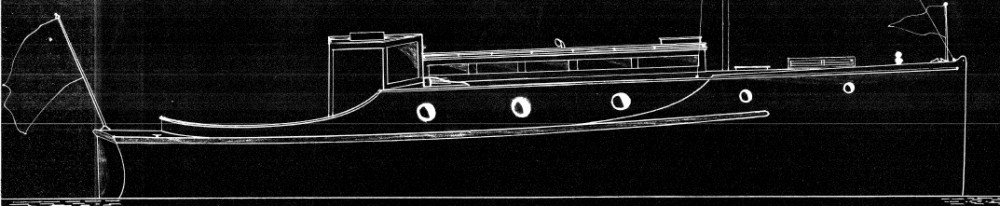
Arethusa ticked over 96 this year. She started life as a gaff rigged cutter, built by Bob Brown (designer of the Z class) at Sulphur Beach, Northcote. She’s carvel planked kauri, 33′ 4″ LOA with a 12′ Beam. With the aid of a fair bit of ballast she weighs 10 tonnes. She’s had an interesting life, more details here http://deanwright.co.nz/history.html

Chris McMullen Herreshoff Steam Launch – Part 2 (the engine)

The building of a replica 1898 Nathanael Herreshoff triple expansion steam engine – as told by Chris McMullen.
CMcM SteamLaunch AH6

The Herreshoff engine is a triple expansion type with cylinders 3-1/2” x 5”x 8” with a 4-1/2” stroke. It is a smaller version of that depicted in the L Francis Herreshoff book ‘The Wizard Of Bristol’ page 228.

The engine is very different to what the textbooks on the subject show. Everything designed by Nathanael Herreshoff seems to be that way. He certainly never copied traditional thinking but worked it out for him self.

Those interested may notice the two crankshafts gear driven one to one. The right hand one drives the piston valves. Going astern is effected by sliding bush or sleeve within the driven gear activated by a lever, this rotates the valve C/S to a new position. The bush, gear and shaft required machining male and female three start threads, left and right hand 8” pitch!  Not easy. The threads have / had to be cut on a planer using a dividing head coupled to the motion. Modern cars use a camshaft driven by a timing belt, similar to Herreshoff but remember this engine was designed in 1898!  The engine is very short to allow the crankshaft to be supported by two bearings and also to prevent loss of heat as the exhaust steam travels from one cylinder to the next, thus trying to reduce pressure loss.

If you look at the image of the crankshaft casting (below) you will notice the overhung balance weights. Notice the lack of material in the web between the second and third journal. The crank can’t be ground and there is no easy way to machine the metal designed to be eliminated by casting.  Casting this crank was a mission in SG iron. To cast it in steel (with 1/4” to the foot possible contraction) is going to be more difficult to achieve the correct length.

H.M.C.O had an outside foundry cast their steel but I notice in reading a recent article on Herreshoff Anchors they did have problems with their steel castings.

The base of the engine is a bronze casting to hold oil. The engine max revs are about 700 so the engine will have to be enclosed or throw oil everywhere.

There are good drawings available for this engine but no tolerances are given. I guess the fitters knew what was required. The original drawings were coloured to show the different materials, as was normal drafting practice.  The prints I got were black and white and difficult to read. No layers as in CAD drawing.

The Boiler is a three-drum type with curved tubes. It is similar to a Yarrow Type boiler. All the circulation is achieved in the tubes, the outer tubes being cooler than the inner. Once the circulation starts it continues. This was proven by Yarrows experiment in the early 1900’s. So Herreshoff and Yarrow, an ocean apart, came to similar conclusions. The upper drum of the boiler is 8“ OD, the lower drums 4-1/2” all with 5/16” wall. The 1/2“ tubes are expanded. Not easy to do up a tube just over 4” ID.

The boiler was built under survey. The working pressure is 250 PSI.

There are no pumps on the engine. The boiler is fed and the cooled exhaust condensate is removed for reuse by an independent steam driven combined feed and air pump. These pumps were the only item on the launch not made in house by H.M.C.O.  There were no drawings of these Marsh Pumps made by The American Steam Pump Co., Battle Creek Mitch. I copied mine from ‘Vapo’, an incredibly clever but simple pump with two moving parts but very difficult to manufacture.

I should add there has been no fabrication. Everything has been cast in iron or bronze.

Again this interesting project has been done for no other reason than for my own personal satisfaction.  I guess Prof. Evers Burtner’s comments (see copy of magazine article below), I quote “It is too bad that this engine is so complicated that amateurs would not be tempted to build one of their own”, was red rag to a bull.

To view part one i.e. the boat click here https://waitematawoodys.com/2014/07/07/chris-mcmullens-herreshoff-steam-launch/

Click Any Image / Photo Below To Enlarge


Chris McMullen’s Herreshoff Steam Launch – Part 1

Chris McMullen’s  Herreshoff Steam Launch

I visited a rather special boat shed the other day, shed is a bit of an understatement – I have a shed, Chris McMullen’s one is more like an aircraft hanger.
The reason for the invite was to have a look at the 1933 Colin Wild built launch Wirihana out of the water, but what really made me accept the invite in a flash was the chance to view the 34′ Herreshoff steam launch that Chris has been creating for nearly 30 years.
I use the term creating because every piece of this boat (including the steam engine) has been crafted by Chris’s own hands. Its a little way off launch day but already its a piece of art.

Why would someone undertake a project of this magnitude ? Chris’s view is “the whole project is an engineering exercise and an interesting challenge to recreate what was done 100 plus years ago.  Further, traveling on a fast steam launch is a great experience and there is something about generating your own power from fire and water”.

Click any of the above photos to enlarge 😉

I’ll let Chris tell the story – read on

“I have been building this (lets say) machinery and boat on and off for would you believe 27 years!  I started the project in 1987 –88 the year I sold McMullen & Wing Ltd.  Unlike some of my steam friends in the USA and the UK who are single minded,this has not been my only interest, during the time I have owned or had the use of other boats and done many other things.
The long winded project, is an embarrassment for me being a professional boat builder. It must be explained that I am not a trained Engineers Pattern Maker,  Foundry Moulder, Fitter and Turner, Coppersmith or a Boilermaker. I have had to learn these skills. Believe me, the Herreshoff’s draftsmen certainly did not compromised his design to make it easy for manufacture.  The castings for the engine are complex and thin walled. Several foundry’s kindly allowed me to do my own sand moulding on their premises. It would never have been possible without their cooperation.  I have had four attempts at casting the crankshaft. The only good casting (currently installed in the Engine) is of material not up to spec.  This has been a major blow and I guess my knowing this has set back the job.
The 3 throw crank has been drawn in “Solid Works” with the idea of machining it from a solid 9 inch diameter bar of steel on a NC lathe and Mill. A huge job and still can not be completely finished on these remarkable machines. At this stage there is no way to change the design. Crazy, the original was cast and machined in steel over one hundred years ago!
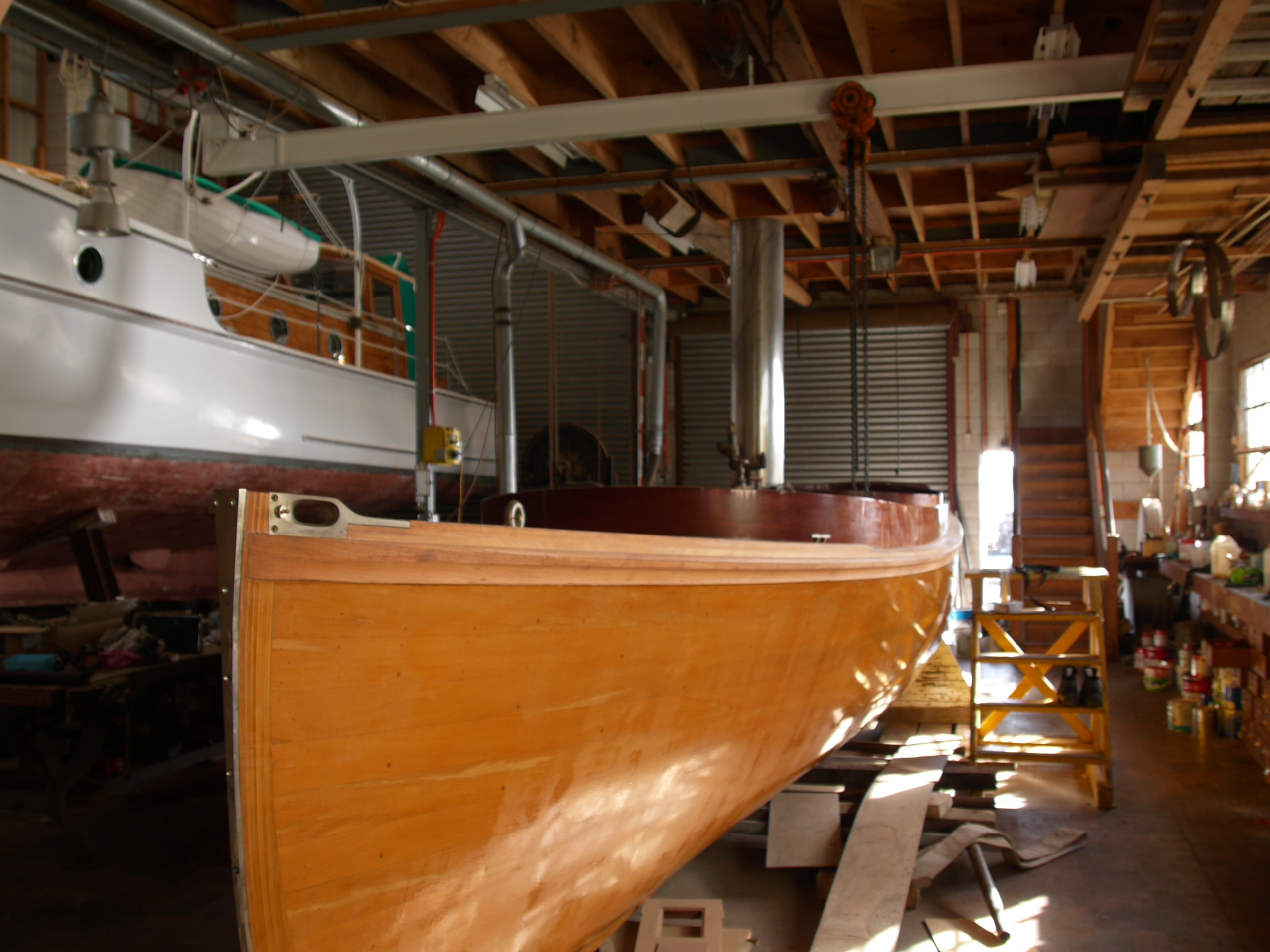
I went on and built the 34’ x 6’ 3” x’ 1’10”hull exactly the Herreshoff way (with a mould for every White Oak steamed frame) The hull double planked carvel style and glued with epoxy rather than set in shellac (as was the original) The planking was two skins of 5/16 NZ Kauri. So thin it could not be edge set. On the bilge the planks were made from thicker stock as they had to be backed out (hollowed and rounded) Very easy to loose control of thickness doing this and I believe Herreshoff Manufacturing (some how) steamed the round into the planks. I have a steam box, experimented but could not make it form the planks. I could have built the same boat double diagonal in a fraction of the time but the design scantlings would have had to be changed. At the time I wanted an exact replica! To what end? Now, I am not sure. (See below Vapor)
Anyway, the hull is basically finished with the boiler engine and water tank installed ready for the plumbing.
For those interested the design is HMCO design # 263 it was built 1908 as the Starboard launch for the Beautiful Twin Screw Steam Yacht “Cassandra”  Cassandra was built for an American owner by Scott’s at Greenock. Scotland in 1908 .She was 238 f.t O.A.L and could travel at just over 15 knots. Her tender was designed and built in the USA would have been “State of the Art” at the time and most likely the fastest launch available.  It would seem to me there were excellent Steam Launch builders in the UK. Simpson Strickland and Liquid Fuel Engineering (Lifu) and others but the owner chose the Herreshoff design / build. I have a copy of a letter written by Francis Herreshoff (the designers son) stating these launches could do 14 knots. To many, that seems unlikely but I have been on two Steam launches on Lake Windermere that can do  13 knots, so lets say we do not know.  These launches are proportioned closer to a rowing eight than a normal hull. On design #263 The boiler pressure is 250 PSI  The propeller is four bladed 22 x 30 inch pitch. the Hull and machinery is light. The shaft is low angle and the weights well forward.  The speed and shape of “Vapor” a similar steam launch has been discussed at length on Wooden Boat Forum  I have never got involved in the discussion but I am very familiar with “Vapor” and know the owner. Ed Louchard a boat builder from Port Townsend has done a wonderful job of building a replacement hull.  Vapor is the only surviving Herreshoff Steam Launch. The hull had been re planked at some time but the machinery is all original. Regarding “Vapor”, when I started my project I thought there were no Herreshoff Steam Launches in existence. I tracked down” Vapor” and her friendly owner in California about 12 years ago. Now she has been rebuilt it sort of makes my replica surplus.  In some ways procrastination has helped as more information about these remarkable launches comes to light from all over the world. I have enjoyed the research but now I am looking forward to finishing my project but it does get harder as one gets older”

Part 2 – The building of a replica 1898 Nathanael Herreshoff triple expansion steam engine –  https://waitematawoodys.com/2014/07/11/chris-mcmullen-herreshoff-steam-launch-part-2-the-engine/

Update on Vapor on the WoodenBoat Forum 24/07/2014

Vapor photos & kind words about Chris McMullen

http://forum.woodenboat.com/showthread.php?179519-Herreshoff-Steam-Launch-In-Auckland-New-Zealand&p=4235461#post4235461

And more Vapor – 25/07/2014

http://forum.woodenboat.com/showthread.php?179519-Herreshoff-Steam-Launch-In-Auckland-New-Zealand&p=4236325#post4236325

Is This The Future?

Is This The Future?

ESC. KEY

Esc.Key is a new solar electric riverboat recently launched by Denman Marine Australia.

The initial design brief was for a river launch that was similar in concept to the early 20th century Noosa River putt-putt boats which had a hard top to keep the harsh Queensland sun at bay.

The boat is constructed from strip plank western red cedar on celery top pine structural timbers. Fit out is Tasmanian blackwood and Huon pine. Decks and sole are laid teak. The hard top is 25mm core cell foam/western red cedar and celery top pine. She has a beautiful birds eye Huon pine table aft that lowers to form a day bed for those lazy afternoons.

She is powered by a Mastervolt Drive Master ultra 3.5kw 48V AC motor which pushes her along at a nice cruise speed of 4.5kts with max speed 6.5kts. She has a 450Ah 48V AGM battery bank which is fed by 1000 watts of thin film, high output Solbianflex solar panels on the hard top. At full charge, the boat is energy neutral at 4kts.

The engine was small enough to have it completely below the sole and the set allows you to cruise along with no noise/fumes or the smell of diesel, definitely the way of the future.

DESIGN SPECS

LOA (feet): 23′

0″

Beam (feet): 8′

4″

Type/Rig/Power: electric powered river launch
Home Port: Noosa, Queensland , Australia
Designer Name: David Payne/Imagineocean Yacht Design/Denman Marine
Builder Name: Denman Marine
Launching Date: February 18, 2014


Classic Bling

CLASSIC BLING – ONLY $4995….. 

Ok, you have restored the boat, built (bought) the kauri clinker tender & the pocket money is burning a hole in your pocket – best get on to trade me & buy this. If you think its too beautiful to use, think of it as a piece of art 🙂

The A-Series outboard was Johnson’s first ‘kicker’ and it placed Johnson & Brothers well & truly ‘on the map’ – the opposed twin platform provided 2hp & proved a fabulous design and one that is just as beautiful today as it was nearly a century ago – the lightweight, easily handled Water Bug revolutionised power boating in the 20’s for the exact same reasons they are to this very day with Johnson’s advertising slogan ‘ – Dependable Outboards – ‘ certainly prophetic!

The 3 brothers (Clarence, Harry & Lou) sold their growing business to investors from Wall Street at the turn of the decade so this vintage Water Bug (or ‘Light Twin’ as it was also coined) was produced while the brothers were at the tiller so to speak – 360 degree swivelling gave high levels of manoeuvrability, tilting enabled easy beaching plus a ‘1 Year Guarantee’ guaranteed the Bug’s success with it eventually paving the way for the SeaHorse badged Johnson’s – heres some basic specs on this delightful machine: Year & model: 1925 Johnson Water Bug Cooling: Mechanical piston water pump

Horsepower: 2hp @ 2400 rpm      Cylinders: 2 – opposed twin

Ignition: Johnson magneto      Oil/gas mix: 1/2 pt TCW-3

Spark plug: Champion C7      Retail 1925: US$ 142.50

Condition: Restored      Serial: 226xx (1925)

Point gap: 0.020      Weight: 35 lbs.

Stroke: 1.5″      Bore: 2″

Baldrick The Steamer

This slideshow requires JavaScript.

Baldrick The Steamer

A 16’ Clinker built steam engine launch, built in 1953 by Percy Vos Ltd. Auckland
Converted to steam and completely refurbished by Don Penn from 1999 – 2006.

LOA 16’ LWL 15’.3” Draught 1’.7” Beam 5’.9”
Boiler:- A coal fired VFT ( Vertical fire tube design} by Graeme Wilkinson.

Construction: Planking and Keel – heart kauri. Stem –Pohutukawa natural crook.
Timbers – bent mangaeo. Fore and aft decks – teak 
 
Currently for sale on trademe  http://www.trademe.co.nz/a.aspx?id=548696749

Zoom Zoom – Hogan runabout

Image

Garth Hogan restored Runabout Jan 29 2013Zoom Zoom - Hogan runabout

The runabout above was built by Ted Hogan & recently restored by his grandson Garth Hogan. The Hogan family including Garth’s Dad Ron, have a long history of preparing the Ford flathead V8 engines that power the boat. In the past most of the go-fast speedway race cars at Western Springs & Waikaraka Pack were running engines tuned by the Hogan’s.

Harold Kidd commented on the CYA forum that his “1930 Ford roadster pickup was putting out 85 bhp at the back wheels on a dyno with standard carb and exhaust manifold. Unbelievable power and torque for a side-valver. It had a wild cam, lightweight invar strut pistons and huge valves and looked like a bog standard 40 bhp Model A engine at a casual glance (apart from the finned alloy Hogan head) but had that really magnificent Model C truck block with fully circular webs. I had it balanced at Air New Zealand so it revved like a banshee and was turbine-smooth.”

John Dory & her Lister engine

image002IMG_6201_MG_2377_MG_2395 copy

Built as a commercial fishing boat for coastal long lining the objective of the overall design and construction methods was to create a simple, cost effective and easy driven vessel. John Dory is also an outstanding sea boat and has demonstrated this ability on many occasions.

Her 27hp Lister Diesel is a good example of the type of machinery once used in small coastal fishing boats. John Dory is well maintained to a commercial standard. Howard Pascoe cruised the Coromandel and Northern Coastline up until his death in 2001.

23/09/2014 – The Lister is getting some love, including a new (out of the box) reduction box – love the bronze nuts.