Electro-Chemical Damage In Wooden Boats Update

rudder electrochemical damage


ELECTRO-CHEMICAL DAMAGE IN WOODEN BOATS UPDATE
A Special Post By Chris McMullen

Recently I received a note from Chris where he questioned if the story we posted last year on ww about electro-chemical damage to wood  was a little too long & were people reading it. Well I can tell you that the post is the single most visited story on ww, ever, & gets read by people all over the world. Its frequently referred to on the hugely popular WoodenBoat Forum in the USA. The link below takes you to the original story.

Electrochemical Damage To Wood – the marine version of ‘leaky homes’

For the impatient ones out there 🙂 Chris has done a ‘Readers Digest’ version & refers to a vessel that recently featured on ww.
I encourage all of you to read today’s story & if you own a classic wooden boat – read both versions – the problem is the biggest risk to the life of our classic boats.

In Chris’s words:
“I received the above disturbing images of another woody being destroyed by an owner who I believe is unintentionally loving his boat to death.

The use of anodes and bonding on a wooden boat is fatal. The cathode or protected metal makes hydrogen gas and this combined with saltwater makes Sodium Hydroxide (Caustic Soda). This chemical is used to pulp wood in the paper making industry. Not on my boat thank you! I say again, there is no reason to use anodes and bonding on any boat. The only exception, steel hulls require anodes. If copper or bronze are being corroded it is due to a positive DC leak and Zinc anodes will not help. Find the electrical leak is the cure. If there is brass or manganese bronze underwater it will corrode due to the
zinc in the alloy. Anodes will possibly stop the corrosion but at the expense of wood damage. A better plan is to replace the brass with proper marine bronze.

Bronze and copper should last indefinitely in the sea. To prove that statement, I ask you to look at the Roman coins and artifacts salvaged from ships wrecked in the fourteenth century. There was no anodic protection and the metal is well preserved. So what is the difference to the copper and bronze on your boat? There is absolutely no difference so why waste your money buying anodes that will in time destroy
your wooden boat.

Three or four bottles of wine will cost the same as anodes and will make you and your boat happier.”

Note: ww is read all around the world, if there is water & boats, there are people reading ww. So a little about the man for non kiwi’s  – Chris is one of NZ’s most respected boat builders (retired) and at one time was the Lloyds (Honorary) Wood Boat Surveyor in Auckland. Chris’s (the original company) ‘McMullen & Wing’ built and repaired wood, steel and marine aluminium vessels. They built the first welded aluminum vessels in NZ. Chris is the current holder of the Classic Yacht Association of New Zealand ‘Outstanding Achievement Trophy’ for services to classic boating.

14-05-2016 Photo Update
Gavin Gault sent in the below photos of a Nova skeg floor that he believes were probably damaged due to engine – anode bonding failure. Pretty graphic !!

10-07-2016 Reply from Chris McMullen

“Wow. Thank you Gavin Gault for sharing your very graphic images. Very sad, small consolation but yours will not be the only wooden boat affected by this scourge.
Maybe, at last some of the Flat Earth Society will start to believe what I have been saying. The worst detractors are some in the Marine Industry who have been preaching the Anode, Bonding party line for years.  Now there is no where to run for cover,  they continue to conjure up excuses and it seems, refuse to accept a simple scientific fact.
“If you have a positive and negative electrode in salt water, the negative cathode or protected metal makes hydrogen gas and this combined with salt water makes Sodium hydroxide.”
This chemical is also known as caustic soda and removes paint and destroys wood.  There is no doubt about this fact. You do require a power source and bonded dissimilar metals ( zinc and copper) provide sufficient current to do the damage, but slowly.
If there is a negative DC leak (to the sea)on a bonded boat the process is accelerated. If there is a positive leak any metal becomes an anode and will waste away. It is important to isolate the DC power from contact with the sea. Again bonding is just asking for trouble. Please remove Anodes and Bonding from your wooden boat now!
Chris McMullen”

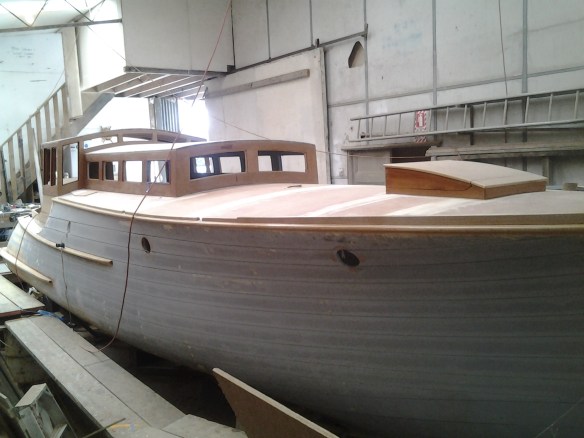
06-09-2106 In case you were not to sure what to look out for – the below photo should be a wake-up call to a few woodys 😉

IMG_1120


Little Tasman

LITTLE TASMAN - STARBOARD SIDE - 7.3.16 - 3

LITTLE TASMAN - STARBOARD SIDE - 7.3.16 - 0

LITTLE TASMAN
shed photos & info ex Ken Ricketts. Pt Wells photo ex Mark Edmonds. details ex Harold Kidd. edited a lot by Alan H

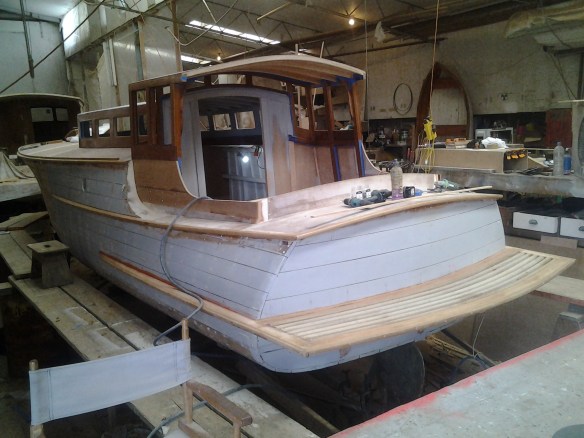
Back in early March Ken Ricketts dropped in to see artisan boat builder Colin Brown at his Omaha yard. Colin & side kick, Josh, have been restoring the rather pretty 26′ Colin Wild launch Little Tasman.  She was named Tasman when built in 1925 for Albert Spencer & changed her name to Little Tasman in 1927 when the bigger Tasman (photo included below) was launched by the same owner/builder. Its said she that LT was a prototype / test boat – Mr Spencer was not short of a few pennies 😉

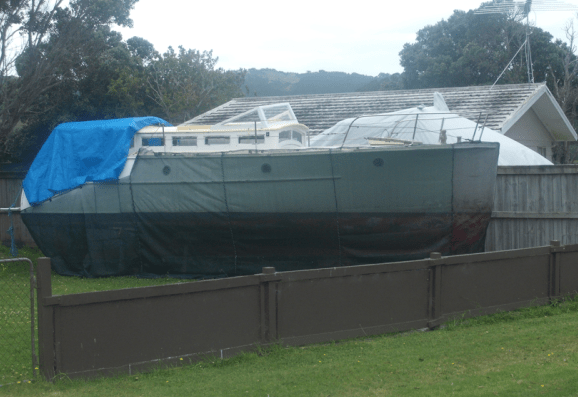
It is such good news to see whats happening to Little Tasman as she sat on a front lawn at Pt. Wells for a number of years (photo below) & her future was at risk.

Little Tasman at Pt Wells

In Harold Kidd’s words Little Tasman is ‘pure class’ & whats happening in Colin’s shed is also pure class  – the man is one of the best classic friendly tradies out there.

You will see in the above photos that she now has a brand new 4 cyl Nanni 38 hp diesel in place, which should give her a top speed of around 10 knots, with a cruising speed, with her 2 to 1 reduction gear, of around 7 knots. Will be interesting to see her performance as the Nanni is a lot lighter than the old 6 cyl Ford diesel it is replacing.

Her restoration has seen most of her ribs replaced, a full recaulk (no splining), work on the forepeak & bow, a new dodger, very faithfully copied from the original & a full interior refit & partial redesign of the interior layout, for greater space use, & practicality.
Steering will be from the front of the tram top, as it was before, where there will be a large hatch fitted, to the newly replaced, as original, T & G cabin top. Check out the stern photo, classic Colin Wild on show there 🙂

Launch date is fast approaching so we will update on the event.

Read more on her past here      https://waitematawoodys.com/2015/04/20/little-tasman/

Below is a photo of Tasman that I took a few years ago in Sullivans Bay. She is stunner & on a lot of woodys bucket list.

Tasman @ Sullivans Bay

30-06-2016 – Another great photo update from Ken R of Little Tasman’s restoration at Colin Brown’s yard. Remember click on photos to enlarge 😉

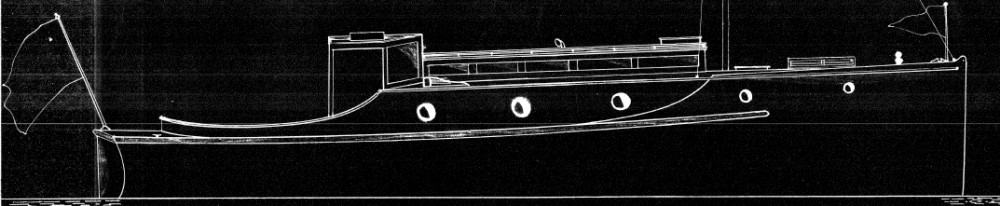
Mystery Launch Quiz

Mystery Launch

Mystery Launch Quiz
Win a copy of Robert Brooke’s book – ‘Beautiful Boats’

Ok woodys the first woody that can supply the boat name, designer, builder & year of launch will win a copy of Robert’s just released book ‘ Beautiful Boats’. The first reply in the ww comments section with all 4 answers correct – wins.

Robert has been collecting classic yacht designs for over 50 years, amongst his collection is work from our most talented & recognized designers – Arch Logan, Chas Bailey, Charlie & Alex Collings, Colin Wild, Bert Woolacott, Bob Stewart, Des Townson, Alan Wright & Robert’s father – John Brooke.
From his collection Robert has chosen 50 & redrawn each design, tracing off the original drawings to present them in a similar format. To add to the wow factor, Robert used the drawing equipment & ships curves that were once used by either Arch Logan, Charlie & Alex Collings or his father.

The 105 page, A4 size book allocates 2 pages to each vessel with specs & photo/s on the left & the drawings – hull lines, profile, half breadths, sections, diagonals & sail plan on the right hand page (refer Rainbow drawing example below). Its a must have in all serious woodys library.

Robert has very generously donated 4 copies of the book to waitematawoodys so over the next few weeks I will be giving them away as prizes. In addition I also have a framed 380 x 300 rendered copy of one of the Beautiful Boats. I have not decided yet how this will be ‘won’, details soon.

There are thousands of ww followers out there so do not get your hopes up on winning a copy 🙂 I would suggest you visit Boat Books at 22 Westhaven Drive, Westhaven, Auckland & grab a copy for yourself, cost is $60. For out of towners or those who refer the web – copies are available on line at  https://www.boatbooks.co.nz/
Its a very limited print run & Boat Books are the sole outlet. Boat Books also have framed copies of the prints for sale – David Glen was one of the first to race in & buy a print of his Rainbow.

Cover, Tawera

Rainbow

Okura Gigs – Sailing Sunday

Okura Gig 49 (9)

Historic photo 01

Historic photo 02

OKURA GIGS
photos & details ex Darren Arthur

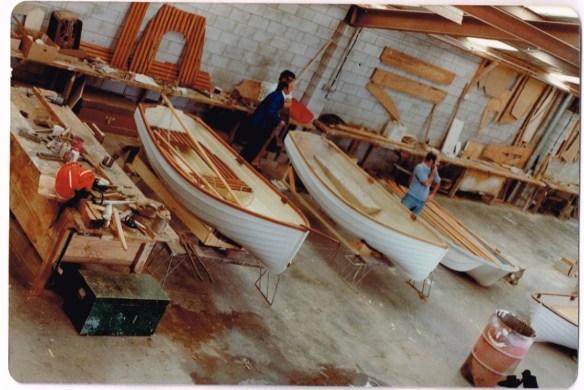
We did a post on ww a little while ago about ‘Seabird’ dinghies & this generated chat & subsequent comments about the ‘Okura Gig’. This sparked Darren to contact his wife’s uncle – Dennis Hart, who with his late brother Ray ran Hart Brothers Marine and were behind the Okura Gigs. Darren encouraged Dennis to document their history.
Darren asked me that given that the boats we not wood, was it a potential ww story – after a quick peek at the photos – I replied that there was more than enough wood & bronze to get the ww tick 😉

I have published Dennis’s story below word for word, its a great tale & combined with the above collection of older & recent photos is a cracker read. Enjoy 🙂

THE OKURA GIG:  A Brief History By Dennis Hart

Background

During the late 1800’s the area at Silverdale now known as Millwater included the Grut (pronounced Grew) farm which had access to the Orewa Estuary. Mr Grut had a 10 foot kauri clinker rowing boat, understood to have been built by Bailey & Lowe at Sulphur Point, Northcote. The boat was mostly used for net fishing. Charles St.Croix Grut and Alec Grut later inherited the farm and continued farming until the 1960’s ?

Dennis believes Croix and his wife Merle had the 38ft Wollacott design yacht Iorana, built by Don Wood at his yard in the Orewa Estuary. However the memory can play tricks over time & Dennis would be interested to learn if he is correct in this. The couple then in their late 60’s were the first Weiti Yacht Club members to circumnavigate the globe.

Croix brought the boat to my brother Ray and I at Hart Bros Marine  in the mid to late 70’s for a full restoration to its original configuration as the 70 plus years had taken their toll. We duly completed the ‘no expenses spared’  job resulting in a very pretty and sound rowing boat. We negotiated a deal whereby we could use the boat as a plug and take a mould from it in order to produce the boat in fibreglass , We made no charge for the restoration returning it to Croix and Alex with a fibreglass replica rowing boat each for their general use. The original boat was retired.

I tried to locate the original boat and was told by Croix that he had entrusted it to a gentleman who had promised to donate it to the Maritime Museum. On enquiring there I was told that no such boat had been received. Croix Passed away in November 2012 aged 94.

Building the OG

Because of the tumblehome created by the very pretty wineglass transom the mould had to be in two parts. The original boat had no centrecase so a slot was cut in the keel and a case was moulded in -situ at the same time as fitting the buoyancy thwarts and stern benches . A galvanised steel swinging plate was hinged at the top forward point, raised and lowered  by a stainless wire. After release from the mould Kwila slats were fitted to the thwarts, the inner and outer gun’les were copper riveted together, the thwart  and lodging knees fixed in place followed by the remainder of the fit-out . Two rowing positions were provided, the forw’d pair provided fitting for the side stays.

The rig

The sails were kept as traditional as possible by using ‘tanbark’ coloured sail cloth and braided lacings. The oregon spars were made so that they would fit inside the boat, when not in use. This worked well as a handy sized main was set with the peak well above the mast top. This, coupled, with a boom that overhung the transom and a jib tacked to a short sprit,  giving plenty of sail.  Many of the fittings  that controlled the running rigging (cleats and blocks, were made by hand or modified from Harken traditional range. All other fittings were sourced from the depths of Fosters basement or were bespoke by us of copper, brass or bronze. The gaff jaws were covered in leather. Rope sheets were a light tan poly. The gaff halyard was rove to a bridle to make setting the main more simple.

Development

Like the old harbour ferries the OG has a balanced waterline with fine ends so does not drag water at the transom as the boats bottom lifts the transom clear of the water at the stem of the wineglass.  Fit-out of these boats was kept to an affordable minimum at the time.  As production continued we made some minor modifications and improvements, i.e. separate peak and throat halyards to give better shape control to the main, reefing points and tackle for the main, a change from cane rings to lacing on the luff.  The rudder is if fixed shape with a swivelling tiller, its bottom edge does not extend below the keel line which allows safe beaching.

The sail plan was easy enough to balance on paper.  In practice it showed a slight weather-helm  in fresh airs which was easily adjusted by swinging the centreplate back,  flattening or easing the sails.

Production

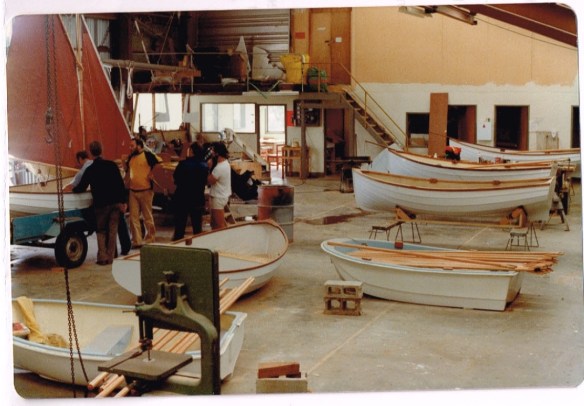
The Okura Gig became a ’boutique’ activity.  As a result of the boat tax being imposed in 1979 we reduced the size and scope of our business and closed our fibreglass manufacturing operations and moved our boat shop into the mould shop. We had built about 55 OG’s between 1978 and 1981.  The moulds were taken by Dinghy Developments who resumed production giving the OG a Seabird name.  I believe that they took their version to USA west coast boat shows where they were warmly received. I have no idea how many more were built.

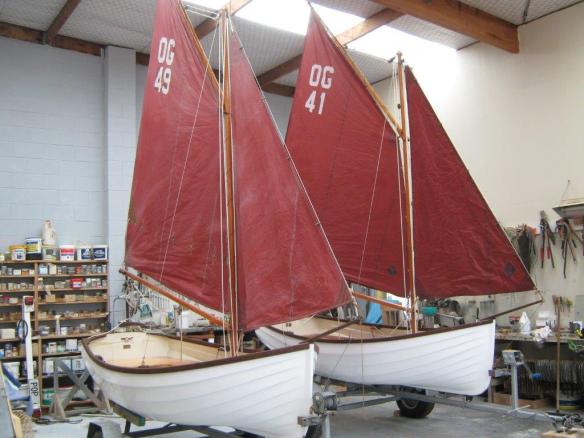
I have  two OG’s,  No. 41 and No 49.  One had spent about 35 years in a wet boatshed at Lake Rotoiti,  it required a complete grind off of the osmosis damage before refitting.  The other is our long time family boat. I have refitted them both to a much higher standard than the originals. They are currently in my shed at Whangaparaoa.  I still sail OG49 occasionally and still find it enjoyable. It really romps sailing just off the wind with the peak halyard eased . OG 41 is too pretty to put in the water. It would make a fine centre piece in a large lounge.

Croix Grut  got to see OG’s 41 & 49 restored and fully rigged before he passed away. Photo below.

Photo0006

Foot note:

I was fortunate to have served my apprenticeship at the Devonport Naval Dockyard commencing in 1958.  Marty Martinengo was in the same intake as I, as was Denis Cantell, in 1958. We have enjoyed  a very solid friendship ever since, as we do with many of the apprentices who were indentured before or since us.   The Dockyard provided a very traditional training in all aspects of boatbuilding and shipwrighting  . It was a very competitive environment with up to 14 apprentices at any one time. My brother Ray Served his time at Lidgard’s and Lane’s before moving to Max Carter. He  moved to Whangaparaoa about 1968 where he started boatbuilding.  I joined him  in 1972.

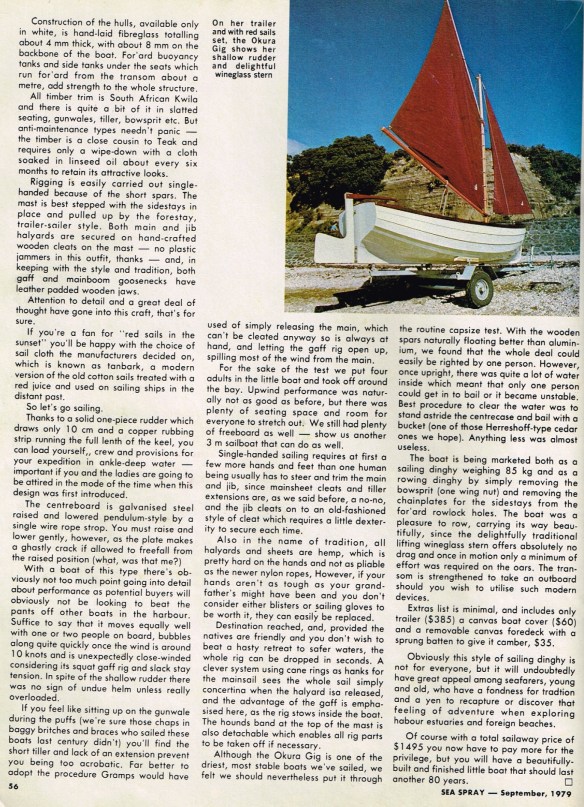
Below is an article reproduced from Sea Spray magazine Sept 1979

Sea Spray Article Sept '79 p1.pdf

Sea Spray Article Sept '79 p2.pdf

OLIVE (Tokatea > Enna De > Waitika)

TheOlive(Tokatea)&ErnestinWhite

OLIVE (Tokatea > Enna De > Waitika)
photo & details ex Baden Pascoe

Today’s post is of the very stunning small seiner, Olive, built for Morgan Hayward by Ernie Harvey. Morgan owned or was a partner in one of the Thames “Fish Sheds” as they called them in the old days. (Shortland Fish Co Ltd). Olive was later purchased by Sanfords.
Baden thinks in the above photo, Ernie is the man under the boat with braces on.

I’m not sure if she was christened Tokatea when launched or if that was a later name change. Tokatea is the name of the mountain ridge between Coromandel town and Kennedy Bay. In the 1870’s Tokatea was the site of extensive gold-mining activity.

Baden does not know her launching date & is keen to learn more about Olive & what became of her.

Input from Harold Kidd

Lovely image of OLIVE. According to Chris Rabey, who knew her well, and please amplify these comments, Ray, Ernie Harvey built OLIVE in 1934 at Thames (I would have thought a shade earlier, perhaps). Anyway she was registered as suitable for wartime purposes as OLIVE in 1940 No. TS21 owned by L.M. Hayward of Thames with a 44hp Kelvin and dimensions of 43’x11’x4′.
She became TOKATEA much later when bought by the Government as a Fisheries Patrol vessel. Later again (about 1965) Bert Subritzky bought her and renamed her ENNA DE after his wife, the former Enna De Vera Davenport. I think it was then that Chris was on her.
I identified her, with Chris’ help, derelict at Lake Dunstan in 2008 and later at Oamaru in 2011, renamed WAITIKA.

Below is a photo of Ernie Harvey on his 80th birthday.

Ernest-80th birthday

Photo of Olive/Tokatea at Thames c.1950’s ex Geoff Brebner

Tokatea

05-03-2016  Input from Baden Pascoe

Fore foot is exactly same profile as boat in photo. Just remember she has been built up, note the change in angle of tumble home, a sure sign of an extra plank.

23-05-2016 Photo below of Tokatea at Whangarei 1952 ex Geoff Brebner

Tokatea Whangarei 1952

Tainui On The Move

Screen Shot 2016-02-10 at 3.06.01 PM

Screen Shot 2016-02-10 at 7.54.18 PM

TAINUI ON THE MOVE
photos ex Pam Cundy

One of the ww woodys, John Sloane, recently purchased the 1967, 38′ kauri plank carvel launch Tainui from the Great Barrier Island. We do not know a lot about her but she did start life as an Auckland Harbour Board work boat.

John has retained the service of the Whangateau Traditional Boat Yard to under take a two year restoration of Tainui. Pam & George had previously travelled to the island to inspect her & yesterday (10-02-2016) the real work began with Pam & George towing Tainui back to Whangateau with the help of Dave Jackson & his wee ship Karros. Pam reports it was a very pleasant trip & Tanui’s now tucked up at T Point and will go up the creek to the boat yard later today.

Tainui is a great looking launch & I’m sure John picked her up for a good price. She is also a very lucky boat because she is now in the care of one of the best classic friendly yards in NZ.
We will follow the work at WTBY with great interest.

Still keen to learn more about Tainui’s past – anyone able to help?

More details on Tainui here https://waitematawoodys.com/2015/12/28/tainui-3/

15-06-2018 Update – photo below ex Whangateau boat year fb  showing Tainui’s rebuilt Gardner being delivered ex Dave Shaw’s workshop. Looking stunning 🙂 well done John. 

Visit the yard fb page to see / follow the restoration

IMG_3084

Update 10-09-2019 – Tainui seen here off Cape Brett, in the 1958>1966 period. Her owner John Sloane commented to me that she was probably ‘working’ in her role as an Oyster Inspector boat.

Screen Shot 2019-09-10 at 12.43.08 PM

Screen Shot 2019-09-10 at 3.57.54 PM

Screen Shot 2019-09-11 at 6.36.17 PM

Ballerina Restoration


IMG_0834

Haul out at Omaha

Haul-out


IMG_0832

BALLERINA REFURBISHMENT

photos & details ex James Groenhart

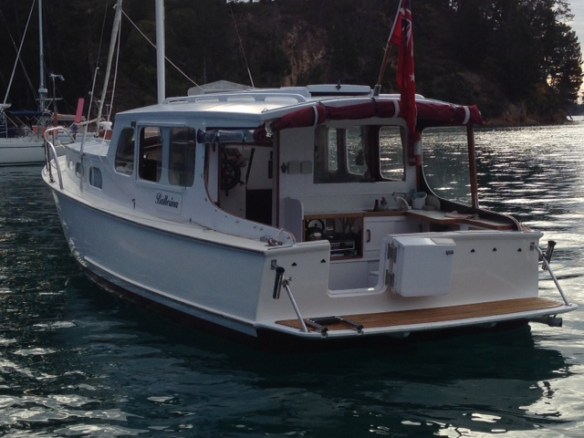
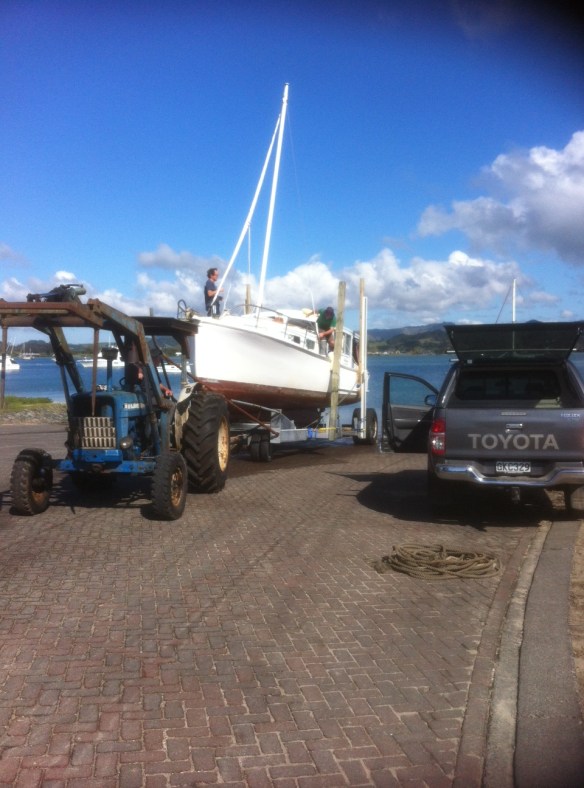
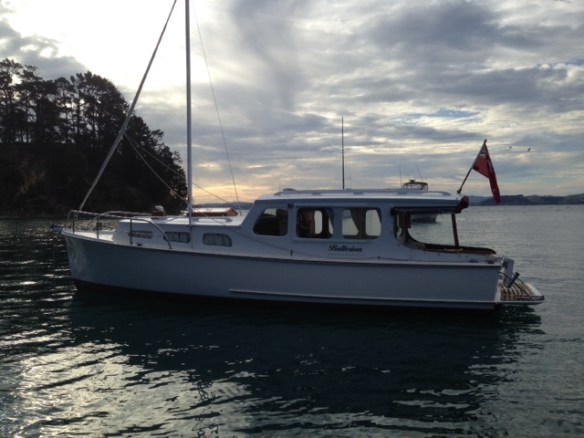
I spied Ballerina at Mahurangi during the 2016 Regatta weekend & she was looking superb. James told me she had recently spent 5 weeks in the care of Colin Brown & Dave Walker at Jones Road, Omaha (same site as Anita Bay & Little Tasman). While she was structurally in great condition there were some areas that needed attention.

Colin & Dave completed the following work to a superb standard, & interpreted what James wanted perfectly, as well as being completely sympathetic to the character of the boat.

  • A new hardwood worm shoe was made & fitted.
  • Mahogany cabin sides & coamings were taken back & minor rot repairs carried out, particularly around the sliding side windows & timber fixed window beading.
  • Butterfly skylight hatch was restored & glass re set to stop leaks.
  • A new timber forehatch was made & fitted.
  • Duckboard deck was replaced.
  • Cabin top grab rails removed, restored & re fastened.
  • Repainted hull (using Altex ‘Classic White’), cabin sides & deck.

Great to see work like this recorded so thoroughly.

Click photos to enlarge.

Another Record Viewing Day Yesterday !!!!!!

Majestic

Screen Shot 2016-01-01 at 8.42.42 PM

MAJESTIC

Details & photos ex ‘Nelson Mail’ via John Burland (edited by Alan H)

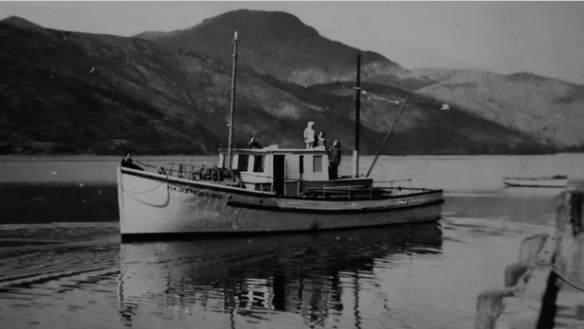
The 14.5m Majestic started life back in 1937 as a commercial trawler & cray boat in Nelson. Built at the famed Wells family boatyard at Whakatahuri at the head of Pelorus Sound by her ex owner Lionel Wells and his late brother Gordon. She was built to their father Claude’s design, using Marlborough Sounds kahikatea (white pine) for the double-skinned planking, and heart rimu for the deck beams and stringers.
The brothers fished out of Port Nelson for many years, trawling for snapper, gurnard and flounder. Wells eventually bought his brother out and took the Majestic cray fishing from Milford Sound for 15 years.
He sold her in 1978 and Majestic continued its fishing career from Greymouth before finally being brought back to Nelson.

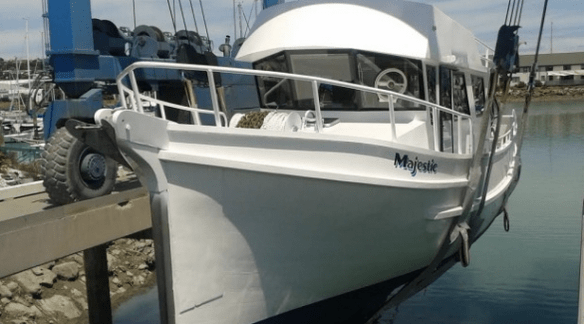
Two & half years ago Majestic was facing the chainsaw but was saved by the Motueka owner of Cotton Heavy Haulage in Richmond, Lynn Cotton who gradually restored her at the Richmond boat yard. The fish hold has gone and the accommodation has grown to allow for eight people. The few rotten planks were replaced and rimu and macrocarpa were specially milled to fit out the interior.
Most notably, the old superstructure was removed and replaced with a new one, each to their own but I would have chosen something closer to the original.
In the six years the boat had been idle the 190hp Gardner diesel had seized, but that was soon remedied and on the trip across Tasman Bay to its new mooring at Port Motueka it produced an average 8.2 knots.

Below are photos from her re-launch. One shows 95 year old ex owner/builder Lionel on the left with Lynn Cotton.

Screen Shot 2016-01-01 at 8.43.25 PMScreen Shot 2016-01-01 at 8.43.09 PM


Arohanui Restoration – Watch it ‘live’


Arohanui Restoration – Watch it ‘live’

The above video records the renovation of the classic 1965 Lane Motor Boat Co. built launch Arohanui. The refit work was undertaken in 2015 at the Sandspit yard of Lees Boatbuilders for owners Fiona Driver & Rod Marler. Greg Lees & his team have established themselves as the go to yard for the application of Awlwood MA (Uroxsys) the flexible polyurethane marine clear coat finish. But I have to say that the yards craftsmanship & attention to detail prior to the final applications was second to none. Lees is a very classic friendly yard & whether the vessel is sail or motorboat, large or small its in good hands.

The short film was produced by Gareth Cooke (SubZero) who also filmed the restoration of Trinidad at Lees, refer below videos.


1966 Holiday’s on the Waitemata

1966 Holiday’s on the Waitemata
photo ex the Gordon Miller family archive, sent in by Adrienne Miller

I have been sitting on this photo for a few weeks – aside from being a very cool photo, its a hoot because it shows two very well known boating people in the photo. The pic was taken in the Christmas 1966 period & shows two Mason Clippers. One person is easy to ID – in the background we have Tony Mason and his family on their Clipper.

The question of the day is – who is the ‘lad’ in the foreground snoozing on the stern of the Clipper ‘Diana’?

ps I’m in hiding – I might get a clip on the ear for posting this 🙂