Unknown's avatar

About Alan Houghton - waitematawoodys.com founder

What is Waitemata Woodys all about? We provide a meeting point for owners and devotees of classic wooden boat. We seek to capture the growing interest in old wooden boats and to encourage and bring together all those friendly people who are interested in the preservation of classic wooden vessels for whatever reason, be it their own lifestyle, passion for old boats or just their view of the world. We encourage the exchange of knowledge about the care and restoration of these old boats, and we facilitate gatherings of classic wooden boats via working together with traditionally-minded clubs and associations. Are you a Waitemata Woody? The Waitemata Woodies blog provides a virtual meeting point for lovers of classic and traditional wooden boats.
 If you are interested in our interests and activities become a follower to this blog. The Vessels Featured The boats on display here (yes there are some yachts included, some are just to drop dead stunning to over look) require patrons, people devoted to their care and up keep, financially and emotionally . The owners of these boats understand the importance of owning, restoring and keeping a part of the golden age of Kiwi boating alive. The boats are true Kiwi treasure to be preserved and appreciated.

Aloha

Aloha
photo ex Angus Rogers

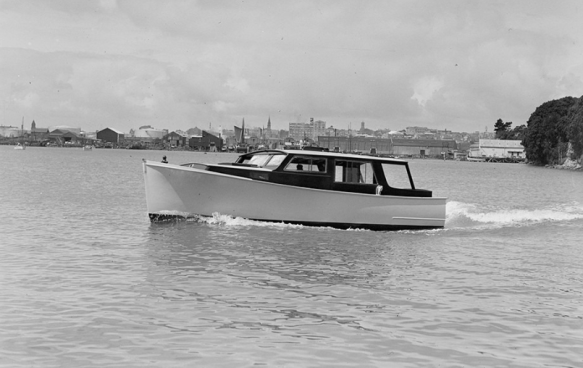
The above photo of Aloha was taken in Bostaque Bay. Aloha was built by Dick Lang at St Mary’s Bay c1928  see below

What more do we know about her?

Harold Kidd Update

ALOHA was built at St Mary’s Bay in 1926 by Charles Robinson, not Dick Lang. Robinson had been building at Ohinemutu, Rotorua for many years from about 1909, for a time with Percy McIntosh, who moved to Whangarei in 1911. Robinson carried on at Ohinemutu until the 1930s. He built the keel yacht MAHOE at Ponsonby in November 1894. He worked with James Clare for some years and went to Tonga with him after building MAHOE. A most neglected builder (and a very fine one).

11-12-2015 Update ex Bert Boswell

The Aloha was bought from the Wilkinson family in 1965 or 66 by Tom Wood. Tom had crewed on the Aloha as a youngster and had been told he would have first choice if she ever went on the market. He was given the choice years later when Mr Wilkinson died. When Tom bought her she was powered by a power kerosene motor which had to be started by filling priming cups with petrol. I think the motor was a Commodore. Tom changed the motor for a diesel which was still in her when he eventually sold her. He used to tell the story of how as a young crew member he and his mates would swap from kerosene to petrol when they were racing in a regatta in the Whangarei Harbour – much to the skipper’s annoyance as he thought petrol was too expensive!
Tom was a bachelor and my  late wife’s, cousin. For many years he took me and my family of three  youngsters and one or the other of their cousins cruising every Christmas. We cruised from Whangaroa to The Barrier for many wonderful cruises. She was a large part of my young family’s life after my wife died shortly after Tom bought her. What wonderful experiences for my kids who grew up with a love of the sea. Most years we cruised in company with  Aumoe owned by Selwyn Wilkinson. The two boats ofter made a great sight cruising together or rafted up together for the night. Tom lavished a huge amount of care on the old girl and I was sad to see her a few years after Tom died looking sad and bedraggled  as some sort of fishing smack. However I saw her again some time later moored in the Whangarei Town Basin looking her old smart self. She was renowned for her long saloon table but I understand it was removed at some stage. That’s a pity.
The boat shed shed she lived in still remains as one of a group of three at the entrance to the Town Basin, The Aumoe’s shed was next door and also remains. They are all that is left of historic buildings at the Basin.
I am so thrilled to see someone is recording the histories of these lovely old ladies of the sea. I have a few photos of her if you are interested. The photo of the Aumoe alongside the Tiri was taken from Aloha. We called on the Tiri on our way back from the Barrier and were
invited on board. I remember the radio crew played a request for us after we left them – and a crate of beer, for which they were very grateful!
Bert Boswell

12-07-2019 Input from Deb Green (Bert Boswell’s daughter)

The photos below are from during the Tom Wood ownership period. Tom was Deb’s uncle.


IMG_20190310_0128

Picture 087


Update – 09-10-2020 photo below of Aloha c1960’2, in the Bay of Islands. When owned by Tom Wood

Wakanui & Rakanoa

Wakanui  & Rakanoa – Two classics we don’t see a lot of

The older photos were taken by Gwenyth Herbert from aboard Kotanui. I understand that in the photos Wakanui was only a year old.

Can anyone supply more details on Wakanui?

Harold Kidd Input

According to Salthouses’ records WAKANUI was commissioned by S.G. “Nobby” Clark in 1967. According to Nobby she was finished and launched in early 1968.Bob Salthouse was responsible for her design.

10-01-2016 photo of Wakanui at Great Barrier Island ex Pam Cundy

Wakanui at GB Jan 2016

Johnny Wray Is Calling For Your Help – Ngataki Finalist in Classic Boat Restoration of the Year

Johnny Wray Is Calling For Your Help – Ngataki Finalist in Classic Boat Magazine Restoration of the Year

Good morning folks – I’d like to ask you to spend 2 minutes of your time doing something that could have a big impact on the NZ  marine restoration industry. The legendary classic yacht Ngataki is a finalist (Restoration of the Year – Under 40′) in the prestigious Classic Boat 2015 Awards. Classic Boat Magazine choose their short list (6 only) from around the world & then its up to the classic community to vote on who they think is the winner.

A fact of life is most people are lazy & do not get around to voting – so how about we all rally together & vote for Ngataki. If we win the publicity for the NZ marine trade will be huge.

Other than voting, what more can you do? – on-forwrd the link to this ww page to your friends, family & business associates & ask them to vote.

Ngataki’s category is top of the list so that makes things easy for you & the UK have great privacy laws so unless you tick the ‘Send me stuff’ box they will not make your name or email address available to third parties. BUT you do need to tick the ‘Privacy Policy Acceptance’ box.

CLICK THIS LINK TO VOTE NOW  http://www.classicboat.co.uk/awards2015/

ps the competition is stiff & our girl was designed by Johnny himself so every vote we can get will be needed 🙂

Waiapu – Sailing Sunday

WAIAPU – Sailing Sunday

photo & details from Merv Stockley ex Don Ross

Now the photo of the keeler pictured above is named on the back of the photo as Waiapu and it shows N9 on the mainsail & came from Don Ross.  The photo was discovered by Merv Stockley when he was preparing / sorting out Don’s property in Whitianga. Don has lived there for 64 years.

Can any of the canvas & stick brigade confirm the yacht is Waiapu & possibly supply more details on her?

Harold Kidd Input

For a start, she’s a bona fide 20ft MULLET BOAT, not a keeler. WAIAPU was built in December 1912 to the Mullet Boat Restrictions for 20 footers by Harvey & Lang at Freeman’s Bay for Syd Eslick. Fred and Roy Lidgard bought her around 1920 and won the 20 footer Championship with her. Subsequent owners were F. Newman, J.C. Willcocks, L. French, A.E. Follas, the Douglas brothers, R.H. Wood who sold her to Ashton-Baker of Whangarei in 1937. She was eventually sold to H. Hemphill of Suva in 1940ish.
She had a spell on the Manukau between 1927 and 1929 owned by Leo Bouzaid, the rather famous sail maker.
When the alpha-numeric sail numbers were issued in 1922, she was allocated N9. The N Class was for bona fide mullet boats, 20ft loa and under. The V Class 18 footers of “mullet boat type” were not regarded as genuine mullet boats for a number of good reasons, the principal of which was historical, 18 footers were never used to net mullet, because they were too small to get a viable catch, commercially.
This image must have been taken after 1937 when she was converted from gaff to bermudan.

Lyrebird

LYREBIRD

photo & details ex Ken Ricketts

Lyrebird, viewed above hauled out at the Mahurangi marina hardstand is a little bit of a mystery boat, her owner Grant Sutherland thinks she might be a Lidgard. She is  28ft by 9ft 6in. & powered by 4 cyl Perkins diesel. ‘Home’ is a mooring in the Mahurangi area.

Anyone know the boat or any more details on her?

24/02/2015 – update & photos from previous owner Mark Sorrenson

Harold is correct. I purchased Lyrebird from Brian Juers around 2006. Brian kept her on a mooring at McLeod Bay, Whangarei Heads. We painted her inside and out and refurbished the interior, fitted a anchor windlass etc. Brian purchased her from a fellow that lived at Bland Bay, so I can only assume that she was moored in Whangaruru Harbour. Brian believed that she had spent some time on the Hokianga Harbour.
I do not know what her design was, but only that Brian thought she may have been a Lanes.
She was very sweet.

Mosquito Craft Dinghy

Mosquito Craft Dinghy
details ex Geoff Brebner

OK woodys, who has one of these under the house?
Geoff found the old advertisement below & wondered how many of us remember the little 9ft Mosquito Craft moulded ply dinghy popular as a tender from the late ’40’s through to the mid ’60s. Geoff’s late brother-in-law Hector George was sent by his father Geoff to Davison’s in Vancouver to learn the method of of pressure-moulding with veneer and marine glue. This was in about 1948.The same technique was used during WW2 with the Mosquito bomber, hence the name.

The George family started building them at their home at Tamaki Drive Kohimarama before moving to a factory at Ellerslie. The design of the 9 footer was the prize winner of a RNZYS competition for a yacht tender “way back when”. Geoff was led to believe Bill Couldrey was the winning designer, but is prepared to be corrected on that. Incidently, the George and Couldrey families were related by marriage.

The boats were laminated up over a very heavy solid wooden mould out of four layers of 1/16th veneer, with the apron and kelson integral, then put in a large rubber bag which was pulled down to 30 inches of vacuum until the Aerodux glue cured. Seats, gunwhales and tuck were fitted to the finished shell. Later on a 12 ft and a 10’6″ model were also built.They were produced up until 1965 when the cheaper glass-fibre boats found favour.
Geoff can’t recall the figure, but over 900 of the 9 footers were built. Geoff worked there for eleven years & his sister sister’s family still own the first and the last of the 9ft line.
Geoff thinks the 2nd one built was the tender on Harold George’s VICTORY A8.

There must be a few out there tucked away at the back of the shed.

Harold Kidd Input

The Mosquito dinghies were built in quite a different manner from the “cold-moulded” veneer dinghies. As Geoff describes above the Mosquitos were much more elaborately manufactured than the Lidgard type. There were a lot of the latter built. All that was needed was a good sturdy mould, a supply of straight-grained veneer (often pinus radiata), some Aerodux resorcinol raspberry jam adhesive and a staple gun.
Jack Logan produced heaps of them and many backyard builders whacked them out. I used to help my mate Barry Brickell’s father, Maurice, build them at Tui Street Devonport and went on to use the same technology with John Chapple to build several racing 12 footers and that became almost the standard construction technique for one-off and volume centreboarders, especially Des Townson’s famous Zephyrs and Mistrals.
But the Mosquito craft were the pioneers and arguably the best.
The fuselage of the de Havilland Mosquito (DH98) was originally built of a birch/balsa sandwich using CASEIN glue which was all they had when it was designed in 1938. It caused problems in hot humid conditions by unpeeling. However de Havilland developed urea formaldehyde glues, later available commercially as Aerolite, which aced that issue. The Mosquito wasn’t the first plane to use that construction. I used to fly and part-own a de Havilland Moth Minor (DH94) ZK AKM, which was cold-moulded with casein. She’s still flying happily with no fuselage issues after 77 years.

21/02/2015 Photo ex Darren Arthur


Darren commented that the oil on the transom was the result of running a “Seamaster 400”. A rather odd ball outboard that used an air cooled Tecumseh lawnmower engine. Noisy, heavy, smelly and leaky were some of the more polite adjectives Darren recalls his father using to describe it 🙂

24/02/2015 – story & photos from Roger Lacey

My father bought a 12′ Mosquito craft in about 1969. It was a couple of years old and had a 7.5hp Archimedes Electrolux motor that used to eat spark plugs for breakfast. We used it for fishing in the Waitemata and also at Lake Rotoiti where I learned to row. When my parents bought a bach in Turangi we moved the boat down there but not before sanding back the outside and giving it a coat of epoxy resin, which in hindsight probably saved it. The boat caught many times its weight in trout and made both an ideal fly fishing platform and a stealthy trolling vessel over the shallow weed beds near Tokkanu and at the other smaller lakes nearby. The unreliable Electrolux was replaced by an infernal 2.5hp air-cooled Tas outboard which provided just enough power to motor up the lower reaches of the Tongariro River but was useless for trolling so we rowed it most of the time. In the late ’90s my dad sold the boat with the bach without consulting me so I tracked down the new owner and bought it off him, took it home and restored it. As I didn’t have room for yet another boat I ended up selling it to a friend who has it still. He recently found some rot in it, got it professionally repaired and fitted an new foredeck. It is currently awaiting paint.


NZ Antique & Classic Boat Show 2015

NZ Antique & Classic Boat Show 2015
March 7>8th Lake Rotoiti – Nelson Lakes

This South Island event is world class – if you are in or around Nelson on the weekend of 7th & 8th of March, make an effort to attend.

More details here http://www.nzclassicboats.com

Iawai (Tidesong)

Iawai (Tidesong)

The above photos were sent to me by Andrew Pollard, owner of the 1913 Tom Le Huquet launch Aumoe.
Andrew received them from the grandson of Aumoe’s original owner, Mike Brookfield.

Can anyone ID the launch? (done)

Harold Kidd (+ Baden Pascoe) Update

She’s the 55 footer IAWAI, built for Judge H.G. Seth-Smith of Russell by James Reid’s brother David Reid at Customs St W in late 1911. She had a 40hp (rated) heavy duty 4 cylinder Buffalo engine. She was the largest pleasure launch in Auckland at the time. Seth-Smith donated her to the Government in 1915 for war work. The Government sold her to R.B.S. Hogwood in 1922 and then she went to Auckland metal and carrying contractor A.W. Bryant and used for commercial work, heavily modified from this configuration, but looking very smart. I’ll post a pic later. Baden and I struggled over this pic for some time until Baden hit the spot.
In 1933 she was renamed TIDESONG and run by C.D. Cooper until 1938 when F.D. Cadman bought her and had her renovated by Joe Wheeler at Bayswater. She was taken over by the RNZAF as W95 by 1942 for towing at Hobsonville. She also possibly went to the flying boat base at Lauthala Bay. There is some confusion in the RNZAF records on this (and her correct W number).
Post war she was used as a hire launch at Gisborne and Tauranga. She finished up being a total loss when she sank at anchor in Shipwreck Bay, Northland on 23rd June 1972 when owned by Roy Callister of Browns Bay.

Photos ex Harold Kidd

23/02/2015 – A message from Shelley Arlidge , the Curator at the Russell Museum

Hi Alan,
I was able to narrow down the date of that photo of Iawai to about a five year window. Your commentators say that she was built in 1911. There was a Russell Regatta in 1912 after a gap of some years and then every year after that until the 1950s. There is a building in the background of your photo of Russell’s first town hall. It collapsed in a storm in 1916 and a new one wasn’t built until 1922. So this photo must have been taken in the years 1912 to 1916.

Centaurus – A peek down below

Centaurus – A peek down below

Last week I posted some on-the-marina photos of Centaurus & on Sunday I spotted her anchored in the upper harbour. Thanks to Tim Jackson I can now share some interior photos with you.

We know that she was built by Bailey Bros & owned by the Sibun family for approx 40 years, her present owner purchased her off the Sibuns & has had her for 10 years.  I’m told she still has her original 1965 Cummings V6 engine. Based on this comment I’m assuming she was launched in 1965.

Rather smart.


Mechanics Bay 1945

Mechanics Bay April 1945

photo ex James Dreyer ex ‘Old Auckland’ facebook

I thought it was time for an old b/w photo & a who can tell us more about the motor boats featured.

Updated ex Harold Kidd

My pennyworth is the the left hand launch is one of the Hubert Scott-Paine designed control tenders, built by his company, British Power Boat Co, in 1939 for Tasman Empire Airways Ltd for the flying boat base at Mechanics Bay and later copied here. They floated around between RNZAF and TEAL operated by the Civil Aviation Board so it’s hard to be precise, at this distance, on which one she was. The first Hythe-built one arrived on EMPIRE STAR in June 1939 and was 37ft 6ins x 8ft 6ins and had twin 100hp petrol engines (Meadows I think, as fitted to Invicta and Lagonda sports cars and those Bren Gun carriers which didn’t have Ford V8s). They were guaranteed to do 18 knots but could touch 25.
I think the middle launch is TASMANAIR, built for TEAL by Colin Wild in July 1941 with a very similar spec to the Scott-Paine boats, but had a large passenger capacity.
The right hand boat is possibly the Scott-Paine 23 foot aircraft tug brought out on the EMPIRE STAR in 1939, fitted with a single Meadows.
My Standard 5 and 6 classrooms at Devonport School, high up on Mount Victoria, had splendid views of proceedings at Mechanics Bay. We had one student teacher who would stop the class and let us see all departures and landings. There were some hairy ones, especially Catalinas in a strong westerly.

PS the little launch coming in at left is probably one of the locally-built runabouts used at Mechanics Bay for general purposes, often in charge of Flight Sergeant Johnny Wray of NGATAKI fame. Dave Jackson will probably be more precise on that one as his father was in the RNZAF Motorboat Section. It could even be the Collings & Bell 28 footer PIRI PONO which got rather modified by the Air Force and had a Chrysler Crown installed in place of its “orphan” 150hp Niagara..

Additional photo added ex Pam Cundy

Harold Kidd input

It’s a pity we can’t see if the Scott-Paine launch in the foreground of Pam’s pic has a W number on the bows, which would identify it precisely. My guess is that she’s W6 which was returned to Auckland in May 1944 from Lauthala Bay, Fiji. The plane in that image is an RNZAF Short Sunderland.
The planes in the top pic are the Short Empire class civilian flying boat ZK AMC “AWARUA” in the foreground, 3 RNZAF Sunderlands and an RNZAF Consolidated PBY5 Catalina at the rear. As a child, I thought it strange that AWARUA had been named after the Auckland Meat Company.