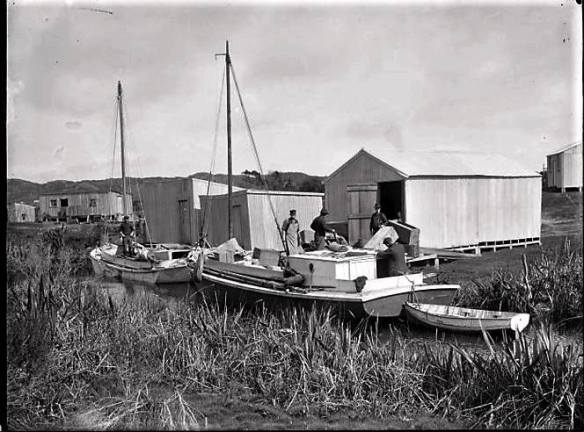
Today’s photo ex Lew Redwood’s fb shows two woodys alongside the boat sheds at Wiahopo in the Far North. Wiahopo is situated at the upper reaches of the Houhora Harbour & was a big kauri gum field area.
The photo is tagged 1910-39 & attributes ownership as ‘Nortwood’s Ark & Harold Wagener’s Oi.
Harold Kidd Input – Don’t know about ARK but she’s obviously a small square bilge scow. OI is actually the cargo launch OEI, built for H.B. Wagener of Pukenui by T.M. Lane & Sons at Mechanics Bay (NOT Totara North) in 1910. She was fitted with a 7hp Standard engine (hardly zoom zoom). Dims were 36’6″x10’x2’8″. Arthur Subritzky delivered her north in November 1910 taking 25 hours Auckland-Mangonui.
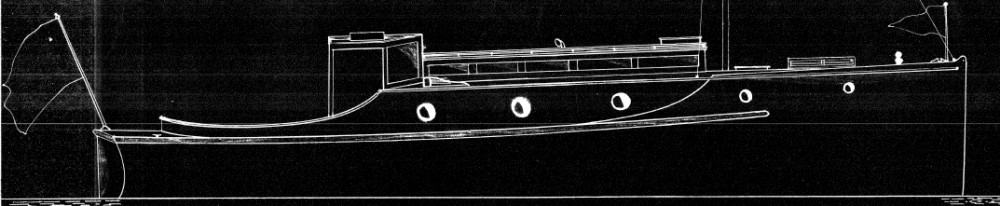
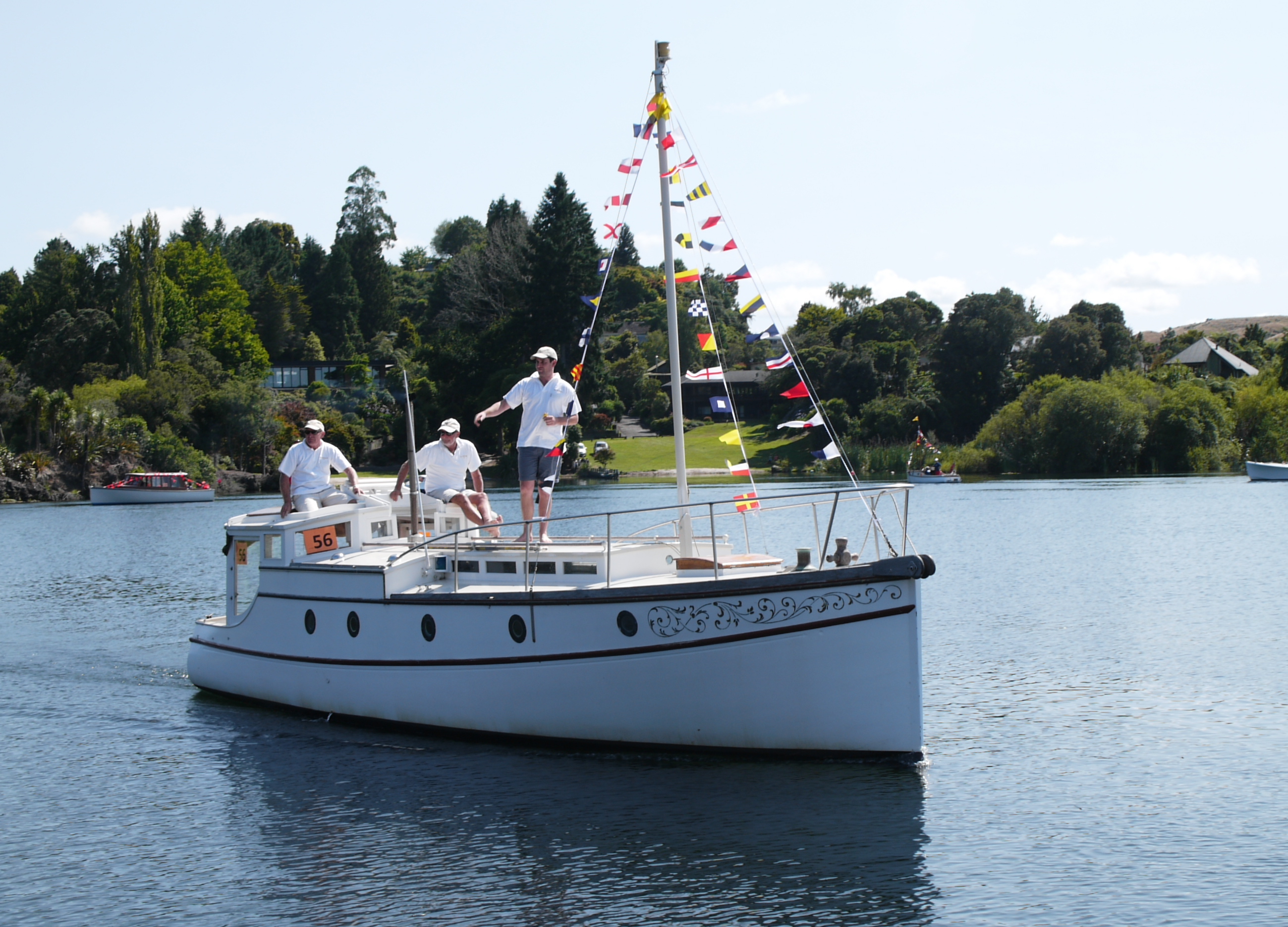
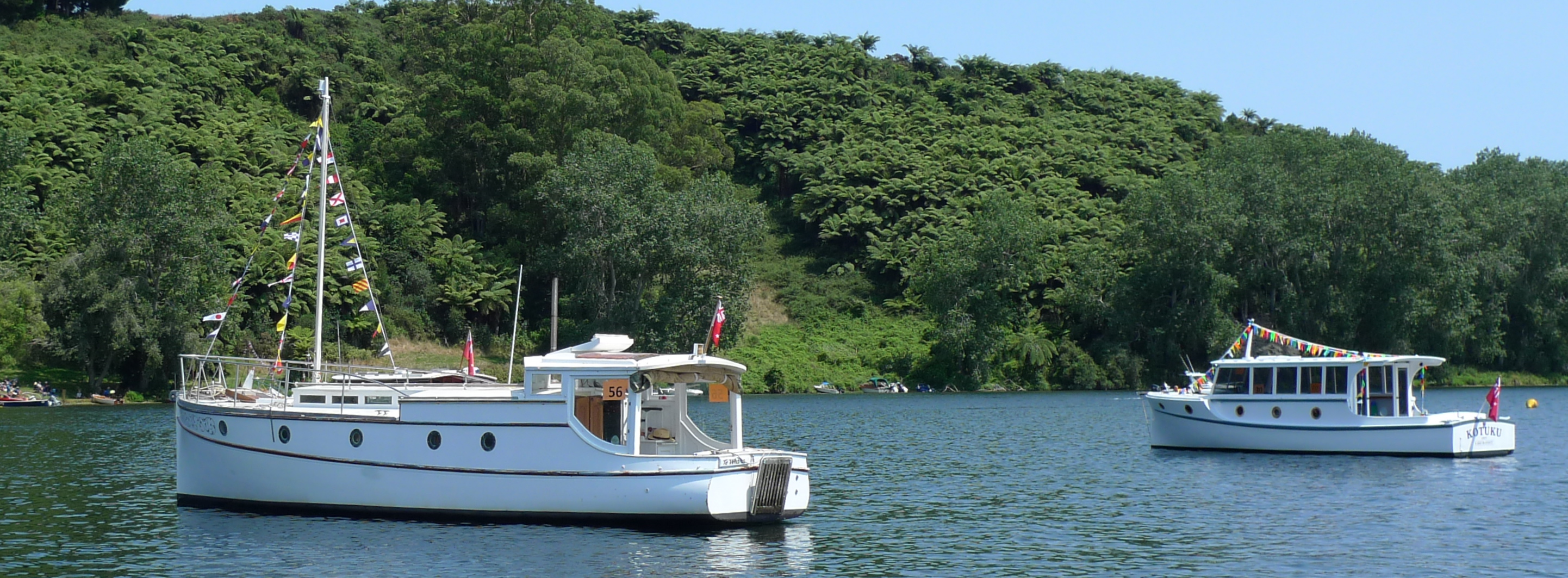
Each year for the last 5 years in February I have attended the Lake Rotoiti Classic and Wooden Boat Parade, each year there are always several boats that ‘ring my bell’, one in particular is – Te Whara, the 32’, 1916 Bailey & Lowe built launch. Te Whara is not your typical lake boat, in my eyes she needs to be on the Waitemata & she could be – she is for sale. Firstly some details.
Te Whara was built by Bailey & Lowe at their yard at Sulphur Beach, Northcote in January 1916 for the Drummond brothers of Whangarei. Her first engine was a 10hp and probably a Sterling for which Bailey & Lowe were the agents. In February 1916 she was sailed up to Whangarei where she was based (always kept under cover). Originally flush-decked, Te Whara was taken back to Bailey & Lowe in the 1920’s where the wheelhouse area and companionway to the top deck was altered. She has the first rack-and-pinion steering ever fitted in Auckland. In 1972 she was refitted with the current 6 cylinder 106hp diesel which pushes her to around 10 knots. Owners Bruce Stewart and Andy Coupe purchased this launch (sporting a very rough paint job) in March 2005 for $40,000 and, after sailing her down from Whangarei harbour, spent a month sanding and repainting her at Orams in Auckland. After a short few months interlude in Auckland, Te Whara was launched at Lake Rotoiti in June 2005 and is now moored at Gisborne Pt. When searching for a launch, Bruce and Andy wanted a rear wheelhouse so that the helmsman and fisherman could be together. Of particular appeal was the elegant saloon, which runs from the engine bay to the bow. Te Whara still has the original interior fit out, including the porcelain ‘head’.
In 2013 Te Whara was lifted out of the lake and taken for a $25,000 re-paint and re-fit. The original canvas waterproofing on the decks was removed and the decks glassed. All other hull and deck timbers are original and in good condition. Unfortunately, being on a mooring and exposed to the weather takes it’s toll on Te Whara. In addition, Bruce and Andy are getting older and are beginning to find it more difficult to manage, and it is for these reasons that Te Whara is offered for sale for $35,000, or swap for a smaller classic launch.
I took the above photos of Te Whara at the 2015 & 2018 Parades. Come on woodys, lets bring her back to the Waitemata or alternatively she is a very cheap floating bach at the lake 🙂
15-09-2021 UPDATE – photos below sent in by Bill Upfold, whose client Grant Faber has one of Bill’s launches – Te Whara V, named after his grandfather, the original owner of Te Whara. Grant has named all of his boats Te Whara. The b/w photos show Te Whara with Cape Te Whara (Whangarei Head) in the background. The photos are mounted on Grants saloon bulkhead.
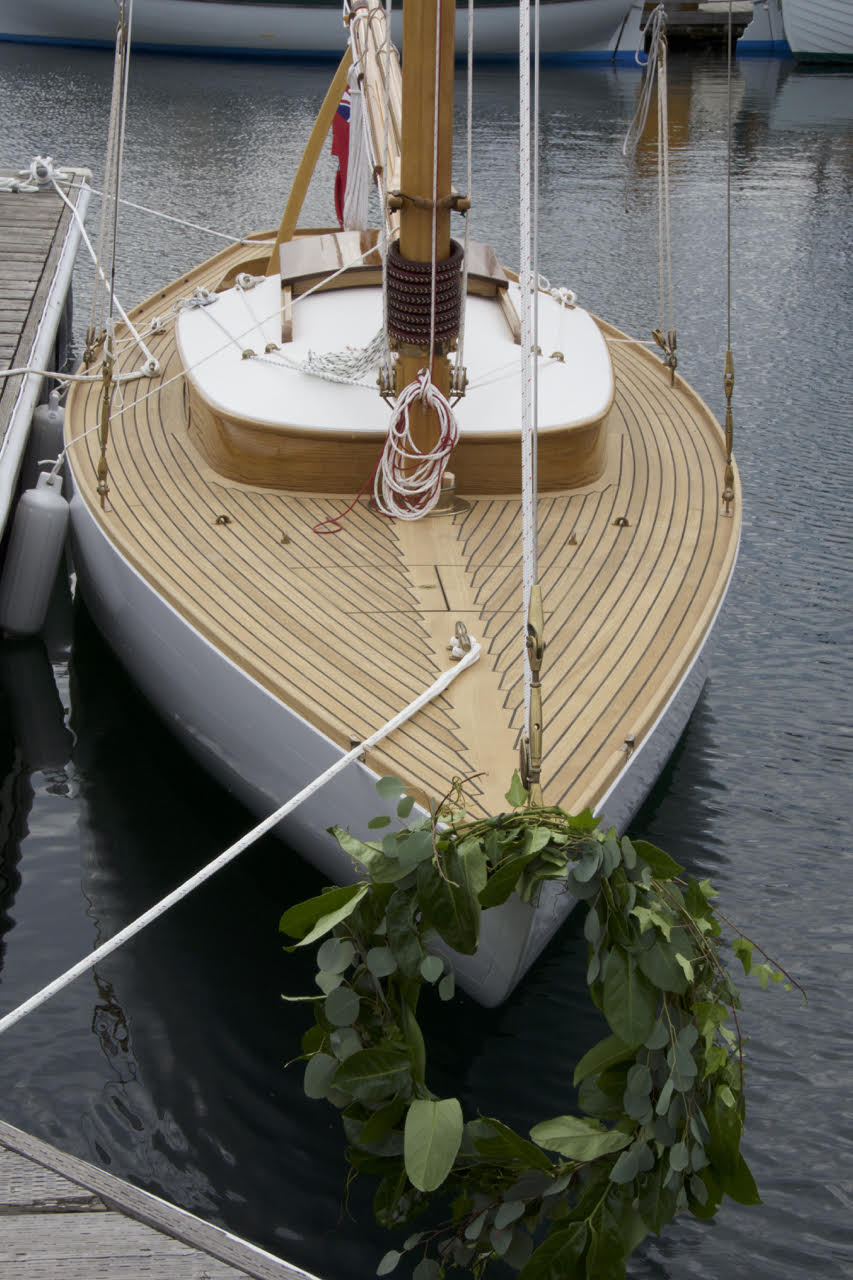
On my last visit to the NZ Traditional Boatbuilding School I got chatting to one of the trustees – Kere Kemp & he casually dropped in that he was building a Dark Harbor 17 1/2’. Thats cool I thought & then I discover its being built in Port Hadlock out on the Olympic peninsula oppposite Seattle, Washington USA.
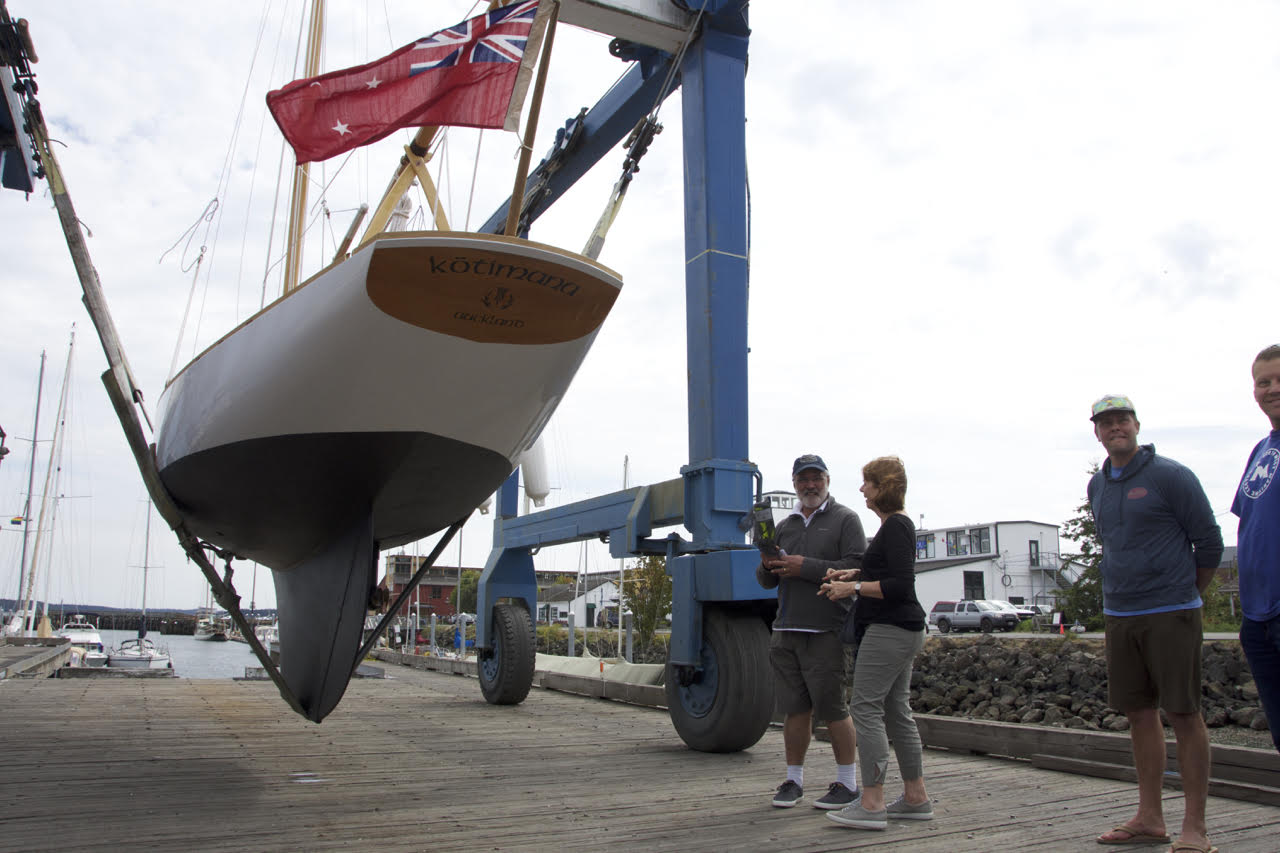
The yachts name is Kotimana – Maori for scotch thistle in recognition of Kere’s mother – Scottish, and his dad – Maori.
Kere commissioned her in September 2016 at the end of a post-retirement year at the North West School of Wooden Boatbuilding in Port Hadlock.
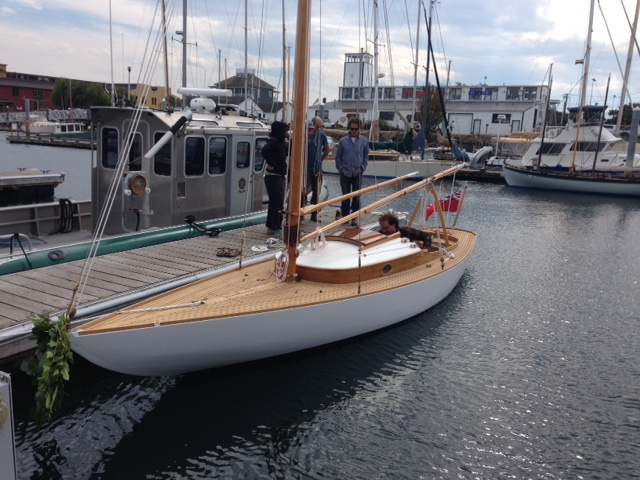
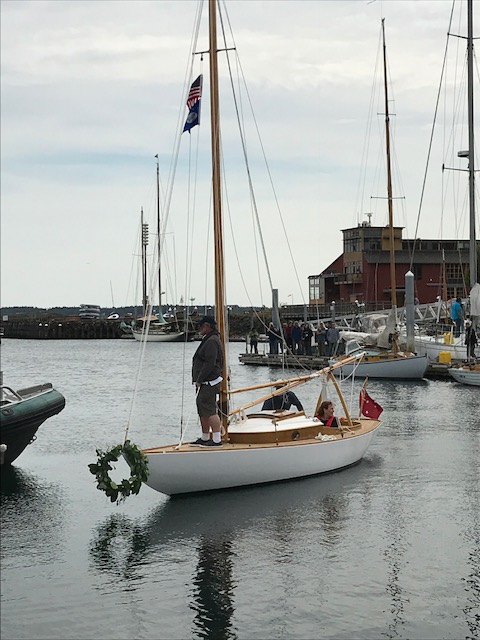
She was built by the classes of 2017 and 2018, & was launched at Point Hudson Marina, Port Townsend on August 29th. She is heading down under but with a few stops on the way – firstly Kotimana will be on display at the 42nd Port Townsend Wooden Boat Festival, second weekend of September and will then head via container to the 2019 Australian Wooden Boat Festival in early 2019 before finally making it home to Auckland in mid February 2019.
For those of you scratching your head thinking “what is a Dark Harbour 17-1/2 below is a description excerpted from a pre-launch write up that the NWSWB wrote when announcing the launch.
Dark Harbour 17-1/2
Originally designed for the Manchester Yacht Club in Massachusetts USA and called the Manchester 17, the first boats were built by the Rice Bros in 1908. As the design’s popularity spread it acquired a number of different names including the Bar Harbor 17 and eventually the Dark Harbor 17-1/2. The plans for this yacht are credited to BB Crowninshield and were completed by R. N. Burbank, an employee of the firm at the time.
The Dark Harbor 17-1/2 is a pure sailing machine of great beauty, but large enough to offer considerably more comfort through a larger cockpit well and a small cuddy cabin. Low freeboard combined with a wide, self-bailing cockpit well that seats you “down in” the boat puts you very close to the water. The lovely, slender hull lines, long ends, deep draft and large rig provide wonderfully sweet feel in this powerful, fast, wet, responsive and handy boat.
BB Crowninsheild was a US Naval Architect from the late 1800’s / early 1900’s who designed a number of boats including an America’s Cup contender and the largest ever steel hulled sailing boat (just prior to the introduction of the steam engine to sail boats).
Kerry commented that he fell in love with the lines of a Dark Harbor back in 2010 and decided that he would ultimately build one for himself. Sanity eventually crept in and he commissioned her instead – Kerry was able to do some work on her prior to his move to New Zealand in mid 2017.
I’ll get a sneak preview of her at the Australian Wooden Boat Festival in Feb 2019 so will update this story with more photos.
Kotimana will be a magnificent additional to Auckland’s classic fleet.
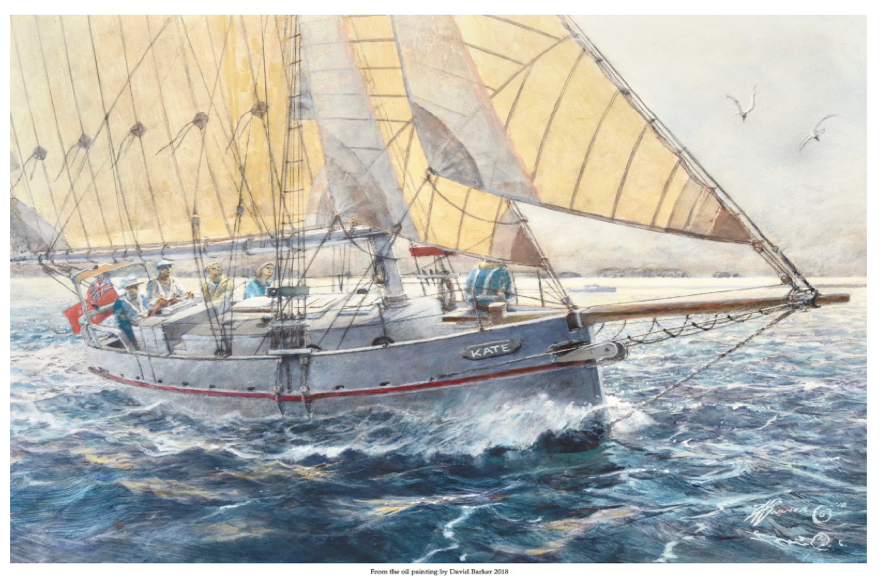
I have been recently contacted by Bernard Rhodes in regard to the yacht Kate – I’ll let Bernard tell the story –
“From the 1860s onwards, sailing cutters, schooners and ketches gradually replaced Maori canoes as the principal means of transport around our coasts, till steamers in turn replaced them for passengers, and scows for bulk cargoes.
The Kate is a rare part of our nautical heritage, being one of only 3 of this once common type still in existence as far as we know. (Her near sister Rewa is displayed indoors in the Auckland Maritime museum, and the Undine is still sailing in the Bay od Islands).
When the Waiheke Working Sail Charitable Trust took over the Kate in 2013 she had a recently added cabin with full headroom and an 8” deep false keel. These made her suitable for conversion into a small sail training ship, giving today’s youth an opportunity to experience travel much as it was 150 years ago.
The restoration and re-purposing are now well under way – the work about 60% complete and the funding 50% with the big ticket items such as engine, sails and compliance to come.
We need another $60,000 to get her sailing.
The Kate’s history and an account of our progress can be found on our website, http://www.waihekeworkingsail.org, click on the brochure at the top. Much of her history was lost the last time she sank, but a surprising number of people have contacted us with stories of her, and we welcome any more.
Earlier this year we hauled her out a second time and fitted a lead ballast keel and new rudder, among many other tasks. The addition of the cabin has raised the centre of gravity, and the boom needs to be above head height for safety, so the 1 tonne external lead keel will compensate, giving her adequate stability and near-original performance.
The accommodation has been designed for 6 trainees, a master and mate. We anticipate running 5-day Youth Development voyages for 13- to 15- year olds, based on the wonderful programme developed by the Spirit of Adventure Trust. With her relatively small size and simplicity, by the end of the voyage the trainees will be handling the ship themselves, under supervision. The sense of achievement and satisfaction they gain from this will stay with them for the rest of their lives.
Recently I re-connected with an old friend, marine artist David Barker, as he visited Waiheke on his launch “Feather”.
I talked of the vision of “Kate” as she will be, outward bound under full sail with a bunch of trainees aboard, and he agreed to do a painting encapsulating the dream.
I have long admired his talent for depicting boats and the sea, for giving an almost magical touch to a beautiful seascape, and I’m excited to be able to share this with you.
You are invited to subscribe to a strictly limited edition of 100 numbered, signed prints suitable for framing. $225.00 each.
When all subscriptions are sold, a draw of one number will win the original framed oil painting, generously donated by David.
This fund is to be spent exclusively on the restoration of the ‘Kate’ for youth sail training on Waiheke Island.”
For an informative card with bank details for payment, a ticket for the draw and for delivery of the print, please email your postal address to info@waihekeworkingsail.org.
Harold Kidd Input – She was built in 1896 by Thompson & Sons as a sailing fishing boat, and owned successively by J.F. Smith, J Moros (1900) then as a launch by Morgan Bros at Helensville from 1913, Bill and Archie Curel from about 1920. They fitted a K2 Kelvin in 1932 and owned her until WW2 at least at Helensville. To say she’s a near sister of REWA and (by implication) UNDINE is pretty far-fetched (to be polite).
13-10-2021 Update – looking very smart, back under sail
The launch Cygnet has just popped up on trademe (thanks Ian McDonald) & while the listing makes no reference to her past, given the location of Motueka, one would have to assume that she is the ex Mokau River work boat, previously featured on WW (photo below), with a lot of work done to her.
Details – she is approx. 30’ in length, made of kauri carvel construction in c.1960s. Her zoom zoom comes from a Lombardini 87hp diesel that pushes her along at a cruising speed of 8.5 knots, max 10 knots approx.
In her previous appearance on WW, Harold Kidd commented that she was built in Auckland and shipped down to Waitara for Sjolund of Mokau in July 1913, She was described as “on the tunnel style” 34ft in length, 7ft 6in in beam with a draft of 12 ins unloaded and 18ins with a two ton load. No hint of builder but Baden Pascoe thinks she is by T.M. Lane and Sons and that seems entirely likely. She was meant for the then flourishing Mokau River trade. Sjolund had several launches.
You can view / read more on her at the WW link below.
I was recently contacted by Anita Friedman in regard to the launch Roamer, which was owned by one of her father-in-law’s uncles, Frederick Louis Pierce Friedman, possibly from 1919 and to late in WW2.
In the photos above, the top one shows Roamer moored at Diamond Harbour, Lyttelton Harbour.
The hauled out photo, dated Labour Day 1940, was taken on the slipway at Lyttelton. At the time Roamer was still owned by Fred Friedman.
Anita’s understanding is that Fred Friedman entered ocean races, probably to Akaroa, in Roamer. (Refer the April 28, 1930 press clipping above). He also was a member of the New Brighton Powerboat Club and moored the Roamer there. He lived on Roamer.
When Fred died Roamer was passed to his nephew, Maurice Friedman. After Maurice was killed in WW2 the Roamer was sold.
Can any of the woodys enlighten us more on Roamer & what became of her?
Input ex Harold Kidd – George Andrews of Redcliffs built the 40 footer ROAMER in 1911-2, possibly at Millers in Corsair Bay. Andrews ran her commercially as a passenger launch until he went off on the Hospital Ship MAHENO in 1915 in charge of the two donated motorboats aboard. Lawrence Joyce took her over and passed her to F. L. Friedman by 1927. By 2003 she was still in Lyttelton owned by Noel Norris and in 2011was for sale on Trade Me. So she still soldiers on it seems..
10-09-2018 Update from Dennis Rule – Dennis was in Lyttleton on Sunday (09-09-2018) and spotted Roamer, a live & well & looking very sharp.
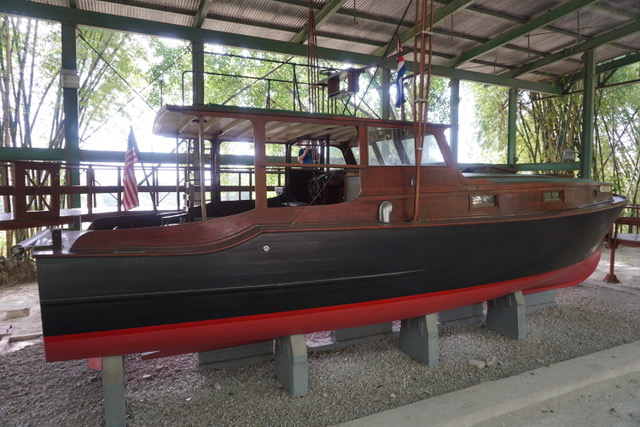
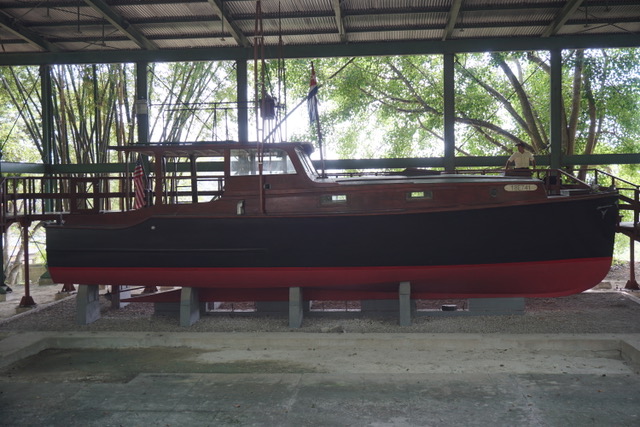
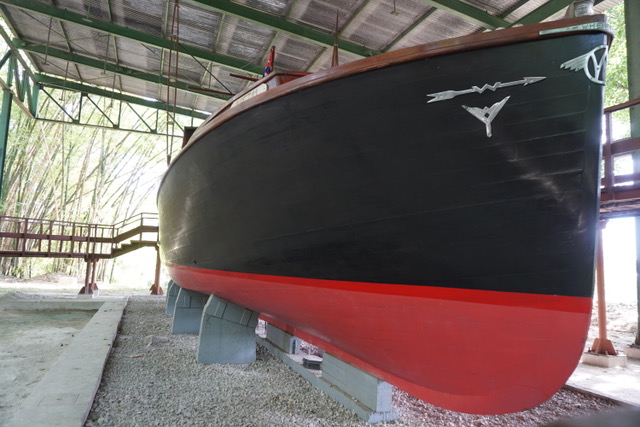
A little while ago woody Rod Marler was in Cuba, while there he visited the Ernest Hemingway museum & photographed – ‘Pilar’, Hemingway’s 38’ sport fisher. Built by the Wheeler Boatyard, Brooklyn New York and launched in 1934.
Below is a great read on the history of the boat, published courtesy of the Hemingway Home website, as are the b/w photos below.
“Returning to Key West from an African safari in 1934, Ernest Hemingway stopped off in New York to take a few meetings. At one with the editor of Esquire, Arnold Gingrich, Hemingway was given a $3300 advance for some short stories. He promptly took himself out to Coney Island to the Wheeler Shipyard and used the cash as down payment on a customized yacht.
Wheeler was known and rewarded for producing exceptional hand-crafted wooden boats. It had begun producing a pleasure yacht called the Playmate in 1920 and been very successful (the model would be produced until 1939.) Hemingway’s modifications to the 38-foot version he ordered included a live fish well and a wooden roller spanning the transom to aid in hauling fish aboard. He also requested extra large fuel tanks so he could stay at sea for longer periods of time. The boat had two motors – a 75hp for traveling and a 40hp for trolling. And he requested a flying bridge. The photo above shows Hemingway atop that flying bridge as Pilar pulls out of Havana harbor.
The finished yacht cost $7500 and was brought to Key West and christened Pilar. (Not only the name of the heroine in For Whom the Bell Tolls, Pilar is also the nickname for then-wife Pauline.) Through Key West friend and hardware store owner, Charles Thompson, Hemingway gained permission to dock her at the Navy Yard (the Navy was barely using it at the time.) This put the ship at dock only a few blocks from Hemingway’s home on Whitehead Street.
In 1940, when Ernest and Pauline divorced and he subsequently married Martha Gelhorn (whom he’d met at Sloppy Joe’s,) they relocated to Cuba and bought Finca Vigia (Lookout Farm) the home on a hilltop overlooking Havana. Pilar was docked at Cojimar, a small fishing village east of Havana, which was the inspiration for Ernest Hemingway’s The Old Man and the Sea.
When he left Cuba in 1960 with fourth wife, Mary he knew he’d be back. But the Bay of Pigs invasion in 1961 cut off his return and separated him from his beloved Pilar. After Hemingway’s death in July of that year, his widow gave the ship to Gregorio Fuentes who had served as her captain. Fuentes also served as the basis for the character Santiago, in The Old Man and The Sea and passed away in 2002 at the age of 104.
Today, Finca Vigia is a museum where Pilar is on display atop the tennis courts with a walkway encircling her so visitors can view the interior.”
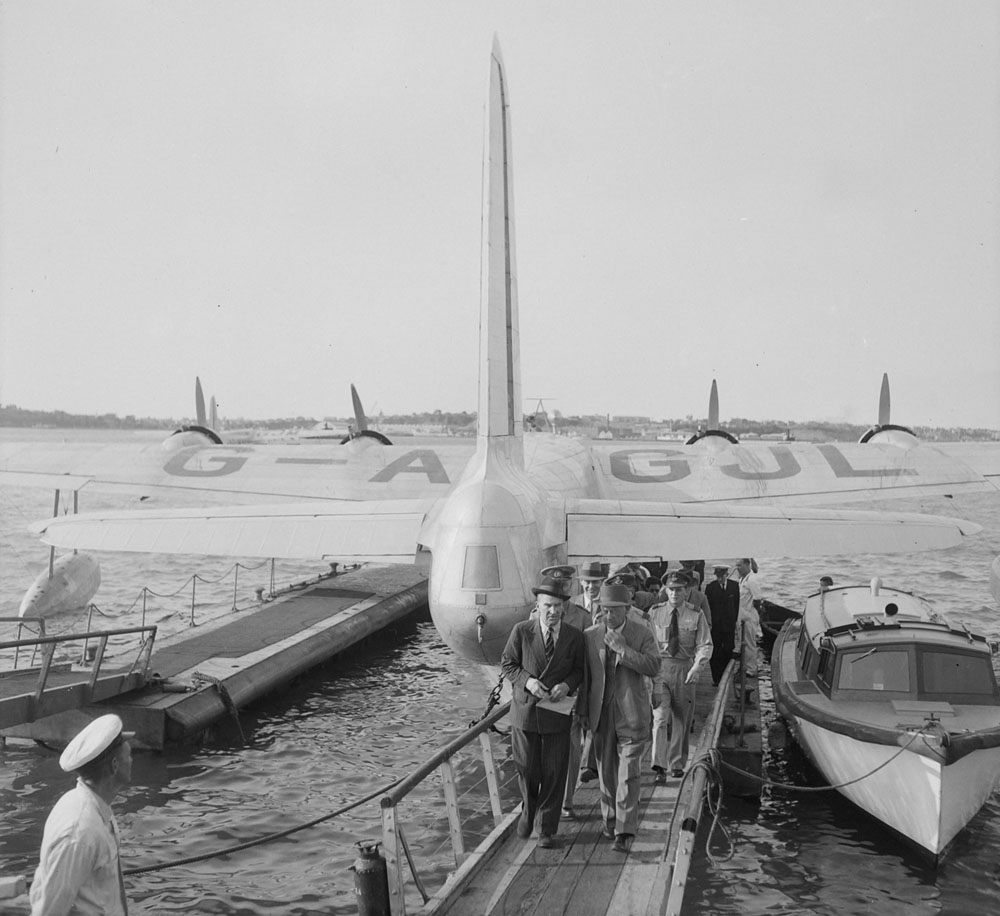
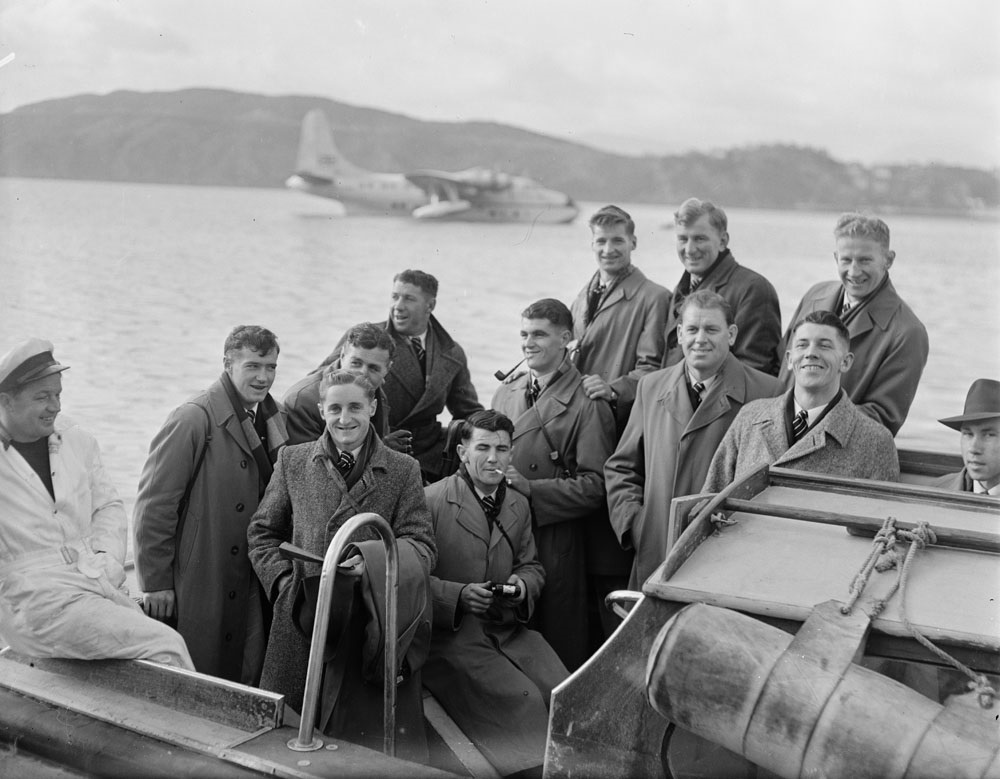
I have been sent the above collection of b/w photos that John Bullivant found on a British seaplane site, it appears a lot of the photos are from our national library or similar. They give a snap shot into the Teal flying boat history in Wellington. In them we see a large clinker launch, a work boat (Wild Duck which has an identical sister), a Civil Aviation flarepath launch (the dark stepped cabin launch to right of jetty) two different Teal launches (one from Auckland for some reason) Len Southwards Red Head racing one of the planes and a few views of the larger Teal launch.
The Teal launch appears to have the engine box towards the stern so may have had a v-drive (more room in the cabin / safety / noise perhaps?) The group of fine gentlemen in the Teal launch (pipes and all) are some of the 1951 All Blacks departing for the test in Australia.
















 waitematawoodys.com #1 for classic wooden boat stories, info, advice & news - updated daily - 15+ million views