
W1– WWII CIRCA 1942 In Cook Strait

W1 — WWII CIRCA 1942 — BRIDGE

W1- NAPIER LIONS MARINISED AIRCRAFT ENGINE

W1 — SIDE VIEW – AT SPEED CIRCA 1942

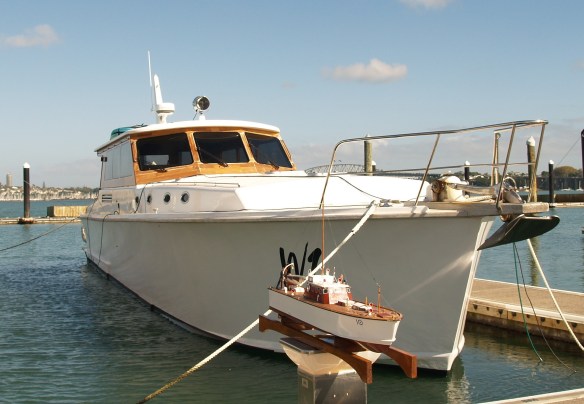
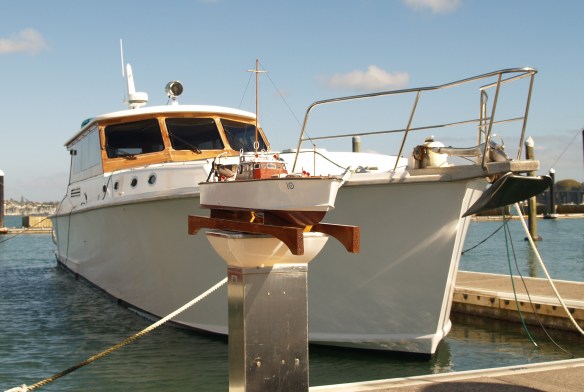
W1 — CAROMA — AS AT TODAY

W1 — WWII CIRCA 1942 AT SPEED

W1 – WWII AT GISBORNE — CIRCA 1942
The story below & photos above from Ken Rickets is the accumulation of over 65 years of one mans fascination with this vessel. It all started when Ken was 10 years old & saw her on her moorings, adjacent to the huge flying boat hanger & apron, at Hobsonville Air Force base. This one off experience moved Ken enough to see him for the next 65 years constantly making enquiries & researching the vessel. In 2001 Ken meet with a retired WWII air force officer, who was stationed on her during her wartime service, the officer gave Ken many of the photos above. Then more recently chats with Mr Allright Jnr. the second member of that family to own her, they had her in total for 40 years, & Mr Keith Bellingham who owned her from the mid 1990s to early 2000s provided enough additional insight for Ken to put together this wonderful story about a vessel that spearheaded our WWII air force coastal maritime defenses.
(Note: Harold Kidd accompanied Ken Ricketts when he met with the retired air force officer & may be able to add more details from that encounter)
Read below & enjoy. Alan H
THE STORY OF W1 – as told by Ken Ricketts
W1 was one of 2 identical boats ordered by the RNZAF during WWII for coastal defence duties & they were named W1 & W2.
W1 arrived circa 1939 from England, where she was designed & built to a Scott Payne design.
W2 never got here, the ship that was transporting her to NZ, was torpedoed & sunk, on the way out from the UK.
W1 was powered by 3 x W12 x 1000HP (3 banks of 4 cylinders) marinised Napier Lion aircraft engines, marinised by “Power Marine” in UK. — refer photo. The engines were configured with one either side & one in the centre facing forward, & driving through a Vee drive as there was not enough width to have the 3 engines side by side.
Such was the layout, power & performance of this boat, that it required an engineer to be seated in a padded chair in the engine room with massive ear muffs, whenever she went out, with a fire extinguisher in his hand. He also also had to control all engine controls including throttles & reverse levers, which were huge long steel arms standing vertical on the gear boxes of the engines.
On her maiden voyage, after she arrived, it was decided, I am told, that they would go for a run to Tiri, to “try her out,” but such was her petrol consumption that they ran out of fuel at Rangitoto Lighthouse.
While W1 was a “one off” for NZ & in her day, capable of very high speeds (I was told she could do over 50 knots), as evidenced by the photos — not bad for a 64 feet vessel. There were a total of 21 of these craft built & 3 of the early boats went to South Africa & were fitted with 2 Rolls Royce aircraft engines of bigger horsepower than the Napier Lions, but Hubert Scott-Payne had a disagreement with RR & they refused to supply any more engines for the boats, hence the change to Napier Lions.
A smaller 42 foot version was built later & there is one of these in a military museum in the South Island.
She is substantially made of spruce & mahogany & the bridge was more like the flight deck of an aircraft.
I saw her many times after WWII, on her moorings adjacent to the flying boat base & slipway, at Hobsonville airport, when cruising with my parents, Ralph & Wyn Ricketts on their first boat, JULIANA, (1946-49). — I never actually saw her going anywhere, (just wish I had), but obviously she did so, however I think she had almost no use, after the war, until they eventually sold her which I think was circa late 40s or early 50s.
She had a very impressive side exhaust system just above the waterline amidships, with 2 groups of 3 exhaust outlets one side & 1 group of 3 outlets the other side. — Have not seen many boats around that have that layout.
After the war, she was eventually sold in 1955 by tender to Mr Norm Allright, who lived in Mt Wellington, on the banks of the Panmure River, not far upstream from my parents waters edge home, at No 1 Bridge St Panmure, they could see her from their lounge windows.
Mr Allright Snr., refurbished her to a degree, for pleasure use, when he bought her off the air force & called her “CAROMA”, he also replaced the 3 Napier Lions with a matched pair of counter rotating 671 GM Detroit diesels, she still went well, as you can see in the photos. Later Mr Allright Jnr. did a splendid job totally & massively refurbishing her in the early 1960s, see photo.
She was sold in the mid 1990s to a Mr Keith Bellingham, who had intended to do a major refasten of her hull, along with other significant work, which was in serious need of attention, however, it proved not to be cost effective & he onsold her to a man in Tauranga, who in turn sold her later to a Waiheke owner, in the later 1990s & she was moored at Waiheke at that time.
She later still, sat on a marina at Bayswater, looking very neglected & painted purple, with her beautiful cabin top, as per the photo above, removed, & generally in a serious state of disrepair, apparently, & she was there until a couple of years or so ago.
I beleive she was taken to the Silverdale industrial area after that & has been moved now, to a private property, address at the moment unknown.
Any info on her current whereabouts would be appreciated.
Harold Kidd Update
Ken is substantially right on all points. However there was a W2, a 28 footer that had been built for the NZ Permanent Air Force for use at Hobsonville to service its DH Gipsy Moth and Fairey IIIF seaplanes. There’s a good book on the subject “The Golden Age of N Z Flying Boats” by Harrison, Lockstone & Anderson. The RNZAF’s W numbering really only started after W1 arrived in 1940.
One of her first tasks was get to the NIAGARA which struck a German mine off the Hen & Chickens on 19th June 1940. The Whangarei launches, Florence among them, were on the scene first but the skipper of W1 ordered them by radio to keep away, ostensibly because of the minefield but really because he wanted the glory of getting there first. The Whangarei boats had towed the ship’s lifeboats clear however by the time W1 arrived, leaving her with only 20 people to bring back to Auckland.
Norman Allright bought her in 1948. She is now called CARROMA.
Nobody ever claimed more than 38 knots for her or her type.
Update – 10/08/2014 from Ken Ricketts
In the original post on W1 Ken spoke of the engineer that had to be seated in the engine room with ear muffs to supervise & control the engines & of course to guard against a fire. In the photo below you will see the engineer’s chair in front of the centre engine (3x Napier Lion 1000 HP W12’s each being 3 banks of 4 cylinders).
& the 3 leavers with the black round knobs on each one surrounding the chair. Note the centre engine is sloping forward to drive in to the vee drive unit. The noise must have been unimaginable when they were flat out.
Gearbox photos below show an original vee drive gear box that were fitted to all centre engines with the Napier Lion W12 engines.
Also one photo shows the original engine installation concept of a WI – with the 3 Napier Lion 1000 HP W 12 (3 banks of 4 cylinders) configuration engines.
The photo of the interior of the large boat shed with several boats under construction was taken at Hyde Southampton, U.K. where the British Powerboat Company owned by Hubert Scott-Payne was sited & where all the W1 family of boats were built.
Photo also of Scott-Payne the 1930’s designer of the W1.
UPDATE 08-08-2025 INPUT ex JIM DONALD
“My Uncle Norman Allright was the owner of W1 . Here are a few facts about it as I remember.
He tendered for the boat in about 1947. I don’t think he was all the fussed about it so tendered $1200 , ( 600 pounds of course) . His was the only tender.
The boat was on a huge cradle in shed at Hobsonville Air Base. It was then towed around to his mooring he had put down in the Tamaki River opersite his property at the end of Waipuna Rd. His new house on the point had not been built as yet so he was still in the old farm house in Waipuna Road. He was a keen Ministry of Works auction attender and purchased a old D9 Caterpillar dozer that had built the Air Field on Gt Barrier Island. With this he constructed a road / track down the beach around the point from his mooring. He brought some Brengun carriers and removed the tracks which he concreted into the beach upside down. On the huge cradle he fitted the solid rubber tyred wheels which ran in the tracks. He then pulled W1 out with the D9. The 3 Napier Lions were then removed as they were useless to him . They ran on AV gas and used horrendous amounts of fuel . They were Supercharged and I think 2 stroke. The story was they could be a bit unreliable anyway and often returned on 2 motors. There was a permanent engineer in Air Force days in the engine room. The fuel tanks which were under the Wheelhouse held 5000 gallons of AV gas. There was no access from from the Wheel house to the forward crew’s cabin as it had water tight bulkheads so you had to go on deck and climb down a ladder. My uncle cut excess holes in the bulkheads. The engineer has his own cabin and head aft af the motors. There was then another compartment with a winch in it and a cable ran out a hole in the stern to winch aircraft which what the were there for. The Napiers were replaced with 2 Gray Marine motors ( GM 671) that were purchased secondhand from Honalulu. These were out of WW2 landing craft and purchased through a chap in Hamilton , Jack Tidd. Of course it had 3 shafts ,props and rudders. The center one removed and plugged up. The boat had no keel at all ( for speed) so the props and gear was very vulnerable. I guess this detracted a bit for the strength of the hull a bit and would explain the many frames / bearers on the cradle, for support. I remember it had a 2 cylinder motor driving a generator so I presume it had 240v but didn’t have it working in my day. I remember in the wheelhouse the incredible bank of guages on the .panel ahead of the wheel the 3 huge Tacos taking pride of place. Of course Norman had to run throttles and gear levers through to the wheel house as these were operated by the engineer down below . My uncle had to go below to the motors to start them as the buttons were mounted on top of the motors ?? Not sure why ? It had a large bank of big batteries but I think only charged from the motors own generators so always seemed to have power trouble meaning very very often the anchor had to be pulled by hand ??? About a 50mm rope and a big chain and anchor so jolly heavy work.
I went away many times on the boat with my cousin Robert Allright who was the second son , Donald being the eldest. No alterations or mods were done to the boat while Norman ran it but after his passing Don ( as we called him ) took over the boat and carried out a major refit which included the new cabin top and flybridge. The motors were removed , overhauled ( at Stevensons workshop at Otahuhu ) an on a Dyno and refitted. This would have been about the late 70s I think? It was at this time it was named ” Carroma” it had no name before that. It was a much nicer and more user friendly craft after that and had more speed with the uprated motors. During the earlier yrs my uncle had built a Jetty , and dinghy shed near the point so the boat was then tied up to it and the mooring pulled up. He had also built a lovely home just above which eventually sadly taken along with some land for the new Waipuna Road bridge. The house that was built mainly of native timber was torn down ??????? I have knowledge of the Carroma after it was sold but glad to hear it’s still about !! The story was they were built for the war only and not meant for longevity???? I remember one-time going up to Walkworth and tieing to the walf there and going for a shop in town. On leaving it was quite a job turning the thing around awning to the length so needed a 3 point turn to go about. Hope this is a bit enlightening for some interested folk.”







 waitematawoodys.com #1 for classic wooden boat stories, info, advice & news - updated daily - 15+ million views