Percy Vos book to be launched

Percy Vos book to be launched

A little bit of a heads up, very very soon we will see the launch of a new book ‘Launching Dreams – Percy Vos – The Boats & His Boys’ by CYA member Baden Pascoe. I have had the pleasure to work with Baden on the production of the publication & its a both a great read & a wonderful pictorial insight into the world of Percy Vos & the people that rubbed up against him.

Its a ‘big’ book so clear some space on the coffee table & start saving the pennies because if you are seriously interested in classic wooden boats – this will be a must have book.
Its on the printing press as we speak so more re publication date soon 🙂
Harold Kidd Comment:

It’s not only a great read but a beautiful thing to hold in the hand; a superbly produced book that glitters at you at all sorts of levels. A complete “must buy” for anyone with a whiff of salt in his or her veins.

An Oops or a mid season bottom clean?

An Oops or a mid season bottom clean?

Someone out there might be able to enlighten us as to what really was happening but by the assembled ‘crowd’ looks more like Shenandoah had been practicing her impact hygrography skills 🙂
I also posted a photo to once again remind us what a magnificent ‘ship’ she was in her heyday.
photos from Roger Guthrie

Charles (Chas) Collings – Designer / Boat Builder

Image

This slideshow requires JavaScript.

Charles (Chas) Collings – Designer / Boat Builder

The story below on Charles Collings’ approach to design in the immediate post-WW1 period has been penned by Harold Kidd.

Charles Collings emerged from World War I with a massive reputation for fast craft. In late 1914, when the war was just a distant rumble in France, he had built the 21ft restricted racer FLEETWING with which he raced and beat the Christchurch boat DISTURBER on the Waitemata in April 1915 at exactly the time of the landings at Gallipoli. He developed his “concave-convex” hull design where the chine hull had a convex (hollow) entry and progressively transitioned though straight to convex at the stern. He was by no means the originator of the idea, but certainly grabbed it as his own through decades of successful planing hulls he built for racing, fast cruising and whale chasing.
There is no doubt that he was well ahead of his time in a local context, although Major Lane was close behind.
By war’s end in 1918 Charles Collings had been a notable war effort contributor as a pal of local motorboat guru Charles Palmer (see ADELAIDE on this site), had lost his partner Alf Bell who had gone to the Walsh Brothers helping them build flying boats at Kohimarama for their flying school (and did not welcome him back afterwards), and was preparing for the post-war boom in large launch building that was inevitably coming, during which he built MARGUERITE, PAIKEA and RUAMANO amongst many others.
I have had a chip at his aesthetics from time to time but, to be fair to the man, he did not have the hindsight we have on the way launch design went and could not know what looks good to us today.
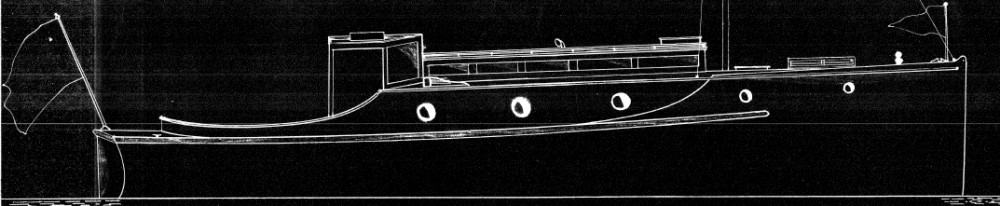
Faced with the design of a fast cruiser, only 32ft loa by 8ft 6in beam, and the desire for headroom in the main cabin, he came up with his second motorboat called FLEETWING (by now a brand for him). She was an extension of the ideas in the 1915 ADELAIDE.
I think, with this second FLEETWING, Collings’ first training as a civil engineer shows through more than his secondary training with Robert Logan Sr. as a shipwright. To obtain headroom he carried the tramtop/clerestory concept to the point IMHO of ugliness, using the parameters of the railway carriage, the electric tram and the motor bus of the time, abandoning completely the parameters of the yacht, even a token attention to which had kept launches aesthetically pleasing until now.
Anyway, see what you think of this image of the second FLEETWING which I have taken from one of Collings’ own glass plates, very decayed, but an amazing insight into the goings on in St Mary’s Bay in late 1920. Collings & Bell’s yard is out of picture to the left, so we see the yards of Dick Lang and Leon Warne close up.
This launch was on TradeMe at Picton recently, erroneously called MISS FLEETWING.

Update: Charles Collings was a very good amateur photographer with excellent gear. After his death in 1946 his glass plates got scattered around in the workshop, many were used for skipping across the Bay, most were smashed one way or another. A very few survived, most cracked or with their emulsion badly decayed. I have a handful more of which a couple are excellent and the definitive shots of his 26ft mullet boat CORONA after her launching in 1936.

PS Leon Warne took over the shed on the right in 1916 from Henry Barton who left for the US with his family because of his anti-war convictions (and had a shocking time on the way). Warne had served his time with Collings & Bell. He painted up the shed very nicely as you can see but was building in St.Mary’s Bay only until c1924 when he and his brother set up in Russell, building and chartering game fishing launches.
Hi Woodys

Quote

Hi waitematawoodys

As ww has been evolving its been pointed out to me that not everyone is au fait with the background to the many design / build gurus that we make reference to.

So we are going to start backgrounding a few of the masters from the past.

Kicking off tomorrow, Harold Kidd has penned a wonderful piece on Charles Collings’ approach to design in the immediate post-WW1 period. AH

Do not marry a farm girl

This slideshow requires JavaScript.

A tale for any waitematawoody considering marriage & also those that are now boat-less.
I found this tale, ‘Something to remember -by James S Pitkin’, a few years ago in the wonderful old 1947 book ‘The Book of Boats’ by William Aitkin. Aitkin saw the book as becoming a quarterly journal but only two issues were printed then publication ceased. You can find / buy copies on ebay & its a collection of short stories & a great read.
I had a copy & one day hopefully the CYA member I lent it to, whose name eludes me, will open the dust cover & see my stamp & return it 🙂
Harold Kidd Update:
A visit to the maritime provinces of Canada and the New England seaboard reveals the similarities between the Canucks, the Down Easters (and other Yankees) and Kiwis; each of these sets of populations originally arrived by sea, mainly in sailing craft; and each traded and gathered their food and went from place to place on the sea. No wonder there is a great fellow feeling between these peoples. There is the same feeling in Brittany and Cornwall too. The sea is at the core of our being.

Corinthia & new Arran Bay Wharf

CORINTHIA. 

A Shipbuilders design c.1960, purchased by Ivan Guthrie in 1987, his last boat. Sold to CYA member (now MV Kailua ) Graham Guthrie who re-powered her. Seen here tied up to the new (c.1990) wharf in Arran Bay, Waiheke. Rotorua Island & Ruth Passage in the background.

Click photos to enlarge & see captions

photos ex Roger Guthrie

258 Stunning Classic Boat Photos

258 Boat Porn Photos

 
The few above are to tease you to view all the 258 stunning  photos from the Bell Street Harbour Classic Rendezvous, pull the cork on a nice Pinot, find a good chair & click the link below. Enjoy 🙂

Atatu

An update on Atatu
words & photo from Frank Stoks
Here are a couple of fresh pictures of Atatu (1919, Bailey and Lowe) mentioned on this site about a month ago.
The new hardwood aerofoil rudder (installed 3 years ago) replaced the flat steel plate in order to eliminate all zincs and stop delignification of hard to repair timbers.
Moreover the rudder still works drifting into the berth at 1 or 2 knots whereas the flat steel rudder didn’t work at low speed.
She was a luxury launch for Holloway, then Nathan family, war service in Wellington, converted to fishing vessel in 1947, has had several wheelhouses the last of which (shown) by us about 15 years old now. Present engine is a Caterpillar D330B installed new in 1968 still going strong [touch kauri].
I have an extremely detailed history of her, concerning owners, incidents, activities, conversions, and engines – with photos starting from before she was launched to the present day. Unfortunately the Atatu embossed Royal Dalton China, cutlery, carpets and etched glass have long disappeared.
And yes the funnel is a folly – but I’m proud of it!

Adelaide

ADELAIDE

An interesting example of how quickly the classics were ‘modernized’. The photo on the left above was taken in 1914 & the second in 1916. In two years she gained a low tram top & the broom stick mast is now a proper mast.
Harold Kidd Update
Well, not so, actually. There were 5 Adelaides built by Collings & Bell for Charles Palmer between 1912 and 1924. The 26 footer ADELAIDE I was launched on 22 February 1913 and fitted with a 6hp Bridgport two-stroke marine engine. Palmer soon grew out of her and sold her to A Rogers in June 1913 and replaced her with the 26ft ADELAIDE II in September 1913, this time with a Doman engine, for which Collings & Bell were the agents. It is ADELAIDE II in the January 1914 image where the launch carries the number 8 and has foliate engraving at the bow. She was sold to H B Washington in Whangarei and renamed ISABEL ANDREA. 
ADELAIDE III was launched in August 1915 and was a 36 footer. Palmer was heavily involved in the NZPBA and the Motor Boat Patrol so the much bigger launch was built for serious work. This is the launch in the 1916 image, bearing her wartime number 1, (numero uno because Charlie Palmer was Numero Uno in just about everything to do with motorboating in Auckland) without foliate engraving and with a clerestory (tramtop). She had a 30hp (rated) Doman. When Palmer had Collings & Bell build him the 32ft ADELAIDE IV in 1922, he sold ADELAIDE III and she became GEISHA (II)…confused?
ADELAIDE III was clearly a development of ADELAIDE II, lengthened and with a clerestory, much along the lines of Collings’ RONAKI for the Harbour Board, so the two images DO actually show the changing face of Auckland launches in the two years between 1913 and 1915.